



Abstract
We undertook a scoping review of the published literature to identify and summarise key findings on the telehealth interventions that influence waiting times or waiting lists for specialist outpatient services. Searches were conducted to identify relevant articles. Articles were included if the telehealth intervention restructured or made the referral process more efficient. We excluded studies that simply increased capacity. Two categories of interventions were identified – electronic consultations and image-based triage. Electronic consultations are asynchronous, text-based provider-to-provider consultations. Electronic consultations have been reported to obviate the need for face-to-face appointments between the patient and the specialist in between 34–92% of cases. However, it is often reported that electronic consultations are appropriate in less than 10% of referrals for outpatient care. Image-based triage has been used successfully to reduce unnecessary or inappropriate referrals and was used most often in dermatology, ophthalmology and otolaryngology (ENT). Reported reduction rates for face-to-face appointments by specialty were: dermatology 38–88%, ophthalmology 16–48% and ENT 89%. Image–based triage can be twice as effective as non-image based triage in reducing unnecessary appointments. Telehealth interventions can effectively be used to reduce waiting lists and improve the coordination of specialist services, and should be considered in conjunction with clinical requirements.
Introduction
In Australia, specialist outpatient care is provided predominantly by public hospitals via outpatient clinics. 1 Outpatient clinics involve consultations with medical specialists, allied health practitioners or nurse practitioners. Demand for specialist outpatient care is growing, and a review of general practice activity identified that referrals for specialist outpatient care increased from 12.0 to 15.9 per 100 general practice encounters between 2005–2015, resulting in an additional 9.7 million specialist outpatient episodes of care. 2 Growth in demand for specialist services is not unique to Australia. In the USA, by 2025, the demand for 10 common medical specialties is predicted to exceed current levels by greater than 14%. 3
Increasing demand has resulted in long waiting lists for specialist outpatient services in Australia’s public hospital system. 4 Similar problems exist in many other developed countries – more than half of doctors in Canada, France, Germany, New Zealand and Norway recognised that patients often faced long waiting times to see specialists. 5 Long waiting times for outpatient services may cause distress among patients, have adverse health consequences and be perceived as inappropriate delivery and planning of healthcare. 6 Hence, improving the timeliness of outpatient care has been recognised as a priority for improvement in healthcare systems. 7
Alternatives to the current face-to-face consultations may potentially improve the timeliness of care. One such alternative is telehealth. The aims of this study were to identify telehealth interventions that influence waiting times or waiting lists for specialist outpatient services and to collate and summarise key characteristics of these interventions.
Methods
We performed a scoping review of literature to identify telehealth interventions for reducing waiting times or waiting lists for specialist outpatient services. A scoping review (as opposed to a systematic review) is warranted when synthesis of research findings needs to be exploratory, rapid, pragmatic and is intended to inform subsequent stages of investigation. 8 In keeping with the pragmatic goal, we summarised research findings pertinent to the policy maker namely: the effectiveness of identified interventions for reducing waiting times and organisational effects (e.g. resources and infrastructure required to implement the intervention). Whilst waiting times or waiting lists were the primary effectiveness measures, we also reported secondary outcome measures (e.g. relative cost) when reported in included articles.
Search strategies
Search terms.
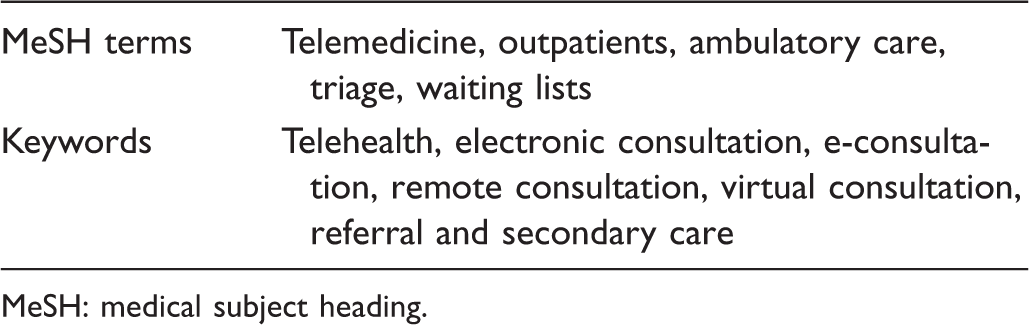
MeSH: medical subject heading.
Inclusion criteria
Inclusion and exclusion criteria.

Results
The categorisation of included studies elicited two predominant interventions which affect waiting lists or waiting times: electronic consultations and image-based triage of referrals.
Electronic consultations
Summary of electronic consultation studies.

NR: not reported.
The success of electronic consultations is reliant on the referrer providing a well-articulated clinical question. 9 To facilitate this, specialty-specific templates for the electronic consultations are used. The purpose of these templates is to provide decision supports to help the referrer identify which medical conditions are suitable to electronic consultations and to ensure completeness of referral information. One cardiology service reported that over 50% of referrals were suitable for an electronic consultation. 15 However, most services report that less than 10% of referrals are suitable for electronic consultations (Table 3).
Effectiveness
Waiting lists
The effectiveness of electronic consultations to obviate face-to-face appointments has been investigated in a number of studies and has been reported to be between 34% 13 and 92%. 19 When stratified by speciality there is not a great variation in the proportion of avoided face-to-face appointments with the exception of infectious diseases. Electronic consultations for infectious diseases resulted in face-to-face appointments being avoided in 92–97% of cases14,18 which is substantially higher than any other medical specialty.
The use of electronic consultation may have a negative effect on waiting lists. In one study, specialists estimated that 27% of electronic consultations represented new work (i.e. consultations that would not have occurred in the absence of electronic consultations). 9
Waiting times
Waiting times were the outcome measure in one randomised control trial. 15 Median waiting time for a cardiology consultation was 2.5 days for an electronic consultation, 29 days for an electronic consultation that had been converted to a face-to-face appointment and 25 days for a conventional face-to-face consultation.
Cost analysis
A number of studies have provided comparative cost analysis of electronic consultations versus face-to-face consults from the perspective of the health care provider. For example, Scherpbier-de Haan et al. 22 reported the cost of electronic consultations was less than face-to-face consultations (€107 versus €600) and similarly Liddy et al. 23 estimated the cost of an electronic consultation was half that of a face-to-face visit (Can$75 versus Can$150). One study reported Veteran’s Health Administration saved nearly $3 million dollars in travel reimbursements by using electronic consultations. 24
Organisation effects
Infrastructure
Contemporary electronic consultation systems are most often implemented using a shared electronic medical record (EMR) or a dedicated web-based platform. Functionality with an EMR allows a referring doctor to order an electronic consultation in a similar way to how they would order radiology or pathology. 14 The use of email for electronic consultations has been previously reported.25,26 However, due to privacy concerns email may not be appropriate for use as an electronic consultation system. Web-based products may 22 or may not 27 have integration with a patient’s medical record to automate the inclusion of the patient history as part of the consult question and the specialist’s response in the patient record.
Resources
The time to undertake an electronic consultation has been examined in a number of studies. Times ranged from 8 min to more than 20 min. No studies provided comparison for face-to-face consultations. In one service, specialists recorded the time they spend as part of the consultation – the self-reported consultation times from this study were: less than 10 min in 57% of cases, 10–15 min in 34%, 15–20 min in 9%, and over 20 min in 1%. 20
Potentially the biggest impact of electronic consultation is on the referrer. Receiving the specialist’s response generates additional work that may have fallen to the specialist in the case of a face-to-face consultation. 9 As the patient is not seen by the specialist, the referrer has the responsibility to communicate the specialist’s recommendations. Relative to the specialist, there is limited evaluation of the time taken to prepare an electronic consultation. However, around 10 min has been reported by two authors.9,28 Electronic consultations are also reported to have educational value for general practitioners. 29
Image-based triage
Image-based triage involves the referrer (or an intermediary) packaging images to accompany the referral and the specialist performing either triage or a store-and-forward consultation based on the transmitted information. Our searches and subsequent filtering of results identified 15 published articles on the influence image-based triage has on outpatient service waiting list and waiting times. It was identified that image-based triage is practiced in the visually-oriented specialties of dermatology, ophthalmology, otolaryngology and vascular surgery (wound care). The largest volume of published research was on dermatology (n = 8, 53%).
Effectiveness
Image-based triage has been compared to non-image based triage in a number of studies. In a dermatology randomised control trial, twice as many face-to-face appointments were avoided using image-based triage than non-image based triage. 30 Similar proportions of avoided appointments were reported in a controlled ear, nose, and throat (ENT) study. 31
Waiting lists
An avoided face-to-face appointment was an outcome measure in 10 of the reviewed studies. For dermatology, the reported rate of avoided face-to-face appointments ranged from 38–88% and for ophthalmology ranged from 16–48%. Single studies for ENT 32 and vascular surgery/wound care 33 reported an 89% and 18% reduction in face-to-face appointments, respectively.
Avoided face-to-face appointments were most often (93%) achieved by reducing unnecessary or inappropriate referrals – for example, patients who could be managed in primary care. For these cases the triage process included teleconsultation which informed the referrer of a diagnosis and a suggested management plan. Another strategy that helped reduce face-to-face waiting lists was ensuring there was definitive care at first appointment by booking diagnostic procedures before or during face-to-face visit.33–36
Image-based triage may have a negative effect on waiting lists. In one study, the number of face-to-face appointments increased despite 195 teledermatology referrals. 37 This was presumably due to the novelty value of access to new mobile-device dermoscopes or a decreased threshold in referral reasons due to increased convenience of referral.
Waiting times
The subsequent effect that reducing waiting lists had on waiting times was also reported by a number of authors. Median waiting time for ophthalmology outpatient clinics reduced from 14 weeks to four weeks after implementation of retinal imaging-based referrals. 38 Waiting times to see an ENT surgeon were reduced from 4.2 months to 2.5 months. 32
Summary of image-based triage studies.

BCC: basal cell carcinoma; ENT: ear, nose and throat; F2F: face-to-face; IQR: inter-quartile range; SCC: squamous cell carcinoma.
Organisation effects
Dermatology
Nearly all of the contemporary teledermatology triage services used dermoscopic imaging in conjunction with digital photography due to the superior diagnostic accuracy of dermoscopy relative to digital photography. 45 Commercial teledermoscopy systems were used as the transport mechanism from referrer to the specialist. These were either web client/server30,35 or mobile device client (e.g. iPhone)/server37,39 systems. Other transport options include a shared EMR used by Veteran’s Health Administration. 40
Ophthalmology
Tele-ophthalmology referrals involve digital photography, slit-lamp imaging, 46 retinal imaging 34 and optical coherence tomography, 44 as well as results from other diagnostic tests including intra-ocular pressure and visual acuity. Transport mechanisms include secure intranet email and commercial web-based tele-ophthalmology systems. Imaging was performed by either the general practitioner (GP) or community-based optometrists.
ENT
The ENT services described in included studies involved a travelling audiologist or nurse packaging diagnostic information including otoscopic images, tympanometry and audiometry for the subsequent store-and-forward review by an ENT surgeon. ENT had the highest reported rate of avoided face-to-face appointments (89%). 32
Discussion
There is some evidence to show that electronic consultations and image-based triage of referrals can be effective in reducing waiting lists and waiting times. Variation in the reported effectiveness of electronic consultation may be explained by the type of electronic consultation system. More comprehensive patient history and referral information being available to the specialist when using and integrated EMR/electronic consultation system may have accounted for the higher number of avoided faced-to-face consultations14,18 relative to web-based systems. 20 Further, variation may occur due to the time of measurements and, for example, two studies from the same provider reported a variation in the number of face-to-face appointments avoided. Around 90% of face-to-face appointments were avoided up to 28 days after the electronic consultation, 14 whereas when the time period was extended to 90 days the number of avoided face-to-face appointments was reported to be around 80%. 18
Most reports of electronic consultations were from integrated healthcare providers in the USA. Favourable reimbursement models resulting from the Affordable Care Act may have accelerated adoption in these organisations. Research on successful electronic consultation systems has identified executive and clinician leadership, and established funding models for specialist clinician reimbursement as integral to the success of electronic consultations. 47
It is recognised that an image-based, store-and-forward dermatology referral increases the duration of the GP consultation. 48 It has been reported that teledermatology services in Australia are underutilised by GP referrers. 49 One possible reason is the economic disincentive for GPs due to the increased time to image the patient and package the referral. General practitioners were the photographers in a number of studies included in this review.30,37,39 However, these studies originated from countries where general practice is not solely funded by fee-for-service models. A number of studies from New Zealand35,42 have used an intermediary as the photographer. Potential teledermatology referral services should consider adopting a similar model to enhance compliance to image-based triage.
All telehealth interventions that resulted in a decrease in waiting lists or waiting times used store-and-forward methods. Simple substitution of face-to-face consultations with real-time video consultations may be consultation time neutral or in some circumstance more time consuming. 50 As a result, real-time consultations can have no effect on waiting lists and waiting times. One study demonstrated that complex reorganisation of services involving coordinating care with community providers may result in decreased video consultation time for the specialist. 51 However, this study did not report on resultant changes to waiting lists for the specialty service.
Limitations
Confidence in some of the reported findings from studies included in this review may be limited by small sample sizes and reporting of results from pilot projects. 19 The limited reporting of negative outcomes raises concerns of publication bias. Multiple publications about the same service13,16,17,20 may also bias findings.
Conclusion
This review has shown that, in some circumstances, telehealth interventions can be effectively used to reduce waiting lists and waiting times for specialist outpatient services. The reduction in waiting lists can be achieved without increasing the capacity of the service. The identified telehealth interventions almost exclusively use store-and-forward methods. Introducing these interventions has required significant service re-organisation, the implementation of additional infrastructure and consideration of the appropriate context for use. Developing funding models to support store-and-forward consultations may be required as part of the requisite service re-organisation.
Footnotes
Declaration of Conflicting Interests
The author(s) declared no potential conflicts of interest with respect to the research, authorship, and/or publication of this article.
Funding
The author(s) disclosed receipt of the following financial support for the research, authorship, and/or publication of this article: This work was funded by Metro South Health.