



Abstract
For regional and rural Queenslanders, chronic viral hepatitis treatment is a major unmet health need, with restricted access to specialists outside of tertiary, largely metropolitan hospitals. To increase treatment of chronic viral hepatitis in regional Queensland, a team-based telehealth model was expanded. This expansion embedded an initial nursing consultation prior to specialist telehealth consultation. We conducted a retrospective audit of the introduction and expansion of hepatology telehealth services. Activity from July 2014–June 2015 (pre-expansion) was compared with July 2015– June 2016 (post-expansion). Interviews were conducted with key staff to determine factors contributing to success of the service and identify ongoing challenges to the service model. A greater than four-fold increase in clinical consultation was observed (131 telehealth consultations pre-expansion vs 572 post-expansion; p < 0.001). The failure to attend rate decreased (13.0% vs 6.5%, pre vs post-expansion respectively; p = 0.030), suggesting engagement with the service increased. Staff cited nurse-conducted primary assessment prior to specialist consultation and personalised patient treatment packs as key contributors to increased patient flow and engagement. This expanded team approach appears effective in delivering specialised treatment to an underserved area in regional Central Queensland. It may serve as a model to further expand telehealth management of chronic disease for regional Queenslanders.
Introduction
Chronic infection with hepatitis B virus (HBV) and hepatitis C virus (HCV) is a leading cause of chronic liver disease in Australia with consequent cirrhosis, decompensated liver disease and hepatocellular carcinoma (HCC) associated with high morbidity, mortality and significant healthcare expenditure. 1 Untreated HCV infection progresses to cirrhosis in 20–30% of cases after an average infection period of 15 years. 2 The incidence of serious liver complications is expected to increase as duration of infection progresses with aging of the population living with chronic HCV, a trend seen in similar Western populations. 3
In Australia, HCC is the fastest increasing cause of cancer mortality, a metric largely driven by increases in HBV prevalence and HCV-associated cirrhosis. 4 Currently only 1–2% of infected individuals in Australia undergo treatment for viral hepatitis annually. 5 In the case of hepatitis B, 43% of the infected population are thought to be undiagnosed, for those with known infection, 87% are not in regular care. 6 Without improvement to current treatment rates the number of people living with HCV-associated cirrhosis and HCC is projected to double in the next 20 years. 7
Viral hepatitis treatment has evolved significantly, with new drugs offering attainable cure for HCV and resistance-free viral suppression for HBV. Combination pegylated-interferon (PEG-INF) and ribavirin was the previous standard of care treatment for HCV, but achieved cure (sustained viral response (SVR)) in less than 50% of patients with genotype 1 HCV, while being associated with significant toxicity and poor tolerability for patients. Direct-acting antiviral (DAA) therapies for HCV have recently been added to the Pharmaceutical Benefits Scheme (PBS). 8 These DAA therapies are all oral for the majority of Australians infected with HCV, with higher efficacy, shorter duration and greatly reduced toxicity in comparison to older interferon-based treatments. However, DAA treatment alone with improved SVR rates, is insufficient to curb the climbing chronic liver disease problem on a population level. 7 To have significant impact on the rising burden of chronic liver disease, treatment rates need to increase at least five-fold. 7 Understanding and overcoming barriers to treatment is critical in addressing the HCV-related pandemic of cirrhosis.
Major barriers to treatment uptake include social marginalisation of the affected population and models of care that are slow at upscaling to meet the opportunity provided by new treatments. 9 Living in regional and remote areas further confounds barriers such as poor health literacy and lower socioeconomic levels. 10 It is well established that people living in rural regions of Australia have higher rates of hospitalisation and mortality, and reduced access to both primary and specialist health care services. 11 Disparities in HCC incidence and survival in Queensland are influenced by race, remoteness and socio-economic background. 12
Queensland is Australia’s second largest and most decentralised state, covering a land area of 1,722,000 km 2 (1,070,001 square miles). 13 Vast geography and centralised specialist health services, add to challenges faced by rural and remote populations in Queensland.14,15 Effective management of chronic liver disease requires specialist consultation, however specialists are seldom present outside of metropolitan tertiary facilities, further limiting treatment uptake in rural and regional areas.
The Blood Born Virus and Sexual Health Service (BBV&SHS) was established in Rockhampton (Central Queensland) in 2000 and operated via an on-site general practitioner (GP) and visiting local specialist. In 2013 the service consisted of a locally based GP, an infectious disease specialist and a remotely accessible liver specialist. Over the course of the next 12 months, the service evolved from internal pressure (workforce attrition causing the loss of local medical staff) and increasing external demand from patients outside of the health service district. To continue providing a clinical service, a shift in the model was required. Expansion led to an integrated team approach consisting of two locally based nurses, an administrative staff member and a metropolitan-based specialist consultant, consulting exclusively via telehealth. Initially providing a service to patients within the Central Queensland Hospital and Health Service District, the telehealth expansion facilitated servicing a much larger rural population outside this district. Currently, 22 outreach sites cover an estimated area of over 1 m square kilometres. In the post-expansion care pathway an initial nursing consultation and ‘nurse navigation’ became embedded. Following referral to the service, patients are contacted by nursing staff who collect a baseline history, coordinate liver fibrosis assessments and collate medical records. The nursing consultation facilitated a reduction in time required for specialist assessment. Pre-expansion, the initial specialist consultation (face-to-face consultation with a GP, infectious disease (ID) specialist or remote specialist via telehealth) was allocated a one-hour timeslot. Post-expansion, the consultation period was reduced to a half-hour timeslot with a remote specialist via telehealth. The care pathway following treatment commencement remained unchanged. The BBV&SHS care pathways are detailed in Figure 1.
Blood Born Virus and Sexual Health Service (BBV&SHS) model of care for chronic viral hepatitis management.
Methods
We conducted a retrospective audit of the introduction and expansion of hepatology telehealth services at the BBV&SHS, comparing activity from July 2014–June 2015 (pre-expansion), with July 2015–June 2016 (post-expansion).
Pre-expansion care utilised a traditional referral and assessment approach, with an initial specialist triage consultation, then fibrosis assessment and further review prior to treatment commencement. Post-expansion, nursing staff conducted the initial consultation, ensured fibrosis assessment was completed and results were available prior to specialist consultation. During the study there was a reduction in the total number of medical officer hours, with attrition of the locally based specialist and GP, requiring the remotely located liver specialist to absorb this patient load in the context of the team-based approach.
Administrative staff provided a clinical audit detailing type and number of consultations occurring monthly across the two-year study period. Clinic data included number of specialist consultations, nurse led assessments, and fail-to-attend (FTA) occurrences for the study period.
A convenience sample of BBV&SHS staff involved with the telehealth expansion were invited via email to take part in a single semi-structured interview. Interviews were conducted in person or via telephone with responses transcribed verbatim. Interviews were conducted individually, lasting approximately 30 min. The interviewer, KK, is a research student who is not directly involved with clinical activities described in this study. An interview guide with five questions was used to stimulate discussion comparing the new and old model across five key areas, including efficiency and quality of care, patient and staff satisfaction, and ongoing obstacles.
Consultations were delivered by videoconference using the Queensland Department of Health Wide Area Network. All sites were equipped with dedicated videoconferencing units including TV screen, commercial grade codec (Cisco) and pan-tilt-zoom camera with connection speeds ranging from 512 kbit/s to 2.3 Mbit/s. This study was approved through a formal service level agreement which includes service planning, development and evaluation.
Basic descriptive details (total numbers and percentages) of quantitative data were reported. Stata/MP 13.1 for Windows was used to calculate confidence intervals and hypothesis testing. For qualitative data collected, inductive thematic analysis was used to categorise answers to open-ended questions into meaningful categories. 16 This process was carried out by the interviewer. Phrases were first coded before being grouped together under an overarching theme. Where single phrases contained multiple identified factors each component was sorted individually with appropriate categorisation.
Results
Telehealth services
A total of 2496 consultations were carried out during the two-year period. From July 2014–June 2015, 927 telehealth consultations were provided by the service, consisting of 796 nurse led consultations and 131 specialist consultations (14.1%, 95% confidence interval (CI) 11.8–16.3). From July 2015–June 2016, the total number of consultations increased to 1569 overall. Of these, 997 were nurse led consultations and 572 were specialist consultations (33.6%, 95% CI 31.3–35.9). Whilst nurse-led consultations increased by 25% (p < 0.001), the number of specialist consultations increased substantially by 337% (p < 0.001) (see Figure 2).
Telehealth activity from July 2014–June 2016.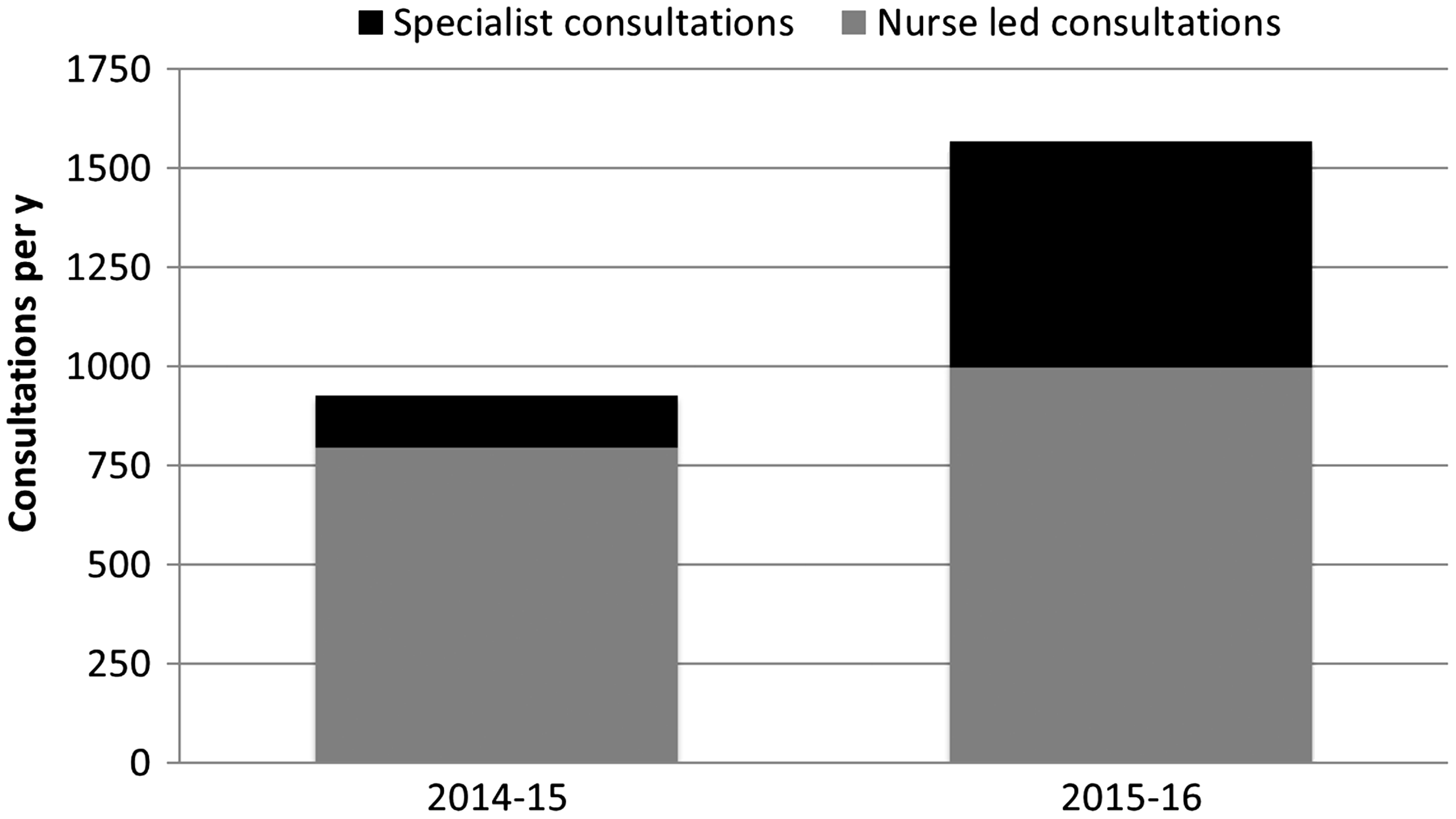
FTA rates
FTA rates reported by the service reduced during the study period, from 11.5% (95% CI 6.0–17.0; n = 17/148) during 2014–2015 to 6% (95% CI 4.1–8.1; n = 37/609) in 2015–2016 (p = 0.030).
Staff Interviews
Staff opinions regarding post-expansion model.

GP: general practitioner.
Staff felt that the post-expansion model generally increased efficacy. Key factors contributing to this included optimised usage of nursing staff skill set, shortened specialist appointment timeslots and depth of pre-consultation work-up undertaken by nursing staff. Reducing the number of specialist visits required to make a plan, makes more use of the RN [registered nurse] role to prepare the patient for care and ensures the specialist appointment is best used, which is both time and cost efficient. Patient work-up occurs at much earlier point so specialist pre-treatment consultation can occur very efficiently and treatment starts sooner. (Medical specialist)
Obstacles identified were largely technological, principally inadequate access to telehealth connectivity and equipment in GP practices, with patients consequently relying on regional hospital facilities. Reliance on regional facilities was cited as problematic as remote site staff needed to be present to supervise access to and set up of equipment, though these staff were not required for the consultation itself.
Discussion
To our knowledge, there is no equivalent telehealth hepatitis service in rural and regional Queensland. The expansion of a team-based telehealth model for hepatitis care led to significant growth of the service. Models using a primary nursing assessment and patient centred management, have been successfully established in Western Australia. 17 Despite similarities these models differ from the BBV&SHS model in their reliance on in-person consultation between patient and nursing staff. Models with pathology and imaging work-up prior to specialist consultation have been successful in California, however these services typically have little nursing involvement and rely on primary care physicians (PCPs) to coordinate care locally or, in the case of the Extension for Community Healthcare Outcomes ‘ECHO’ model, use an expert panel to support PCPs.18,19
In the Australian context there has been little success in having GPs as care coordinators for telehealth services due to the combination of time pressures and lack of incentives. 17 Well-trained nurses adept in navigating the complex requirements of chronic liver disease management are able to facilitate patient care in an efficient and effective manner. Initial nursing staff assessment establishes treatment expectations for the patient, emphasising the importance of treatment milestones and required pathology investigations. For the specialist it provides a core dataset, including fibrosis assessment, to determine any further requirements (e.g. liver biopsy), and to expedite decisions regarding the nature and duration of treatment. This practice algorithm provides a focused clinical picture of the patient prior to specialist consultation, minimising delay in treatment commencement. A well-structured and well communicated model of care tailored to the individual patient is a key contributor to the success of similar telehealth models. 20 Given the efficiency improvement provided by the initial nursing consultation BBV&SHS will continue to employ this model with a focus on expansion of outreach services.
Rurality and remoteness has traditionally been a significant obstacle to treatment for patients with chronic viral hepatitis. 21 In Queensland, specialist treatment for chronic liver disease is largely restricted to metropolitan and major regional centres, leaving rural patients needing to travel for treatment. Travel for treatment is often an unattractive option for patients due to financial and time burden as well as associated personal inconvenience. Travel time to Rockhampton varies, however patients within the clinic would have to undertake an up to nine-hour return journey to attend in person, making telehealth a critical component of the services expansion.
The reduction in FTA rates is consistent with findings of similar telemedicine studies. 22 Diminished obstacles to treatment, specifically patient travel, likely contributed to increased patient flow and reduced FTA. Introduction of DAAs as standard treatment may also have contributed to FTA improvement, though these drugs became available through the PBS in March 2016, relatively late in the study.
For patients with viral hepatitis, early treatment can prevent progressive liver fibrosis. HCV can be relatively asymptomatic until the late stages and may go unrecognised by patients and their GPs alike. This is particularly important where major obstacles to treatment persist and patients can be lost to clinical care. If such failures are prolonged progressive disease may ensue, with late presentation and poor outcomes resulting. 23 Telehealth facilitates easier and earlier access to specialists, improves engagement, reduces loss to follow-up and decreases delays for rural patients seeking treatment.
This model of care may also be applied in the custodial setting. The BBV&SHS recently expanded to include inmates of the regional prison, with further streamlining of the assessment and treatment program. Infection rates amongst prisoners are significantly higher than rates in the general population. Despite well-established health services and infrastructure within prisons, HCV treatment of inmates is poor with less than 1% receiving treatment. 24 Using team assessment and telehealth to provide a consistent service that is not location dependent, it may be possible to overcome institutional barriers and improve HCV treatment rates in prisons.
The uptake and expansion of telehealth models such as the one described in this paper are influenced by technological, organisation and funding factors. Numerous studies have reported lack of funding and willingness to change practice as major roadblocks to telehealth services.15,25,26 With further development it may be possible to extend the BBV&SHS model of care directly to patients using smart-phones and other software-based videoconferencing systems, further reducing costs and inconvenience of travel.
Our findings must be considered in light of the study’s strengths and limitations. A convenience sample of staff was used to determine factors contributing to success of the service. It is possible participants were more likely to express a positive experience with the service and identify expansion as successful given their involvement with its implementation. Nevertheless, a range of perspectives are represented here. Clearly numbers are small. Further studies should assess the satisfaction level and perspectives of patients regarding the telehealth service.
Conclusion
Our integrated team approach to deliver telehealth services is feasible for regional patients with complex medical needs. Continued expansion of these services is contingent on more flexible delivery networks and better access to videoconferencing infrastructure within general practice settings and in-home settings.
Footnotes
Acknowledgements
The authors wish to thank Metro South Hospital and Health Service for providing access to the Princess Alexandra Hospital (PAH) telehealth centre facilities, and for permission to conduct the analysis. They also thank the staff and patients of the health service and the referring doctors serving regional Queenslanders.
Declaration of Conflicting Interests
The author(s) declared no potential conflicts of interest with respect to the research, authorship, and/or publication of this article.
Funding
The author(s) disclosed receipt of the following financial support for the research, authorship, and/or publication of this article: Paul Clark was supported by National Health and Medical Research Council (NHMRC) of Australia Early Career Fellowship (APP1052622) and Royal Australasian College of Physicians, Cottrell Fellowship; Patricia Valery (#1083090) and Steven M McPhail (#1090440) were supported by NHMRC Career Development Fellowships.