



Abstract
Background
Telerehabilitation promises to improve quality, increase patient access and reduce costs in health care. Physiotherapy with exercises is generally recommended to restore function after surgery in patients with chronic subacromial syndrome. Relatively few studies have investigated the feasibility of telerehabilitation interventions in musculoskeletal and orthopaedic disorders. The aim of this study was to evaluate the feasibility and effectiveness of a customizable telerehabilitation intervention and compare with traditional care.
Methods
This research includes 18 consecutive patients with subacromial impingement who underwent arthroscopic subacromial decompression in a controlled clinical prospective study. Patients were randomized to either a 12-week telerehabilitation programme or the usual face-to-face physical therapy for immediate postoperative rehabilitation. We have developed a telerehabilitation system to provide services to patients who have undergone shoulder arthroscopy. An independent blinded observer performed postoperative follow-up after 4, 8, and 12 weeks.
Results
The preliminary efficacy of this telerehabilitation programme in terms of both physical and functional objective outcome measures was assessed on eight patients. Using the Constant–Murley score to evaluate functional outcome, patients in the telerehabilitation group were shown to have improved from a mean 43.50 ± 3.21 points to a mean 68.50 ± 0.86 points after 12 weeks. The physical and functional improvements in the telerehabilitation group were similar to those in the control group (p = 0.213). There was a non-significant trend for greater improvements in the telerehabilitation group for most outcome measurements.
Conclusion
The results of this study provide evidence for the efficacy of telerehabilitation after shoulder arthroscopy in shoulder impingement syndrome. A telerehabilitation programme with range of motion, strengthening of the rotator cuff and scapula stabilizers exercises seems to be similar and not inferior to traditional face-to-face physiotherapy after subacromial arthroscopic decompression. Through this study, we are developing our preliminary dataset to evaluate the efficacy of telerehabilitation programmes following surgical procedures in musculoskeletal injuries and for comparison with more traditional interventions.
Keywords
Background
Subacromial impingement syndrome (SIS) is the most common disorder of the shoulder, accounting for 44–65% of all complaints of shoulder pain. 1 Shoulder pain is a common cause of sick leave and disability, and therefore represents high consumption of healthcare resources and lost productivity. 2 SIS has been defined as the compression and mechanical abrasion of the rotator cuff structures as they pass beneath the coracoacromial arch during elevation of the arm. 3 It results from an ‘inflammation and degeneration of the anatomical structures in the region of the sub-acromial space’. 4 This musculoskeletal disorder affects the tendons of the rotator cuff and the subacromial bursa. SIS appears to result from a variety of factors. 4 Initial treatment of SIS is predominantly conservative, and may include rest, non-steroidal anti-inflammatory drugs, corticosteroid injections, physical therapy and various forms of exercise and manual therapy. When symptoms persist for a periods of more than 3 months it is usual to refer the case for a re-evaluation by the orthopaedic surgeon. 5
The main problem in SIS is the perception of pain. Pain is associated with dysfunction expressed by patients as being unable to work full time at their usual job and being unable to lift a weight above their head. 6 Surgical and non-surgical strategies are used to treat SIS. Arthroscopic subacromial decompression (ASD) is a state-of the-art surgical procedure for chronic SIS. 7 Articles have been published on the effectiveness of post-surgical interventions for SIS 8 showing high success rates of surgical procedures.9,10
Physiotherapy with exercises is generally recommended to restore function after ASD. However, little is known about the effectiveness of such intervention, and there is currently no consensus about the most appropriate postoperative exercise strategy. 11 Early progressive exercises (range of motion and strengthening exercises) have been shown to result in greater improvements in the range of motion at 3 and 12 months than later dynamic and strengthening exercises. Noted pain reduction was similar for both groups. 12 A recent multi-centre trial concluded that a standardized physiotherapy exercise intervention results in statistically significant and clinically relevant improvement in shoulder pain and function at 12 months when compared with traditional care. 11
We have developed a telerehabilitation programme to provide outpatient rehabilitation for patients who have undergone ASD. Telerehabilitation is a term used to describe the provision of rehabilitation services at a distance using telecommunications technology as the service delivery medium. 13 It has also been defined as the remote delivery of rehabilitative services, such as monitoring, training, and long-term care, using telecommunications technology. 14 Relatively few studies have investigated the feasibility of telerehabilitation interventions in musculoskeletal and orthopaedic disorders.15–20 The aim of this study was to evaluate the feasibility and effectiveness of a customizable telerehabilitation intervention compared with traditional care of patients after ASD. In addition to this, it aimed to measure the efficacy of this programme in terms of the physical and functional objective outcome measurements.
Methods
A telerehabilitation system was designed to enable rehabilitation via web-based exercise programmes and videoconferencing. This was a single-blind prospective, randomized not inferiority clinical trial in rehabilitation services in south of Spain.
Patients
Eighteen patients who had undergone ASD were considered for this study. Patients who met the inclusion criteria were provided with an information sheet and informed consent was obtained before the study. All subjects who met the inclusion criteria agreed to take part in the study. The relevant ethics committees approved the research protocol. Inclusion criteria are summarized in Figure 1.
Inclusion and exclusion criteria.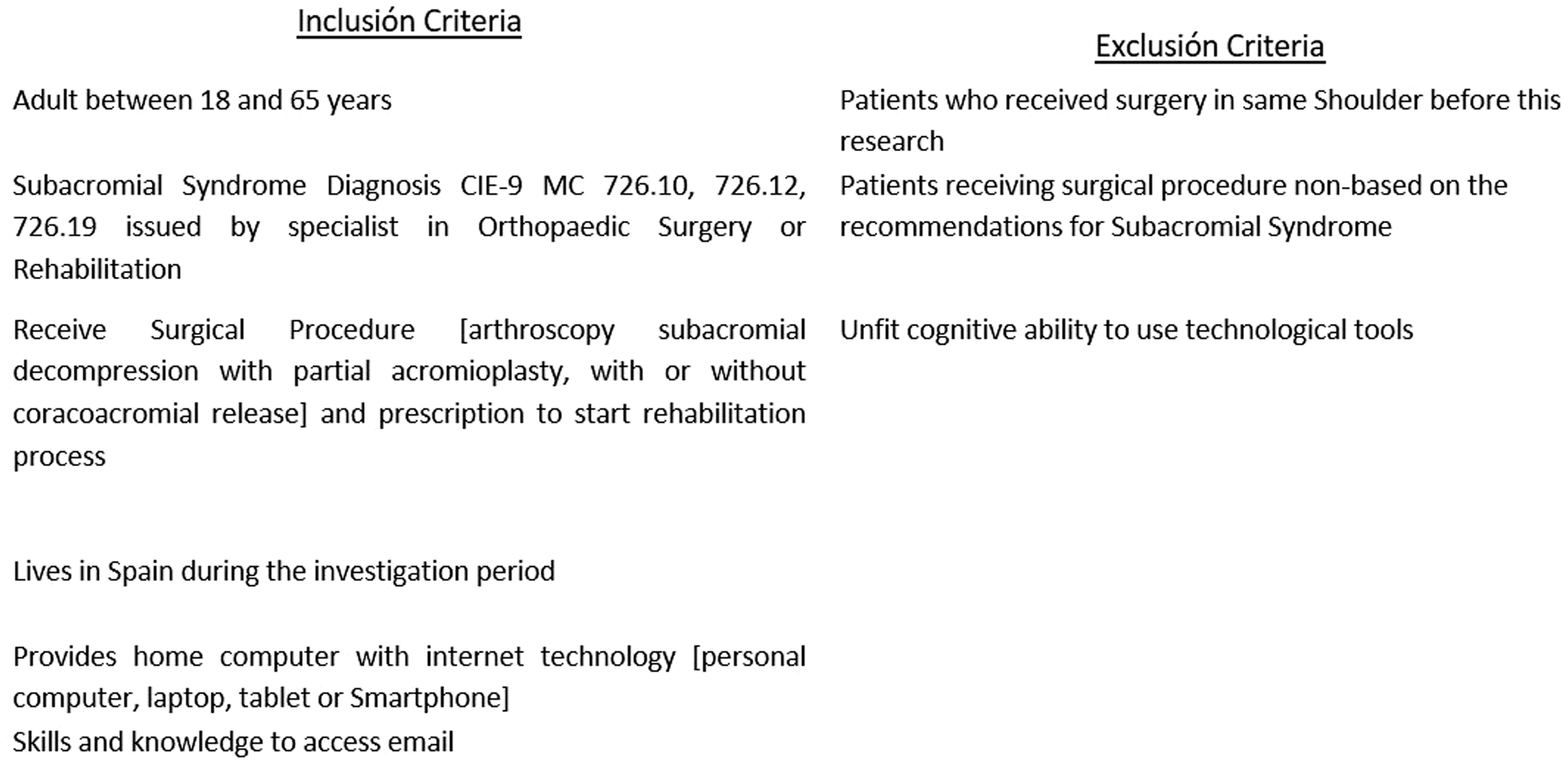
Randomization and single blinding
Subjects were randomized to either a telerehabilitation (TR) group or a traditional physiotherapy group (PT) using a computerized random number generator. Initial baseline measurements were taken from all subjects. The initial assessment included the development clinical interview to ascertain the patient’s current condition, past medical history, relevant personal and environmental factors, medications, an appraisal of the patient’s goals and a validated shoulder test to determine functional status. The nature of the intervention in both groups does not allow blinding of patients and physiotherapists. All assessments were conducted by a study investigator who was blinded to the participant’s group assignment. Participants were advised not to reveal their group assignment to the assessor.
Intervention
Patients in the TR group received a customized exercises programme through a web application that allows the physiotherapist to generate videos, images and parameters of each exercise programme and send them via email. The intervention was always performed by the same experienced physiotherapist. Subjects received a 12-week (5 days/week) set of self-workout video exercises following the telerehabilitation programme as well as a supporting document called Telerehabilitation Patient Manual (this document is held by the corresponding author and includes a tracking sheet for each exercise).
The PT group received face-to-face physical therapy (manual therapy, home exercise programmes and other physiotherapy techniques) in a 12-week programme (5 days/week). Three physiotherapists performed the treatment to ensure that patients were always attended by the same professional. Figure 2 shows and example of a customized telerehabilitation programme.
Example of customized telerehabilitation programme.
Outcome measures
The Constant–Murley Test (CM) was used to track the progress of the participants with a minimum follow-up of 3 months following surgery (4, 8 and 12 weeks). We assessed changes in the CM scores from baseline, including CM subscales (pain, daily live activities, range of motion and strength). The CM score is a universally used and accepted evaluation instrument for shoulder function 21 with internal consistency (Cronbach’s alpha = 0.7). 22 The minimal detectable change (MDC) was 17 points on the Constant score for SIS as has been reported in a recent study proving that the MDC on the CM score is different in patients with impingement, supraspinatus tears, and massive rotator cuff tears. 22
Statistical analysis
The central hypothesis of the study was tested by comparing change in the CM score between the two groups for the intervention shoulder. Student’s t-test was used to compare independent outcomes between the two groups. A recent study showed that a change ≥ 10 points is considered to be a clinically relevant change in the CM score between groups,7,23 with a standard deviation (SD) of 11.2 for patients with SIS. 22 The difference in the CM score between treatment groups was measured from baseline to 4, 8 and 12 weeks.
Results
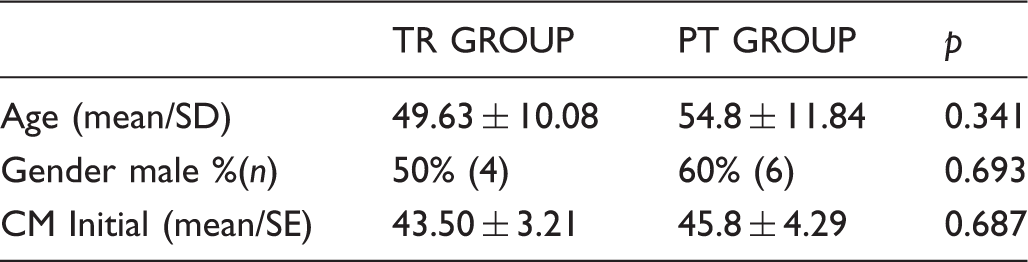
Baseline characteristics of patients with SIS undergoing ASD (n = 18).
Changes from baseline to 4, 8 and 12 weeks of follow-up in CM scores and subscores among 18 consecutive patients with subacromial impingement.
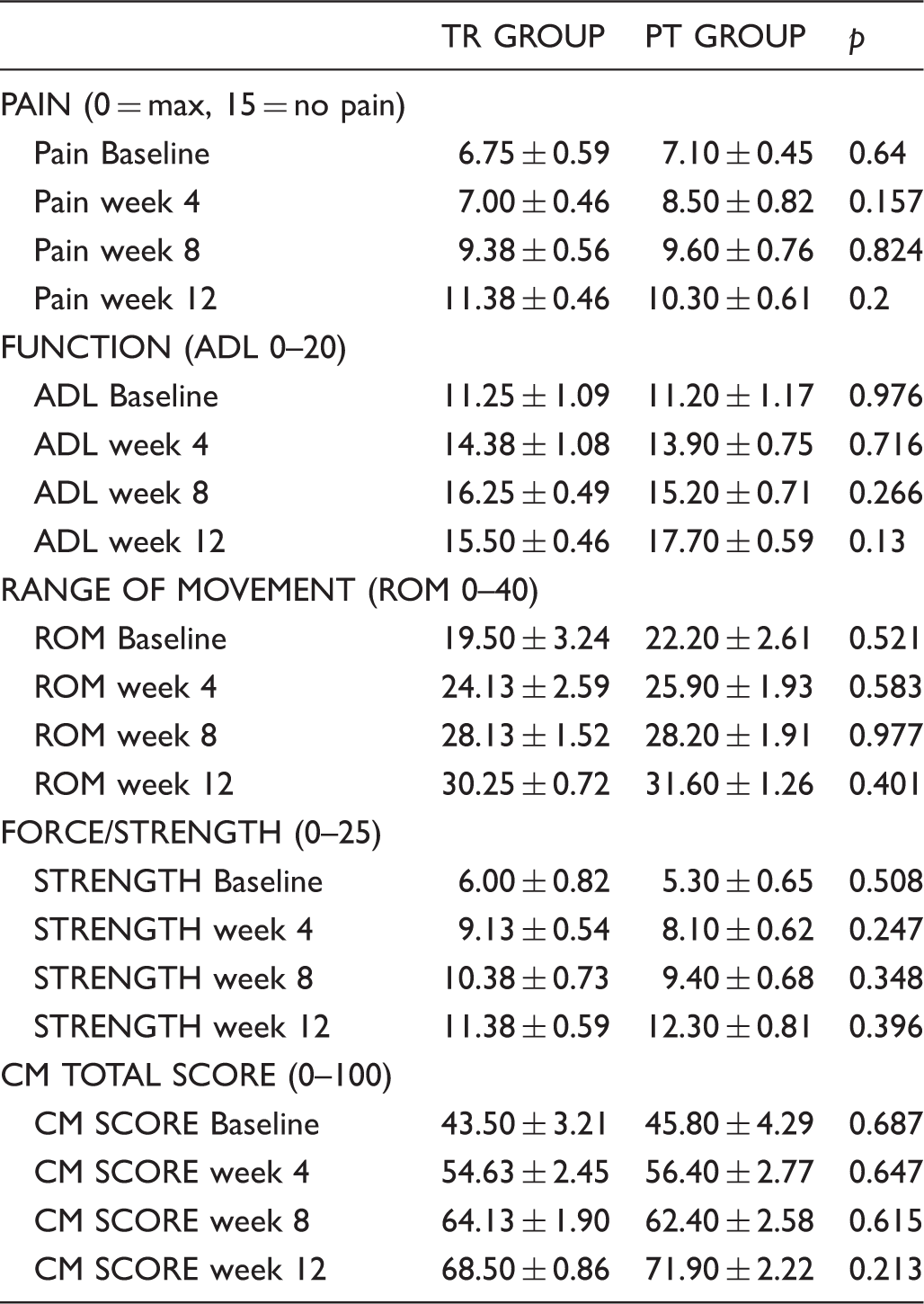

CM scores changes from baseline to 4, 8 and 12 weeks.
Both groups showed significant improvements. No statistical difference was found between the two rehabilitation methods, the difference being non-significant. No group differences in mean pain and dysfunction score improvement were found.
Discussion
The aim of this study was to evaluate the feasibility and effectiveness of a customizable telerehabilitation intervention compared with traditional care of patients after ASD. In addition to this, we aimed to measure the efficacy of this programme in terms of the physical and functional objective outcome measurements.
The physical and functional improvements in the telerehabilitation group of up to 20 points in CM score MDC ≥ 17 were similar to those in the control group. Improvements in subscores were similar after 12 weeks for pain (p = 0.2), function (p = 0.266), range of movement (p = 0.401) and strength (p = 0.396). This research provides valuable information about a new approach to care after surgical procedures for this group of patients, and proves that telerehabilitation is both feasible and effective.
Telemedicine promises to improve quality, increase patient access and reduce costs in health care. 24 Recent advances in telecommunication technologies have driven the possibility of rehabilitation processes through the Internet. 25 Studies have shown that telerehabilitation is effective in improving clinical outcomes in various diseases, and have found a strong positive effect for patients, especially after orthopaedic surgery, suggesting that increasing the intensity provided by the telerehabilitation is a promising option to offer to patients. 25 Shoulder pain is a common cause of sick leave and disability and therefore responsible for a high consumption of healthcare resources and lost productivity. 2
Other interventions require software installations on specific devices, whereas our intervention is available on any commonly possessed, Internet-enabled device (desktop, laptop, tablet, and smartphone), allowing access from any location and different devices. This contrasts with other studies that require highly complex technology platforms, software installation and multidirectional cameras for clinical control in order to connect the physical therapist and the patient. 26
Potential issues in this study are the occurrence of selection bias and information. This study does not consider the influence of previous physical therapy or conservative treatment on the results. This study only includes individuals who have Internet-enabled devices and access to the Internet, and therefore we have not information about individuals without access to the Internet, who may have a different outcome. This study does not consider the influences of dominant shoulder and workers’ compensation claims on the results. A further limitation is the use of a single-blinded evaluator, which can introduce measurement error, related to the interpretation of the observer, especially in the CM score as has been mentioned in previous studies. 27 The limited number of subjects in these preliminary results does not allow to us to study in detail the impact of age on functional outcome, as has been suggested recently. 28 It is worth noting that significant improvement in shoulder function was found as early as 3 months after surgery according to another study, 7 although long-term follow-up is recommended after ASD. It is our belief that the positive results in the active range of motion are primarily due to a notable reduction in pain, allowing patients to perform more physically demanding activities. Further studies will show whether telerehabilitation can be applied in other categories of patients.
Footnotes
Authors' contributions
All authors have made significant contributions to the article. JMPB coordinated the project, contributed to the conception, design of this study, and drafted the manuscript. RMV and FJBL were responsible of the methodological guidance, analysis and interpretation of data. NGM and MJEP contributed to coordinating intervention protocols and patient acquisition. All authors read and approved the final manuscript as submitted.
Declaration of Conflicting Interests
The author(s) declared following potential conflicts of interest with respect to the research, authorship, and/or publication of this article: JMPB, the corresponding author, states the following potential conflicts of interest: owns commercial licence of web My-Fisio (Exercise Prescription Software) used as a telerehabilitation tool. The other authors declare that they have no competing interests.
Funding
The author(s) received no financial support for the research, authorship, and/or publication of this article.
Ethical approval and consent to participate
This trial has the approval of the Ethics Committee of the Malaga Provincial Research 0761-M1-16 and Ethics Committee of the Hospital Costa del Sol with number 0761-M1-16. Patients in the study are required to read and approve the consent form by signing the previous information for patients and the consent form. (This document is held by the corresponding author).