



Abstract
The coronavirus disease 2019 pandemic placed an unprecedented demand on health systems to rapidly shift ambulatory in-person care to virtual care. Geriatric patients face more challenges with video visit access compared to younger patients due to discomfort with technology and less access to devices and internet. Medical students at the University of Michigan created an initiative to improve access to and comfort with video visits for geriatric patients. The program's goals were to (a) explore options for the delivery of personalized training to older adults, (b) create materials for volunteers to successfully navigate conversations with patients and caregivers, (c) provide patients one-to-one remote guidance while identifying and overcoming barriers—with practice sessions to increase comfort, (d) share with the larger health system, and (e) ensure program sustainability. Over a 10-week evaluation period, providers whose patients worked with our geriatric education on telehealth access volunteers had a video visit rate of 43% compared to 19.2% prior to participation in the program (adjusted odds ratio = 3.38, 95% confidence interval = 2.49, 4.59), ultimately providing a platform for geriatric patients to foster stronger connections with their providers, while increasing Michigan Medicine's overall proportion of video telehealth visits.
Introduction
The onset of the coronavirus disease 2019 (COVID-19) pandemic brought an abrupt transition from in-person to virtual visits for health care. 1 Although geriatric patients have shown equal satisfaction with telemedicine versus in-person visits, they can be at a significant disadvantage due to their lack of access to and comfort with technology.2–5 For example, a 2019 Pew Research survey reveals that although 81% of Americans own a smartphone, only 53% of those over the age of 65 years do. 6 While 73% of Americans have broadband internet service at home, only 59% of people who are 65 years or older do. 7 Previous publications advocate for the wide dissemination of telehealth instruction, emphasizing the importance of providing support for older adults.8,9 Indeed, a survey of Michigan Medicine (MM) health care system ambulatory psychiatry clinic patients at the pandemic outset comparing patient demographic factors, including age, race, insurance status, and sex, revealed that age was the only factor that significantly impacted access to virtual care. 10 Because geriatric patients are at increased risk of morbidity and mortality from COVID-19, it is necessary to prioritize remote connections with these patients. 11
The Michigan State of Emergency was declared on March 10, 2020, and the Stay at Home order began on March 23, 2020, mandating that only emergency health care could be provided in person, and MM closed all non-urgent ambulatory care clinics. 12 The efforts of the multisite MM Geriatric Clinic demonstrated an exceptional increase in virtual visits in a short period of time, but the majority of these virtual visits utilized telephone, with video visits being the underutilized minority. 13
At the time of the program launch, we were unaware of studies comparing the video to telephone visits. Since program initiation approximately 1 year ago, several studies have shown that patient satisfaction is higher with video visits in comparison with telephone visits.14,15 Video visits provide better interpersonal connection, and improved ability to evaluate the patient, especially in psychiatry, where eye contact and emotional body language are key aspects of the patient–provider interaction. 16 Another advantage of the video visit is the ability of providers to perform informal screenings of patient's homes for fall-related safety risks and offer tailored suggestions for home modifications. 17 A pre-pandemic systematic review of geriatric telepsychiatry revealed that telemedicine had the ability to deliver high-quality psychiatric care to older adults, but was only available to a small fraction of rural patients, due to many barriers, most notably Medicare restrictions. They recommended strong public policy advocacy to remove those restrictions to provide broader access to this high-value method of care. 18 Our institution, like others, lacked the infrastructure to guide patients on how to access and effectively use video telemedicine technology. 8 With the onset of the COVID-19 pandemic, under the constraints of an underprepared system, creative solutions were needed to help geriatric patients get connected to telehealth.
Program design and implementation
Responding to the particular need to increase older adult participation in video visits, medical student volunteers, removed from their clinical responsibilities, created the geriatric education on telehealth (GET) access initiative. 19 The goals of this initiative were to (a) explore and refine educational opportunities to deliver virtual personalized training to older adults, (b) develop training materials, (c) provide patients one-to-one remote guidance, identifying and overcoming barriers, with practice sessions to increase comfort, (d) share with the larger health system, and (e) ensure the sustainability of the program.
Program creation
We explored modalities for video visits that were relatively user friendly, could be used on different electronic devices, and were compliant with the health care system. We created a volunteer manual that included a structured process for how to call patients, a walk through of the video modalities, an algorithm for choosing which modality is best for each patient (Figure 1), and troubleshooting resources. We created a basic three-call format. To protect volunteer personal information, volunteers utilize caller-ID blocking services (Google Voice and Doximity) and a designated initiative email when connecting with patients.

Geriatric education on telehealth (GET) access technology algorithm. This algorithm was created to help the GET access volunteers properly assess each patient's personal technological needs and decide which video visit modality to teach them. Our three-call model includes the initial assessment call, the practice call where they walk the patient through the E-check-in process if applicable, and a follow-up call to gather feedback and ask if they would like a “refresher” call before their next scheduled video visit. Graphic created using Visme (Visme Co, 2021, V3.1.2).
Our three-call model
During the initial call, the volunteer contacts the patient 1 week before their appointment to gauge interest and discuss preferences/options for video visits. Volunteers and patients decide together which video software would be best, based on patient comfort and experience with technology, functional limitations, and who needs to be present for the visit. We guide the patient through the video modality step by step, working creatively to meet each patient at their level of understanding. We distribute instructions through email as well as de-identified text messages with links to applications that the patient needs to download, to decrease confusion and stress. We also use this call to coordinate with family members, caretakers, or assisted living facility staff if necessary. At the end of the call, we offer a practice call to reinforce learning, ensure comfort with technology, and identify possible areas of troubleshooting ahead of their actual appointment.
During the second practice call, we help the patient complete the electronic check-in process, practice the call using the chosen video modality, and answer additional questions. This enables the patient to prepare in a stress-free setting separate from the actual health care encounter. We then inform the provider of their patient's newly learned video skills.
Following the patient's appointment, a third call is made to discuss what went well, troubleshoot any problems that arose, and collect any general feedback. We also inquire if the patient would like a “refresher” call before their next appointment to review the process.
Setting
GET access volunteers primarily consisted of second- and third-year clinical medical students. As the program expanded, we also trained pre-clinical first-year medical students and pre-medical undergraduate volunteers to ensure the sustainability of the program. 20 All volunteers completed training in Health Insurance Portability and Accountability Act (HIPAA) Privacy Rules to protect privileged health care information. 21
Volunteers worked with patients aged 65 years and older in two clinics, Geriatric Psychiatry Clinic (GPC) and the Geriatric Medicine Clinic. All patients who contacted through the GET access program had refused previous offers by schedulers to receive coaching at the onset of the COVID-19 pandemic.
Implementation
Volunteers participated in virtual training programs to explore the training manual, learn communication techniques, and video modalities. We piloted the program in the GPC, with one provider assigned to each volunteer. The provider generated a list of patients’ details, including contact information, about the patient's social situation, and the need for family members or others to join the visit, highlighting communication difficulties, cognitive impairment, or dementia. All patient information was communicated via email with MM outlook/exchange encrypted emails. Volunteers implemented the three-call model and recorded call duration, video service modality taught, any issues/concerns, and feedback provided by patients.
Ethical considerations
The institutional review board of the University of Michigan Medical School reviewed the evaluation of our program and determined that it did not constitute human subjects research as it was a quality assurance/quality improvement (QA/QI) initiative limited to improving health care quality and delivery, and collecting, measuring, and/or reporting patient or provider data was used for clinical, practical, training, or administrative purposes (UM-HUM00182975).
Post-program evaluation of completed video versus telephone visits
We obtained all completed telephone and video visits provided during a 12-week evaluation period (March 15–June 6, 2020) from both clinics. Although interventions were made by training the patients, we evaluated the effectiveness of the program as an intention-to-treat approach. That is, the success of the program was based on the proportion of completed virtual visits that were conducted by video versus telephone. The denominator was all visits completed post-exposure to the program from the time a provider was paired with any volunteer, regardless of how future visits were scheduled and whether or not help was actually provided for those visits. Because the participating providers were enrolled in a staggered format, and overall video visits increased across all providers, we compared video versus telephone visits within 1-week intervals for intervention visits. Intervention visits by participating providers after they were paired with volunteer medical student support were compared with two different types of control visits: (a) visits by participating providers before the intervention began and (b) visits by non-participating providers throughout the study period. To calculate the estimated proportion of video visits each week in the three groups, we used logistic regression and indicator variables for each week. To estimate the marginal effect of the intervention versus two control groups, we used a longitudinal random-effect study design with visits clustered within weekly panels. We used STATA 14.2 for all analyses.
Additionally, we solicited feedback from providers who had worked with our volunteers for more than 2 weeks using an online, short open-ended survey in order to improve the workflow of the program. We also solicited feedback from patients via phone interview during follow-up calls. Questions asked in both surveys are detailed in Table 1.
Questions from provider and patient surveys.
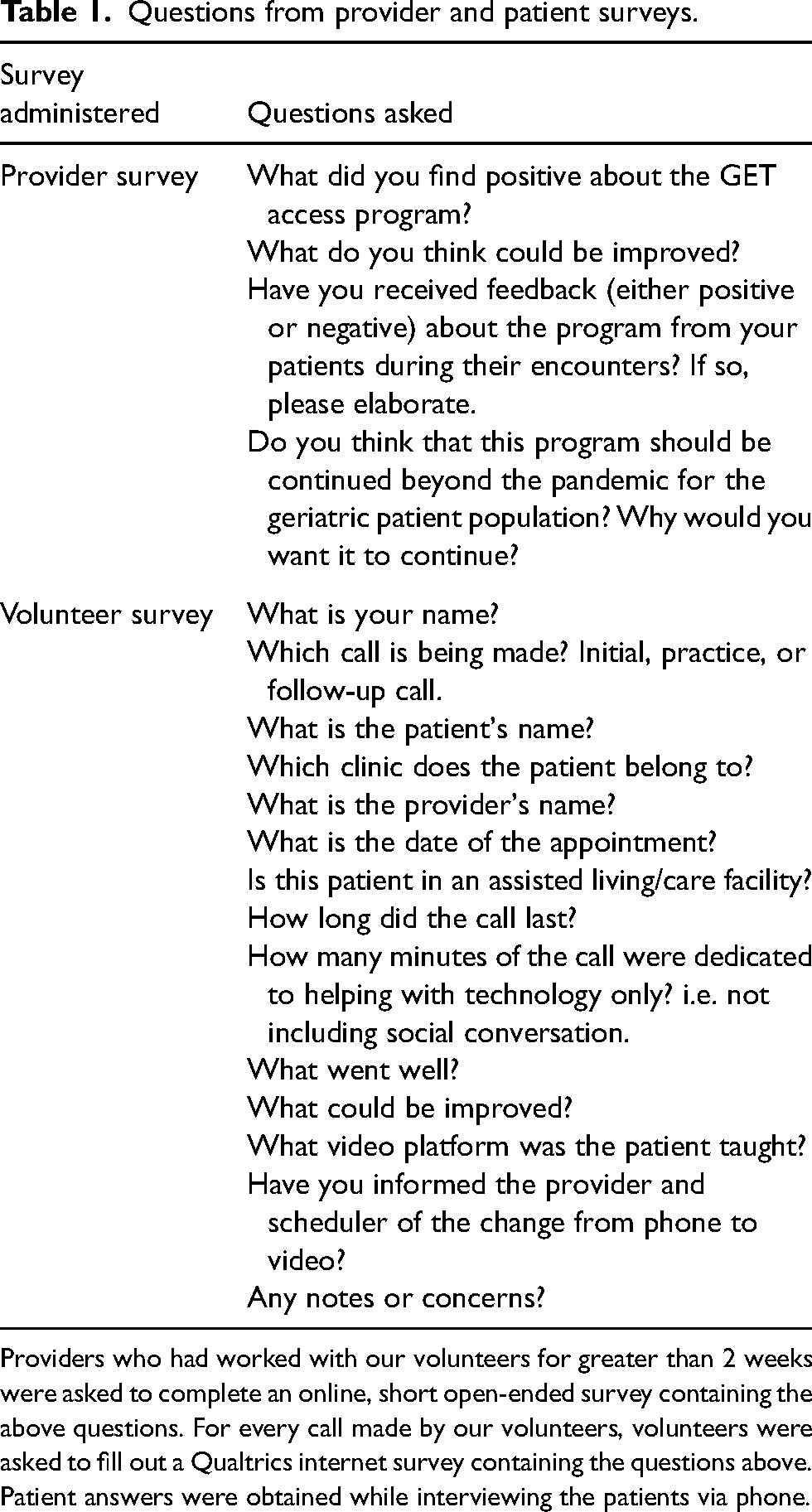
Providers who had worked with our volunteers for greater than 2 weeks were asked to complete an online, short open-ended survey containing the above questions. For every call made by our volunteers, volunteers were asked to fill out a Qualtrics internet survey containing the questions above. Patient answers were obtained while interviewing the patients via phone.
GET access program results
Between April 21 and June 6, 26 volunteers worked with 12 providers (physicians and nurse practitioners). A total of 219 calls were made to 188 patients with upcoming scheduled telephone visits, yielding 80 patients who underwent the study protocol, and conversion of 72 of those patients to scheduled video visits (Figure 2). The primary modality used was MiChart Portal (Epic Systems Corporation, Verona, WI) video visits, followed by Zoom for Health (Zoom Video Communication Inc.; San Jose, CA) video visits approved for protected health information (PHI) (HIPAA data). Most calls lasted <10 min (50 of 93 calls, or 53.8%), but some were longer (32 calls or 34.4% were 10–30 min; 8 calls or 8.6% were 30–45 min, 2 calls or 2.2% were 45–60 min, and 1 call or 1.1% was over 1 h). The proportion of the call spent actually on technical support for video visits also ranged from 0% to 100%. Using the midway point in each category to estimate a mean time per call, we estimated 14.7 min (SD, 13.3) on average per call of which 8.6 min (SD, 11.8) was time spent on technological support.

Phone call flow diagram. Of the 80 patients successfully assessed, geriatric education on telehealth (GET) access had an 88.75% success rate of conversion from phone visits to video visits over the span of 5 weeks. This data includes patients from both the Geriatric Psychiatry Clinic as well as the Geriatric Medicine Clinic. All patients contacted by GET access were previously offered video visits by scheduling staff but initially refused (*doxy.me).
The estimated proportion of virtual visits (of total video and telephone visits) in each clinic for intervention and two types of control visits (pre-participation visits and non-GET access provider visits) is shown in Figure 3. During the 12-week evaluation period, 1942 patients had 2865 visits to the two clinics. Of 57 total providers in both clinics, 12 providers received help for at least one visit—after which all of their visits were considered to be intervention visits. The number of weeks providers were exposed to the intervention ranged from 1 to 7 weeks (mean 4.3 weeks).
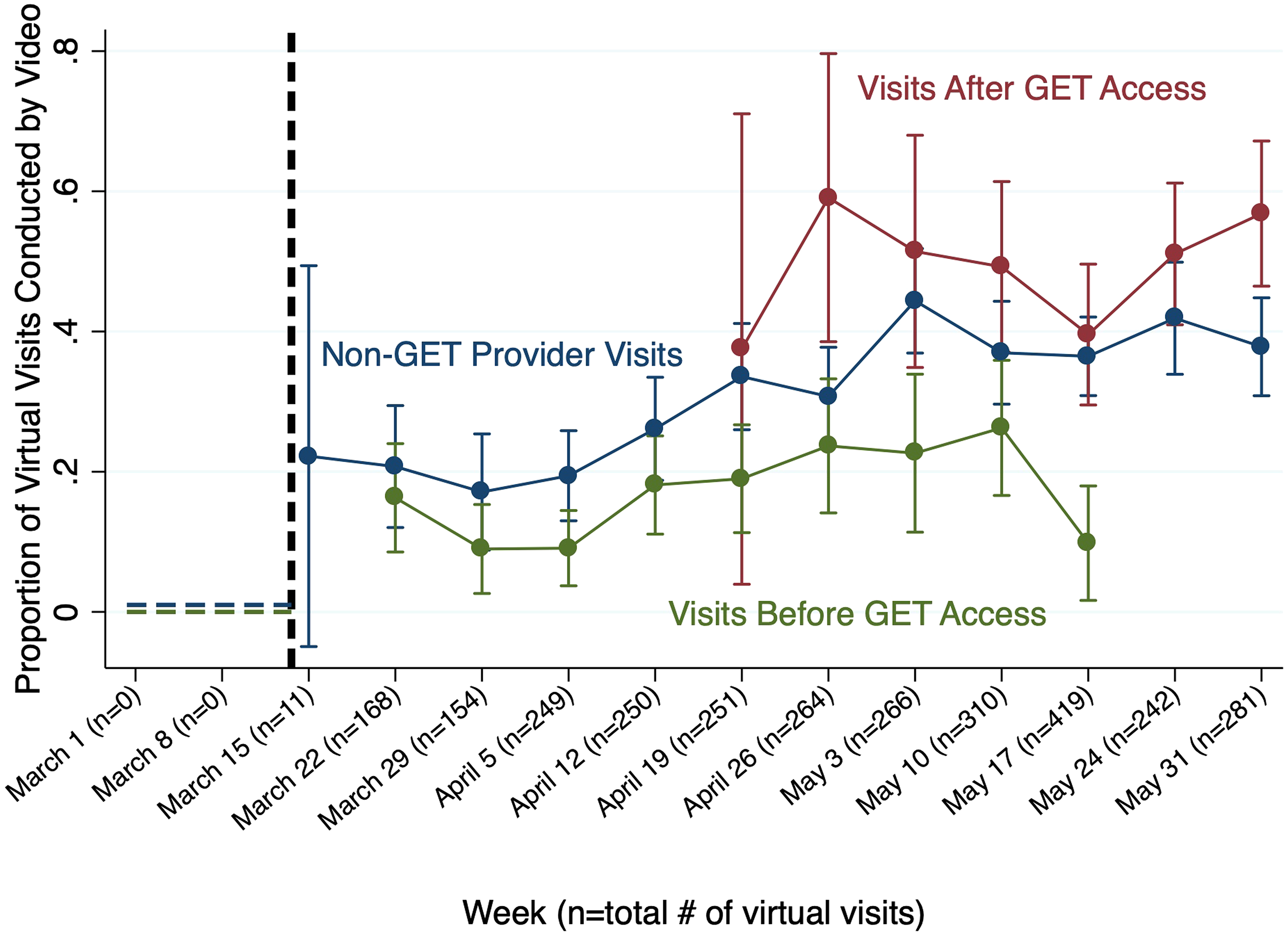
Patient-centered Education Program to facilitate geriatric telehealth: Completed telephone versus video visits. After the providers in the Geriatric Psychiatry Clinic and Geriatric Medicine Clinic implemented the GET access program, the proportion of video visits increased. The blue line represents visits by providers who never implemented the GET access program. The green and red lines represent providers who implemented the program; green indicates the proportion of video visits before the intervention, and red indicates this proportion after intervention. Providers started receiving the intervention during the period of April 21 through the end of May. Visits after intervention were associated with video format 43% of the time compared to 19.2% before participation (adjusted OR = 3.38; 95% CI = 2.49, 4.59) and the percentage of video visits by non-intervention providers was 32.1% (adjusted OR = 1.65; 95% CI = 1.31, 2.08).
Of a total of 2865 visits made to the two clinics, 1710 visits (60.0%) were to non-participating providers who were never helped during the entire evaluation period. For participating providers, 752 visits (26.3%) occurred prior to their joining the program and 403 visits (14.1%) were intervention visits. (Again, intervention visits were any visits conducted by a participating provider whether or not a specific patient was contacted by a volunteer.) Averaged over the 12 weeks of the evaluation period, visits after participation in the program were associated with video format 43% of the time compared with 19.2% for visits prior to participation (adjusted odds ratio (OR) = 3.38; 95% confidence interval (CI) = 2.49, 4.59). Non-participating providers had a video visit rate of 32.1% during the same time period (adjusted OR = 1.65; 95% CI = 1.31, 2.08).
Narrative feedback
A total of 14 patients and 7 providers contributed feedback. The following quotes demonstrate the prominent theme of appreciation for increased patient confidence with technology for telehealth crediting the amount of time that volunteers put into guiding them step by step.
An 85-year-old patient exclaimed, “I’ve always wanted to get on Portal, and my wife is on it. No one has ever taken the time to do it with me! Thank you!”
The husband of a 93-year-old patient who assisted with his wife's video visit stated, “We even liked it better than sitting right there. It was more comfortable being at home.”
Areas where patients said they ran into difficulty included working with older technology and adjusting sound and visual settings to best suit them.
Feedback from providers was overwhelmingly positive. The strongest recurring theme was that the program increased their number of video visits overall and their patients seemed grateful for the help.
Patients were empowered and able to learn a new skill they thought would never be possible. The also appreciated the kindness of the practice session before the real appointment.
When asked if providers thought that a similar program should continue to exist beyond COVID-19, their responses were also encouraging:
Absolutely yes. [Older adults] are the most vulnerable, need medical care, and can fall through the cracks. During the winter months, they cancel appointments due to risk of falls in ice and snow. If they could get year-round care, rather than seasonal care, their overall risk of morbidity and mortality would be lower.
Areas of improvement revolved around the time-consuming task of going through their patient list and compiling the patient's information for their volunteer.
Discussion and targets for future improvement
This innovative project describes the rapid development and implementation of a video virtual care training program for the geriatric patient population in response to the COVID-19 pandemic. To the best of our knowledge, this is the first report of a specific process that a health care system can use to convert phone visits to video visits en masse in the geriatric population. We hope the findings from this initiative will be of interest to other health care organizations eager to convert phone or in-person visits to video visits. In the long term, creating a geriatric-specific telehealth model has validity beyond the COVID-19 pandemic, addresses barriers to care such as travel in inclement weather, physical limitations, as well as issues of transportation and anxiety surrounding in-person visits. 2
Our primary goal was to improve virtual health care interactions between patients and providers. A secondary benefit of the GET access project could be to decrease social isolation in the geriatric population and give them the skillset to create virtual interactions outside of medicine. The physical isolation mandated by health care officials due to COVID-19 has increased social isolation and loneliness among older individuals, which may lead to long-term sequelae including increased rates of depression, anxiety, and physical frailty.22–25 Teledelivered behavioral activation has been demonstrated to be effective in improving social connectedness and decreasing depressive symptoms and disability in homebound older adults.
Limitations of this project include that it was only implemented in two clinics at one institution, overall, only reaching a small portion of the entire geriatric community at MM. Additionally, the materials created for the program are somewhat specific to MM's preferences and technological availability and might not be directly transferable to other health care systems. The need to use platforms that were available only on certain device types prioritized or approved by the health system was a constraint. Hopefully, as the demand for platforms for telehealth is recognized, more easily navigable options, will be developed. Given the lack of data directly comparing video versus phone telehealth, more studies are needed to determine, on a broad scale, what advantages video telehealth has compared to phone telehealth, especially in terms of reducing social isolation and depression in the geriatric population. 26 Finally, we call attention to the “digital divide,” acknowledging that in addition to age, factors related to lower levels of technology ownership and broadband access include race, ethnicity, socioeconomic status, and education level.6,27 The location of this clinic in a university town might have influenced the acceptance and success of the program. When efforts are made to keep in-person visits to a minimum, special preference should be given to those patients who do not have any access to the technology necessary for video visits.
While the GET access program materials may be more tailored to MM's processes, the iterative, interactive, self-sustaining program structure could be naturally translated to other health care systems and entities. Implementation requires (a) a dedicated team of patients and creative members with devoted time to make the volume of calls necessary, (b) collaboration with physicians and clinic administrators for their input, and (c) a project lead to oversee the process. Initially, we requested patient information from the providers themselves. As the program evolved, we were able to mitigate this burden to providers by utilizing ancillary clinic staff to obtain and disseminate this information to our volunteers. Key features of creating successful engagement with patients involve time and timing. For those providing the service, it is imperative to have ample time to practice with the patient. Additionally, to decrease the stress that many of our patients experience surrounding telehealth and technology, it was a benefit that our volunteers conducted their work at least 1 week prior to the actual appointment. Finally, it is critical that volunteers or trainers have an open mind, to be able to adapt to whatever resources the patient has rather than making the patient fit the needs of the health care system.
In summary, the GET access program was created and implemented by medical student volunteers, as an initial, immediate response to the abrupt transition to telehealth necessitated by the COVID-19 pandemic. The student coordinator created training materials and sessions. Volunteers devoted time and patience to work individually with tailored education and practice sessions for geriatric patients who had previously refused offers for coaching. The 88.75% rate of conversion from telephone to video calls occurred during this period of rapid transition, within the constraints of state Stay at Home orders. Future programs might have the luxury of a calmer atmosphere and in-person training, but the value of patience, tailored education, and practice will still likely be essential to success. With the burgeoning availability and understanding of the benefits of telehealth, more programs and resources are necessary to address the disparity in comfort with and access to technology, for older adults and other disadvantaged groups.
Declarations
The authors report no conflicts of interest with any product mentioned or concept discussed in this article. All authors meet the criteria for authorship stated in the Uniform Requirements for Manuscripts Submitted to Biomedical Journals. The institutional review board of the University of Michigan Medical School reviewed the evaluation of our program and determined that it did not constitute human subjects research as it was a QA/QI initiative limited to improving health care quality and delivery, and collecting, measuring, and/or reporting patient or provider data was used for clinical, practical, training, or administrative purposes (UM-HUM00182975).
Footnotes
Acknowledgements
The authors thank Maire DeLand for creating the video about effective communication with older adults for our volunteers, Cassidy Merklen for helping implement the program, Kinsey Vear for taking leadership of the program following the clerkship student's return to the clinical space, and Jacqueline Freeman for helping us with our literature search.
Author Contributions
CMP contributed to program creation, design, and revision, materials design and revision, project implementation and evaluation, analysis plan and interpretation; manuscript drafts, revisions, and final approval. CEA contributed to statistical design and analysis, manuscript revision, and final approval. LCM contributed to data acquisition, manuscript revision, and final approval. MCB contributed to program creation, design and revision, project implementation and evaluation, manuscript revision, and final approval.
Declaration of conflicting interests
The authors declared no potential conflicts of interest with respect to the research, authorship and/or publication of this article.
Funding
The authors received no financial support for the research, authorship and/or publication of this article.
