



Abstract
Introduction
The usual referral pathway is from a primary care provider (PCP) to a specialist; however, specialists also refer to and consult with other specialists. Electronic consultation (eConsult) allows clinicians to submit questions on behalf of patients to specialists to receive timely advice. Most eConsult studies in the past have examined questions asked from PCPs to specialists. This study investigates the utilization of specialists submitting clinical questions to other specialists through the Ontario eConsult Service and identifies use-case scenarios where specialist-to-specialist eConsult may be beneficial.
Methods
A retrospective, descriptive, cross-sectional analysis of eConsults submitted by specialists through the Ontario eConsult Service for 24 months (March 2019 to February 2021). Utilization data is collected automatically by the service, including specialty referred to, time billed, region, and results from a closeout survey which includes the referral outcome of the eConsult and the utility to the submitting clinician.
Results
4% (n = 3285) of all eConsults sent within the study period were specialist-to-specialist, with the others being sent by a PCP. The number of specialist-to-specialist eConsults grew 120% following the onset of the COVID-19 pandemic. The top three specialties that submitted eConsults were pediatrics, internal medicine, and endocrinology. The top three specialties that specialists submitted to were dermatology, neurology, and hematology. A face-to-face referral was avoided in 69% of referrals.
Conclusion
Evaluating the utilization patterns of specialist-to-specialist eConsults allows us to better understand and expand the scope of eConsult services, which have traditionally been thought of as a workflow between a PCP and a specialist.
Introduction
In Canada, access to specialty care remains a barrier. Although the usual referral pathway is from primary to specialist care, this is not always the case. Specialists often refer to other specialists, either in a different specialty or a subspecialist within their specialty. In 2019, 55% of the 10,509,008 referrals sent in Ontario came from primary care providers (PCPs; i.e. family medicine physicians and nurse practitioners), while the remaining 45% came from specialists (i.e. physicians who are not in family medicine). 1 This large portion of referrals sent by specialists can be partly explained by the Canadian healthcare's shortage of PCPs, with approximately 4.6 million Canadians reporting not having a family doctor or a regular healthcare provider to see for care and advice. 2 When patients do not have a PCP accessible to them, common medical conditions that could be cared for by PCPs end up being treated by specialists for an extended period. 3 In this case, specialists oversee routine follow-ups and management of chronic diseases, and may be asked to address medical conditions or referrals outside of their usual scope of practice. In Canada, generalists, for example, in Internal Medicine or Pediatrics, are often the only specialists outside of urban centers and may request access to a subspecialist for more complex cases.
Electronic consultation (eConsult) services enable access to specialist advice through provider-to-provider communication using a secure platform.4–6 Most eConsult services focus on the PCP-to-specialist referral pathway and recruit specialists to answer rather than submit eConsults. However, given the number of specialist-to-specialist referrals, eConsult services provide an opportunity to enable specialists to access other specialists’ advice for their patients and enable them to provide care outside their usual scope—an even more common event during the COVID-19 pandemic.
The literature describing the specialist-to-specialist eConsult pathway is quite limited. A survey of specialists answering eConsults in Ontario, Canada reported that 67% of specialists supported expanding the service to allow for specialist-to-specialist eConsults due to its ease of use, value in reducing unnecessary face-to-face consultations, and ability to provide education and reassurance to the referring provider. 7 Given the scarcity of literature on specialist-to-specialist eConsults and the potential for growth in usage, we sought to investigate the current utilization of the Ontario eConsult Service by both specialists who provide eConsults for PCPs and specialists who do not answer eConsults but have access to the Ontario eConsult service.
Our results will inform the identification of use-case scenarios where specialist-to-specialist eConsults may be beneficial. This can further inform engagement strategies to increase specialists’ utilization of eConsult in these scenarios, which will be of interest for innovators looking to do the same in their jurisdictions.
Methods
Design
We conducted a retrospective, descriptive, cross-sectional analysis of eConsults submitted by specialists through the Ontario eConsult Service for 24 months (March 2019 to February 2021). We further defined the time period by differentiating pre (March 2019 to February 2020) and post (March 2020 to February 2021) the onset of the COVID-19 pandemic, given the new challenges presented. We also reviewed utilization data collected automatically by the Ontario eConsult Service to examine the perceived benefit of the eConsult to the requesting provider and their patients and the impact on care delivery, as determined from the close-out survey responses.
Setting
The study was conducted in Ontario, Canada, which is home to almost 40% of the country's population. Ontario is divided into five health regions. Ontario Central is the most populous region and home to 33% of the province's population, whereas Ontario Health North is the least populous, with only 5% of the population (Table 1). 8 Each region is also home to a wide range of specialists and specialties (Table 1). 9 Healthcare in Ontario is publicly funded and administered through the federal and provincial governments. 10
Population and number of specialists in Ontario, Canada by health region.

Service
The Ontario eConsult Service is a secure and asynchronous online communication tool that allows requesting providers, usually PCPs, such as family doctors and nurse practitioners, to submit questions about a patient's care to specialists from over 100 specialties and is freely available to all physicians in Ontario. To use the Ontario eConsult service, a requesting provider logs onto a secure web portal and fills out a structured electronic form that includes the patient's demographic information, the clinical question(s) being asked, and any pertinent attachments, such as, but not limited to labs and imaging. As part of their response, the specialist reports how long they spent answering the question, which is used to provide pro-rated remuneration. Responses are capped at 60 min, though multiple responses for a single case can exceed this limit. When the requesting provider chooses to close a case, they are prompted to complete a close-out survey that gathers information on their actions following the consultation.
Participants
Participants in this study included specialists who submitted or responded to eConsults on the Ontario eConsult Service between March 1, 2019, and February 28, 2021. We defined “specialist” as anyone who was not a family medicine physician or nurse practitioner. General Internal Medicine specialists were included as specialists for this project given their role as consultants rather than PCPs in the Canadian health care system, which is different than many other jurisdictions. 11 eConsults submitted by PCPs (family medicine physicians and nurse practitioners) or optometrists (PCPs for eye care) were excluded from this study, as were cases submitted to multidisciplinary BASE™ groups. Subspecialties were grouped into their parent specialties (e.g. pediatric hematology was classified as hematology).
Data sources and analysis
We utilized descriptive statistics to analyze the two years of Ontario eConsult Service utilization data (March 2019 to February 2021) to calculate the number of eConsults, number of providers, specialty distribution, regional distribution, response interval, time billed, average cost, and results from the close-out survey. Population data from each Ontario Health region was used to determine the number of eConsults sent per 1000 residents. Data were grouped by requesting provider regions to observe trends in different regions of the province. Time series analysis was conducted to observe growth and change in the data between the two time periods (pre- and post-onset of the COVID-19 pandemic).
Ethics
The study was approved by the Ottawa Health Science Network Research Ethics Board (Protocol#: 2009848-01H).
Roles of the funding source
Funding for this project was provided by the Ontario Ministry of Health. The opinions, results, and conclusions reported in this paper are those of the authors and are independent of the funding sources. No endorsement by the Ontario MOHLTC is intended or should be inferred. The views expressed herein do not necessarily reflect the views of the province.
Results
Utilization data
A total of 3285 eConsults were submitted by specialists over two years between March 2019 and February 2021 (Figure 1), representing 4% of all eConsults submitted on the Ontario eConsult Service during the same period (n = 84,119). A total of 554 specialists submitted eConsults during the study period, 56% of whom were also registered on the Ontario eConsult Service to answer as eConsult specialists. A total of 513 specialists answered specialist-sent cases. The top five specialties that specialists submitted to were dermatology, neurology, hematology, infectious diseases, and psychiatry (Figure 2). The top five specialties that submitted eConsults were pediatrics, internal medicine, endocrinology, geriatrics, and cardiology. Pediatricians sent 14% (n = 450) and surgeons sent 3% (n = 114) of all specialist-to-specialist eConsults between March 2019 and February 2021.
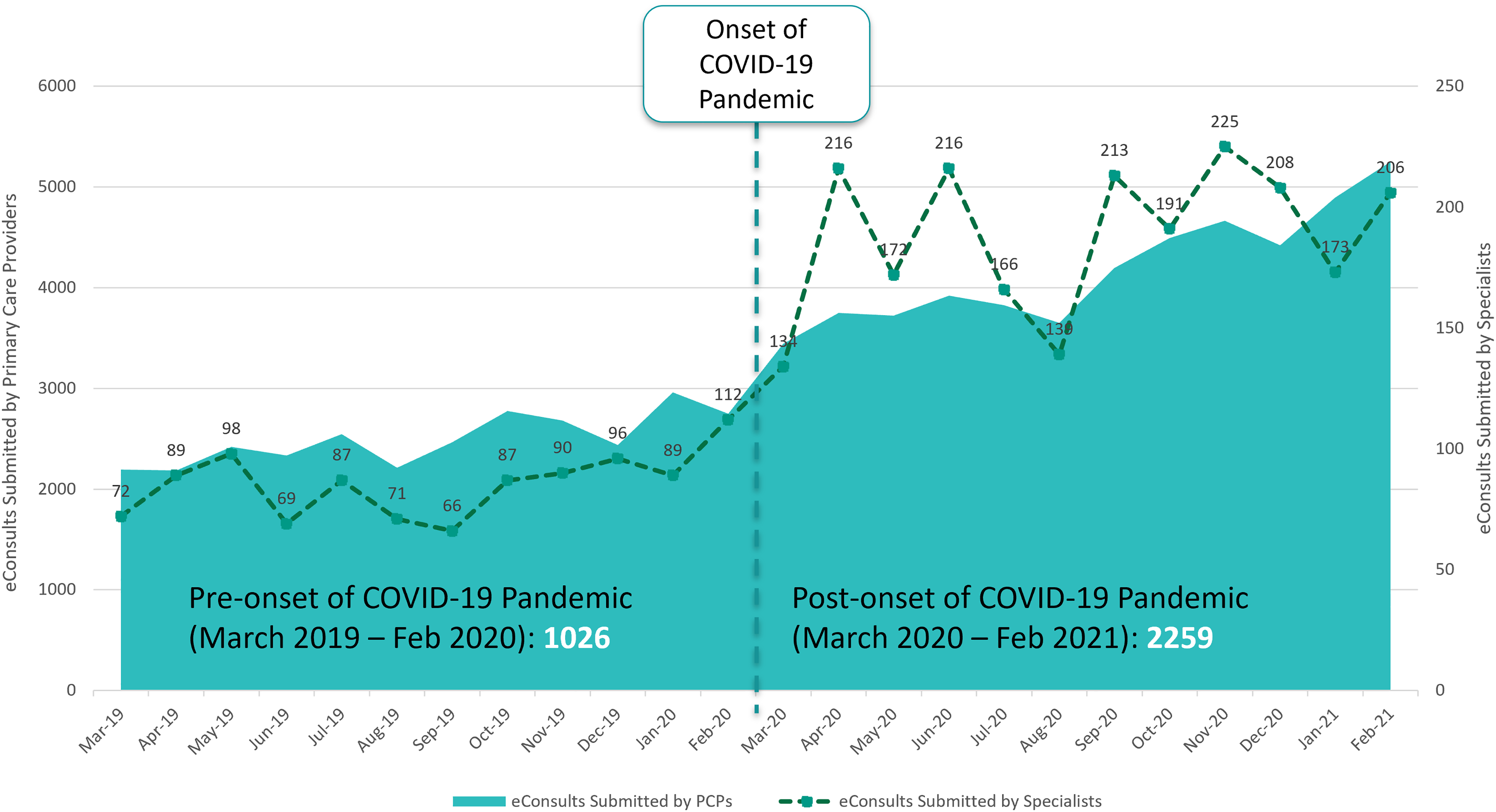
Number of eConsults submitted by specialists (line graph) and primary care providers (area graph) on the Ontario eConsult Service by month.

Specialty distribution for eConsults submitted by specialists (n = 3260). Specialty is unavailable for 25 eConsults.
Time billed
Eighty-eight percent (n = 2895) of cases sent by specialists were closed by the end of the study timeframe. Of these cases, 94.2% (n = 2724) of eConsults were answered in 7 days or less. The median response interval was one day (range: 3 min to 95.9 days) and the median time billed by responding specialists was 15 min (range: 0 min to 300 min, with over 84% answered in 30 min or less).
Close-out survey
Survey data were unavailable for 90 closed eConsults, allowing for analysis of 2805 cases in total. Among this subset, the submitting specialist confirmed a course of action in 44% of cases (n = 1240) and received good advice for a new or additional course of action in 53% of cases (n = 1475) (Figure 3). In 69% (n = 1906) of cases, specialists indicated that they could treat the patient without requiring a face-to-face referral with the specialty group contacted through the eConsult service (Figure 3).
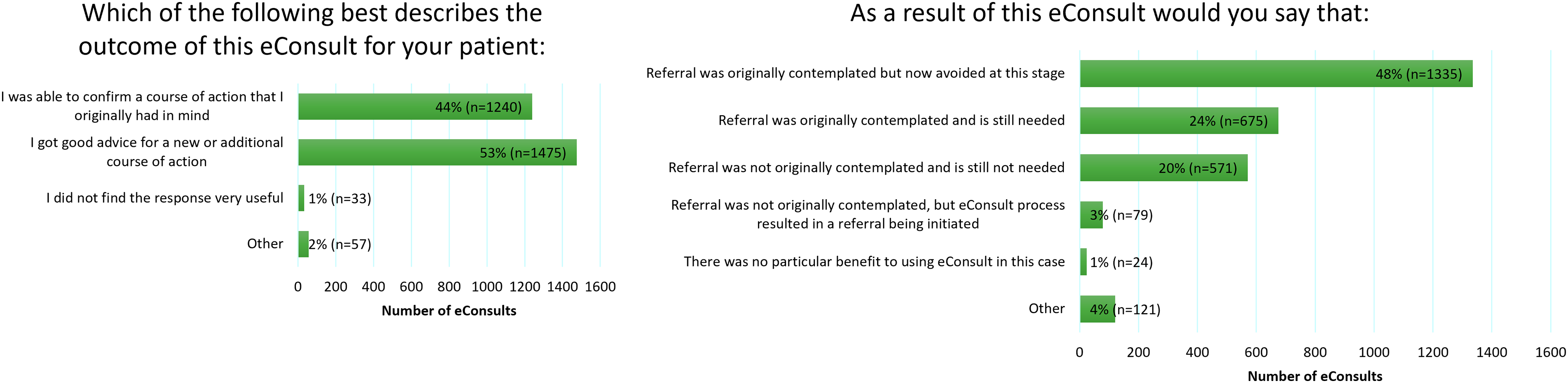
Results from the close-out survey for closed eConsults (n = 2805). Results unavailable for 90 closed eConsults.
Pathways
The most common specialist-to-specialist pathway was cardiology to neurology. Pediatrics to pediatrics represented the largest pathway for pediatric specialist-to-specialist eConsults (n = 93), followed by pediatrics to dermatology (n = 47), and pediatrics to psychiatry (n = 46). Cases sent from general surgery to diagnostic radiology represented the largest specialist-to-specialist pathway (n = 44), followed by vascular surgery to infectious diseases (n = 12).
Comparison pre and post COVID-19
Specialists submitted 1026 cases pre-onset of the COVID-19 pandemic and 2259 post-onset, which is an increase of 120% (Table 2). In comparison, there was only a 67% increase between the eConsults submitted by PCPs during the same time period (Figure 1). Post-onset of COVID-19, the top 5 specialties submitted to and the top 2 regions where cases were submitted from changed (Table 2). Table 2 also highlights the differences between the specialty and sub-specialty pathways, close-out survey questions, time billed, and response interval pre- and post-onset of the COVID-19 pandemic.
Comparison of specialist eConsults pre and post the onset of COVID-19 pandemic.

Discussion
Our study examining the use of eConsult by specialists found that specialists initiated 4% of all eConsult cases sent over a 24-month period. The most common groups that sent eConsults included specialty services that may have a traditional primary care role and, as a result, deal with more diverse issues and are prepared to follow up with the patients once advice is received. While less frequent than PCP-initiated cases, specialist-to-specialist eConsults occurred regularly throughout the study period. Submissions from specialists had a larger increase pre- vs. post-onset of the COVID-19 pandemic (120%) in comparison to the increase of cases submitted by PCPs (67%). Outcomes pertaining to the specialist's course of action and decision to refer largely aligned with broader data from PCPs reported in previous studies.12–14 These studies suggest that the eConsults are useful and may avoid the need for further face-to-face referral. Our study shows that eConsult improved timely access to specialist advice with a median response interval of one day. It was successful in integrating into the care process as 53% of cases resulted in a new or additional course of action, versus 55% for PCPs. 15 Additionally, 69% of cases were resolved without requiring an additional face-to-face visit, versus 72% for PCPs. 16
Few studies have examined specialist-to-specialist electronic consultation services, and none have occurred within the Canadian healthcare system.15,17–20 The two groups with the most evidence supporting the use of specialist-to-specialist eConsults are the Mayo Clinic in the United States 17 and the Centre Hospitalier Andre-Mignot (CHV) de Versailles in France. 20 At the Mayo Clinic, the ordering of e-consultations was expanded to specialists in 2011 and allowed numerous specialties to be contacted for advice about outpatients. Currently, eConsult at the Mayo Clinic is typically a specialist-to-specialist. During the first 6 months of 2013, the Mayo Clinic reported that 30.1% of the 3008 total eConsults were inter-specialty (specialist-to-specialist, different specialty), 7.5% were intra-specialty (specialist-to-specialist, same specialty), and 8.7% were specialist-to-surgeon. 17 These percentages are much higher than those reported by the Ontario eConsult Service. This may be because of certain clinical indications and abnormal test results in which ordering an eConsult was made mandatory at the Mayo Clinic.
In comparison, the CHV Andre-Mignot study presents the findings of 116 eConsults sent over 26 months, during which specialists sent eConsults using a teledermatology service for dermatological advice. 20 In addition to all cases being responded to within 24 h and the avoidance of in-person visits or dermatological hospitalizations, the information and photos sent by the requesting provider allowed for a definitive diagnosis in 42% of cases, a hypothesis of diagnosis in 58% of cases, and a treatment proposed in 74% of cases. The acceptability of the teledermatology service was considered excellent by patients, requesting physicians at the CHV, and specialists at the expert center. However, this study is limited to a single-specialty service and a small scope within a single hospital. Regardless, these findings on the feasibility of eConsult, improved timely access to specialist advice, and reduced need for face-to-face visits are consistent with those reported in our study.
To our knowledge, our study is the first to examine a multi-specialty electronic consultation service where specialist providers not working in the same organization can voluntarily send eConsults to request advice about a patient's care. Other aspects of its novelty include the scope of the jurisdiction, the volume of eConsults for which data are available, and the close-out survey results describing the outcomes of the eConsult for the patient. With the promising results of our study, increasing specialist engagement with eConsult can facilitate the growth of specialist-to-specialist cases. When onboarding specialists, we primarily them about the opportunity to send questions in addition to answering. Furthermore, specific groups of specialists, such as general pediatricians, have also been targeted to increase specialist-to-specialist eConsults.
Limitations
There are several limitations to our study. Despite the large scope of the jurisdiction, the data are still from a single province in Canada and, as such, may not be generalizable to other settings. We also identified limitations from the data, such as the possibility of family medicine physicians with a specialty (e.g. obstetrics, oncology, women's health) not having been identified as specialists sending eConsults and some users not listing a specialty. Another limitation of the data involves the grouping of specialties, as some granularity might be missing in the specialty distribution. For example, grouping all pediatric specialties together instead of grouping them into parent specialties, such as cardiology, neurology, and dermatology would have placed pediatrics in the top 10 for specialty distribution. Regardless, this cross-sectional study presents evidence for the utilization of specialist-to-specialist eConsults, which will be useful for innovators looking to develop this pathway in their own jurisdictions.
Conclusion
The current literature examining specialist-to-specialist eConsults is limited regarding provider satisfaction, feasibility, and usefulness of the eConsult service, integration into clinical workflow, and perceptions of increased workload. Evaluating the utilization patterns of specialist-to-specialist eConsults allows us to better understand and expand the scope of eConsult services, which have traditionally been thought of as a workflow between a PCP and a specialist. As specialist-to-specialist referrals in Ontario accounted for almost half of the referrals in 2019, increasing awareness and use of eConsult among specialists may provide substantial benefits, such as timely access to specialist advice. 1 Further studies should explore use-case scenarios where specialist-to-specialist eConsults may be beneficial. Additionally, further studies should identify engagement strategies to increase utilization for these scenarios while ensuring these strategies do not remove PCPs from the circle of care.
Footnotes
Acknowledgements
The authors wish to thank the providers who use Ontario eConsult, JJ Hupka for his support in this project, as well as Jessika Hammond and Justin Joschko for their assistance in preparing the manuscript for publication.
Declaration of conflicting interests
The author(s) declared the following potential conflicts of interest with respect to the research, authorship, and/or publication of this article: Drs. Liddy and Keely are co-founders of the Champlain eConsult BASE™ Service, but they have no commercial interest in the service and do not retain any proprietary rights. Dr. Keely is the co-Executive Director, and Dr. Liddy is the Evaluation Lead of the Ontario eConsult Centre of Excellence and they receive salary support From the Ontario Ministry of Health. Dr. Keely answers occasional eConsults (less than one per month) as a specialist through the service, for which she is reimbursed.
Funding
The author(s) disclosed receipt of the following financial support for the research, authorship, and/or publication of this article: This work was supported by the Ontario Ministry of Health.

Data availability statement
Data from the study can be made available from the Corresponding Author upon reasonable request.