



Abstract
Background
While telemedicine has been beneficial in oncology by reducing infectious exposure and improving access for patients with poor functional status, it also has intrinsic limitations, including the inability to perform a physical exam, which could lead to increased downstream utilization in this population at high risk of medical decompensation. We conducted a retrospective cohort study investigating the relationship between telemedicine use in oncology and subsequent outpatient oncology encounters, emergency department (ED) visits, and hospitalizations.
Methods
We included outpatient oncology encounters, including telemedicine and in-person visits, occurring between 1 January 2018 and 31 December 2022 at a large academic health system. Unadjusted descriptive statistics and multiple linear regressions were used to estimate subsequent outpatient oncology visits, ED visits, and hospitalizations within 30 days of an index visit based on modality (telemedicine versus in-person). The multiple regressions were adjusted for various demographic and clinical characteristics, including palliative care visits, baseline utilization, recent chemotherapy, and comorbidities.
Results
Our cohort included 63,722 patients with 689,356 outpatient encounters, of which 639,217 (92.7%) were in-person and 50,139 (7.3%) were telemedicine visits. Patients on average had 0.91 outpatient oncology visits, 0.04 ED visits, and 0.05 hospitalizations within 30 days following an index encounter. In our adjusted analyses, telemedicine was associated with 13.7 fewer downstream outpatient oncology visits (95% CI 12.5–14.9; p < 0.001) per 100 index encounters, 0.7 fewer ED visits (95% CI 0.4–1.0; p < 0.001) per 100 index encounters and 0.9 fewer hospitalizations (95% CI 0.6–1.3; p < 0.001) per 100 index encounters compared to in-person visits.
Conclusions
Contrary to our hypothesis, oncology patients who had a telemedicine visit had fewer follow-up outpatient oncology encounters, ED visits and hospitalizations after 30 days than those with in-person visits. Future studies should further investigate the efficacy of telemedicine in oncology and outline specific scenarios for appropriate use in this and other populations.
Keywords
Introduction
Over the past few decades, telemedicine has been increasingly employed in a variety of clinical contexts, including cardiovascular care, 1 endocrinology, 2 and medical oncology.3,4 Several pilot studies from before 2020 showed successful implementation of telemedicine programs and provided preliminary evidence that telemedicine may promote favorable outcomes across multiple clinical contexts.1–5
More recently, the Covid-19 pandemic led to the rapid expansion of telemedicine. Although the widespread adoption of telemedicine was intended to ensure access to care during the pandemic, telemedicine now remains a routine part of clinical practice, though questions remain about where telehealth is best applied, along with the effect of telemedicine on healthcare spending and outcomes.6,7
Since the pandemic onset, telemedicine has shown promise in increasing access to care for certain populations8–11 as well as promoting favorable patient outcomes, especially for management of chronic diseases such as hypertension and diabetes.12–14 Though telemedicine can play a valuable role in care delivery, the extent to which it serves as a viable replacement for in-person care is the subject of ongoing debate.15–19 Telemedicine has inherent limitations, including technical difficulties and the inability to perform a physical exam. In fact, some recent studies have shown increased utilization following telemedicine visits for pain conditions and post-acute care, raising concern that telemedicine may be an inappropriate modality of care for acute visits or high-risk patients.15,20
In medical oncology, the growth of telemedicine since the onset of the pandemic has played an important role by reducing potential exposure to infection and improving access for patients with reduced performance status.21,22 However, for this uniquely complex patient population at high risk of decompensation, it is possible that telemedicine may not provide an adequate means of evaluation as compared to in-person encounters and may unintentionally increase the likelihood of future acute care hospital and emergency department (ED) visits. 23
To understand how telemedicine relates to downstream utilization among patients with cancer, we studied the association of telemedicine vs. in-person oncology visits and subsequent 30-day outpatient oncology visits, ED visits and hospitalizations. We hypothesized that, given the limitations of telemedicine in enabling maximally thorough clinical evaluations for a vulnerable patient population, telemedicine would be associated with more subsequent outpatient oncology visits, ED visits and hospitalizations than in-person visits.
Methods
This study was approved by the Institutional Review Board (IRB) as minimal risk and was exempt from the requirement for informed patient consent.
Study design, setting & participants
This retrospective cohort study examined all outpatient encounters that occurred within the Division of Hematology/Oncology at the University of California, Los Angeles (UCLA) Health System from 1/1/2018 to 12/31/2022. Encounters from pre-Covid years were included to illustrate trends in telemedicine use in oncology before and after the pandemic.
UCLA Health is a large academic health system that includes two hospitals and 20 outpatient oncology clinics, most of which are in Los Angeles County. Prior to the pandemic, telemedicine had limited use at UCLA Health, employed only in certain contexts such as postoperative visits and was not offered to all patients. UCLA Health developed full telemedicine capabilities in 2020 in response to concerns about Covid-19. From January to April 2020, telemedicine visits were scheduled by default for patients who had symptoms of and exposure to Covid-19 and were not offered to patients who did not have both symptoms and exposure. Beginning in May 2020, telemedicine was offered to all patients, and the decision to use telemedicine was based on patient preference, except for patients who had symptoms of and exposure to Covid-19 infection, who were scheduled to be seen via telemedicine. During both time periods, if a patient with Covid-19 exposure and symptoms preferred to be seen in-person rather than via telemedicine, they would need to contact the clinic for approval. Telemedicine visits were scheduled in conjunction with in-person visits, and patients choosing telemedicine were not seen faster than those seen in-person. In addition, patient calls made after hours were triaged via telephone by the covering physician on-call.
Our sample included in-person office visits and telemedicine visits, which comprised both video and telephone visits. Visit type was identified based on electronic health record encounter-type codes, which were unique identifiers for visit modality. We included adult patients who had a cancer diagnosis at the time of their oncology encounter per the 10th edition of the International Classification of Diseases (ICD-10). We studied downstream encounters following an index visit, which we defined as any outpatient oncology patient visit. Index visits could also be downstream encounters from prior visits.
To adjust for differences between the telemedicine and in-person patient populations, we extracted sociodemographic data, including patient age, sex, primary language, self-reported race and ethnicity, insurance status, five-digit clinic zip code, home zip code, and social vulnerability index (SVI). 24 We also obtained clinical data regarding appointment length, presence of a hospice referral, number of palliative care visits, chemotherapy ordering and administration date, and comorbidity count as measured by items on the patient's electronic problem list. Additionally, using the patient cancer registry encoded within the health record and generated based on ICD-10 diagnosis codes, we collected variables indicating whether a patient had breast, prostate, lung, colon, endometrial cancer, and/or advanced cancer, which includes both high-risk cancers (e.g., pancreatic cancer) and findings that indicate advanced cancer (e.g., metastatic disease, malignant ascites or pleural effusion, leptomeningeal spread). 25 Finally, we retrieved data regarding health system ED visits and hospitalizations among this population.
Outcomes
The primary outcome was the number of outpatient oncology encounters, including both telehealth and in-person visits, within 30 days following an index visit. The secondary outcomes were the number of all-cause ED visits and hospitalizations within 30 days following an index visit.
Statistical analysis
We generated descriptive statistics regarding patient demographics for the telemedicine and in-person populations. Using encounter-level data, bivariable linear and logistic regression to compare the telemedicine and in-person populations, and analyses were clustered by patient identification number to correct for repeat patient visits.
We conducted two-sided t-tests comparing outpatient, ED visits, and hospitalizations in the 30 days following telehealth versus in-person visits. We then used multiple linear regression to estimate the number of 30-day outpatient oncology visits, ED visits and hospitalizations, adjusting for covariates and clustering by patient ID. Covariates included patient age, sex, race, ethnicity, primary language, insurance type, distance from patient's residence to clinic and to the nearest health system hospital (estimated using zip code data from the United States Census Bureau26,27), SVI score, baseline health care utilization (defined as the number of outpatient visits in the prior 30 days for the model examining downstream outpatient utilization, ED visits in the previous 2 years for the model examining downstream ED visits, and hospitalizations in the previous 2 years when examining downstream hospitalizations), type of cancer (breast, prostate, colon, lung, endometrial, and/or advanced), number of palliative care encounters prior to the visit, whether a patient was referred to hospice during or prior to their visit, whether an encounter was the patient's final visit, comorbidity count, appointment length, month and year of visit, and whether a patient received recent chemotherapy (defined as oral chemotherapy ordered or IV chemotherapy administered within 30 days prior to the index visit). Additionally, as many oncology visits are preplanned to coincide with specific time points during chemotherapy cycles, the models also included an independent variable indicating whether a visit occurred earlier than expected based on a patient's chemotherapy cycle, estimated by calculating the median interval between the prior 3 visits and defining a visit as “off-cycle” if it occurred less than 3 days before the median interval (19.0% of visits). This variable was intended to capture unexpected and acute visits. Lastly, we adjusted for whether a patient was seen at a hospital-adjacent clinic vs. a satellite university clinic not located adjacent to one of the two health system hospitals, on the theory that patients seen at the former would be more likely to be admitted to one of our health system hospitals rather than a hospital outside the university system.
Missing data accounted for 0–10.9% of the covariates in the model, with ethnicity having the highest missing rate at 10.9%, followed by SVI at 2.2%. For categorical variables, missing data were included as an unknown variable, and, for continuous variables, missing data were omitted. The dataset did not include ED visits and hospitalizations that occurred outside the health system. To minimize the potential impact of these missing data on the models, we also included a variable quantifying the distance from the patient's home and the nearest health system hospital in the system to account for patients seen at outside hospitals.
Hypothesis tests were two-sided, and statistical significance was defined as a p-value of less than 0.05. All analyses were conducted in STATA version 17.0 from 05/01/2023 to 1/18/2024.
Sensitivity analyses
In addition to 30-day outcomes, we conducted sensitivity analyses examining outpatient encounters, ED visits and hospitalizations within 7, 14, 60, 90, and 120 days following telehealth visits. Downstream utilization after a shorter time period (e.g., 7 days) is more likely attributable to the index visit. However, this approach would miss many downstream visits attributable to the index visit, whereas examining utilization over a longer time horizon (e.g., 120 days) could capture more of the subsequent utilization attributable to the index visit. Given this tradeoff, these sensitivity analyses assessed whether varying the time thresholds for downstream utilization changed our findings. In the models in which the outcome of interest was downstream outpatient oncology visits, baseline utilization was defined as the number of prior visits over the same length of time (e.g., utilization in the prior 60 days was used as an independent variable when assessing 60-day downstream outpatient utilization).
To support the robustness of generated covariates, we additionally performed analyses in which an off-cycle visit was defined as a visit occurring earlier than half of the median visit interval rather than 3 days prior to the median visit interval. We also performed analyses in which recent chemotherapy was defined as oral chemotherapy ordered or IV chemotherapy administered in the prior 90 days rather than the prior 30 days. Furthermore, to address the study design limitation that some patients in our sample likely experienced hospitalizations and downstream encounters that were outside our health system (and thus not included in our analyses), we performed a sensitivity analysis on a subgroup restricted to only oncology visits at hospital-adjacent clinics because these patients would be less likely to have an encounter outside the health system. Finally, to account for patients who did not utilize downstream healthcare as they were deceased, we performed a sensitivity analysis in which we adjusted for whether the patient was documented as deceased by the end of the study period.
Results
Patient demographics
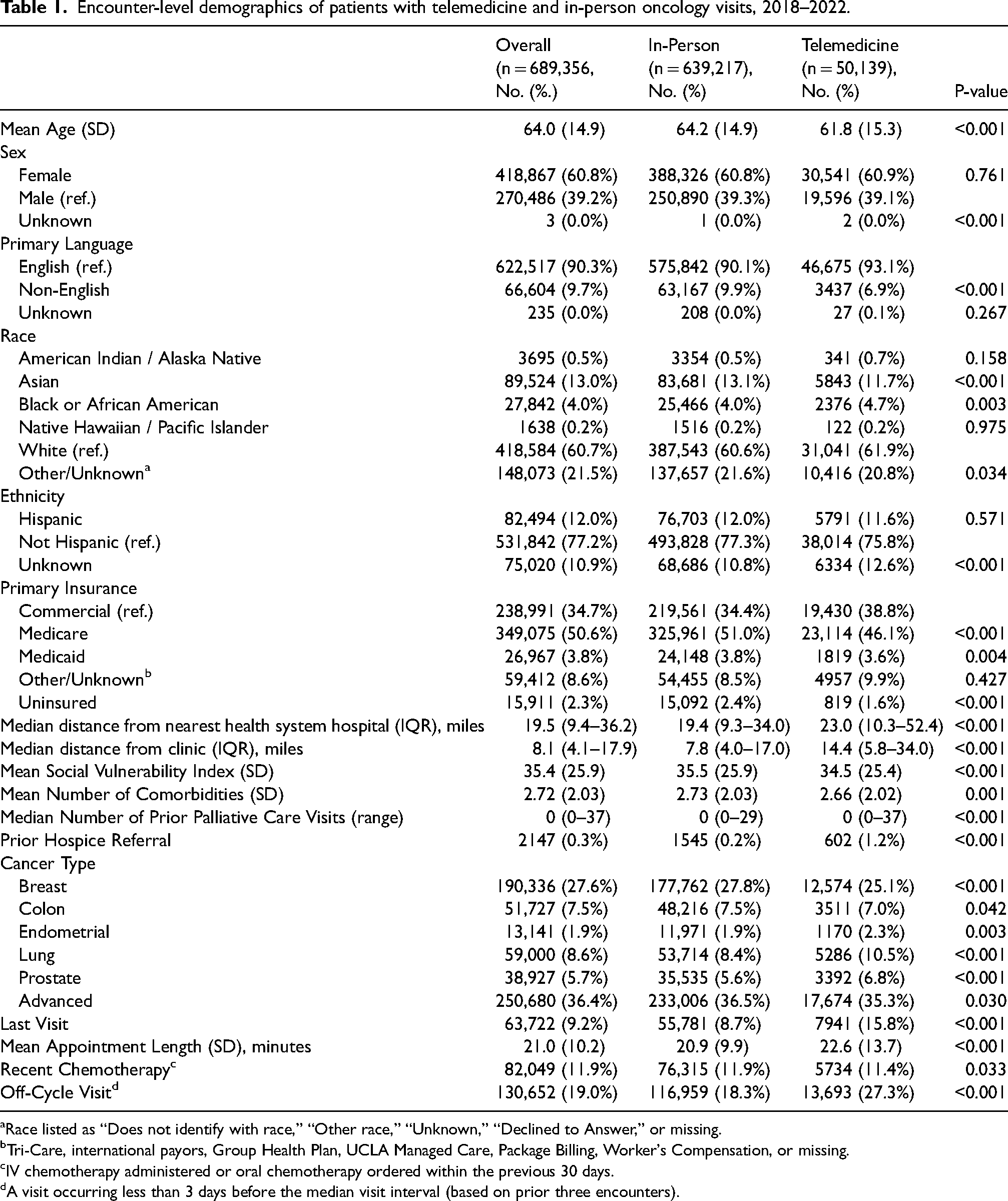
From 1 January 2018 and 31 December 2022, there were 63,722 unique patients with 639,217 (92.7%) in-person oncology visits, 41,766 (6.1%) video oncology visits and 8373 (1.2%) telephone oncology visits during the study period. Demographics of the population seen via telemedicine and in person are summarized in Table 1. Compared to patients with in-person visits, patients with telemedicine encounters on average were younger (p < 0.001), lived farther away from clinics and health system hospitals (p < 0.001), lived in neighborhoods with less vulnerable SVIs (p < 0.001), and had fewer comorbidities (p = 0.001). There were also fewer patients of Asian race (p < 0.001), more patients of Black race (p = 0.003), and fewer patients with Medicare (p < 0.001) or Medicaid (p = 0.004) seen via telemedicine.
Encounter-level demographics of patients with telemedicine and in-person oncology visits, 2018–2022.
Race listed as “Does not identify with race,” “Other race,” “Unknown,” “Declined to Answer,” or missing.
Tri-Care, international payors, Group Health Plan, UCLA Managed Care, Package Billing, Worker's Compensation, or missing.
IV chemotherapy administered or oral chemotherapy ordered within the previous 30 days.
A visit occurring less than 3 days before the median visit interval (based on prior three encounters).
Encounter types over time
Monthly telemedicine and in-person oncologic visits over the duration of the study period are summarized in Figure 1. Telemedicine encounters comprised 28.5% of all outpatient visits in April 2020 (following county stay-at-home orders issued March 19, 2020) and decreased to 11.8% of all visits from May 2020 to December 2022. On average, telemedicine visits increased from 0.50 per month before March 2020 to 1499 visits per month beginning April 2020 through December 2022. Mean in-person office visits also increased from 10,479 to 10,822 per month starting in April 2020 compared to before March 2020.
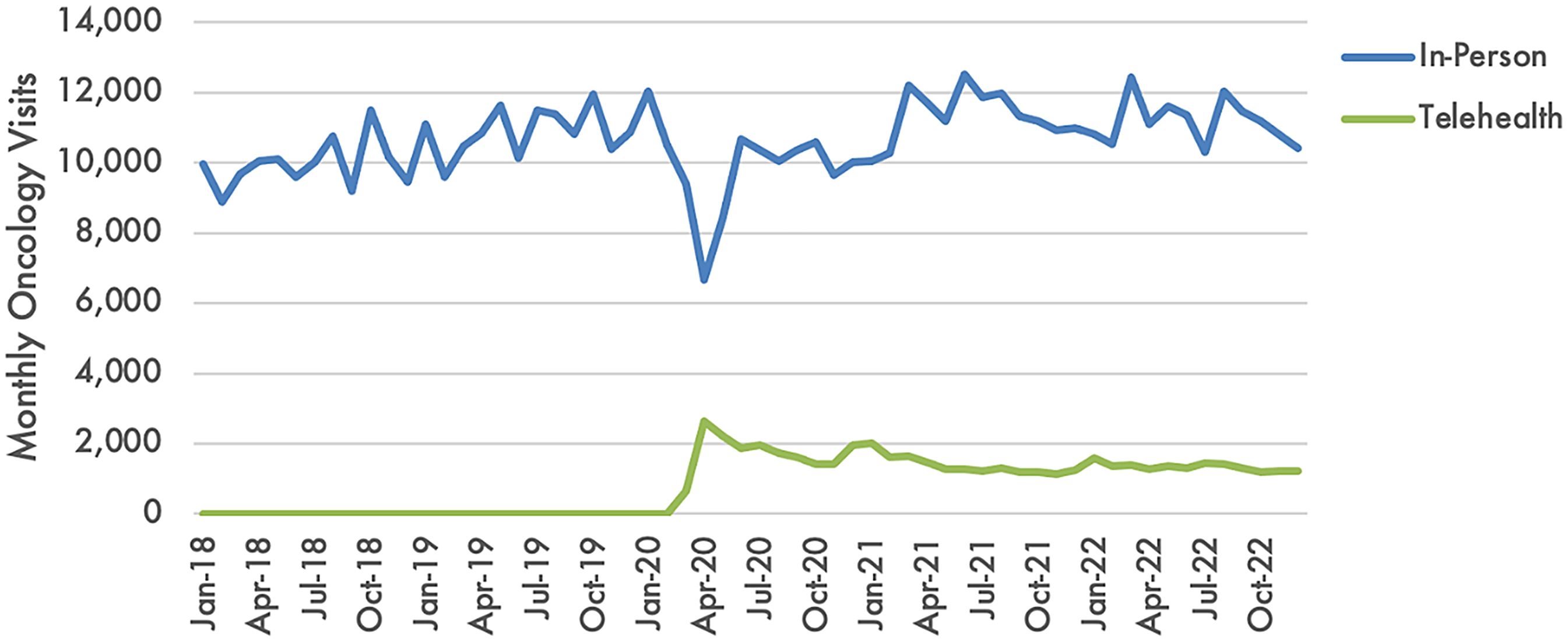
Telehealth vs. in-person visits in oncology, 2018–2022.
Outpatient encounters
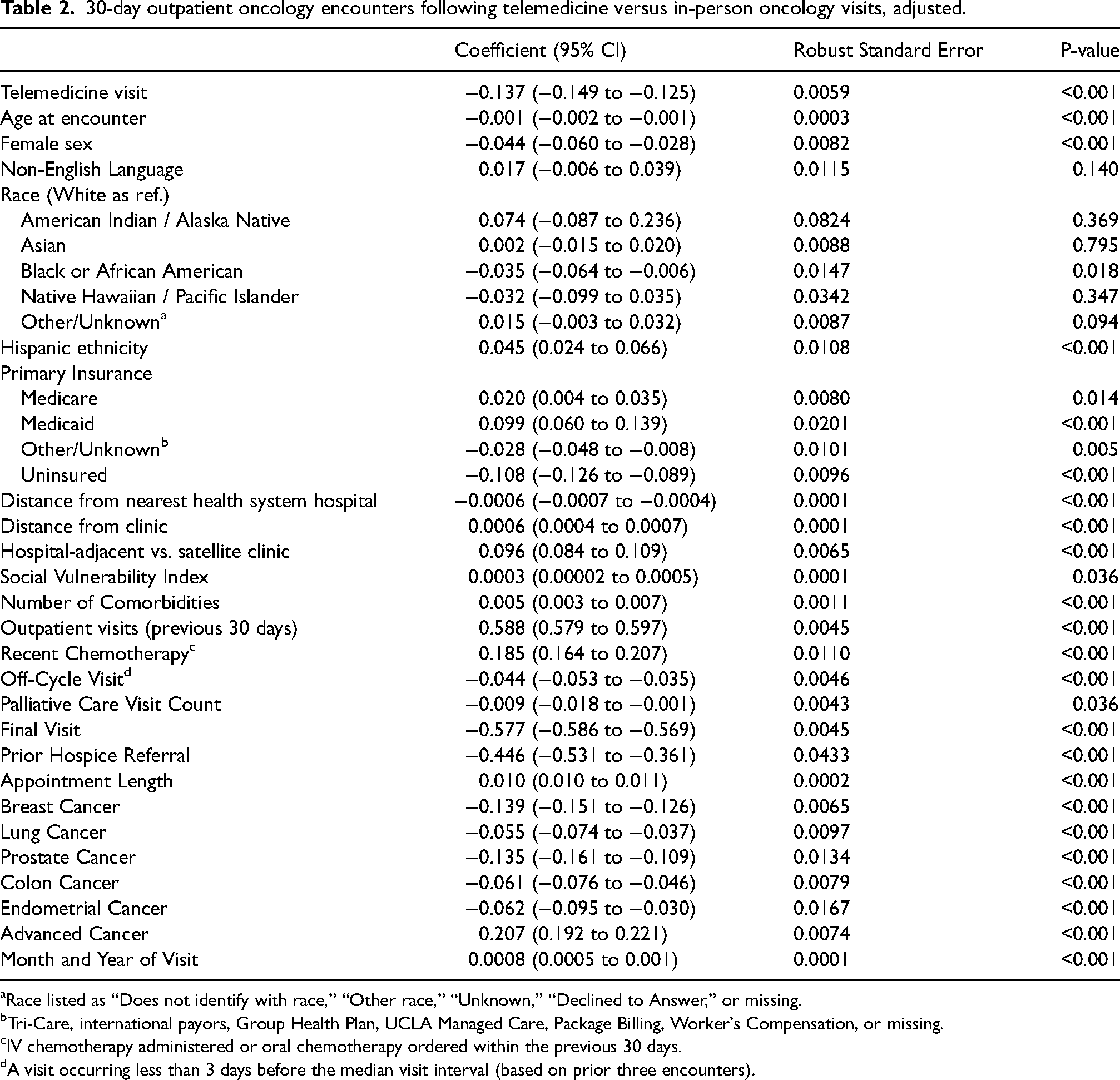
In our unadjusted analysis, patients with in-person office visits had a mean of 0.93 (SD 1.38, p < 0.001) downstream outpatient oncology visits within the following 30 days, while patients with telemedicine visits had a mean of 0.67 (SD 1.07, p < 0.001) downstream outpatient oncology visits. In the adjusted model, telemedicine was associated with 13.7 fewer downstream outpatient visits (95% CI 12.5–14.9; p < 0.001) per 100 index encounters as compared to in-person visits (Table 2).
30-day outpatient oncology encounters following telemedicine versus in-person oncology visits, adjusted.
Race listed as “Does not identify with race,” “Other race,” “Unknown,” “Declined to Answer,” or missing.
Tri-Care, international payors, Group Health Plan, UCLA Managed Care, Package Billing, Worker's Compensation, or missing.
IV chemotherapy administered or oral chemotherapy ordered within the previous 30 days.
A visit occurring less than 3 days before the median visit interval (based on prior three encounters).
ED visits & hospitalizations
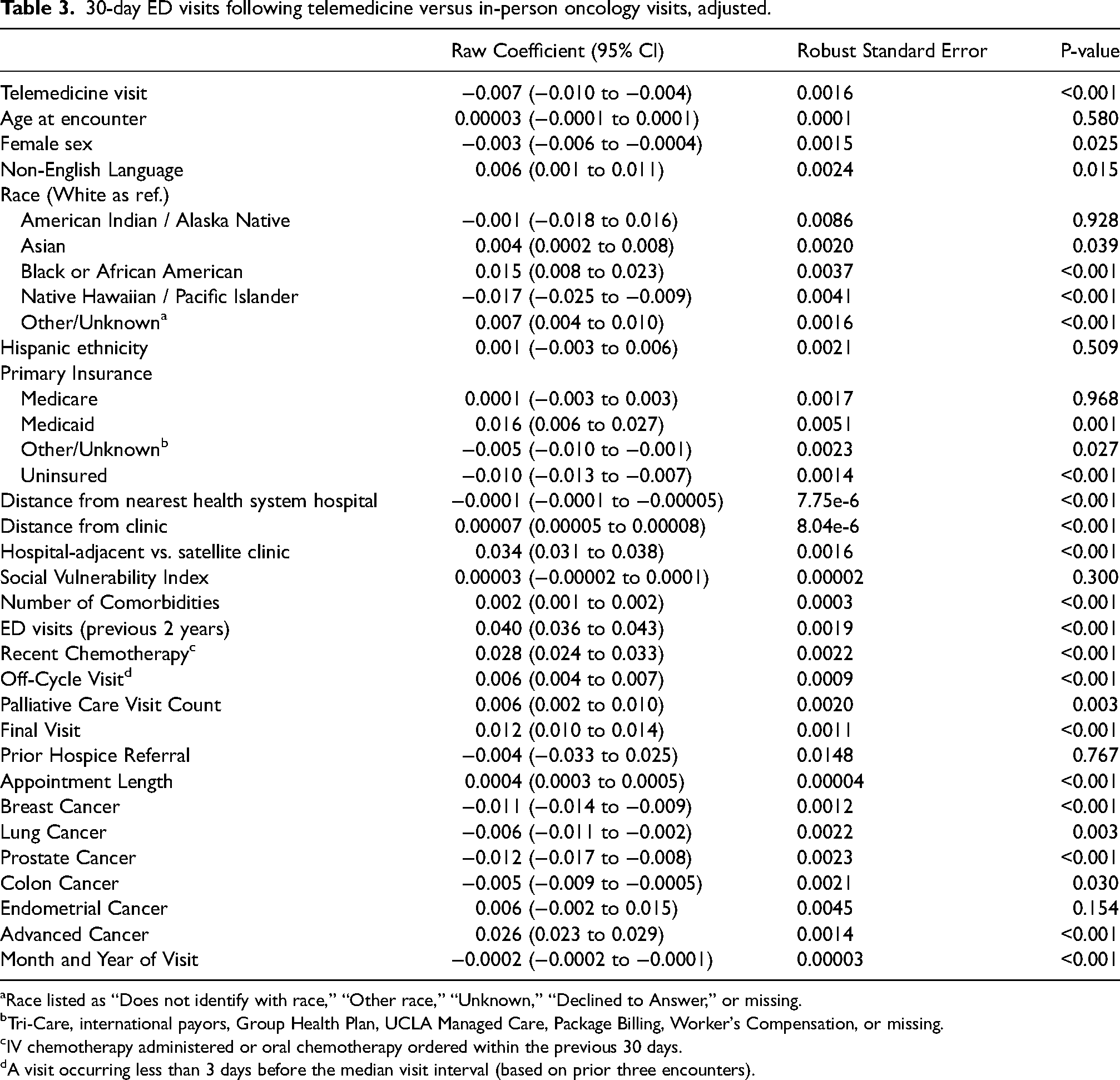
Patients with in-person visits had a mean of 0.04 (SD 0.24) ED visits, whereas patients with a telemedicine visit had a mean of 0.05 (SD 0.25) ED visits within the following 30 days (p < 0.001) in our unadjusted analysis. Additionally, in-person visits had a mean of 0.05 (SD 0.25) hospitalizations, while telemedicine visits had a mean of 0.06 (SD 0.26) hospitalizations after 30 days (p < 0.001). In the adjusted models, as compared to in-person visits, telemedicine was associated with 0.7 fewer ED visits (95% CI 0.4–1.0; p < 0.001) and 0.9 fewer hospitalizations (95% CI 0.6–1.3; p < 0.001) per 100 index encounters (Tables 3 and 4).
30-day ED visits following telemedicine versus in-person oncology visits, adjusted.
Race listed as “Does not identify with race,” “Other race,” “Unknown,” “Declined to Answer,” or missing.
Tri-Care, international payors, Group Health Plan, UCLA Managed Care, Package Billing, Worker's Compensation, or missing.
IV chemotherapy administered or oral chemotherapy ordered within the previous 30 days.
A visit occurring less than 3 days before the median visit interval (based on prior three encounters).
30-day hospitalizations following telemedicine versus in-person oncology visits, adjusted.

Race listed as “Does not identify with race,” “Other race,” “Unknown,” “Declined to Answer,” or missing.
Tri-Care, international payors, Group Health Plan, UCLA Managed Care, Package Billing, Worker's Compensation, or missing.
IV chemotherapy administered or oral chemotherapy ordered within the previous 30 days.
A visit occurring less than 3 days before the median visit interval (based on prior three encounters).
Sensitivity analyses
The unadjusted comparisons of downstream utilization between telemedicine and in-person visits at 7, 14, 60, 90 and 120 days after the index encounter are presented in Supplementary Table 1, and the adjusted analyses are presented in Supplementary Table 2. In each of these sensitivity analyses, telehealth was associated with fewer subsequent outpatient visits, ED visits and hospitalizations. Notably, the difference between telemedicine and in-person visits in the rate of downstream utilization increased over longer time horizons.
In the analysis in which we redefined an off-cycle visit as occurring earlier than half the median visit interval from the prior three visits, we found similar trends in downstream utilization at 30 days. Results were similar when redefining recent chemotherapy as IV chemotherapy administered and oral chemotherapy ordered within the past 90 days, rather than 30 days, and when restricting the analysis to oncology visits at hospital-adjacent clinics (n = 265,790). Per the health record, 5817 (9.3%) patients were deceased by the end of the study period; results did not change when adjusting for death as a covariate. The results from these sensitivity analyses are outlined in Supplementary Table 3.
Discussion
In this retrospective cohort study, we found that among oncology patients, telemedicine was associated with lower rates of subsequent outpatient oncology encounters, ED visits and hospitalizations, as compared with in-person visits. These associations remained robust across all sensitivity analyses. To our knowledge, this analysis is the first to compare downstream utilization following outpatient oncology telemedicine and in-person visits. Our findings run counter to our original hypothesis and suggest that telemedicine is not associated with increased downstream utilization and may even play a role in reduced utilization of higher acuity downstream health services. While the magnitude of the reduction in utilization is modest, this reduction could be consequential in terms of enhancing the patient experience, curbing costs, and improving outcomes on a population level.
There are several possible explanations for these findings that are not mutually exclusive. First, when used in combination with in-person visits, telemedicine may enhance the communication between providers and patients by offering increased comfort to the patient and instant interaction with the provider. Multiple studies have reported that both physicians and patients are satisfied with telemedicine in oncology,28–30 and for this population with high informational needs, telemedicine may help improve outcomes by providing more easily accessible care to patients.31,32
Second, many oncology visits do not require a physical examination, and therefore, there may not be much added benefit to in-person visits in this population. Often, visits are conducted to review recent imaging, for ongoing surveillance for cancer recurrence, or to simply check-in about issues that are already known. For patients on active chemotherapy, symptoms such as nausea and diarrhea are often due to known medication toxicities or due to space-occupying lesions, and laboratory and imaging studies are routinely ordered for an accurate diagnostic workup independent of examination findings. 33
Third, it is possible that cancer patients seen at academic centers are seen more frequently compared to those seen at community clinics and clinics serving an underserved population. 34 Any potential drawbacks of telemedicine may be counteracted through close patient follow-up using a combination of in-person and telemedicine visits.
Importantly, we cannot rule out the potential impact of residual confounding in this observational study: there may be key differences in how telemedicine versus in-patient visits are deployed in cancer populations that are not captured in our models. For example, it is possible that patients who choose telemedicine over in-person visits have other unmeasured physical or psychological reasons for avoiding in-person visits which could explain the lower utilization we observed following these visits. It is also possible that telemedicine was deployed for patients who were healthier or for follow-up in patients whose initial complaint stabilized, leading to less downstream utilization.
These findings are consistent with several studies in other patient populations showing that telemedicine is not highly associated with increased utilization compared to in-person visits.35–40 For example, one cohort study examining the use of telemedicine in primary care found that telemedicine was not associated with increased ED visits and hospitalizations, though it was associated with slightly increased downstream outpatient utilization. 36 Another study found that increased expansion of direct-to-consumer telemedicine was not associated with increased downstream outpatient or inpatient utilization compared to in-person visits for patients with urinary tract infections and sinusitis in Minnesota. 37 Additionally, a recent meta-analysis showed that telemedicine was associated with reduced ED visits and readmissions following abdominal surgery. 39 Lastly, these findings are consistent with national data showing that Medicare beneficiaries in the highest quartile of telemedicine use had fewer ED visits compared to those in the lowest quartile of telemedicine use. 40
There were several limitations to this study. First, we examined data from a single health system, and patterns at other health systems may differ from those we report here. Second, as mentioned above, there is the possibility of unmeasured confounders that could bias the results, including the specific visit complaint and patients’ preferences for care modality. In addition, some patients likely experienced the healthcare utilization at clinics, EDs and hospitals outside this system, which could bias our findings if going outside the system was associated with using telemedicine. We attempted to minimize the impact of this potential source of bias by adjusting for factors that could shape a patient's likelihood of utilizing care outside of the system, but this remains a limitation of this study design. Future analyses spanning multiple institutions and/or using claims data could provide more generalizable results.
Conclusions
In this cohort study at a large academic health system, we found that contrary to our hypothesis telemedicine visits in oncology were associated with fewer subsequent outpatient oncology visits, ED visits, and hospitalizations as compared to in-person visits. Given potential concerns that telehealth may lead to additional care and associated spending, the findings from this study suggest otherwise. This study contributes to the growing body of work examining the relationship between telemedicine and downstream utilization across various clinical settings. While further investigation regarding the efficacy of telemedicine is needed to define the specific contexts in which telemedicine is optimal and achieves similar or better outcomes to in-person oncologic care, these findings suggest that telemedicine may continue to make sense as a desirable and safe mode of care for oncology patients.
Supplemental Material
sj-docx-1-jtt-10.1177_1357633X241282820 - Supplemental material for Association between telehealth use in oncology and downstream utilization at a large academic health system
Supplemental material, sj-docx-1-jtt-10.1177_1357633X241282820 for Association between telehealth use in oncology and downstream utilization at a large academic health system by Preeti Kakani, Adam E Singer, Manying Cui, Chad W Villaflores, Sitaram Vangala, Miguel A Cuevas, Maria Han, Cheryl L Damberg, John N Mafi and Catherine A Sarkisian in Journal of Telemedicine and Telecare
Footnotes
Acknowledgements
We would like to thank Scott Teplin (Clinical Services Manager) and Joni Boucher (Director of UCLA Oncology Clinics) for sharing with the team key institutional knowledge regarding the rollout of telemedicine and management of after-hours calls at UCLA.
Access to data and data analysis
Preeti Kakani had full access to the study data and took responsibility for the integrity of the data and the accuracy of the analysis.
Data sharing statement
Data included in this study will not be shared to the public.
Declaration of conflicting interests
The authors declared no potential conflicts of interest with respect to the research, authorship, and/or publication of this article.
Funding
The authors disclosed receipt of the following financial support for the research, authorship, and/or publication of this article: This work was supported by the National Institutes of Health/National Institute on Aging, NIH/NCATS UCLA Clinical & Translational Science Institute, (grant number 1K24AG047899-06, UL1TR001881).

Data availability statement
The datasets generated from this study are available in deidentified form from the corresponding author upon reasonable request.
Supplemental material
Supplemental material for this article is available online.
References
Supplementary Material
Please find the following supplemental material available below.
For Open Access articles published under a Creative Commons License, all supplemental material carries the same license as the article it is associated with.
For non-Open Access articles published, all supplemental material carries a non-exclusive license, and permission requests for re-use of supplemental material or any part of supplemental material shall be sent directly to the copyright owner as specified in the copyright notice associated with the article.
