



Abstract
Objective
Inability to attend in-person care is a common barrier to accessing exercise therapy and education programs for knee osteoarthritis. The primary aim of this randomised clinical trial (RCT) was to determine if telehealth was non-inferior to ‘in-person’ delivery of a group-based exercise therapy and education program (GLA:D®) for knee-related burden at 3 (primary timepoint), 12 and 24 months in people with knee osteoarthritis.
Design
This pre-registered (ACTRN12619000235101) two-arm (in-person v telehealth) non-inferiority limited-disclosure RCT commenced in April 2019, with a planned sample of 110. Knee-related burden was evaluated at baseline, 3- (primary timepoint), 12- and 24-month following intervention commencement by summating four Knee injury and Osteoarthritis Outcome Score subscales (KOOS4: pain, symptoms, activities of daily living, quality of life [QoL]). Secondary outcomes included health-related QoL, pain severity, physical activity, functional performance, patient satisfaction and global rating of change.
Results
Recruitment ceased in March 2020 due to COVID-19 restrictions. Forty-four participants enrolled at baseline (22 per group). Forty-three (98%), 40 (91%) and 29 (66%) participants provided 3-, 12- and 24-month follow-up data, respectively. The lower limit of the 95% confidence interval (CI) was above the non-inferiority threshold (i.e. −10 points) for KOOS4 at 3 (mean difference, 95%CI = 6, −2 to 15) and 12 months (0, −9 to 9). Compared to in-person, mean reduction in worst pain was greater for telehealth delivery at 3 months (16.5, 95%CI 0.8 to 32.2). No other secondary outcomes were different between groups.
Conclusion
Knee-related burden outcomes following telehealth-delivered group-based exercise therapy and education in people with knee osteoarthritis might not be different to in-person delivery.
Keywords
Introduction
Knee osteoarthritis affects one in four people over the age of 50 years.1,2 Symptoms (pain, stiffness) create lifelong burden, increasing the risk of poor health-related quality of life (QoL), 3 physical inactivity,4,5 and other chronic diseases.5,6 Guidelines recommend exercise therapy, education, and weight management if indicated, as first-line care for knee osteoarthritis, regardless of radiographic or pain severity. 7 These treatments target modifiable risk factors (muscle weakness, physical inactivity, lifestyle, obesity), improve pain and QoL,3,8,9 are cost-effective, 10 and can reduce surgical need. 11
The Good Life with osteoArthritis from Denmark (GLA:D®) group-based exercise therapy and education program is implemented internationally. Danish, Canadian and Australian outcomes12–15 indicate clinically meaningful pain and QoL improvements 3- and 12-month following commencement. Yet, qualitative work from Australia with physiotherapists, 12 patients and doctors 16 highlights barriers to uptake, including difficulty attending ‘in-person’ sessions due to geography, lack of available services, transportation requirements and work and family commitments. Telehealth may potentially increase uptake of group-based exercise therapy and education programs like GLA:D®, providing more flexibility, and reducing travel times and costs, compared to in-person care. 17
One-on-one telehealth services for musculoskeletal pain conditions are acceptable to patients and physical therapists,18,19 and associated with similar improvements in pain and disability as in-person care. 20 A recent randomised controlled trial (RCT) reported one-on-one telehealth delivery of exercise therapy and education to people with knee osteoarthritis was non-inferior to in-person delivery for pain and function. 21 Evaluation of group-based delivery of telehealth services for musculoskeletal pain conditions are less well researched. Recent qualitative findings do indicate telehealth-delivered group-based exercise therapy and education is acceptable, 22 and evaluation of GLA:D® outcomes during the pandemic indicate similar pain and knee-related burden outcomes as in-person delivery.23,24 However, there is a paucity of RCTs evaluating group-based telehealth services for knee osteoarthritis or other musculoskeletal pain conditions. 25
The primary aim of this RCT was to determine if telehealth was non-inferior to in-person delivery of group-based exercise therapy and education for knee-related burden at 3 (primary timepoint), 12 and 24 months in people with knee osteoarthritis. The secondary aims were to compare outcomes between telehealth and in-person delivery in relation to health-related QoL, worst pain, physical activity participation, functional performance, patient satisfaction and surgical desire.
Methods
Study design
Recruitment to this two-arm pragmatic prospectively registered (ACTRN12619000235101) non-inferiority RCT comparing GLA:D® delivered via telehealth to in-person commenced 5 April 2019. Planned timepoints for follow-up include 3 (primary timepoint), 12, 24 and 60 months. Reporting of 3-, 12- and 24-month outcomes here have been guided by the CONSORT checklist, 26 and extension for non-inferiority and equivalence trials. 27 Ethical approval was obtained from La Trobe University (HEC18500).
Deviations from protocol
Our trial registration stated that four subscales from the Knee Injury and Osteoarthritis Outcome Score (KOOS) for our primary outcome would include ‘pain’, ‘symptoms’, ‘knee-related QoL’ and ‘sport and recreation’. However, aligning with other RCTs of people with knee osteoarthritis 11 ‘function in daily living’ replaced ‘sport and recreation’ due to its greater responsiveness and content validity in people with knee osteoarthritis. 28 Thus, KOOS4 was defined based on a composite score from the ‘pain’, ‘symptoms’, ‘knee-related QoL’ and ‘function in daily living’ subscales. For pain severity, we included average pain alongside worst pain in the previous 4 weeks to allow comparison of outcomes with GLA:D® Australia data. 12 We did not include Keele STarT MSK, 29 as this outcome is not validated to determine treatment effectiveness. We did not collect any arthritis self-efficacy scale data, 30 or complete a health economics evaluation as stated in our original registration.
Our planned sample size (n = 110) was powered at 90% to detect a minimal important difference of 10 (SD = 16) points for change in KOOS4 between groups (n = 88), allowing for a 20% dropout. However, study recruitment was forcefully ceased in March 2020 due to COVID-19 restrictions on in-person group exercise therapy sessions. Two trial restart attempts (February and July 2021) were unsuccessful due to new government-enforced-pandemic restrictions being enacted. A decision to finish the trial with 44 participants (22 per group) was made in March 2022 due to inadequate ongoing trial funding.
Participants
Participants were recruited via the Musculoskeletal Australia phone helpline, La Trobe University clinical partners and social media channels. Participants eligibility required being aged >40 years and being clinically diagnosed with knee osteoarthritis by a registered physical therapist based on NICE guidelines (activity-related joint pain and morning joint stiffness that last no longer than 30 min). 31 Exclusion criteria were previous completion of GLA:D®, any physical therapist treatment in the previous 6 months, history of joint replacement in the most affected knee, physical or cognitive impairment preventing participation in GLA:D® exercise therapy or education, identification of reasons other than osteoarthritis for their joint problems (recent trauma, tumour, inflammatory joint disease) and other symptoms more pronounced than osteoarthritis. People who were non-English speakers, self-identified as having low digital literacy (unable to use videoconferencing software) or living more than 10 km from a Melbourne physical therapist clinic providing GLA:D® in-person as part of this study were also excluded.
Procedures
Participant flow through this RCT is outlined in Figure 1. The trial coordinator telephone screened initial eligibility, and prospective participants were sent a Participant Information Statement and Consent Form. A registered physical therapist completed additional subjective and physical screening at La Trobe University prior to informed consent being signed, and trial enrolment. Patient-reported outcome and functional performance assessment was subsequently facilitated and completed by a physical therapist research assistant prior to randomisation.

Flowchart of the clinical trial.
Randomisation, blinding and allocation concealment
Randomisation was stratified by sex (male/female) in permuted blocks (4 and 6) at a 1:1 ratio. The process was masked, being performed by a person not involved in screening or data collection, using computer generation (https://www.sealedenvelope.com/), with group allocations concealed in opaque envelopes, which remained unopened until group allocation. Following randomisation, research staff booked the participant for their first session with a physical therapist providing telehealth-delivered, or in-person GLA:D® at a convenient time.
Limited-disclosure principles were applied. Participants were informed that they were being randomised into one of two delivery methods of education and exercise therapy, but not informed what the other treatment entailed or the study hypothesis until after their 3-month follow-up. The physical therapist research assistant completing functional performance measures and facilitating patient-reported outcomes remained blinded to group allocation at 3 months.
Interventions
A summary of interventions provided to both groups including similarities and differences following the template for intervention description and replication (TIDieR) 32 is provided in Table 1.
A summary of interventions provided to both groups following the template for intervention description and replication (TIDieR). 33
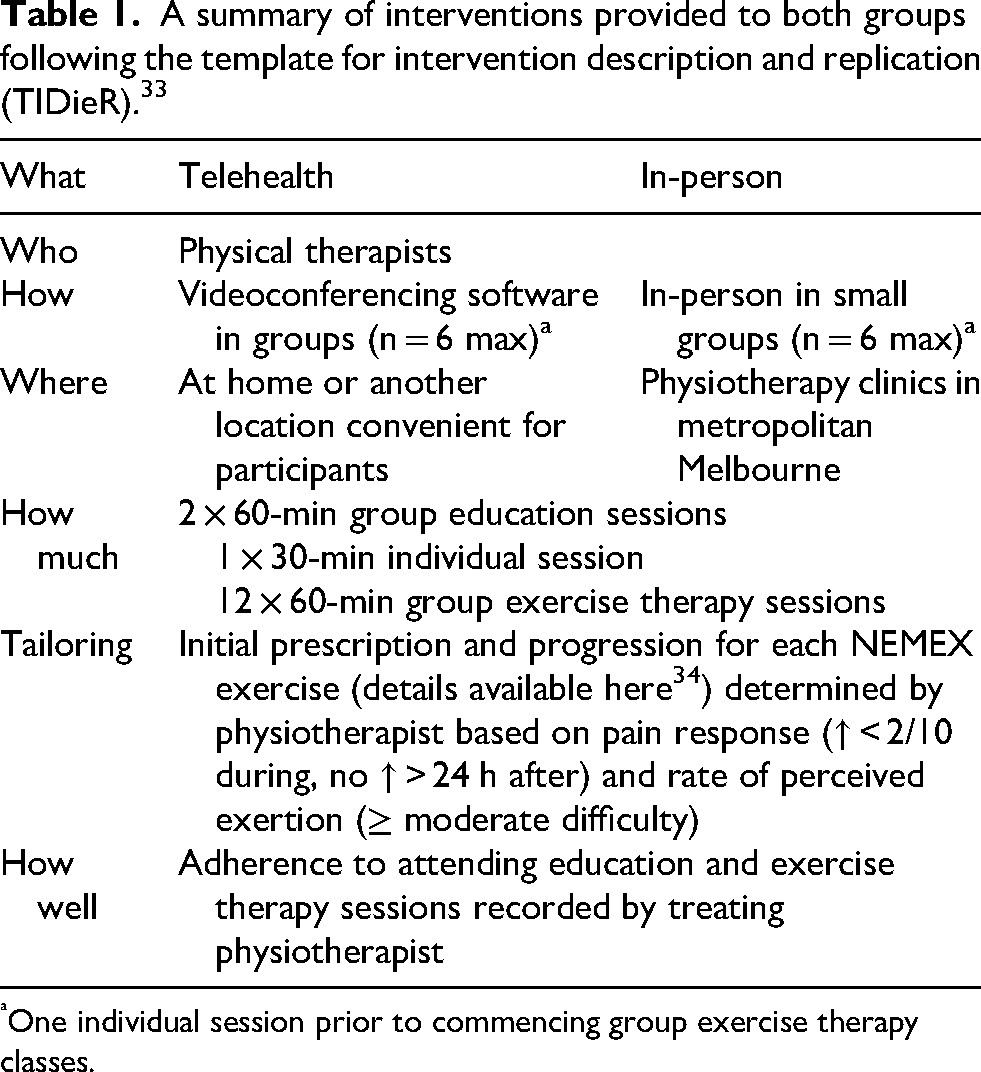
One individual session prior to commencing group exercise therapy classes.
Group-based patient education and exercise therapy (GLA:D®) intervention
Both telehealth and in-person groups were provided group-based patient education and supervised exercise therapy consistent with the GLA:D® program.12,14 Group sizes were between two and four participants. GLA:D® involves 2 education and 12 exercise therapy sessions based on the neuromuscular exercise program, 33 delivered over 6–8 weeks. Each education session lasts 60–90 min and covers information about osteoarthritis; factors associated with pain and disability; benefits and harms of treatments including exercise therapy, weight management, and pharmacological and surgical options; and the importance of physical activity and self-management. Questions and group discussions are encouraged during each education session.
Each exercise therapy session consists of three parts: a warm-up (10 min of any cardiovascular exercise), a set of standardised but individualised circuit-based exercises and a cool down (walking and stretching). Exercises include sliders which are progressed to lunges, functional (step ups and chair stands), knee strength in sitting (flexion and extension), hip strength in standing (adduction and abduction) and trunk strength in supine with the aid of a gym ball (sit ups and pelvic lifts). Pain is allowable, and each exercise is progressed within and between levels with the goal of achieving moderate difficulty (Borg rate of perceived exertion scale), 34 and avoiding pain flares during (<2/10 increase) or following (return to day-to-day symptoms within 24 h) sessions. Further details of the exercise program, including video instructions to support both groups in this study can be found at www.nemex.trekeducation.org.
Prior to commencing GLA:D® each participant completed an initial one-on-one session with the physical therapist providing the program, to build rapport, orientate to equipment set up and requirements, and to determine initial exercise therapy prescription. For telehealth participants, the session also included a run-through of camera setup within their environment to ensure the therapist had appropriate visibility to monitor safety effectively. For participants reporting difficulty getting on and off the floor, floor exercises were performed on their bed during the initial session to ensure safety and assess their ability before attempting these exercises on the floor remotely.
Mode of delivery
In-person
All patient education and exercise therapy sessions were at a health service with a physical therapist offering GLA:D® within a 10 km radius or convenient location to them. Twelve physical therapists (3–30 years clinical experience) at five health services provided the program to participants in this trial. Participants attended GLA:D® sessions already routinely offered by the health services.
Telehealth
All patient education and exercise therapy sessions were facilitated by videoconferencing software. The eHAB® platform was initially used for telehealth sessions; however, a switch was made to Zoom® after the first month of the trial due to ongoing eHAB® software technical issues. To facilitate telehealth delivery of GLA:D®, a virtual service involving four physical therapists (3–16 years clinical experience) was established at La Trobe University (Bundoora).
Physical therapists delivering telehealth were not involved in delivering in-person GLA:D®. Consistent with the implementation of GLA:D® at these health services, participants in both groups could attend their sessions with multiple different physical therapists (up to 3), depending on available days and times that best suited them.
Physical therapist training
All physical therapist in this trial had completed the 2-day GLA:D® Australia education and training course.12,14 Each trained physiotherapist receives an implementation manual, ready-to-use patient education materials (PowerPoint presentations and printable booklets), access to online implementation resources; and completes pre- and post-course knowledge and certification tests to ensure competency.
Outcome measures
Table 2 outlines all outcome measures and time points, included those presented in this paper, and planned in the future.
Outcome measures evaluated at each timepoint.
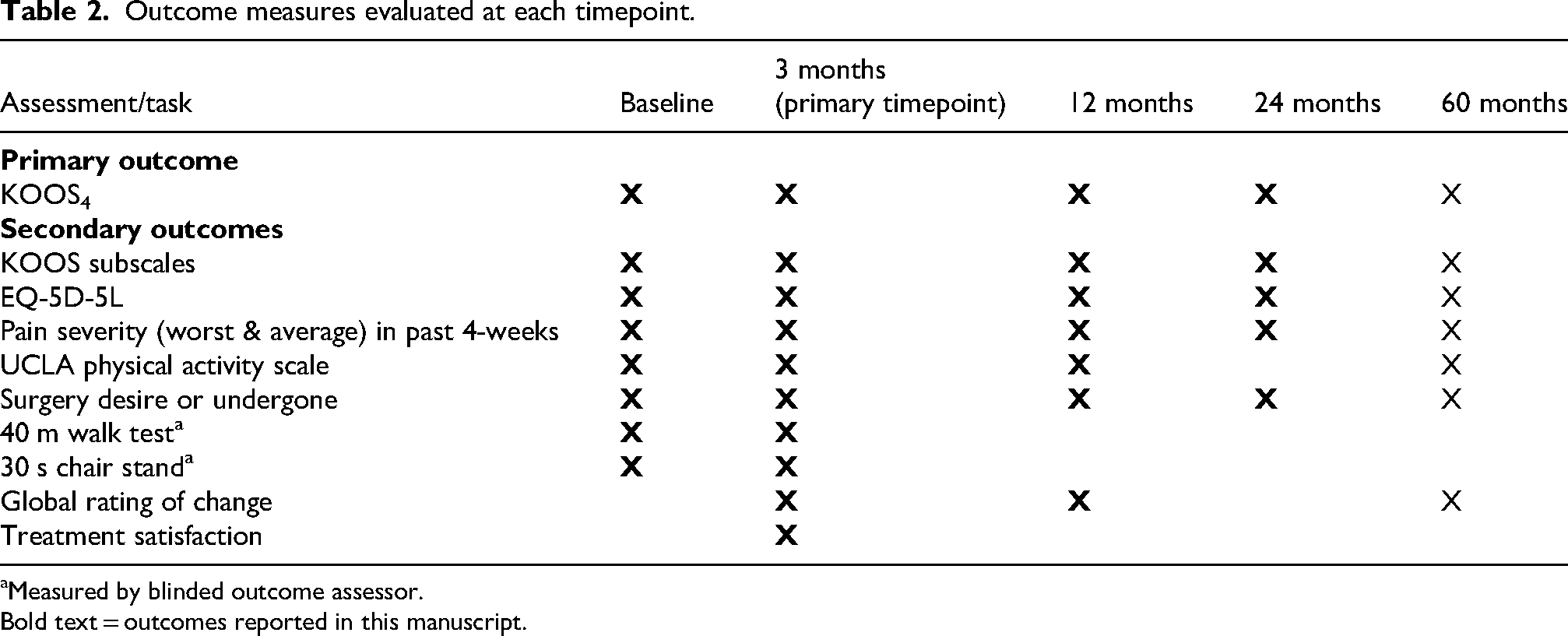
Measured by blinded outcome assessor.
Bold text = outcomes reported in this manuscript.
Baseline and 3 months
Patient-reported and functional performance outcome measures were collected at La Trobe University (Bundoora), facilitated by a physical therapist research assistant at baseline and 3-month (primary timepoint) follow-up. The blinded research assistant was not involved with treatment allocation, providing treatment, or completing the data analysis. Patient-reported outcomes and physical performance measures were entered by participants into the Research Electronic Data Capture (REDCap) system, with support from the blinded research assistant if required.
12 and 24 months
Patient-reported outcome measures were repeated at 12 and 24 months from baseline, facilitated by an automated email prompt, and up to three reminder phone calls at 12 months. Follow-ups completed at 24 months relied solely on automated email prompts. Additional planned follow-ups at 60 months will be analysed and reported in the future.
Primary outcome (change from baseline to 3 months, baseline to 12 months and baseline to 24 months)
Our primary outcome of knee-related burden was evaluated by the Knee Injury and Osteoarthritis Outcome Score (KOOS), which is a 42-item self-reported outcome measure, involving five subscales, including pain (9 items), symptoms (7 items), activities of daily living (17 items), knee-related QoL (4 items) and sport and recreation (5 items). 35 KOOS is a valid reliable outcome measure for people with knee osteoarthritis in the short and long term. 36 We were specifically interested in the KOOS4, defined as the average score of 4 of the 5 KOOS subscales (pain, symptoms, function in daily living, QoL). KOOS4 and each KOOS subscale is scored from 0 (extreme problems) to 100 (no problems). 35
Secondary outcomes (change from baseline to 3 months, baseline to 12 months and baseline to 24 months)
KOOS subscales
The five KOOS subscales including pain, symptoms, function in daily living, QoL, and sport and recreation. 35
Health-related quality of life
The European quality of life-5 dimensions-5 level quality of life scale (EQ-5D-5L: mobility, self-care, usual activities, pain/discomfort, anxiety/ depression) was calculated using an England-based value set 37 as it closely resembled the Australian population. 38
Pain severity
Average and worst pain in the previous four weeks was measured on a 100 mm visual analogue scale, using anchors of ‘no pain’ and ‘worst pain imaginable’. 39
Physical activity participation
The University of California, Los Angeles (UCLA) physical activity scale (1–10). 40
Surgery desire
Determined through a custom-developed question, previously reported to be sensitive to change following GLA:D® – ‘Do you have so much pain and trouble from your knee that you want to have surgery?’ with answers categorised as ‘yes’ or ‘no’. Undergoing knee surgery prior to 3- or 12-month follow-up was automatically categorised as ‘yes’.
Secondary outcomes (3 months and 12 months)
Global rating of change
Participants rated recovery on a 7-point Likert scale (completely recovered, strongly recovered, slightly recovered, unchanged, slightly worse, strongly worse, worse than ever). 41
Secondary outcomes (change from baseline to 3 months only)
Physical performance
The 30-s chair stand and 40 m walk tests, both recommended by OARSI 42 and routinely measured as part of GLA:D®,12,14 were measured by a physical therapist research assistant blinded to participant allocation.
Secondary outcomes (3 months only)
Treatment satisfaction
Rated on a 5-point Likert scale (very satisfied, satisfied, neutral (neither satisfied or dissatisfied), not satisfied, not at all satisfied).
Statistical analysis
Statistical analysis was completed by a researcher blinded to group allocation, using SPSS (IBM SPSS Statistics for Macintosh, Version 29.0.2.0 Armonk, NY: IBM Corp). Program adherence data were reported descriptively as proportions (≥10 exercise therapy sessions, ≥ 1 education session). Baseline demographics were reported descriptively and compared between groups using chi-square tests for categorical variables and independent t-test for continuous variables. Within-group changes and between-group comparisons were evaluated using and intention-to-treat analysis with linear mixed models, including participants as a random effect, group as a fixed factor, and outcome measures assessed at baseline, 3, 12 and 24 months as repeated factor. Bonferroni's post hoc test was used for multiple pairwise comparisons. Significance level was set a priori at 0.05. Effect sizes (Hedges’ g) were calculated for between-group comparisons.
Our non-inferiority KOOS4 threshold was set as a minimal important difference in change of 10 (SD = 16) points. 36 Therefore, if the lower bound of the 95% confidence interval (CI) when comparing change in KOOS4 of the telehealth with the in-person group was above −10 points, non-inferiority of telehealth was accepted. Associated p-values were not reported due to difficulty with interpretation for non-inferiority hypotheses. 43 A sensitivity analysis was completed using the per-protocol dataset 44 (including reallocating participants randomised to in-person who attended ≥3 telehealth sessions to telehealth). Secondary outcomes were assessed using data from all participants (i.e. intention-to-treat), with CIs interpreted based on consideration to superiority.
Results
Forty-four participants enrolled at baseline (22 per group). Baseline characteristics between groups were similar (Table 3), except for a greater proportion of the telehealth group taking medications for their knee (Chi-square = 4.96; p-value = 0.026; ES = 0.34). Eight participants in the telehealth group and nine in the in-person group had undergone arthroscopy surgery on the most affected knee, at an average (SD) of 10 (9) and 12 (9) years prior to the study respectively. One participant in the telehealth group had received a Kushner nail insertion in the left hip 43 years prior to the study.
Baseline demographics of in-person and telehealth groups.
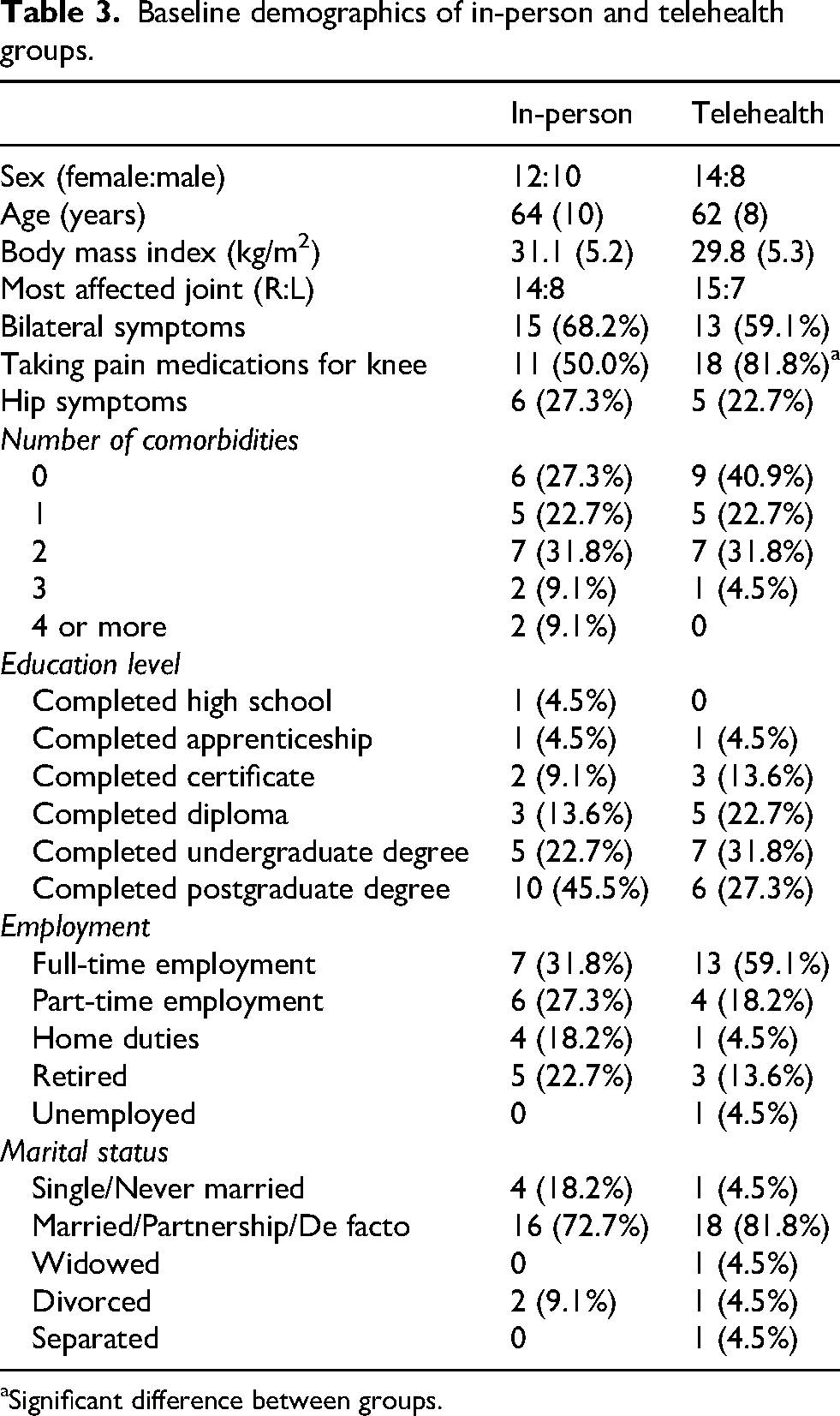
Significant difference between groups.
Follow-up rate, withdrawals and adherence
Forty-three (98%; 22 in-person, 21 telehealth) and 40 (91%; 22 in-person, 18 telehealth) participants provided 3- and 12-month follow-up data, respectively. One telehealth participant withdrew following randomisation before starting the program, citing not being able to commit to the time required to attend exercise sessions, and did not provide 3- or 12-month data. Three additional telehealth participants were unable to be contacted at 12 months. At 24 months, 19 in-person (84%) and 10 telehealth (45%) participants completed follow-up data collection, leading to an overall response rate of 66% (29/44) at this timepoint.
Three participants randomised to receive in-person GLA:D® were unable to complete the program as intended due to the introduction of COVID-19 pandemic restrictions. All finished the program with the same physical therapist they were allocated, with one completing three exercise therapy sessions via telehealth, and the other two completing the entire program via telehealth. One participant underwent a total hip joint replacement surgery 10 months after enrolling on the study.
Detailed program adherence data is provided in Supplementary file 1.
Adverse events
Four adverse events were reported during the trial, unrelated to the education and exercise therapy program. One in-person group participant fractured their 4th metatarsal in a fall but was able to continue the program in a modified form. One in-person group participant was unable to complete more than nine exercise therapy sessions due to contracting a virus, and another in-person group participant reported shortness of breath with exercise due to persistent symptoms following a bout of pneumonia. One telehealth participant was admitted to hospital due to atrial fibrillation and heart-related illness, and they completed just three supervised exercise sessions and no education sessions prior to this, and no further participation following.
Primary outcome (KOOS4) and KOOS subscales
KOOS outcomes over time, including KOOS4 and each of the five individual KOOS subscales are presented in Figure 2. Comparison of within-group changes at 3 and 12 months to determine non-inferiority are presented in Table 4. Telehealth was not found to be inferior compared to in-person for changes in KOOS4 at 3 (mean difference, 95%CI = 6.2, −2.1 to 14.6) and 12 months (−0.3, −9.3 to 8.8), with the lower limit of the 95%CI being above the non-inferiority threshold of −10 points at both time points and favouring telehealth at the 3-month primary timepoint. The per-protocol sensitivity analysis (i.e. reallocation of in-person group participants who attended ≥3 telehealth sessions to the telehealth group) did not change findings and is presented in Supplementary file 2. No between-group differences were identified between telehealth and in-person groups for KOOS4 or any individual KOOS subscales at baseline, 3 or 12 months (see Supplementary file 3). At 24 months, no difference between telehealth and in-person groups for within-group changes was identified for KOOS4, or any individual subscales (see Supplementary file 4). However, non-inferiority could not be confirmed for the primary outcome of KOOS4 at 24 months (−2.5, −14.7 to 9.7).

Primary outcomes of KOOS4, and individual subscales of KOOS over time.
Comparison of within-group changes for Knee Osteoarthritis Outcome Score (KOOS) results, including KOOS4, at 3 and 12 months.
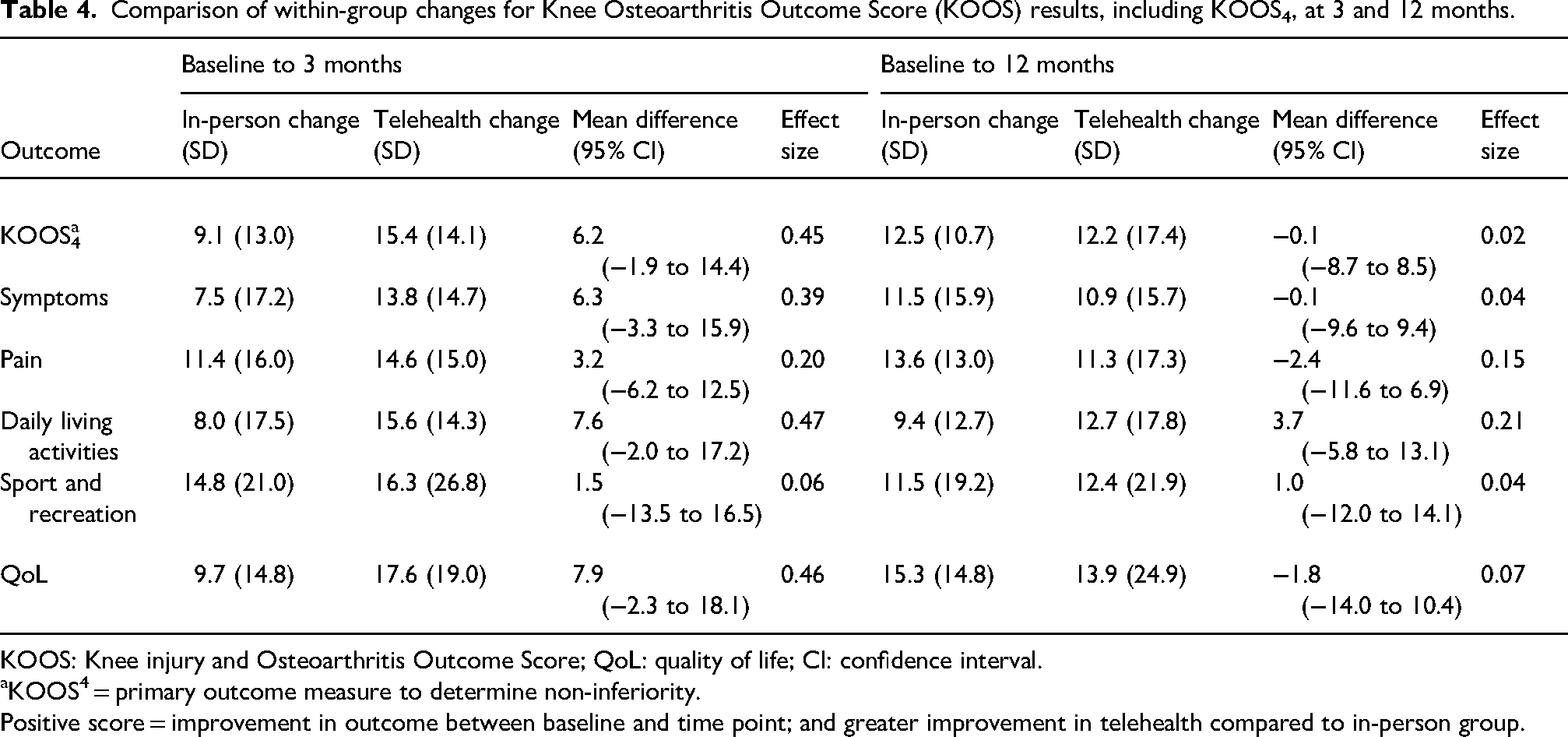
KOOS: Knee injury and Osteoarthritis Outcome Score; QoL: quality of life; CI: confidence interval.
KOOS4 = primary outcome measure to determine non-inferiority.
Positive score = improvement in outcome between baseline and time point; and greater improvement in telehealth compared to in-person group.
Secondary outcomes
Comparison of within-group changes for secondary outcomes is presented in Table 5 at 3 and 12 months, and in Supplementary file 4 for 24 months. Except for worst pain between baseline and 3 months favouring the telehealth group (mean difference, 95%CI = -16.5, −32.2 to −0.8), these comparisons revealed no statistically significant differences between groups. No between-group differences were identified at baseline, 3 or 12 months for any continuous secondary outcomes (see Supplementary file 5). Detailed results related to global rating of change, treatment satisfaction and UCLA physical activity participation scale outcomes can be found in Supplementary file 6. There was no difference between groups for global rating of change at 3 or 12 months (chi-square = 0.12, p-value = 0.729; 1.93; p-value = 0.165) or for satisfaction at 3 months (chi-square = 0.89, p-value = 0.346). Recovery (slightly, strongly or completely recovered) was reported by 86% (18/21) of telehealth and 82% (18/22) of in-person participants at 3 months; and 83% (15/18) of telehealth and 64% (14/22) of in-person participants at 12 months. Satisfaction (satisfied or very satisfied) was reported by 83% (19/23) of telehealth and 91% (20/22) of in-person group participants at 3 months. There was no difference in UCLA physical activity participation outcomes between groups at baseline (chi-square = 1.8; p-value = 0.874), 3 (chi-square = 7.3; p-value = 0.396), and 12 months (chi-square = 6.5, p-value = 0.257).
Comparison of within-group changes for health-related quality of life, pain severity, and functional performance measures at 3 and 12 months.
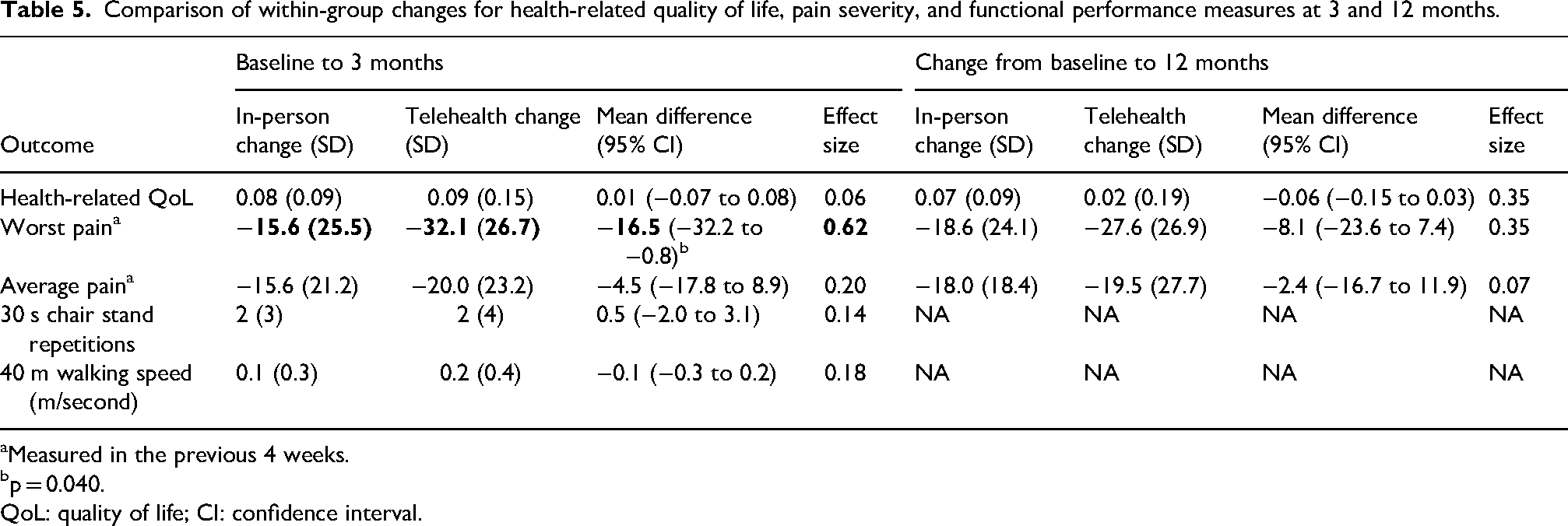
Measured in the previous 4 weeks.
p = 0.040.
QoL: quality of life; CI: confidence interval.
At baseline, three participants in the telehealth group and two participants in the in-person group desired surgery due to their knee pain, including one who was on a waiting list for a surgical opinion. At 12-month follow-up, only one participant in the telehealth group continued to desire surgery. Of those who completed 24-month follow-up data collection, 4 (3 most affected, 1 in other side) out of 19 participants (21%) in the in-person group, and 2 (1 most affected, 1 bilateral) out of 10 participants (20%) in the telehealth group had undergone total knee replacement surgery. Additionally, two in-person and one telehealth participants underwent total hip replacement surgery.
Discussion
We were unable to definitively determine the non-inferiority of telehealth-delivered group-based exercise therapy and education from this trial due to early cessation of recruitment due to COVID-19 pandemic restrictions. While underpowered, results indicate that group-based telehealth services for people with knee osteoarthritis may not be inferior to in-person delivery, with the lower bound of the 95%CI for our primary outcome not exceeding the minimal important difference of 10 points set 36 at 3 and 12 months. Of secondary outcomes evaluated, only change in worst pain at 3 months differed between groups, favouring telehealth delivery. At 12 and 24 months no differences between groups were found for any secondary outcomes.
Our novel findings related to group-based telehealth are consistent with trials indicating non-inferiority of one-on-one telehealth services for knee osteoarthritis and other musculoskeletal conditions. 20 Improvements in knee-related QoL measured by KOOS-QoL at 3 and 12 months for both the in-person (10 and 15 points) and telehealth (18 and 14 points) groups in this study are also comparable with published real-world Australian (14 and 17 points) 12 and international12–15 GLA:D® registry data. Additionally, 24-month outcomes revealed no differences between groups for any outcomes, although the non-inferiority threshold of 10 points for the lower bound 95%CI of KOOS4 was crossed, likely owing to a low follow-up rate. Combined with other recent RCT findings from telehealth trials involving people with osteoarthritis, 21 our results highlight an opportunity for health systems to actively support the expansion of telehealth models to reduce healthcare disparities experienced by underserved populations with limited access to in-person physical therapy services.
High satisfaction rates for group-based telehealth in this study for those receiving it, alongside similar outcomes following real-world telehealth delivery of group-based osteoarthritis care during the pandemic (i.e. GLA:D®) in Australia 23 and Denmark 24 indicate its implementation should be supported. However, at the beginning of the COVID-19 the pandemic, just one in five physical therapists felt they had received adequate training to implement telehealth. 45 Despite support provided to physical therapists delivering GLA:D® in Australia to provide telehealth during the pandemic, very few clinicians adopted this group-based delivery method. 23 This may be because, both patients and physical therapists generally perceive telehealth to be of less value compared to in-person care for musculoskeletal pain conditions.46–48 Notably, although individually delivered telehealth was funded by public and private health in Australia during and following the pandemic, this funding was not extended to group-based telehealth services. 23 This lack of perceived value by patients, clinicians and the health system is a key barrier to implementation. Other key barriers identified specific to implementation of group-based services for osteoarthritis via telehealth previously identified are similar to individually delivered telehealth, 46 and include inadequate technology literacy and access to internet and devices, and safety concerns. 23
Future work should consider developing, refining, testing and promoting adoption of training and education resources (e.g. TREK, 49 PEAK 21 ), and improving funding models to support access to group-based telehealth for people with osteoarthritis and other musculoskeletal pain conditions. 23 46–48 Further research could also explore optimising telehealth delivery, including identifying the ideal group size, session structure and strategies to enhance participant engagement. Future studies could also investigate long-term adherence to telehealth-delivered interventions to determine if the convenience of remote care leads to sustained engagement and lasting functional benefits.
Limitations
This study's a priori sample size was not met due COVID-19 pandemic restrictions interrupting recruitment mid-trial, but our findings do indicate that telehealth delivery of group-based exercise therapy and education might not be inferior to in-person delivery. Recruitment for this trial also ceased before planned fidelity checks could be completed for both groups, limiting our ability to assess adherence to intervention protocols. Although some participants completed their 3-month (primary time point) follow-ups following the emergence of the COVID-19 pandemic, most (31/44) completed this phase of the trial before restrictions were implemented. Additionally, all but three participants were able to complete their allocated intervention as intended. Our sensitivity analysis with reallocation of these participants to the telehealth group did not change our results. Although we had high follow-up rates at 3 and 12 months (>90%), our follow-up rates for 24 months were lower (66%), likely contributed by an inability of our research team at the time to follow-up automated emails with phone calls to those not responding.
Due to the pragmatic nature of this trial, we did not include any potential stratification to account for clinic or physical therapist clustering. Participants were not blinded to their group allocation. However, risk of bias was minimised by limited disclosure regarding the alternative intervention to each participant, and the researcher completing physical performance measures was blinded to group allocation. Additionally, physical therapists delivering each intervention were not provided details of the other intervention arm or the studies hypothesis. Generalisability of our findings should be considered in the context of the characteristics of participants recruited. Enrolment required English-language proficiency, and participants were required to live within a 10 km radius of a metropolitan Melbourne clinic already offering the GLA:D® program. Finally, we did not complete specific digital literacy assessments, meaning we could not evaluate the influence of participants’ technical skills on the effectiveness of telehealth delivery, a factor that may affect scalability to broader populations.
Conclusion
This RCT indicates physical therapist-led telehealth-delivered group-based exercise therapy and education might not be inferior to in-person delivery at 3 and 12 months for people with knee osteoarthritis. Knee-related burden, QoL, physical performance and treatment satisfaction outcomes following group-based care were all similar between telehealth and in-person delivery. Health system funding reform, alongside efforts to develop, test and refine strategies to improve the uptake of individual and group-based telehealth exercise therapy and education services to people with knee osteoarthritis are warranted.
Supplemental Material
sj-docx-1-jtt-10.1177_1357633X251406691 - Supplemental material for Telehealth-delivered group-based exercise therapy and education for knee osteoarthritis: A non-inferiority randomised clinical trial disrupted by COVID-19
Supplemental material, sj-docx-1-jtt-10.1177_1357633X251406691 for Telehealth-delivered group-based exercise therapy and education for knee osteoarthritis: A non-inferiority randomised clinical trial disrupted by COVID-19 by Christian J Barton, Marcella Pazzinatto, Zuzana Perraton, Kay M Crossley, Trevor Russell, Karen Dundules, Danilo De Oliveira Silva and Joanne L Kemp in Journal of Telemedicine and Telecare
Footnotes
Acknowledgments
We would like to thank the physical therapists who provided GLA:D® via telehealth, and private physiotherapy clinics and their physiotherapists for providing GLA:D® in-person to participants in this study, including Complete. Physio Exercise Performance (Richmond), Clifton Hill Physiotherapy, Lifecare (Croydon, Prahran), Mill Park Physiotherapy, and Total Physiocare (Heidelberg, Reservoir). This study was funded by a La Trobe University Sport and Exercise Rehabilitation Research Focus Area grant, with additional in-kind support provided by the not-for-profit GLA:D® Australia program. CJB was supported by an MRFF TRIP Fellowship (APP1150439) and JLK was supported by an NHMRC Early Career Fellowship (APP1119971).

Ethics
Ethical approval was obtained from La Trobe University (HEC18500), and the study was pre-registered (ACTRN12619000235101).
Author contributions
CJB, KMC, TR and JLK conceptualised the study. CJB, ZP and MP led recruitment. MP, ZP, KD and DOS facilitated data collection. MP performed the analyses. CJB and MP led initial drafting of the paper. All authors contributed to writing and read and approved the final version of the manuscript.
Funding
The authors disclosed receipt of the following financial support for the research, authorship, and/or publication of this article: This work was supported by the La Trobe University Sport and Exercise Rehabilitation Research Focus Area grant,
Declaration of conflicting interests
The authors declared the following potential conflicts of interest with respect to the research, authorship, and/or publication of this article: CJB, KMC and JK are project leads for the implementation of GLA:D® Australia. MP, KD and DOS are funded through the training of GLA:D® Clinicians to provide the program. The authors have no other conflicts of interest to declare.
Data availability statement
The datasets generated during and/or analysed during the current study are available from the corresponding author on reasonable request.
Trial registration
Australian and New Zealand Clinical Trials Registry, ACTRN12619000235101, https://www.anzctr.org.au/Trial/Registration/TrialReview.aspx?id=376881&showOriginal=true&isReview=true
Supplemental material
Supplemental material for this article is available online.
References
Supplementary Material
Please find the following supplemental material available below.
For Open Access articles published under a Creative Commons License, all supplemental material carries the same license as the article it is associated with.
For non-Open Access articles published, all supplemental material carries a non-exclusive license, and permission requests for re-use of supplemental material or any part of supplemental material shall be sent directly to the copyright owner as specified in the copyright notice associated with the article.
