




Abstract
This study explored refugee children’s ways of coping focusing on their strengths. The present study involved 26 students, 8 Iraqi Kurds, 6 Afghans, and 12 from Syria attending reception classes (called early morning reception zone) in the morning program of two Greek Elementary schools. Data were gathered using semi-structured interviews. This study using interpretative phenomenological analysis (IPA) explored the subjective narratives of the participating refugee children. Three superordinate themes relating to the aims of the current research emerged from the data: (1) caring relationships, (2) a place of (and for) safety and (3) new perspectives. Supportive family bonds, being securely resettled with other family members, security of housing and opportunities to study in a supportive school environment were found to be factors which either reduced significant stressors or ameliorated the effects of adverse childhood experiences as regards this study’s participants.
Keywords
A plethora of research data highlight the role that early childhood experiences play in human development (i.e. Fox et al., 2010). This explains why research regarding adverse childhood experiences (ACEs) is important as these adversities can have a crucial negative impact on children’s development (McLaughlin, 2016). Research data suggest that a wide range of adverse contextual factors (Hughes et al., 2017; McLaughlin, 2016) often cluster in children’s lives resulting in developmental disruptions and psychological and health problems (Kalmakis & Chandler, 2015). These adversities include family relationships (McLaughlin, 2017), discrimination (Finkelhor, 2018), separation from family (McLaughlin, 2017), and abrupt relocations (McLaughlin & Lambert, 2017). Previous research findings show that refugee children are more likely to be exposed to a wide range of adversities or traumatic events (Bronstein & Montgomery, 2011). In some cases, being a young refugee entails growing up in violent and uncertain conditions, experiencing the stresses of a dangerous journey to another country and finding novel ways of coping and surviving in a new environment and culture (Correa-Velez et al., 2010; Hodes et al., 2018). This could also mean long term exposure to hunger, limited access to education and health services and being exposed to extreme adverse conditions such as war violence which could have deleterious consequences (ISSOP Migration Working Group, 2018). In addition, refugee children are in most cases under continuous stressful situations resulting from unknown language, food, and social customs which combined with losses coming from forced displacement could affect their ability to overcome hardships drastically (Akhtar, 1999). Nevertheless, despite the fact that refugee children might in some cases have some common experiences without doubt each one has a different account of displacement, resettlement and unplanned changes in their lives representing a heterogeneous group different in many aspects. Stressful early experiences could also result in positive coping strategies instead of a negative effect depending on various individual and/or situational factors (Turner-Cobb & Steptoe, 1998). Loss of aim in life and ambition were factors that advocated resilience in a group of Sudanese refugee youth in United States (Goodman, 2004). Previous research findings report that there are coinciding factors that elevate resilience for refugee children regardless of their considerably different cultural contexts and migratory life experiences. These factors involve having their basic needs met, social support (from friends and community), sense of belonging, valuing education, living with family members and having supportive and positive family relationships. Research data also highlight the critical relationship between valuing education, school belonging and beneficial adaption across cultures (Pieloch et al., 2016). Several studies have underlined the significance of coping when dealing with adversity (Fletcher & Sarkar, 2013). The coping conceptualization employed in the present research refers to “the process of coping with stressors, adversity, change or opportunity in a manner that results in the identification, fortification, and enrichment of resilient qualities or protective factors” (Richardson, 2002, p. 308). Since different coping strategies are used in childhood, adolescence, and adulthood (i.e. Aldwin, 2009) it is important to explore young refugee’s early coping strategies as they try to manage their life’s stresses and ability to overcome obstacles emanating from the major forced and unplanned changes they experience. As deficiencies in adaptive functioning can increase refugee children’s vulnerability to adversities, insights into their coping ways in the uncertain Greek context could contribute to the improvement of their well-being health and everyday living having in mind that not all refugee children face severe problems or are in need of ameliorating the effects of these stressors. This study explored refugee children’s ways of coping and the potential protective function of their coping ways in buffering possible ACEs negative impact focusing in this way not on aspects of their loss and vulnerability but on the important aspects of their strengths (i.e. Malkki, 1995). Results could also contribute to a better understanding of their refugee status as experienced by this seldom heard group of children.
Methodology
The present study is part of an ongoing research in which refugee children were interviewed about their adverse experiences and their coping ways (after being resettled in different areas of Northern and western Greece). This study acknowledges the children’s role in the continuous dynamic interplay of possible variables that could influence their environment and consequently hinder or stimulate their development (e.g. Sameroff, 2010). This study using interpretative phenomenological analysis (IPA; Smith & Osborn, 2003) explored the subjective narratives of the participating refugee children. As there were not any preconceived hypotheses (i.e. Smith & Eatough, 2006) any themes emerging from the collected data were explored using literature and research relevant to the material.
Participants
The present study involved 26 students, 8 Iraqi Kurds, 6 Afghans, and 12 from Syrian (19 girls and seven boys, out of a total of 32 students, see Appendix 1) attending reception classes (called early morning reception zone) in the morning program of two Greek Elementary schools in western and central Macedonia. Their average length of stay in Greece was 5.2 years. All participating children stayed with their parents in apartments run by nongovernmental organizations (NGOs). They all had a residence permit, a document allowing them to reside in Greece for a fixed length of time. Detailed information about the study was given to parents during the initial contact. One week later, 26 out of 32 parents agreed and provided informed consent translated to their native language and assented to their child’s participation. The study was verbally explained to the children and verbal consent was gained from them. Participants’ ages ranged from 6 to 11 years.
Instruments and procedure
In this culturally sensitive research qualitative data were gathered using semi-structured interviews. Interviews were conducted in a private office at their school with the assistance of translators between November 2019 and January 2020. They ranged in length from 30 to 45 minutes. The interview schedule was structured into two sections: Demographic questions (rapport building) and any factors, persons and/or circumstances under which they felt safe and optimistic during their journey to Greece and during resettlement. Interview begun with an open-ended question and then was guided by each child. The interviews were successfully conducted with the assistance of two translators known and trusted by the children and their parents. Greek and Arabic language were used interchangeably. Parents were not present during the interviews. To the researchers’ knowledge the two translators did not had any specific training. Participants were indicated as initials (i.e. p1: participant 1, p2: participant 2. . .). After the interviews children and their parents were verbally debriefed.
Data analysis
Interviews were audio taped and then transcribed verbatim. The principles of interpretative phenomenological analysis were used. This approach has been used by other researchers in this field (e.g. Schweitzer et al., 2007). The analysis of transcripts was conducted according to Smith and Osborn’s (2003) guidelines. Each transcript was read and reread, along with the audiotapes, to familiarize the researcher with its contents. The emerging themes evolved from the initial notes made during reading the transcripts. An independent rater checked and validated the themes and the interpretations. Any differences in the analysis were discussed and a decision made about their inclusion (Silverman, 2013). The aim was “to ensure credibility of the final account” and not to establish objectivity (Brocki & Wearden, 2006, p. 98). Data analysis resulted in three superordinate themes which were illustrated using quotes from the interviews.
Results
Three superordinate themes relating to the aims of the current research emerged from the data: (1) caring relationships, (2) a place of (and for) safety, and (3) new perspectives
1. Caring relationships
. . . in many circumstances I was very afraid. . . when we were in the boat trying to reach a Greek island . . .it was raining and I was hiding under my mother’s arms. . .. (p.6)
This theme highlighted the importance of family bonds as an essential element in children’s way of coping with adversities. Several children also reported enjoyable interactions and shared activities with their family members (like playing together) and the unconditional love and support they had from them in difficult situations.
. . .my mother was playing with me almost all the time during our journey. . . (p.20)
. . .I knew that my father would protect us. . . when I was afraid I went near him. . . (p.24)
Their relationship and bonding with their primary caregivers seemed to be a crucial component for their sense of security as in their narratives children conveyed the message that their families were behind them, always supporting them under almost every circumstance. Being accompanied by their family members and the resulting sense of security created by their physical presence may have an impact on the children’s optimistic feelings with regard to their future. Physical proximity and feelings of relatedness were crucial components of this safe experience.
2. A place of (and for) safety
. . .Now I have my belongings to my house. . . they are safe.. (you also feel safe?) . . .. Yes.. I feel safe. . . for now. . .(p.5)
Children’s experience of being on the move (where belonging and belongings are usually at risk) is conveyed in this theme reflecting their need of a safe place and/or base. This emphasis on safe, protected places in children’s utterances could also reflect their need for a physically and psychologically safe context. A context that could also offer them a sense of control over their lives in a time where all other aspects of their lives seemed uncontrolled. Papadopoulos (2002) notes that a sense of home is developed in childhood and adds to the child’s sense of reliability about life.
. . .We are living now in an apartment with my family. . .. It’s small but we can sleep at night. . .. (p.23)
..it’s only us (his family) in the apartment.. which is nice. . . especially at nights. . .. (p.26)
. . .we are not in danger now.. I feel good.. (p.18)
Not only resettlement to another country but most importantly moving to their own apartment seemed to offer a safe base for feeling secure and maybe an opportunity to promote a positive outlook through having a sense of belonging or community support. In children’s utterances home was felt as a place of safety, privacy and retreat giving them the perspective of being comfortable either by themselves or with their family. Basic necessities that was gone due to their leaving their homeland.
3. New perspectives
.. I want to learn Greek. . . even if we go to Germany or Sweden. . . I want to communicate.. maybe we will stay here. . . who knows. . . (p.7)
In their narratives children conveyed their family’s plans as they understood them and also expressed their will to make their own plans for the future. New perspectives and hopes were reflected in children’s narratives. They seemed to value their schooling experience and several expressed the desire to learn the Greek language and upgrade their level of education. The language barrier was a difficulty faced by most of the children.
..when I was in the camp we were not doing anything. . .. Now I want to learn Greek. . . I understand some words. . . I don’t speak so good. . . Greek is difficult. . .. I like it in school.. I have friends here. . . (p.17)
. . .I like my teacher.. he is helping me a lot with all short of matters. . . (p.13)
Since language was a crucial impediment for their everyday life function their will to benefit from the Greek educational system could indicate their optimistic thoughts about their future in Greece. From children’s narratives it also emerged the positive impact of educator–student relationship which seemed to add to their feelings of competency and worthiness. Knowing the Greek language seemed to provide them with a sense of achievement and control over their lives.
Discussion
For refugee children, it is critical to obtain a significant understanding of factors that promote their coping due to the adverse events they face for an extended period during their childhood and adolescence. Refugee children, who have lived through extreme adverse and traumatic experiences in their home country, and potentially during their migration and post migration as well, are at increased risk for developing significant cognitive and socio-emotional disorders and even irreversible developmental impairments (Fegert et al., 2018). “Just at the time when young refugees need to explore and develop their personal and social identity and become autonomous, their lives are put on hold” (Sleijpen et al., 2017, p. 362). According to Weine et al. (2004) refugee children are a highly vulnerable group because their exposure to stressors and displacement takes place during important developmental transitions and may disrupt typical developmental processes. These risks are increased if the parents are also affected as they might be inefficient to accomplish their parental responsibilities sufficiently and formulate a safe and beneficial environment for their children. Further, the family dynamics are often complicated and worsen by crowded housing conditions where there is little or no privacy or personal space to retreat to (El-Khani et al., 2017; Fegert et al., 2018). The current study provided an empirical understanding of the participating children’s way of coping and the important factors in ameliorating some of the adverse impacts of their early life adverse experiences and trauma. Supportive family bonds, being securely resettled with other family members, security of housing and opportunities to study in a supportive school environment were found to be factors which either reduced significant stressors or ameliorated the effects of adverse childhood experiences as regards this study’s participants. Parent child relationships proved crucial for children exposed to early life adversities in order to effectively mobilize their strengths and cope with past or current difficulties. In children’s narratives their relationship with their parents was most important (i.e. Maragel & Manachi, 2018). Their dependency on their parent’s capacity to protect them was evident in their utterances (i.e. Hillmann & Dufner, 2019). Being cared for and supported seemed to set the fundamental means for children to cope effectively with their multiple transitions and contextual shifts over the course of their displacement. Thus, a coping promoting factor that emerged from the interviews was caring relationships. This study’s finding coincide with previous studies reporting that providing nurturance and support to children who had significant early life trauma could promote effective coping strategies and support their development (Garner, 2013). Previous research data have shown that intact family could be a protective factor acting as barrier to negative experiences and stress (Montgomery, 2005) whereas family separation and longing for re-union could create additional stresses for resettled children (Rousseau et al., 2004). The impact of this finding is critical as refugee children’s parents are often faced with difficult situations including unemployment, low income, language and cultural barriers after being resettled in a host country (Vaughn et al., 2017). Past research data have already drawn attention to the critical impact of loss of home for refugees. According to Papadopoulos (2002, 2007) although refugees may differ in their personal experiences and adversities most share the common condition of having lost their homes. Finding a new one seemed most crucial in children’s narratives. Having a home of their own offered them a base for feeling safe again. This study’s qualitative findings point to the need of the participating children to experience a sense of home in a new country and culture and becoming attached to it potentially favoring the development of future attachment relationships. Previous studies have also demonstrated that children benefit by having at least one positive relationship with an educational agent, such as a teacher (Perez et al., 2016). Children having healthy relationships with at least one school official improved their academic achievement and development (Correa-Velez et al., 2010). In general, the refugee education plan put emphasis on the progressive integration of the refugees into the Greek education system. Children between 6 and 17 years of age were supposed to attend Reception Classes (RCs) taking place in the morning program of primary, secondary, and intercultural schools. Children of preschool age were supposed to attend kindergartens that would be set up within the accommodation centers (Ministry of Education Research and Religious Affairs, 2017).
This study’s results indicate that there are overlapping factors promoting refugee children’s coping and consequently their adjustment to forced displacement. Their efforts and strengths rely not only on their own individual characteristics, actions and responses but also on their access to extended family support and having their basic human needs met including housing and their need to attend school. These contextual conditions emerged as having a positive impact on children’s coping with the stressors and hardships of their displacement. A crucial concern for the researcher was to create a safe condition that could contain children’s stories and narratives, especially in times when children seemed emotionally intense due to the pressures and worries of a difficult and dangerous journey. Further the researcher tried to acknowledge any personal and professional influences that could affect his making sense of things. The fact that the children trusted their stories, displaying a wide range of emotions verified the usefulness of a secure and containing environment. The common origin of several children operated as a common link connecting their stories and experiences. Interviewing young refugees proved to be even more difficult and challenging than initially thought due to various reasons. The most important were, (a) at the time of the interview several young children and their parents were relocated and (b) the majority of young refugees parents’ refused to participate in the study emphasizing that for their own reasons neither they nor their children wanted to disclose personal information’s and experiences. The presence of the interpreters was crucial since spoken language can in many cases become very ambiguous hindering not only meaning making but also the process of creating a reliable relationship. Further, their presence had an intermediating role as they supported the building of the necessary trust between participants and researcher.
Limitations
This study’s data were gathered from a small sample of refugee children volunteered to participate in this study. Their experiences were unique and cannot be generalized. Findings presented in this study cannot be paralleled with other regions of Greece or other countries. However, this study results could be used to inform this field of research regarding refugee children ways of coping with early adversities.
Conclusion
Overall, this study’s results highlight the importance of family bonds, parenting practices, a secure sense of home and social support (supportive teachers) as protective factors. These protective factors could be used by professionals developing interventions to promote resilience among children exposed to early adversity and their parents.
Footnotes
Appendix
Participants demographic.
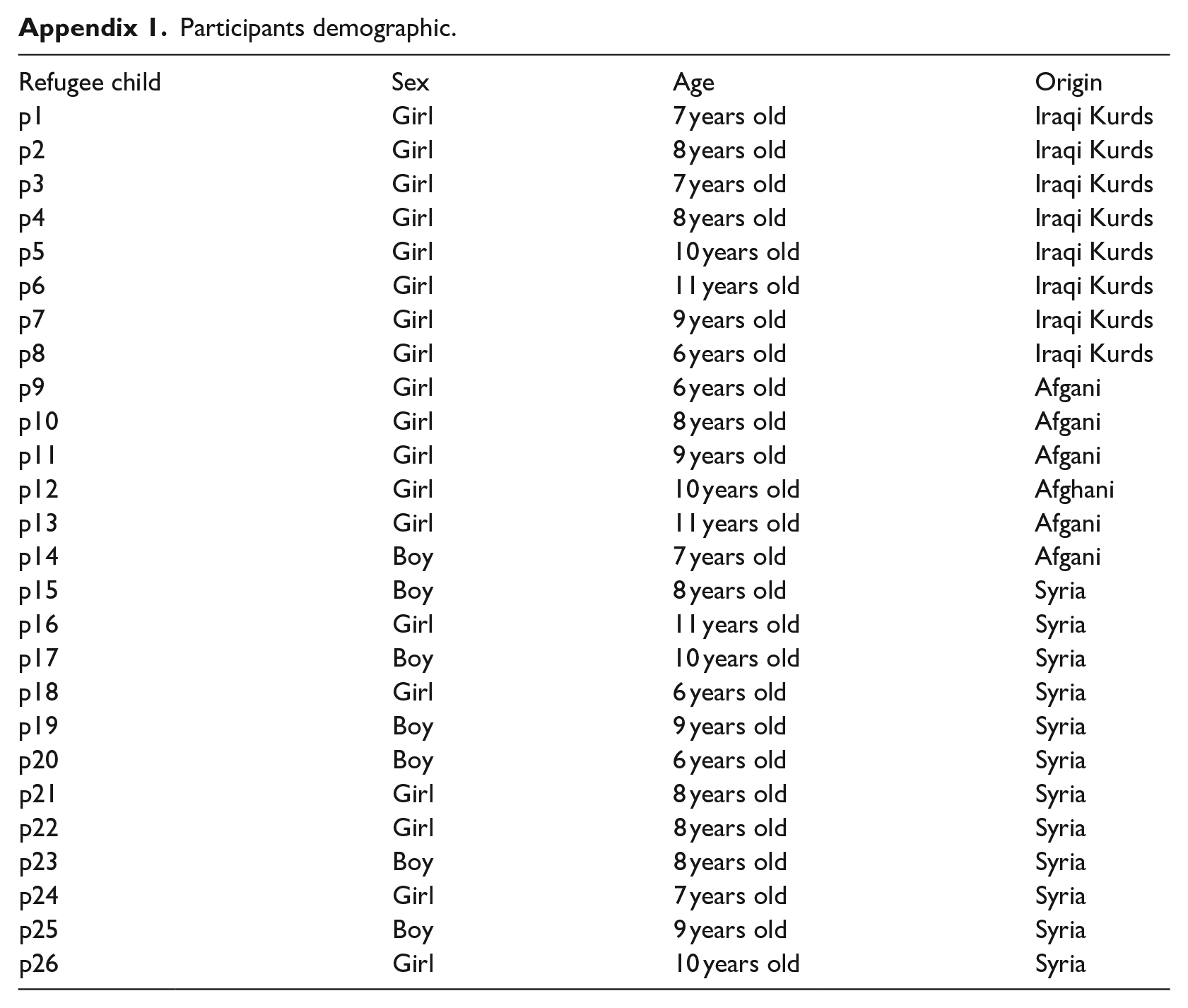
| Refugee child | Sex | Age | Origin |
|---|---|---|---|
| p1 | Girl | 7 years old | Iraqi Kurds |
| p2 | Girl | 8 years old | Iraqi Kurds |
| p3 | Girl | 7 years old | Iraqi Kurds |
| p4 | Girl | 8 years old | Iraqi Kurds |
| p5 | Girl | 10 years old | Iraqi Kurds |
| p6 | Girl | 11 years old | Iraqi Kurds |
| p7 | Girl | 9 years old | Iraqi Kurds |
| p8 | Girl | 6 years old | Iraqi Kurds |
| p9 | Girl | 6 years old | Afgani |
| p10 | Girl | 8 years old | Afgani |
| p11 | Girl | 9 years old | Afgani |
| p12 | Girl | 10 years old | Afghani |
| p13 | Girl | 11 years old | Afgani |
| p14 | Boy | 7 years old | Afgani |
| p15 | Boy | 8 years old | Syria |
| p16 | Girl | 11 years old | Syria |
| p17 | Boy | 10 years old | Syria |
| p18 | Girl | 6 years old | Syria |
| p19 | Boy | 9 years old | Syria |
| p20 | Boy | 6 years old | Syria |
| p21 | Girl | 8 years old | Syria |
| p22 | Girl | 8 years old | Syria |
| p23 | Boy | 8 years old | Syria |
| p24 | Girl | 7 years old | Syria |
| p25 | Boy | 9 years old | Syria |
| p26 | Girl | 10 years old | Syria |
Declaration of conflicting interests
The author(s) declared no potential conflicts of interest with respect to the research, authorship, and/or publication of this article.
Funding
The author(s) received no financial support for the research, authorship, and/or publication of this article.
