




Abstract
This study analyzed how the culture of origin, educational level, sexual orientation, and experience of male sex workers may mediate their commercial sexual behaviors. A total of 100 Spanish agency male sex workers were interviewed. Most of them were young men, Latin American, homosexual, and had middle-level education. Our results showed that cultural differences and sexual orientation could influence male sex workers when engaging in sexual behaviors with their clients. Social and health projects with male sex workers may have to take into account sexual myths and taboos related to sexual orientation and cultural differences.
Introduction
The number of people engaged in sex work has increased, especially among immigrants because of financial reasons (Belza et al., 2001) and new technology facilities (Gaffney, 2003). Nevertheless, the scientific literature has focused on female sex workers. There are few studies about male sex workers (MSWs) (Lorway et al., 2009), and they have some deficiencies (Mariño et al., 2003). For example, previous researchers have usually paid attention to street MSWs. Therefore, research in other places where MSWs offer their services, and in other aspects such as characteristics of their clients, is scarce (Parker, 2006; Weitzer, 2005, 2009). In addition, they have focused on topics such as drug consumption, HIV prevalence, and condom use with clients. In fact, most studies have assumed that the MSW is a focus of HIV infection (Anderson, 2002; Bimbi, 2007; Llewellyn-Jones, 1987; Romi, 2006).
On the other hand, few studies have explored sexual behavior pattern among MSWs going beyond sexual risk behaviors. For example, some of them have shown masturbation, oral sex, and anal penetration as the most common sexual behaviors with clients (Ballester and Gil, 1996; Liguori and Aggleton, 1998; Minichiello et al., 2002). However, they have paid limited attention to personal variables such as personal motivations to engage in sex work, sexual behaviors with steady or casual partners, or personal and professional satisfaction.
In Spain, the first research that investigated variables other than risk behaviors was developed by Ballester and Gil (1996) with a group of 20 MSWs offering sexual services in apartments. The study analyzed aspects such as physical self-perception, sexual history, location of their sex work, most common practices with clients, condom use in their professional and personal relationships, and factors related with life satisfaction. Later, because of the increase of immigrants engaged in sex work, Zaro et al. (2007) explored other aspects such as the prevalence of the culture of origin related to sexual condom use with clients and HIV testing. However, the approach of these studies was descriptive.
Moreover, some researchers have examined possible connections among personal and sociodemographic characteristics of MSWs and their commercial sexual behavior and HIV risk (Smith and Seal, 2008). For example, gay-identified MSWs reported higher rates of condom use in both personal and commercial sex exchanges (Smith and Seal, 2008). In addition, the culture of immigrant MSWs has revealed some influences on their sexual risk and sexual behavior (Padilla, 2008). Cultural myths and taboos may condition protection and safe sex of MSWs (Arredondo et al., 2004; Ballester et al., 2011). In Spain, immigrant MSWs have reported lower education and engaged in more sexual risk practices than Spaniards (Belza et al., 2001).
Nevertheless, after analyzing multiple variables associated with men engaged in sex work, different authors have concluded that the group of MSWs is very heterogeneous. As a consequence, generalizing results is difficult (Parsons et al., 2004; West and De Villiers, 1993), and our knowledge of sexual behaviors or HIV transmission among MSWs is still insufficient (De Cai et al., 2009). In fact, more information about personal and professional MSW profiles is needed due to the lack of attention to aspects such as professional and noncommercial sexual behaviors, reasons for starting sex work, or their self-perception as sex workers.
Therefore, in the absence of recent data in Spain about MSWs (Salmerón, 2011), the aim of our study was to examine some aspects of the professional activities of MSWs: self-perception as MSWs, reasons for starting sex work, perceived risk of this activity, frequency of certain sexual behaviors, and reasons for refusing to engage in certain practices. We also examined the possible influence of some variables (culture of origin, educational level, sexual orientation, and how long they have been MSWs) on sexual behaviors and their access to social and health-care resources. These factors may increase the degree of stigma and secrecy with which this activity is carried out, thereby their vulnerability to HIV infection and social exclusion could be increased (Padilla et al., 2008).
Methods
Participants
Hundred MSWs offering their services (21 days in an apartment managed by a third-party manager) were recruited in the cities of Castellón and Valencia (Spain). The mean age was 23.7 years (standard deviation (SD) = 3.61), and the ages ranged from 18 to 35 years. The majority of the participants (83%) were Latin American, 5 percent were Spanish, and 12 percent were from other European countries. Most of the immigrants (57%) were from Brazil and 73.5 percent of Latinos were illegal immigrants. Regarding educational level, 18 percent started their degree, 62 percent had secondary school, 10 percent had primary education, and 2 percent had no education. In addition, 16 percent were self-reported atheists or agnostics, 56 percent were Catholics, and 17 percent affiliated to another religion. As for self-perceived sexual orientation, 66 percent of MSWs were homosexuals, 20 percent were bisexual, and 13 percent were heterosexuals. One MSW, however, did not want to classify himself in any sexual orientation category. All participants reported that their participation in sex work was voluntary.
Measures
Semi-structured Interview for MSWs by Ballester, Gil, Salmerón y Albiach (2009) contains 82 questions divided into seven blocks: sociodemographic data, sexual history, aspects of sex work, health conditions, drug use, HIV/AIDS, and general welfare.
This article reports the findings related to MSW activity and sexual behaviors: different aspects of sex work (self-consideration as MSWs and motivations were assessed by open questions); perceived risks and fears of sex work (yes/no questions); services that MSWs refused to carry out (an open question); and real frequency of sexual behaviors with clients (a Likert scale for each behavior: never—sometimes—quite often—always). On the other hand, some independent variables have been studied, such as educational level (none, basic, secondary, and university), country of origin (Spain, other European countries, and Latin American), sexual orientation (heterosexual, bisexual, and homosexual), and time worked as a MSW.
Procedure
The interviews were conducted from March 2009 to April 2010 in five apartments managed by a third-party person in Valencia and Castellón (Spanish cities). The study was in line with the standards of the American Psychological Association Ethics Code (APA, 2010) and guarantees the confidentiality of participants. Once we had obtained the approval of the Ethics Committee by the University, according to ethical principles of A.P.A, we started the study. First, we contacted all the apartments where MSWs worked in both cities to explain the purpose and implications of the research to the participants and their managers. These contacts were facilitated by Col·lectiu Lambda, a lesbian, gay, transgender, and bisexual association from Valencia that implements various programs to prevent HIV infection among men who have sex with men (MSM) and MSWs.
The participants stayed 21 days in the same apartment with other MSWs, and then, they were relocated to apartments in the other city. All the MSWs were informed; two refused to participate and five who did not understand Spanish were excluded.
Each interview involved the interviewer (the research team psychologist) and one MSW and lasted approximately 1 hour. In order to obtain a climate of trust and intimacy, MSWs gave us the informed consent in the rooms of the apartments, and afterward, they were interviewed. Written consent forms included only the first name of MSWs because most of the participants were illegal immigrants. Anonymity and confidentiality were guaranteed throughout the process. Participation was completely voluntary; however, MSWs were given a monetary incentive (€10) at the end of the interview.
Analyses
Statistical analysis was performed using SPSS-17 software. Descriptive statistics were calculated to examine sociodemographic variables and other questions related to several aspects about sex work. Differential analyses were also calculated: analysis of variance (ANOVA) and Scheffé post hoc test (variables such as condom use) or Chi-square for nominal variables (i.e. infection as a perceived factor).
Multiple linear and logistic stepwise regression models were analyzed in relation to associations among the independent variables (educational level, country of origin, sexual orientation, and time as MSW) and fear of HIV infection during sex work, not risk perceived of their job, refused sexual behaviors with clients (unprotected intercourse, no ejaculation in the mouth of MSWs, and not adopting a passive role) and sexual behaviors frequency (vaginal sex, cunnilingus, insertive and receptive fellatio, and insertive and receptive anal sex).
Results
Aspects of sex work
A total of 25 percent of participants did not recognize themselves as “a sex worker” because they wanted to do the work only for a short time period (9%). Overall, 5 percent felt ashamed at this description and preferred not to be classified, and some of the MSWs (3%) preferred to say that they were “escorts.” Despite the temporary nature of their job, some respondents had been doing sex work for years. Among those MSWs, 25 percent had been in this business for over 5 years, 52 percent from 1 to 4 years, while 19 percent had been working for less than 1 year. Four MSWs did not answer this question. The average age for starting this activity was 21.1 years old (SD = 4.03).
The main reason for engaging in sex work was economic necessity (83%). They reported usually earning an average of
Perceived risks and fears of the sex work exercise
The main fear among MSWs was the possibility of becoming infected with a sexually transmitted infection (STI), especially HIV (73%), although 13 percent of them did not perceive any risk of their profession. Other risks included the client aggression (15%), increased substance use (9%), or if their illegal status is reported by the client (4%). Professing fear of the mafia organization was virtually nonexistent (1%) in this sample. None mentioned sex worker stigma.
Most common sexual behaviors
The frequency of certain sexual behaviors was evaluated on a Likert scale (never, sometimes, quite often, or always). Table 1 shows that the most common behaviors were fellatio to MSWs (
Sexual behaviors with clients sorted out by frequency (last 6 months) a .
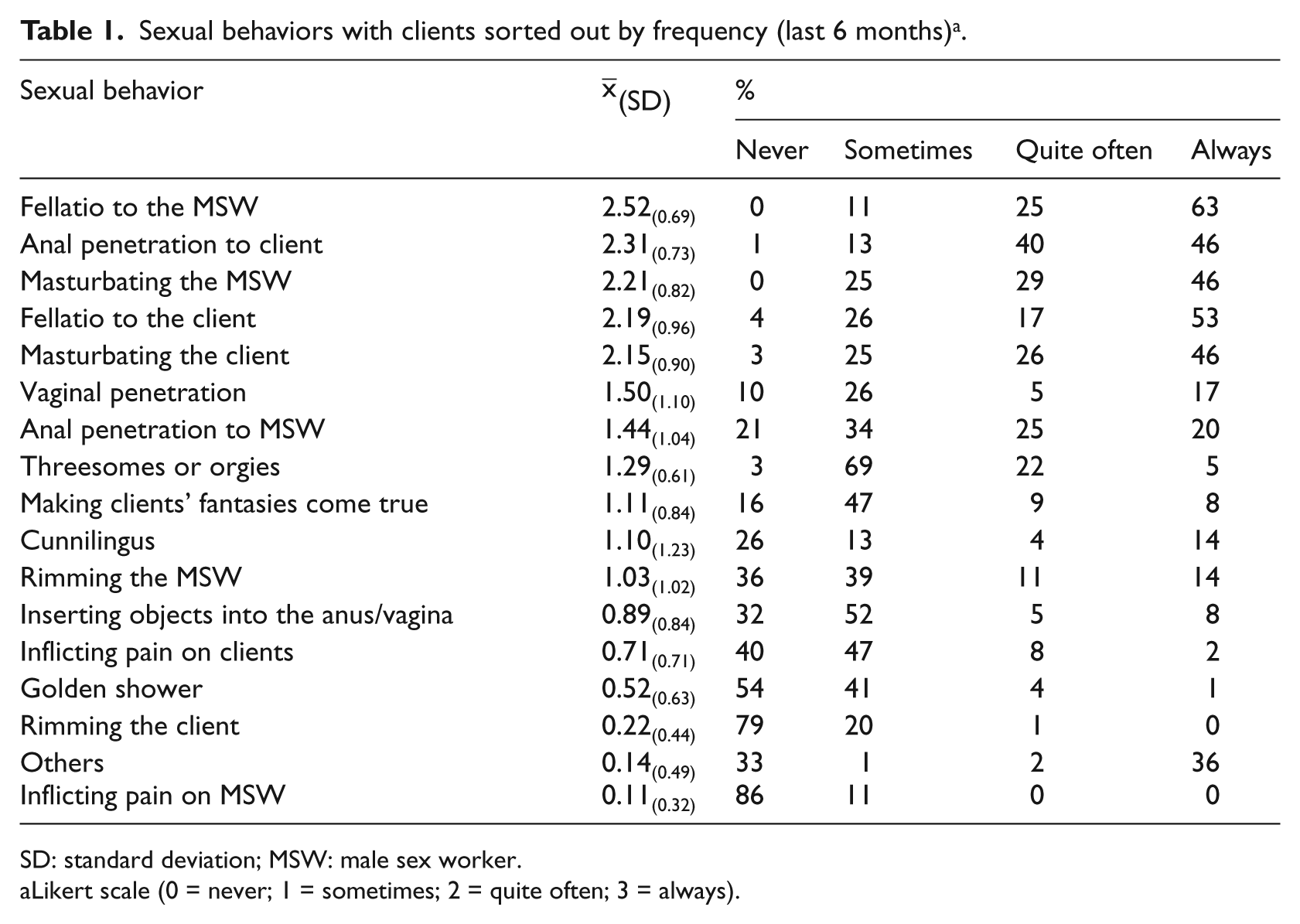
SD: standard deviation; MSW: male sex worker.
Likert scale (0 = never; 1 = sometimes; 2 = quite often; 3 = always).
Moreover, MSWs refused to provide some services for clients, such as any risk behavior without protection (51%), especially if it involved client ejaculation in the mouth (6%). In all, 10 percent of the MSM never adopted a passive role in sexual intercourse, and some of them never performed some sexual behaviors with their customers, such as licking client’s anus (17%), kissing the client (13%), sadomasochism (15%), or scatological behaviors (11%). Reasons argued offered for refusing these behaviors were fear of HIV infection (21%), and that certain practices made them feel sick (13%). Some of them (8%) reported both reasons.
Differences according to country of origin, educational level, sexual orientation, and time worked as a MSW
We studied the possible difference depending on educational level, country of origin, sexual orientation, and time worked as a MSW in some variables related with sex work such as self-perception as a sex worker or reasons for engaging in this activity, and others that may mediate possible sexual risk behaviors: perception of risks associated with their professional activity, behaviors related to the risk of HIV infection, and frequency of sexual practices that may entail risk of infection if protection is not used (Table 2).
Differential analysis according to country of origin and sexual orientation.
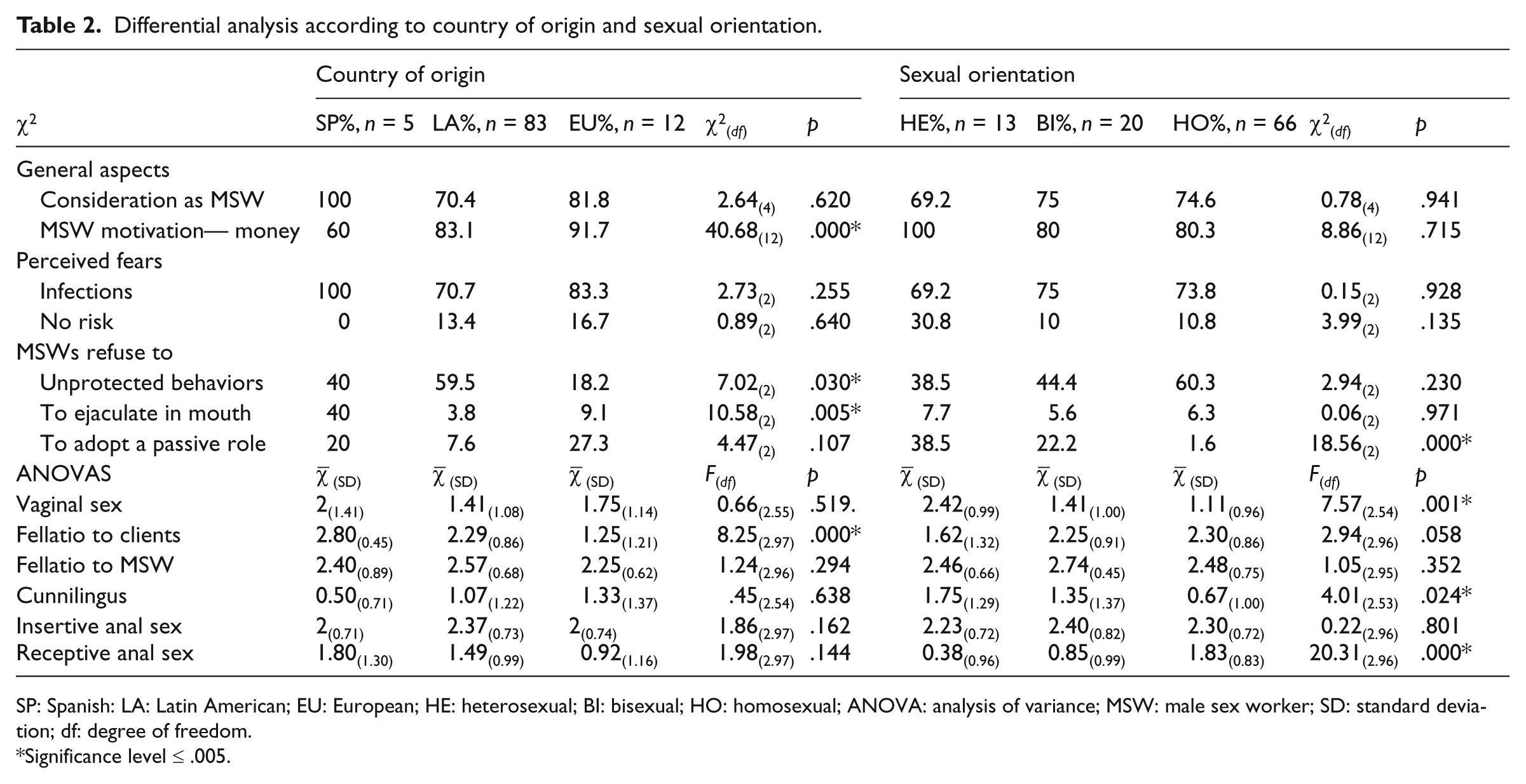
SP: Spanish: LA: Latin American; EU: European; HE: heterosexual; BI: bisexual; HO: homosexual; ANOVA: analysis of variance; MSW: male sex worker; SD: standard deviation; df: degree of freedom.
Significance level ≤ .005.
Educational level
First, there were no statistically significant differences by educational level in the following variables: self-perception as a sex worker (χ2 = 2.64; p = .856); the economic motivation for engaging in sex work (χ2 = 4.44; p = .974); perceived risks (fear of infections: χ2 = 1.35; p = .717; no risk: χ2 = 2.14; p = .543). Nonetheless, most of the times MSWs who perceived no risk in their profession had secondary school or university studies. In fact, STI risk perception decreased with an increasing educational level. With regard to behaviors that the MSWs refused to practice, there were some differences in responses to the following: “I refuse the client ejaculate in my mouth” (χ2 = 6.66; p = .084), where the higher percentage appeared in those participants with primary school education (none studies = 0%; primary = 20%; secondary = 1.7%; university = 5.9%), and in “not adopting a passive role with the client” (χ2 = 6.57; p = .087), which is also more common among those who have not had any type of education (no studies = 50%; primary = 10%; secondary = 5.2%; university = 17.6%). There were no differences in the variable “engaging in unprotected sexual intercourse” (χ2 = 2.69; p = .442).
Finally, ANOVA analysis showed no statistically significant differences by educational level in any of the behaviors analyzed. However, the frequency of receptive anal intercourse seemed to be more relevant (F = 2.29; p = .084). The MSW with lower educational level have never been penetrated by clients (none studies:
Country of origin
Because of the wide range of countries of origin, this variable was grouped into three categories: Spanish, MSWs from elsewhere in Europe, and Latin America. However, there were significant differences in their reasons for engaging in sex work (χ2 = 40.68; p = .000). Therefore, economic need is more common for the immigrants from Europe and Latin America (Table 2).
There are also statistically significant differences by country of origin in two services that the participants refuse to practice: “unprotected behaviors” (χ2 = 7.02; p = .030), which is more refused by the Latin-American and the Spanish MSWs, while the Europeans did it the least, and “ejaculating in the mouth of MSWs” (χ2 = 10.58; p = .005), which is more rejected by the Spanish and, contrarily, less refused by the Latin American.
We also found statistically significant differences in the frequency of client fellatio (F = 8.25; p = .000). The Spanish and Latin-American MSWs perform this behavior more often than the European MSWs.
Time worked as a MSW
Participants who had been engaged in sex work for more time acknowledged themselves as “MSWs” more frequently (r = 0.23; p = .026). There are not significant correlations according to general aspects about sex work, perceived fears, refused sexual behaviors, and the frequency of sexual behaviors with customers.
Predictive variables: Educational level, country of origin, sexual orientation and time as MSW
The percentage of variance explained by independent variables (educational level, country of origin, sexual orientation, and time worked as MSW) is very low for cunnilingus (9.9%), insertive (2.7%) and receptive (11.2%) fellatio, and insertive anal sex (2.5%). Regarding vaginal sex (24.3%) and receptive anal sex (29.2%), the percentage of variance explained is higher. Moreover, the results show that “country of origin” predicts the frequency of receptive fellatio (B = −0.88; p = .005), and “sexual orientation” predicts the frequency of cunnilingus (B = −0.60; p = .015), vaginal sex (B = −0.75; p = .000), and receptive anal sex (B = 0.80; p = .000). Spaniards are more likely to engage in insertive fellatio and heterosexual MSW in cunnilingus and vaginal sex, while they could carry out receptive anal intercourse less frequently.
On the other hand, the percentage of variance explained for variables analyzed by logistic regression is low (infection fear = 7.7%; no risk perceived = 11.7%; refuse unprotected behaviors = 14.3%; refuse ejaculation in mouth = 8.3%). The exception is refusing a passive role with clients in which the percentage is 28.7 percent. Moreover, bisexual MSWs perceived less risk during sex work (odds ratio (OR) = 6.89; p = .027).
Discussion
This study has contributed to our knowledge about apartment MSWs in Spain. As West and De Villiers (1993) indicated in street MSWs, our research found a large heterogeneity among men engaged in sex work in apartments managed by a third party. Despite these differences, we observed some common points among the apartment MSW population. In terms of demographic characteristics, as in other studies (Meng et al., 2010; Minichiello et al., 2002; Zaro et al., 2007), these MSWs were young men and most of them were homosexuals. In Spain, some publications have shown that most of men engaged in sex work are immigrants, especially from Latin America, East of Europe, and Arab countries (Belza et al., 2001; Secretaría del Plan Nacional sobre el Sida (SPNS), 2005; Zaro et al., 2007). In our investigation, although most of the MSWs are immigrants, they were from Brazil and other Latin-American countries, and we have not found any sex worker from Arab countries.
On the other hand, we have analyzed other personal characteristics that had not been studied before in Spain. For example, MSWs presented a medium education level and most of the participants were Catholics. Considering these variables could be important, because culture, religion, or sexual orientation may influence attitudes and behaviors related to HIV prevention (SPNS, 2005; Zaro et al., 2007) and sexual behaviors in general (Padilla, 2008). Therefore, it is important to take into account these cultural differences in health and social prevention and intervention programs with MSWs.
Sex work provides incomes quickly (Allman, 1999; Harcourt and Donovan, 2005; Jordan, 2005). As in other studies (Ballester and Gil, 1996; Mimiaga et al., 2008; Uy et al., 2004; West and De Villiers, 1993), we found that the main motivation for starting and continuing to engage in sex work is economic. For that reason, their time working as a sex worker is longer than they expected. Perhaps, this situation is related to the high level of illegal immigration associated with the sex trade. On the other hand, economic factors play an important role in determining sexual behaviors with clients (Smith and Seal, 2007).
The main fear associated with sex work is the risk of a possible infection, and especially HIV. According to their responses, MSW refuses to perform sexual behaviors that involve a real risk of infection, such as penetration without a condom. However, this type of result might be related to the internalization of the institutional discourse about condom use, as Zaro et al. (2007) indicated, and unprotected sex could be more common than they have acknowledged. A possible tendency to underreport some socially unacceptable information could compromise self-reported condom and HIV testing (McCabe et al., 2011; Sackett, 1979). For this reason, asking about the frequency of certain behaviors might be more useful than investigating alleged condom use (Mariño et al., 2003). As for the influence of certain personal variables on behavior and sexual attitudes of MSWs, we found that educational level does not influence the type of sexual practices that are engaged in with clients.
Regarding the country of origin, immigrant MSWs undertake sex work for economic reasons more frequently than Spaniards. If we pay attention to Latin Americans, they also reported their illegal status in Spain as a motivation for starting in sex work. European immigrants do not mention this reason probably because they are European Union (EU) citizens and do not have problems with their residence in Spain. In addition, Spanish and Latin-American MSWs refuse to perform unsafe sex more often than the others, and European MSWs perform unprotected oral sex more frequently. Some previous studies have suggested that morality and culture associated with the country of origin may lead to avoidance of certain sexual behaviors (Belza et al., 2001; Zaro et al., 2007).
In our study, we observe that Spanish and Latin-American sex workers engage in unprotected behaviors less than European immigrants. Moreover, Spaniards reject client ejaculation in their mouth more frequently. On the other hand, Latin American adopt a passive role with clients more easily than the others. Moreover, we have seen that country of origin could predict receptive fellatio with clients. So, more research about the role of culture, religion, and moral differences on sexuality and sexual risk behaviors is required. Some cultural values may influence on sexual behaviors or roles such as “to be always the man and maintain a masculine social reputation” (Padilla, 2008).
Concerning the length of time worked, our research showed that those MSWs who have worked as a sex worker for a long time are more ready to acknowledge themselves as “MSWs.” Although the “time worked as a sex worker” was not found to influence unprotected intercourse with clients or warning the client about ejaculating in the mouth of MSWs, MSWs could internalize more easily how to manage risky behaviors because they have a greater knowledge about clients’ wishes and demands.
Furthermore, in our regression analyses, educational level or time worked as a MSW did not predict sexual behaviors with clients or fears during sex work. But sexual orientation seems to be an important variable when we analyze sexual behaviors and risk perceived in sex work. In this sense, heterosexual MSWs could engage in vaginal penetration and oral sex with women more probably than bisexuals and homosexuals, while homosexuals could carry out receptive anal sex more frequently. Bisexual MSWs perceived less risk of sex work. In Spain, sexual risk behavior programs with MSWs are organized by lesbian, gay, transsexual, and bisexual associations. Therefore, the implication of other general social and health organisms is necessary because nonhomosexual MSWs could identify themselves with other institutions more deeply.
Therefore, our study presents some implications, although some limitations should also be considered. First, we focused on MSWs working in an organized apartment, but this can help us to compare our results with other studies with MSWs offering their services in open-air venues such as streets. As a consequence, possible differences among the interventions for each group could be established. Apartments were chosen because of the lack of information about MSWs who offer their services there. However, there are no formal data in Spain on how many men are engaged in sex work and how many work in any particular venue (street, bars, saunas, apartments, and so on). Second, the study findings are the product of the subjectivity and self-reporting of behavior and experience by the MSW participants. For this reason, comparing their information with the reports of clients would be appropriate. However, this is a very difficult task because clients are afraid of being recognized due to the stigma associated with this activity (Pinedo, 2008). So they are reluctant to participate in this type of research. In addition, the instrument was an interview and not a validated questionnaire. Finally, the number of participants was problematic for some analyses. Probably, adding more immigrant MSWs, who require the assistance of the interviewer because of their language, and the possibility of obtaining further information, would make this research more enriching. Nevertheless, the access of all the apartments in the geographical area in which the study took place shows the reality of men engaged in sex work in Spain.
Summarizing, the wide individual differences within the group of MSWs must be considered in designing and carrying out programs for health-care access, such as HIV prevention. Related to the implementation of these programs, more experienced MSWs could play a key role to prevent risky sexual behaviors (Mariño et al., 2003). Moreover, given the differences in sexual orientation among MSWs, sexual risks must be analyzed depending on the behavior or on the role adopted. Therefore, safe-sex negotiating, communications skills or rational decision-making, that can be learned easily, should be included in prevention programs among MSWs (Bloor et al., 1993; Mariño et al., 2003). Given the differences between street and agency MSWs, specific strategies, programs, and materials should be developed. Moreover, coordinated community projects are needed among this population, especially with illegal immigrants who have more difficulty accessing social and health resources.
Footnotes
Acknowledgements
The authors appreciate the involvement of the participants in this research, MSW’s and the manager flats, but also the collaboration of Damián Albiach and Col.lectiu Lambda Valencia (Spain).
Funding
This research received no specific grant from any funding agency in the public, commercial, or not-for-profit sectors.