



Abstract
The purpose of this study was to test two models of the impact of mental health stigma on both attitudes toward seeking psychological help and physical health. General self-efficacy, self-esteem, and anxiety were tested as potential mediators of these two relationships. A sample of adults (N = 423) aged 18–72 years was surveyed using the participant pool of a large, distance learning university. Structural equation modeling results indicated that mental health stigma directly and indirectly influenced treatment attitudes and physical health. Internal self-variables mediated the relationship between mental health stigma and both study outcomes.
Introduction
It is well established that mental illness has deleterious personal, social, and economic consequences for individuals, families, and society (Gadermann et al., 2012; Kessler et al., 2009; Levinson et al., 2010; Parks et al., 2006). Mental health stigma (MHS) can be seen as the result of a complex social cognitive process. First, an individual’s mental health status is perceived through observable cues leading the observer to deem an individual mentally ill (Bandura, 2001; Corrigan, 2004; Goffman, 1963; Pescosolido et al., 2008; Quinn and Chaudoir, 2009). The observer then forms stereotypes or negative expectations about the identity of the individual with mental illness (e.g. “this mentally ill person is dangerous”). These social cognitive events, therefore, contribute not only to the given individual’s stigmatized status and but also strengthen the observer’s stereotype about all individuals with mental illness (e.g. “mentally ill people are dangerous”). The presence of these observer stereotypes can, in turn, lead to prejudice and discriminating behavior (Corrigan, 2004; Corrigan and Kleinlein, 2005; Goffman, 1963; Pescosolido et al., 2008).
Research indicates that stigma is a broad concept that has been internationally identified and shown to impact many different identities and life domains. For example, Ranjbar et al. (2016) demonstrated that HIV-related stigma can be intensified when HIV patients share HIV-related information with caretakers. Stevens et al. (2017) found that weight stigma significantly mediates the relationship between physical, weight-related variables and mental health symptoms. Sublette et al. (2017) found that stigma surrounding infection with Hepatitis C served as a treatment barrier for patients and healthcare providers alike. Finally, Pescosolido et al. (2008) reported MHS in a sample of five European countries, a finding that has been corroborated well beyond Europe (Aromaa et al., 2011; Park et al., 2015; Patten et al., 2016; Reavley and Jorm, 2011). Current research indicates that MHS is a growing impediment not only to mental health treatment (e.g. Ando et al., 2013; Corrigan et al., 2014) but also to physical health (PH; e.g. Corrigan et al., 2014; Happell et al., 2012; Henderson et al., 2014). Despite support for these bivariate relationships, few researchers have tested potential mediators of these relationships.
MHS and mental health treatment seeking
Fewer than half of all individuals living with a diagnosable mental illness actually seek treatment for their mental health issues. Among those who do, a significant proportion seek suboptimal care and/or do not fully adhere to the protocol or duration of their prescribed treatment regimens (Kessler et al., 2005b). While there are many empirically supported barriers to mental health treatment seeking (e.g. Clement et al., 2015; Sickel et al., 2014), MHS has emerged as one of the most significant obstacles to mental health in the last decade (Corrigan, 2004; Corrigan et al., 2014; Lannin et al., 2016; Mojtabai et al., 2011; Perese, 2007). This research is largely limited to clinically diagnosed populations, populations with more severe forms of mental illness and does not measure potential mediators in the stigma–treatment relationship (Fung et al., 2008; Verhaeghe et al., 2010).
MHS and PH
There is growing recognition of the importance of the mental health-PH relationship. Prince et al. (2007) conducted a global review examining potential relationships between mental health and PH and reported that 14 percent of global PH conditions correlate with psychiatric disorders. Researchers have found MHS to be linked to elevated cortisol, increased blood pressure, hypertension, sick days, experiences of chronic pain, and general measures indicating poor PH (Bahm and Forchuk, 2008; Major and O’Brien, 2005). Quinn and Chaudoir (2009) found that having visible or nonvisible stigmatized identities in a nonclinical sample of university students was related both directly and indirectly to poor self-reported PH. Their findings further demonstrate the potential implications for MHS in what might be considered a more general population and suggest that use of mediational analyses in understanding the potential impact of MHS on mental and PH outcomes relative to self-variables is feasible.
Potential mediators: self-esteem, self-efficacy, and anxiety
Consistent with the social cognitive theory (Bandura, 2001) and the stigma process of social identification and internalization, it is logical that self-variables may act to modulate the impact of MHS (Corrigan, 2004; Goffman, 1963; Pescosolido et al., 2008). A number of studies found that self-stigma mediates between public stigma and treatment-seeking attitudes (Bathje and Pryor, 2011; Brown et al., 2010; Jennings et al., 2015; Vogel et al., 2007). Consequently, there may be other self-variables that mediate the MHS and treatment seeking/PH relationships. Quinn and Chaudoir (2009) found that stigma qualities demonstrating personal relevance (e.g. salience and centrality) acted as mediators in the stigma–health relationship. Self-esteem and self-efficacy have consistently correlated with MHS, indicating the potential for these variables to serve as unique explanatory mechanisms within the MHS-mental health/PH relationship. Among studies that have examined these variables, MHS has been found to decrease self-esteem and self-efficacy and increase anxiety (Link et al., 2001; Rodrigues et al., 2013; Watson et al., 2007). What remains less understood is whether the self-variables self-esteem, self-efficacy, and anxiety mediate between the relationships between MHS and outcomes such as treatment seeking and PH in a general population.
Present research
Existing research has shown that MHS directly influences both treatment-seeking attitudes and PH as well as certain self-variables such as self-esteem, self-efficacy, and anxiety. Consistent with social cognitive theory and with the understanding that limited empirical testing has been conducted, we propose that these self-variables may mediate the MHS-outcome relationships. Existing literature is also limited in that the vast majority of studies have been conducted with more severe mentally ill populations (e.g. Fung et al., 2008). As the majority of people with mental illness suffer from conditions other than schizophrenia and that are considered in the mild-moderate range of severity, this is an important gap in the literature (Kessler et al., 2005a). While there is support for the relationships between MHS and both treatment seeking and PH, no theoretical models specifying the interrelationships between these and potential mediating variables (anxiety, self-efficacy, and self-esteem) have been proposed and/or tested. This study was conducted to develop and test two structural models, one predicting attitudes toward seeking mental health treatment (Figure 1) and the other predicting participants’ self-reported PH symptoms (Figure 3). Study hypotheses were (1) MHS directly influences both mental health treatment seeking and PH, (2) anxiety mediates the relationships between MHS and both treatment seeking and PH, (3) self-esteem mediates the relationships between MHS and both treatment seeking and PH, and (4) self-efficacy mediates the relationships between both treatment seeking and PH.

Hypothesized model predicting ATSPH.
Methods
Participants and procedure
This study was approved by the institutional review board of a large online university. This study was part of a larger cross-sectional, quantitative design utilizing Internet survey methodology. For inclusion, participants needed to read and complete computer generated surveys and were aged 18 years and over. Because the number of participants recruited was based on meeting the power requirements for the proposed structural equation modeling, the guidelines of Stevens (1996) were used. Stevens (1996) stated that for each construct, direct pathway, and error pathway included in a structural model, there should be a minimum of 15 participants. In the proposed models, the greatest number of constructs being tested is six with eight direct pathways and eight error pathways. As such, a minimum of 330 participants would need to be recruited for sufficient statistical power.
Data were collected between spring 2010 and spring 2012. Participants provided informed consent and completed an online survey via Survey Monkey that included data collection for all study measures. Online measures to assess MHS, mental health, and attitudes toward mental health have been reliably utilized in a number of previously published studies (e.g. Lyons et al., 2015; Wynaden et al., 2014). The survey protocol took approximately 40–60 minutes to complete. Following survey completion, participants were provided with an online document that described information about the study, thanked them for their input, and provided contact information for mental health services if they desired to speak to someone. Participants were also able to indicate whether they would like to learn of the results generated from this study. A total of 471 adults were surveyed using the participant pool of a large, American-based, online university population consisting of students and faculty.
Missing data were examined. Cohen and Cohen (1983) suggest that missing data of 10 percent or less is generally acceptable for similar analyses. Participants with missing data >10 percent missing data were eliminated; however, prior to eliminating these variables, t-tests were conducted to identify significant group differences between complete cases and those with missing data. None were identified. An additional consideration regarding missing data is the guidelines of Kline (1998) which state that missing cases for structural equation modeling (SEM) should be handled in one of the two ways: deletion or some form of imputation. After removal of missing data, a total of 423 remained. Sample characteristics are presented in Table 1.
Sample demographic data for categorical study variables.
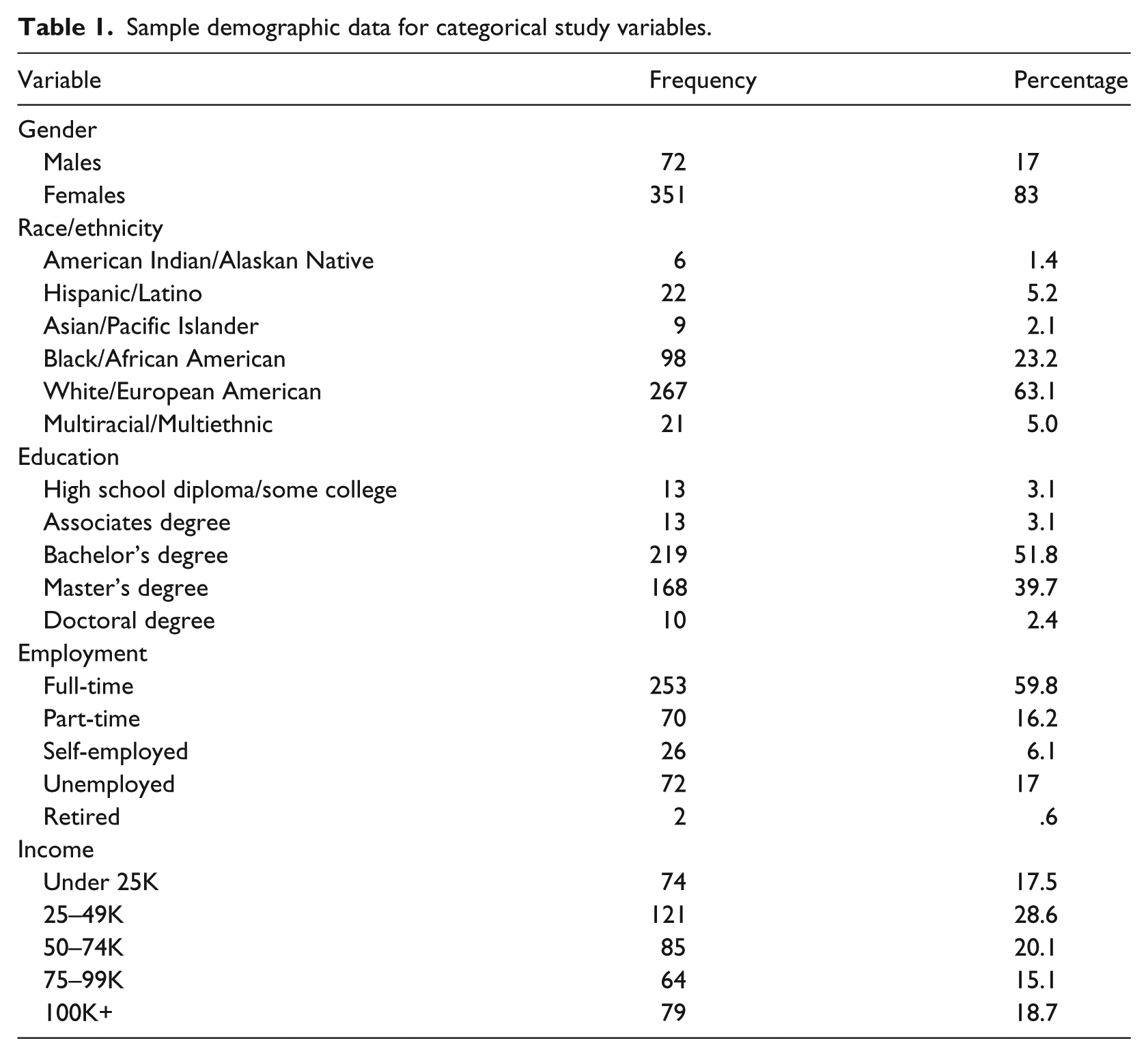
Overall, the majority of participants were female (83%), and the sample was relatively diverse with the majority of participants identifying as White/Caucasian (63%). The majority of participants was employed full-time (59.8%) and had earned at least a bachelor’s degree (51.8%). The majority of participants earned below US$74,000 annually. Continuous data sample characteristics are presented in Table 2. As seen in Table 2, participant age was fairly well dispersed and ranged from 18 to 72 years (M = 36.06 years; standard deviation (SD) = 7.22 years).
Means, standard deviations, and bivariate correlations for continuous study variables.

SD: standard deviation; ATSPH: attitudes toward seeking psychological help; RSE: Rosenberg Self-Esteem; MHS: mental health stigma; PH: physical health; GSE: General Self-Efficacy; BAI: Beck Anxiety Inventory.
p < .05; **p < .01; ***p < .001.
Measures
MHS
The Self-Stigma of Mental Illness (SSMI) Scale (Corrigan et al., 2006) assessed four constructs: stereotype awareness, stereotype agreement, stereotype self-concurrence, and self-esteem decrement, all proposed to represent dimensions of self-stigma. A sample item is “I think most persons with mental illness are to blame for their problems.” The response format for questions ranges from “1” (strongly disagree) to “9” (strongly agrees). Respondents could choose a response of “5” (neither agrees/nor disagrees). The total stigma score was used, and the internal consistency for the present data was excellent, α = .92.
Attitudes toward seeking professional psychological help
The Attitudes toward Seeking Professional Psychological Help Scale–Short Form (ATSPPHS-SF; Fischer and Farina, 1995) is a 10-item scale. A sample item is “The idea of talking about problems with a psychologist strikes me as a poor way to get rid of emotional conflicts.” The 4-point response format ranged from disagrees to agree with some items reverse scored. Internal consistencies reported by scale and previous authors ranged from .73 to .80; the internal consistency score for the present data was good at α = .83.
PH
The SF-36 (Ware, 2004) is a 36-item inventory measuring generalized physical and mental health, well-being, and functional impairment using eight scales (physical functioning, role-physical, bodily pain, general health, vitality, social functioning, role-emotional, and mental health). Because the focus of this study was specific to PH, only the physical functioning, role-physical, and bodily pain scales were used for these analyses. Questions contain varying response formats depending on the question. A sample item is “Does your health now limit you in these activities? If so, how much?” with 3-point response format ranging from yes, limited a lot to no, not limited at all or “How much bodily pain have you had during the past 4 weeks?” with 6-point response format ranging from none to very severe. The internal consistency scores by scale and previous authors over .70. The internal consistency scores for the scales used in this study were excellent with α = .91 and .93 and good at .81, respectively.
General self-efficacy
The General Self-Efficacy (GSE) Scale (Schwarzer and Jerusalem, 1995) is a 10-item scale measuring overall self-efficacy and scores ranging from 10 to 40. Higher scores indicate higher GSE. A sample item is “I can always manage to solve difficult problems if I try hard enough.” The 4-point response format ranges from “1” (not at all true) to “4” (exactly true). The internal consistency scores reported by scale authors ranged from .78 to .89; the internal consistency score for the current data was good at α = .87.
Self-esteem (Rosenberg Self-Esteem)
The Rosenberg Self-Esteem (RSE) Scale is a 10-item measure of global self-esteem (Rosenberg, 1989). Scores on this scale range from 0 to 30 with higher scores indicating higher self-esteem. A sample item is “I am able to do things as well as most other people.” The 4-point response format ranges from “0” (strongly disagree) to “3” (strongly agree). The internal consistency scores reported by scale and subsequent authors ranged from .89 to .91; the internal consistency score for the current data was excellent at α = .91.
Anxiety (Beck Anxiety Inventory)
The Beck Anxiety Inventory (BAI) is a 21-item anxiety that measures the severity of anxiety (Julian, 2011; Steer et al., 2007). Scores on this scale range from 0 to 63. Suggested interpretation of BAI scores includes 0–9 (normal/no anxiety), 10–18 (mild/moderate anxiety), 19–29 (moderate/severe anxiety), and 30–63 (severe anxiety; Julian, 2011). Each item rates on a 4-point scale ranging from “0” (not at all) to “3” (I could barely stand it). A sample item is “Fear the worst happening.” The internal consistency scores from scale authors were above .90; the internal consistency score for these data was excellent at α = .92 (Steer et al., 2007).
Results
In this study, we developed and tested two possible theoretical models predicting the interrelationships between self-reported MHS and individual’s attitudes toward mental health treatment seeking as well as self-reported MHS and self-PH. Structural models were developed in conjunction with existing theory and tested using EQS 6.2 (Bentler, 2006).
Preliminary analyses
A Spearman bivariate correlation matrix was computed to assess the demographic variables that were significantly associated with the two main dependent variables of the study (Nehra et al., 2014; Pyne et al., 2004; Rosenthal and Rosnow, 1996; attitudes toward seeking psychological help (ATSPH) and PH; Table 2). Only participant gender was found to be significantly associated with ATSPH and was retained as a covariate in subsequent tests of both models.
Main analyses
Model 1—predicting attitudes toward mental health treatment seeking
In model 1, we sought to test the direct and mediated effects of MHS on attitudes toward mental health treatment seeking (ATSPH). In this model, MHS served as the exogenous predictor variable, while self-esteem, self-efficacy, and participant anxiety served as endogenous mediating variables. Participant gender served as a covariate (Figure 1). In addition to assumptions about missing data, three other key assumptions of SEM were tested. First, we assessed linearity using the method suggested by Kline (1998) by examining bivariate scatter plots of the main independent and dependent variables. All assessed variables exhibited linear (homoscedastic) trends in subsequent scatter plots. Next, we examined multivariate normality. Tests of multivariate normality indicated slight nonnormality in the data (Mardia’s = 5.49). As such, all mediating variables were centered using a mean centering process described by Kline (1998). Additionally, the five cases with the most significant outliers were identified and removed bringing the final sample for the purpose of inferential analyses to N = 418. SEM has been demonstrated to be relatively robust to slight transgressions of multivariate nonnormality (Bentler and Chou, 1987). Finally, SEM typically requires a sample size minimum of at least 100 participants (Kline, 1998), but 200 participants are seen as the general standard for SEM studies (Kenny, 2015).
SEM analysis with EQS software commonly includes review of the chi-square index, the root mean square error of the approximation (RMSEA), and the comparative fit index (CFI) along with confidence interval (CI; Kenny, 2015). Hooper et al. (2008) caution about the temptation to provide too many indices of fit as this can be cumbersome and confusing for readers. They advocate for the use of the chi-square plus the following combination (CFI and RMSEA) and the standardized root mean square residual (SRMR).
Analysis of the initially hypothesized model indicated that the model was not a good fit to the data (χ2(7) = 256.44, p < .001, CFI = .25, RMSEA = .29, SRMR = .171, CI = .262–.323). Because the goal of this study was to develop and test original models predicting attitudes toward mental health treatment seeking, we sought to re-specify the original, poorly fitting model, and this process is described below.
Re-specified model 1
In particular, three issues with the initially specified model were identified and considered in the re-specification process. First, as can be seen in the bivariate correlations, participants’ levels of self-esteem (RSE) and GSE were highly correlated. As such, their respective error terms were also found to be highly correlated. Further testing revealed that inclusion of RSE into the model failed to predict additional variance in ATSPH above and beyond GSE and that the path from RSE to ATSPH was minimally significant. This was confirmed with Wald testing which identified the pathway from RSE to ATSPH to be dropped—eliminating RSE as a mediating variable. Finally, significant paths from the covariate (gender) were also added. The resulting modifications were consistent with theory and were largely consistent with our original predictions. The re-specifications resulted in a model that was better fitted to the data (χ2(2) = 7.91, p = .02, CFI = .95, RMSEA = .084, SRMR = .039, CI = .029–.149). Overall, the model accounted for 8.4 percent of the variance in attitudes toward treatment seeking (Figure 2). To ensure the accurate temporal ordering of our proposed variables, we tested an alternate model based on the guidance of Kline (2005) by switching the positions of the mediating and dependent variables. The resulting model substantially declined in fit from our revised original model, as expected, suggesting that our proposed temporal ordering was appropriate (χ2(2) = 54.41, p < .001, CFI = .58, RMSEA = .25, SRMR= .090, CI = .195–.308).
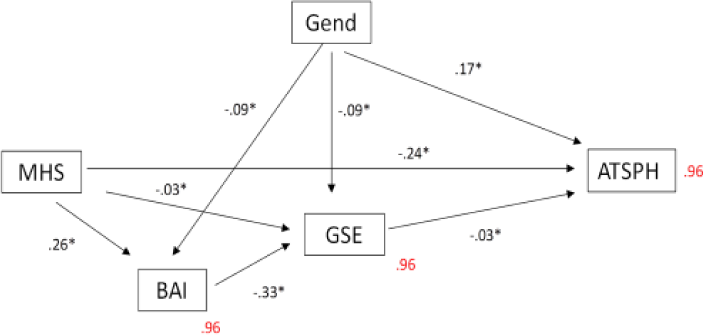
Re-specified model predicting ATSPH.
Model 2—predicting PH symptoms
In model 2, we sought to test the direct and mediated effects of MHS on individuals’ ratings of PH. As with model 1, MHS served as the exogenous predictor variable, while self-esteem (RSE), GSE, and anxiety (BAI) served as endogenous mediating variables. Finally, the physical symptom subsection of the SF-36 (PH) served as the endogenous dependent variable. Again, participant gender was included as a covariate. As with model 1, the data were slightly skewed at the multivariate level (Mardia’s = 6.00). Consistent with model 1, all mediating variables in model 2 were mean centered using the process described in Kline (1998). The originally hypothesized model predicting PH systems was tested using SEM, and this model did not prove to be a good fit to the data (χ2(9) = 243.65, p < .001, CFI = .27, RMSEA = .266, SRMR = .171, CI = .237–.294; Figure 3).
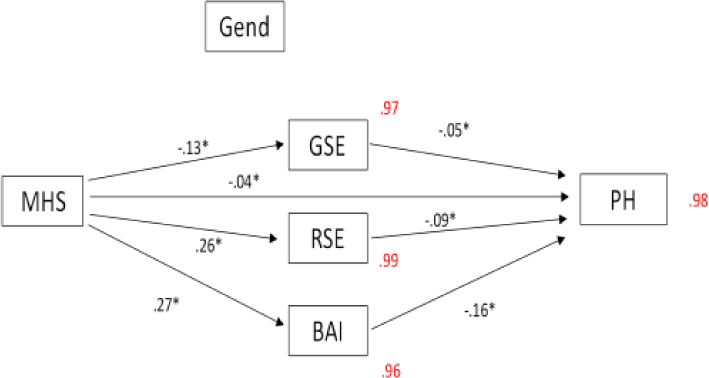
Hypothesized model predicting PH.
Based on the lack of fit in hypothesized model and the goals of this study, model re-specification was undertaken. Modifications to the originally proposed model were made only when consistent with existing theory or when the modifications made intuitive sense based on the originally hypothesized relationships.
Re-specified model 2
A significant issue with the hypothesized specification of model 2 was the high degree of multicollinearity between several of the mediating variables. Additionally, several proposed mediating pathways between MHS and PH including RSE-PH, GSE-PH, and BAI-PH were not found to be statistically significant. Interestingly, only the pathway of MHS-BAI-PH was found to be statistically significant. The resulting, re-specified model was a better fit to the data and was consistent with existing theoretical expectations (χ2(2) = 1.58, p = .45, CFI = 1.0, RMSEA = .001, SRMR = .020, CI = .000–.090). Overall, the model accounted for 5 percent of the variance in PH (Figure 4). As with our first model, an alternate model was tested to determine whether our proposed temporal ordering of variables was appropriate. The alternate model was a poorer fit to these data (χ2(2) = 31.05, p = .000, CFI = .52, RMSEA = .19, SRMR = .090, CI = .132–.247), suggesting the proposed variables were appropriately ordered.

Re-specified model predicting PH.
Discussion
We sought to test two models predicting the impact of MHS on treatment-seeking behavior and PH symptoms within a sample of participants from a general population. Although research on MHS and its consequences is growing (Corrigan et al., 2015; Ilic et al., 2013; Link et al., 2015), few of these studies have developed and tested models predicting MHS effects. Furthermore, despite MHS being widely prevalent within the general population (Parcesepe and Cabassa, 2013), few studies have assessed MHS and its consequences within the general population. This study is the first known to develop and test mediational models to further understand the relationships between MHS, attitudes toward treatment-seeking behavior, and PH symptoms in a general population.
The models tested indicate that MHS does play a significant role in predicting these outcomes but that the relationships between these variables are likely nuanced. In the case of mental health treatment attitudes, MHS appears to have both direct and partially mediated effects on ATSPH. Specifically, as ratings of MHS increased, attitudes about treatment seeking became more negative (Figure 2). Additionally, as MHS became more severe, participants reported greater amounts of anxiety and lower levels of GSE. Each of these factors, in turn, was significantly associated with treatment-seeking attitudes (Figure 2). While the overall amount of variance in treatment-seeking attitudes explained by our revised model was low, the findings provide initial evidence for critical factors that may be influencing individuals’ attitudes about seeking mental health treatment.
We also sought to determine what effects MHS would have on the PH symptoms. In the same fashion as our previous model, we tested whether MHS contributed to direct and/or mediated effects on participants’ reports of PH symptomatology. As can be seen in the revised model (Figure 4), the impact of MHS on PH symptoms was less clear, with no direct effects on PH. Instead, it appears that the effects of MHS on PH symptoms are likely at least partially mediated by participants’ reported levels of anxiety. Here again, the total amount of variance accounted for in PH was low but should not be discounted.
These findings are consistent with social cognitive theory more generally (Bandura, 2001) which states that individuals are active participants in understanding their identity relative to social forces and with social identity theory (Goffman, 1963) and self-stigma theory (Corrigan, 2004) in particular. These theories collectively indicate that individuals with a mental health problem look outward for social validation/repudiation of their identity. Internalization of social values regarding mental health is internalized and applied to the self, here, in the form of MHS. Our findings suggest that an individual’s attitudes toward mental health may impact both subsequent internal state and self-assessment which, in turn, impacts attitudes toward mental health treatment seeking and PH. Findings are consistent with previous work examining MHS relative to treatment seeking. Jennings et al. (2015) found support for the mediational role of self-stigma in the stigma–treatment attitude relationship such that higher stigma related to higher self-stigma which, in turn, related to more negative attitudes toward treatment seeking. Pedersen and Paves (2014) found increased public stigma related to negative attitudes toward treatment. These authors also found that female participants reported higher public stigma.
These theories have previously been applied toward examination of PH (Ford et al., 2015; Ng et al., 2008). Hunger et al. (2015) specifically proposed a model in which social identity threat directly and indirectly impacts not only mental health but also PH. Our findings regarding the potential impact of MHS on PH are supported by current research. Ai et al. (2014) found that more positive racial/ethnic identity had a positive impact on both mental health and PH. O’Donnell et al. (2015) found that greater anticipated MHS was associated with increased psychological distress and PH problems. Our findings support earlier work by Quinn and Chaudoir (2009) who found that having visible or nonvisible stigmatized identities in a nonclinical sample related both directly and indirectly to poor self-reported PH.
There are limitations to the current research. Many of the measures used in this study (e.g. GSE and anxiety) were global measures of these constructs and may not have been sufficiently sensitive to capture the true range of participants’ reported outcomes on these constructs (Bandura, 1989; Nelson et al., 2015). Second, the cross-sectional nature of these data may have impacted the sensitivity of our study. While numerous psychological studies have successfully employed and published findings based on using SEM with cross-sectional data (see MacCallum and Austin, 2000), the utility of such studies to infer temporal relationships between variables may be limited. As such, future researchers should seek to employ longitudinal, repeated measures designs to test these current findings. Finally, this study measured treatment attitudes instead of treatment behavior or behavioral intentions which some researchers may find a limitation. Within social-psychological research, the measurement of behavior is understood to be imperfect and multifaceted (Zemore and Ajzen, 2014). Attitudes are commonly understood to be one element impacting behavior.
Implications: research and practice
The results from this study suggest several potential paths for future research. First, given the large numbers of individuals having a mild-moderate mental disorder who may or may not receive treatment (Kessler et al., 2005a, 2005b), future studies should attempt to replicate this study’s findings with additional, more diverse general populations.
In order to obtain a more comprehensive understanding of exactly how MHS impacts physical and psychological health, future research on these outcomes should seek to expand assessment of PH more directly, such as by examining psychobiological markers (e.g. Hamer and Chida, 2011; Kyle et al., 2010; Olff et al., 1993), specific physical conditions, diseases, or related behaviors (Michaels et al., 2015) or using participant journaling of physical activity and health, a method shown to be useful for measurement of conditions susceptible to stereotype threat (Seacat et al., 2014).
The results of this study also suggest that anxiety may play a uniquely powerful role in impacting both PH and treatment attitudes and, therefore, may provide particularly valuable insights into PH and psychological health behavior. This finding is consistent with previous work (Rusch et al., 2009) examining how MHS may result in a stress response as well as research documenting the impact of anxiety on physical conditions (Eisner et al., 2010; Johnson et al., 2004). Our study also suggests that gender may have a unique relationship with treatment attitudes, and this finding is consistent with existing research and suggests further development regarding how pathways between MHS and treatment attitudes and PH may differ for male and female patients and providers (Fox et al., 2014; Hamberg, 2008; Ojeda and Bergstresser, 2008).
These findings suggest that individuals with mild or moderate mental health disorders who experience stigma may be seen and diagnosed by primary care providers rather than mental health providers (Shim and Rust, 2013). As such, primary care providers should routinely screen for mental distress to provide needed mental health referrals particularly when there is evidence of stigma related to addressing the mental distress. Conversely, the findings suggest that mental health professionals need to pay attention to the possibility of PH challenges in their clients with mild to moderate mental illness, particularly for those clients who display MHS (Birch et al., 2005; Graham et al., 2013).
In sum, this study finds that MHS has both direct and indirect relationships with mental health treatment-seeking attitudes and PH. Female participants reported significantly more positive attitudes toward mental health treatment, and internal variables, generalized self-efficacy and anxiety, can mediate the MHS-treatment attitudes. The MHS-PH relationship may be dependent on anxiety as a mediator. These findings expand current understanding of the potential pathways by which MHS can influence both mental and PH and begin to pave the way for a greater theoretical understanding of this important social-psychological phenomenon.
Footnotes
Declaration of Conflicting Interests
The author(s) declared no potential conflicts of interest with respect to the research, authorship, and/or publication of this article.
Funding
The author(s) disclosed receipt of the following financial support for the research, authorship, and/or publication of this article: This research was funded in part through a Walden University Presidential Research Fellowship (2009) # 03-05-10-0304050.