




Abstract
Although nature relatedness is considered a positive characteristic, its relationship to constructs involving worries about the negative effects of artificial environmental factors is also feasible. A questionnaire assessing modern health worries, electrosensitivity, somatosensory amplification, spirituality, and nature relatedness was completed by 510 individuals. Nature relatedness was related to electrosensitivity, modern health worries, and spirituality. In a binary logistic regression analysis, somatosensory amplification, modern health worries, and nature relatedness were associated with electrosensitivity, and nature relatedness moderated the connection between modern health worries and electrosensitivity. In naive representations, “natural” might be associated with health, whereas “modern” and “artificial” evoke negative associations.
Keywords
Introduction
In the last decades, worries about the possible harmful effects of modern technologies (e.g. environmental pollution or chemicals in food) have shown a considerable increase in the industrialized countries (Petrie et al., 2001). This phenomenon, called modern health worries (MHWs), is associated with higher levels of health anxiety and somatic symptoms, and a worse perceived health status (Andersen and Jensen, 2012; Filipkowski et al., 2010; Freyler et al., 2013; Indregard et al., 2013; Köteles and Simor, 2014a, 2014b; Rief et al., 2012). A proportion of these worries is certainly well founded. However, the objective risk to human health posed by these factors is often exaggerated in the mass media (Claassen et al., 2012; Huiberts et al., 2013; Litmanen and Tuikkanen, 2008; Petrie et al., 2001; Petrie and Wessely, 2002; Witthöft and Rubin, 2013). Consequently, somatic symptoms and diseases of unknown (i.e. medically not explainable) origin are more and more often ascribed to various environmental factors (Szemerszky et al., 2015a). For example, both subjective food sensitivities and perceived sensitivity to electromagnetic fields were found to be connected to MHWs in past studies (Dömötör et al., 2016; Lind et al., 2005).Electromagnetic hypersensitivity, or idiopathic environmental intolerance attributed to electromagnetic fields (IEI-EMF), refers to the propensity to experience unpleasant symptoms in the proximity of electrical devices and ascribe them to the presence of electromagnetic fields (Rubin et al., 2005; Seitz et al., 2005). IEI-EMF is a self-diagnosed condition with symptoms ranging from mild complaints to serious impairments in everyday functioning (Foster and Rubin, 2014). According to conservative estimates, it affects 1.5 to 8–10 percent of the general population (Foster and Rubin, 2014; Hillert et al., 2002; Levallois et al., 2002; Tseng et al., 2011). Although individuals with IEI-EMF attribute their complaints to various sources of electromagnetic fields, symptoms were not associated with actual exposure under double-blind conditions (Köteles et al., 2013; Röösli et al., 2010; Rubin et al., 2010; Szemerszky et al., 2015b). In fact, the believed presence of the EMF was a significant predictor of reported symptoms in several studies, thus providing support for the proposal that symptoms are a product of top-down processes (e.g. expectations or attribution) (Dömötör et al., 2016; Szemerszky et al., 2010, 2015b). As psychological processes play a crucial role in the development of the condition, identification of the predisposing and maintaining psychological factors seems to be an important step toward a complete understanding of the phenomenon.
Past studies have reported considerable differences between individuals with and without IEI-EMF concerning somatosensory amplification (i.e. the tendency to experience body sensations as intense, noxious, and disturbing), MHWs, health anxiety (the fear of having a serious illness), and body awareness (i.e. the disposition to monitor body sensations and changes) (Dömötör et al., 2016; Köteles et al., 2013; Szemerszky et al., 2010, 2015b). Unsurprisingly, the IEI-EMF phenomenon was characterized by higher levels of all of these trait-like characteristics. Additionally, the aforementioned psychological constructs are not independent of each other. For example, somatosensory amplification, health anxiety, and body awareness all relate to body focus (Abramowitz et al., 2007; Dömötör et al., 2016; Köteles and Doering, 2016), and MHWs are associated with somatosensory amplification and health anxiety (Köteles et al., 2011; Köteles and Simor, 2014a). Interestingly, MHWs are also connected with spirituality, a characteristic that is generally regarded as positive (Köteles et al., 2016a). Spirituality represents an intuitive way of thinking (MacDonald, 2000), usually associated with better coping and positive emotions, which lead to higher levels of well-being (Krok, 2008; Levine and Targ, 2002; Somlai and Heckman, 2000; Wheeler and Hyland, 2008). However, spiritual beliefs and experiences may become pathological (Crowley and Jenkinson, 2009). For example, following a false spiritual teacher or belonging to a so-called harmful spiritual group can lead to the acquisition of a false belief system (Crowley and Jenkinson, 2009). False beliefs usually exhibit the core features of spirituality, such as the feeling of connectedness and the perception of connections among seemingly independent phenomena (Wheeler and Hyland, 2008). As intuitive thinking is an automatic mode of information processing (Epstein, 2014; Pacini and Epstein, 1999), it can be triggered by any perceived similarity among the phenomena in question. According to Köteles et al. (2016a), modernity constitutes a meaningful similarity among the environmental factors categorized under the umbrella term MHWs, and this common feature leads to the overgeneralization of the health risks posed by the individual factors. Moreover, negative emotions triggered by increased worry support emotional (i.e. intuitive-experiential) information processing and inhibit rational thinking (Epstein, 2014). In conclusion, as individuals with IEI-EMF overestimate the objective hazards of electromagnetic exposure and show higher levels of worry, it seems reasonable to assume that they are also characterized by higher levels of spirituality.
Beyond spirituality, nature relatedness is another construct that is positively connected to happiness, vitality, positive affect, and satisfaction with life (Capaldi et al., 2014; Howell et al., 2011; Nisbet and Zelenski, 2013; Zelenski and Nisbet, 2014). Nature relatedness refers to the affective, cognitive, and experiential aspects of an individual’s connection to nature (Nisbet et al., 2009). The construct is based on the biophilia hypothesis (Wilson, 1984), which emphasizes the importance of the implicit bond between humans and the natural environment. In several empirical studies, living or natural components of the environment were found to support physical and mental health (Beauchemin and Hays, 1996; Kline, 2009; Raanaas et al., 2012; Ulrich, 1984), and the term nature-assisted therapy has been proposed (Annerstedt and Währborg, 2011). Although non-ionizing EMFs with certain frequency domains (e.g. geomagnetic field, electric field of the atmosphere, atmospherics, visible light, and infrared radiation) are present in the natural environment (IARC, 2002; Presman, 2013), they are generally affiliated with modernization in people’s minds. It is often assumed that the overall presence of electromagnetic exposure is a modern phenomenon with unknown health consequences (IARC, 2002; Valberg et al., 2007). Thus, it is reasonable to suggest that nature relatedness will show a connection to MHWs.
As mentioned, attribution plays a decisive role in the IEI-EMF phenomenon. Individuals with medically unexplained symptoms often try to find a reasonable cause for their complaints (Barsky and Borus, 1999), and possible targets for the attribution process are determined by the availability and accessibility of appropriate cognitive contents (Köteles et al., 2016b; Szemerszky et al., 2015b). MHWs are widely promoted by the mass media, which may shape an individual’s attributions, and thus explain the connection between MHWs and IEI-EMF (Witthöft and Rubin, 2013). Moreover, for those who feel an intimate connection to nature, perceived susceptibility to, and cognitive availability of artificial (i.e. unnatural) factors may be heightened. In other words, higher levels of nature relatedness might have an effect on the connection between IEI-EMF and MHWs.
The study presented here tests the following hypotheses: (1) individuals with IEI-EMF show higher levels of somatosensory amplification, MHWs, spirituality, and nature relatedness than those without IEI-EMF; (2) MHWs are positively associated with nature relatedness; and (3) the connection between IEI-EMF and MHWs is moderated by nature relatedness.
Methods
Participants
A non-representative community sample was used. Participants (N = 510; 74.7% female; age: 34.8 ± 13.12 years) were recruited from Hungarian Facebook pages that are thematically unrelated to either the IEI-EMF or MHW phenomenon. Typically, members of groups belonging to local communities (e.g. cities or sport associations) were asked to participate in the research. Participants were told that the goal of the research was to gain a better understanding of the connections among health, illness, and certain environmental factors. The questionnaire was completed on-line in Hungarian. Participants received no reward for their participation. The study was approved by the research ethics board of the university, and all participants signed an on-line informed consent form.
Questionnaires
Self-reported IEI-EMF was assessed using a yes-or-no question:
Many people experience unpleasant symptoms (e.g. headache, nausea, concentration problems, palpitation, etc.) when staying in the vicinity of electromagnetic fields (e.g. near electric devices, computers, electric power lines, or during mobile phone calls). This phenomenon is called electromagnetic hypersensitivity or electrosensitivity. Do you consider yourself to be electrosensitive? (Köteles et al., 2013; Szemerszky et al., 2015b)
Severity of IEI-EMF
Participants with IEI-EMF were asked to characterize the negative impact of the symptoms they experience on their everyday life (0 = no impact at all, 1 = some impact, 2 = medium impact, 3 = high impact) (Dömötör et al., 2016).
Nature relatedness was assessed using the short form of the Nature Relatedness Scale (NR-6) (Nisbet and Zelenski, 2013). The scale consists of six items measuring subjective connectedness to the natural environment using a 5-point Likert scale. Higher scores refer to greater perceived connectedness. Hungarian translation of the scale was conducted by two translators (R.Sz. and F.K.), and back-translation into English was completed by a third person. Finally, a native English speaking colleague compared the original and back-translated English versions, and the Hungarian translation was finalized based on her comments. Cronbach’s alpha coefficient of the scale in this study was 0.76.
The short version of Modern Health Worries Scale (MHWS) (Köteles and Simor, 2014b; Petrie et al., 2001) is a 10-item questionnaire that measures people’s concerns regarding various aspects of modernity that supposedly affect their health. Higher total scores refer to higher levels of MHWs. The scale showed good internal consistency (Cronbach’s α = 0.89).
Spirituality was measured using the Spiritual Connection Questionnaire Short Version (SCQ-14) (Köteles et al., 2016a; Wheeler and Hyland, 2008). The 14-item scale measures experience and beliefs related to spiritual connection, an aspect of spirituality that is consistent with both religious and non-religious interpretations. Higher scores refer to higher levels of spiritual connection. The scale showed excellent internal consistency (0.95) in the study.
Somatosensory Amplification Scale (SSAS) measures the tendency to experience a somatic sensation as intense, noxious, and disturbing (Barsky et al., 1990; Köteles et al., 2009). The 10-item questionnaire assesses sensitivity to unpleasant bodily sensations on a 5-point Likert scale, with higher scores referring to higher levels of amplification tendency. Cronbach’s α coefficient was 0.72 in this study.
Statistical analysis
Data were analyzed using the SPSS v20 software. According to the results of Shapiro–Wilk tests, SCQ-14 and NR-6 scores showed a significant deviation from normal distribution; therefore, non-parametric methods were used throughout the analysis. Homogeneity of the two groups with respect to gender ratio and age was checked using a χ2 test and a Mann–Whitney test, respectively. Connections among variables were estimated using Spearman’s correlation. With respect to SCQ-14, NR-6, SSAS, and MHWS scores, groups with and without IEI-EMF were compared using Mann–Whitney tests. Effect sizes were estimated using the r = |Z/√N| formula. Finally, a multiple binary logistic regression analysis was carried out with IEI-EMF as the criterion variable. To test the hypothesized moderation effect, MHWS and NR-6 scores were centered (i.e. means were subtracted from the individual scores), and an interaction term (i.e. the product of the two centered values) was calculated. In Step 1, socio-demographic control variables (age; gender: male = 0, female = 1) were entered, followed by SSAS (Step 2), centered MHWS (Step 3), and centered NR-6 (Step 4) scores. Finally (Step 5), the MHWS_x_NR-6 interaction term was stepped in.
Results
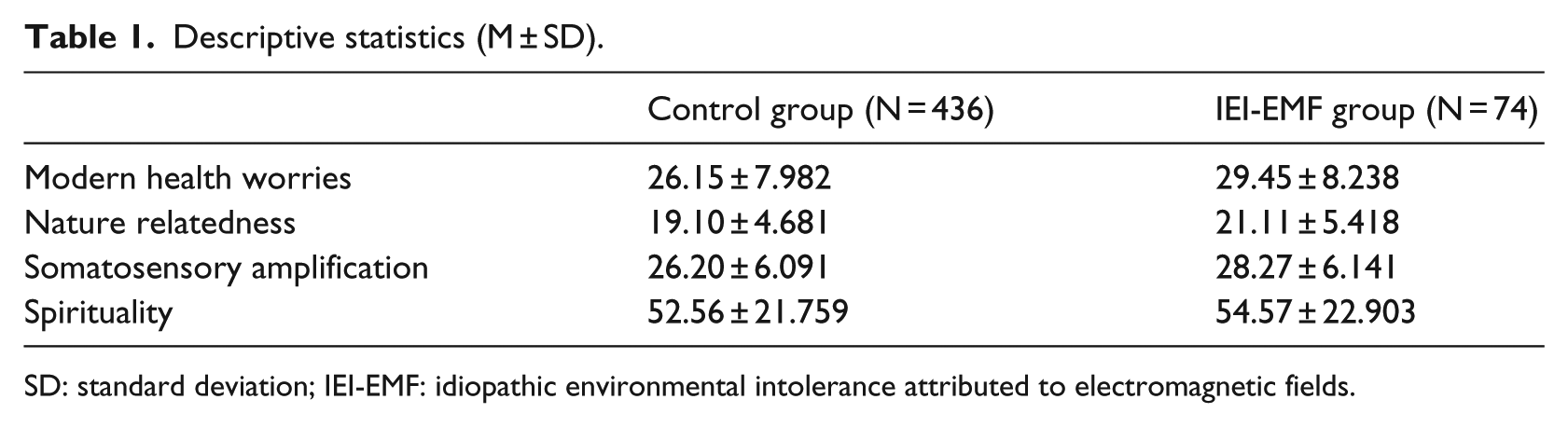
In total, 14.5 percent of participants (74 individuals) reported electromagnetic hypersensitivity. In the IEI-EMF group, mean impact of the condition on the everyday life was 0.74 ± 0.684, indicating low severity. There were no significant differences between the two groups with respect to gender ratio (χ2 = 1.156, p = 0.282) and age (Mann–Whitney U = 15,303, p = 0.479). Descriptive statistics of the assessed variables are presented in Table 1. In the correlation analysis, MHWS scores showed weak connections to SSAS (σ = 0.17, p < 0.001), SCQ-14 (σ = 0.12, p < 0.01), and NR-6 scores (σ = 0.18, p < 0.001), while a medium-level correlation (σ = 0.45, p < 0.001) between SCQ-14 and NR-6 scores was found. SSAS was not connected to NR-6 (σ = 0.01, p = 0.742) or SCQ-14 (σ = 0.04, p = 0.508).
Descriptive statistics (M ± SD).
SD: standard deviation; IEI-EMF: idiopathic environmental intolerance attributed to electromagnetic fields.
Mann–Whitney tests indicated a significant difference between the two groups regarding SSAS (U = 13,015.500, Z = −2662, p = 0.008, r = 0.118), MHWS (U = 12,602.500, Z = −3013, p = 0.003, r = 0.133), and NR-6 (U = 12,310.000, Z = −3.267, p = 0.001, r = 0.145) scores. The IEI-EMF group was characterized by higher values in all cases. No significant difference was found for SCQ-14 (U = 3114.500, Z = −0.461, p = 0.645).
In the regression analysis, SSAS, MHWS, and NR-6 scores showed independent contributions to IEI-EMF after controlling for participants’ gender and age (Table 2, Step 2–4). The interaction term was also significant in Step 5, which indicates a moderating effect.
Steps of the binary logistic regression analysis with IEI-EMF as the criterion variable (Exp(B) coefficients).

SSAS: Somatosensory Amplification Scale; MHWS: Modern Health Worries Scale; NR-6: Nature Relatedness Scale; MHWS_x_NR-6: interaction term; IEI-EMF: idiopathic environmental intolerance attributed to electromagnetic fields.
p < 0.05; **p < 0.01.
Discussion
In this cross-sectional questionnaire study, self-reported IEI-EMF was associated with MHWs, somatosensory amplification, and nature relatedness. MHWs were connected to nature relatedness, and nature relatedness moderated the relationship between IEI-EMF and MHWs.
The relationship between the Radiation sub-scale of the MHWS and IEI-EMF has already been established in past research (Dömötör et al., 2016; Köteles et al., 2013; Szemerszky et al., 2015b). As this sub-scale represents worries about the harmful effects of electromagnetic radiation, its ability to discriminate between individuals with and without IEI-EMF is explicable. In this study, however, a short version of the MHWS which represents the entire (i.e. much broader) construct was used. According to the present findings, individuals with IEI-EMF have a general tendency to worry about health risks posed by modern environmental factors.
The connection between IEI-EMF and somatosensory amplification was also demonstrated in past research (Dömötör et al., 2016; Köteles et al., 2013; Szemerszky et al., 2015b). Somatosensory amplification is characterized by the experience of symptoms (Duddu et al., 2006; Köteles and Doering, 2016; Nakao and Barsky, 2007) and a sensitivity to threat (Ferguson et al., 2000; Lawrence and Ferguson, 2008). Both of the aforementioned components are also part and parcel of the IEI-EMF phenomenon.
The novel and most interesting result from this study is the positive connections between nature relatedness, IEI-EMF, and MHWs. Nature relatedness is generally considered a positive characteristic related to well-being and spirituality (Zelenski and Nisbet, 2014), thus its association with negative conditions might be surprising at first sight. However, if we consider that electromagnetic radiation is represented as an artificial phenomenon in people’s minds (and the term “modern” is a synonym for “artificial”), these relationships are logical. The connection between MHWs and spirituality has been explained by a tendency to overgeneralize based on perceived similarities, such as modernity (Köteles et al., 2016a). The link between MHWs and nature relatedness, however, may be helpful in understanding why modern (as an antonym for “natural”) represents a particularly meaningful category. Since “natural” is widely used as a synonym for “healthy” and “beneficial” in our culture, its opposites (i.e. artificial and modern) automatically evoke negative associations in the context of health.
The most important limitation of this study concerns its generalizability as the sample was not representative of the population. IEI-EMF is a self-diagnosed condition and, therefore, its assessment might be subject to biases (Baliatsas et al., 2012). MHWs were measured using the short form of MHWS, and this may be inferior to use of the full version. Furthermore, the explanation given for the nature relatedness–related findings is speculative in its current form. For a better elaboration, further experimental studies would be needed.
Conclusion
Nature relatedness is connected with MHWs and perceived electromagnetic hypersensitivity.
Footnotes
Acknowledgements

Declaration of conflicting interests
The author(s) declared no potential conflicts of interest with respect to the research, authorship, and/or publication of this article.
Funding
The author(s) disclosed receipt of the following financial support for the research, authorship, and/or publication of this article: This research was supported by the Hungarian National Scientific Research Fund (K 109549) and by the János Bolyai Research Scholarship of the Hungarian Academy of Sciences (for R.Sz.).