



Abstract
We aimed to assess the prevalence of suicidal ideation and to examine the relationships between obstructive sleep apnoea severity, sleep-related problems, social support and suicidal ideation in obstructive sleep apnoea patients. We included 149 patients (68% male; mean age, 48.99 ± 9.57 years) with diagnosed obstructive sleep apnoea (Apnoea–Hypopnoea Index ⩾5) based on full-night polysomnography. The prevalence of suicidal ideation among obstructive sleep apnoea patients was 20.1 per cent. Structural equation modelling showed that suicidal ideation in obstructive sleep apnoea was strongly related to poor sleep quality and high fatigue levels. No relationship between social support and suicidal ideation in obstructive sleep apnoea patients was found.
Keywords
Introduction
Obstructive sleep apnoea (OSA) is an incapacitating chronic disease caused by pharyngeal collapse during sleep (Manarino et al., 2012), which is characterized by repeated breathing pauses (apnoeas). OSA, along with insomnia, is considered to be the most common sleep disorder in adults (Subramanian et al., 2011), with an estimated prevalence of 2 to 10 per cent (Leger et al., 2012).
Recently, an increased level of suicidal ideation (SI) has been observed in patients treated in medical sleep centres (Krakow et al., 2011), including among OSA patients (Choi et al., 2015). Suicide is an important cause of death worldwide. Globally, more than 800,000 people take their own life every year, and there are many more suicide attempts (World Health Organization, 2016). Recent approaches have defined suicide as a health behaviour, in the sense that a person makes a decision to take his or her own life, so an appreciation of the psychology of the suicidal mind is crucial to suicide prevention (O’Connor, 2017). The annual prevalence of SI in the general population according the World Mental Health Survey is around 2 per cent (Borges et al., 2010). The cross-national lifetime prevalence of SI in the general population is 9.2 per cent (Nock et al., 2008), while 13 per cent of participants treated in medical sleep centres reported SI, 4.5 per cent of whom had clinically significant SI (Krakow et al., 2011). In 2015, Choi et al. reported an SI prevalence of 20.5 per cent in a Korean population of OSA patients, but information about the prevalence of SI in OSA patients in other countries is lacking.
Sleep disturbances were not included in the recent suicide risk factor lists compiled by the World Health Organization (2012). Nonetheless, the potential association between sleep-related problems and suicide has been recognized. In a meta-analysis by Pigeon et al. (2012), sleep disturbances were identified as a risk factor for SI and suicidal behaviour beyond the effects of depression in various clinical and healthy population groups. Poor sleep quality was found to be associated with an increased risk of committing suicide in one decade, even when adjusted for depressive symptomatology (Bernert et al., 2014). Krakow et al. (2011) found an association between sleep-related problems and SI in patients treated in medical sleep centres, which remained significant after controlling for depression. A Korean study on OSA patients found that they suffered from insomnia and SI and that the concepts of SI, insomnia and depression showed overlap (Choi et al., 2015).
Adequate social support may have a positive influence on SI and suicidal behaviour (Kleiman and Liu, 2013). In recent years, increasing attention has been paid to the protective effect of social support in many chronic diseases (Reblin and Uchino, 2008). Lower social support was associated with worse health status (Bucholz et al., 2014) and more depressive symptoms (Bucholz et al., 2014; Lee et al., 2016a) in men and women with acute myocardial infarction (Bucholz et al., 2014) and chronic arthritis pain (Lee et al., 2016a). However, OSA patients may experience lower levels of social support compared to other populations. Some previous studies have demonstrated, for example, that the partners of OSA patients were unable to engage in social activities due to poor energy levels (Luyster et al., 2016), and their overall quality of life was adversely affected by OSA (Luyster et al., 2016; McArdle et al., 2001).
Another source of concern is that individuals with sleep problems suffering from psychological distress rarely seek formal mental health evaluation and treatment (Weissman et al., 1997; Wojnar et al., 2009). Therefore, the idea of depending solely on the available psychological and psychiatric care to detect individuals at risk of SI may be insufficient for early suicide prevention efforts, especially for people with chronic diseases such as OSA. However, in general, little is known about the relationships between OSA severity, sleep-related problems, social support and SI in OSA patients. Understanding the pathways of and interrelationships between these constructs is of major importance, as better knowledge may contribute to better disease management and may help us to enhance our ability to predict and prevent death by suicide.
The aims of this study were to (a) assess the prevalence of SI and (b) examine the relationships between OSA severity, sleep-related problems, social support and SI in OSA patients. Based on previous findings in OSA populations, we hypothesized that OSA severity is related to poor night-time sleep quality, contributing to higher levels of fatigue and daytime sleepiness which may, in turn, contribute to a higher level of SI. Furthermore, we hypothesized that OSA severity and sleep-related problems may be directly related to a higher level of SI. Social support was expected to be associated with SI, that is, poorer social support could contribute to a higher level of SI
Methods
Sample and procedure
This cross-sectional study was conducted at the Department of Pneumology and Phtiseology, L. Pasteur University Hospital, and the Medical Faculty of PJ Safarik University in Kosice, Slovak Republic. All patients who visited the Department for one-night polysomnography (PSG) from July 2013 to June 2016 and underwent PSG were eligible for the study. Indication for PSG was based on a general practitioner referral form. OSA was diagnosed based on an overnight sleep study. PSG was used to determine whether OSA was present and to identify the severity of the disorder.
Only patients aged between 18 and 65 years were included due to possible functional changes, increased vulnerability and a decline in abilities and performance related to age. The study sample consisted of patients with an Apnoea–Hypopnoea Index (AHI; number of apnoeas + hypopneas per hour of sleep) score of 5 or more (American Academy of Sleep Medicine, 2005), who had no previous continuous positive airway pressure treatment or other OSA treatment, were Slovak-speaking and had no major comorbidities. Out of a total of 260 patients, 39 refused to participate in the study (response rate 85.0%). Another 72 patients were excluded because of major comorbidities (a coexisting major sleep disorder such as insomnia, narcolepsy or circadian rhythm sleep disorder; major cardiovascular diseases, primary pulmonary hypertension, chronic obstructive pulmonary disease, diabetes, Pickwick syndrome, a history of cancer in the past 12 months, neurological deficit, a major psychiatric diagnosis in the medical record such as schizophrenia, bipolar disorder and cognitive decline, and/or current usage of psychiatric medications such as sedative-hypnotics, or narcoleptics or drug abuse in the past 6 months) and regular shift work in the past 6 months. Medical examinations were conducted by a pulmonologist specialized in sleep-disordered breathing. Clinical diagnoses were stated according to the International Classification of Diseases, 10 Revision codes. Screening on comorbidities was based on medical data and an initial clinical interview prior to data collection. The final sample consisted of N = 149 OSA patients (68% male; mean age, 48.99 ± 9.57 years). Patients received a self-reporting questionnaire.
The study was approved by the Ethics Committee of PJ Safarik University in Kosice (approval no. 115/2011). All patients signed a written informed consent prior to study participation. Participation in the study was fully voluntary, with no incentives for participation.
Measures
Sociodemographic and clinical data
Information on age, gender and marital status was obtained from patient records. The body mass index (BMI; height and weight) was assessed by a physician. This was used to sort patients into categories: underweight (<18.50), normal (18.50–24.99), overweight (25.00–29.99) and obese (⩾30.00). OSA severity was determined using PSG and was based on the AHI (number of apnoeas + hypopneas per hour of sleep), starting with a score of 5 or more according to the standard criteria (American Academy of Sleep Medicine, 2005). According to this, OSA severity is mild (AHI ⩾ 5 ⩽ 15), moderate (AHI > 15 ⩽ 30) or severe (AHI > 30).
Sleep-related problems
Sleep-related problems included night-time sleep quality, daytime sleepiness and fatigue. Night-time sleep quality was measured using the Pittsburgh Sleep Quality Index (PSQI; Buysse et al., 1989). The PSQI consists of 19 self-reported responses to questions covering seven domains: subjective sleep quality, sleep latency, sleep duration, habitual sleep efficiency, sleep disturbances, use of sleep medication and daytime dysfunction. The total score with a maximum of 21 was used, with higher scores reflecting poor night-time sleep quality. A cut-off score of 5 points separates good sleepers from poor ones (Buysse et al., 1989). Cronbach’s alpha in our sample was 0.86.
Daytime sleepiness was measured using the self-reporting Epworth Sleepiness Scale (ESS), an eight-item questionnaire assessing the tendency to fall asleep in various daytime scenarios (Miletin and Hanly, 2003). The score ranges from 0 to 24, with higher scores indicating higher daytime sleepiness. An ESS total score greater than 10 indicates excessive daytime sleepiness (Miletin and Hanly, 2003). Cronbach’s alpha in our sample was 0.87.
Fatigue was measured using the Multidimensional Fatigue Inventory (MFI-20; Smets et al., 1995). It consists of 20 individual items measuring five dimensions of fatigue: general fatigue, physical fatigue, reduced activity, reduced motivation and mental fatigue. Each dimension contains four items with a five-point response format; the total score in each dimension ranges from 4 (no fatigue) to 20 (highest possible fatigue). Cronbach’s alpha values were as follows – general fatigue: 0.80; physical fatigue: 0.89; reduced activity: 0.75; reduced motivation: 0.81; and mental fatigue: 0.83.
Social support
Social support was measured using the Multidimensional Scale of Perceived Social Support (MSPSS), a 12-item measure of subjectively assessed social support using a seven-point Likert-type scale, with responses ranging from 1 (very strongly disagree) to 7 ‘very strongly agree’. The total score ranges from 12 to 84, with higher scores indicating perceived higher social support (Zimet et al., 1988). The scale, with four items for each subscale, measures support provided by a significant other, family and friends. In our sample, Cronbach’s alpha was 0.90 for each of the three items, and Cronbach’s alpha for the total scale was 0.94.
SI
SI was assessed using the General Health Questionnaire (GHQ-28; Goldberg and Hillier, 1979). Four items directly dealing with SI were used: ‘Have you thought about the possibility of killing yourself?’ ‘Do you wish to be dead and far away from everything?’ ‘Do you have continual thoughts about ending your life?’ and ‘Do you have the impression that life is not worth of living?’ The validated four-item SI subscale of the GHQ-28 has been previously used to assess SI (Gili-Planas et al., 2001; Watson et al., 2001). In some previous studies, the threshold of SI ⩾ 1 was used to assess the presence of SI (Biddle et al., 2004; Gili-Planas et al., 2001). However, the GHQ threshold is partly determined by the prevalence of multiple diagnoses, with higher thresholds being associated with higher rates of both single and multiple diagnoses (Goldberg et al., 1998). Thus, based on the presence of severe physical illness raising the best threshold to be adopted (Goldberg et al., 1998), we determined the prevalence of SI with a cut-off of SI ⩾ 2, in a binary manner, with the negative responses given a score of 0 and the positive responses a score of 1. The sum score of the four items of SI therefore ranged from 0 to 4. SI was also used as a continuous variable (1–4) in structural equation modelling (SEM), ranging from 4 to 16. Higher scores indicated a higher level of SI. In our sample, Cronbach’s alpha was 0.83.
Statistical analyses
The analyses were performed using the Statistical Package for the Social Sciences (SPSS 23; IBM). SEM was performed with Mplus 7.1 (Muthén and Muthén, 2015). First, we described the background characteristics of the sample, determined the SI prevalence and calculated the mean values of OSA severity, night-time sleep quality (PSQI), fatigue (MFI), daytime sleepiness (ESS) and social support (MSPSS) for the total sample and stratified by SI yes/no (SI ⩾ 2). Chi-square analyses were conducted on dichotomous variables. T-tests were conducted to assess the differences between OSA patients with SI (yes/no). Second, we used correlation analysis to assess the association between social support and SI, when controlled for age, gender and marital status. Third, we used SEM to examine the relationships between OSA severity, night-time sleep quality, fatigue, daytime sleepiness, social support and SI in OSA patients. The used model fit criteria were chi-square test, root mean square error approximation (RMSEA), 90 per cent confidence interval (CI), Comparative Fit Index (CFI) and Tucker–Lewis Index (TLI). Swain’s corrections of the model fit criteria were used because of the small sample size (Herzog and Boomsma, 2009). A p-value of <0.05 was considered to be statistically significant.
Results
Sample characteristics
The majority of the patients were male (68.0%), had secondary education (57.4%), had a partner (77.6%), were obese (44.9%) and had severe OSA (50.0%). Patients reporting SI scored significantly higher on sleep-related problems compared to non-SI patients. We observed no significant differences in the main clinical and sociodemographic data, OSA severity and social support between OSA patients with and without SI. Based on the increased level of the threshold due to the presence of physical disorder, the prevalence of SI among OSA patients was stated at 20.1 per cent (Table 1).
Baseline characteristics of OSA patients (AHI ⩾ 5), total sample and stratified by SI yes/no (SI ⩾ 2).
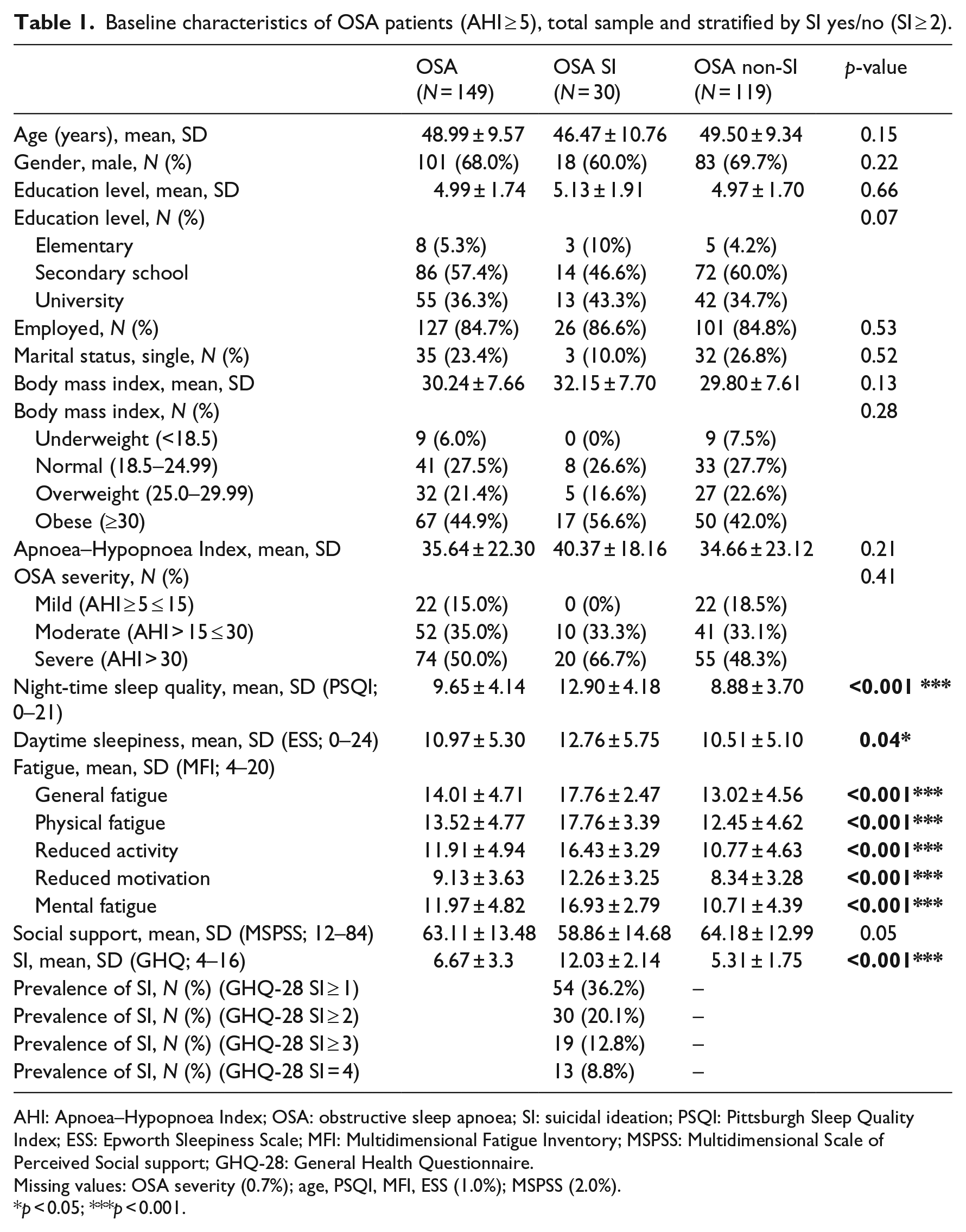
AHI: Apnoea–Hypopnoea Index; OSA: obstructive sleep apnoea; SI: suicidal ideation; PSQI: Pittsburgh Sleep Quality Index; ESS: Epworth Sleepiness Scale; MFI: Multidimensional Fatigue Inventory; MSPSS: Multidimensional Scale of Perceived Social support; GHQ-28: General Health Questionnaire.
Missing values: OSA severity (0.7%); age, PSQI, MFI, ESS (1.0%); MSPSS (2.0%).
p < 0.05; ***p < 0.001.
Relationships between OSA severity, night-time sleep quality, daytime sleepiness, fatigue, social support and SI
Daytime sleepiness and social support were not significantly related to night-time sleep quality and SI in the hypothesized model (Supplemental Figure 1). As our hypothesis was not confirmed, we tested an alternative, modified model without sleepiness and social support (Supplemental Figure 2, Table 2). The model fit criteria of the modified model were chi-square test = 29.909 (p = 0.04) and RMSEA = 0.066 (90% CI = 0.016–0.107). The CFI was 0.984 and TLI was 0.975. Swain’s correction factor was 0.972. Swain’s corrected chi-square statistic was 29.063 (p = 0.05). Swain’s corrected RMSEA was 0.064 (90% CI = 0.007–0.106), Swain’s corrected TLI was 0.971 and Swain’s corrected CFI was 0.991.
Relationships between OSA severity, night-time sleep quality, fatigue and SI.
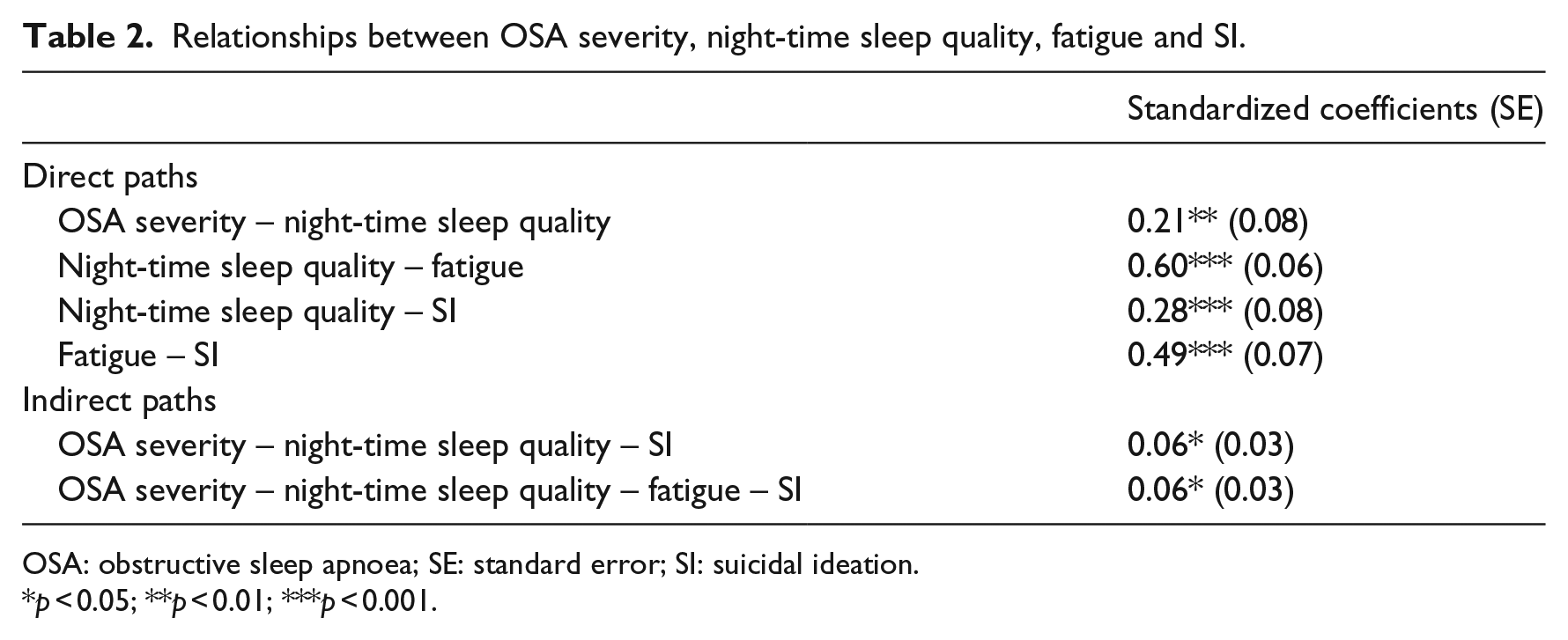
OSA: obstructive sleep apnoea; SE: standard error; SI: suicidal ideation.
p < 0.05; **p < 0.01; ***p < 0.001.
Sleep quality (β = 0.28, p < 0.001) and fatigue (β = 0.49, p < 0.001) were strongly related to SI. Sleep quality mediated the effect of OSA severity on SI (β = 0.06, p < 0.05), OSA severity was associated with poor sleep quality (β = 0.21, p < 0.01), while fatigue was associated with poor sleep quality (β = 0.60, p < 0.001). Social support was not significantly associated with SI using complex modelling, and adjustment for sociodemographic variables as potential confounders (age, gender and marital status) did not change the association between social support and SI either.
Discussion
This study shows a 20.1 per cent prevalence of SI in people with OSA. Patients reporting SI scored higher on sleep-related problems compared to non-SI patients. Poor night-time sleep quality and fatigue were directly related to SI. Night-time sleep quality mediated the effect of OSA severity on SI. We found no relationship between social support and SI in OSA patients.
Based on the presence of OSA, which represents severe physical illness consistently raising the best threshold to be adopted (Goldberg et al., 1998), we can assume that 20.1 per cent of OSA patients in our study reported SI. This finding is in line with Choi et al. (2015), who found an SI prevalence of 20.5 per cent in a Korean population of OSA patients. This SI prevalence of 20.1 per cent among OSA patients is alarming, especially when compared to the cross-national lifetime prevalence of SI (9.2%) in the general population (Borges et al., 2010) and the annual prevalence of SI (2.0%–2.1%) in the general population (Borges et al., 2010).
OSA severity was not directly related to SI in our study. Choi et al. (2015) also found no correlation between OSA severity and SI in OSA patients. However, night-time sleep quality mediated the effect of OSA severity on SI in our study. Although one-night PSG is sufficient for the diagnosis of OSA (Gouveris et al., 2010; Scholle et al., 2003), significant variability in the AHIs taken from two nights was revealed in people with OSA (Gouveris et al., 2010). Thus, the missing direct relationship between OSA severity and SI may be related, according to Choi et al. (2015), to subjects’ adaptation to the combination of the hospital environment and the recording equipment. However, some previous studies suggest that AHI based on numbers of all apnoeas and hypopneas, but not severity of apnoeic events, may not be the most appropriate measure of OSA severity when considering the clinical impact of OSA on subjective quality of life assessment (Lee et al., 2016b; Weaver et al., 2005).
Our findings demonstrate that disturbed night-time sleep quality was directly related to SI. This finding aligns with Bernert et al. (2014), who showed that poor night-time sleep quality in an older population was associated with increased risk of committing suicide, even after adjustment for depressive symptomatology. SI not only represents a symptom of major depression but has also been found to be driven by neurobiological processes (Du et al., 2017; Fried and Nesse, 2015). Another recent meta-analysis revealed that psychiatric patients with sleep disturbances, including sleep-related breathing disorders, are about twice as likely to report suicidal behaviours compared to those without sleep related-problems (Malik et al., 2014). Similarly, Choi et al. (2015) found that higher insomnia levels correlated with higher level of SI in OSA patients.
We found that fatigue was most strongly related to SI. Patients reporting SI scored significantly higher on daytime sleepiness, but the association was weak and no relationship between daytime sleepiness and sleep quality or SI was observed using complex modelling. Within a medical framework, excessive daytime sleepiness and fatigue are generally considered a result of sleep deprivation or poor sleep quality (Fava, 2004; Nicassio et al., 2002). However, according to Chervin (2000), some OSA patients report fatigue more often than daytime sleepiness, and therefore, treatment of fatigue complaints in the absence of clear daytime sleepiness warrants more attention in OSA treatment. Nevertheless, the possibility that daytime sleepiness may simply be masked by the presence of psychological distress associated with a chronic state of hypervigilance (Krakow et al., 2015) should also be considered.
Unexpectedly, the relationship between social support and SI was not significant. Some previous analyses have revealed that social support had a greater impact on well-being (Antonucci and Akiyama, 1987; Walen and Lachman, 2000) and health (Walen and Lachman, 2000) in female compared with male populations. However, we found no significant impact of gender on the association between social support and SI when controlled for sociodemographic variables.
Given the evidence that sleep disturbances may represent an important predictor of daytime functioning, including engagement in social activities (Dew et al., 1994), it may also be hypothesized that in the case of extreme fatigue or daytime sleepiness, the sources of social support may not be adequately utilized and thus may be of less importance. On the other hand, it is also plausible that the reverse pathway is true; that is, sleep disturbances may lead to a more negative perception of the social environment (Troxel et al., 2010). Furthermore, social interactions may represent stressful situations for patients with OSA; for example, OSA patients subjectively felt a lack of trust from co-workers which caused them subsequent embarrassment (Reishtein et al., 2006). In line with these assumptions, OSA symptoms were also found to be associated with reduced social participation (Liu et al., 2016). Nevertheless, Choi et al. (2015) identified significant correlation between social support and SI in OSA patients with comorbid insomnia. In line with their findings, most subjects in our study had a partner, were employed and had relatively high education. However, the patients in our study were observed to have higher mean scores for social support (63.11 ± 13.48) compared to the mean score of 44.38 ± 7.81 found by Choi et al. (2015) using the MSPSS. Another possible explanation may be that discrepancies in the results were caused by the different statistical methods used.
Strengths and limitations
To our knowledge, this is one of the first studies examining OSA severity, sleep-related problems, social support and SI in a rarely studied population of OSA patients using SEM. Another strength is that the patients in our sample were diagnosed by means of PSG, which is considered the criterion standard for diagnosing OSA and determining the severity of the disease. However, in interpreting our data, one has to consider certain limitations. First, the diagnosis of OSA was stated based on a single sleepover. Second, no formal psychiatric diagnosis of SI was established, but, on the other hand, the GHQ-28 items are frequently used to assess the presence of SI in various populations (Gili-Planas et al., 2001; Hamilton and Schweitzer, 2000; Kawabe et al., 2016; Romeo et al., 2013; Watson et al., 2001). Furthermore, it should be noted that the four-item GHQ-28 SI subscale has shown good concurrent validity with Beck’s Suicide Intent Scale (Watson et al., 2001). Different cut-off values of the GHQ-28 SI subscale were used in some previous studies (Biddle et al., 2004; Gili-Planas et al., 2001). In our study, we set the cut-off value of SI ⩾ 2, considering this threshold to be a good representation of the clinical picture (Goldberg et al., 1998). Another limitation to be mentioned is gender bias. In our sample, 68 per cent of the OSA patients were men; thus, our results may be less generalizable to the female population. However, the number of participants in our study is consistent with the man-to-woman ratio in OSA (3:1). Finally, the cross-sectional nature of this study does not allow firm conclusions about causality in the relationships between the variables. Nevertheless, it has been argued that SEM methods may offer the potential for tentative causal effects to be drawn when used with specified and controlled designs (Bullock et al., 1994).
Implications for practice and future research
This study shows that disturbed night-time sleep quality and fatigue are directly related to SI. Our findings, if confirmed in longitudinal studies, may highlight the necessity of monitoring SI in OSA patients during clinical care. Intervention studies may be helpful in determining whether the continuous positive airway pressure (CPAP) treatment is effective in reducing the level of SI via reduction of fatigue, although the results of previous research are less encouraging, indicating that OSA patients suffering from psychological distress have poor compliance with CPAP treatment (Hussain et al., 2014; Kjelsberg et al., 2005), which means that the role of compliance bias should additionally be considered. Next, in research and clinical practice, symptoms common to OSA and depressive symptomatology such as daytime sleepiness and fatigue represent obstacles in determining the presence, causality and severity of one condition in the presence of the other (Harris et al., 2009). As such, severe fatigue can contribute to longer and more severe depression, or vice versa, fatigue may be aggravated by depressive symptomatology (Carney et al., 2014), and therefore, the presence of reverse causality should be examined in OSA patients. However, the latter pattern may be more applicable to the general population than to OSA patients, as previous longitudinal studies defined OSA and its symptoms as risk factors for psychological distress. In particular, sleep fragmentation was identified as a primary cause of daytime sleepiness and fatigue in OSA patients, which is assumed to result in depressive symptomatology (Schröder and O’Hara, 2005).
Due to a lack of general consensus regarding the CPAP treatment effects on self-reported health outcomes such as functional status or quality of life in people with OSA (e.g. Weaver, 2013), current research and clinical practice should focus not just on treating OSA but also on ensuring that the symptoms such as poor night-time sleep quality, fatigue and daytime sleepiness, as well as depression and anxiety, are managed. Based on the strong relationship between poor sleep quality, fatigue and SI, clinicians should consider investigating SI in people with sleep-related disorders. Furthermore, SI may suddenly lead to suicidal behaviour (Du et al., 2017; Simon, 2014), while across all countries, 60 per cent of transitions from ideation to plan and attempt occur within the first year after ideation onset (Nock et al., 2008). This may be dangerous, especially for people with undiagnosed and untreated OSA. SI may be largely preventable (Simon, 2014; Stanley and Brown, 2012) through early detection. However, sleep disorders including OSA are very rarely assessed on a regular basis in patients suffering from psychological distress. This is of particular importance, as adjunct treatment for symptoms of depression such as sedative-hypnotics may exacerbate OSA (Pagel and Parnes, 2001). Another source of concern is that OSA patients with depressive symptomatology and/or fatigue may suffer from reduced activity and, consequently, may have poor motivation to visit hospital, get a diagnosis and receive appropriate OSA treatment. Thus, it may be beneficial to detect undiagnosed OSA in psychological and psychiatric care with simple and economical screening tools. Disturbed night-time sleep quality is largely modifiable through medication or behavioural interventions. The education of people with OSA on basic sleep hygiene may improve the quality of sleep and decrease fatigue. With a larger sample and a longitudinal design, the relationships should be further unveiled.
Conclusion
The prevalence of SI in OSA patients was found to be 20.1 per cent. Poor night-time sleep quality and fatigue were strongly related to SI. Social support was not significantly related to SI. Our findings emphasize the necessity of monitoring SI in OSA patients during clinical care. Longitudinal research is needed as a source of better understanding of the pathways between OSA severity, sleep-related problems, social support and SI in OSA patients, as this may contribute to better disease management.
Footnotes
Acknowledgements
The authors wish to thank the people with obstructive sleep apnoea who participated in this study. They also wish to express their gratitude to Dr I. Tomeckova and Dr I. Paranicova for the recruitment of patients, their clinical management and the scoring of the sleep studies and to Ms A. Schejbalova and Ms Z. Lazarova for all the technical work in the Sleep Laboratory, Department of Pneumology and Phtiseology, Faculty of Medicine, PJ Safarik University, and L. Pasteur University Hospital, Kosice, Slovakia.
Authors’ Note
Any underlying research materials related to this article can be accessed on demand.
Declaration of conflicting interests
The authors declared no potential conflicts of interest with respect to the research, authorship and/or publication of this article.
Funding
The authors disclosed receipt of the following financial support for the research, authorship, and/or publication of this article: This work was supported by the Slovak Research and Development Agency under contract APVV-15-0719 (50%) and by the Agency of the Ministry for Education of the Slovak Republic for the Structural Funds of the European Union, Operational Programme Research and Development (Contract No. 034/2009/2.1/OPRandD; 50%).
Supplemental material
Supplemental material is available for this article online.

References
Supplementary Material
Please find the following supplemental material available below.
For Open Access articles published under a Creative Commons License, all supplemental material carries the same license as the article it is associated with.
For non-Open Access articles published, all supplemental material carries a non-exclusive license, and permission requests for re-use of supplemental material or any part of supplemental material shall be sent directly to the copyright owner as specified in the copyright notice associated with the article.
