



Abstract
Although our bodies change as we age, there is limited research exploring body image among middle-aged and older adults. This study considered 70 adults with diabetes’ (Mage = 60.01 years) body image and revealed relatively high levels of body dissatisfaction in this sample. Furthermore, participants’ own and perceptions of their partners’ dissatisfaction with their bodies were moderately associated, and participants’ body dissatisfaction was associated with higher levels of depressive symptoms. These findings highlight the need for further research, exploring the social and psychological correlates of body image among men and women in mid-late adulthood.
Body image is typically conceptualized as a sociocultural construct; a sense of one’s self that derives meaning from one’s context. However, the contexts typically explored in this literature—families, peers, and the media surrounding female youths—limit our understanding of body image later in life and in less obvious contexts, such as within the confines of chronic illness. This study will examine body image among women and men in mid-late life with diabetes and will consider their romantic partners and depressive symptoms as possible correlates. This approach is consistent with both sociocultural theories of body image (e.g. Cafri et al., 2005) and the homeostatic theory of obesity (Marks, 2015).
Although historically body image has been explored primarily among children and adolescents, presumably affected by pubertal development (Gillen and Markey, 2015), age-related changes in middle and older adulthood also have the potential to affect body image. Across adulthood, our bodies typically move aesthetically away from the sociocultural ideals of beauty and tend to lose functionality (Dunaev et al., 2016). Although some research suggests that body dissatisfaction does not necessarily increase in adulthood, as priority may be placed on health while the focus on appearance declines (Liechty and Yarnal, 2010), other research reveals that concerns about both health and appearance may contribute to high levels of body dissatisfaction among older adults (Baker and Gringart, 2012). In this research, we conceptualize body dissatisfaction as the extent to which an individual’s perception of their body differs from their ideal; one of our primary aims is to examine rates of dissatisfaction among a chronically ill sample of men and women in mid-late life.
Consideration of gender is important in this research because the effects of aging on body image may differ for men and women. For instance, women often struggle with accepting an aging body and fight aging at all costs (Grogan, 2012; Roy and Payette, 2012) while men may be more concerned with declines in body functionality (Liechty et al., 2014). One increasingly common source of functional limitations with age is diabetes (Centers for Disease Control and Prevention (CDC), 2017). Physical functionality—or lack thereof—may be particularly relevant to an understanding of body image among both middle-aged and older men and women. Older, disabled individuals have been found to experience particularly low body esteem (i.e. lower than individuals without disabilities; Kaminski and Hayslip, 2006). In one study, older, disabled women were found to be at risk for depressed mood, which was also associated with body dissatisfaction (Rakhkovskaya and Holland, 2017). However, another study suggests that there may be a reciprocal relationship between health status and body image, with bodily perceptions influencing health and health influencing body image (Thomas and Wardle, 2014). This may be particularly true of patients with diabetes who undergo a variety of changes to their daily lives, regardless of any functional limitations. It is clear that additional research that takes into account health status is needed if a clearer understanding of body image in older adult populations is to emerge. For this reason, in this study, we examine a sample of middle-aged and older adults with diabetes. An exploration of body image among individuals with diabetes is of particular interest because of not only the high (and rising) rates of diabetes but because of the link between weight status, diet, and diabetes management (August and Sorkin, 2011; CDC, 2017). Because weight status is typically associated with body dissatisfaction and with diabetes (type 2) diagnoses, it will be considered as a covariate in this research (Bays et al., 2009).
Previous theory (e.g. sociocultural influences on body image; Cafri et al., 2005) and research (e.g. Markey and Markey, 2006, 2011, 2014) suggests that body image is influenced by individuals in participants’ social contexts (e.g. their romantic partners). A growing body of research has established links between relationship experiences and body image among relatively young heterosexual couples as well as same-sex couples (Markey and Markey, 2006, 2011, 2014; Meltzer et al., 2011). Romantic partners may be particularly relevant to body image because of the physical intimacy most people desire from these relationships. It may be that aging and body dissatisfaction negatively affect these relationships on physical and/or emotional levels (e.g. Montemurro and Gillen, 2013). However, there is some evidence that within the comfort of a relationship, body dissatisfaction may be lessened among older adults (Thorpe et al., 2015). What seems likely is that individuals’ assessment of their own and their partners’ views of their bodies are related and this has implications for body image development and overall physical and mental well-being in mid- to late-life (Markey and Markey, 2006; Oh and Damhorst, 2009). However, romantic partners have received limited empirical attention in body image research among middle-aged and older adults. Thus, one aim of this research is to examine associations among individuals’ own body dissatisfaction and their perceptions of their partners’ dissatisfaction with their bodies.
Another consideration in understanding body dissatisfaction is its potential association with threats to individuals’ well-being. Marks’ (2015) homeostatic theory of obesity posits one means of conceptualizing links between depression and body image, with general negative affect and specific negative emotions about the body contributing to each other. Furthermore, individuals with diabetes are twice as likely to have depression as the general population (Ali et al., 2006; Anderson et al., 2001). One reason may be due to the stress incurred due to diabetes management, such as the need for dietary control among individuals with diabetes (August et al., 2015 Talbot and Nouwen, 2000). Furthermore, perceived disability and reduced life expectancy can make diabetes both physically and psychologically challenging (Talbot and Nouwen, 2000). One unexamined factor that may be associated with depressive symptoms among individuals with diabetes is concerns about their body image. Among younger samples, links between body image and depression are well-established; however, this may be more likely among women than men (Gillen et al., 2012). It is unclear the extent to which poor body image may be associated with and predict depressive symptoms in this at-risk population.
Aims
Although more researchers have begun to examine body image among older adults (i.e. past early adulthood), these studies have focused primarily on women, have been mostly qualitative, and findings have proven inconsistent (Baker and Gringart, 2012; Liechty and Yarnal, 2010). This study extends our current understanding of body image in mid- to late-life by considering quantitative assessments of both men’s and women’s body image, the relationship context of body image, and participants’ depressive symptoms in a clinical sample of individuals with diabetes.
We hypothesize that
(1) Both men and women in this sample will report body dissatisfaction that is comparable to dissatisfaction reported among younger samples (e.g. approximately 65%–69% of men will be dissatisfied and 67%–78% of women will be dissatisfied as per Gillen and Markey, 2015). However, men and women’s body dissatisfaction will differ with women reporting greater levels of body dissatisfaction.
(2) Consistent with past research (e.g. Markey and Markey, 2006), positive associations will be found among men and women’s own body dissatisfaction and their perceptions of their partners’ satisfaction with their bodies.
(2a) The above association will remain significant, even after controlling for relevant covariates including gender, age, weight status, race/ethnicity, and time since diagnosis.
(2b) Analyses will consider the extent to which these associations are due to perceptions of partners’ ideal bodies or perceptions of partners’ evaluations of participants’ current bodies. In other words, the two ratings that contribute to our measure of body dissatisfaction will be considered separately and as a discrepancy score.
(3) Positive associations will be found among men and women’s body dissatisfaction and depressive symptoms.
(3a) The above association will remain significant, even after controlling for relevant covariates including gender, age, weight status, race/ethnicity, and time since diagnosis.
Method
Participants and procedure
Data for this study are from a larger study that took place from 2013 to 2015 to examine psychosocial correlates of diabetes management. Individuals in the greater Philadelphia area, who had a physician diagnosis of type 2 diabetes, were 45–85 years old, fluent in the English language, free of significant cognitive impairment, and seeing a diabetes provider at least once per year were recruited through fliers and advertisements; 72.3 percent of participants who responded to these recruitment materials completed participation in the study. Of 119 total participants, 70 reported having a romantic partner and had complete data on all study variables and were thus used as the analytic sample in this study.
Participants included 38 men and 32 women, and were 60.01 years old on average (standard deviation = 9.69; range = 44–83; the 44-year-old “underage” participant did not differ from the rest of the sample on key variables, and thus was retained for analyses). Most participants were non-Hispanic White (59.4%), with 30.4 percent being Black and 10.2 percent being of other races/ethnicities (Asian, Hispanic, mixed race, and other). A majority (75.7%) of participants reported being married, with the remainder (24.3%) being unmarried but partnered. Of the sample, 31.9 percent had a high school education or less, 47.8 percent had attended at least some college, and the remaining 20.3 percent had some graduate or professional education. Participants reported having diabetes for 10.46 years, on average (SD = 8.23, range = 0.5–35), which they rated as mildly to moderately severe (M = 2.48 on a 1–5 scale). Participants’ average body mass index (BMI) was 31.84 (SD = 6.61, range = 18.83–49.37), or “obese,” common in individuals with type 2 diabetes (Bays et al., 2009).
After eligible participants provided consent and cognitive impairment was ruled out (Pfeiffer, 1975), they completed a structured interview at the researcher’s laboratory or another convenient location, and two self-administered questionnaires. Measures included those described below as well as other measures assessing social interactions that may be relevant to diabetes management. Participation was approximately 2 hours in total. All participants were compensated US$20 in cash for their time and were entered into a drawing for a chance to win an additional US$100. This study received institutional review board approval at the relevant university.
Measures
Body image
To assess body image variables in this study, the Contour Drawing Rating Scale (CDRS; Thompson and Gray, 1995) was used. Participants were asked to select 1 of 9 gender-specific figures (1 = very underweight, 9 = very overweight) that represented: (1) what they think they currently look like (i.e. current body), (2) what they would like to look like (i.e. ideal body), (3) what they think their romantic partner thinks they currently look like (i.e. perceptions of their partners’ view of their current body), and (4) what they think their romantic partner would like them to look like (i.e. perceptions of their partners’ view of their ideal body). From these items, two body satisfaction scores were calculated: participants’ own body satisfaction (calculated by subtracting item #1 from item #2) and participants’ perceptions of their romantic partners’ satisfaction with their bodies (calculated by subtracting item #3 from item #4). Absolute values of these scores were used so that a score of 0 indicates satisfaction and a score >0 indicates some level of dissatisfaction, with higher scores indicating more dissatisfaction (three men and one woman indicated a heavier ideal body). The pictorial ratings were also used separately in analyses to determine the extent to which associations are attributable to the ideal perceptions versus perceptions of current body. The test–retest reliability for this measure has been reported to be good (.79; Thompson and Gray, 1995), and this measure has been found to be associated with weight status and dieting behaviors in other adult samples (Markey and Markey, 2005; Markey et al., 2001).
Depressive symptoms
To assess participants’ depressive symptoms, the 11-item version of the Center for Epidemiological Studies Depression Scale (CES-D; Radloff, 1977) was used. Participants responded on a 4-point Likert-type scale (1 = rarely or none of the time, 4 = most or all of the time) to indicate how they felt in the past month. Items were summed to create a composite measure of depressive symptoms (α = .81). The CES-D has been found to have high sensitivity and specificity in screening depressive symptoms in patients with type 2 diabetes (McHale et al., 2008).
Covariates
Covariates were selected based on the inclusion of these variables in the previous literature on body image and psychosocial aspects of diabetes management and included the following: self-reported weight status, assessed by BMI (weight (kg)/height (m2)); gender (0 = male, 1 = female); age; race/ethnicity (two groups: Black and other race/ethnicity); time since diabetes diagnosis; and number of comorbid health conditions, assessed by averaging the number of affirmative responses to 13 possible chronic health conditions.
Analyses
The analyses were conducted using SPSS version 24. Hypothesis 1 was addressed using descriptive analyses and t-tests. Hypotheses 2 utilized correlation analyses and regression analyses (2a and 2b). Hypothesis 3 was also addressed using correlation analyses and regression analyses (3a).
Results
Providing partial support for Hypothesis 1, 84.4 percent of women and 89.5 percent of men reported some level of dissatisfaction with their bodies. In addition, 84.4 percent of women and 78.9 percent of men reported that they perceived their partners to be dissatisfied with their bodies to some extent. In order to further address Hypothesis 1, we ran independent samples t-tests. Contrary to our hypothesis, men and women did not significantly differ in their overall body dissatisfaction (see Table 1). However, men reported that they looked heavier and wanted their body to be heavier compared to women. Similarly, men and women did not differ in their perceptions of their partners’ satisfaction with their bodies, but men perceived their partners to think they looked heavier and wanted their body to be heavier compared to women. In other words, women wanted to look thinner than men and believed that their partners wanted them to look thinner as well.
Means, standard deviations, and correlations for study variables (N = 70).
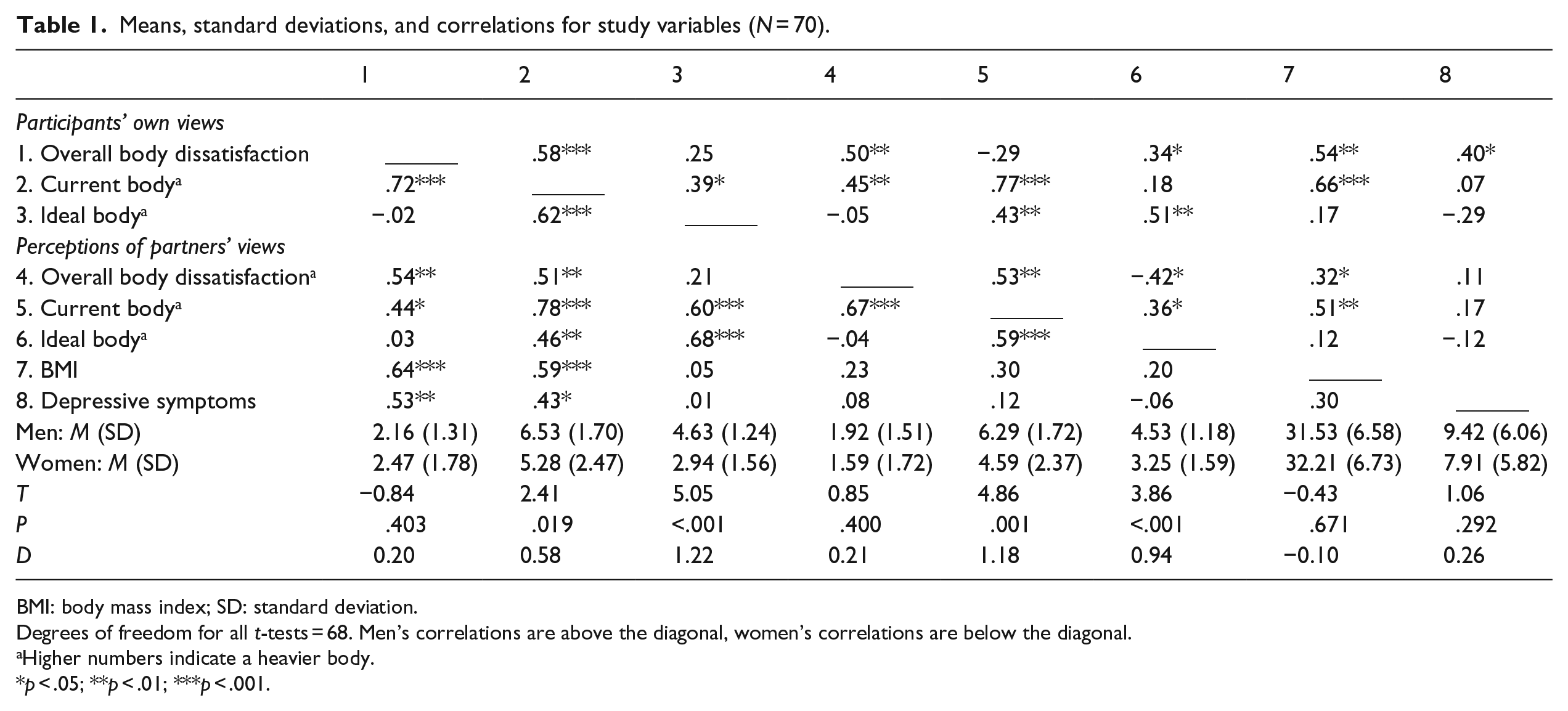
BMI: body mass index; SD: standard deviation.
Degrees of freedom for all t-tests = 68. Men’s correlations are above the diagonal, women’s correlations are below the diagonal.
Higher numbers indicate a heavier body.
p < .05; **p < .01; ***p < .001.
In order to address Hypotheses 2, we ran bivariate correlations among key study variables (see Table 1). Findings indicate that for both men and women, participants’ own and perceptions of their partners’ body dissatisfaction were significantly and positively correlated. Multivariable regression analyses were then conducted to examine Hypothesis 2a. We wanted to determine if participants’ perceptions of their partners’ dissatisfaction with their bodies were associated with their own body dissatisfaction, controlling for participants’ BMI, age, race/ethnicity, time since diabetes diagnosis, and number of comorbid conditions. Considering gender differences in body image, we examined gender as a potential moderator, but all interactions were non-significant so only results with gender as a covariate in these models are reported. As expected, participants’ perceptions of their partners’ dissatisfaction with their bodies were positively related to their own body dissatisfaction (B = .43, b = 0.41, standard error (SE) (b) = 0.09, t (62) = 4.55, p < .001). Both participants’ perceptions of their partners’ dissatisfaction with their bodies (R2 = .24) and the overall model with covariates (R2 = .49) explained a significant proportion of variance in body dissatisfaction (both ps < .001).
In examining specific components of participants’ perceptions of their partners’ views of their body (hypothesis 2b), participants’ perceptions that their partner had a thinner ideal body was significantly associated with participants’ own body dissatisfaction. In other words, participants’ own body dissatisfaction was not related to their perceptions that their partner viewed them as relatively heavy but was related to their perceptions that their partner wanted them to be relatively more slender.
Correlation analyses also were used to examine Hypothesis 3 (See Table 1). As predicted, participants’ body dissatisfaction was significantly and positively correlated with depressive symptoms for both men and women. To address Hypothesis 3a, we examined whether participants’ own body dissatisfaction was associated with depressive symptoms, controlling for participants’ BMI, age, race/ethnicity, time since diabetes diagnosis, and number of comorbid conditions. As expected, participants’ own body dissatisfaction was positively related to depressive symptoms (B = .49, b = 1.89, SE(b) = 0.54, t(62) = 3.51, p = .001). However, only body dissatisfaction (R2 = .18, p < .001), not the overall model with covariates (R2 = .29), explained a significant proportion of variance in depressive symptoms.
Discussion
This study adds to the literature with its consideration of mid-late adults’ body image within the context of romantic partnerships, mental health comorbidities, and chronic illness. Rates of body dissatisfaction were somewhat similar to young adult samples (i.e. in past samples 67%–78% of women and 65%–69% of men report dissatisfaction), but actually rates were higher (i.e. 84.4% of women and 89.5% of men) than that are often reported in younger samples. Although some researchers (e.g. Liechty and Yarnal, 2010) have speculated that body dissatisfaction decreases with age, as other health-related concerns come to the fore and less emphasis is placed on physical appearance, our findings suggest otherwise. It may be that body dissatisfaction is particularly high in this sample due to limits on functionality and overweight—both somewhat characteristic of individuals with type 2 diabetes. It is also possible that discrepancies concerning rates of body dissatisfaction are at least partially attributable to different approaches to assessing body dissatisfaction across studies. Hopefully, additional research will contribute to a more comprehensive understanding of both the degree and correlates of body dissatisfaction among mid-late adult samples. However, contrary to our expectation, men and women did not significantly differ in their overall body dissatisfaction. It appears that both men and women in this sample had surprisingly high levels of body dissatisfaction.
Our second hypothesis predicted relations among participants’ body dissatisfaction and participants’ perceptions of their partners’ dissatisfaction with their bodies. This hypothesis was predicated on sociocultural theories that are prevalent in the body image literature; they surmise that social, contextual, and interactional forces are essential in the development of body image (e.g. Cafri et al., 2005). Our results suggest that participants’ own body dissatisfaction was related to their perceptions of their partners’ dissatisfaction with their bodies.
Hypothesis 2a predicted that the above associations among participants’ body dissatisfaction and their perceptions of their partners’ dissatisfaction with their bodies could not be explained by relevant covariates such as gender, age, time since diagnosis, weight status, and comorbid health conditions. In other words, we posited that the links between body dissatisfaction and perceptions of partners’ dissatisfaction were sufficiently robust as to not be accounted for by other relevant constructs. As expected, the covariates did not change the relationship between the perceptions of their partners’ dissatisfaction with their bodies and participants’ own dissatisfaction.
However, these findings did not clarify whether or not participants believed that their partners found them to be too heavy currently or they believed their partners had very slender body ideals (i.e. what participants thought their partners thought they currently looked like versus what participants thought their partners wanted them to look like). Thus, these two ratings were also considered in regression analyses (Hypothesis 2b), which suggested that perceived body ideals (i.e. of thinness) may be driving the association between participants’ own body dissatisfaction and perceptions of their partners’ dissatisfaction with their bodies.
Our third hypothesis examined the associations among participants’ body dissatisfaction and depressive symptoms. This hypothesis is consistent with Marks’ (2015) homeostatic theory of obesity, which presents a comprehensive model positing links among many factors including weight, body image, and psychological well-being. Marks has summarized evidence for the persistent and potentially reciprocal link between body dissatisfaction and negative affect (oftentimes operationalized as depressive symptoms). Thus, it is not surprising that body dissatisfaction was found to be positively associated with depressive symptoms in our sample.
Furthermore, body dissatisfaction remained a significant predictor of depressive symptoms when covariates were considered (Hypothesis 3a).
Limitations, future directions, and conclusion
Limitations of this study include the use of a modest sample size and relatively brief measures of the constructs explored. Future research should include additional body image measures, including assessments of functionality (e.g. the Embodied Image Scale; Abbott and Barber, 2010). Given that aging confers loss of functionality for many individuals, an understanding of this particular aspect of body image is of interest. Furthermore, additional research should examine a more diverse and representative sample of participants in terms of age, sociodemographic variables, and chronic illness experiences.
Furthermore, this cross-sectional design cannot impart conclusive information about the direction of effects. Although, in our analyses, we examined body dissatisfaction (Hypothesis 2a and 2b) and depression (Hypothesis 3a) as our outcomes of interest, it is possible that depression, for example, precedes body dissatisfaction. Longitudinal studies are needed to further explore potential paths of influence.
In spite of these limitations, this study expands our understanding of body image among middle-aged and older adults by considering a sample of mid-late life individuals with diabetes, a population that has been largely ignored in this area of research. As diabetes becomes a more commonly diagnosed condition in the United States and globally (CDC, 2017), understanding chronic illness as a context for body image concerns will only become more essential. Although links among physical and mental health (e.g. diabetes, depression, and body image) are intuitive, they are inevitably complex and require further investigation.
Although some researchers (e.g. Liechty and Yarnal, 2010) have posited that body dissatisfaction may wane with age as appearance-related concerns become less concerning, our findings suggest otherwise. Perhaps, it is somewhat idealistic to consider body dissatisfaction as only affecting the young. Although outgrowing these concerns would be advantageous for both men and women, it seems interventions and treatments that address them earlier in life are what are needed.
Footnotes
Declaration of conflicting interests
The authors declared no potential conflicts of interest with respect to the research, authorship, and/or publication of this article.
Funding
The authors disclosed receipt of the following financial support for the research, authorship, and/or publication of this article: The second author received funding to support this research from a NSF RU Fair Grant awarded to Rutgers University.
