



Abstract
This cross-sectional observational study assesses differences in depressive symptoms and diabetes-distress between adults with type 1 diabetes using continuous subcutaneous insulin infusion (CSII) or multiple daily injections (MDI) insulin delivery methods. Two-hundred and seventy-one adults with type 1 diabetes were recruited who used CSII (n = 104) or MDI (n = 167). Results show that, compared to CSII users, scores on the Severity Measure for Depression – Adult questionnaire and Management and Physician subscales on the Type 1 Diabetes Distress Scale were significantly greater in users of MDI. Thus, MDI users may require greater targetted support to improve these aspects of psychological wellbeing.
Keywords
Introduction
Type 1 Diabetes Mellitus (T1DM) is an autoimmune disease in which the destruction of pancreatic beta cells leads to complete insulin deprivation. Guided by self-monitoring of blood glucose levels, individuals living with T1DM manually administer insulin to avoid hyperglycaemia (or high blood glucose levels). Consequently, living with diabetes can be stressful, burdensome, and take a psychological toll on the individual due to the constant demands to self-manage this chronic health condition (Robinson et al., 2018). Studies have revealed these demands can lead to negative outbursts in relation to specific aspects of psychological wellbeing, namely, greater depressive symptoms (Engum, 2007) and diabetes-distress (Fisher et al., 2014). Furthermore, whilst the demands of T1DM can affect how an individual feels, the emotional struggle can also lead to difficulties in self-management and non-adherence to treatment (Ducat et al., 2014). This is concerning, as mistreatment of diabetes can cause serious short- and long-term complications, such as blindness, amputation, and premature death (Berry, 2019; Ducat et al., 2014). Thus, understanding and establishing the factors that negatively affect these facets of psychological wellbeing in adults living with T1DM is vital.
Modern insulin replacement therapy consists of two delivery methods: (i) multiple daily injections (MDI) or (ii) continuous subcutaneous insulin infusion (CSII), also known as a ‘pump’, whereby insulin is delivered via a cannula and refillable reservoir. In the United Kingdom (UK), most adults with T1DM use MDI, and those who fail to achieve satisfactory control with MDI are eligible for CSII subject to specific criteria (National Institute for Health and Care Excellence [NICE], 2008; NHS Digital, 2019). Critically, the existing literature suggests that these different insulin delivery methods have varying effects on physical health. For example, compared to MDI, CSII use has shown to produce lower Haemoglobin A1C (HBA1c) levels without an increase in hypoglycaemic episodes (Hoogma et al., 2006; Rodrigues et al., 2005). Both high HBA1c levels and hypoglycaemic episodes are potential indicators for future diabetic complications, suggesting that MDI may have a more detrimental impact on physical health. Additionally, Rubin and Peyrot (1999) suggest that glycaemic control is associated with better quality of life (QoL). Both Todres et al. (2010) and Barnard et al. (2006) also demonstrated that CSII may be advantageous because it can improve several parameters of a diabetic’s life, including lifestyle and treatment flexibility (Hoogma et al., 2006).
In addition to physical health and QoL, researchers have become increasingly interested in investigating the relationship between diabetes and psychological health. In a recent report from the American Diabetes Association (ADA) and European Association for the Study of Diabetes (EASD) on the principles for management of T1DM in adults (Holt et al., 2021), the importance of monitoring psychological wellbeing, including depressive symptoms and diabetes-distress, was advocated. In terms of depressive symptoms, it is estimated that up to 31% of adults living with T1DM experience moderate to severe depressive symptoms (Anderson et al., 2001), which might be caused by the psychological stress of the illness or blood-glucose instability (Engum, 2007; Holt et al., 2009). The relationship between diabetes and psychological health is crucial, as depressive symptoms have been linked with decreased physiological care, such as reduced glucose recognition (Littlefield et al., 1992), as well as irregular medication administration (Sartorius, 2018), which can lead to an emergence of complications including increased hospitalisations (de Groot et al., 2001) and premature death (Park et al., 2013). To aid psychological wellbeing, as well as prevent physical health complications in adults with T1DM, it is essential to understand factors contributing to these depressive symptoms. Insulin delivery methods used by individuals with T1DM have not yet been considered a factor in the onset or hinderance of depressive symptoms, nor have they been related to negative psychological wellbeing. Thus, the extent to which insulin delivery methods result in a difference in depressive symptoms warrants further scrutiny.
As well as depressive symptoms, the day-to-day responsibility of adults living with T1DM to self-manage their condition can lead to feelings of stress and frustration. Consequently, it is estimated that 42% of adults with T1DM experience emotional burnout, termed diabetes-distress (Fisher et al., 2016a). Greater diabetes-distress has been associated with poor self-management (Fisher et al., 2016a) and glycaemic control (Reddy et al., 2013; Snoek et al., 2000), as well as high HBA1c levels (Fisher et al., 2014). Therefore, it is also necessary to investigate contributing factors to diabetes-distress, including insulin delivery method, to reduce diabetic complications. Given that high HBA1c has been shown to be less common in CSII users, it could be predicted that MDI users may experience higher diabetes-distress. Even so, in a recent study by Wardian et al. (2020), no significant differences between insulin delivery methods and diabetes-distress were found. However, most participants included in this study reported low levels of distress, possibly because they were able to choose their insulin method since they resided in the United States (US). As a result, further research may be necessary in a sample where insulin delivery method is more prescriptive, such as within the publicly funded UK National Health Service (NHS).
Physical health outcomes have been shown to be poorer for MDI compared to CSII users (Askew and Solomons, 2019). Even so, while the prevalence of depressive symptoms (Anderson et al., 2001) and diabetes-distress (Fisher et al., 2016a) are high in adults with T1DM, there is limited research assessing whether insulin delivery methods might be associated with these outcomes. Subsequently, this study aimed to investigate whether there are differences between insulin delivery methods in terms of depressive symptoms and diabetic-distress in adults with T1DM. Overall, based on exiting evidence comparing insulin delivery methods, it was predicted that both depressive symptoms and diabetes-distress would be poorer in MDI compared to CSII users.
Methods
The Methods are reported in accordance with STrengthening the Reporting of OBservational studies in Epidemiology (STROBE) checklist for cross-sectional studies (von Elm et al., 2007).
Design
An independent group, cross-sectional research design was employed. The independent variable, insulin delivery method, had two categories: (i) CSII and (ii) MDI. The dependent variables measured were (i) depressive symptoms and (ii) diabetes-distress.
Participants
An a priori power analysis for testing the mean difference between two independent means (t-tests) was conducted using G*Power version 3.1.9.2 (Faul et al., 2007). Based on existing research comparing general wellbeing between MDI and CSII users (Hoogma et al., 2006), to detect a medium (d = 0.5) effect size, based on 80% power, and a two-sided type I error rate of 5%, a minimum of 64 participants were required per group (total sample size: 128).
Participants were recruited via opportunity sampling during the COVID-19 pandemic between the 3rd and 11th of February 2021. An anonymous link to the online survey, delivered via Qualtrics XM software, was posted on to social media, namely, the ‘Type 1 Diabetes UK’ Facebook group discussion forum, which has over 10,000 members. Participants were eligible for inclusion in the study if they self-reported a T1DM diagnosis, reported either CSII or MDI use, and were ⩾18 years of age.
Outcome measures
Demographic variables were measured categorically, including gender, age, diabetes duration, and healthy lifestyle in terms of diet, physical activity, smoking, stress and alcohol consumption (Hanawi et al., 2020). In addition, the following validated self-administered measures of depressive symptoms and diabetes-distress were completed:
Severity Measure for Depression Scale – Adult (SMfD; Kroenke et al., 2001). This nine-item measure assesses the severity of depressive symptoms according to DSM-IV criteria (American Psychiatric Association, 1994). Each item (e.g. little interest or pleasure in doing things) is measured on a four-point Likert Scale (0= not at all; 3= nearly every day). The sum of all items (out of 27) denotes the level of depressive symptoms, with higher scores indicative of greater depression. In the current study, the SMfD scored excellent internal consistency (α = 0.89).
Type 1 Diabetes-Distress Scale (T1-DDS; Fisher et al., 2015). This 28-item measure asks respondents to rate statements (e.g. Feeling that I have to hide my diabetes from other people) on a six-point Likert Scale (1 = not a problem; 6 = a very serious problem) across seven subscales (Powerlessness, Management Distress, Hypoglycaemia Distress, Negative Social Perceptions, Eating Distress, Physician Distress, Friend/Family Distress). An average score across all items, as well as each individual subscale, can be calculated. While the 17-item DDS scale can be used to measure diabetes distress in both T1DM and T2DM (Polonsky et al., 2005), we opted to use the 28-item measure as this is specific to individuals with T1DM who were the focus of the current study (Fisher et al., 2015). The T1-DDS scored excellent internal consistency across all items (α = 0.92).
Procedure
A short pilot study with two individuals was conducted prior to the survey distribution to ensure ease of completion, this raised no issues. A detailed description and informed consent form were provided prior to survey completion. Participants were made aware that their responses would be anonymous, which meant data could not be withdrawn once their responses had been submitted. Participants were required to answer all questions but could withdraw from the study by closing their web-browser if they did not wish to respond to any question. Participants were optionally advised to undertake any relevant blood glucose checks prior to conducting the survey due to the 20-minute completion time. The study was approved by Loughborough University’s Ethics Review (Human Participants) Sub-Committee.
Data analysis
Differences between insulin delivery groups for demographic variables (i.e. gender, age, diabetes duration, healthy lifestyle) were assessed using separate Mann-Whitney U tests. To assess differences between insulin delivery groups on the SMfD and T1-DDS (both total and subscale scores), independent samples t-tests were first conducted. Separate univariate analysis of covariances (ANCOVAs) were then completed, where insulin delivery group was entered as the independent variable and gender, age, diabetes duration, and healthy lifestyle as covariates. For all analyses, significance was set to p ⩽ 0.05 (two-tailed), and Bonferroni corrected for multiple comparisons. Small, moderate and large effect sizes were set at 0.2, 0.5 and 0.8, respectively (Cohen, 1988).
Results
Participant demographics are provided in Table 1. In total, 271 adults were recruited and completed the online survey; 104 (38.4%) were CSII users and 167 (61.6%) were MDI users. Most of the participants were female (n = 210, 77.5%) and between 18 and 24 years of age (n = 124, 45.8%). Demographic factors did not differ statistically between CSII and MDI users (p ⩾ 0.519), except for diabetes duration, which was greater in CSII compared to MDI users (U = 5668.5, p < 0.001).
Baseline characteristics and frequencies of the entire study sample, as well as by method of insulin delivery: (i) continuous subcutaneous insulin infusion (CSII) and (ii) multiple daily injections (MDI).

The Levene’s F test was violated for SMfD scores, and equal variance could not be assumed, F (269) = 4.88, p = 0.028. As a result, a Welch’s t-test was used to assess group differences for this outcome. By comparison, for T1-DDS scores (both total and subscale scores), the assumption of homogeneity of variances was satisfied (p ⩾ 0.100), and, therefore, standard independent samples t-tests were used. As shown in Table 2, on average, MDI users had statistically higher SMfD scores compared to CSII users. Similarly, T1-DDS scores were statistically higher in MDI compared CSII users for the following sub-scales: Management Distress, Negative Social Perceptions, and Physician Distress. No significant differences between insulin delivery groups were found for T1-DDS total or the remaining subscale scores (p ⩾ 0.104).
Differences between continuous subcutaneous insulin infusion (CSII) and multiple daily injections (MDI) insulin delivery methods, for the Severity Measure for Depression Scale – Adult (SMfD) and Type 1 Diabetes-Distress Scale (T1-DDS).

Bold indicates p < 0.05.
Prior to ANCOVA analyses, both SMfD and T1-DDS scores were checked for normality and homogeneity of variance. Although all measures violated normality (Kolmogorov-Smirnov test, p ⩽ 0.018), the variances were equal (Levene’s test: p ⩾ 0.053). Critically, ANCOVAs have been shown to be robust to non-normality when homogeneity of variance is held (Rheinheimer and Penfield, 2001). The results from each ANCOVA, controlling for gender, age, diabetes duration, and healthy lifestyle, are provided in Table 3. All the covariates were poorly correlated with each other (rs ⩽ 0.31). As shown in Figure 1a, compared to CSII, MDI users reported statistically greater depressive symptoms (F (1, 265) = 4.22, p = 0.041, d = 0.36). A similar pattern of findings was also found for the following T1-DDS subscale scores: Management Distress (F (1, 265) = 5.58, p = 0.019, d = 0.37) and Physician Distress (F (1, 265) = 7.17, p = 0.008, d = 0.36), as shown in Figure 1b and Figure 1c, respectively. No significant differences between insulin delivery groups were found for T1-DDS total or the remaining subscale scores (p ⩾ 0.084).
Means, standard deviations and analysis of variance between continuous subcutaneous insulin infusion (CSII) and multiple daily injections (MDI) insulin delivery methods, for the Severity Measure for Depression Scale – Adult (SMfD) and Type 1 Diabetes-Distress Scale (T1-DDS), with gender, age, diabetes duration and healthy lifestyle entered as covariates.

Bold indicates p < 0.05.
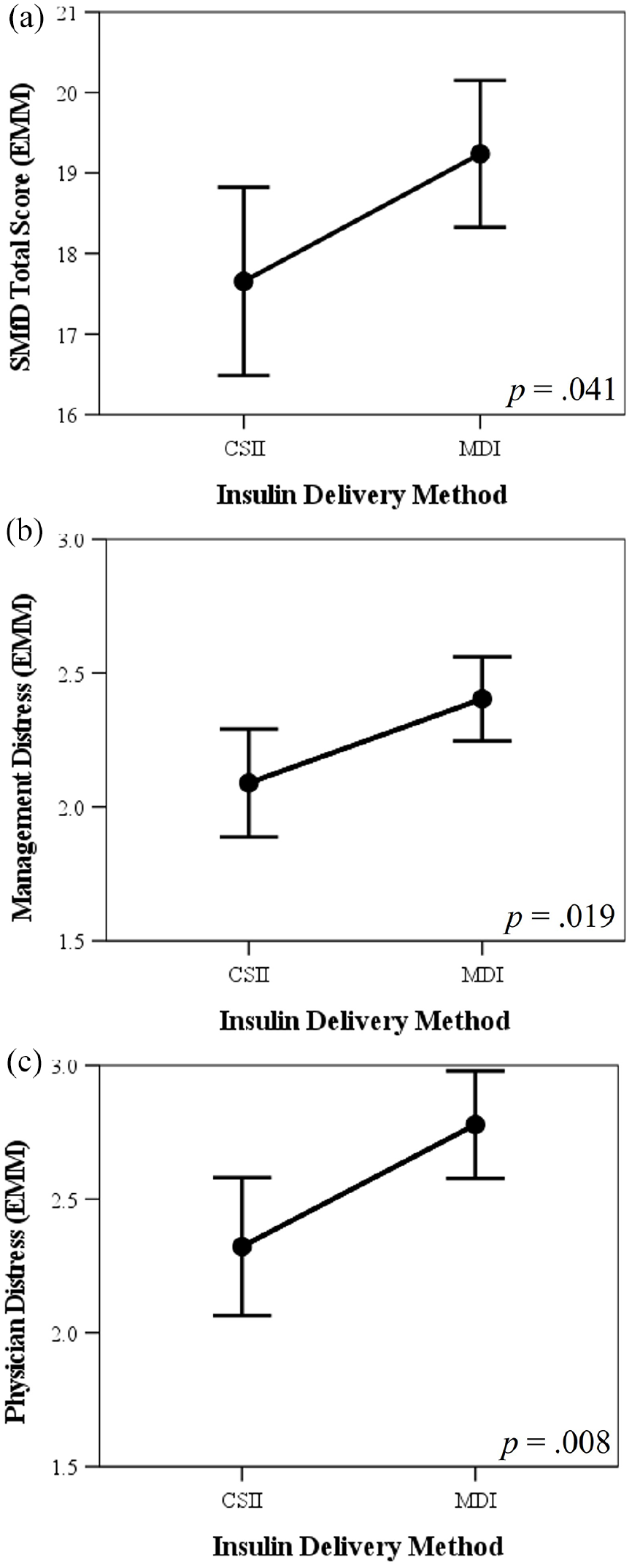
Statistically significant estimated marginal means (EMM) for continuous subcutaneous insulin infusion (CSII) and multiple daily injections (MDI) insulin delivery methods for (a) Severity Measure for Depression Scale – Adult (SMfD) total scores, as well as (b) Management- and (c) Physician-Type 1 Diabetes-Distress Scale Management Distress (T1-DDS) subscale scores when the covariates gender, age, diabetes duration and healthy lifestyle were entered into the model. Error bars represent 95% confidence intervals.
Discussion
The present study investigated depressive symptoms and diabetes-distress in adults living with T1DM and how this might be affected by insulin delivery method. Overall, we found that, even when controlling for gender, age, diabetes duration, and healthy lifestyle, MDI users reported greater depressive symptoms and diabetes-distress, specifically management- and physician-related distress, compared to CSII users. Thus, these findings may suggest that adults with T1DM who inject multiple times per day (MDI) have significantly greater depressive symptoms and diabetes-distress than individuals who use an insulin pump (CSII), irrespective of several demographic factors (i.e., gender, age, diabetes duration, healthy lifestyle). This could be important in understanding the factors that influence these facets of psychological wellbeing in this population, which may also be associated with physical health complications (Ducat et al., 2014).
A potential explanation for our results showing differences in depressive symptoms between insulin delivery methods may be the result of CSII users’ ability to programme basal rates on their devices, whereas MDI users cannot. Programmable basal rates allow for reduced insulin over short periods of time, reducing activity-induced hypoglycaemia (Bode et al., 2002). Moreover, there is evidence to suggest that exercise can be used to treat depression (Daley, 2008; Dunn and Jewell, 2010). It could be speculated that the ability to exercise is easier with CSII (due to programmable basal rates), which could contribute to lower depressive symptoms. Nevertheless, despite finding that MDI users have higher depressive symptoms, there is no previous research on the relationship between depressive symptoms and insulin delivery methods. Consequently, future research is necessary to explore why these differences between delivery methods might exist.
In addition, our findings suggest that MDI use also results in higher management- and physician- related diabetes-distress than CSII use. In relation to our findings for management distress, a possible explanation could be that CSII makes diabetes more manageable, as it allows users to provide insulin at the touch of a button; enabling them to time meals and snacks accordingly (Todres et al., 2010). This is in line with Bode et al.’s (2002) findings, who found that CSII users are more in control of their diabetes, instead of letting diabetes control them. MDI users also appear to have greater concerns in relation to their physicians; showing that individuals who use MDI report that they do not receive adequate support to manage their diabetes, and that their doctors do not know or understand enough about diabetes care. These findings align with Todres et al. (2010), who found significant changes in the relationship with health professionals after starting CSII, moving towards a more collaborative, patient-centred care approach where the physician provides helpful and credible adjustments to help the individual manage their diabetes.
However, it should be acknowledged that our results are not consistent with those of Wardian et al. (2020), who found no difference in diabetes-distress scores between insulin delivery methods. The difference in findings could be due to key methodological differences. For example, Wardian et al.’s (2020) US-based sample had greater choice of insulin delivery method, which could have resulted in the lower distress found. In comparison, our sample was recruited online, via a Type 1 Diabetes UK forum, and likely received their healthcare from the publicly funded UK NHS. In this context, individuals are unable to choose their insulin delivery method, and instead clinicians must adhere to specific healthcare guidelines with regards to candidature. Furthermore, in Wardian et al.’s (2020) study, most participants reported low levels of distress. By comparison, in the current study, both MDI and CSII users were classified, on average, as having ‘moderately severe depression’ and ‘moderate distress’.
Taken together, this study provides insight and understanding into the effects of T1DM on psychological wellbeing and how this might be impacted by method of insulin delivery used. Since depressive symptoms and diabetes-distress have been associated with decreased physiological care and poor self-management (Fisher et al., 2016b; Littlefield et al., 1992), the findings from our study may suggests that the psychological wellbeing of MDI users should be closely monitored to improve physical health outcomes. Additionally, in MDI users who experience greater depressive symptoms or high diabetes-distress, CSII could be recommended as an alternative, as this may alleviate these symptoms. Nonetheless, it should be acknowledged that CSII users need to be highly motivated, as they need to be willing to make consistent adjustments and attend several training sessions (Litton et al., 2002). It could be speculated that MDI users suffering with poorer psychological wellbeing may lack motivation (Smith, 2013), making adhering to treatment guidelines a challenge. Moreover, according to Pickup et al. (2002), those with psychological ill-health tend to be less likely to meet the demands of CSII. Therefore, whilst these results suggest that CSII may help improve psychological wellbeing in individuals living with T1DM, this option may not be appropriate for everyone, and MDI users may require additional psychological services before transitioning to CSII.
There are several limitations to this study. For example, in our endeavour to only collect personal data necessary to answer the research question, potential confounding variables, including socioeconomic status, education, ethnicity, social support, and formal diagnoses of mental health conditions (e.g. major depressive disorder) were not measured. In adults with T1DM, previous research has shown that poorer socioeconomic status (Pandit et al., 2014), lower education (Chaturvedi et al., 1996), ethnicity (Peyrot et al., 2014), and lack of social support (Baek et al., 2014; Skinner et al., 2020) are all associated with poorer psychological wellbeing, as well as poorer self-management. In addition, depression in T1DM has been shown to amplify symptom burden (Ludman et al., 2004), and is a contributing factor to poor metabolic control, decreased QoL, and increased medical morbidity (Ciechanowski et al., 2000). On this basis, further research is necessary to determine whether these variables impact the association between insulin delivery method and psychological wellbeing found in the current study.
Additionally, the data was collected primarily online via social media, as well as during the COVID-19 pandemic, which may have impacted how participants responded. It is possible that recruiting solely from social media may have resulted in a self-selection bias (Benedict et al., 2019), whereby those who are more likely to engage in treatment are likely to take part in diabetes-related research. In relation to COVID-19, T1DM has been associated with higher symptom severity, medical complications (Wang et al., 2020), and mortality (Onder et al., 2020). This could account for the current finding that higher depressive symptoms and diabetes-distress we observed in MDI versus CSII users. Nevertheless, in their study of both CSII and MDI users, Mianowska et al. (2021) found that diabetes-distress decreased significantly in adolescents, and remained the same in children, before and after the COVID-19 lockdown. On this basis, the present study could be replicated on a larger, more diverse sample who are not collectively experiencing difficulties arising from initial lockdown restrictions imposed by the global pandemic.
Future research should primarily focus on two areas. Firstly, extensive research should be conducted into the potential reasons why MDI users are likely to suffer with higher depressive symptoms and diabetes-distress. Indeed, there has been research identifying causes of diabetes-distress in adults with T1DM (Balfe et al., 2013), including factors such as stigma, management difficulties, and concerns about the future; these factors should be explored more deeply. A qualitative study, like Saarinen et al. (2014)’s content analysis describing the transition to CSII from MDI, could provide an in-depth insight into the lived experiences and factors related to insulin delivery method and psychological wellbeing in adults with T1DM, and why MDI users may suffer with poorer psychological wellbeing than CSII users.
Secondly, three milestones have been identified in their impact on diabetes care: (i) the development of CSII technology, (ii) different methods of blood glucose monitoring and (iii) automated technologies (Kubiak et al., 2020). There are currently ten types of CSII technologies available on the NHS (Diabetes.co.uk, 2020), and this continues to grow, including new automated insulin delivery technologies. Additionally, there are now several blood glucose monitoring methods (including capillary and continuous). Self-monitoring of one’s blood glucose (SMBG) is the standard care for most individuals with T1DM (Maria et al., 2021). Whereas continuous glucose monitoring (CGM) is a new technology worn on the skin which continuously measures an individual’s blood glucose levels. CGM use in T1DM has been associated with better glycaemic control and improved QoL (Stone and Bailey, 2020). The DIAMOND trial (Polonsky et al., 2017) further suggests that CGM significantly improves psychological wellbeing, including producing significantly lower diabetes-distress compared to those using SMBG. More recently, the UK’s NICE submitted draft guidelines which suggests individuals with T1DM should be given the choice of either capillary or continuous methods (NICE, 2022). Therefore, to augment our findings, future research could evaluate both depressive symptoms and diabetes-distress in accordance with the different types of insulin pumps, methods of blood glucose monitoring, and automated technologies.
Conclusion
This study has expanded research on the differences between CSII and MDI use in relation to psychological wellbeing in adults living with T1DM. Specifically, MDI users reported significantly greater depressive symptoms, as well as management- and physician-related diabetes distress. What this suggests is that MDI users may require greater targetted (or patient-centred) support to improve these aspects of psychological wellbeing. Therefore, and like Wardian et al. (2020), we also recommend a continuation of both insulin delivery methods, but a potential expansion of eligibility criteria for CSII. Not all adults with T1DM are eligible for CSII; criteria include continuous high glucose, uncontrollable HBA1C levels, and uncontrollable hypoglycaemia (NICE, 2022). Based on our findings, practitioners could also consider expanding eligibility criteria to accommodate adults with T1DM suffering from greater depressive symptoms and/or diabetes-distress. Additionally, if commissioners and healthcare professionals had a better understanding of the impact of CSII on an individual’s psychological wellbeing, it could help to inform their decisions in relation to healthcare service provision and funding. Furthermore, the insulin delivery method decision involves a healthcare professional and patient discussion about the relative benefits and disadvantages of each method. Due to the results of the present study, better psychological wellbeing could be referred to as a possible advantage of CSII, alongside improved QoL and physical health outcomes.
Research Data
sj-sav-1-hpq-10.1177_13591053221098498 – Supplemental material for Assessing depressive symptoms and diabetes distress in Type 1 diabetic adults: A comparison of continuous subcutaneous insulin infusion (CSII) and multiple daily injections (MDI) users
Supplemental material, sj-sav-1-hpq-10.1177_13591053221098498 for Assessing depressive symptoms and diabetes distress in Type 1 diabetic adults: A comparison of continuous subcutaneous insulin infusion (CSII) and multiple daily injections (MDI) users by Ella Dowling and David W Maidment in Journal of Health Psychology
Research Data
sj-spv-2-hpq-10.1177_13591053221098498 – Supplemental material for Assessing depressive symptoms and diabetes distress in Type 1 diabetic adults: A comparison of continuous subcutaneous insulin infusion (CSII) and multiple daily injections (MDI) users
Supplemental material, sj-spv-2-hpq-10.1177_13591053221098498 for Assessing depressive symptoms and diabetes distress in Type 1 diabetic adults: A comparison of continuous subcutaneous insulin infusion (CSII) and multiple daily injections (MDI) users by Ella Dowling and David W Maidment in Journal of Health Psychology
Footnotes
Acknowledgements
The authors would like to thank all the individuals who took part in this study.
Data sharing statement
The current article is accompanied by the relevant raw data generated during and/or analysed during the study, including files detailing the analyses and either the complete database or other relevant raw data. These files are available in the Figshare repository and accessible as Supplemental Material via the SAGE Journals platform. Ethics approval, participant permissions, and all other relevant approvals were granted for this data sharing.
Declaration of conflicting interests
The authors declared no potential conflicts of interest with respect to the research, authorship, and/or publication of this article.
Funding
The authors received no financial support for the research, authorship, and/or publication of this article.

References
Supplementary Material
Please find the following supplemental material available below.
For Open Access articles published under a Creative Commons License, all supplemental material carries the same license as the article it is associated with.
For non-Open Access articles published, all supplemental material carries a non-exclusive license, and permission requests for re-use of supplemental material or any part of supplemental material shall be sent directly to the copyright owner as specified in the copyright notice associated with the article.
