



Abstract
The proportion of people seeking a partner later in life has increased in recent decades. However, studies exploring age variation in partner preferences are quite rare. We aim to fill this gap by examining the partner preferences for household care skills, financial resources, and education of unpartnered individuals aged 19–65 years (n = 1145) who participated in speed-dating events in the Czech Republic. We hypothesized that the importance of these characteristics varies with age, and that this variance may differ for men and women. The results show that gender differences concerning these characteristics are mostly stable across age groups. The exception is the importance of household care skills, which increases for older men and decreases for older women. We found that older adults value financial resources more than younger adults, and that this increase is true for women and men. Finally, we did not find evidence that the importance of education differs with age.
Introduction
In recent decades, partnership trajectories have become more diverse and unstable. These changes are largely attributed to the increased emphasis on individual autonomy and self-realization in contemporary societies (Beck and Beck-Gernsheim, 1995; Giddens, 1992; Jamieson et al., 2009; Van de Kaa, 1987). As a result, the number of people who do not live with a partner at ages conventionally associated with having co-resident partnerships and children has risen (Jamieson et al., 2009; Roseneil, 2006). The proportion of people seeking new partners at middle and older age has thus increased considerably (Brown et al., 2019; Gałezewska et al., 2017; Hamplová, 2012; Schimmele and Wu, 2016). For instance, in the Czech Republic, the divorce rate is 45% with an average relationship length of 13 years. Even if unmarried cohabitation prevails as a form of post-divorce coresidential union in the Czech Republic (Kreidl and Hubatková, 2017), 25% of newlywed couples have been previously married (Czech Statistical Office, 2019).
The literature shows that mating patterns later in life are different from those in first unions, and that socioeconomic predictors of union formation differ substantially with age (Brown et al., 2019; Rapp, 2018; Schimmele and Wu, 2016). Studies from North America and European countries, including the Czech Republic, demonstrate that people prefer different types of partner arrangements based on their age and gender (Formánková and Křížková, 2015; Hasmanová Marhánková, 2016; Mahay and Lewin, 2007). However, less is known about whether these differences in union formation patterns are the result of constrained dating markets or due to shifting expectations and preferences of aging individuals looking for a new relationship.
Partner preferences have received considerable research attention in the past, especially in the United States. There is consistent evidence that men emphasize attractiveness and youth, while women value socioeconomic status (Buss et al., 2001; Shackelford et al., 2005). In contrast, studies that address age differences are rare and mostly focus on a limited age range, mainly young adults (Bleske-Rechek and Ryan, 2014; Sprecher et al., 2018). These studies often relied on student samples, which raises issues of generalizability to a nonstudent population (Hanel and Vione, 2016; Peterson, 2001). Furthermore, while examining union formation at middle and older age, researchers often relied on patterns in final partner choices, and only a few studies explored partner preferences (Potarca et al., 2017). Ultimately, previous partner preference research often included respondents who already had a partner, and there is some evidence that the traits of the desired partner can be confounded by the respondent’s current partner (Sprecher et al., 2018). These limitations are also evident in Czech partner preference research that focused mostly on individuals in a limited age range (Katrňák and Fučík, 2009; Šetinová and Klímová Chaloupková, 2019; Vymětalová, 2000).
The lack of focus on the role of age in partner preferences is surprising, because individuals search for love throughout their lives. To understand partner choices across the life-course, it is vital to examine whether the preferences underlying union formation patterns change with age. Comparing final matches and partner preferences can contribute to a deeper understanding of the relative importance of structural opportunities in the partner market and individual choice (Kalmijn, 1998). Furthermore, analyzing the association of age and partner preferences adds to a better understanding of how expected relationship qualities change in the process of aging.
In this article, we aimed to fill these gaps by exploring age variations in partner preferences for education, economic resources, and household skills. These characteristics address the primary gender differences in partner selection preferences and are important predictors of union formation (Buss et al., 2001; Schwarz and Hassebrauck, 2012; Sprecher et al., 2018). In particular, we explored whether expectations from a new partner vary by age and whether the association between partner preferences and age differs by gender. We used data on self-reported partner preferences of unpartnered individuals aged 19–65 years who participated in speed-dating events in the Czech Republic. These findings can help broaden the understanding of variation in partner preferences and determinants of union formation across the life-course. We interpret the results within the local context, but we also discuss whether the institutional context mitigates these links.
Theoretical background
The life-course perspective posits that individual action is embedded in a process of decisions and behaviors over time, meaning that union formation and underlying partner preferences may be seen as a process that is a result of prior experiences and current social contexts in which individuals are located (Bernardi et al., 2018; Elder et al., 2003). The theory of life-course emphasizes interdependencies across multiple levels of analysis (from inner-individual, individual to macro level), interdependencies between life domains (e.g. education, work, family), and multiple interrelated people (the ‘linked lives’) (Bernardi et al., 2018; Elder et al., 2003). Within this context, partner preferences can be considered as the inner-individual conditions, and, in a dynamic perspective, outcomes of individual behavior over the life-course. Despite the continuing debate to what extent values and attitudes change over the life-course and whether they are formed in adolescence and then remain stable, there is some evidence that experiences affect change in attitudes and aspirations (Lesthaeghe and Moors, 2002). Individuals who differ in age or have experienced different life transitions (such as a marriage or divorce) can thus have different expectations regarding a partner (Holmes, 2006; Mahay and Lewin, 2007; Roseneil, 2006). Ideally, longitudinal data would be needed to shed a light on the process through which people adjust their preferences based on their life-course experiences. Although using cross-sectional data, it is not possible to disentangle relative role of these factors or to differentiate between the effect of aging, period, and the cohort effect, age is an important variable as at the individual level, it can be viewed as a proxy for biological maturation, psychological development, life stage, or cohort membership (Settersten, 2003).
We expect that partner preferences might vary by age due to the following reasons. First, the pool of potential partners can change with age. Marital search theory (Oppenheimer, 1988) posits that partnering choices are constrained by the characteristics of the partner market, that is, by the availability of desirable partners. The dating pool of young individuals provides many potential romantic partners, but older individuals operate in a smaller dating pool (Rosenfeld and Thomas, 2012). In a constrained partner market, individuals may relax their criteria for partners. This can lead to a decrease in older individuals’ selectivity. In line with this, using data of individuals in the age range from 18–40 years from the United States, Sprecher et al. (2018) found that the more a person believed that they could find a desirable partner, the more selective they were. Moreover, older respondents were less selective than young respondents concerning economic resources and the partner’s intrinsic traits, and this decrease in selectivity was more pronounced for men than for women.
Another reason to believe that partner preferences can change with age comes from psychological research that links partner preferences with personal traits, which may change with the developmental changes that come from aging (Brumbaugh and Wood, 2013; Menkin et al., 2015; Roberts et al., 2006). For example, Bleske-Rechek and Ryan (2014) found that during emerging adulthood, emotional stability, intelligence, and ambitions become more important partner characteristics, while the importance of physical attractiveness decreases.
Studies on union formation demonstrated that socioeconomic factors, such as education, income, and occupational status, play different roles in union formation across the life-course. At a young age, when individuals are at the beginning of their professional careers, education serves as a proxy for future socioeconomic status, but later in life education is of less concern. Studies from North America and Europe show that remarriages tend to be more heterogeneous regarding education, and partner’s socioeconomic status appears to be less significant compared to first marriages (Shafer, 2013; Shafer and James, 2013; Theunis et al., 2015). However, higher educated men are more likely to re-partner than lower educated men. In contrast to the first marriage, lower educated women are more likely to marry than higher educated women (Shafer and James, 2013). This difference is often explained by constraints of the dating pool and divorced men’s unwillingness to marry similarly educated women (Shafer, 2013; Shafer and James, 2013).
However, there is a mixed evidence for the actual preferences for older individuals’ prospective partners’ education. In research based on data from the Netherlands, Buunk et al. (2002) found only a few age differences, except that older respondents valued education more than young respondents. In contrast, in an analysis of an Australian online dating site, Whyte and Torgler (2017) identified that older women and young men are more likely to contact less-educated counterparts. Thus, it is unclear whether the observed educational heterogamy in remarriages is due to different preferences or structural constraints.
Furthermore, individuals prefer different types of partnerships at different ages, depending on experiences in previous relationships, existing care commitments for children or parents, and work opportunities (Holmes, 2006; Roseneil, 2006). Studies have consistently shown that in various cultural contexts across Europe and North America, women aged 50 years and older prefer less traditional partnership arrangements, such as living apart together (Karlsson Ghazanfareeon and Borell, 2002; Lewin, 2018). Even in the Czech context, where traditional gender role attitudes prevail (Salin et al., 2018), older women express a preference for non-coresidential relationships (Formánková and Křížková, 2015; Hasmanová Marhánková, 2016). Using data from 11 European countries, Lewin (2018) showed that older women have lower intentions to cohabit than older men. Compared to younger women, older women may perceive the gains from cohabitation or marriage to be lower because their childbearing desires may already have been fulfilled, and they may want to avoid caregiving responsibilities and household care (Lewin, 2018). Similarly, a qualitative study from the United States showed that older men desire more instrumental and emotional support from new partnerships, while women prefer companionship without demanding caring roles (McWilliams and Barrett, 2014). Thus, the importance of a partner’s household care skills can diverge with age and gender.
The relationship between the importance of financial resources and age seems to be more complicated. Using data from the German Socio-Economic Panel, Rapp (2018) found that the role of socioeconomic status in partnership formation is the most salient in middle age (30–50 years of age), while its importance for young adults and older adults is lower (Rapp, 2018). When young adults are at the start of their careers, income or occupational status is not as meaningful as a predictor of future earning potential as in middle age. After 50 years of age, financial resources are less important for partnership formation, because older adults may have already achieved financial independence and no longer need additional resources to support minor children. This finding is consistent with findings based on data from the United States that socioeconomic status has a stronger effect in the first marriage than in the second marriage (Shafer and James, 2013). Given older women’s lower preference for a residential relationship, we expect that they place less importance on the economic resources of their potential partners. Thus, the importance of economic resources for men and women may converge with age.
In contrast, Vespa (2012), who examined union formation among Americans aged 50 years and older, found that wealthier older adults are more likely to re-partner than their less wealthy counterparts, regardless of gender. This result indicates that financial resources remain important even at an older age. One could argue that financial hardship may be more difficult for older adults because they may have limited opportunities to improve their financial status, and thus, they may view partners’ economic resources as more critical. Greater emphasis on sufficient economic resources later in life was also found among Czech divorced individuals (Katrňák and Fučík, 2009). In this view, the importance of financial resources later in life could be higher regardless of gender. Nevertheless, it is important to note that union formation patterns and individuals’ preferences may not match due to structural constraints.
Previous studies showed that partner preferences are associated with the division of gender roles in a family (Eastwick et al., 2006). Age variation in partner preferences, therefore, could result from cohort shifts toward more egalitarian gender attitudes. For example, using American data, Buss et al. (2001) documented a rise in the importance of men’s physical appearance for women, and women’s economic status for men, compared to older cohorts (Buss et al., 2001). Psychological literature notes that in comparison to the past, young people are less interested in finding a marriage partner to fulfill their economic needs, but emphasize romance and self-actualization needs (Coontz, 2005; Finkel et al., 2014). In the Czech Republic, family behavior and attitudes toward union formation and childbearing have become more liberal in recent decades (Rabušic and Chromková Manea, 2018). However, despite changes toward more egalitarian views, attitudes toward gender roles and childcare have remained more traditional in the Czech Republic compared to Western and Northern Europe (Salin et al., 2018). We, thus, expect older men to emphasize women’s household care skills, and their economic resources and education less than younger men. In contrast, we expect older women emphasize men’s education and economic resources more and men’s household care skills less than younger women.
To sum up, we are interested in two research questions. First, how do the preferences for potential partners’ financial resources, education, and household care skills vary with age? (RQ1). Second, how does the interaction between age and gender affect the preferences for potential partners’ financial resources, education, and household care skills (RQ2)?
Data and methods
We used data from a self-reported partner preference questionnaire administered at speed-dating events, that is, meetings organized to find a romantic partner. Data were collected from January 2018 to March 2019 in Prague, the capital of the Czech Republic. 1 The aims were briefly explained to participants. They were assured anonymity and instructed that the questionnaire needed to be filled in only once in case they attended speed-dating event repeatedly.
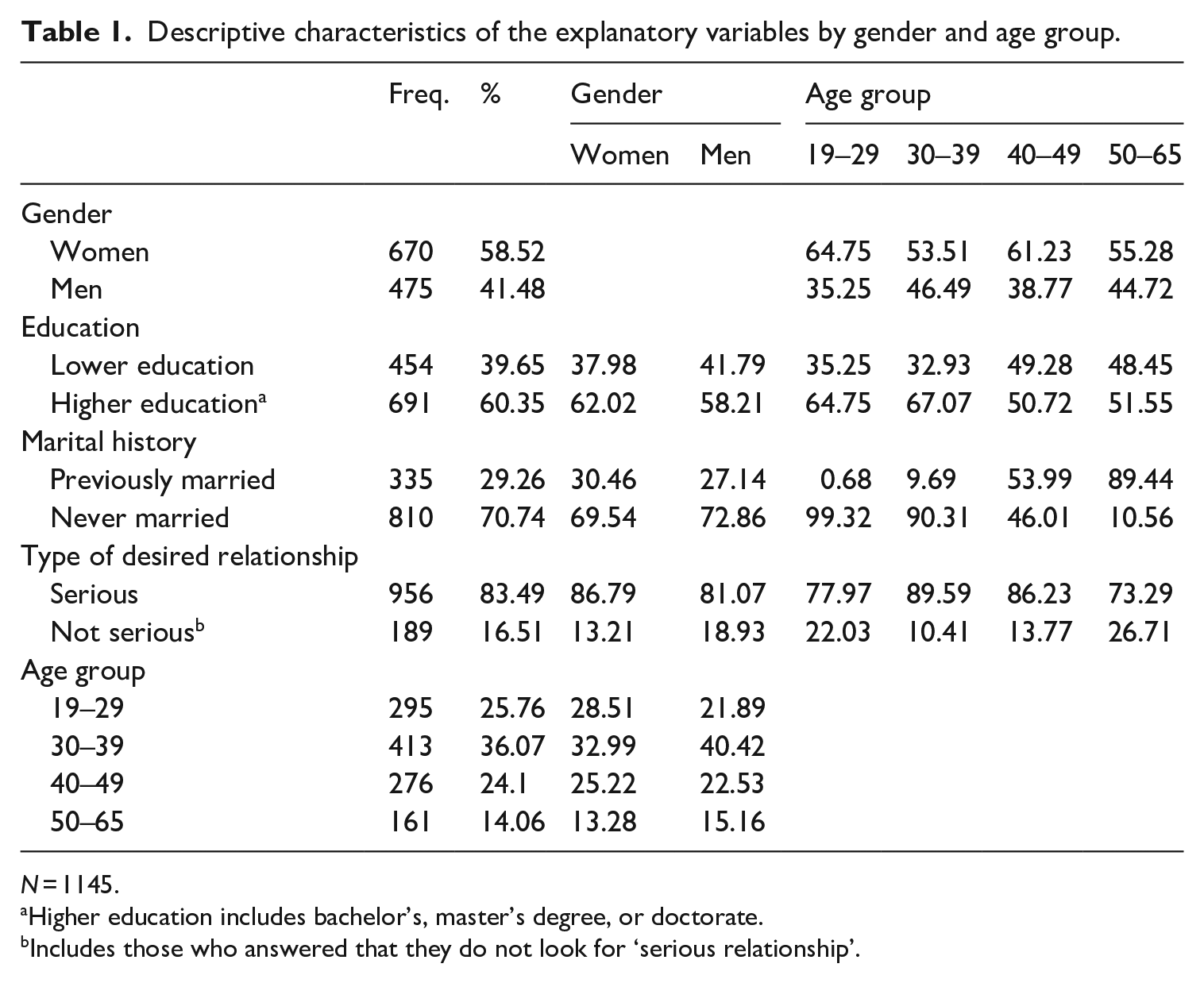
The analytical sample included 1145 heterosexual respondents age 19–65 years (58% of women and 42% of men). We used the following exclusion criteria for the original sample (n = 1409): we omitted those who did not declare their partner preferences (n = 143) and those who did not state any or our explanatory variables (n = 105). Due to the low number of observations (n = 16), we restricted the data sample to respondents with a maximum age of 65 years. The sample description and distributions of control variables by gender and age groups are shown in Table 1.
Descriptive characteristics of the explanatory variables by gender and age group.
N = 1145.
Higher education includes bachelor’s, master’s degree, or doctorate.
Includes those who answered that they do not look for ‘serious relationship’.
In comparison with the characteristics of unpartnered individuals in the nationally representative data sample Czech Household Panel 2015, these data are biased toward younger, single, more educated people, likely with higher socioeconomic status, living in the capital. Moreover, speed-dating participants may differ from the general unpartnered population with unobservable traits; for example, the participants may be more selective or motivated. Despite these limitations, the data have several advantages compared to datasets from previous studies. These data included unpartnered individuals across age groups who were actively searching for a romantic partner. In this regard, this research is similar to those utilizing samples of online daters, which, although non-representative, capture mating preferences directly in their ‘natural’ setting, that is, during the dating process, and thus are more relevant for the study of partner preferences compared to standard surveys (Alterovitz and Mendelsohn, 2013; Buunk et al., 2002; Potarca et al., 2017; Topinková and Šetinová, 2020).
Dependent variables
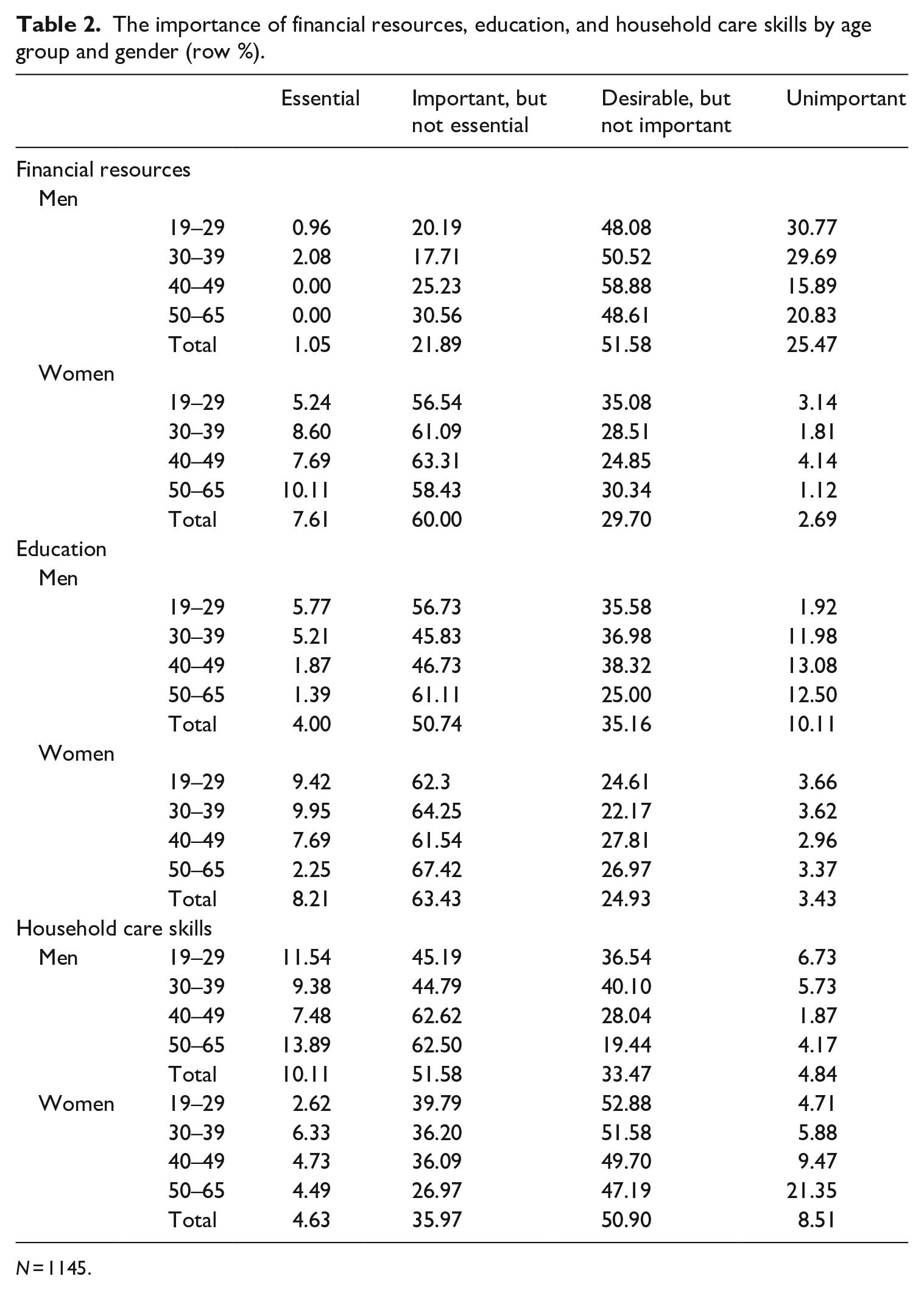
We used three dependent variables, each representing the importance of a partner’s trait. Respondents rated on a 4-point Likert-type scale (1 = Essential, 2 = Important but not essential, 3 = Desirable but not very important, and 4 = Unimportant) how important education, financial resources, and household care skills were when choosing a life partner. As both extreme categories (1 and 4) were low (see Table 2), for purposes of following logistic regression analyses (described later), we opted to dichotomize the scale. The high preference of a given partner’s trait was coded ‘1’ when an individual valued the given quality as ‘Essential’ or ‘Important but not essential’ (1 or 2) and ‘0’ when an individual valued the given quality as ‘Desirable but not important’ or ‘Unimportant’ (3 and 4). This allowed us to distinguish between individuals who highly preferred particular characteristics and those who do not.
The importance of financial resources, education, and household care skills by age group and gender (row %).
N = 1145.
Explanatory variables
In the analysis, age and gender were the main explanatory variables. Age was measured in years and ranged from 19–65 years. The mean age in the sample was 38 years. For descriptive purposes, we distinguished four broad age categories: 19–29 (emergent adults), 30–39 (young adults), 40–49 (middle aged), and 50–65 (older age; see Table 2). In the subsequent analysis, however, we used age as a continuous variable, rather than pre-defined age intervals. Gender was coded as 1 for women (the reference category were men).
Control variables
In addition, we controlled for education, marital history, and type of relationship sought. As the sample was biased toward higher educated individuals, especially at younger age (Table 1), education was measured with a dummy variable to determine whether the respondent had (1) higher education (bachelor’s degree, master’s degree, or doctorate) or (2) lower education (including postsecondary non-university education). Lower education was set as the reference category. Based on previous research, we expected that education affected partner preferences. Highly educated young adults have a much more extended search for a permanent partner in life and form a family later than those with low education (Furstenberg, 2008; Sironi et al., 2015). Having higher education is linked to lower emphasis on traditional gender roles within the family and a more egalitarian division of housework (Hamplová et al., 2019). In addition, high-educated individuals emphasize education homophily more than low-educated individuals (Skopek et al., 2011). Despite the tendency to homogamy in terms of socioeconomic characteristics, previous research on partner preferences in the Czech Republic suggested that high-educated men and women emphasize education more but partner’s financial resources less compared to their low-educated counterparts, partly because they may have higher confidence in their economic independence (Vymětalová, 2000).
In an additional analysis, we tested whether having higher socioeconomic resources could potentially be associated with greater selectivity even at later ages. As an interaction between age and education did not improve the models, it is not presented here. Information on other dimensions of social-economic status, such as occupation, income, or any information about family background, was not available in the data. However, education is the most important determinant of occupational success in industrial countries and reflects the cultural resources that influence individual tastes and preferences (Blossfeld and Timm, 2003).
Finally, we controlled for marital history which distinguishes never married and previously married (the reference category). Previously married included divorcees (26%), widowers (2%), and separated but still married individuals (1%). Marital history is strongly associated with age: middle-aged and older individuals are more likely to have experienced marriage (Table 1). In the analysis, we explored variation by age and control for marital experience rather than comparing groups of never married and divorced individuals, which might be confounded by a relatively marginal but selective group of the never partnered (Bellani et al., 2017). The group of never married individuals included never partnered individuals and individuals who had previously lived in unmarried cohabitation and may have similar experiences to divorced individuals. The proportion of individuals not having any previous partner (including a non-coresidential partnership) ranged from 9.2% in the youngest group to 0.6% in the oldest group. In a control analysis, we also ran models with marital status as the main explanatory variable without controlling for age and a model with age without controlling for marital status. However, these analyses yielded the same substantive results relating to shifts in partner preferences across life-course.
As partner preferences can vary according to individuals’ relationship goals (Buunk et al., 2002), we used the desired type of relationship as a control variable. Based on the answers to the question ‘What type of relationship are you looking for?’ which included the following four options: (1) serious relationship; (2) short-term relationship, flirting; (3) I don’t know; and (4) I’m not looking for a relationship, a dummy variable was created. It indicates whether the individual was looking for a serious relationship (first option) or not (all other answers; the reference category). ‘Serious relationship’ was not defined more closely, thus the answer depends on respondent’s subjective perception.
Analytical strategy
As the three dependent variables (i.e. high preference for education, financial resources, and household care skills) were dichotomous (‘1’ indicated high preference and ‘0’ low preference), binary logistic regression was used. Logistic regression gives the probability of a high preference for each partner’s characteristic given the values for the explanatory variables, that is, age, gender, education, marital history, and type of relationship sought. For each dependent variable, we estimated two models to address the two research questions. To find whether the preference for the given trait varied by age (RQ1), we fitted a baseline model (M1) that included all explanatory and control variables. To test whether the partner preferences varied for men and women based on their age (RQ2), we added the interaction between age and gender in the model (M2). Moreover, we tested non-linear effects of age; and we estimated the model with the interaction between age and education. These models did not fit the data better and, therefore, are not reported.
Results
Table 2 presents partnership preferences across four age categories by gender. In line with previous research, we observed that more women rated education and finances as important, than men did. However, more men rated household care skills as important, than women did. The results shown in Table 2 suggest that perceptions of the importance of finances and household care skills vary across age. Older men rated finances as more important more frequently than younger men. The majority of women rated finances as important, with young women rating important least frequently. Middle-aged and older men (40–49 and 50–65 years old) rated household skills as important more often than younger men. For women, the older they were, the more often they rated partner’s household skills as unimportant. The preference for education seemed to be stable for women as most rated it as ‘Important but not essential’. The oldest (50–65 years) and youngest (19–29 years) men reported more often that they found education important compared to men age between 30 and 49 years. The youngest men also less often rated education as ‘Unimportant’ compared to men who were 30 years and older.
Table 3 reports the regression coefficients and the odds ratios (in square brackets) estimated from binary logistic regressions, predicting high preference of each of three qualities expected in a potential partner. The reference category was ‘low preference’, that is, comprised those who rated the given quality as unimportant. M1 refers to baseline models, M2 to models with an added interaction between age and gender.
Logistic regression predicting high preference for a given potential partner’s trait (reference category is ‘low preference’).

AIC: Akaike information criterion; BIC: Bayesian information criterion.
Regression coefficients, t-statistics in round brackets, exponentiated coefficients (odds ratios) in square brackets. Reference categories are men, lower education, previously married, looking for other than serious relationship.
p < 0.05; **p < 0.01; ***p < 0.001.
Logistic regression models confirmed that education and finances were perceived as more important by women, while household skills were perceived as more important by men. This result corroborates previous literature and the preliminary findings shown in Table 2.
Nevertheless, in this study, we were mainly concerned with age. First, we were interested in whether the preferences of older and younger respondents differed (RQ1). Second, we examined whether shifts with age are gender specific (RQ2). Regarding RQ1, age seems to have no effect on the importance of partner education. Regarding RQ2, gender differences in education preferences remained stable across age groups.
However, age differences were revealed in financial resources preferences (Figure 1). The probability of emphasizing prospective partners’ financial resources was approximately 20 percentage points higher, on average, for individuals in their 60s than for individuals in their 20s. These results contradict the findings of Sprecher et al. (2018) of less selectivity in partner preferences of older respondents and contrast with findings that the effect of socioeconomic status on marriage entry is stronger in the first marriage than in the remarriage (Shafer and James, 2013). In line with Vespa (2012), these findings show that the preference for financial resources actually increases with age regardless of gender.
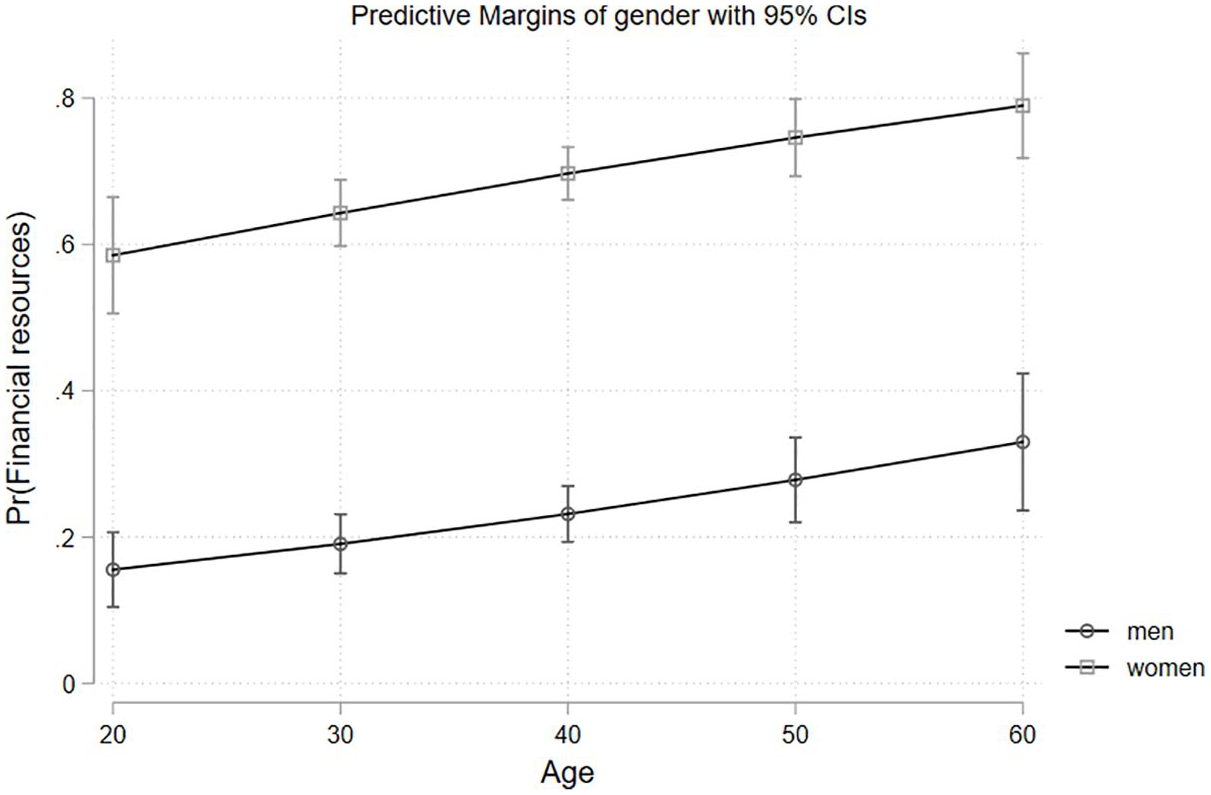
The importance of partner’s financial resources: Marginal effects of age with 95% confidence intervals.
Related to the preference for household care skills, we found a difference across ages which varies by gender. Although age was not statistically significant in the baseline model (M1), this changed when we added the interaction between age and gender (M2). Figure 2 shows that with increasing age, women find partner’s household skills to be less important. In contrast, with increasing age, men emphasize household skills more. To illustrate, 20-year-old men and women have roughly the same probability of having a high preference for partner’s household care skills (45% and 47%, respectively). This preference changes for older counterparts, as the probability rises to over 64% for 40-year-old men and declines to 39% for 40-year-old women. The disparity continues to grow even further for the oldest respondents. The average 60-year-old man has a 79% probability of stating a high preference for partner’s household care skills, while a woman of the same age has a probability of 32%.
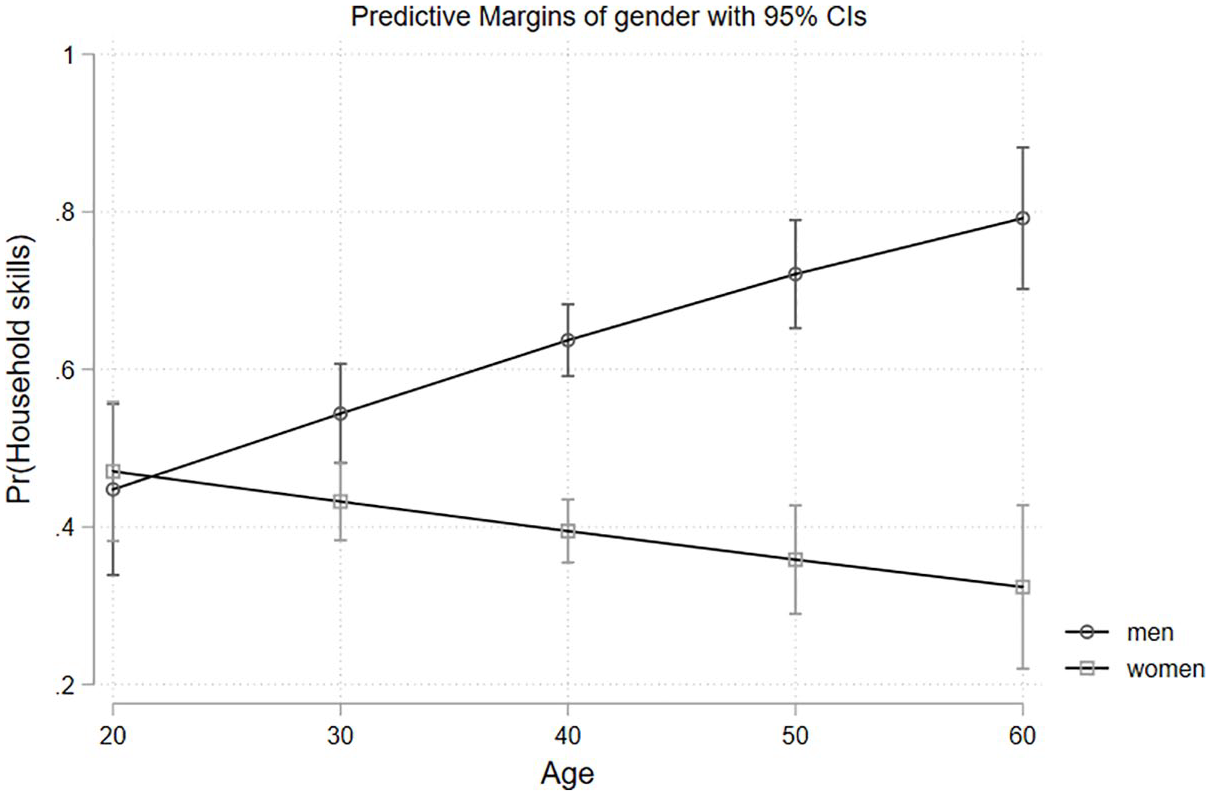
The importance of partner’s household care skills: Marginal effects of age and gender with 95% confidence intervals.
For the control variables, respondents who were looking for a serious relationship were more likely to emphasize the importance of financial resources in partner selection. Similarly, never married individuals considered finances more important than those who had previously been married. In addition, although the coefficient for marital history was not statistically significant, the t-statistics showed that it was very close to the 0.05 p-value threshold. Somewhat surprisingly, the effect of a serious relationship on the preferences for partner’s education levels was negative (although not statistically significant). This effect might be driven by singles in their 30s who are not looking for a serious relationship but who value education highly. We also observed that partner preferences differ by educational attainment. More educated individuals are more likely to emphasize a partner’s education and less likely to emphasize household care skills, which is in line with previous findings (Vymětalová, 2000).
Discussion and conclusion
This study extends existing research on partner preference and union formation across the life-course by examining the variation in partner preferences related to education, economic resources, and household care skills by age, while controlling for previous marital experience. We examined data from individuals aged 19–65 years who were actively looking for a partner from the Czech Republic.
Based on marital search theory (Oppenheimer, 1988), which postulates that partnering is constrained by the partner market characteristics, we expected that at a later age, when the dating pool is more limited, individuals may relax their criteria for potential partners. However, our findings do not support the idea of a universal decrease in selectivity with age. We propose two likely explanations for this finding. First, partner preferences might be reassessed during the process of searching for a partner and thus, preferences at the early stage of union formation might differ from the final matches. Second, the analyses were based on participants of speed-dating events who might aim to expand the pool of available partners instead of lowering one’s preferences for a potential partner.
In contrast, the findings for age variation in partner preferences can be interpreted in terms of different expectations and needs across the life-course. We found that the importance of a partner’s economic resources increases with age. The findings also suggest that this association does not differ by educational level. It corroborates the findings that personal income has a lower impact on the likelihood of partnership formation at a young age when individuals are at the early stage of a career or enrolled in education compared to middle-aged adults (Rapp, 2018). In contrast to Rapp (2018), these findings suggest that adults emphasize a potential partner’s economic resources later in life more than in middle age. In line with Vespa’s (2012) findings, older women and older men are likely to look for an economically independent partner who does not need any additional financial support from them. Moreover, more economic resources may be necessary to maintain two separate living arrangements that older adults often prefer. The high preference for partners’ secure financial situation among middle-aged and older adults also suggests that individuals may reconsider their partner selection criteria based on previous experiences, for example, to avoid potential sources of conflict between partners due to financial strain, to compensate for the economic downturn following a divorce, or to prevent socioeconomic status decrease during re-partnering (Goldthorpe, 2000; Katrňák and Fučík, 2009).
These findings show that preferences concerning partner education do not differ across the life-course. This finding contrasts previous research showing that partnerships formed later in life are more educationally heterogeneous than first unions (Shafer, 2013; Theunis et al., 2015). These findings suggest that differences in union formation patterns across the life-course in terms of education are influenced by structural factors of the dating market rather than by a shift in individual preferences. Despite the reversal of the gender gap in education in younger cohorts (Van Bavel et al., 2018), women’s preferences regarding education do not vary by age. This might be associated with increasing tensions between social norms, individual expectations, and partner market opportunities. At a young age, education is a more meaningful indicator of future socioeconomic status than income compared to later stages of a professional career. However, later in life, education remains an important indicator of both socioeconomic status and cultural capital, individual preferences, and values. To avoid adjustment problems, older adults might prefer a new partner who shares their social background (Gelissen, 2004).
This study showed that gender differences in partner preferences are mostly stable across the life span. The only exception is the preference for household care skills, where we found diverging expectations for potential partners among men and women of different ages. For men, the importance of household care skills increases with age. In contrast, older women are less interested in household care skills compared to young and middle-aged women, who may plan childbearing or have childcare commitments, and thus, may prefer partners with childcare and household care skills. In contrast, men’s preferences for household care skills are not associated only with intentions of family formation and with childcare but persist and strengthen even in middle and older age when men prefer more instrumental support in the household. These findings are consistent with previous studies that showed older women prefer different types of partnership arrangements than older men and try to ‘redo’ gender roles in their new relationships (Formánková and Křížková, 2015; Karlsson Ghazanfareeon and Borell, 2002; Lewin, 2018; McWilliams and Barrett, 2014; Mahay and Lewin, 2007). The finding is also consistent with findings that divorced men tend to have more traditional attitudes about gender roles (Goldscheider et al., 2009; Shafer, 2013). This divergence in expectations in middle and later age might explain the persisting gender gap in re-partnering (Kreidl and Hubatková, 2017).
These findings can be partly explained in line with the cohort shifts toward more liberal attitudes toward family behavior in the Czech Republic (Rabušic and Chromková Manea, 2018). Older women express less emphasis on men’s housework skills and more emphasis on men’s economic resources than younger women, while older men emphasize women’s household skills more than younger men. However, although older men are expected to adhere to a more traditional male-breadwinner role than their younger counterparts, older men emphasize women’s economic resources more than younger men. This discrepancy provides more support to the other explanations mentioned earlier than to cohort shifts.
The analyses were based on data from the Czech Republic. In the Czech Republic, traditional gender norms regarding childcare and household care prevail, and the level of re-partnering is lower than in more egalitarian countries (Gałezewska et al., 2017; Hamplová, 2012). However, there is also high female labor force participation and expectations that both genders will succeed economically. Nevertheless, it remains unclear whether and how the institutional context mitigates these age variations. Previous studies showed that the institutional context determines the economic consequences of separation, and that has an impact on women’s re-partnering options (Andreß et al., 2006). In contexts where women’s economic dependence on a partner’s economic resources is higher, women may have a greater need to re-partner, and thus, may lower their partner preferences. For example, Potarca et al. (2017) revealed differences among divorced individuals’ readiness to accept a partner with children across European countries, which are associated with the national level of the gender pay gap (Potarca et al., 2017). Future studies using cross-national data could examine whether age differences in partner preferences vary by institutional as well as cultural contexts, that is, whether the differences are linked to prevailing social norms related to family and gender roles. This can shed light on understanding cross-national differences in the levels of re-partnering.
We must also note that our study has some limitations concerning research design. First, the longitudinal study design would be needed to differentiate between the effect of aging and cohort effects. Second, the data described a group of individuals who participated in speed-dating events, and thus the dataset is not representative of the general population of unpartnered individuals. Moreover, the data used in this study did not provide complete information about an individual’s partnership and parenting history, or about more detailed measures of socioeconomic status. In particular, we had no information on the respondents’ resident children, which might significantly impact level of selectivity in partner preferences (Potarca et al., 2017). Despite these limitations, this study contributes to research on union formation across ages by examining differences in partner preferences across a larger age range.
Footnotes
Funding
The author(s) disclosed receipt of the following financial support for the research, authorship, and/or publication of this article: This work was supported by the grant from the Czech Science Foundation under Grant 17-12099S and from the Charles University, GA UK no. 602120.
