



Abstract
Although boredom can be regarded as a ubiquitous emotion in most educational settings, including foreign and second language classrooms, and this condition can have a detrimental effect on the process of learning, it has to a large extent escaped the attention of second language acquisition researchers dealing with individual learner differences. The study reported in this article sought to fill this gap by investigating the trajectories of boredom exhibited in a practical English class by 11 Polish university students majoring in English. The data were collected by means of a background questionnaire, the Boredom in Practical English Language Classes Questionnaire (BPELC), and an in-class boredom questionnaire, including a self-report boredom grid, an open-ended query and an evaluation of the class based on a semantic differential scale. It was found that general proneness to experience boredom in practical English classes translated into distinct patterns of boredom in the class in question. At the same time, it turned out that the individual trajectories in experiencing boredom often deviated from the general patterns, being shaped by unpredictable constellations of individual and contextual factors.
I Introduction
Boredom is described as the most alarming problem in contemporary classrooms (Bridgeland, Bruce, & Hariharan, 2013; Goetz, Frenzel, & Hall, 2014), including second or foreign language (L2) learning environments (Kruk & Zawodniak, 2018; Chapman, 2013), and research findings show that it seriously impedes the learning process at all educational levels (Daniels et al., 2009; Daschmann, Goetz, & Stupinsky, 2011; Nett, Goetz, & Hall, 2011). Evidently, boredom is a silent emotion because it does not cause classroom disruption to the same extent as anxiety or anger (Fahlman, 2009; Pekrun, Goetz, Daniels, Stupinsky, & Perry, 2010); yet its prevalence among students of different ages, levels, abilities and backgrounds (Siemer, 2009) constitutes a powerful argument for seeking effective ways of coping with it. However, this emotion still remains sorely underappreciated and insufficiently understood, with little empirical research being undertaken, particularly in regard to L2 learning and teaching (Merrifield & Danckert, 2014). One reason for this might be that boredom is all too often regarded as an inconspicuous emotional state and a trivial topic (Mercer-Lynn, Flora, Fahlman, & Eastwood, 2011). In an attempt to fill the evident gap in the existing research and broaden the scope of empirical investigations into individual differences (IDs) in L2 pedagogy (Kruk & Zawodniak, 2018; Pawlak, 2017; Piniel & Csizér, 2013), the article reports a study which explored the individual trajectories in experiencing boredom manifested by 11 Polish university students majoring in English. In this way, it builds upon the existing research on IDs, such as motivation and willingness to communicate, that has adopted a micro-perspective (e.g. Pawlak, 2012; Pawlak, Mystkowska-Wiertelak, & Bielak, 2016) in which IDs are explored in specific contexts. Similarly to previous empirical investigations, it set out to examine changes in levels of boredom during naturally-occurring classes and reasons for these changes, thus making an important contribution to this line of inquiry in research on individual learner variation in L2 learning.
II Literature review
1 Towards defining the construct of ‘boredom’
An attempt at defining ‘boredom’ represents a major challenge, given that it is a very complex and multifaceted concept that cannot be easily squeezed into a concise description. To begin with, it is referred to as a trait or state emotional experience, with the latter being prevalent in the learning environment (Weinerman & Kenner, 2016), also in the L2 classroom, and it has been primarily explored as such in existing research, including the study reported below. State boredom is an avoidance-oriented transitory affective condition drawing on the interaction of low arousal levels with unpleasant emotions, which entails mental and/or behavioral disengagement (Harris, 2000; Mikulas & Vodanovich, 1993). More precisely, when the task at hand is unexciting, students react to it with frustration, dissatisfaction, disappointment or disinterest (Fahlman, 2009; Nett, Goetz, & Daniels, 2010), wanting to engage in what others perceive as involving, but feeling unable to do so (Eastwood, Frischen, Fenske, & Smilek, 2012). This implies that, contrary to common beliefs, boredom results from not being able to do what one enjoys doing rather than from having nothing to do at all (Mann & Robinson, 2009; Martin, Sadlo, & Stew, 2006). Although related to depression, apathy and anhedonia, boredom has been empirically shown to be a distinct variable (Goldberg, Eastwood, LaGuardia, & Danckert, 2011). It has also been linked, among others, to sensation seeking, impulsivity, increased absenteeism, higher levels of stress and lower levels of self-actualization (Kass, Wallace, & Vodanovich, 2003; Thackray, 1981). In academic settings, boredom has been reported to correlate to student achievement, motivation and anxiety (Kruk & Zawodniak, 2018, Daniels et al., 2009).
The level of arousal and positive/negative emotions are issues which underlie the classification of boredom into five subtypes as follows (Goetz et al., 2014):
indifferent boredom, which relies on low arousal and pleasantly experienced fatigue;
calibrating boredom, which is characterized by a higher level of arousal and moderately unpleasant emotions connected with one’s desire and at the same time inability to change the annoying situation;
searching boredom, which consists in actively looking for something more interesting to do;
reactant boredom, pertaining to individuals who angrily and/or aggressively deflect the blame onto other people and things; and
apathetic boredom, in which case an extremely unpleasant experience of helplessness and dissatisfaction is associated with depression-related characteristics.
This typology shows that despite being such a negative, debilitating attribute, boredom can also be seen as a motivating force likely to give an impulse for new actions.
The complexity of boredom also concerns its causes (Daniels, Tze, & Goetz, 2015; Daschmann et al., 2011), which can be accounted for in terms of several theories and models. First, students can feel bored because they are under-challenged as a result of being exposed to repetitive activities (under-stimulation model; Larson & Richards, 1991). Second, boredom can emerge when students find themselves overwhelmed by excessive teacher control, which frustratingly reduces their opportunities to make choices on their own (forced-effort model; Hill & Perkins, 1985). Third, bored students have alexithymic difficulty attending to, processing and communicating their emotions (emotion theory; Eastwood et al., 2012). Fourth, students’ appraisals of control that they have over a given task and value that they attribute to it can be important predictors of boredom (control-value theory of achievement emotions; Pekrun, 2006). Fifth, boredom can be caused by poor attentional control which can be related to a low level of self-awareness of attention, leading to distractibility and memory lapses (attentional theory of boredom proneness; Harris, 2000; LePera, 2011). Sixth, boredom can be both an activating and deactivating emotion, meaning that students can make attempts to sustain attention and cope with anger when a boring activity is too long, in which case arousal behavior is activated (dimensional model; Pekrun et al., 2010). Seventh, boredom may be triggered by both under-challenging and over-challenging tasks. In other words, students can be bored not only because of mental energy surplus but also due to its insufficient amount (Menton theory of boredom; Davies & Fortney, 2012). It has also been shown that boredom is negatively correlated with intrinsic motivation (Pekrun et al., 2010), it may stem from a lack of meaning in learning as well as from distorted time perception which gives one the impression of being stuck in a given activity (Eastwood et al., 2012).
2 Boredom and dis/engagement
An inherent element of boredom, as indicated by various authors (e.g. Fahlman, 2009; Macklem, 2015), is disengagement, which is usually mentioned before other constituent components of this condition, including dissatisfaction, inattention, altered perception of time passing and impaired vitality. Since bored students are said to be disengaged from participating in a satisfying task and since preventing disengagement is viewed as directly corresponding to combating boredom (Macklem, 2015), it seems warranted to shed some light on this construct. This, however, is hardly possible without examining the flip side of the concept by discussing engagement, which has attracted much more scholarly attention than its negative counterpart.
In general, ‘engagement’ is described as the extent to which individuals are actively involved in certain behaviors (Appleton, Christenson, & Furlong, 2008). A more nuanced definition of ‘student engagement’ posits that it occurs in situations where one simultaneously and intensely experiences concentration, interest and involvement in a given activity (Shernoff, 2013). Engaged students manifest persistence, readiness to make effort, prosocial behavior, enthusiasm, strategic thinking and/or sophisticated learning strategy use, to name but a few of the defining characteristics (Veiga, Reeve, Wentzel, & Robu, 2014). Although engagement is a multidimensional phenomenon comprising emotions, behaviors and cognitions (Shernoff, 2013), researchers agree that the behavioral aspect is the most reflective of engagement in the classroom (Dörnyei, 2019; Skinner, Furrer, Marchand, & Kindermann, 2008). Engagement has been reported to positively affect self-esteem and self-regulated learning as well as to decrease negative emotions (Lam, Wong, Yang, & Lui, 2012).
The description of engagement provided above helps better understand the notion of ‘disengagement’, which can be defined as the act of withdrawing from involvement in an activity or situation because of an individual’s inability to generate interest, pleasure and/or satisfaction (Macklem, 2015; Pekrun et al., 2010). Disengaged students are alienated from their passions and desires, and they feel discouraged by an impoverished environment. Disengagement can culminate in avoidance behaviors or attempts to change the unrewarding situation, depending on a more or less successful interplay of students’ individual dispositions and environmental influences (Daschmann et al., 2011). In view of the close link between disengagement and boredom, seeking ways to reduce the former can offer valuable insights into how that latter can be successfully combated in educational settings, including L2 classrooms (Weinerman & Kenner, 2016).
3 Boredom in L2 learning from an empirical perspective
Boredom is a commonly experienced academic emotion but it remains an understudied topic, especially in relation to L2 learning. There are two distinct lines of inquiry in this respect: one referring to boredom in an indirect way (i.e. Beermann & Cronjäger, 2011; Jean & Simard, 2011; Kikuchi, 2015; Peacock, 1997) and the other treating it as a primary object of investigation. Because of the focus of this article, the overview provided in this section will be confined to studies falling into the second category.
In one of the first research projects dealing with boredom in L2 learning, Chapman (2013) examined the beliefs about boredom held by English learners of German as a foreign language and their teachers. She showed that the former’s attitude towards the latter was more predictive of the occurrence of boredom than the activities performed. Chapman also investigated the participants’ ‘bored’ behaviors, classifying them into active (e.g. making lists, reviewing upcoming deadlines) and passive (e.g. daydreaming, playing with a phone, biting fingernails).
The bulk of existing research on boredom has been conducted in the Polish educational context, in particular at the university level. Kruk (2016a), for example, investigated the dynamics of boredom manifested by senior high school students of English as a foreign language during a three-week period. The analysis of the data revealed changes in the level of boredom in single classes as well as sequences of classes, with the fluctuations resulting from boredom proneness and the activities performed. In another study, which was longitudinal in nature and spanned an entire semester, Kruk (2016b) explored changes in the levels of boredom, together with motivation and anxiety, experienced by English majors during their visits to Second Life. The participants’ boredom and motivation were found to fluctuate with a tendency to rise (boredom) and fall (motivation) over time, whereas anxiety remained relatively stable. Also focusing on English majors at the university level, Kruk and Zawodniak (2017) investigated the relationship between general boredom proneness and the actual boredom displayed during practical English classes. The findings led the researchers to conclude that the two variables were positively and significantly correlated, and that boredom tended to grow over time. The study also illuminated the reasons for boredom, such as lack of feedback, poor correspondence between classroom activities and L2 proficiency, the repetitive nature of these activities, the teacher and the choice of student groupings. In a follow-up study, Kruk and Zawodniak (2018) examined boredom in relation to a sample of the participants from their 2017 study. In addition to identifying the reasons for student boredom and changes in its levels, the study explored the differences between the occurrence of boredom in practical English classes and other academic subjects, also delving into respondents’ manifestations of this negative emotion and the strategies they adopted to combat it. The analysis of the data revealed that students were more eager to cope with out-of-school boredom than with its in-school counterpart. They also turned out to be more bored with theoretical subjects than with practical English classes which were perceived as more useful, due to small-size groups and sole reliance on English as the language of instruction.
While the studies outlined above have shed some light on the experience of boredom in the L2 classroom, they have mainly done so with respect to group patterns, focusing in particular on the changes in this respect over time and seeking to pinpoint the causes of such fluctuations. By contrast, the study reported below aimed to investigate boredom at the individual level by looking into its trajectories exhibited by 11 university students majoring in English in the course of a single practical English class as well as determining the influences responsible for shaping them.
III The study
The study examined the levels of boredom and their fluctuations, as self-reported by 11 advanced learners of English at the university level during a single practical English class intended to hone their target language (TL) skills. In effect, as has been the case with the bulk of existing research, the focus was on state rather than trait boredom, mainly because the construct was investigated from a micro-perspective where the occurrence of this negative emotion in a specific context was the main goal. The following research questions were addressed:
What are the patterns of boredom in a single practical English class reported by students characterized by moderate and high levels of boredom in such classes?
Are such general patterns reflected in the individual trajectories of boredom experienced by the participants?
What influences are responsible for shaping individual trajectories in experiencing boredom?
1 Participants
Convenience sampling (Dörnyei, 2007) was used to identify students willing to take part in the study, which was dictated by the nature of the investigation, that is, the desire to investigate boredom in the course of naturally-occurring classes, as well as the availability of such classes related to the readiness of instructors to provide access to them. In effect, the participants were 11 English majors (10 females and 1 male) enrolled in the final year of a three-year BA program. They were on average 21.91 (SD = .70) years of age and their mean experience in learning English equaled 12.73 (SD = 3.72) years. Regarding their proficiency level, it oscillated between B2/C1 according to the Common European Framework of Reference, although some individual variation could be observed regarding both the general mastery and the command of different TL skills and subsystems. The participants’ mean grade in the end-of-the-year examination in English was 3.73 (SD = .65) on a scale from 2 (fail) to 5 (very good), whereas their self-assessment was only a bit higher and amounted to 3.86 (SD = .60) on the same scale. Their general level of boredom was above average, as indicated by the mean score on the Boredom in Practical English Language Classes Questionnaire (BPELC; see Section III.2.) which equaled 4.12 (SD = .68). According to the score obtained on the BPELC, the 11 students were divided into two groups: Group 1 (G1) – moderately bored students or MBS (i.e. students who experience below average boredom in English language classes) – and Group 2 (G2) – highly bored students or HBS (i.e. students who experience above average boredom in English language classes). G1 comprised six students, while G2 consisted of five participants. Table 1 offers detailed information about each of the 11 students, also with respect to other variables investigated in the present study (see Section III.2.).
Description of participants.

2 Data collection
The changes in the levels of boredom were investigated in a single 90-minute English class conducted by one of the present authors. Table 2 provides a short description of this class, focusing on the activities used, the skills practiced, the modes of class organization employed and the time allocated to each stage of the class. In general, the class focused on the development of different areas involved in English language learning covered in the course.
Description of the lesson.
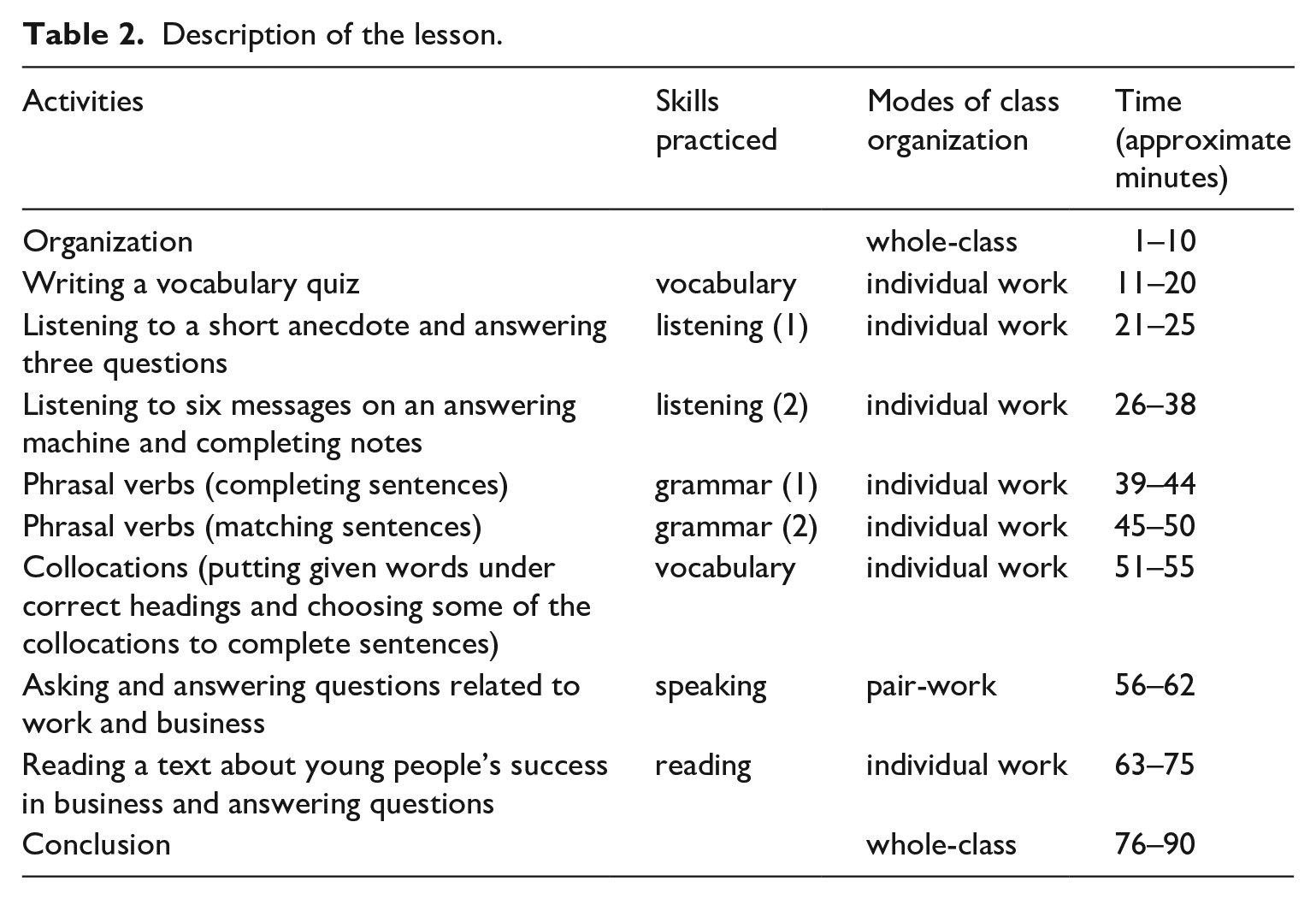
In order to address the research questions presented above, data were gleaned from four different sources, which were as follows:
the background questionnaire: this was filled out by the participants in the class preceding the one under investigation and provided information needed for arriving at their profiles included in Table 1; the students were asked about their age, sex, length of experience in learning English, the grade on the final examination in English taken at the end of the previous academic year, their self-assessment of English proficiency and favorite ways of learning English; the background questionnaire also included statements related to students’ preferred learning style taken from the Perceptual Learning Style Preference Questionnaire developed by Reid (1987) (e.g. When the teacher tells me the instructions, I understand better; I understand better when I read instructions; I learn better when I make drawings as I study);
the Boredom in Practical English Language Classes Questionnaire (BPELC): this was also completed in the class preceding the class in question; it was a slightly modified version of a similar instrument used in an earlier study conducted by Kruk and Zawodniak (2017); the version used in the present study consisted of 27 7-point Likert-scale statements (1 – strongly disagree, 7 – strongly agree) related to the experience of boredom in practical English classes; example items are as follows: I often find myself at loose ends in a language class; I often do not feel like doing anything in practical English classes; I would like to have more challenging things to do in my English classes; During language classes. I often think about unrelated things; higher scores indicated higher levels of boredom, but eight items were key-reversed; in view of lack of empirical evidence to the contrary, boredom, as measured by the tool, was conceptualized as a unitary construct; the Cronbach alpha value for this instrument was satisfactory and equaled .812; 1
the in-class boredom questionnaire: this was completed in the course of the class under investigation and comprised four parts: ○ Part One, where the subjects provided their names and the date of the class; ○ Part Two, which included a boredom grid in which the students self-rated the level of boredom on a scale from 1 (minimum) to 7 (maximum) at 5-minute intervals in response to a prerecorded sound; it was a modified version of the tool developed by one of the authors (Pawlak, 2012) for studying motivational dynamics; ○ Part Three was completed towards the end of the class and included seven items on a semantic differential scale that were meant to describe the class in question (i.e. meaningless vs. meaningful; dull vs. exciting; useless vs. useful; unsatisfying vs. satisfying; usual vs. unusual; unappealing vs. appealing and monotonous vs. absorbing); this in fact encompassed a 7-point Likert scale as the extreme responses were accorded a numerical value from 1 (e.g. monotonous) to 7 (e.g. absorbing); yet again, the tool was a modified version of the instrument employed by one of the authors (Pawlak, 2012); ○ Part Four required the participants to write a short paragraph about the experience of boredom during the class (e.g. at what stages they manifested boredom and the reasons they identified as triggering this negative emotion); they were given ten minutes to complete this task at the very end of the class;
the lesson plan: this provided information related to progression of the class, its stages and the language activities performed.
Two important issues should be stressed at this point. First, Polish, the students’ mother tongue, was used in all the data collection instruments to avoid misunderstanding or misinterpretation, but the participants were free to use Polish or English when describing their feelings of boredom in the narratives. Second, all the students gave their consent to take part in the study and were informed that their decision would not affect their grades in a negative way. Still, in order to encourage them to participate and approach the data collecting procedures seriously and honestly, they were offered an additional credit in the course.
3 Data analysis
The gathered data were analyzed quantitatively and qualitatively. Quantitative analysis involved calculating descriptive statistics in the form of means and standard deviations for some of the items in the background questionnaire, the BPELC (overall as well as separately for the six MBS and five HBS), the boredom grid and the semantic differential scale items. A decision was made not to investigate the statistical significance of the differences between the levels of boredom manifested by the participants at any point of the class or the differences between different points of the class for single participants, as the study was exploratory in nature, seeking to identify the patterns of boredom and the factors responsible for them at the individual level. Such an approach is in the spirit of employing the micro-perspective and has typically been adopted in previous research (e.g. Pawlak, 2012; Pawlak et al., 2016; Mystkowska-Wiertelak & Pawlak, 2017). As for qualitative analysis, the participants’ narratives were read several times by the three researchers in order to detect the influences that had or could have had a bearing on the experience of boredom at particular stages of the class. Notes and annotations were used to record any immediate observations. Next, the identified influences were agreed upon by the present researchers.
IV Results
This section presents the findings of the study. For the sake of clarity, it is subdivided into two subsections, one dealing with variations in boredom levels experienced by the MBS and the HBS, and the other focusing on the evaluation of the class by the members of the two groups.
1 Variation in boredom levels manifested by the MBS and HBS
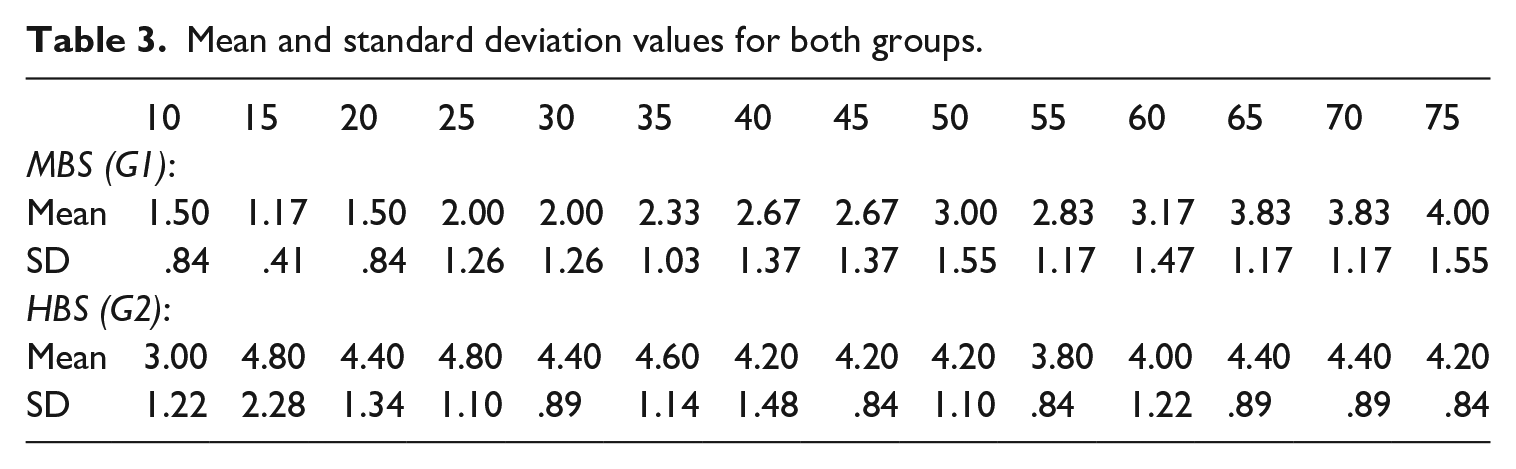
As demonstrated in Table 3 and Figures 1 and 2, the levels of boredom reported by MBS (i.e. students who experience below average boredom in English language classes; G1) and HBS (i.e. students who experience above average boredom in English language classes; G2) were subject to some changes. It should be noted, however, that, overall, the six MBS manifested a steady increase in the level of boredom, as it was the lowest in the initial stages of the class (1.15-1.17) and the highest in the end (4.00). By contrast, in the case of the five HBS, the levels of boredom remained relatively stable, fluctuating between the values of 3.80 and 4.80 throughout the class, with the exception of its initial phase (i.e. minute 10) when organizational issues were being discussed (3.00). As far as the activities performed are concerned, overall, the students in G1 were the least bored in the middle of the quiz (minute 15→1.17) and they experienced the most boredom when reading the text about research into young people’s attitudes to work (the value between 3.83 and 4 points in minutes 65-75). As for the participants in G2, they reported the least boredom at the beginning of the quiz (minute 10→3.00) and they were the most bored in its midst (minute 15→4.80) as well as between the two listening tasks (minute 25→4.80).
Mean and standard deviation values for both groups.
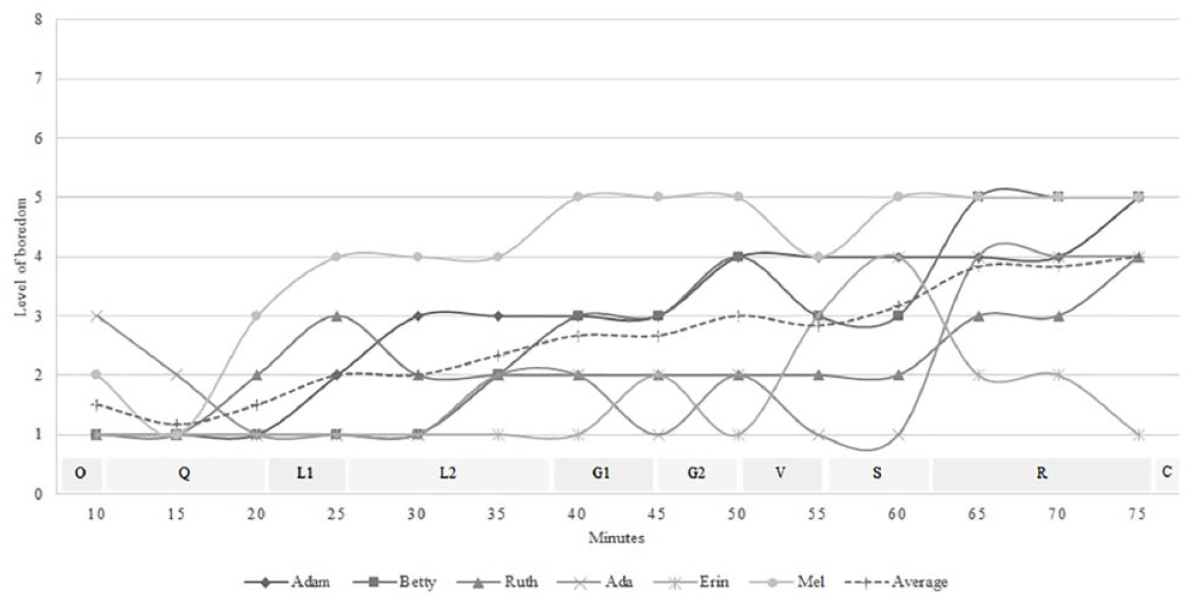
Changes in the level of boredom reported by the MBS in G1 (n = 6) as a function of the activities performed in the lesson.
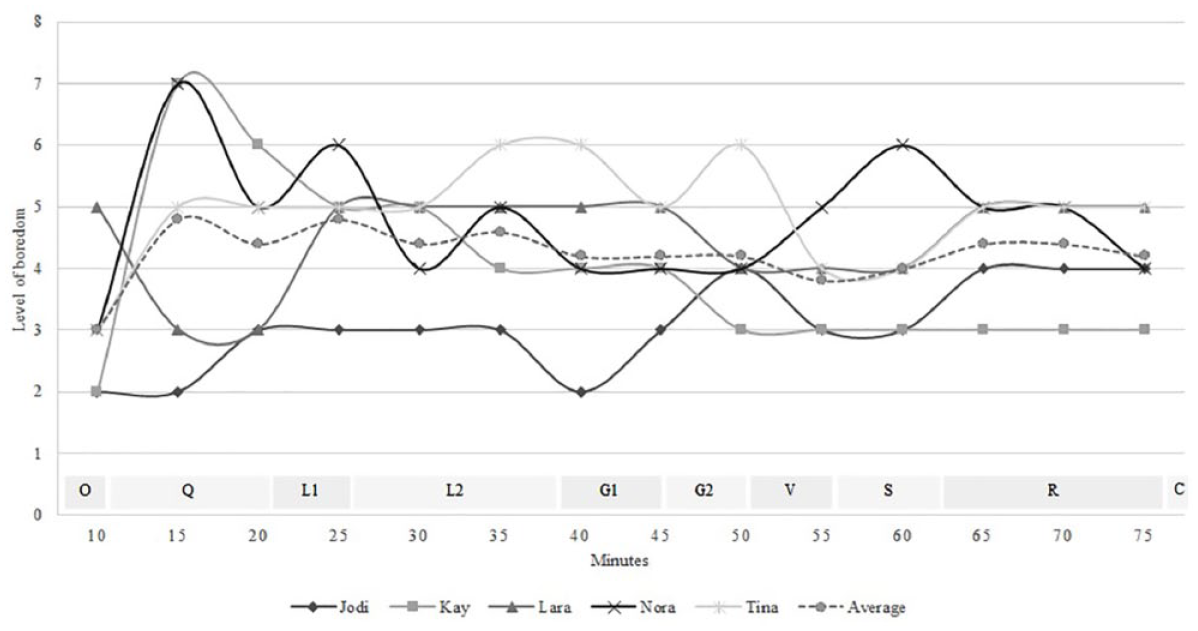
Changes in the level of boredom reported by the HBS in G2 (n = 5) as a function of the activities performed in the lesson.
A closer look at Figure 1 reveals, however, that the individual trajectories of the six MBS did not always reflect the general pattern of boredom levels in G1. Adam reported no boredom during the quiz but then he felt a little bored during the listening tasks (the values of 2.00 and 3.00 in minutes 25-35). The student’s boredom did not change during the first grammar exercise (3.00) but increased by one point at the end of the second grammar activity. Adam’s self-reported levels of boredom then remained the same (4.00) from minute 50 to minute 70, when the participants were asked to do a vocabulary activity, perform a short speaking task and read a rather long text about young people’s success in business, reaching the highest level (5.00) at the end of the reading task. As regards Betty, the learner was not bored in the first 30 minutes of the lesson (1.00). However, somewhere in the second part of the second listening task she started to experience some boredom (2.00). She became quite bored at the end of the second grammar exercise (minute 50→4.00) and then her self-reported levels of boredom dropped to some extent (minute 55→3.00) when the focus of the class was shifted to talking about work and business. This was followed by a sudden increase in boredom levels during the reading task (minutes 65-77→5.00). The reason for this student’s rise in boredom can be understood if we consider her comment in the in-class boredom questionnaire: ‘The most boredom was caused by the reading activity. The topic I read about was very boring.’
2
Ruth reported no boredom in the first 15 minutes of the class and she felt a bit bored from minute 30 to minute 60 when her self-reported levels of boredom leveled off (2.00). The student experienced the most boredom between the two listening tasks (minute 25→3.00) and during the reading task (minutes 65-75→3.00-4.00). As for Ada, the student was a bit bored in the initial minutes of the class (minute 10→3.00), in the middle, that is, at the end and beginning of the second listening task (2.00) and the first grammar exercise (2.00) and towards the end of second grammar exercise (2.00). Ada reported no feelings of boredom during the speaking activity but then her experience of boredom spiked in the last 10 minutes devoted to reading the text (4.00). She wrote in the in-class boredom questionnaire: ‘This not very absorbing text influenced on my experience of boredom.’ Erin did not report any feelings of boredom in the first half of the class. Then she started to experience boredom at the outset of the second grammar activity (minute 45→2.00) and was even more bored at the start and end of the speaking task (minutes 55 and 60→3.00 and 4.00, respectively). Then the levels of boredom dropped a bit (minutes 65 and 70→2.00) during the reading task. Finally, Mel experienced some boredom in the first 10 minutes of the class (2.00). This was followed by a drop in the middle of the quiz (1.00) and an increase at the end of it and the first listening task (minutes 20 and 25→3.00 and 4.00, respectively). The levels of boredom remained high during the second listening task and then increased slightly at the start of the first grammar activity (minute 40→5 points). The student continued to be considerably bored until the end of the second grammar exercise (minute 50→5.00), which was followed by a one-point decrease and an increase at the end of the vocabulary exercise and towards the end of the speaking task, respectively. The level of boredom remained relatively high throughout the reading task and until the end of the lesson (minute 65 onwards→5.00). The reasons for Mel’s initially low boredom and for its rather high levels throughout the remainder of the class become easier to understand if we consider the following comment in the in-class boredom questionnaire: The new and interesting part of the lesson was the quiz which check our knowledge from the previous lessons. It made us aware of our weak points. Besides, the pace of the lesson and the kind of exercises have not changed.
When it comes to the individual trajectories of the five HBS, they also deviated from the general pattern (see Figure 2). More specifically, Jodi’s boredom exhibited a slight increase (minute 20 – a change from 2.00 to 3.00 at the end of the quiz), a period of stability during the two listening tasks (minutes 20-35→3.00), followed by a decrease at the start of the first grammar activity (minute 40→2.00), a considerable increase in the course of the second grammar activity (minutes 45 and 50→a rise from 2.00 to 4.00), a slight decrease during the speaking task (minutes 55-60→3.00), and a final increase that persisted throughout the reading task (minutes 65-75→4.00). The student explained that she enjoyed the level of difficulty of the tasks and the pace of the lesson but she would have been less bored if there had been ‘more speaking’ and ‘more diverse language activities’. Kay experienced some boredom in the first 10 minutes of the class (2.00) but then her self-reported level of boredom skyrocketed during the quiz, reaching its maximum value (minute 15→7.00). This was followed by a rather steady fall during the listening task (minutes 20-35→6.00-4.00, respectively), a leveling-off phase during the first grammar activity and a one-point drop at the end the second grammar exercise (minute 50→3.00). This self-reported boredom level did not change for the remaining 25 minutes, which were devoted to doing the vocabulary exercise, performing the speaking activity and reading the text about success in business. When asked to comment on her experience of boredom during the class, the student pointed to ‘easy’ and ‘not demanding’ language tasks. Lara felt quite bored (5.00) in the first ten minutes and then her boredom level dropped by two points in the middle of the quiz and remained unchanged until its completion (minutes 15-20→3.00). Then boredom level increased by two points at the end of the first listening activity and stabilized throughout the second listening and grammar activities (minutes 25-45→5.00). This was followed by a small decrease while performing the vocabulary and the speaking activities (minutes 50-60→4.00) and, yet again, a one-point increase in the first phase of the reading task (minute 65→5.00), with the boredom level remaining unchanged until the end of the class. The reasons for these pretty high levels of boredom can be best understood when taking into account the student’s comments: ‘The classes were carried out as usual – the same pace and the use of similar materials, which can cause monotony . . . The unannounced test for sure revived and motivated the group.’ Similarly to Kay, Nora did not experience much boredom in the first minutes but then, suddenly, her boredom level shot up in the middle of the quiz and reached its maximum (minute 15→7.00). Subsequently, the boredom levels followed an increase-decrease pattern for about 20 minutes. During that time Nora reported the highest level of boredom (6.00) at the end of the first listening activity and the lowest one (4.00) in the middle of the second listening task. While the following activities (i.e. grammar exercises) were moderately boring (4.00) for the student, her experience of boredom started to rise at the end of the vocabulary task (minute 55→5.00), a trend that continued into the speaking task (minute 60→6.00). Nora was also quite bored during the last reading task, although a small decline in the level of boredom could be observed in minute 75 (4.00). The student’s trajectory of boredom can be explained by her desire to perform most language activities ‘right on the spot’ and ‘not by devoting too much time on their solving and then checking with the teacher’. Finally, Tina experienced a lot of boredom throughout the class, which is evident in the fact that her reported values oscillated between 3.00 and 6.00. She was the most bored at the end of the second listening task and the first grammar activity, as well as at the outset of the vocabulary exercise (minutes 35, 40 and 50→6.00 in all cases). In contrast, the student was less bored while performing the speaking task (minute 60→4.00). As she explained, her experience of boredom during the class was caused by ‘doing yet another set of unabsorbing and undemanding language tasks’.
2 The evaluation of the class by the MBS and HBS
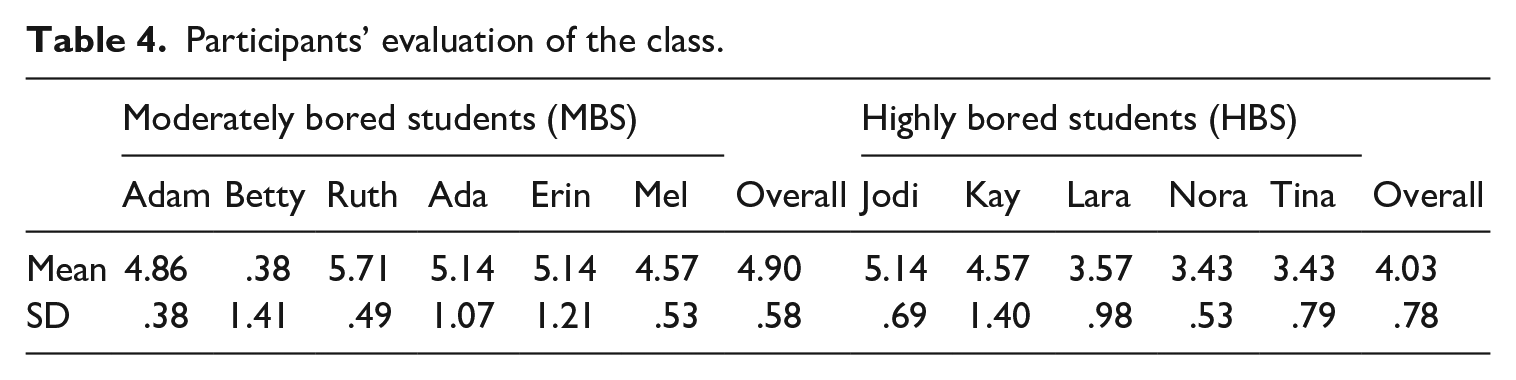
The patterns of boredom experienced at both group and individual levels can be hypothesized to be related to some extent to the participants’ evaluation of the class under investigation. These evaluations are included in Table 4, where responses on the semantic differential scale have been converted into values on a 7-point Likert scale. It is immediately clear that the MBS in G1 felt more positive about the class than the HBS in G2 (M = 4.90 and M = 4.03, respectively), with the difference of 0.87. Quite revealing, though, are the values of standard deviations for both the entire groups and individual students. First, there was more individual variation among the HBS with regard to their perception of the class in comparison to the MBS (0.78 vs. 0.58). Second, irrespective of whether the participants reported below average or high levels of boredom in practical English classes, as measured by the BPELC, some of them (e.g. Betty, Ada, Erin, Kay, Lara) differed quite considerably in their evaluation of the specific dimensions according to which the class was assessed (e.g. meaningfulness, excitement, appeal, monotony). This suggests, for example, that activities that are meaningful may not be appealing or exciting and vice versa, which may have crucial implications for the occurrence and intensity of boredom.
Participants’ evaluation of the class.
V Discussion
The study was intended to address three research questions, concerning overall differences in the patterns of boredom experienced by the MBS and HBS (research question 1), the extent to which these patterns found a reflection in the trajectories of boredom reported by individual students (research question 2), and the factors that contributed to these trajectories (research question 3).
When it comes to research question 1, although the average self-reported levels of boredom were found to fluctuate in both groups, the patterns were evidently different. In the case of the MBS, a gradual increase could be discerned with the passage of time, with the ups and downs being minute and the level of boredom reaching an apex during the reading activity towards the end of the class. By contrast, once the level of boredom rose among the HBS in the course of the quiz administered at the outset of the class, it remained high throughout its duration, in most cases exceeding the value of 4.00. In effect, even though the level of boredom among the MBS was initially much lower than in the case of HBS (1.50 vs. 3.00) and remained so through most of the class, it was comparable towards the end, oscillating around 4.00. Logically, these distinct patterns can be the corollary of the fact that the participants in G1 were on the whole less bored during practical English classes than those in G2. Apparently, this general tendency was carried over into this particular class which, not surprisingly, the MBS evaluated more positively than the HBS. At the same time, since the participants in G1 approached the class with more interest and potentially engagement, the likelihood that boredom would be on the increase was higher, whereas in G2 the initially considerable levels of boredom may have created a ceiling that was not easy to overcome. While there is tenuous evidence for the effect of task type, as the levels of boredom were the highest during the reading activity for the MBS and the listening activity for the HBS, this can perhaps be more reasonably attributed to the impact of the general patterns rather than the intrinsic nature of these tasks.
Moving on to research question 2, it is clear that the general patterns of boredom experienced during the class under investigation by the MBS and HBS did not match the individual trajectories reported by the participants. For example, in the case of G1, Mel was considerably more bored most of the time than the group as a whole (i.e. the reported value was 4.00 or higher for 11 out of the 14 points of measurement), whereas Erin defied the overall pattern, reporting a major drop in boredom levels during the reading task (from 4.00 in minute 60 to 1.00 in minute 75). As regards G2, the deviations from the general trend are particularly visible for Jodi and Nora. The former was evidently less bored than her peers for most of the class, at least until the onset of the second grammar activity (minute 50), after which more of an overlap became apparent. The latter exhibited much more variation in the levels of boredom than the remaining HBS, as demonstrated by the spikes during the quiz, the listening activity and the speaking task (minutes 15, 25, 60, respectively). Additionally, the participants’ evaluations did not always match those tabulated for the two groups, since, for instance, Betty’s mean (0.38) was much lower than those of the remaining MBS, whereas that of Jodi considerably exceeded the average in G2 (5.14 vs. 4.03). Findings of this kind clearly illustrate that, as advocated by those who apply dynamic systems theories to the study of motivation and other IDs (e.g. MacIntyre, Dörnyei, & Henry, 2014), statistically computed tendencies tend to mask what is happening at the individual level. Even when we do not wish to slavishly adhere to this theoretical stance, this situation should still alert us to the fact that the investigation of general tendencies would always benefit from being complemented with careful analysis of specific learners.
Finally, with respect to research question 3, it would be tempting to state that the individual trajectories are shaped by the same factors that have been shown to account for the intensity of boredom identified in previous studies, such as the teacher, the repetitive nature of the activities, poor match between the learning challenge and proficiency level, the topics, or the way in which tasks are implemented (e.g. Chapman, 2013; Kruk & Zawodniak, 2017, 2018). While some of these influences also emerged in the responses provided by the participants, looking at the individual level allows us to seek more nuanced explanations and attempt to pinpoint the constellations of factors that may impinge on the extent to which a given student is bored at a particular point of a class. For example, Erin, who, judging on the basis of her grades, was to some degree struggling in the program, was not bored at all or minimally in the first 50 minutes of the class and evaluated it very positively (5.14). This could be explained in terms of her awareness that she needed to make the most of practical English classes to be able to keep up with others, also in view of the fact that her experience in learning English was the shortest (6 years). Nonetheless, the boredom levels did increase in the speaking activity performed in pairs which may have clashed with her predilection for individual work. Another interesting case is Nora, the only one characterized by an auditory learning style among the 11 participants. For most of the class, she reported higher levels of boredom than the average for G2 and she was also one of two students whose evaluation was the lowest (3.43). This can be accounted for to some extent in terms of her long experience in learning English (17 years), and the fact that she was apparently a successful student who may not have found the class particularly useful, let alone interesting or appealing. Her preference for interaction with others in pairs or small groups could be yet another reason for the elevated experience of boredom since most of the activities during the class were based on individual work. This does not explain, however, the spike in her boredom levels in the course of a speaking task conducted in pairs. Another interesting observation is that her feeling of boredom decreased somewhat during the performance of listening activities, which can tentatively be linked to her predominantly auditory learning style. The complex nature of the individual trajectories in experiencing boredom is further underscored when we consider the fact that the participants’ evaluations of the class differed considerably with respect to the dimensions included in the semantic differential scale, as indicated by high values of standard deviation. This indicates that one and the same student may simultaneously have found the class meaningful, unusual and useful but less appealing, absorbing, exciting and satisfying. This further testifies to the intricate nature of the causes of boredom and their unpredictable interplay during any single class.
VI Conclusions, directions for future research and pedagogical implications
The present study provides yet another piece of the puzzle concerning the occurrence of the feeling of boredom in L2 learning, a line of inquiry with considerable potential that is only now beginning to be exploited by researchers. The analysis showed that general inclinations regarding boredom in L2 learning translate to some extent into the patterns of boredom actually manifested during a foreign language class. On the other hand, it demonstrated that group patterns may often be acutely different from the individual trajectories of boredom self-reported by students and that such trajectories are shaped by a myriad of individual and contextual factors which conspire to make learners more or less bored at different stages of a language class. This said, these findings should be viewed with circumspection because the study is not exempt from limitations. In particular, the participants were all advanced learners and they were mostly females, the analysis was confined to a single class, no interviews were carried out to further delve into the reasons for the differences in individual trajectories in experiencing boredom, and no attempt was made to tap into the impact of such individual difference variables as motivation, anxiety, willingness to communicate, beliefs or learning strategies. These factors should be taken heed of in future research which could approach the issue of individual trajectories in experiencing boredom in a more longitudinal way, making use of a greater palette of data collection tools (e.g. interviews, stimulated recall). In order to obtain a more comprehensive picture of the role of boredom in L2 learning and teaching, it also seems necessary to complement this micro-perspective which would allow identification of factors underlying boredom (e.g. in the case of the BPELC) as well as the relationships between these factors and other ID variables. Despite the limitations outlined above, careful observation of in-class boredom patterns in relation to individual students’ comments provides a basis for suggesting some instructional options for alleviating this negative condition, such as, for example, the provision of feedback on a regular basis, implementing a moderate dose of novelty into the L2 classroom or enabling students to take more control over tasks performed and topics discussed (Pekrun, 2006). To sum up, even at this juncture, it is evident that if the feeling of boredom is to be reduced or turned around for the benefit of the learners, as posited by the dimensional model (Pekrun et al., 2010), an individualized approach to L2 instruction may be indispensable, a recommendation that brings its own share of problems and challenges.
