



Abstract
As a personality trait, ‘grit’ has been defined as a combination of perseverance and passion for long-term goals. Past research in social psychology has found grit as an important predictor of success across different populations in various academic and non-academic areas. Since successful mastery of a second language (L2) is highly dependent on learners’ sustained effort, the notion of grit and its relationship to language achievement gains immediate relevance in second language acquisition (SLA). The present study introduces the notion of grit and examines its relationship with motivational behaviors and language achievement in a sample of English as a foreign language learners (n = 191). Toward these ends, a language-specific grit scale was developed and validated to measure L2 learners’ grit. L2 grit was found to be positively related to students’ language learning motivation and achievement above and beyond domain-general grit. Taken together, and consistent with results of past research in social psychology, we propose that L2 grit be considered among other more established individual differences associated with L2 development.
I Introduction
How language learners think, feel, and behave in language learning environments, and how those thoughts, feelings, and behaviors influence their language learning have long interested second language acquisition (SLA) researchers. For more than half a century, SLA scholars have been engaged in research documenting the potential roles learner factors – cognitive and non-cognitive – play in language achievement. Although research on some of these factors, such as second language (L2) motivation (Masgoret & Gardner, 2003), aptitude (Li, 2016), or anxiety (Teimouri, Goetze, & Plonsky, 2019) has come of age, research on one particular learner factor remains at its infancy: Personality. In fact, in their review of personality research published 2005–15, Dörnyei & Ryan (2015) concluded that ‘one has the feeling that, apart from a few exceptions, the SLA research community as a whole has given up on exploring how personality is implicated in the L2 learning process’ (p. 33).
It is not surprising, therefore, that findings from research on personality are far from conclusive: ‘weak,’ ‘mixed,’ ‘equivocal,’ and ‘insignificant’ are some terms personality researchers have selected to describe their results about the relationships between personality and L2 learning (Dörnyei & Ryan, 2015). These conflicting findings will indeed obscure judgments regarding the role students’ personality traits play in their language learning. In this study, we will first address the main issues underlying personality research in SLA. Then, we will argue that the lack of attention to specific personality traits in L2 learning as well as a lack of any language-domain instruments to measure learners’ personality traits within the L2 context contribute to the current state of affairs in personality research in SLA. Next, we will introduce and focus in on one specific personality trait with immediate relevance to L2 learning – grit – and will examine its relationship to the behaviors and achievements of L2 students.
1 Review of literature
For decades, personality researchers have been engaged in developing personality models wherein people’s unique characteristics can be classified accurately. Each model typically consisted of a few higher-order (or ‘super’) personality traits, each of which consists of multiple interrelated lower-order (or ‘primary’) traits. Such models include the Big One model (e.g. Musek, 2007), the Big Three model (e.g. Eysenck, Eysenck, & Barrett, 1985), the Big Five model (e.g. McCrae & Costa, 1999), the New Big Five model (e.g. McAdams & Pals, 2006), and the Myers–Briggs Type Indicator (MBTI; e.g. Briggs, 1976).
Personality research has been of particular interest in educational environments, and many studies have examined the links between students’ personality traits and academic achievement. Although research has related certain personality traits to learning and academic performance, the strength of these relationships is often weak, especially when compared to the strengths of relationships between other non-cognitive factors, such as study habits and study skills (Credé & Kuncel, 2008), test anxiety (Seipp, 1991), adjustment (Credé & Niehorster, 2012), emotional intelligence (Perera & DiGiacomo, 2013), learning strategies (Credé & Phillips, 2011; Richardson, Abraham, & Bond, 2012), and academic performance.
Some studies have also examined the role of personality in L2 achievement. Studies in this area, however, paint an inconsistent picture. Extroversion-Introversion traits, for instance, have attracted the most attention. Because extroversion consists of primary traits that are reflective of a person’s willingness to interact with others, teachers and researchers alike were led to believe that extroverted students are probably better language learners than introverted students. Research findings, however, depicted a different picture: Extroversion had mixed relationships with language achievement (Dewaele, 2007; Dewaele & Furnham, 1999; Naiman, Fröhlich, Stern, & Todesco, 1978), whereas introversion has exhibited a generally positive correlation with language learning (Ehrman, 2008; MacIntyre, Clément, & Noels, 2007; van Daele, Housen, Pierrard, & De Bruyn, 2006). Such findings have led some scholars to hypothesize that extroverts and introverts hold unique preferences toward learning/using the target language, and we should not assign any superiority to either personality trait (e.g. Dewaele, 2012, Dörnyei & Ryan, 2015; MacIntyre et al., 2007; Wakamoto, 2009). Neuroticism is another example of a trait with inconsistent findings in SLA personality research (e.g. Dewaele, 2002, 2007; Robinson, Gabriel, & Katchan, 1994; Verhoeven & Vermeer, 2002). For instance, while neuroticism was found to be positively related to students’ oral and written test grades (Robinson et al., 1994), it did not reveal any bearing on foreign language course grades (Dewaele, 2007) or L2 communicative competence (Verhoeven & Vermeer, 2002). Lack of any conclusive findings regarding the links between personality research and SLA has lulled this domain into a long-lasting period of relative dormancy.
Dewaele (2012) pinned these conflicting findings to (1) the use of diverse language success outcomes and (2) situational variations of personality effects. Likewise, Furnham (1990) identified the use of diverse personality measures and linguistic outcomes as the main sources of inconsistent results. Along with these methodological concerns, Dörnyei and Ryan (2015) raised issues about the focus of SLA personality research on higher-order traits rather than lower-order traits even though ‘a large proportion of the meaningful findings relating personality to L2 achievement has emerged with lower-order personality constructs’ (p. 34).
We believe another limitation of past personality research in SLA lies in its application of global personality assessment tools used in social psychology (e.g. the Big Five model). The use of such domain-general (i.e. non-language specific) measures may not be suitable for documenting behavioral variances among learners in L2 settings: ‘To a certain extent people are the same regardless of context, and to a certain extent they also are different depending on the context’ (Pervin & John, 2001, p. 290). Such contextual variations of personality traits have significant implications, both in theory and practice, for SLA research (Dörnyei & Ryan, 2015). We argue that a language-domain-specific measure of personality will provide a more precise assessment of students’ personality traits and behavioral features in L2 settings than out-of-context, domain-general personality measures. The argument here parallels theoretical models and empirical endeavors in other individual differences studied in SLA. In L2 motivation research, for instance, scholars explore students’ motivational orientations in reference to language learning; L2 anxiety research focuses not so much on general anxiety among learners but, rather, second/foreign language anxiety. Similarly, we believe personality research in SLA should also explore personality characteristics of learners in relation to L2 development and settings for L2 learning.
Language-domain-specific measures of personality will also strengthen findings of personality research in SLA because personality traits and language achievements of the students are both measured at the same language-domain-specific level. In other words, we will have a local-local consistency of measures contrary to the global-local inconsistencies of past personality research in SLA. Language anxiety research provides a good example in this regard. While the use of general instruments from psychology in early anxiety research in SLA generated inconsistent findings, the development and application of language-specific anxiety questionnaires (for instance, Foreign Language Classroom Anxiety Scale or FLCAS; Horwitz, Horwitz, & Cope, 1986) led to more consistent findings regarding the role of anxiety in language achievements of students (Teimouri et al., 2019).
In the current study, we examine the role of an important personality trait – grit – in L2 learning. Because successful mastery of an L2 is highly dependent on L2 learners’ sustained effort and passion over a long period of time (e.g. Dörnyei & Ushioda, 2013), the study of grit and its relationship to students’ language achievement becomes immediately relevant in SLA. Moreover, we describe the development of an instrument to measure L2 grit. In the following sections, we provide an account of the grit literature in general as well as in relation to L2 learning.
2 Grit
Grit – perseverance and passion for long-term and higher-order goals – has received growing attention both from academia and the public since its introduction by Duckworth and her associates in 2007 (Duckworth, Peterson, Matthews, & Kelly, 2007). As asserted by Duckworth et al. (2007), ‘[g]rit entails working strenuously toward challenges, maintaining effort and interest over years despite failure, adversity, and plateaus in progress’ (pp. 1087-1088). The US Department of Education has recently emphasized grit, tenacity, and perseverance as significant determiners of students’ success in the 21st century (Shechtman et al., 2013). Various educational institutions and organizations have commenced designing and implementing instructional materials and programs to foster students’ grit in schools (see Cohen, 2015; Shechtman et al., 2013).
Grit is as important as talent in determining the success of students, adding incremental predictive validity for achievement criteria above and beyond natural or inherent ability (Duckworth & Quinn, 2009; Duckworth et al., 2007). Having interviewed many people from diverse professions about the essential qualities necessary for high achievement, grit or similar terms (e.g. industriousness) was mentioned as often as talent (Duckworth et al., 2007). According to Duckworth et al. (2007), grit comprises two lower-order constructs: perseverance of effort and consistency of interest. Perseverance of effort refers to a person’s inclination to invest durable energy over a long period of time, whereas consistency of interest refers to a person’s consistency of passion for a higher-order goal, even when encountering challenges, obstacles, or failures. Grit may also grow with age. When people grow older, they may appreciate more the value of hard-work and persistency of their efforts toward a specific goal (Duckworth et al., 2007). Grit, however, was found to be unrelated to a person’s gender, race, or academic status (Credé, Tynan, & Harms, 2017) or to physical health and general intelligence (Eskreis-Winkler, Duckworth, Shulman, & Beal, 2014).
Grit is different from the need for achievement. According to McClelland (1961), the need for achievement reflects an individual’s proclivity for completing tasks – especially those that are not too easy or too difficult – that elicit immediate (positive) feedback on a person’s performance. Gritty individuals, on the other hand, deliberately set for themselves long-term goals and remain committed despite obstacles and failures (Duckworth et al., 2007). Grit should be distinguished from resilience. While both resilience and grit subsume an inclination of resisting failure, gritty people remain loyal to a long-term goal over an extended period of time: ‘Grit is not just having resilience in the face of failure, but also having deep commitments that you remain loyal to over many years’ (Perkins-Gough, 2013, p. 16). Grit has been also argued to be distinct from self-control, a sub-component of Big Five conscientiousness, which has, nevertheless, been found to be closely related to grit (Credé et al., 2017). According to Duckworth et al. (2007), although grit and self-control both involve guarding one’s goals against temptations and impulses, what makes them different is the content of goals: Grit is about focusing on one’s long-term goals, whereas self-control is about defending one’s relatively short-term goals. Gritty people remain royal to their highest-level goal over long stretches of time, despite disappointments and setbacks (Duckworth & Gross, 2014). But, people with self-control need to adjudicate between lower-level goals, which may require taking conflicting actions at times. Grit should also be distinguished from the Big Five trait of conscientiousness, although the two traits are closely correlated (Credé et al., 2017). While conscientiousness emphasizes that one is hardworking, grit emphasizes one’s hardworking nature toward a long-term goal. In other words, it is the stamina of gritty people that differentiates them from only hardworking individuals (Duckworth et al., 2007). Moreover, keeping one’s passion for a long-term goal – even when encountering failures and challenges – is another feature of grit that is absent in conscientiousness (Datu, Valdez, & King, 2016).
In a series of studies, Duckworth et al. (2007) showed that grit was a consistent predictor of achievement outcomes across a range of situations: Grittier people achieved higher levels of education and made less career changes (Study 1 & 2); grittier undergraduates achieved higher grade point averages (GPAs) (Study 3); grittier cadets had higher rates of successfully completing military training courses; grittier students outperformed others at the National Spelling Bee competition (Study 4 & 5). Additionally, grit was found to be unrelated to students’ cognitive abilities. The findings of other studies have established positive associations between grit and well-being (e.g. Datu et al., 2015), marriage commitment (Eskreis-Winkler et al., 2014), happiness (Von Culin, Tsukayama, & Duckworth, 2014), flourishing (Datu et al., 2016, Lake, 2013), emotional stability (Credé et al., 2017), and behavioral and emotional engagement (Datu et al., 2016).
Educational psychologists have shown a keen interest in grit and its influence on students in educational environments. Findings in this area reveal that gritty students generally score higher in achievement tests and course grades than less gritty students (e.g. Duckworth et al., 2007; Strayhorn, 2014). Grittier students also express higher educational aspirations (Duckworth et al., 2007) and show higher rates of education from high schools (Eskreis-Winkler et al., 2014). Although some studies have not found any relationship between grit and students’ achievement (e.g. Chang, 2014; Ivcevic & Brackett, 2014), Credé et al.’s (2017) meta-analysis depicts a positive – though somewhat weak – relationship between students’ grittiness and their academic performance and GPAs.
Although the grit literature has grown exponentially since Duckworth et al. (2007), it has also been criticized (e.g. Credé, 2018; Credé et al., 2017; Hofer, 2010; Muenks, Wigfield, Yang & O’Neal, 2017; Rimfeld, Kovas, Dale, & Plomin, 2016). In particular, Credé et al.’s (2017) meta-analysis of grit – including 88 independent samples of 66,807 individuals – raised concerns on the current measurement of grit and its utility. First, they put into question the construct validity of grit as a higher-order construct, arguing that perseverance of effort is a more powerful predictor of performance than consistency of interest. Second, they cast doubts on the significance of grit due to its moderate relationships with retention and performance. Third, the authors questioned the divergent validity of grit because of its strong correlations with conscientiousness and self-control (see also Schmidt et al., 2018), concluding that grit research has fallen victim to the ‘jangle fallacy’, that is, they argue that grit is ‘simply a repackaging of conscientiousness or one of the facets of conscientiousness’ (Credé et al., 2017, p. 11).
A few studies have also investigated the role of grit in the context of L2 learning (Changlek & Palanukulwong, 2015; Kramer, McLean, & Shepherd Martin, 2017; Lake, 2013; Robins, 2019; Wei, Gao, & Wang, 2019; Yamashita, 2018). In his survey of 800 female Japanese university students learning English, Lake (2013) probed the nature of the relationship between grit and a host of positive psychological variables. Using a modified version of Duckworth et al.’s (2007) grit measure, Lake found that grittier students have a greater passion for investing time and effort in learning the English language and feel more confident in their English abilities. Grittier students also scored higher in self-esteem, subjective happiness, curiosity, hope, and flourishing scales. In another study, Changlek and Palanukulwong (2015) surveyed 183 Thai students in an attempt to examine motivational characteristics of gritty students. Their results showed that high-achievers were grittier than low-achievers. Furthermore, grit was found to be positively related to students’ motivations and negatively related to their language anxiety. In a pilot study, Kramer et al. (2017) also explored the links between grit and English language learning of 102 Japanese university students. They used the Grit-O scale (Duckworth et al., 2007) to measure the students’ level of grittiness and assessed students’ English learning and reading habits over a semester as the criterion measures. The results of item response theory analyses lent empirical evidence to the reliability and validity of the Grit-O measure. Furthermore, correlational analyses shed light on the positive paths between students’ grittiness and their vocabulary learning and reading habits (r = .39 and r = .23, respectively).
The links between language learners’ grit and their overall language achievement were also explored in other studies (e.g. Robins, 2019; Wei et al., 2019; Yamashita, 2018), although the results in this area are less clear and consistent. Wei et al. (2019), for instance, found a positive but weak correlation (r = .25, p < .001) between grit and English language course grades of 832 middle school students in China; likewise, Robins (2019) found positive but weak correlations (r = .16, p < .001) between grit (and its sub-components) and language achievement (i.e. GPAs) of 966 learners of English as a second language (ESL) in an online context. On the contrary, Yamashita (2018) found no relationship between 78 Japanese learners’ grit and their Japanese course grades, and, surprisingly, the perseverance of effort sub-component of grit was found to be negatively associated with course grades for a sub-sample of the students. It should be noted that, however, these studies used the original grit scales developed by Duckworth and her colleagues (Duckworth & Quinn, 2009; Duckworth et al., 2007) and measured students’ grit globally rather than locally in relation to the context of L2 learning. Thus, as argued before, the global-local inconsistency existing between the measures of grit and language achievement in those studies could be argued as a potential reason for such inconclusive results.
II The present study
Drawing on the latest advances in the field of personality psychology (Duckworth et al., 2007), in this study we conceptualize the notion of grit into the realm of language learning context and examine its relationship to students’ language learning behaviors and achievement. In order to do so, a language-domain-specific measure of grit is developed and validated to gauge students’ grittiness in relation to L2 learning/use. More specifically, we aim to answer to the following research questions:
RQ1: How valid and reliable is the newly developed L2-Grit scale in measuring learners’ perseverance and passion for L2 learning and use?
RQ2: How is L2 grit related to L2 learners’ motivation and emotions?
RQ3: How is L2 grit related to language achievement?
III Methods
1 Participants
A total of 191 L1-Persian students studying English Translation at a private university participated in this study. The sample of students consisted of 143 females and 48 males whose ages ranged from 18 to 66 years old (M = 31.35; SD = 9. 26). The language learning experience of the students ranged from 1 to 20 years (M = 4.47; SD = 2.77), their language proficiencies from beginner to upper-intermediate (M = 3.14; SD = 1.06), and their age of acquisition from 8 to 60 years old (M = 24.18; SD = 10.05).
2 The instrument
We explored learners’ personality traits, motivation, emotions, and language achievement by collecting various types of data: self-reported data, test scores, and observational data. This variety of different sources of information was obtained to shed light on our variables of interest as well as to contribute to the process of developing and validating the L2-Grit scale. Below is a detailed description of the measures we used in our study.
3 Personality measures
a Domain-general grit scale (Grit)
By drawing on the data they had elicited in interviews with high-achievers in diverse professions (e.g. lawyers, businessmen, etc.), Duckworth and her associates created a self-report measure of grit (Duckworth & Quinn, 2009; Duckworth et al., 2007). They then assessed the psychometric properties of the grit scale by administering it to thousands of people in a series of studies. Statistical analyses – item-total correlations, reliability analyses, factor analyses, correlational analyses – evidenced the reliability and validity of the grit scale: Sub-components of the grit scale were found to be distinct (though, related) and were predictive of outcome measures such as academic performance. Of note, a short version of the grit scale was also developed and validated (Duckworth & Quinn, 2009). In both scales, half of the items tap into perseverance of effort (e.g. I finish whatever I begin) and the other half of the items measure consistency of interest (e.g. My interests change from year to year). We used the original 12-item grit scale (Duckworth et al., 2007) in the current study.
b Language-domain-specific grit scale (L2-Grit)
We created a language-domain-specific grit scale to specifically measure students’ grit in L2 settings. Like the domain-general grit scale (Duckworth et al., 2007), the L2-Grit scale consists of two related but distinct sub-components: consistency of interest and perseverance of effort in learning a language. Consistency of interest measures changes of students’ interest during L2 learning and perseverance of effort assesses how persistent learners are in achieving their L2 goals.
We developed the L2-Grit scale in a pilot study. First, an item pool measuring students’ grit in L2 settings was generated (10 items measuring consistency of interest and 10 items measuring perseverance of effort). Next, a questionnaire was developed comprising 20 items and was administered to 35 undergraduate students studying English as a foreign language in a private university. After running statistical analyses, including item analyses, reliability analyses, and principal component analyses, we retained 12 items: Six items measuring perseverance of effort (e.g. I will not give up learning English until I master it) and six items measuring consistency of interest (e.g. My interests in learning English changes from year to year). Similar to Duckworth et al.’s domain-general grit scale, all the items are measured using a five-point Likert-type scale ranging from 1 ‘not at all like me’ to 5 ‘very much like me’. The L2-Grit scale can be accessed by readers in the IRIS digital repository (http://www.iris-database.org) (for a copy of the L2-grit scale, see also Appendix 1).
c Teacher’s perception of students’ grit
Both Grit and L2-Grit scales are self-report measures. As such, their use has certain limitations. The Grit scale, for instance, is vulnerable to social desirability because of the nature of its composite items (e.g. I am a hardworking individual) (Duckworth et al., 2007). In order to compensate for the limitations of our grit scales, we also included an external measure of grit by observing students’ behaviors over an extended period of time.
We first created two 10-point Likert-type scales each measuring how passionate and enthusiastic and how hard-working and perseverant each student was during L2 learning in class. Next, we asked the teacher to rate both scales for the students based on his semester-long observation of their behaviors in class. The scales were given to the teacher right after the end of the semester. These observational scales of students’ grit allow us to assess the convergent validity of our self-report grit scales. In other words, we will be able to examine the consistency between students’ self-report of grit and the teacher’s perception of their grit.
d The Big Five personality traits
Personality psychology has long been involved in classifying core personality characteristics of people (John, Robins, & Pervin, 2008). Of numerous personality models developed so far by various personality scholars, the Big Five personality model is among the most well-established. The model consists of five higher-order personality traits or super traits (i.e. the Big Five): extraversion, agreeableness, conscientiousness, openness to experience, and neuroticism (McCrae & Costa, 1999). And each higher-order trait entails a multitude of lower-order or primary traits.
Numerous questionnaires have been developed to measure the Big Five personality traits, such as the NEO Personality Inventory (Costa & McCrae, 1992), the Big-Five Inventory (John & Srivastava, 1999), and the Trait Descriptive Adjectives (Goldberg, 1992). Because these questionnaires are long and their administrations in certain research contexts can be costly, scholars have also developed shorter versions of the same questionnaires with comparable psychometric power. In the present article, we used Gosling, Rentfrow, and Swann’s (2003) 10-item measure of the Big Five personality, which has been frequently used by researchers in personality and social psychology.
4 Motivational variables
a Intended effort
Intended effort assesses students’ intention to invest time and effort in learning English (Taguchi, Magid, & Papi, 2009). This construct has been used in many studies of L2 motivation as an important descriptor of students’ overall motivation (e.g. Dörnyei, 2009; Taguchi et al., 2009). Past research has shown that intended effort is closely related to actual effort (Lake, 2013). Three items (six-point Likert-type scale) were adopted from Taguchi et al. (2009) to measure students’ intended effort (e.g. I would like to spend lots of time studying English).
b Second language willingness to communicate (L2 WTC)
L2 WTC refers to students’ ‘readiness to enter into discourse at a particular time with a specific person, using a L2’ (MacIntyre, Clement, Dörnyei, & Noels, 1998, p. 547). It represents students’ intention to use the target language voluntarily in class and has been used as an important criterion variable in SLA research (see Khajavy, MacIntyre, & Barabadi, 2018). Past research has shown that L2 WTC is positively related to L2 use (Hashimoto, 2002). Four items (six-point Likert-type scale) were adopted from Yashima (2002) to measure students’ L2 WTC (e.g. If you were free to choose, how much would you like to speak English in the class).
c Attention
The attention scale measures students’ motivation in terms of their actual level of mental attentiveness in class, such as how much attention they pay to their teachers, classmates, and class activities (Crookes & Schmidt, 1991; Trembley & Gardner, 1995). The results of Trembley and Gardner’s (1995) study have evidenced attention as highly reflective of students’ motivational behaviors. Three items (six-point Likert-type scale) were adopted from Teimouri (2018) to measure students’ attention in class (e.g. how much attention do you pay to your teacher when she is speaking in the L2 class).
5 Mindsets
According to Mindsets Theory (Dweck, 2006), people hold different views about their cognitive abilities. Those who believe their cognitive abilities are stable possess fixed mindsets (or entity theories) and those who believe their cognitive abilities are malleable possess growth mindsets (or incremental theories) (Dweck, 2006, 2016). Overall, mindsets research has endorsed the positive role of growth mindsets and cautioned against detrimental effects of fixed mindsets (Dweck, 2006).
Recently, some SLA researchers have highlighted the role that language learners’ mindsets may play in L2 learning and use (e.g. Lou & Noels, 2016; Waller & Papi, 2017). Initial findings have revealed that students with growth mindsets are more motivated to invest time and effort in L2 learning and are better equipped to deal with L2 failures. Lou and Noels (2016) observed that proper interventions directed at enhancing students’ growth mindsets will boost their language learning performance. Four items (seven-point Likert-type scale) were adopted from Dweck (2016) to assess students’ mindsets (e.g. you can always greatly change how intelligent you are).
6 Emotional measures
a L2 anxiety
Language anxiety has been researched extensively in SLA, and its negative effects on L2 learners have been well documented (for a review, see Teimouri et al., 2019). For instance, anxiety impairs language learners’ cognitive processing (e.g. MacIntyre & Gardner, 1994), motivation (e.g. Papi, 2010), and L2 WTC (e.g. Hashimoto, 2002; Khajavy et al., 2018). Overall, language anxiety is negatively associated with language achievement (Teimouri et al., 2019). Four items (six-point Likert-type scale) were adopted from Taguchi et al. (2009) to measure students’ anxiety (e.g. how nervous and confused do you get when the teacher asks you a question?)
b L2 joy
Emotion research in SLA has recently witnessed a drastic shift from negative emotions to positive emotions. Inspired by positive psychology, a new wave of research has emerged investigating the role of positive emotions in L2 learning. MacIntyre and Gregersen (2012), for instance, argued for the motivational effects of positive emotions, such as broadening learners’ attention and thinking, countering the effects of negative emotions, promoting resilience to stressful events, building personal resources, and leading toward greater well-being. Four items (six-point Likert-type scale) were adopted from Teimouri (2017) to assess students’ joy (e.g. I enjoy speaking English).
7 Language achievement measures
To better examine the relationship between grit and students’ language learning success, we have included various measures of language achievement: (1) students’ grades in three English courses (Grammar Course, Laboratory Course, and Speaking Course), (2) GPA, and (3) English language proficiency. The final grade for each course was computed based on students’ mid-term and final exams. Students’ English language proficiency was assessed by using Taguchi et al.’s (2009) self-report proficiency measure.
IV Results
Our initial statistical analyses involved examining the cohesion of the newly developed L2-Grit scale as well as its reliability and validity (RQ1). To that end, we calculated the mean, standard deviation, and item-total correlations of the L2-Grit scale. The results showed that most of the items in each sub-scale – perseverance of effort and consistency of interest – had similar means, sufficient dispersions, and appropriate item-total correlations. The item-total correlations for three items, however, fell below the minimum criteria of .40 (Field, 2013) and were, therefore, removed. The nine remaining items were then used to form the L2-Grit scale. Next, we computed the reliability analyses as well as descriptive statistics for all the scales. As seen in Table 1, all the scales depicted from good to excellent internal consistencies except for the interest subcomponent of the L2-Grit scale and intended effort, whose alphas fell slightly lower than the generally acceptable level of .70 (.66 and .64, respectively) (see Plonsky & Derrick, 2016). Moreover, the students reported reliably higher scores for language-domain-specific grit than domain-general grit (t(190) = 84.34, p < .001, Cohen’s d = .81) (see Plonsky & Derrick, 2016), which was mainly due to substantial differences in consistency of interest sub-components of the grit scales.
Reliability analyses for all scales (n = 191).
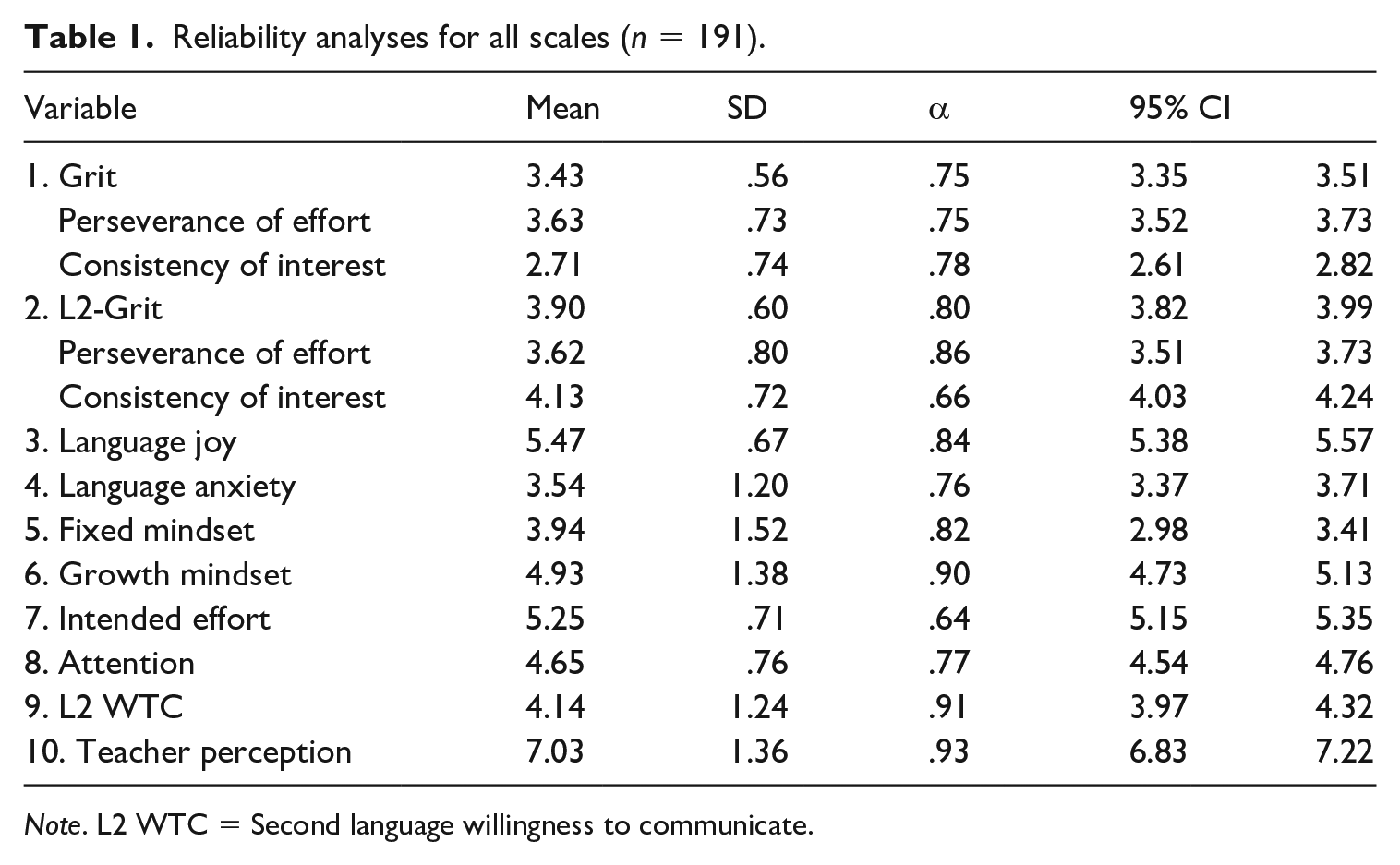
Note. L2 WTC = Second language willingness to communicate.
In the next step, we ran principle component analysis (PCA) using direct oblimin rotation to examine the structure of the L2-Grit scale and its sub-components. The scree plot (Figure 1) and eigenvalues were initially examined to determine the number of significant components (see Plonsky & Gonulal, 2015). The results of both criteria indicated a two-factor solution. We then ran parallel analysis (PA) to further examine the number of components in our data. The results of PA (Table 2) revealed that the eigenvalues of components 1 and 2 are greater than their corresponding PA values, suggesting the existence of two significant components. Consistent with the theoretical underpinnings of our L2-Grit scale, overall, the results of scree plot and parallel analysis confirmed the presence of two main components in the scale. Component 1 (Eigenvalue = 3.65) and Component 2 (Eigenvalue = 1.72) explained 46% and 19% of the variance in the data, respectively. Afterward, we examined the items loading onto each component: All the items of perseverance of effort and consistency of interest had neatly loaded onto their respective scales (see Table 3).
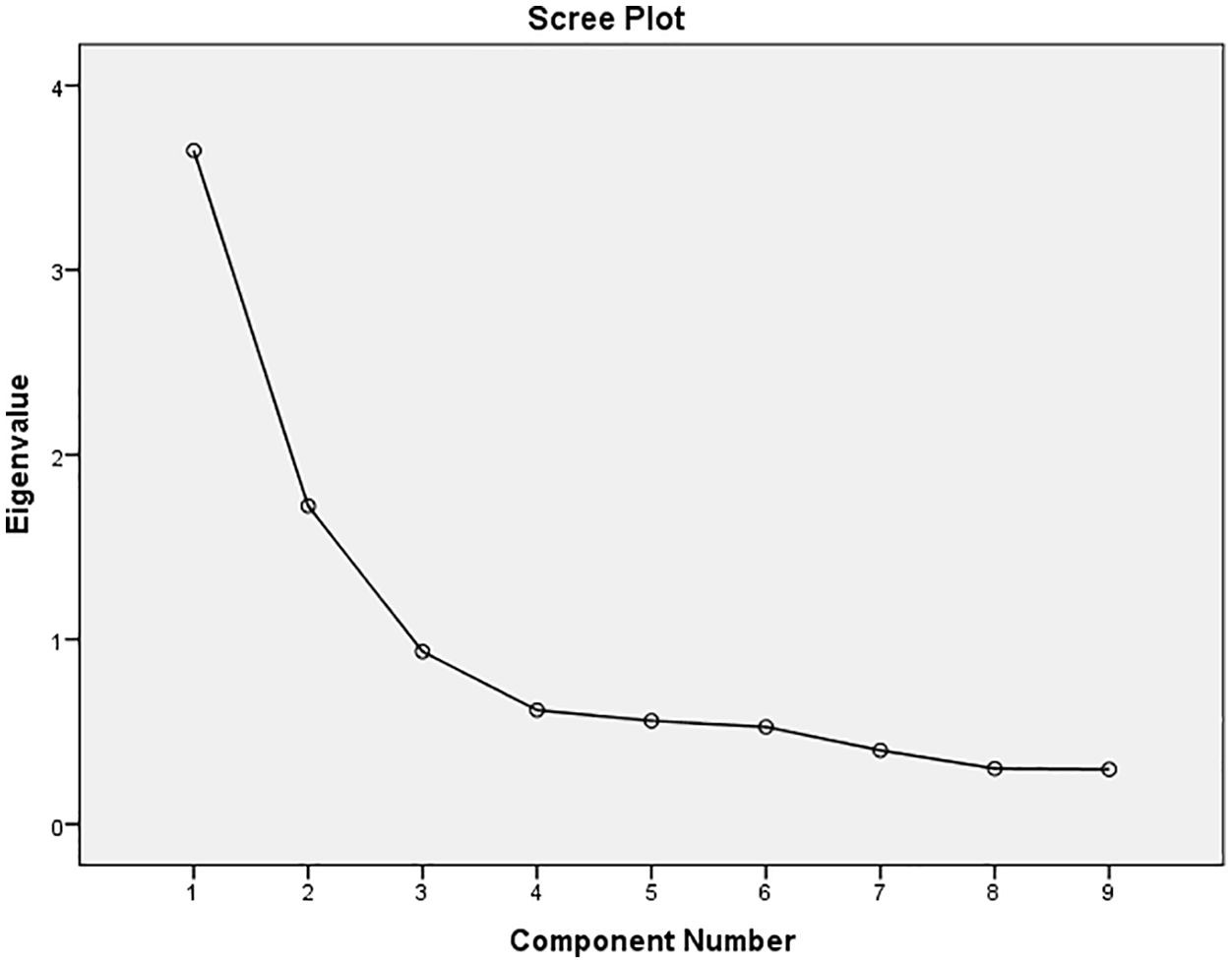
Scree plot for principal component analysis of second language (L2) grit
The results of principle component analysis and parallel analysis.

The results of principle component analysis.

Note. n = 191. All the component loadings > .40 are reported in the table. Component loadings are obtained using principal component extraction with direct oblimin rotation.
We ran a set of standard multiple regression analyses to probe the links between the Big Five personality traits and L2 grit (Table 4). In other words, we tried to investigate the construct validity of L2 grit as a distinct personality trait by examining its relation to other personality traits. The results pinpointed emotional stability and extroversion as predictors of L2 grit. However, the effect sizes (β, R2) for these variables as well as for the overall model were quite small (Cohen, 1988; Plonsky & Ghanbar, 2018). Of particular interest, conscientiousness did not have significant effects on L2 grit. These results, overall, support the distinction between L2 grit and other personality traits (Duckworth et al., 2007).
The results of regression analyses of personality traits with L2 grit as the dependent variable.
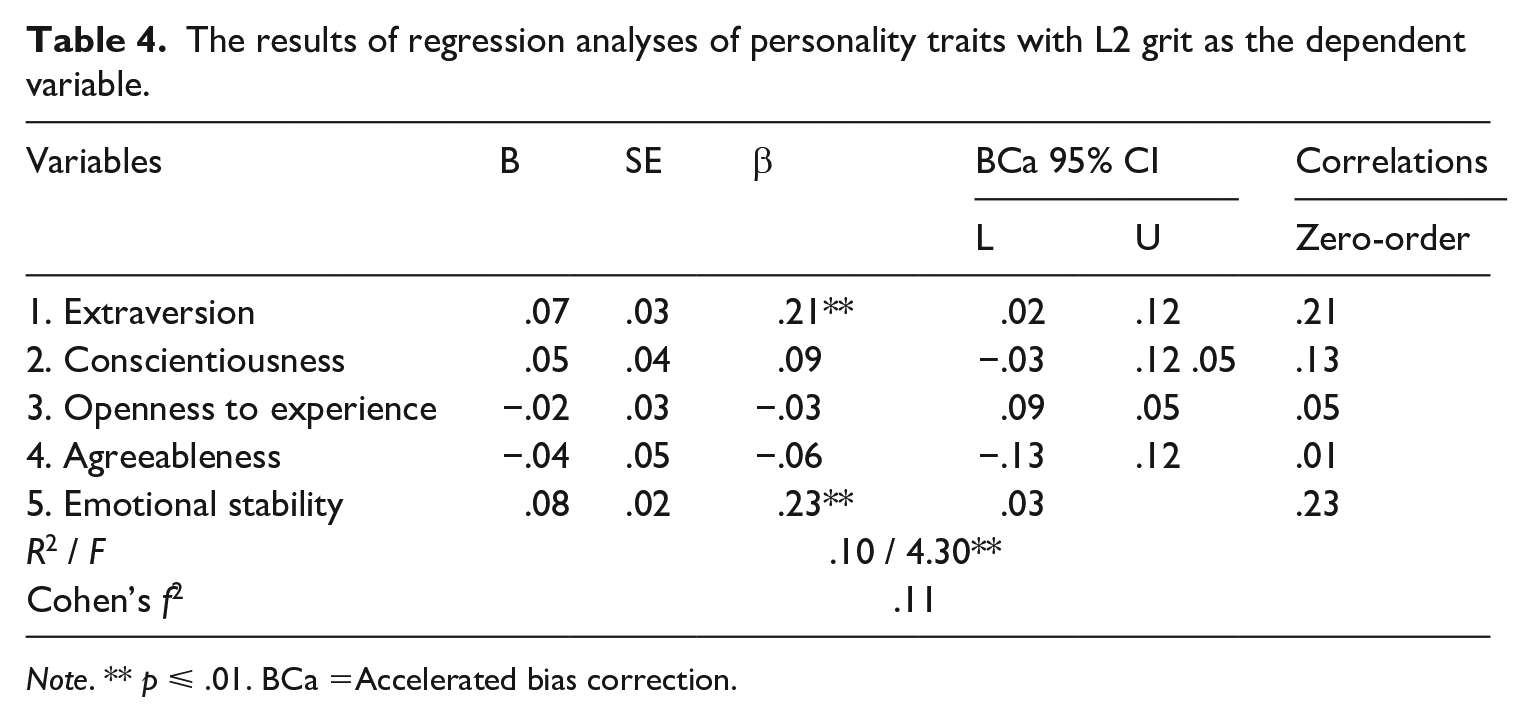
Note. ** p ⩽ .01. BCa =Accelerated bias correction.
In order to address research question two, we conducted a series of correlations between grit and students’ motivational and emotional characteristics. Of note, because scales with lower alphas contain higher measurement errors, and because measurement errors of a scale will attenuate subsequent correlations with it (Osborne, 2002; Pedhazur, 1997), we corrected the measurement errors of all the scales included in our study. It should be noted that, however, corrected correlations may overestimate the true correlation between two variables (see DeSimone, 2014; Raju, Lezotte, Fearing & Oshima, 2006). In other words, while true correlational estimates are expected to be larger than raw correlations, they may be smaller than corrected correlations. The results of both raw and corrected correlations are presented in Tables 5 and 6 (for the correlational matrix of all the variables, see also Appendix 2). Both grit scales – domain-general grit and language-domain-specific grit – were found to be positively associated with all the motivational variables: intended effort, L2 WTC, and attention. The teacher’s perception of students’ grit was also strongly and positively correlated with both general- and language-domain-specific grit scales. Both grit scales were found to be positively related to growth mindsets but negatively associated with fixed mindsets; likewise, both grit measures were positively correlated with language joy but negatively correlated with language anxiety. Of critical note, however, is the strength of these relationships: Whereas the effect size for domain-general grit fell between what might be described as low-to-moderate (see Plonsky & Oswald, 2014), the correlations for language-domain-specific grit were much stronger. Critically, the perseverance of effort sub-component of grit measures revealed a much stronger association with all the motivational and emotional factors than the consistency of interest sub-component.
Correlations between motivational variables and grit scales.
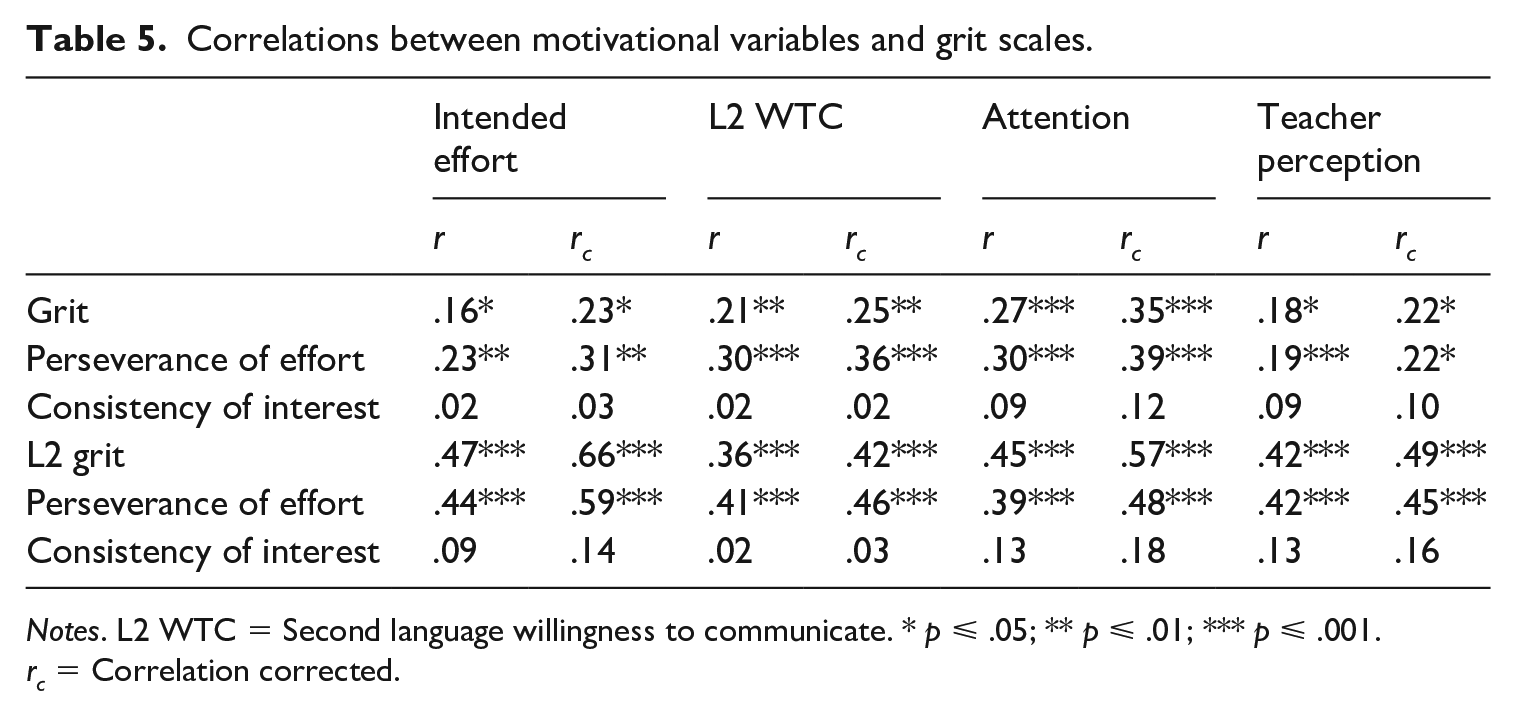
Notes. L2 WTC = Second language willingness to communicate. * p ⩽ .05; ** p ⩽ .01; *** p ⩽ .001.
rc = Correlation corrected.
Correlations between mindsets, emotions, and grit scales.
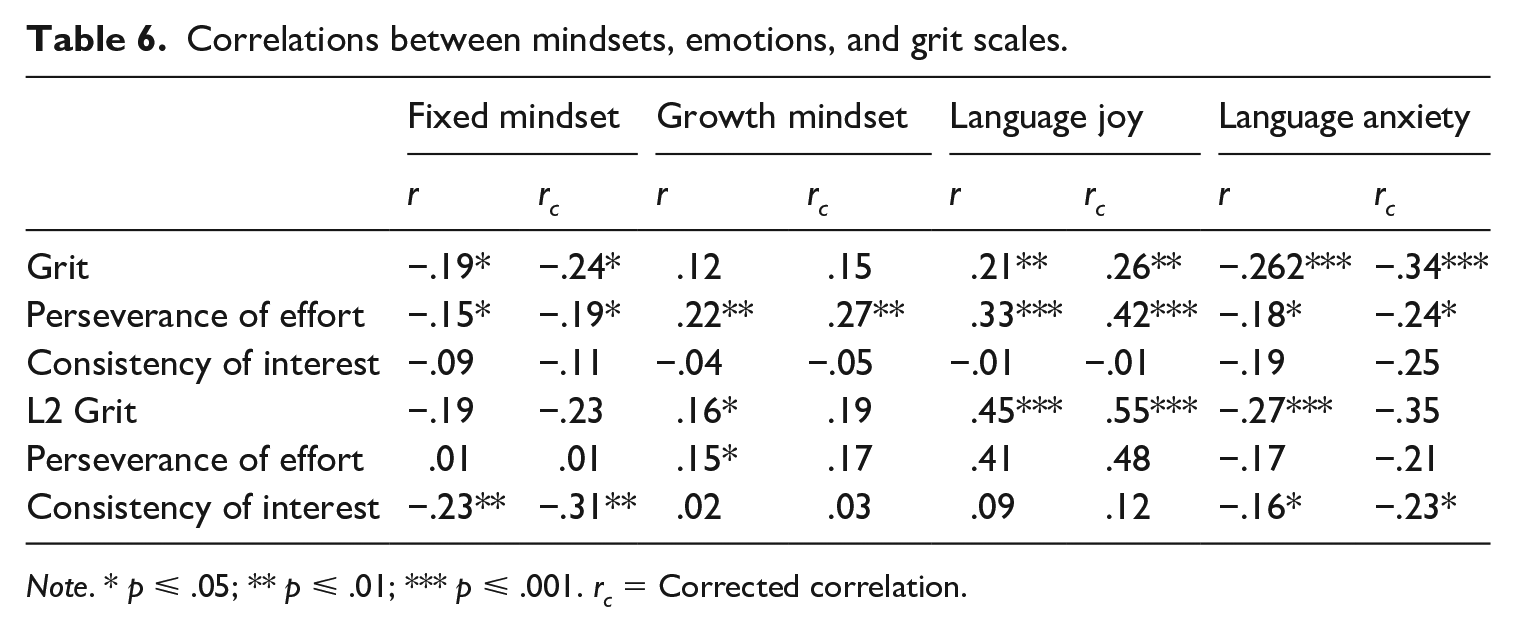
Note. * p ⩽ .05; ** p ⩽ .01; *** p ⩽ .001. rc = Corrected correlation.
In response to RQ3, another set of correlations was conducted. Our interest in this phase of the analysis was the relationship between students’ grit, both general- and language-domain-specific, and their language achievement. As shown in Table 7, while domain-general grit showed little to no such relations, language-domain-specific grit exhibited a consistently positive and moderate relation with all the language achievement measures. Likewise, the perseverance of effort sub-component of grit measures showed a much stronger relationship with all the language measures than the consistency of interest sub-component.
Correlations between language achievement measures and grit scales.
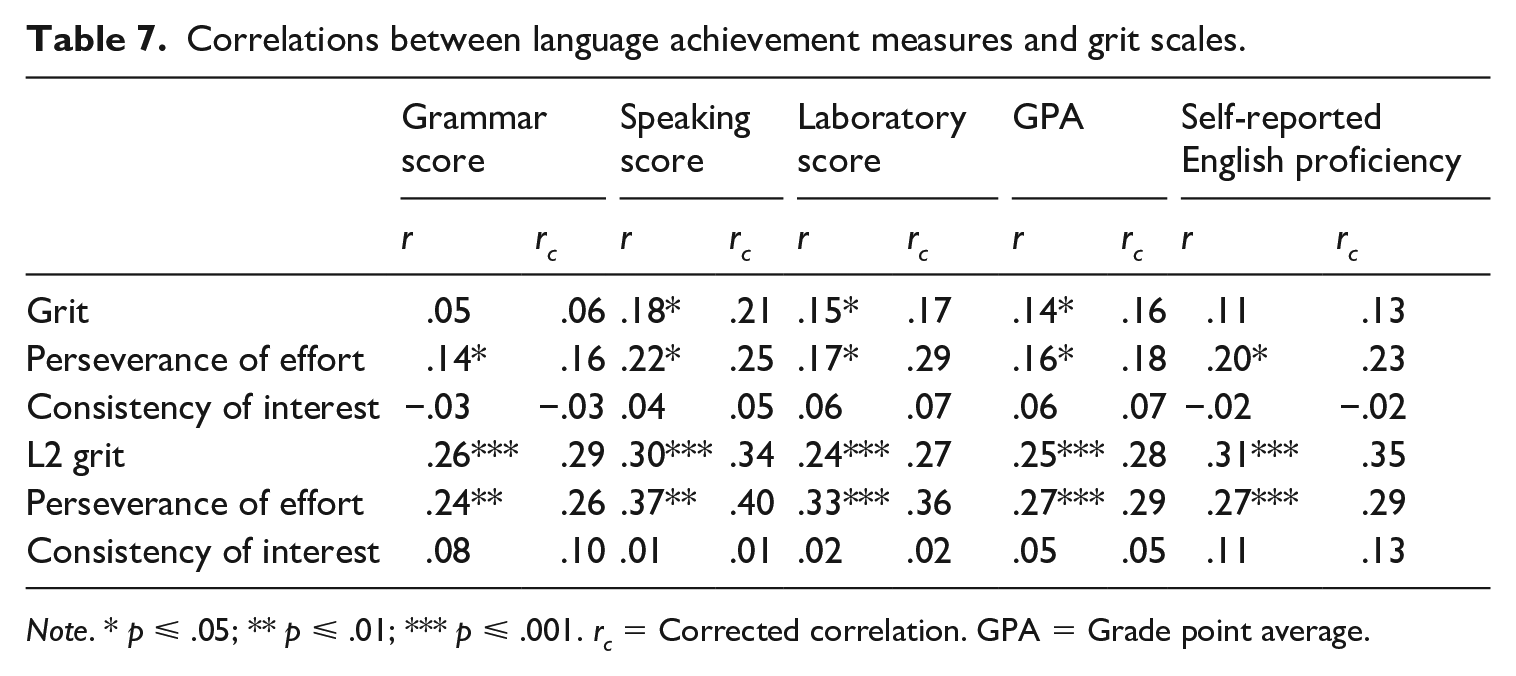
Note. * p ⩽ .05; ** p ⩽ .01; *** p ⩽ .001. rc = Corrected correlation. GPA = Grade point average.
V Discussion
Our first research question addressed the reliability and validity underlying a newly developed scale for measuring grit in the context of L2 learning. Reliability analyses indicated that the scale was internally consistent, with an alpha coefficient (α = .80) exceeding that of the domain-general grit scale (α = .75). The PCA further corroborated the construct validity of L2 grit and its sub-components. The discriminant validity of the L2-Grit scale was supported when it correlated positively but moderately with the domain-general Grit scale. A strong, positive correlation (r = .53) between the teacher’s perception of students’ grit and their own grit self-report evidenced the concurrent validity of the L2-Grit scale. Also, the positive relationships between L2 grit and all language achievement measures substantiated its predictive validity. In short, the results of our psychometric analyses attested to the reliability and validity of the language-domain-specific Grit scale.
Although previous studies have shown a close relationship between conscientiousness and grit (e.g. Credé et al., 2017), we did not find such a relationship with respect to L2 grit. Of the Big Five personality traits, only extraversion and emotional stability predicted students’ L2 grit, but the effect sizes were weak (Cohen, 1988; Plonsky & Ghanbar, 2018). It should be highlighted, however, that the 2-item conscientiousness scale used in this study does not allow an examination of the links between grit and those facets of conscientiousness (e.g. industriousness and self-discipline) that are argued to be closely related to grit (Credé et al., 2017; Schmidt et al., 2018).
Our second research question focused on the motivational and emotional characteristics of language learners and their relationship to L2 grit. The findings indicated that gritty students were more eager to expend efforts during L2 learning and were more inclined to engage in class discussions than their less gritty peers. Likewise, gritty students were more cognitively engaged in class: They paid closer attention to their teachers, classmates, and class activities. These findings are in line with findings of other grit studies in both social psychology (Duckworth & Quinn, 2009; Duckworth et al., 2007) and applied linguistics (Changlek & Palanukulwong, 2015; Lake, 2013), in which grit was found to be closely associated with students’ motivation.
Of critical note, domain-general and language-domain-specific grit exhibited differential relations with the motivational factors: Although both measures of grit exhibited positive correlations with all motivational variables, the strength of the relations was much stronger – almost double – for the L2-Grit scale, suggesting that a language-specific personality scale yields stronger predictive power than a domain-general scale.
What do gritty students think about their intelligence? As noted, the findings of achievement motivation research (see Dweck, 2006; Yeager et al., 2019) favor a growth mindset because it is closely related to perseverance of effort. Given that perseverance of effort is a sub-component of grit, gritty students are more likely to entertain a malleable view of intelligence (Perkins-Gough, 2013). Positive correlations between overall grit and growth mindset and negative correlations between overall grit and fixed mindset add empirical support to this assumption.
How do gritty students feel during L2 learning? Because the findings of the study revealed that there was a negative correlation between consistency of interest – one of the main sub-components of grit (Duckworth et al., 2007) – and anxiety, gritty learners are thus expected to feel less anxious in class and enjoy to a greater extent the process of learning an L2 (Credé et al., 2017). A negative relationship between grit and language anxiety and a positive relationship between grit and joy confirm this expectation. These findings are in line with previous research in which grit was found to be positively related to emotional stability (e.g. Credé et al., 2017) and hope and flourishing (Lake, 2013), and negatively associated with language anxiety (Changlek & Palanukulwong, 2015).
The findings discussed thus far have revealed that (1) gritty students remain persistent in their efforts in L2 learning, passionate about using the target language, and attentive to unfolding events in L2 class; (2) gritty students believe that they can become smarter by working harder; and (3) gritty students feel less anxious in class and enjoy their L2 learning experiences. Each of these motivational and emotional correlates of the L2-Grit scale may greatly influence language learners’ efforts (e.g. Dörnyei & Ryan, 2015). Therefore, as expected, in response to RQ3, we found positive relationships between students’ L2 grit and the measures of L2 achievement. In Credé et al.’s (2017) meta-analysis, domain-general grit was found to be positively but weakly correlated with students’ academic performance and GPA (r = .15 and r = .17, respectively). Likewise, domain-general grit in our study exhibited positive but weak correlations with all L2 achievement measures, even after correcting for the effects of measurement error (attenuation). Of note, the perseverance of effort component of domain-general grit correlated more strongly with the achievement measures than the overall grit, reflecting critiques on higher-order model of grit.
Language-domain-specific grit, on the other hand, exhibited much stronger correlations with L2 achievement measures than general-domain grit. Considering the sub-components of L2 grit, perseverance of effort had slightly higher correlations with speaking and laboratory grades and GPA than the full L2-Grit scale scores. Although the influence of L2 grit on language achievement of the students (r = .27–.35) is less than that of language aptitude (r = .49, Li, 2016), it is comparable to L2 motivation (r = .37, Masgoret & Gardner, 2003) and language anxiety (r = –.36, Teimouri et al., 2019). Overall, these results add evidence to our previous arguments that empirical examination of additional traits with respect to L2 learning along with their assessment within the L2 learning context will bear theoretically and practically meaningful results.
VI Limitations, future research, and pedagogical implications
In this article, we introduced and investigated a personality trait of high relevance to language learning: grit. We also developed and validated a language-domain-specific measure of grit (the L2-Grit scale) to examine its associations with language learning behaviors and achievements. Although our study painted a bright picture regarding the potential role of grit in L2 learning, we recognize a number of limitations and, given the novelty of grit in the realm of L2 learning and teaching, propose several potentially fruitful directions for future research involving L2 grit.
Because our sample consisted of English-major university students whose future careers are dependent on their English language skills, such students might possess greater L2 grit than other students (e.g. high school students). We suggest that future studies examine the generalizability of our findings among other language learner populations. More studies are also needed to verify the two-factor structure of our L2 grit scale, its construct validity and reliability. (For additional evidence of this structure, see Sudina & Plonsky, under review.)
We used Gosling et al.’s (2003) brief version of Big Five personality dimensions to assess students’ personality traits. Although the questionnaire enjoys widespread use in personality research for its efficiency, it yielded unsatisfactory reliability coefficients in our study (see Appendix 3). To lessen the negative influence of low alphas (e.g. attenuating effects on correlations), we excluded the negative items (e.g. anxious, easily upset) and only retained the positive items (e.g. calm, emotionally stable). As a result, the findings regarding the relationships between the personality traits and the grit scales in this study should be limited to the extraversion scale, which had an acceptable reliability coefficient (α = .79). Future studies need to use fuller versions of personality scales, weighing this choice along with other factors such as logistical constraints and participant fatigue. Although we accounted for the attenuation effects of scale errors on the correlations, low Cronbach’s alphas of the intended effort (α = .64) as well as the consistency of interest sub-component of the grit scale (α = .66) should be also noted.
Because students’ language learning behaviors are a function of their personality characteristics within the language learning context, we maintain that SLA researchers should also explore those personality characteristics within the L2 context. Our study findings substantiated this argument: First, students showed higher grit in an L2 setting relative to grit in general and second, language-domain-specific (L2) grit was a much stronger correlate of students’ language learning behaviors and achievements than domain-general grit. In sum, future research using language-domain-specific measures of personality traits – especially, those of immediate relevance to L2 learning – will provide more accurate findings and pedagogical implications.
How is students’ grit related to their motivational orientations? Because gritty students are geared toward the long-term goal of learning a new language, it would be interesting to see how their motivation (e.g. Ideal L2 self vs. Ought-to L2 self, Dörnyei, 2009; Teimouri, 2017) is associated with grit.
As noted, grit was claimed to be as important as talent – or intelligence, as these terms are used interchangeably in the grit literature – in predicting student success (e.g. Duckworth et al., 2007). Talent in SLA has been defined as language aptitude, and extensive research has painted strong, positive paths between language aptitude and L2 learning (see Li, 2015, 2016). Examining the nature of the relation between L2 grit and language aptitude as well as the incremental validity of L2 grit beyond language aptitude are both questions that merit empirical attention. Future research on the predictive power of L2 grit compared to a host of other language learning behaviors and skills such as class attendance and study skills would be also of theoretical and practical benefit.
Although the focus of our study was placed on exploring students’ grit and how it is associated with their L2 learning, language teachers’ grit and how it affects their motivation, identity, teaching practices, and even attrition should not be overlooked. Research has shown that not only are grittier school teachers more committed to their teaching responsibilities but that they are also more efficient in educating their students (Robertson-Kraft & Duckworth, 2014).
In this study, we investigated the influence of grit as an independent variable on students’ L2 learning as a dependent variable. Recently, however, Dewaele (2012) has endorsed an intriguing shift of research direction: To examine the influence of language learning/use as an independent variable on personality traits as dependent variables. Put simply, how do learning and using a new language influence one’s personality? Although several studies have evidenced cognitive benefits of bilingualism (see Bialystok, 2011), non-cognitive benefits of multilingualism remain relatively unexamined (see Dewaele & Van Oudenhoven, 2009; Dewaele & Wei, 2013). Because language learning is a long-term goal, the achievement of which entails surmounting challenges through hard-work, we believe that second/foreign language learning may enhance students’ overall grittiness.
Following the US Department of Education’s report (Shechtman et al., 2013), we emphasize the role of grit in L2 learning, and our results support its teachings in language learning environments. This is mainly because grit may be more amenable to interventions than other predictors of language learning success, such as cognitive abilities (e.g. Duckworth & Gross, 2014). In particular, grit interventions may benefit minority students or students of low socioeconomic status (see Strayhorn, 2014). However, we need more research in SLA substantiating the role of grit in L2 contexts before we can recommend any such interventions.
At the same time, teachers might seek to enhance students’ grit in various ways: by asking students to read about inspirational narratives of highly successful people whose grittiness was key to their great achievements; by using educational tools and software designed to enhance students’ grittiness (e.g. The Knowledge is Power program; Shechtman et al., 2013); by assigning students to challenging, semester-long language learning projects whose completion involves continuous efforts over time; by instilling growth mindsets in language learners via praising their efforts rather than ability during class activities (e.g. Lou & Noels, 2016).
VII Conclusions
In the present study, we argued that personality research in SLA has generated incongruent findings because of (1) its focus on super-traits instead of lower-traits with more relevancy to L2 learning and (2) its use of general personality measures instead of situation- or domain-specific measures that assess students’ traits in L2 situations. We conceptualized the notion of grit within the context of language learning and examined its influence on L2 learners’ learning behaviors and achievements. We also developed and validated the L2-Grit scale to measure students’ grittiness in L2 settings. We found that students’ level of grit was higher than their general level of grit in the L2 context and that the language-domain-specific measure of grit produces clearer and more meaningful results. In short, we showed that grittier students are more successful language learners than their less gritty classmates.
Supplemental Material
Appendix – Supplemental material for L2 grit: Passion and perseverance for second-language learning
Supplemental material, Appendix for L2 grit: Passion and perseverance for second-language learning by Yasser Teimouri, Luke Plonsky and Farhad Tabandeh in Language Teaching Research
Footnotes
Appendix
Reliability analyses for all scales (n = 191).

| Variable | Mean | SD | α | 95% CI |
|---|---|---|---|---|
| Extraversion | 4.35 | 1.65 | .79 | 4.11 4.58 |
| Agreeableness | 4.95 | .98 | .11 | 4.81 5.09 |
| Conscientiousness | 5.69 | 1.13 | .54 | 5.52 5.85 |
| Emotional Stability | 4.09 | 1.39 | .43 | 3.89 4.29 |
| Openness to experience | 5.23 | 1.07 | .27 | 5.10 5.40 |
Funding
The author(s) received no financial support for the research, authorship, and/or publication of this article.

Supplemental material
Supplemental material for this article is available online.
References
Supplementary Material
Please find the following supplemental material available below.
For Open Access articles published under a Creative Commons License, all supplemental material carries the same license as the article it is associated with.
For non-Open Access articles published, all supplemental material carries a non-exclusive license, and permission requests for re-use of supplemental material or any part of supplemental material shall be sent directly to the copyright owner as specified in the copyright notice associated with the article.
