



Abstract
Implementing social-emotional learning skills into Collaborative Strategic Reading (CSR), the current study intended to extend the efficacy of CSR for teaching reading strategies when applying it to students in rural areas from a working-class community. To this purpose, forty-four students who made the comparison and the experimental groups were taught reading strategies through CSR and ECSR (Extended Collaborative Strategic Reading), respectively. A reading comprehension test with different question types was given to the students as pretest and posttest, and an interview was given at the end of the study to investigate the perception of the students toward reading strategy instruction through CSR and ECSR. Analysis of data indicated that only the ECSR group improved significantly in overall reading comprehension, but the componential analysis of the reading test showed that despite the fact that the CSR group showed no significant improvement in the reading tests in four formats (true–false, multiple-choice, matching, and cloze), the ECSR group improved significantly in reading tests with multiple-choice and cloze test formats. Moreover, although the students in both groups showed a positive view toward the interventions, the students in the ECSR group improved in social-emotional and communication skills. It seems that CSR can be improved to be effective by implementing the emotional component to it.
I Introduction
Our world thrives on communication, and we communicate with each other in different ways and for different purposes. With regard to the reading skill in a context of English as a foreign language (EFL), teachers can introduce collaborative activities to develop students’ reading comprehension. Vygotsky (1978) regards reading as a cognitive process that can be developed through social interactions in cultural contexts. On the other hand, to comprehend a text, effective readers use strategies when they read. According to Wenden (1991), reading strategies are ‘mental steps or operations that learners use to process both linguistic and sociolinguistic content’ (p. 19). Researchers have long stressed the importance of reading strategies in effective reading. Studies (e.g. Grabe, 1991; Palincsar & Brown, 1984; Paris, Lipson, & Wixson, 1983; Pressley, 2006) showed that effective readers apply different reading strategies (e.g. guessing the meaning of unknown words, activating background knowledge, skimming, scanning, making inferences, summarizing, and setting a purpose for reading) to comprehend the text. Paris et al. (1983) pointed out that strategic reading can promote reading comprehension. According to Palincsar and Brown (1984), strategic reading helps students, especially low-achieving learners, to avoid comprehension problems and boost text retention. As empirical studies have shown that reading strategies are effective in improving reading comprehension, it is recommended that language learners be taught various reading strategies through explicit instruction (Pressley, 2006). Therefore, to get the best result in teaching reading, it seems best to integrate explicit teaching of reading strategies into collaborative reading activities.
1 Collaborative Strategic Reading (CSR)
Learning is collaborative and not an isolated individual’s effort (Turuk, 2008). As a student-centered approach to learning (Jacobs & Renandya, 2019), collaborative learning involves groups of students working together for a few minutes, a couple of weeks, or many months to solve a problem or complete a task (Slavin, 1997). In literacy learning and from the sociocognitive perspective, reading is a complex cognitive process, and social interactions in cultural contexts can facilitate its development (Vygotsky, 1978). Social interaction is a prerequisite for the development of cognition (Donato & McCormick, 1994), and mental functions are ‘intertwined with socio-culturally determined factors’ (Lantolf & Appel, 1994, p. 5).
Collaborative tasks can increase interdependence (DiDonato, 2013). It is through working with others socially, that learners can acquire useful strategies and knowledge (Scott & Palincsar, 2013). There are many instructional models (e.g. reciprocal teaching by Palincsar & Brown, 1984; direct explanation of comprehension strategies by Roehler & Duffy, 1984; transactional strategies instruction by Pressley, El-Dinary, Gaskins, et al., 1992; CSR by Klingner & Vaughn, 1998) for teaching reading strategies viewed from a sociocognitive perspective where ‘learners construct meaning externally and socially before they internalize it’ (Maria, 2000, p. 7). CSR (Klingner & Vaughn, 1998) as a technique in teaching reading strategies was grounded on Vygotsky’s (1978) socio-cultural theory which considers learning as a social process. CSR has the socio-cognitive theory of reading as its theoretical foundation where the role of social context in the cognitive development of reading comprehension is emphasized (Bernhardt, 1991). An essential element of CSR is cooperative learning (Klingner, Vaughn, Boardman, & Swanson, 2012). According to Johnson and Johnson (1990), cooperative learning has criterial elements which promote cooperation, including, (1) positive interdependence; (2) face-to-face promotive interaction within the group and between groups; (3) individual accountability; and (4) the teaching of collaborative skills, and group processing or discussing the dynamics of group interaction and how they can be improved.
CSR as a research-validated reading strategy instruction technique was used in many studies for students with learning disabilities or reading difficulties, English learners, low-average- and high-achieving learners, and upper elementary and middle school students (Klingner & Vaughn, 1996; Klingner, Vaughn, & Schumm, 1998). Klingner and Vaughn (1996) compared the effects of two reading approaches: (1) reciprocal teaching where students received teacher support, and (2) peer-led discussions in cooperative learning groups with minimal adult or teacher support (CSR) on 26 seventh and eighth graders with learning disabilities who used English as a second language in the United States. The participants were randomly assigned to one of the groups. They found significant improvements in reading comprehension in both groups. Klingner et al. (1998) implemented CSR with fourth-grade elementary students with learning disabilities and found that the CSR group significantly outperformed the control group on reading comprehension.
However, some studies show CSR was not effective in developing reading comprehension among learners. Fan (2010) investigated the effect of comprehension strategy instruction through CSR on reading comprehension concerning specific types of reading comprehension questions among 110 Taiwanese university students with low-intermediate to intermediate level of English from two intact classes. Analysis of data showed that CSR had a positive effect on reading comprehension, especially in understanding the main idea and finding the supporting details; nevertheless, no significant effect was found in predicting, inferring, and tackling vocabulary difficulties. Huang (2004) investigated the efficacy of CSR to boost EFL learners’ strategic reading and promote their critical thinking and found no significant difference between the CSR and the control groups in the researcher-made periodic achievement tests. However, CSR was found to be helpful for promoting learners’ writing and critical thinking and facilitating autonomous learning and social skills. Klingner et al. (1998) investigating the effectiveness of CSR designed to foster strategic reading among fourth graders with social studies texts. The experimental group was put in an 11-day experimental condition in small student-led groups and students in the control group taught teacher-led instruction without group work and reading comprehension strategies in the same content with social studies texts. Findings revealed that students in the experimental group showed more improvement in reading comprehension. However, there were no significant differences in terms of content learning. Lin (2008, in Fan, 2009) found no difference between CSR and traditional grammar-translation method in terms of improving learners’ reading comprehension. The post-treatment interview from 42 ninth graders of two classes revealed that only half of the students found CSR effective in understanding the text and had positive attitudes towards it, and the other half had negative feelings about CSR. Some learners found the noises distracting, and some others did not know how to collaborate in their groups and did not find the learner-centered approach of CSR useful. Instead of recommending a solution to eradicate such problems, Lin concluded that the teacher-centered approach might be more suitable for the ninth graders and that students can benefit from direct teacher guidance in this context.
Vygotsky’s notion of Zone of Proximal Development upon which CSR’s theoretical foundation is grounded holds that a more knowledgeable person is needed to support a less knowledgeable learners’ cognitive development. This process is known as ‘scaffolding’ (Foster & Ohta, 2005). According to Wood et al. (1976, cited in Fan, 2009) successful scaffolding serves six prominent functions: (1) recruiting interest in the task, (2) making the task manageable, (3) staying on the track of the problem-solving task, (4) marking relevant differences, (5) controlling frustration, and (6) providing modeling solutions (p. 14). However, the commonplace perspective of scaffolding in collaborative learning, which emphasizes the role of a more knowledgeable person in fostering learners’ cognitive development, seems to neglect or underestimate the significant contribution that social-emotional skills can have in the cognitive and social development of learners. Although Vygotsky’s ideas are both social cultural and emotional (Mahn & John-Steiner, 2002; Swain, 2013), meaning that he emphasized the role of social-emotional skills along with socio-cognitive and socio-cultural skills in language learning, the emotional aspect of his ideas was paid less attention to in collaborative language learning programs. Underestimation of socio-emotional skills in language learning may make the learning process be short-circuited, at least in some learning contexts and regarding some learners with social-emotional problems. Therefore, this study hypothesizes that in facilitating learners’ cognitive development, peers’ function is two-fold in a social context, which is both social-cognitive scaffolding and social-emotional scaffolding.
2 Social Emotional Learning (SEL)
The term social-emotional learning was first used in 1990 by Peter Salovey and John Mayer. To them, emotional intelligence is ‘the ability to monitor one’s own and others’ feelings and emotions, to discriminate among them to use this information to guide one’s thinking and actions’ (Salovey & Mayer, 1990, p. 189).
There are two well-known learner-centered theories on intelligences and competence, i.e. Daniel Goleman’s Emotional intelligence (Goleman, 1995) and Howard Gardner’s Multiple intelligences (Gardner, 2006), which helped to frame the social and emotional learning (SEL) model (Marulanda, 2010). According to Gardner (2006) intelligence is defined as ‘a biopsychological potential to process information that can be activated in a cultural setting to solve problems or create products that are of value in a culture’ (pp. 33–34). MI theory was developed by Gardner in 1983. He viewed intelligence from a broader perspective than the traditional view of IQ. Gardner (1983) introduced different types of intelligences, including linguistic intelligence, logical-mathematical intelligence, musical intelligence, spatial intelligence, bodily-kinesthetic intelligence, naturalistic intelligence, interpersonal intelligence, and intrapersonal intelligence. Among these, intrapersonal and interpersonal intelligences are the ability in perceiving and making distinctions of the moods, intentions, motivations, and feeling of oneself and others, respectively. According to Gardner’s MI, children learn differently from each other as one child might be excellent in math and another might be better at learning languages. The pedagogical implication of MI theory was that a variety of approaches and activities are needed for different learners, and schools should offer individualized education to meet the needs of individual learners (Gardner, 2006).
The publication of Goleman’s Emotional intelligence (1995) in the mid-1990s sparked interest in SEL. Goleman (1995) holds that children have the potential for learning emotional competencies as they are born with general emotional intelligence, and that those children who are better at managing their emotions and empathizing with others, are also better at paying attention, taking in and retaining information at school. As a co-founder of Collaborative for Academic, Social, and Emotional Learning (CASEL) established in (1994), Goleman believes that our emotional intelligence determines our capability for learning the practical social skills which are based on five elements of competency, namely self-awareness, motivation, self-regulation, empathy, and adeptness in relationships.
SEL, according to Zins and Elias (2007), is the capacity to recognize and manage one’s emotions, solve problems, and establish positive relationships with others. According to Spath (2009), ‘cooperative learning requires the continuous use and development of social-emotional skills’ (p. 24), and teachers need to make students aware of these social-emotional skills and how they affect their success and the success of others in the cooperative classrooms. The goal of SEL is to help learners to integrate emotional, cognitive, and behavioral abilities to be a productive member of society (Zins, Bloodworth, Weissberg, & Wahlberg, 2007). The emotional domain of SEL addresses how we express and manage our feelings. The cognitive domain addresses the ability to develop healthy relationships among each other by role-taking and problem-solving. The behavioral domain is about cooperation and the ability to negotiate and respect the other person’s ideas no matter if they agree or not (Elias, et al., 1997).
According to Oxford (2015) ‘all learning is a powerful combination of cognition and emotion’ (p. 371). Emotions serve a social function as through emotions we communicate our feelings to others (Manstead, 1991). Pekrun, Goetz, Titz, and Perry (2002) found that students experience negative and positive emotions in educational contexts. They found that academic emotions are related to students’ cognitive resources, learning strategies, self-regulation, motivation to learn, and achievement. It seems that focus on literacy instruction has inhibited educators from thinking about the relationship between academic and social-emotional learning (Zins, et al., 2004).
II This study
English is a foreign language taught in the Iranian schooling system. In effect since 2013, primary, lower secondary, and upper secondary schools last for 6, 3, and 3 years, respectively. Children from ages 7–12 years attend primary school. From 13 to 15 and 16 to 18, students go to lower and upper secondary schools. It is from lower secondary school that foreign language education begins. After upper secondary school, students take a nation-wide examination to enter universities where up to the completion of doctorate level English courses are offered.
English education at Iranian secondary schools has, for a long time focused on the memorization of vocabulary and grammar rules, reminiscent of the traditional grammar-translation method. In lower and upper secondary schools, students take between 2 and 4 hours of English instruction, weekly with different syllabuses in different years. The course materials at lower secondary school primarily focus on alphabet recognition, pronunciation, and limited vocabulary instruction. However, at the upper secondary school level, the focus is more on reading comprehension, grammar, and vocabulary development. Students write decontextualized sentences to practice writing. A few drills (mainly intended to practice grammar) along with short dialogues which introduce language functions are given as speaking activities, and listening is nearly absent in the syllabus (Sadeghi & Richards, 2016).
Like in many EFL contexts, in the Iranian EFL context collaborative learning pedagogy, despite its advantages has not received due attention and the traditional lecture-based method was the dominant instructional strategy in Iran (Memari Hanjani & Li, 2017; Weaver & Qi, 2005). Recently, at Iranian school level, attempts have been made to implement notions of communicative language teaching (CLT) into English classes and the books (Prospect for lower and Vision for upper secondary schools) are presented in such a way that students get engaged in collaborative learning activities. However, students’ level of involvement is low and mostly unorganized which is partly due to the cultural and educational background of the students which has not developed for social-cultural and emotional involvements in group activities. According to Memari Hanjani and Li (2017), ‘to overcome this problem, it seems necessary for the teachers to modify the traditional paradigm of knowledge transmission by removing themselves from center stage and arranging for students to work together, converse with, and coach one another’ (p. 34).
Factors determining the effectiveness of collaborative learning are still unclear and controversial among scholars (Zambrano, Kirschner, Sweller, & Kirschner, 2019). It is not an easy task to design a reading instructional approach for students as there are many factors (e.g. linguistic, cognitive, and socio-cultural variables) that affect successful reading comprehension (Hudson, 2007). There are challenges in teaching reading strategies such as challenges related to classroom management, how much explicit instruction is needed to be offered, monitoring the learning of students, and amount of time for teaching strategies so that students master strategies and apply them successfully (Hilden & Pressley, 2007, in Boardman, Boelé & Klingner, 2018). Likewise, as mentioned earlier, although many studies investigated the effectiveness of the use of CSR on language learning and found it effective for teaching reading, there are studies which show this technique is not efficient in all educational contexts (Fan, 2010; National Center for Education Evaluation and Regional Assistance [NCEE], 2011). Therefore, it is important to know under which conditions CSR is most effective (Cohen, 1994). In addition, the majority of CSR studies were conducted on students with learning disabilities and students with limited English proficiency (Jitendra, Burgess, & Gajria, 2011; Klingner et al., 1998). However, not many studies seem to have been conducted among high school students with an individualistic mindset in a rural district and within a working-class community, showing misbehavior while working cooperatively. To have the most benefit out of CSR within this context, the authors propose it seems CSR needs to be developed by adding the socio-emotional learning component to it which will result in Extended Collaborative Strategic Reading (ECSR).
This study attempts to improve the efficacy of the collaborative reading technique of CSR and make it flexible and adjustable in learning environments with no or little socio-emotional awareness for collaborative learning. Research by CASEL (Collaborative for Academic, Social, and Emotional Learning) (2008, in Marulanda, 2010) whose mission was to make social and emotional learning an integral part of education from preschool through high school showed positive effects of Social Emotional Learning (SEL) programs in diverse student populations (i.e. geographically (i.e. urban, suburban and rural), racially-ethnically, and socio-economically). According to the authors’ presumption which is based on their experience in teaching to students in rural areas, collaborative approaches to teaching reading in such contexts are not very effective. Therefore, using the mixed-methods research design this study attempts to find a solution to this problem by infusing SEL skills into CSR. In addition, the current study intends to evaluate the perceptions of the students toward CSR and ECSR to study in detail the possible advantages that the proposed ECSR might have over CSR. Thus, quantitative findings can be verified against findings in the qualitative phase ‘to achieve a fuller understanding of the target phenomena’ (Sandelowski, 2003, in Dörnyei, 2007, p. 164) and to make the study more evidence-based. As quantitative data, according to Creswell (2005) provide an overall picture of the phenomena under investigation, quantitative findings can be refined and explained by obtaining qualitative data.
III Research questions
This study attempts to answer the following questions:
Does reading strategy instruction through CSR and ECSR affect EFL students’ reading comprehension differently (Overall and component (i.e. test-format) wise)?
What are the perceptions of students toward CSR and ECSR?
IV Methodology
1 Participants
For investigating the purposes of this study, using convenience sampling 61 upper secondary level male students were selected from two boy public schools situated in the Chahar-dange rural area in Mazandaran province in Iran. Their ages ranged between 16 and 18, with the mode of 16. In addition, the social background of almost all of them was a working-class community. The students in each school were assigned to one of the two groups; that is, a comparison group from one school and an experimental group from the other school to prevent any possible contamination between the participants of the experimental and the comparison groups. They spent three hours a week for their English classes as part of their normal tuition, and they were not participating in any English language institute or supplementary classes. However, in order not to interfere with their regular lessons, for intervention purposes in the CSR and ECSR groups, the reading passages along with their comprehension questions from the students’ course books were also employed.
2 Instruments
The following instruments were used in this study.
a Nelson English Proficiency Test
To measure students’ proficiency level and homogenize them based on their general English knowledge, after viewing some other proficiency tests, the Nelson English Language Tests, Book 1 Elementary (Fowler & Coe, 1976) was regarded as suitable to be used. This test battery consists of 50 four-choice items focusing on English structure, and each item carried one point. Consulting with three English teachers of the selected schools, the researchers chose the level of 050D for the study. Furthermore, the reliability of this test was estimated with 20 students from another school with the same characteristics as the participants in the current study. According to the KR-21 formula, the reliability turned out to be 0.70. The time allotted to this test was 45 minutes.
b Reading Comprehension Test
For measuring students’ reading comprehension ability in this study at pretest and posttest phases, the reading section of the Preliminary English Test (PET) was used. PET is a test developed by the University of Cambridge that can measure the mastery of English and language skills. This test is updated regularly, and its validity and reliability are assured by Cambridge Assessment English. PET can be used for different purposes such as measuring the English level and mastery of English as well as placing students into a program (see cambridgeenglish.org). After viewing many reading comprehension tests, this test was regarded as appropriate to be used in this study in terms of both content and difficulty level. This test is for lower-intermediate learners and is available in two versions, PET designed for adult learners for general and higher education and PET for Schools designed for specifically school-aged students and related to the topics and tasks of a classroom setting. Both versions have the same type of questions; however, since the PET for schools has the content of interest to school-age learners, this study utilized this version. In addition, the PET reading section was employed since it encompasses different test formats that suited best the purpose of the study. The reading section of PET for Schools has five parts and 35 questions. In addition, each question has one point, and the time allocated to the reading part is 50 minutes. Students were expected to read different kinds of short and longer texts for comprehension purposes. Part A of this test comprises five three-choice questions in which students have to read the short text in each question, infer the message, and choose one answer. In part B which has five questions, students read eight texts and select the description which matches the proper text. In part C of this test, students need to identify true or false information; they read a long text about activities for young people living in the countryside and answer 10 true–false questions. In part D, students read another long text and answer five four-choice questions. Finally, in the last part of the test which is a cloze test, students are asked to fill 10 gaps in a short text; each question has four choices, and students have to choose the correct word for each space.
The test was piloted with 20 students with the same characteristics from a different school. Concerning the content validity, the researchers consulted with a university professor in English language teaching and two experienced English teachers to judge the test for being appropriate for this study. The content of the passages was considered to be appropriate for the study; however, nine questions over different parts of the test were deleted after consulting with two experienced English teachers due to some limitations in the administration of this test in a school milieu such as time limitations. Moreover, reliability was calculated by the KR-21 formula which turned out to be 0.88.
3 Interview
Following the quantitative data collection, a semi-structured interview was immediately performed the next session regarding the perception of students toward CSR and ECSR. Eight questions were already developed by the researchers for this purpose. The questions were focused on students’ attitudes toward collaborative reading and reading comprehension, their sense of achievement, and their success in language learning. In addition, the questions were tested for validity with the help of two university professors in English language teaching and an experienced upper secondary level school English teacher. Moreover, three students who had the same characteristics of the participants in this study were asked to read the questions for checking the clarity. The questions were developed in students’ mother tongue (i.e. Persian) in order to ensure their understanding of the items. (for the English version, see Appendix 1).
4 Design
The study is based on classroom research since the classroom was the main research site (Dörnyei, 2007). The study has a sequential (QUAN→QUAL) mixed methods research design in which the quantitative part is nonequivalent groups quasi-experimental design with one comparison group (CSR) and one experimental group (ECSR).
V Procedure
1 Teachers of the two groups
It should be mentioned that the teacher of the ECSR group was the first author of the current study. He was 26 years old and an English language teacher with 5 years of experience in teaching English at the upper secondary school level. He was also an MA student in TEFL. The CSR group was decided to be from another school so that the students of this class would not become conscious of what was going on in the ECSR class during the intervention. The teacher of the CSR group who was a colleague of the teacher of the ECSR group was also an MA student in TEFL. He was 25 years old and had 4 years of teaching experience at the upper secondary school level. The teacher of the CSR group was trained in training workshops by the first author of the current study on how to teach through CSR and was provided with the research instruments and the necessary materials to get a better understanding of the nature of intervention through CSR and the implementation procedures. As soon as the researchers made sure the teacher of the CSR group learned the techniques of implementing the CSR, the first author observed the first two sessions of the CSR group to check the fidelity and accuracy of the implementation of the CSR and informed the teacher to be in touch for the possible problems in the different phases in conducting the intervention. Finally, the CSR teacher was asked to report in detail how the intervention went on.
2 Implementing CSR
In school 1 taking the CSR, there were 31 students in the class. After taking the Nelson proficiency test, 19 students whose scores fell within ±1SD (M = 16.70; SD = 5.97) were selected as the comparison or CSR group. They were divided into four subgroups, one subgroup with four members and three subgroups with five members. Members of each subgroup could go to another subgroup or even take up another role in their own subgroup during the intervention.
CSR was implemented in this class in two phases: (1) teaching the strategies, and, (2) cooperative learning group activity. CSR consists of four comprehension strategies that students apply before reading, during reading, and after reading in cooperative groups, including: (1) preview (before reading) to activate students’ prior knowledge about the topic and the text and help students to predict the content; (2) click and clunk (during reading) to identify the difficult words and concepts in the text and use additional fix-up strategies to understand them; (3) get the gist (during reading) to identify the most important idea in each paragraph or section; and (4) wrap-up (after reading) to summarize what has been learned and answer comprehension questions (Klingner and Vaughn, 1999). The teacher presents these four strategies, including the fix-up strategies to the whole class using the modeling and the thinking aloud techniques.
For the instruction of fix-up reading strategies, the strategy items in Metacognitive Awareness of Reading Strategies Inventory-Revised (MARSI-R) (Mokhtari, Dimitrov & Reichard, 2018) was employed. MARSI-R consists of 15 statements about strategies or actions that readers use when they are reading academic or school-related materials. MARSI-R includes three broad categories of strategies including, Global Reading Strategies, Problem-Solving Strategies, Support Reading Strategies.
For cooperative reading, to become independent readers, students first read with the support of the teacher. This process is referred to as ‘scaffolding’ (Jones, Palinscar, Ogle, & Carr, 1987). In this study, for the scaffolding of the reading process, three types of scaffolding (see McEwan, 2004) were used:
a People (teacher and peers) scaffolding
In people scaffolding, three stages of ‘I do it’, ‘We do It’, and ‘You do it’ are implemented as explained here. In the ‘I do it’ stage, the first phase of CSR, that is Teaching the Strategies by modeling, was applied. In this stage, the teacher models the strategy through thinking aloud which is a common method of teaching strategies (see Pressley, Beard El-Dinary, & Brown, 1992, p. 112).
Students learn four CSR strategies of previewing (pre-reading), click and clunk plus fix-up strategies and getting the gist (while-reading), and wrapping up (post-reading) through teacher modeling. For example, for the preview stage in this study, two key activities (i.e. activating background knowledge and predicting the text) in Klingner and Vaughn’s CSR model were done. The teacher modeled while reading aloud to the students by asking himself questions such as Do I know anything about the topic? Do the pictures, graphs, diagrams, etc. give me a hint of the text content? What is the main idea? Then, he began to think aloud about the answers to these questions. After modeling the preview stage, the teacher began to think aloud about the text using the while reading Click and Clunk strategy as mentioned in CSR. Click is something that readers understand and clunk is something that they don’t understand while reading. When the clunk occurs, fix-up strategies are used. To think aloud, the teacher read a paragraph aloud and asked himself ‘Is everything clicking?’, ‘Where are my clunks?’ The teacher then used the fix-up strategy of ‘guessing the meaning of unknown words’ to figure out the meaning of difficult words he encountered while reading.
Another while-reading strategy is ‘Get the Gist’. Get the Gist is employed for the whole text and for each paragraph. The teacher began to think aloud using this strategy by asking himself aloud questions about the main idea of the text, the main idea of each paragraph, or the most important person, place, or thing in the text. Then, he tried to find the answers to his questions. Finally, the teacher began to think aloud about the text using the post-reading wrap-up strategy. The wrap-up strategy consists of two activities: (1) generating questions, and (2) reviewing. The teacher asked himself questions mainly starting with who, what, when, where, why, and how and tried to answers to his questions. For reviewing, he re-read the difficult parts and used some fix-up strategies such as evaluating reading comprehension to solve them and find out more about the details.
After modeling, the teacher asks the students to form groups of 4 or 5 members, where each student is assigned a role to experience collaborative reading. This comes in the following ‘We do it’ stage.
In ‘We do it’, the teacher divides the class randomly into cooperative groups to read together with the support of the teacher in guided practice using the CSR. For the ‘We do it’ stage, the four strategies of previewing, click and clunk, getting the gist, and wrap-up were implemented. After assigning students to collaborative groups, the teacher assigned roles to students as mentioned in CSR. He changed their roles regularly so that the students could experience a variety of roles. The following roles were given to the members of the groups:
Leader: Telling the other members of the group what to read and what strategy to use and asks for help from the teacher whenever the situation arises.
Clunk Expert: Reminding group members to tell the group what reading problems they faced.
Gist Expert: Guiding the group members toward getting the gist.
Announcer: Calling on group members to read a passage or share an idea.
Reporter: Reporting the main ideas the group members found to the class and sharing the questions the group generated.
The role of each member can be exemplified for the Preview stage as follows:
[before reading]
Today’s topic is ______________. Let’s brainstorm about it.
Now, let’s take a quick look at the whole text.
Everybody, please share your best ideas.
You [calling members one by one] tell us the general idea of the text and each paragraph.
Let’s see what problems you had in reading, how you approached them, and what were your suggested answers.
Now, let’s discuss what we might learn about from reading today and predict what the texts want to tell us.
Well, I would like to report to other groups our preview results and our predictions about the text and the main ideas. I would also like to ask them the questions that we could not answer within our group.
After the ‘I do it’ and ‘We do it’ stages, it is time for independent reading or the ‘You do it’ stage, in which students are encouraged to use strategies more independently, but still with the teacher’s support.
b Text scaffolding
To make sure students have learned to read collaboratively (in the ‘You do it’ stage) and individually (in the ‘I do it’ stage), texts of suitable difficulty level and high interest to students were employed from https://www.k12reader.com, a website providing free reading resources for parents and teachers.
c Task scaffolding
For effective strategic reading to transfer from one task to another, learners were offered reading texts with reading comprehension questions similar to those in the reading test in this study and were asked to read them independently. Then, they ask the possible questions from their group members for seeking hints on how to solve their problems. They were asked to use the four main strategies as mentioned in CSR (i.e. preview, click and clunk, get the gist, and wrap-up) as well as the fix-up strategies introduced to them throughout the intervention.
3 Implementing ECSR
In school 2 as the experimental group taking ECSR, there were 30 students in the class. After taking the Nelson proficiency test, 25 students who got a score within ±1SD (M = 16.70; SD = 5.97) were selected and divided into five groups, each with five members. The same procedure taken for the CSR group was followed for the ECSR group; however, the ECSR group was taught the social-emotional competence treatment through the CASEL (2017) model. This model which was designed to promote students’ social and emotional development, has five core competency clusters:
Self-awareness: It refers to the ability to recognize one’s own emotions, feelings, and thoughts and how they can influence behavior.
Self-management: It is the ability to regulate one’s emotions, feelings, thoughts, and behaviors in different situations by use of impulse control, stress management, self-discipline, self-motivation, goal setting, and organizational skills.
Social awareness: It is the ability to understand others and empathize with them, including those from different backgrounds and cultures.
Relationship skills: It is the ability to build a healthy relationship with diverse individuals and groups and to communicate and cooperate with others as well as to help and resist inappropriate social pressure.
Responsible decision-making: It is the ability to make appropriate individual and social decisions and be responsible for the consequences of their actions.
Along with practicing the CSR technique with the ECSR group, the teacher (the first author of the current study) provided the five core components of CASEL and social-emotional rules for the students by providing examples and modeling. A brief explanation of the procedure is given below.
a Teaching self-awareness
The teacher monitored the students’ interactions and provided ongoing assistance. Sometimes, he even participated in the groups as a group member, and gradually, shifted more responsibilities to them. For example, in one session, one student was upset because of the bad results that he scored in his Sanjesh preparation exam (one of the optional comprehensive exams that students have a few times during their academic year to figure out their strengths and weaknesses), and the teacher, while he was monitoring, noticed this inconvenience, so he tried to set up a peace corner. Therefore, the teacher kindly asked him about the reason. He, in this way, taught them to talk about their own feelings and ask each other about their physical and emotional cues and feelings such as being nervous, excited, fidgety, etc. He showed them that they had to deeply listen to what their friend said and reflect on his feelings since it might influence his and other members’ behavior of the group. The teacher added that other members could help him by doing things to change his feeling and mood. This modeling happened routinely.
b Teaching self-management
Sometimes, the students’ cooperation caused disciplinary problems such as creating a noisy atmosphere; in these situations, the teacher consistently modeled effective self-management such as telling himself, ‘I want to talk, but I have to wait so that my partner can finish his turn’ as a regular part of each session. Then in practice, the teacher praised the students for self-management by saying good words like, ‘I saw the way you waited for your turn,’ ‘I’m proud of you,’ ‘You should be proud of yourself.’ The teacher routinely worked with the class, participated in the groups as a member, and tried to model the procedure for them. He routinely taught them how to use equipment and resources appropriately. For example, he asked the clunk experts to remind their groups of the appropriate cue cards or clunk cards so that they knew how they should further the activity collaboratively.
c Teaching social awareness
Routinely, the teacher explained to the students that they had to think about others’ feelings in different situations and told them to put themselves in the place of the others and think about how they might feel in that specific situation especially when they had opposing ideas about what they were reading. In this way, he taught them to share their ideas with their friends in their groups and let them know about their feelings so that they would learn not only to be heard but also to listen to how others feel differently. The teacher told the students that everyone might have a different or opposing opinion. For example, while he was monitoring the students, a student said, ‘The main idea about this paragraph is the classification of colors,’ and the teacher modeled a different attitude and said ‘Yes you are right, but I think it focuses on the mixing of colors and how we can make a new color.’ By providing these models, the students learned the acceptance of others who might have different attitudes and values.
He encouraged them to write down all the options and ideas in their learning log and check them after reading all the paragraphs. In addition, after finishing reading, he reminded them that how they had not had any consent regarding that part, but they could maintain their interaction and further the teamwork without raving.
d Teaching relationship skills
The teacher taught them to answer each other’s calls by saying, ‘I didn’t understand this part. Can you elaborate on that?’ so that they learned that they were part of a team, and they needed to be at the service of the goals of the group. Routinely, he told the students to remind each other that they have roles and responsibilities in the group, and if they do not observe the rules, it might affect others’ behavior, and everyone might get busy with something else;
The teacher told them that everyone should participate actively and engage in group work and that they had to cooperate because they were responsible for each other’s learning. He told them to respect each other’s turn, and only one person should talk at a time. The announcer in the ECSR group should make sure and manage this process. The teacher taught the students to ask each other about the extent they contributed to each other’s progress and took part in their cooperative group. They learned to thank each other when a member showed any respectful behavior, for example when a member patiently waited for his turn. The teacher even praised the respectful behavior regarding encountering opposing ideas by saying ‘Keep up the good work.’ When the conflicts in a group couldn’t get done by the members, the teacher engaged in the action and supported them. He praised them when he saw any kind of help in a group and provided them with feedback for better support. For example, he added ‘You can also teach your friend the strategy that you used yourself to figure out this part.’ He explained to them that they should concentrate on what is being said and have gestures and eye contact with their partners. They were also taught to think before they speak, speak clearly, and not to shout. Gradually, the learners learned that they had to thank every time they received any help.
Moreover, the teacher explained and exemplified some conflict resolution techniques. For example, he said: Imagine, there are some disagreements among some students in a group which causes some conflicts and is hindering their collaboration. Such disagreements are quite natural as far as each person has his own beliefs and ideas. However, we have to identify and resolve these conflicts. The first thing each person should do is that you have to listen carefully to each other before speaking out. You have to listen to all members in order to understand the nature of the conflicts. Then, start to think about possible solutions. Remember to give everyone a chance to speak and hear all sides. Also, remember to be impartial and do not take one person’s opinion over another’s to come up with a fair solution. Remind yourselves that what you are doing requires teamwork to get complete.
e Teaching responsible decision-making
The teacher modeled good decision-making. He modeled and showed the students how to select the best choice among various options that they had. He became a member of the groups and told the students to imagine that there were some disagreements among the members of the group. The students had to identify the problem, analyse the situation, and provide solutions and evaluated them. For example, they would say to themselves ‘Should I disagree with him right now or later?’, ‘How should I express my recommendation?’ Furthermore, the teacher helped and reminded these steps to students whenever they were confused and could not make any appropriate decisions. He also modeled behavioral and social norms. For example, as a member of the groups, he showed that if a member had rejected his suggestions and choices, he would calmly have explained and elaborated on them to persuade that member instead of raving at him.
It should be mentioned that the intervention for each of the CSR and ECSR groups lasted 12 sessions over 6 weeks (i.e. each week two sessions were held whose duration was 50 minutes for the CSR group and 60 minutes for the ECSR group as the ECSR group was supposed to take an extra treatment of social-emotional skills. The timeline of treatment is given in Table 1 for the two groups:
Treatment timelines for Collaborative Strategic Reading (CSR) and Extended Collaborative Strategic Reading (ECSR) groups.

It should be emphasized the treatment followed a cyclical rather than a linear process and each session, in addition to learning new strategies and skills, students were required to practice their previously learned strategies and skills in their reading tasks. Therefore, by session 12 students had already learned how to orchestrate use of the reading strategies and/or SEL skills while reading cooperatively.
Before and after the interventions, students’ reading comprehension was measured by the Preliminary English Test (PET).
After implementing CSR and ECSR, five students were selected randomly from each group to be interviewed orally. The interviews were administered in the students’ mother tongue so as to get a more precise understanding of their perception of the procedure and what they had experienced. As interest in reading is a multidimensional construct which incorporates affective, cognitive and behavioral aspects related to reading (Hidi, Renninger, & Krapp, 2004), the main topics of the interview rotated around students’ attitudes toward the collaborative reading and reading comprehension considering the interventions, their success in language learning, and their sense of achievement. Moreover, the selected students from both groups were interviewed one-on-one by the first researcher of the current study in a private meeting , and all interviews were recorded, auditorily. It should be mentioned that for interviewing the CSR group, their teacher was also invited to give students a sense of affinity in the interview session and to help in collecting valid data. Next, the researchers transcribed the recordings of the interviews for further analysis.
VI Results
Results for research question 1
Does reading strategy instruction through CSR and ECSR affect EFL students’ reading comprehension differently (Overall and component (i.e. test-format) wise)?
To test this hypothesis and answer the first research question, the researchers initially calculated and tabulated the descriptive data of the pretest and posttest of reading comprehension for each group. Then, the normality of distribution for each set of scores and the differences between the pretest and posttest for each group were tested. Moreover, these distributions were checked for possible outliers. Considering the normal distribution of the pretest and the posttest scores, normal distribution of the differences between them, and no significant outliers, paired samples t-test and independent samples t-test were used to analyse the scores from the test. The results are shown in Table 2 and Table 3.
Group statistics for Preliminary English Test (PET).

Notes. CSR = Collaborative Strategic Reading. ECSR = Extended Collaborative Strategic Reading.
Normality test for Preliminary English Test (PET).

Considering the observed p-values in Table 3, it was argued that the distributions of the pretest, the posttest, and the differences between them for reading comprehension tests for the CSR and ECSR groups were normal due to the fact that the observed p-values for Shapiro–Wilk normality test were above .05. Moreover, no significant outliers were detected in these distributions. Accordingly, parametric tests were used for further analyses.
As shown in Table 2, the raw data shows that the CSR group improved slightly after the treatment; however, the results of the paired samples t-test show the improvement was not significant. It was concluded that the CSR group did not make a progress in reading comprehension from the pretest (M = 6.74, SD = 2.53) to the posttest (M = 8, SD = 2.80), t(18) = −1.42, p > .05. However, the results in Table 4 also show that the ECSR group made a significant improvement in reading comprehension ability from the pretest (M = 8.20, SD = 3.26) to the posttest (M = 12.84, SD = 5.32), t(24) = −4.09, p < .05). Since both Eta squared and Cohen’s d can be used to calculate the effect size of the dependent samples t-test (Pallant, 2016), for ease of calculation, Eta squared was computed which turned out to be .41, indicating that the improvement was high, and the intervention was effective for the ECSR group in promoting the learners’ reading comprehension ability.
Paired samples t-test for Preliminary English Test (PET).

Notes. CSR = Collaborative Strategic Reading. ECSR = Extended Collaborative Strategic Reading.
In addition, the researcher conducted an independent samples t-test for between-groups analyses whose results are shown in Table 5. As shown in Table 5, the difference between the two groups on the pretest was insignificant for the overall reading comprehension, t(42) = −1.61, p > .05; however, the results showed that the difference on the posttest was statistically significant, t(42) = −3.89, p < .05. Besides, with reference to the observed Cohen’s d (1.13), it was argued that the difference was high. All in all, considering the results in Table 4 and Table 5, it was concluded that unlike the CSR group, the ECSR group made a statistically significant improvement after the intervention, and outperformed the CSR group as well.
Independent samples t-test for Preliminary English Test (PET).

In order to test the students’ performance on each test format, further detailed analyses were conducted to find out if grouping students into different CSR and ECSR groups affects their performance on different sections of the reading comprehension test.
To further answer the first research question in terms of the test format, the sections of the reading test were identified as follows: Multiple-choice (seven items), Matching (five items), True or False (five questions), and Cloze Test (nine items). Next, the pretest and the posttest of each section for each group were analysed. For this purpose, the researchers initially calculated and tabulated the descriptive statistics of the pretest and the posttest of each section and tested the differences between the pretest and the posttest of each section for each group to check their normality. The results are shown in Table 6.
Descriptive statistics for each section of the reading test.

Notes. CSR = Collaborative Strategic Reading. ECSR = Extended Collaborative Strategic Reading.
Considering the observed p-values in Table 7, it was argued that all of the distributions except the distributions of the differences between the pretest and the posttest of the ECSR group in the multiple-choice section and the CSR group in the matching section were normal as the observed p-values for Shapiro–Wilk normality test were above .05. However, since the values of their skewness and kurtosis divided by their standard errors fell between ±1.96, it can be concluded that these two distributions were approximately normal. Moreover, the distributions of the differences between the pretest and the posttest of each section for each group were checked for possible outliers, and it was found that there were no outliers in these distributions. However, in the CSR group, the outliers were detected in the differences between the sets of scores for the matching section as shown in Figure 1.
Normality test for the differences between the pretest and the posttest of each section.

Notes. CSR = Collaborative Strategic Reading. ECSR = Extended Collaborative Strategic Reading.
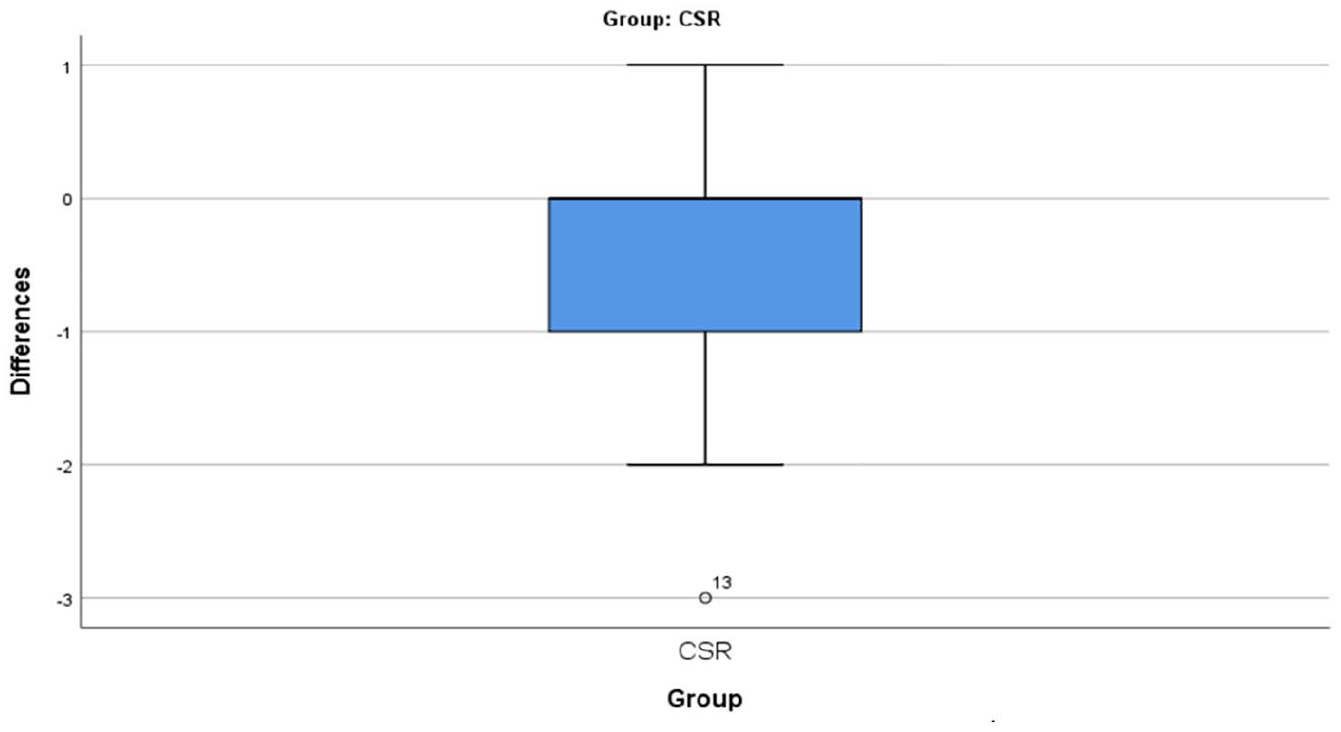
The boxplot for the differences between the pretest and the posttest of the matching section for the Collaborative Strategic Reading (CSR) group.
Based on Table 7, dependent samples t-test was used for comparing the pretest and the posttest of each section of the reading test for each group; however, based on Figure 1, the nonparametric test, Wilcoxon signed-rank test, was chosen for comparing the sets of scores of the matching section for the CSR group. Nonetheless, the symmetrical shape for the distribution of the differences between the pretest and the posttest of the CSR group for the matching section was not met based on Figure 1. Consequently, the researchers adopted the sign test.
Based on Table 6 and Table 8, the CSR group improved in the multiple-choice section from the pretest (M = 2.21, SD = 1.03) to the posttest (M = 2.37, SD = 1.60); however, the improvement was not statistically significant, t(18) = –.32, p > .05. On the other hand, the improvement for the ECSR group for this section from the pretest (M = 2.32, SD = 1.21) to the posttest (M = 3.76, SD = 1.12) was statistically significant, t(24) = −4.40, p < .05. The Eta squared statistic (.44) indicated a large effect size. Based on Table 6 and Table 9, the students in the CSR group did not experience a statistically significant median increase in matching section from the pretest (M = .47, SD = .69) to the posttest (M = .79, SD = .85), p = .54, although they performed better in the posttest. Furthermore, based on Table 6 and Table 8, the ECSR group also improved in this section from their pretest (M = 1.04, SD = 1.13) to their posttest (M = 1.64, SD = 1.28); however, it was not statistically significant. Moreover, the CSR group had a slight improvement for the true and false section from the pretest (M = 2.37, SD = 1.01) to their posttest (M = 2.58, SD = 1.12); it was argued that the improvement was negligible, t(18) = –.65, p > .05. In the same way, the ECSR group did not show statistically significant improvement for this section from the pretest (M = 2.40, SD = .86) to the posttest (M = 3.04, SD = 1.30), t(24) = −1.82, p > .05. For the cloze test section, although the CSR group improved from the pretest (M = 1.68, SD = 1.37) to the posttest (M = 2.26, SD = 1.85), the improvement was not statistically significant, t(18) = −1.08, p > .05. On the other hand, the ECSR group made a significant improvement in this section from the pretest (M = 2.44, SD = 1.41) to the posttest (M = 4.40, SD = 2.72), t(24) = −4.22, p < .05 with a large effect size considering the observed Eta squared (.42).
Dependent samples t-test for the sections of the reading test.

Notes. CSR = Collaborative Strategic Reading. ECSR = Extended Collaborative Strategic Reading.
Sign test for the matching section of the reading test for the Collaborative Strategic Reading (CSR) group.

Results for research question 2
The second research question of the study was as follows: What are the perceptions of students toward Collaborative Strategic Reading and Extended Collaborative Strategic Reading?
In order to analyse the qualitative data collected by means of the interview conducted after the interventions with the learners from both groups, the transcript conventions from Maynard (1988) were used. Next, the researchers employed interpretive thematic analysis to identify the themes. In order to address the interpretive thematic analysis, the following steps were taken. First, the researchers read the transcripts completely considering the objectives of the study. Then, they identified the coding units, encode them, and categorized them. Finally, they determined the connections between categories to allow themes to appear. Table 10 demonstrates the emerging themes and the number of participants in each class elaborated on them.
Emerging themes from the qualitative analysis of the interview.

The students in both groups showed a positive view toward the interventions. However, the students in the ECSR group could name and recall social rules related to communication skills compared to the students in the CSR group. Although one student in the ECSR group found ECSR interesting, he did not consider it plausible due to preferring solo type activities; this can be attributed to individual differences. The superiority of ECSR over CSR based on the data from the interview can be depicted as follows.
As an example, one student in the CSR group mentioned that ‘CSR is good because we can amalgamate our thoughts’; however, after a short pause, he quickly added ‘I had to have a good teammate to work well on the activity. If my partner were a weak student, I could not engage in the activity effectively; I could not practice alone.’ He simply forgot that he was also responsible to help and boost other members of the group, and the activity needed interactions and negotiations to get completed. On the other hand, a student from the ECSR group said: ‘We could talk more and discuss the issues easier because we could exchange our ideas to come to an ultimate decision before telling the answers to the teacher.’ This instance clearly shows how the students in the ECSR group were better able to collaborate since they understood what collaborative activities mean. This would impact the quality of their collaboration.
The most prominent thing that the students in the CSR group could mention in terms of reading comprehension was that they could tell their teammates things that he did not know or vice versa. However, the students in the ECSR group could emphasize the use of strategies. For example, an ECSR student said ‘Before reading the text, we would read the questions. Then, we skimmed the text to get the gist. We could also scan to save time for ourselves so that we could answer the questions easier.’ Even one student in the ECSR group was able to talk about his feelings. He added ‘By ECSR, I was more confident regarding my reading comprehension since I knew my friends were there to help me. I was really relaxed in this technique.’
VII Discussion
Despite their many advantages, due to a myriad of factors, collaborative reading activities might not be always fruitful endeavors for effective reading comprehension. The individualistic mindset of learners is surely a serious hindrance in this regard. However, a more serious problem in many educational programs is that they do not apply the explicit teaching of social-emotional skills which would prepare the ground for effective collaborative activities. Therefore, it is wrong if teachers simply believe that the employment of collaborative reading activities will create positive changes in reading performance in any context regardless of learner variables. The intriguing question is if we need to abandon collaborative practices in contexts where students lack or have a low level of social-emotional skills. According to Wyman (2018), social skills must be taught explicitly by teachers modeling and encouraging students to work toward a common goal, without which cooperative learning lessons will not be a success. This study investigated teaching reading strategies through CSR and the extended version of it, ECSR, devised by the authors on reading comprehension and the perception of students toward the two interventions. Analysis of the data revealed that reading strategy instruction did not improve reading comprehension significantly in the CSR group. However, the ECSR group improved significantly from the pretest to the posttest with a high effect size. However, the componential analysis of the data showed that the ECSR group could show signs of significant improvement from the pretest to the posttest in two out of four sections of the reading test, namely multiple-choice and cloze formats, while the CSR group did not improve significantly in these two sections of reading comprehension tests. However, there was a commonality between the two groups in such a way that in the other two sections of tests, namely true/false and matching test formats, none of the groups showed any significant improvement from the pretest to the posttest.
As already mentioned in the literature review, there were studies (e.g. Fan, 2010; Huang, 2004; Klingner et al., 1998; Lin, 2008, in Fan, 2009) whose findings are similar to the findings of the current study regarding the inefficiency of CSR. Although many possible reasons were given in the literature review for the inefficiency of implementing CSR in collaborative learning activities in some studies, no study gave the lack of social-emotional competence as a possible reason for this inefficiency. According to Johnson and Johnson (2006), if socially unskilled students are arranged into one group, they cannot learn effectively. In the current study in order to extend the efficacy of CSR, social-emotional skills were taught to students. Results showed improvements in overall reading comprehension score and two sections out of four sections of test formats. Many variables affect performance in a test one of which is the test format (Alderson, 2000). Different types of test formats can be used in language testing such as multiple-choice, matching, true or false, cloze, etc. (Alderson, 2000; Kobayashi, 2002). They are to measure different aspects of language ability (Shohamy & Inbar,1991) including reading comprehension (Zheng, Cheng, & Klinger, 2007). Each of these test formats has its own merits. For example, cloze tests can be effective for reading comprehension and vocabulary (Palumbo & Loiacono, 2009). Kobayashi (2002) investigated the effect of test type and test format on test performance. She used three test formats, cloze, open-ended questions, and summary writing. The results showed that the test type and the test format both had a significant effect on learners’ performance. Therefore, Dennis (2009) suggested using different test formats in order to provide a better assessment tool for reading comprehension. In the current study, the in-depth analysis of the data further indicated the efficacy of ECSR over CSR in improving comprehension of texts with different test formats.
The findings of the interview revealed that the students had a positive perception toward both CSR and ECSR. The students in ECSR found the intervention useful for their reading comprehension and stated that they could extend skills they had learned through this intervention to other situations. They could mention the social rules better than the students in the CSR group did which shows that they became better negotiators and listeners to improve their communication skills when they were interacting with their peers. Investigating the development of socio-emotional skills through cooperative learning among undergraduate university students, López-Mondéjar and Pastor (2017) found that improvement in the socio-emotional skills results in greater empathy and assertiveness, as well as greater cohesion and confidence in reaching agreements in group discussions and accepting others’ views which differ from their own, among the participants. They conclude that a positive relationship can be established between the employment of a cooperative methodology and an improvement in the socio-emotional skills among university students. In a meta-analysis of studies based on 213 school-based, universal SEL programs involving kindergarten through high school students, Durlak et al. (2011) found that SEL students demonstrated significant improvement compared to controls in attitudes, social and emotional skills, behaviors, motivation to learn, and academic performance. In addition, they found that internalizing behaviors such as anxiety, depression, and stress and externalizing behaviors such as aggression and noncompliance decreased. Investigating the effects of social-emotional competency on the academic achievement, academic emotions and attitudes, and interpersonal relationships among 7106 fourth-grade and fifth-grade students in western China, Wang et al. (2019) found social-emotional competency positively predicted students’ academic achievement (including reading, mathematics, and science) and emotions and attitudes (including learning anxiety and interest). Reyes et al. (2000) claimed the SEL program could raise the social-emotional competence and academic achievement of students from low-income families or ethnic minorities.
As the findings of the interview suggest, some strategies recalled by both groups were taking notes, asking from the teammates or the teacher, checking the grammar, reading the words/sentences before and after the unknown word/part, scanning, skimming, and getting the gist. However, the students in the ECSR group mentioned some other strategies such as trying to find out the synonyms or antonyms of the unknown words in the text, guessing, skipping, and using pictures provided by the text, etc. It seems that since the students in the ECSR group were able to communicate more effectively because of their awareness after teaching social-emotional skills, they could test and trial the strategies they had used so that they were able to use a variety of strategies. On the other hand, the students in CSR could not make use of strategies effectively since they did not know how to manage their interactions smoothly. Teaching social-emotional intelligence productively had positive outcomes for the students since they could be able to better understand and manage their emotions, show empathy for others, establish and maintain positive relationships, and make responsible decisions. It helped them gain social-emotional knowledge which led to the ability to put that knowledge into practice and consequently internalize positive social-emotional behavior. When students know that their feelings will be heard and respected, they will show positive attitudes toward activities in the classroom. Subsequently, there will be fewer disciplinary problems and more positive social behavior as they know how to express their anger, disagree respectfully, manage their emotions, and act appropriately to maintain relationships, meaning that students can get along better with each other. A huge benefit of teaching social-emotional skills for the ECSR group was that they could manage situations and problems better when facing conflicts and could work better toward their goals; this could help to encourage the students to be themselves and motivated. Therefore, they could talk about their feelings, thoughts, and needs while setting and specifying their goals in their collaborative reading activities. This motivation brought them more attendance while collaborative reading and resilience propelled them through challenges. This caused better management, organization, and planning that contributed to their success over the CSR group. Another justification for this advantage is that the students in the ECSR group showed more empathy which was effective for resolving conflicts since they learned how to care about the feelings and thoughts of others and how to work collaboratively with their partners in their small groups.
If reading strategy instruction is viewed from the sociocognitive perspective, there would be the teacher or a group member as the more knowledgeable other to help the less knowledgeable group members to understand the text by using strategies through social interaction, in the socio-cultural context of the classroom (Vygotsky, 1978). Thus, CSR adapts Vygotsky’s notion of mediation and peer-mediated instruction, where learners co-construct meaning and modify thoughts in collaboration with peer members of the group and peer scaffolding as a result of which they internalize and challenge their cognitive strategic knowledge (Pressley, 2006). Vygotsky (1978) holds that children learn from their interactions with society and their culture. He called the distance between one’s actual and potential levels of development as Zone of Proximal Development (ZPD); that is, students are able to learn concepts that are not too complex and that they do not already know with emphasizing the role of the more knowledgeable other who scaffolds and helps students to develop their learning through social interactions. However, the fact that has not been discussed explicitly and clearly in many collaborative reading activities in general and CSR in particular is Vygotsky’s notion of emotion. In addition to linguistic, cognitive, and social developments, peers also need emotional scaffolding for development; According to Oxford (2015), ‘all learning is a powerful combination of cognition and emotion’ (p. 371).
VIII Pedagogical implications
Despite their importance in language learning development, social emotional skills have been under-researched, especially in experimental research in applied linguistics. This study had unique findings. Implementing SEL into CSR improved not only reading achievement but also emotions and attitudes, interpersonal relationships and reading strategy awareness and use. These findings indicate that the effects of ECSR, in comparison with CSR, on learner development are more comprehensive. According to Long (1996), ‘Environmental support in the form of comprehensible input is necessary for language learning, but insufficient for learning certain specifiable aspects of an L2’ (p. 425). Long (1996) emphasizes the role of interaction and negotiation for meaning, by a more competent interlocutor which triggers interactional adjustments and connects input, internal learner capacities, and output productively. As reading strategies are effective in improving reading comprehension, explicit instruction of reading strategies has been recommended (Pressley, 2006) through collaborative activities (Scott & Palincsar, 2013) and social interactions in cultural contexts (Vygotsky, 1978). CSR as a research-validated reading strategy instruction technique has the socio-cognitive theory of reading as its theoretical foundation where the role of social context in the cognitive development of reading comprehension is emphasized (Bernhardt, 1991). Despite all positive reports from adopting CSR in teaching reading strategies, some studies found CSR not to be effective in improving reading comprehension. For example, Fan (2010) found that CSR had no significant effect on predicting, inferring, and tackling vocabulary difficulties, though it was effective in understanding the main idea and finding the supporting details. Lin (2008, in Fan, 2009) found no difference between CSR and traditional grammar-translation method in terms of improving learners’ reading comprehension. Analysis of the interview data revealed that half of the students found CSR ineffective and had negative feelings about CSR. For example, some learners found the noises distracting, and some others did not know how to collaborate in their groups and did not find the learner-centered approach of CSR useful. However, Lin did not provide a solution to eradicate such problems, and just concluded that the teacher-centered approach might be more suitable for the ninth graders and students could benefit from direct teacher guidance in this context.
Schweisfurth (2013) emphasized the Learner-Centred Education (LCE) and the fact that it is a travelling policy in international perspective. She holds that despite its many benefits and promises, LCE implementation at practical level in classrooms is easier said than done, particularly in developing countries. Though the idea of LCE in modern world originated from developed countries, ‘. . . the history of the implementation of LCE in different contexts is riddled with stories of failures grand and small’ (Schweisfurth, 2011, p. 425) as there are a myriad of factors impacting the successful implementation of LCE. Some of the variables that Schweisfurth (2013) outlined as barriers to effective implementation of LCE include policy process (e.g. teachers might find policy messages difficult to understand, and the wash-back effects of high-stakes examination where the future education as well as career of the students depend on the examination results.), physical environment, class size and teaching materials, human resources, and teacher motivation. Schweisfurth (2013) further added that all of these phenomena are shaped by culture and affect teacher-learner interactions in classroom contexts. Schweisfurth (2013) focuses on two of Hofstede’s (2003) cultural continua, namely power distance and collectivism. In some cultures, there is a greater power distance between those who have less and more power in a society, such as between teachers and students. In this cultural context it is rare to find an affinity between teachers and students or to question teachers’ wisdom. In collectivist cultures, on the other hand, a great emphasis is placed on group rather than each individual in the group. Taking a critical perspective toward LCE, especially Schweisfurth’s (2013) viewpoints, the authors of this study found that the current views on LCE place no or less emphasis on boosting the social-emotional skills of learners as a variable among the many variables affecting successful implementation of LCE. This study showed that the implementation of emotional skills into CSR, which has LCE as one of its solid foundations, can produce far better outcomes in a rural context where the participants are from a working class community. This demands that future researchers add to the available LCE literature by implementing emotional skills into their LCE practices.
As an essential element of CSR is collaborative learning (Klingner, Vaughn, Boardman, & Swanson, 2012), some elements which promote collaboration need to be observed, including, (1) positive interdependence; (2) face-to-face promotive interaction within the group and between groups; (3) individual accountability; and (4) the teaching of collaborative skills, and group processing or discussing the dynamics of group interaction and how they can be improved (Johnson & Johnson, 1990). According to Spath (2009), .cooperative learning requires the continuous use and development of social-emotional skills’ (p. 24). She recommends that teachers need to make students aware of these social-emotional skills. Blatchford, Kutnick, Baines, and Galton (2003) pointed to some problem in employing cooperative learning approach and argued that if cooperative learning is to be used successfully in classrooms, the learning context needs to be prepared, teachers need to be taught their function and how to work with groups, students need to learn appropriate interactional skills, and the lessons and tasks also need to be well organized. Therefore, lack of social-emotional skills may manifest itself as a behavior issue in the classroom (Spath, 2009), and the impact of emotions in language learning deserves much attention as it has been severely under-researched in the field of applied linguistics (MacIntyre, 2002). Therefore, as findings of this study show, instead of abandoning employment of CSR in contexts where cooperative reading is difficult to implement because of the individualistic mindset of the students and lack or low level of social emotional skills, we can improve the efficacy of CSR by adding the socio-emotional dimension to it. The authors believe emotional skills do not necessarily develop by themselves as a result of cooperative activities and lack of them even makes corporative activities a failed attempt and counterproductive. Therefore, any student-centered program where the teacher transfers responsibility to the students to rely on themselves and to trust each other needs to teach explicitly the socio-emotional skills, especially in contexts where the existence of such skills in students is not established. As the focus on literacy instruction seems to inhibit educators from thinking about the relationship between academic and social-emotional learning (Zins, et al., 2004), teachers of reading in L2 can use the findings of this study to value improvements in emotions as much as they value improvements in cognition and treat them with the same status in collaborative learning. Teachers should help their learners to become more socially and emotionally skilled, and educational institutes also need to extend their curriculum to apply and integrate social and emotional perspectives of learning into their programs, especially where the educational contexts are teacher fronted, centralized, and individualistic to some extent and in rural areas where students come from a working-class community, and collaborative activities seem to be difficult to be implemented for them. Therefore, learning environments should provide students with multiple scaffolds (Martin, Tissenbaum, Gnesdilow, & Puntambekar, 2019) including social-cultural emotional scaffolding. As the teaching of collaborative skills is one of the most important elements of collaborative learning (Johnson & Johnson, 1990), and as according to the findings of this study, social emotional skills are teachable and when taught they are effective in improving reading comprehension, reading teachers are suggested to provide social emotional scaffolding along with other types of scaffolding for a more effective interaction for reading comprehension among learners. In fact, reading teachers should learn how to deliver a supportive and productive reading strategy instruction when employing collaborative activities. Therefore, needs assessment should be conducted before the course begins to analyse the socio-cultural emotional needs of learners for collaborative activities.
The authors hope this study can build up our knowledge of a well-devised Collaborative Strategic Reading activity. Further investigations are called for to add to the validity of ECSR as an effective technique in educational settings where students have problems with Collaborative Strategic Reading activities. Longitudinal studies should also be conducted to further examine the long-term effects of ECSR in teaching reading strategies on reader development.
Since this study selected only male participants as only male students were available to the researchers, it is recommended that the same study be replicated on female students to compare the results. The duration of the instruction is another limitation of the study that might affect the results. Future researchers are encouraged to conduct the study with more sessions of treatment and practice with SCR and ECSR.
Footnotes
Appendix 1
Interview questions.
Do you prefer collaborative activities like this technique over other solo activities? Describe your answer by identifying the strengths or weaknesses of this technique based on what you have experienced. How are your comprehending and understanding of what you are reading by this technique different from previous ways of learning reading? In what ways have you overcome the difficulties in your reading comprehension by this technique? Describe the strategies you have used successfully. Do you think you are able to participate effectively in other collaborative activities by training this technique? Why? How much does this technique help you to communicate and interact with others effectively? How much is this technique successful to promote your ability of problem-solving such as when you disagree with your teammate? How would you deal with it? Does this technique make you feel that you are responsible to help your teammates? Why? How different is your feeling after getting work done in this technique from other activities?
Acknowledgements
This article is based on the MA thesis of Ali Amjadi, which was conducted at University of Mazandaran, Iran, and under the supervision of Dr. Seyed Hassan Talebi.
Funding
The author(s) received no financial support for the research, authorship, and/or publication of this article.
