



Abstract
This study examined the relations among loneliness, friendship, and emotional functioning in adults (N = 108) with autism spectrum disorders. Participants completed self-report measures of symptoms of autism spectrum disorders, loneliness, number and nature of friendships, depression, anxiety, life satisfaction, and self-esteem. The results indicated that loneliness was associated with increased depression and anxiety and decreased life satisfaction and self-esteem, even after controlling for symptoms of autism spectrum disorders. In addition, greater quantity and quality of friendships were associated with decreased loneliness among adults with autism spectrum disorders. Multivariate models indicated that friendship did not moderate the relationship between loneliness and well-being; however, number of friends provided unique independent effects in predicting self-esteem, depression, and anxiety above and beyond the effects of loneliness. This was the first study to examine the relations among these aspects of social and emotional functioning in adults with autism spectrum disorders, and the results indicate that this topic warrants further clinical and research attention.
Introduction
Individuals with autism spectrum disorders (ASDs) experience significant difficulties in social functioning, including deficits in core social abilities and problems establishing and maintaining peer relationships (American Psychiatric Association, 2000). These social and interpersonal problems generally persist and sometimes worsen in adulthood, contributing to functional impairment (Seltzer et al., 2004). Despite the steady increase in ASD prevalence (Centers for Disease Control and Prevention, 2012), few studies have focused on the experiences of adults with ASDs.
Existing research indicates that adults with ASDs face many challenges in terms of occupational success, independent living, and relationship formation (Billstedt et al., 2005; Eaves and Ho, 2008; Howlin et al., 2004). In previous studies, only a small percentage of adults with ASDs were reported to have friendships or romantic relationships (Billstedt et al., 2011; Engstrom et al., 2003; Howlin et al., 2004). There is also evidence that increased awareness of social deficits is associated with both depression and anxiety among individuals with ASDs (Mazurek and Kanne, 2010; Sterling et al., 2008). Rates of depressive symptoms increase with age among individuals with ASDs (Ghaziuddin et al., 2002; Sterling et al., 2008), and adults with ASDs are at significantly greater risk of mood and anxiety disorders than are individuals in the general population (Gillott and Standen, 2007; Mazefsky et al., 2008; Moseley et al., 2011). Thus, identifying factors that may be associated with social and emotional functioning for adults with ASDs is highly important.
Loneliness
There is considerable evidence that loneliness and social support have a strong influence on overall well-being in the general population. However, this has yet to be examined among adults with ASDs. Contrary to historical assumptions, individuals with ASDs do not always prefer social isolation. They often want to develop relationships but face barriers in developing relationships due to social competence difficulties (Bauminger et al., 2003; Causton-Theoharis et al., 2009). Thus, loneliness appears to be a clinically important consideration for this population.
Loneliness is generally understood to reflect a negative emotional state arising from a perception of unfulfilled social needs (Peplau and Perlman, 1982; Russell et al., 1984). By contrast, social isolation is an objective measure of social contact, and does not imply subjective appraisal (either positive or negative). In fact, solitude may be perceived positively by some individuals, while loneliness may be experienced by others even in the presence of objective social relationships (Heinrich and Gullone, 2006). As such, loneliness and social isolation are related, yet conceptually distinct.
A need for social connection has long been considered a fundamental aspect of the human experience. As argued by Baumeister and Leary (1995), this basic drive is believed to underlie a range of other psychological processes, and to represent a universal human motivation. Likewise, a lack of belonging is associated with a range of negative psychosocial effects, ranging from physical health to psychological well-being. Among individuals in the general population, loneliness has been consistently linked with negative emotional outcomes, including decreased self-esteem (Davis et al., 1992; Schultz and Moore, 1988), reduced satisfaction with life and perceived meaning (Goodwin et al., 2001; Stillman et al., 2009), increased depression (Cacioppo et al., 2006b; Wei et al., 2005), and increased anxiety (Cacioppo et al., 2006a).
Loneliness in individuals with ASDs
There has been an increasing emphasis on understanding the potential impact of social difficulties on emotional functioning among individuals with ASDs. However, the vast majority of this research has been conducted among children. Across most studies, children with ASDs have reported greater loneliness than typically developing children, including both social and emotional aspects of loneliness (Bauminger et al., 2003, 2004; Bauminger and Kasari, 2000; Lasgaard et al., 2010; Locke et al., 2010). Children with ASDs also experience high rates of loneliness despite the fact that their understanding of the affective components of the construct may be less complete than that of their typically developing peers (Bauminger et al., 2003). There is also evidence that loneliness is associated with negative emotional outcomes for children with ASDs. For example, in previous studies of children with ASDs, loneliness has been associated with decreased feelings of self-worth (Bauminger et al., 2004) and increased social anxiety (White and Roberson-Nay, 2009).
In contrast, studies have yet begun to explore the experience of loneliness among adults with ASD diagnoses. However, some studies have used general population samples to examine the relations between characteristics of the broader autism phenotype and social-emotional functioning. Jobe and White (2007) found that autism traits among young adults in the general population were associated with increased self-reported loneliness. Pollmann et al. (2010) also used a nonclinical population to examine the associations between autism traits and relationship satisfaction within romantic relationships. The results indicated that higher autism traits were associated with decreased self-reported relationship satisfaction among men, but loneliness was not specifically assessed.
Friendship in individuals with ASDs
Individuals with ASDs are at risk of difficulties forming and maintaining friendships, which may place them at greater risk of experiencing loneliness. Previous studies have found that children with ASDs have fewer friends than typically developing children (Bauminger and Shulman, 2003; Koning and Magill-Evans, 2001), and that their friendships are characterized by shorter duration and less frequent get-togethers (Bauminger and Shulman, 2003). Furthermore, there is evidence that peer engagement appears to decline over the course of childhood for children with ASDs (Rotheram-Fuller et al., 2010). Rowley et al. (2012) found that only 34% of children with ASDs were reported by parents to have at least one good friend, as compared to 71% of children with other special educational needs and 93% of typically developing children. Locke et al. (2010) also found that adolescents with ASDs reported poorer quality friendships than typically developing peers, particularly with regard to companionship and helpfulness.
Relatively fewer studies have examined the role of friendship in the lives of older adolescents and adults with ASDs. Orsmond et al. (2004) examined the social experiences of a large sample of adolescents and adults with ASDs who were living with parents. Only 8.1% of the sample had at least one close reciprocal friendship, and 20.9% had at least one relationship with a peer that involved some shared activities. However, almost half the sample had no peer relationships at all. In addition, few of the participants socialized weekly with either friends (20.9%) or people from work or school (13%). More recently, Shattuck et al. (2011) examined social participation among adolescents (ages 13–17 years) with ASDs using data from the National Longitudinal Transition Study-2 (NLTS2). They found that 43% of adolescents with ASDs never got together with friends outside of school or organized activities. Similarly, over half the sample never received phone calls from friends or were invited to social activities by friends. In addition, findings revealed that these indicators of social participation were significantly lower than among adolescents with other types of disabilities.
Friendship as a protective factor
Given that individuals with ASDs may be at risk of experiencing loneliness, and that loneliness is associated with negative emotional outcomes, identifying factors that may serve a protective function is important. Close friendship may represent a potential buffer against negative effects of social difficulties on well-being among adults with ASDs. In fact, there is a precedent for this in previous research among both typically developing children and those with ASDs. Among typically developing children, having at least one good friend is associated with greater well-being even after controlling for overall social success in the larger peer group (Bukowski et al., 1994; Hodges et al., 1999; Linsey, 2002). Parker and Asher (1993) found that children who had a close friend experienced less loneliness than those without a close friend, even when they were not accepted by the larger peer group. In addition, greater friendship quality was associated with decreased loneliness, even after controlling for social acceptance. More recent research has shown that both quantity and quality of children’s friendships provide unique contributions to emotional functioning, including loneliness and depression (Nangle et al., 2003).
Among children and adolescents with ASDs, friendship and social support also appear to influence perceived loneliness. For example, Bauminger et al. (2004) found that children with ASDs who reported higher quality friendships also reported less loneliness and greater overall self-worth. In a more recent study, Whitehouse et al. (2009) found that adolescents with Asperger’s syndrome (AS) reported significantly poorer quality friendships, and lower scores on a measure of friendship motivation as compared to typically developing adolescents. In addition, the adolescents with AS also reported higher levels of loneliness and depression than did typically developing adolescents. Friendship quality was negatively associated with loneliness in both groups, but was not significantly associated with depressive symptoms in either group. Similarly, Lasgaard et al. (2010) found that self-reported loneliness among adolescent boys with ASDs was negatively correlated with perceived social support from classmates, friends, and parents.
There is also some evidence that friendship may offer additional protective benefits for children with ASDs. For example, having at least one reciprocal friendship in elementary school was found to be associated with greater peer acceptance among children with ASDs (Rotheram-Fuller et al., 2010). However, the associations between friendship and emotional functioning have been somewhat mixed in other previous studies. For example, Mazurek and Kanne (2010) found that children and adolescents with ASDs who had friendships that were limited in reciprocity had greater anxiety and depression than either those with good quality friendship or those with no friends. However, Kelly et al. (2008) found that peer relationship quality was not significantly associated with anxiety and depression in a sample of children with ASDs.
Current study
In summary, there have been no previous studies of the associations among loneliness, friendship, and well-being in adults with ASDs. This knowledge would provide important information about whether friendship relationships may serve an emotionally protective role for adults with ASDs. Thus, based on previous research, the following hypotheses were proposed: (1) loneliness will be associated with decreased well-being among adults with ASDs, (2) friendship will be associated with decreased loneliness among adults with ASDs, and (3) friendship will moderate the relationship between loneliness and well-being among adults with ASDs.
Methods
Participants
The sample for this study included 108 adults with ASDs ranging in age from 18 to 62 years (M = 32.4 years, standard deviation (SD) = 12.5 years), who were recruited with the assistance of a national open enrollment ASD registry, the Interactive Autism Network (IAN) Research Database at Kennedy Krieger Institute, and Johns Hopkins Medicine, Baltimore, Maryland. Participants were recruited by email and completed all measures online using a web-based format. Participants were provided with a US$15 gift card for participation in the study, and recruitment continued until the target sample size was achieved. Eligibility requirements included age range (18 years of age or above), ability to complete measures independently, and a previous professional diagnosis of ASDs, including autism or autistic disorder (29.6%), AS (63.9%), or pervasive developmental disorder, not otherwise specified (NOS) (6.5%). The majority of the sample was male (52.8%) and Caucasian (88.0%). Additional sample characteristics are presented in Table 1.
Social and demographic characteristics.

Measures
Participants completed a demographic and history form designed for this study. Information included age, race, diagnostic information, relationship status, employment, living arrangements, and specific information about friendship, as described below.
ASD symptoms
Symptoms of ASDs were assessed using the Autism Spectrum Quotient–Short (AQ-Short) (Hoekstra et al., 2011), an abbreviated 28-item version of the original 50-item self-report questionnaire, the AQ (Baron-Cohen et al., 2001). The AQ was originally developed to assess symptoms of autism along a continuum, using a quantitative approach. Items are rated on a 4-point scale, ranging from definitely agree to definitely disagree. The AQ-Short has demonstrated good psychometric properties, including strong reliability and validity among general population and clinical samples. The original scoring for the AQ utilized a dichotomous approach for each item (with a possible range of scores of 0–50) (Baron-Cohen et al., 2001). However, subsequent studies have utilized the full range of responses in order to provide a more fine-grained differentiation among scores in subsequent analysis (Austin, 2005; Hoekstra et al., 2011). This study utilized this approach for scoring the AQ-Short, resulting in a total score ranging from 28 to 112, with higher scores indicating greater autism traits. The Cronbach’s alpha coefficient of .85 in the current sample indicated solid internal consistency.
Loneliness
Loneliness was assessed using the 8-item version of the University of California, Los Angeles Loneliness Scale (ULS-8) (Hays and DiMatteo, 1987). The ULS is one of the most widely used measures of loneliness and has been used extensively in both the general population and clinical samples (Russell, 1996; Russell et al., 1980). The ULS-8 has demonstrated strong reliability and validity in previous studies (Hays and DiMatteo, 1987), and Cronbach’s alpha in the current sample was .80. Items are rated on a 4-point scale, ranging from never to always, with higher total scores indicating greater loneliness.
Friendship
Friendship status was assessed using a questionnaire developed for this study. Participants responded to the following questions: “How many friends do you have right now?” and “Do you have a close or best friend (who is not a member of your family)?” Participants who reported having a close friend (n = 64), then responded to the following questions: “How often do you get together with your close friend?” “How often do you talk on the phone with your close friend?” and “How often do you use email, Facebook, instant messaging, or texting to talk with your close friend?” See Table 2 for response options.
Ms, SDs, and correlation coefficients (N = 108).
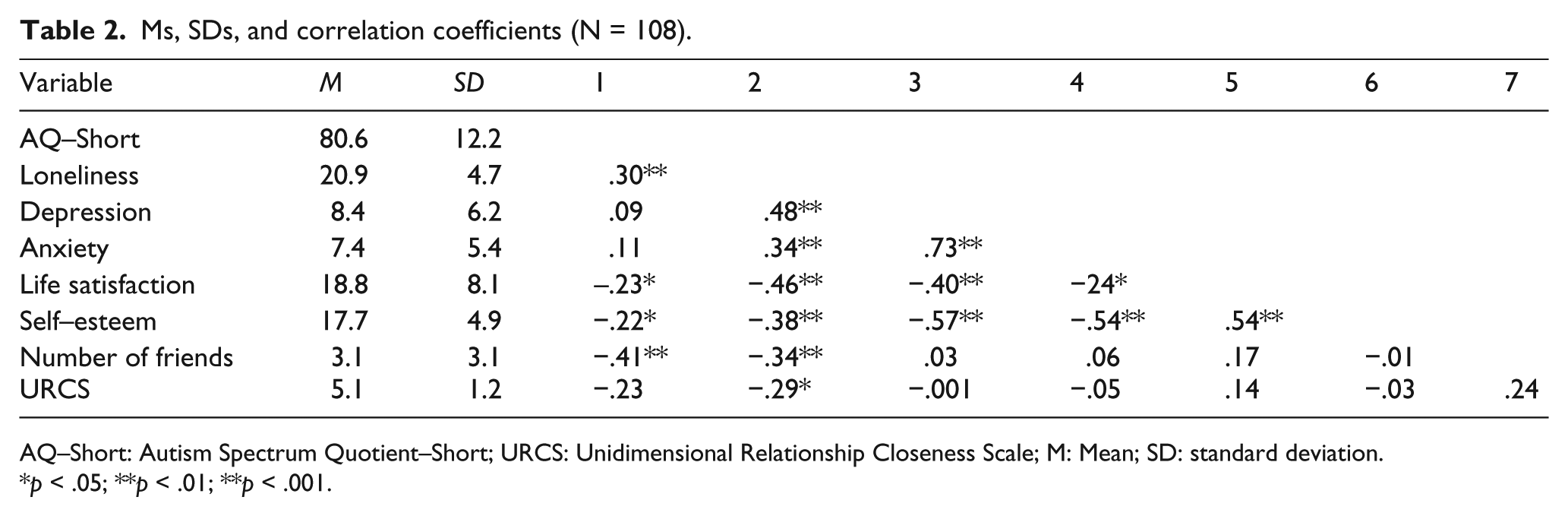
AQ–Short: Autism Spectrum Quotient–Short; URCS: Unidimensional Relationship Closeness Scale; M: Mean; SD: standard deviation.
p < .05; **p < .01; **p < .001.
Friendship quality was assessed using the Unidimensional Relationship Closeness Scale (URCS), a recently developed self-report measure of perceived closeness in personal relationships (Dibble et al., 2012). The URCS is a 12-item self-report scale that assesses the relationship closeness between two persons. Items are rated on a 7-point scale, ranging from strongly disagree to strongly agree, with higher total scores indicating greater degree of intimacy. As suggested by the authors, item 6 was omitted from the scale for this study due to poor discriminant validity, resulting in an 11-item scale. In the development study, the URCS demonstrated very good construct validity, convergent validity, and reliability for both romantic and friendship relationships. Cronbach’s alpha in the current sample was .88. Only participants who reported having a close friend completed the URCS (n = 64) in this study.
Well-being
Life satisfaction was assessed with the widely used 5-item Satisfaction with Life Scale (SWLS) (Diener et al., 1985). Items are rated on a 7-point scale, ranging from strongly disagree to strongly agree with higher total scores indicating greater overall life satisfaction. The SWLS has been used extensively in clinical and nonclinical population samples, and demonstrates excellent construct validity and test–retest reliability (Pavot and Diener, 1993), and Cronbach’s alpha in the current sample was .89.
Self-esteem was assessed using the Rosenberg Self-Esteem Scale (RSE) (Rosenberg, 1965), a 10-item self-report measure assessing general self-concept. The RSE represents the most widely used instrument designed to assess self-esteem, and has shown strong psychometric properties, including reliability, validity, and cross-cultural equivalence (Corwyn, 2000; Schmitt and Allik, 2005) Items are rated on a 4-point scale, ranging from strongly agree to strongly disagree with higher total scores indicating greater self-esteem. Cronbach’s alpha in the current sample was .80.
Depression and anxiety were assessed using the Patient Health Questionnaire (PHQ) (Spitzer et al., 1999). The PHQ contains separate modules designed for specific symptom types, and was designed to be consistent with Diagnostic and Statistical Manual of Mental Disorders criteria for particular diagnoses (American Psychiatric Association, 1994). For this study, the 9-item depression and the 7-item generalized anxiety modules were used. All items are rated on a 4-point scale ranging from not at all to nearly every day, with total scores indicating greater symptom severity. Both the depression and generalized anxiety modules of the PHQ have demonstrated excellent validity, sensitivity, and specificity (Kroenke et al., 2001, 2010; Spitzer et al., 1999). Cronbach’s alpha in the current sample ranged from .86 for the depression scale to .88 for the anxiety scale.
Data analyses
Descriptive statistics, including percentage, mean, standard deviation, and range, were calculated to characterize the sample. To test hypothesis 1, Pearson’s correlations were computed to examine the bivariate relationships between loneliness and each well-being variable (including life satisfaction, self-esteem, depression, and anxiety). To test hypothesis 2, Pearson’s correlations were computed to examine the relationship between loneliness and both number of friends, and friendship closeness (for those with a best friend). One-way analysis of variance (ANOVA) was conducted to examine differences in loneliness between individuals with and without a close friend. Finally, to test hypothesis 3, linear regression analyses were conducted to examine the unique contributions of friendship and loneliness as well as the interaction between the two in contributing to well-being. Separate analyses were conducted for each dependent variable of interest, including life satisfaction, self-esteem, depression, and anxiety.
Results
Initial one-way ANOVAs were conducted to test for potential differences in study variables with regard to gender, race, employment, marital status, or residence. Groups did not differ at the p < .05 level with regard to loneliness, anxiety, depression, life satisfaction, self-esteem, number of friends, or friendship quality. In addition, age was not significantly correlated with any of these variables of interest. Finally, Chi-square tests revealed no significant differences in any of the demographic variables when comparing those with and without a close friend.
Loneliness and well-being
As predicted, loneliness was significantly correlated with all emotional functioning variables. Specifically, loneliness was positively correlated with depression (r = .48, p < .001) and anxiety (r = .34, p = .001), and negatively correlated with both satisfaction with life (r = −.46, p < .001) and self-esteem (r = −.38, p < .001).
Given that AQ was also correlated with loneliness and with some dependent variables of interest (see Table 2), a series of linear regression analyses were conducted to determine whether loneliness contributed to the prediction of these variables after controlling for AQ. Loneliness provided significant main effects in the models predicting depression (β = .49, p < .001), anxiety (β = .32, p = .002), satisfaction with life (β = −.42, p < .001), and self-esteem (β = −.32, p = .001). In contrast, AQ did not contribute to the prediction of well-being in any model. Thus, the results indicate that loneliness contributes significantly to increased depression and anxiety and decreased life satisfaction and self-esteem, even after controlling for the effects of ASD symptoms.
Friendship and loneliness
Consistent with the second hypothesis, one-way ANOVA results revealed that adults with a close friend reported significantly lower levels of loneliness (M = 20.1, SD = 4.8) than those without a close friend (M = 22.2, SD = 4.2), F(1, 102) = 5.2, p = .02. To determine whether friendship contributed to decreased loneliness even after controlling for the effects of ASD symptoms, a subsequent linear regression analysis was conducted with loneliness as the dependent variable, and close friend (dichotomous) and AQ as independent variables. The results indicated that both close friendship (β = −.22, p = .02) and AQ (β = .28, p = .004) provided significant main effects in predicting loneliness.
Also consistent with predictions from the second hypothesis, number of friends was negatively correlated with loneliness (r = −.34, p = .001). Again, to determine whether number of friends contributed to decreased loneliness even after controlling for the effects of ASD symptoms, a linear regression analysis was conducted with loneliness as the dependent variable, and number of friends and AQ as independent variables. The results indicated that number of friends provided significant main effects (β = −.29, p = .007), but that AQ was not a significant predictor.
Finally, for those who reported having a best friend, the closeness of the friendship relationship was negatively correlated with loneliness (r = −.29, p = .02). To determine whether relationship closeness contributed to decreased loneliness after controlling for the effects of ASD symptoms, a subsequent linear regression analysis was conducted with loneliness as the dependent variable, and friendship closeness and AQ as the independent variables. The results indicated that AQ (β = .26, p = .04) provided significant main effects in predicting loneliness, and that friendship closeness approached significance (β = −.23, p = .06).
Friendship, loneliness, and well-being
To examine the extent to which friendship moderates the relationship between loneliness and well-being (after controlling for ASD symptoms), a series of hierarchical linear regression analyses were conducted with the well-being variable as the outcome. Within each model, loneliness, friendship, and AQ were entered as independent variables in step 1, and the interaction between loneliness and friendship was entered in step 2. Prior to analysis, the dependent variables were mean centered, and the interaction terms were computed using centered variables. Interaction terms were not significant predictors in any model; thus, interaction terms were dropped from all subsequent models.
Results from these models are presented in Table 3. For the models examining the contributions of having a best friend to the prediction of well-being, loneliness provided significant main effects in all models (ranging from p = .001 to p < .001), while neither having a best friend nor AQ score were significant predictors in any model (including those predicting life satisfaction, self-esteem, depression, or anxiety).
Linear regression analyses: loneliness and friendship variables predicting well-being.
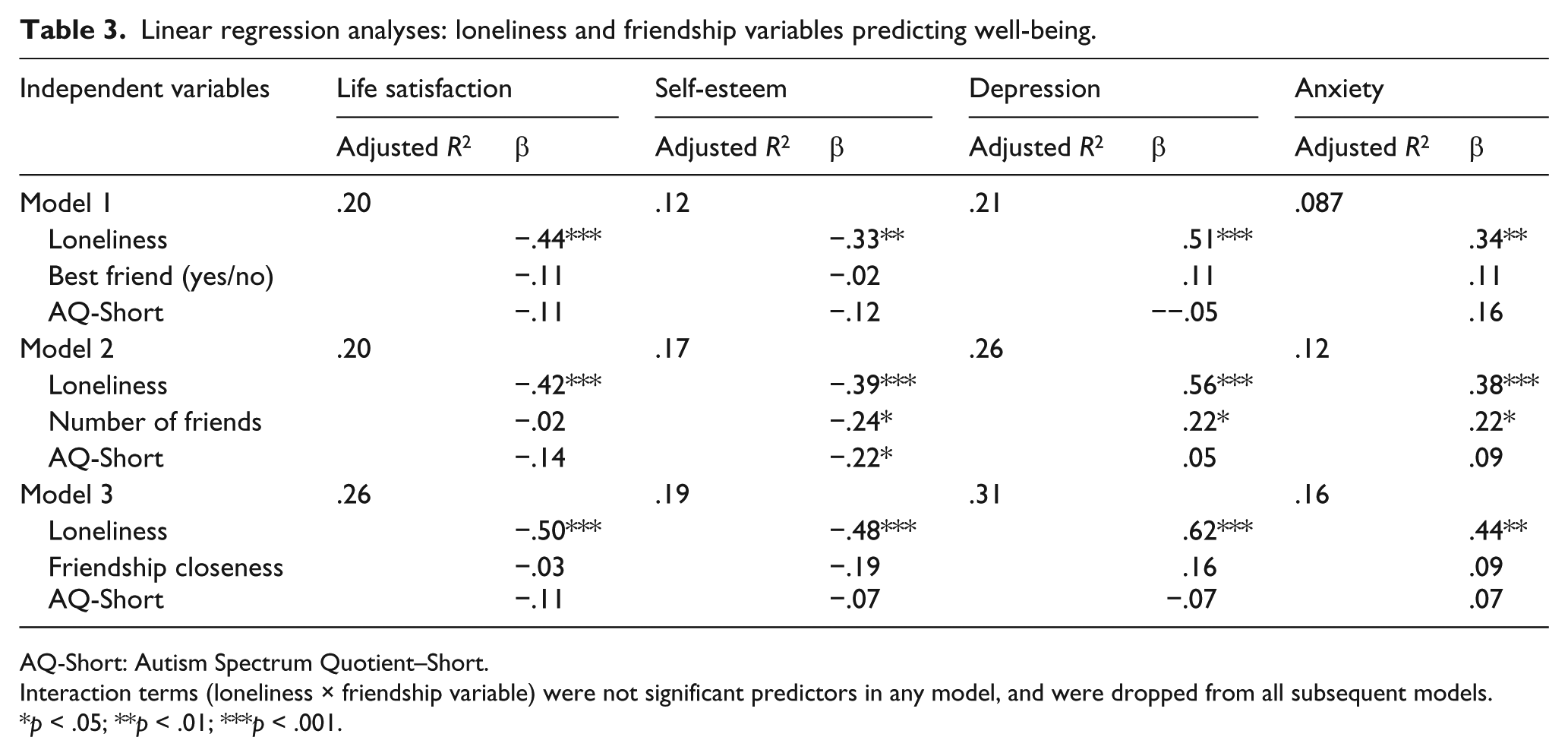
AQ-Short: Autism Spectrum Quotient–Short.
Interaction terms (loneliness × friendship variable) were not significant predictors in any model, and were dropped from all subsequent models.
p < .05; **p < .01; ***p < .001.
Similarly, in the models examining the contributions of friendship closeness to the prediction of well-being, loneliness provided significant main effects in all models (again ranging from p = .001 to p < .001), while neither friendship closeness nor AQ score were significant predictors in any model (including those predicting life satisfaction, self-esteem, depression, or anxiety).
Finally, in the models examining the contributions of number of friends to the prediction of well-being, significant main effects were observed for number of friends in most models. While loneliness was the only significant predictor of life satisfaction (p < .001), number of friends provided additional significant effects in the models predicting self-esteem (p = .03), depression (p = .03), and anxiety (p = .04), even after controlling for the effects of ASD symptoms.
Discussion
This was the first study to examine the associations between loneliness, friendship, and well-being among adults with ASDs. A primary finding from this study is that loneliness was significantly correlated with increased depression and anxiety, and decreased life satisfaction and self-esteem. The effect sizes ranged from medium to large, with the strongest association existing between loneliness and depression. These findings are consistent with a large body of literature on loneliness in the general population (Cacioppo et al., 2006a, 2006b; Davis et al., 1992), and extend our knowledge about the social and emotional lives of adults with ASDs. Contrary to the idea that individuals with ASDs do not experience or are not affected by loneliness, these results show that loneliness can be associated with negative emotional experiences for adults with ASDs, and is worthy of increased clinical and research attention.
Interestingly, the associations between loneliness and emotional functioning remained significant even after controlling for the effects of ASD symptoms. This finding lends support to the idea that loneliness may be a secondary consequence of social difficulties for individuals with ASDs, and that these consequences may have emotional repercussions above and beyond the effects of social impairment. Adults with ASDs who desire social connection, but who perceive that those social needs are unfulfilled, may be particularly vulnerable to depressed mood and a decreased sense of self-worth. These findings are consistent with an emerging body of work examining the associations between loneliness and emotional functioning in children with ASDs (Bauminger et al., 2004; White and Roberson-Nay, 2009), and indicate that the interplay between social and emotional experiences is similar for adults with ASDs. Alternatively, it is also possible that underlying depression and anxiety may give rise to feelings of loneliness and increased social isolation. Longitudinal studies are needed to examine the relationships between these constructs over time.
A second important finding from this study was that friendship was associated with decreased loneliness for adults with ASDs. This is highly consistent with findings from studies of children and adolescents in the general population (Nangle et al., 2003; Parker and Asher, 1993), and from studies of children and adolescents with ASDs (Bauminger et al., 2004; Whitehouse et al., 2009). These results indicate that different aspects of friendship, including having a close friend, the strength of the friendship relationship, and the size of the friendship network are all significantly related to loneliness in adults with ASDs. Additionally, friendship (i.e. having a best friend and number of friends) was associated with decreased loneliness even when controlling for the effects of ASD symptoms.
The third aim of the study was to examine the extent to which friendship may moderate the effects of loneliness on emotional functioning in adults with ASDs. Counter to these predictions, the results did not show evidence of moderation. Specifically, loneliness by friendship interaction terms were not significant predictors in any of the regression models. Instead, loneliness appeared to account for the largest amount of variance in all models, above and beyond the effects of both ASD symptoms and friendship variables; and this relationship did not differ as a function of friendship status. This was the case for models examining self-esteem, life satisfaction, depression, and anxiety. However, further examination of these results reveals that the quantity of friendships does appear to play an important role in emotional functioning. In fact, the total number of friendships provided significant main effects in predicting self-esteem, depression, and anxiety, above and beyond the effects of both loneliness and ASD symptoms. These findings suggest that decreasing loneliness and increasing the total social network may have a significant impact on overall well-being for adults with ASDs.
Limitations
This study was limited in several ways. First, the study utilized a cross-sectional design. Therefore, issues of timing or causality among these variables cannot be determined. In future studies, longitudinal designs will be most informative in examining these issues as they unfold over time. Longitudinal studies among both child and adult samples would allow for a better understanding of potential causal relationships among variables, as well as an examination of developmental shifts in social and emotional functioning. Findings from longitudinal studies in the general population indicate that loneliness predicts increases in depression over time, even after controlling for initial levels of depression and other psychosocial variables (Cacioppo et al., 2006b). Although there has been some evidence of a reciprocal relationship between these variables over time (Cacioppo et al., 2006b), a recent 5-year longitudinal study found evidence that loneliness predicted changes in depressive symptoms across time, while the reverse was not true (Cacioppo et al., 2010). These issues require further study among adults with ASDs to determine whether the relationships between loneliness and emotional functioning are unidirectional or bidirectional over time.
A second limitation of this study is that the sample may not be representative of the larger population of adults with ASDs. The gender ratio in the current sample, with nearly equal numbers of males and females, was not comparable to that of the broader ASD population, which is closer to a 4:1 male:female ratio (Fombonne, 2005). The reasons for this are not clear, but may be an indication of potential sampling bias. That is, females, or those who are more socially interested, may have been more motivated to participate in a study focused on social and emotional functioning. Although there were no gender differences in any of the social or emotional variables assessed, the potential for this bias remains possible. Similarly, the percentage of individuals in the current sample who reported having close friends was much higher than has been reported in previous studies (e.g. Orsmond et al., 2004; Shattuck et al., 2011). Again, this may reflect participation bias, or it may reflect differences in methodology. For example, this study utilized self-report of friendship number and quality, while previous studies (e.g. Orsmond et al., 2004; Shattuck et al., 2011) used parent-report for these constructs.
Finally, the participants were enrolled in a national autism network, and may differ from the general ASD population in additional undetermined ways. Aside from AQ scores and DSM-IV diagnostic categories, additional information about participants’ ASD diagnoses was not available. Specifically, information was not collected regarding the professional qualifications of the clinicians who provided the diagnoses, nor about the diagnostic battery. A better characterization of the participants, including objective measures of ASD symptoms, cognitive functioning, and adaptive skills would be informative in future research.
This study also relied on self-report for all measured constructs. Because internalizing symptoms, self-esteem and life satisfaction, are primarily subjective experiences, self-report is typically preferred in general population studies of these constructs. However, previous studies have suggested that individuals with ASD struggle with understanding and describing emotional experiences (Ben Shalom et al., 2006; Losh and Capps, 2006). Future work in this area may also benefit from the inclusion of multiple reporters, including perceptions of friendship quality from both members of the friendship dyad. This would allow for a more nuanced understanding of the quality of dyadic friendship relationships, and the extent to which concordance or discordance in characterizing the relationship relates to other social and emotional variables.
Conclusion
This study provides an important first look at the social and emotional experiences of adults with ASDs. These findings extend current knowledge in several important ways, and highlight the clinical importance of loneliness. Significant correlations were found between loneliness and a number of negative emotional experiences, including increased depression and anxiety, and reduced well-being. Given that individuals with ASDs are already at increased risk of anxiety and depression (Gillott and Standen, 2007; Mazefsky et al., 2008; Moseley et al., 2011), loneliness may represent an important mechanism in the developmental course of internalizing problems through adolescence and adulthood. A better understanding of the developmental course and consequences of loneliness will be essential to inform our understanding of social and emotional well-being in individuals with ASDs. Finally, strategies to reduce and prevent loneliness in adults with ASDs appear to be important targets for future research and clinical practice.
Footnotes
Declaration of conflicting interest
The author declares that there is no conflict of interest.
Funding
This work was supported by the University of Missouri School of Health Professions Catalyst Award.