




Abstract
Research has consistently shown that children and young people with autism spectrum conditions are more likely to be bullied than those with other or no special educational needs. The aim of this study was to examine risk and protective factors that could help to explain variation in exposure to bullying within this group. A sample of 722 teachers and 119 parents reported on their child’s experience of being bullied. This response variable was regressed onto a range of explanatory variables representing individual and contextual factors. The teacher- and parent-rated regression models were statistically significant, explaining large proportions of variance in exposure to bullying. Behaviour difficulties and increased age were associated with bullying in both models. Positive relationships and attending a special school were associated with a decrease in bullying in the teacher model, with use of public/school transport predicting an increase. In the parent model, special educational needs provision at School Action Plus (as opposed to having a Statement of Special Educational Needs) was a significant risk factor, and higher levels of parental engagement and confidence were associated with reductions in bullying. These findings are discussed in relation to the autism spectrum conditions literature, and opportunities for intervention are considered.
Introduction
The problem of bullying
Although bullying is widely accepted as a form of social aggression (Griffin and Gross, 2004) where a power imbalance is exploited (Olweus, 2013), precise definitions have been elusive. Many studies continue to use the definition originally proposed by Olweus (1993): ‘A student is being bullied or victimised when he or she is exposed, repeatedly and over time, to negative actions on the part of one or more other students’ (p. 9). Nevertheless, Olweus and others (e.g. Byrne, 1993) have acknowledged that single instances of negative behaviour can also constitute bullying, as there is a continuum of bullying behaviour. While categories of bullying initially focused on physical forms, it is now generally acknowledged that it can be divided into direct (e.g. fighting and name-calling – Olweus, 1978) and indirect behaviour (e.g. spreading of rumours and social exclusion – Brock et al., 2006). Reliable prevalence estimates have been difficult to establish, at least in part due to methodological differences between studies (e.g. measures used). Figures reported internationally range from 5.5% of secondary-aged girls in the Slovak Republic (Due et al., 2005) to 57% of secondary-aged pupils in Australia (Bond et al., 2007). In England, a recent large-scale survey of primary and secondary pupils produced a prevalence estimate of around 10% (Chamberlain et al., 2010).
At its most extreme, bullying has resulted in suicide (Nansel et al., 2001). Suicide ideation (Klomek et al., 2007), self-harm (McMahon et al., 2010) and behaviour difficulties (Olweus, 1993) are commonly reported. In addition, being bullied is associated with low self-esteem (Hawker and Boulton, 2000), mental health problems (Turner et al., 2006) and difficulties at school (Green et al., 2010), all of which may persist long after the bullying has ceased. Given these outcomes, addressing the problem of bullying is an ongoing matter of urgency in education systems across the world.
A number of factors associated with bullying exposure have been reported with relative consistency. Being the victim of bullying has been found to decrease with age (Bowen and Holtom, 2010), be more common among boys (Cook et al., 2010) and is associated with internalising and externalising problems (Brock et al., 2006; Card et al., 2008). Difficulties with social relationships increase the risk of bullying (Card and Hodges, 2007), and positive relationships confer protection (Abou-Ezzeddine and Schwartz, 2007). Other factors, such as lower academic achievement, attendance and ethnicity have yielded inconsistent findings. A number of groups at risk of increased exposure to bullying have been identified (e.g. Green et al., 2010), with children with special educational needs and disabilities (SEND) perhaps being the most vulnerable in this regard (McLaughlin et al., 2010).
Bullying of children and young people with autism spectrum conditions
Among those with SEND, students with autism spectrum conditions (ASC) 1 are considered to be particularly vulnerable to bullying. Humphrey and Symes (2010a) found the exposure rate for bullying among learners with ASC to be approximately three times that of students with dyslexia (and those without any identified SEND). Furthermore, in a large-scale national survey, Humphrey et al. (2010) found students with ASC to be second only to those identified as having behavioural, emotional and social difficulties (BESD) in terms of likelihood of being bullied. Additionally, a number of studies have estimated alarmingly high rates for this group. For example, Little’s (2002) survey (N = 411), in the United States, found that 94% of mothers of children with Asperger syndrome (AS) reported their child to have been the victim of bullying during the past 12 months. A parental survey reported in the United Kingdom (N = 1367) by the National Autistic Society (NAS) suggested a rate of 40%, rising to 59% for children with AS (Reid and Batten, 2006). Using smaller samples, Wainscot et al. (2008) (N = 57), in the United Kingdom, found that 87% of secondary-age children with AS or high-functioning autism reported being bullied at least once a week. Carter (2009) (N = 34) in the United States reported a figure of 65% of children with ASC having been bullied in the past year. More recently, Cappadocia et al. (2012), using parent-report in a Canadian sample (N = 192), found that 77% of children with ASC had been bullied in the past month. Finally, another study from the United States reported much lower figures (N = 1100), with 46.3% of children with ASC being classified as victims of bullying (although rates for youth with intellectual disabilities were even higher) (Sterzing et al., 2012). Thus, while these studies show wide variation, which may be due in part to methodological differences, they remain notably higher than most estimates among the general population, or indeed most learners with other SEND.
It is perhaps not surprising that students with ASC are considered to be particularly at risk of bullying. Victims of bullying often exhibit difficulties in social understanding (Garner and Hinton, 2010), occupy low social status (Card and Hodges, 2007) and are perceived as deviating from peer group norms (Horowitz et al., 2004). These are, of course, common characteristics of children and young people with ASC. Difficulties forming and maintaining friendships among those with ASC have been reported extensively by Bauminger and colleagues in recent years (e.g. Bauminger et al., 2010; Bauminger and Shulman, 2003). Lack of friendships can lead to isolation from peers, increasing potential vulnerability among those with ASC (Humphrey and Symes, 2011; Lasgaard et al., 2010). However, when successful, friendships have been found to confer protection against bullying through improved social integration (Bauminger et al., 2008; Humphrey and Symes, 2010b).
Children and young people with ASC may also be perceived as ‘different’ by their peers, due to difficulties in understanding and conforming to social norms. This may result from poor understanding of social rules leading to socially incongruent behaviour (Wainscot et al., 2008), and misinterpretation of non-literal language (including jokes) due to pragmatic language difficulties (Bishop et al., 2008). Such issues may lead peers to actively reject children with ASC or simply ignore them (Kasari et al., 2011), thereby denying them protective social support (Humphrey and Symes, 2010a, 2011). Additionally, internalising difficulties such as anxiety are common co-morbidities in children with ASC, leading to further vulnerability to the bullies who seek out fearful and timid children (Olweus, 1993). Finally, the difficulties in social understanding experienced by individuals with ASC can make them less likely to report bullying when it occurs, because they may incorrectly assume that others are already aware of the situation (Moore, 2007).
Risk and protective factors for exposure to bullying in ASC
Recent research has begun to move towards empirically establishing risk (e.g. variables associated with increased exposure) and protective (e.g. variables associated with decreased exposure) factors for bullying in ASC. Although in its infancy, this body of research has already provided clear evidence that some salient factors may be specific to ASC and/or operate through different mechanisms than those seen in the general population. For example, given that social difficulties are likely to become more apparent as children enter adolescence and social groupings become more complex (Locke et al., 2010), it is questionable whether bullying would decrease with age in children with ASC, as found in the general bullying research field. Only three studies have explored this, with inconsistent findings (Kasari et al., 2011; Little, 2002; Reid and Batten, 2006). Behaviour difficulties are also associated with being the victim of bullying in the broader literature, and children with ASC are recognised as having above-average levels of such problems (Macintosh and Dissanayake, 2006). Nevertheless, the precursors of behaviour difficulties may be qualitatively different from those of typically developing children, being more likely due to the high levels of anxiety and frustration that can occur in children with ASC as a result of difficulties in social understanding (Macintosh and Dissanayake, 2006) and sensory sensitivities (Reid, 2011).
Sofronoff et al. (2011) examined the influence of a range of variables, including internalising and externalising difficulties, social skills and social vulnerability, although only the latter demonstrated a significant independent association with bullying in Australian students with ASC. By contrast, Cappadocia et al. (2012) did find internalising difficulties to be a significant correlate of bullying in a Canadian sample, in addition to age, extent of communication difficulties, parental mental health problems and having fewer friends. Finally, Sterzing et al.’s (2012) analysis identified ethnicity, co-morbidity with attention deficit hyperactivity disorder, lower social skills, higher conversational ability and attending mainstream classes for 76% or more of the school week (compared to 25% or less) as being significantly associated with bullying among students with ASC in the United States. Taken together, these studies suggest that there are a number of salient risk and protective factors for exposure to bullying among children and young people with ASC, although findings have been inconsistent for some variables (e.g. externalising difficulties).
Limitations, gaps and inconsistencies in the current evidence base
There are several limitations, gaps and inconsistencies in the extant literature that suggest that further research is warranted. In terms of limitations, the studies noted in the previous section have relied on relatively small samples that place natural limits on generalisability of findings. Second, some (e.g. Sterzing et al., 2012) have utilised binomial logistic regression, in which the outcome variable is a dichotomous classification. A potential problem with this approach is that it necessitates a line being drawn (in measurement terms) that divides children and young people into a ‘bullied’ and ‘not bullied’ group. This oversimplifies a complex social process and, crucially, may miss important variation in the extent of exposure to bullying experienced. Third, the majority of the studies use a single respondent format, when use of more than one has been recommended in the general bullying field as a means of increasing study validity (Swearer et al., 2010).
There are also several key gaps in the existing knowledge base. For example, while poor attendance and low academic achievement have been suggested as risk factors for bullying (e.g. Green et al., 2010; Smith et al., 2004), this has yet to be investigated, despite nearly a third of parents in an NAS study reporting that their child had missed some school due to bullying and 40% suggesting that their child’s schoolwork had suffered as a result of it (Reid and Batten, 2006). Furthermore, although unstructured times of the day are known to present difficulties to children with ASC, little is known about vulnerability to bullying of those children using public or school transport to get to and from school, even though this is an occasion when there is minimal or no adult supervision (Raskauskas, 2008).
Linked to the notion of unstructured times of the day is participation in extra-curricular activities. While participation in school activities is associated with school connectedness (McNeely et al., 2002), which has been linked to the development of social skills in children with ASC (Rotheram-Fuller et al., 2010), little is known about actual participation in these activities. Some activities may have close levels of adult supervision, but it is also possible that many clubs are less structured than those during the school day, leading to higher levels of anxiety and increased vulnerability to bullies who may take advantage of an isolated and insecure child.
There are also several key variables that have produced inconsistent findings thus far. So, for example, while age was a significant risk factor in Cappadocia et al.’s (2012) study, this was not the case in other studies. Similarly, while externalising/behaviour problems significantly increased the risk of bullying in Sterzing et al.’s (2012) study, this was not replicated in research conducted by Sofronoff et al. (2011) or Cappadocia et al. (2012). Finally, several potentially vital findings in this emerging body of literature require replication. For example, Sterzing et al.’s (2012) finding that increased presence in mainstream school settings increased the likelihood of students with ASC being bullied is of particular significance given the ongoing debate around inclusion and inclusive education for students with ASC (e.g. Ravet, 2011).
Rationale for this study
The aim of this study was to explore a number of risk and protective factors for exposure to bullying among children and young people with ASC. Increasing our understanding of such factors and their relative contribution in the bullying process is a crucial first step towards developing more effective approaches to prevention and intervention.
We sought to address the limitations, gaps and inconsistencies in the extant literature that were highlighted in the previous section. Thus, we used a large, representative sample that would allow for generalisation, a multi-informant design and a continuous outcome measure that permitted us to model the magnitude of exposure to bullying. Our explanatory variables include a mix of factors in need of replication (e.g. educational placement), those where previous research has produced inconsistent findings (e.g. externalising/behaviour problems), and several that have not been examined in previous studies but are nonetheless theoretically plausible risk/protective factors (e.g. mode of transport to school). These are presented in Table 1.
Rationale and justification for inclusion of explanatory variables in this study.

FSM: free school meal; SEND: special educational needs and disabilities.
Consistent with contemporary bullying theory and research (e.g. Richard et al., 2011; Swearer et al., 2010), our work is informed by Bronfenbrenner’s (1979) bio-eco-systemic framework of human development. Applying this framework to the current study, bullying is considered to be a function of interactions between factors within the individual and the various elements of the eco-systems they inhabit. At the most proximal level, this includes the micro-system, which incorporates the child’s peer group, school and family and the meso-system, which represents the relationships between elements of the micro-system (e.g. the level of parental engagement and confidence in a given child’s educational provision). Use of such a framework arguably provides for a more comprehensive and nuanced understanding of the complex social processes involved in bullying. At a practical level, it serves as a reminder of the need to consider contextual (e.g. educational placement) in addition to individual (e.g. age) factors (Cappadocia et al., 2012; Humphrey and Symes, 2011). For the purpose of this study, a risk factor is defined as a variable that is ‘associated with an increased likelihood of poor physical, emotional and behavioural outcomes’ (Gewirtz and Edleson, 2007: 151), while a protective factor is defined as ‘a positive element that is negatively associated with poor outcomes’ (Feinberg et al., 2007: 507–508).
Method
Design
Consistent with previous studies in this specific area and the bullying field more generally, a cross-sectional natural variation design was adopted, with the response variable of bullying being regressed onto a range of explanatory variables. The data included in our study are drawn from a much larger data set acquired in the context of a major study focusing on educational provision for children and young people with a range of SEND (Humphrey et al., 2011).
Participants
Teachers (N = 722) and parents (N = 119) of children and young people with ASC drawn from 269 schools across 10 Local Authorities (LAs) in England participated in the study. These sample sizes were large enough to detect medium (teacher) and large (parent) effect sizes in a regression analysis with the explanatory variables modelled (12 in the teacher analysis and 14 in the parent analysis) (Cohen, 1992). The sample included pupils in Year 1 (aged 5/6 years), 5 (aged 9/10 years), 7 (aged 11/12 years) and 10 (aged 14/15 years) attending mainstream schools, special schools and pupil referral units. Comparisons with national data (e.g. Department for Education, 2010) indicated that both the teacher- and parent-report sample were broadly representative in terms of characteristics such as gender, free school meal (FSM) eligibility, 2 educational placement and stage of SEND provision. 3 With regard to statistical representativeness, assuming a prevalence rate for the broader autism spectrum of approximately 1% (Baird et al., 2006) in a population of 13,300,000 children and young people in the United Kingdom (Office for National Statistics, 2012), our sample of N = 722 produces a sampling error of 0.73% with 95% confidence intervals.
All pupils were in receipt of special educational provision under the terms set out in the Code of Practice for Identification and Assessment of SEND (Department for Education and Skills, 2001). Each had a primary need of ‘autism spectrum disorder’ disclosed by the school’s special educational needs co-ordinator (SENCo). This method of inclusion criteria was chosen as the vast majority of children in receipt of SEND provision for ASC will have undergone multi-professional scrutiny, and as such, it would be unlikely (and unprofessional) for a SENCo to designate a child as having ASC without appropriate clinical information. This sampling approach is also consistent with attempts to establish prevalence of the broader autism spectrum (e.g. Baird et al., 2006; Scott et al., 2002). The majority of previous studies have relied upon identification of ASC that is either dependent on parental report (e.g. Reid and Batten, 2006) or school report (e.g. Sterzing et al., 2012). The composition of the teacher- and parent-rated samples can be found in Tables 2 and 3.
Characteristics of the teacher-rated sample.

FSM: free school meal; SEND: special educational needs and disabilities; SA: School Action; SAP: School Action Plus; SSEN: Statement of Statement of Special Educational Needs.
Characteristics of the parent-rated sample.

FSM: free school meal; SEND: special educational needs and disabilities; SA: School Action; SAP: School Action Plus; SSEN: Statement of Statement of Special Educational Needs.
Materials
A range of data sources were utilised. Background socio-demographic characteristics (e.g. gender, FSM eligibility, ethnicity, educational placement, mode of travel to school, year group, urbanicity, attendance and academic achievement) were extracted from the National Pupil Database (NPD) and LA databases. Other data were obtained via surveys: the Wider Outcomes Survey for Teachers (WOST) and the Wider Outcomes Survey for Parents (WOSP) (Humphrey et al., 2011). The WOST contains three subscales: bullying (7 items), behaviour difficulties (externalising) (6 items) and positive relationships (7 items). The WOSP covers the same three domains and additionally assesses parental engagement and confidence (8 items) and wider participation (8 items). In both surveys, respondents are required to read a series of statements (e.g. ‘[Pupil name] is called names or teased by other children’) and indicate their level of agreement on a four-point Likert scale. 4 Scores are averaged in order to facilitate comparison across subscales, such that every domain is scored from 0 to 3, with a higher score indicative of greater levels of the phenomenon in question. The WOST and WOSP have been subjected to psychometric analysis and found to meet many of the quality criteria outlined by Terwee et al. (2007), including good content validity (exemplified by the clear measurement aims, target population, concepts, item selection and reduction and item interpretability reported by its developers), strong internal consistency (established through acceptable fit indicators in confirmatory factor analysis and Cronbach’s alpha coefficients of >0.8 for each domain in both the normative sample and this study), excellent construct validity (demonstrated by analyses showing that scores are consistent with a range of theoretically derived hypotheses concerning the concepts under scrutiny), acceptable floor (>15% evident in the behaviour and bullying domains) and no ceiling effects (less than 15% for all domains) and good interpretability (aided by normative scores) (Humphrey et al., 2011). For clarity, the full range of variables utilised in this study are detailed in Table 4:
Description of explanatory and response variables used in this study.

FSM: free school meal; WOST: Wider Outcomes Survey for Teachers; WOSP: Wider Outcomes Survey for Parents; SEND: special educational needs and disabilities; SA: School Action; SAP: School Action Plus; SSEN: Statement of Statement of Special Educational Needs; NPD: National Pupil Database; GCSE: General Certificate of Secondary Education; LA: Local authority.
Procedure
Following ethical approval from the University Research Ethics Committee at the authors’ host institution, consent to participate was granted on an opt-out basis. If a parent opted out, no data were collected, including the corresponding teacher survey. To ensure that parents whose first language was not English were able to participate, all information sheets, consent forms and surveys were available in English and the 9 other most commonly spoken languages in the 10 participating LAs – Arabic, Bengali, Chinese (simplified and traditional), French, Gujarati, Polish, Somali and Urdu. Surveys were either completed online via a secure password protected website, in hard copy or via telephone. 5 Teachers completed surveys for one or more students with ASC depending on the number of eligible pupils they taught, while parents responded only for their own child (or children if they had more than one with ASC in the study).
Results
All data were subjected to extensive screening, including missing data analysis. No patterns of concern were identified, with only minor violations of acceptable tolerances (e.g. >5% – Graham, 2009), and as such, it was concluded that the data sets were fit for purpose. Alpha was set at 0.05 for each analysis.
Teacher data
Once the data had been checked and a missing data analysis conducted, descriptive statistics for the 12 explanatory variables and the response variable were obtained (N = 722, mean = 0.592, standard deviation = 0.661), indicating that 65.4% of children were reported to experience at least some bullying. With the minor exception of homoscedasticity, all assumptions of multiple regression were met.
The response variable of bullying was regressed onto the 12 explanatory variables using the Enter method. The model was statistically significant, F(12, 509) = 32.764, p < .001, explaining 42.3% of the variance in exposure to bullying (adjusted R2 = .423). Coefficients are presented in Table 5.
Individual coefficients of explanatory variables in the teacher-rated and parent-rated models.

FSM: free school meal; SEND: special educational needs and disabilities; SA: School Action; SAP: School Action Plus; SSEN: Statement of Statement of Special Educational Needs.
From the 12 variables simultaneously entered into the model, 5 were statistically significant. There was a positive association between bullying and behaviour difficulties, year group and use of public/school transport. A negative relationship was found between bullying and educational placement (attendance at a special school) and positive relationships.
Parent data
The same procedures outlined above were applied to the parent data set (N = 119, mean = 0.947, standard deviation = 0.835), and included the finding that 77.7% of children were reported by parents to experience at least some bullying. As above, all assumptions of multiple regression except homoscedasticity were met.
The response variable of bullying was regressed onto the 14 explanatory variables using the Enter method. The model was significant, F(14, 79) = 5.163, p < .001, explaining 38.5% of variance in exposure to bullying (adjusted R2 = .385). Coefficients are presented in Table 5.
Of the 14 variables entered into the model, 4 were statistically significant. There was a positive association between bullying and behaviour difficulties, year group and stage of SEND provision (School Action Plus (SAP) when compared to Statement of SEND). A negative relationship was found between bullying and parental engagement and confidence.
Concordance between teacher and parent analyses
Teacher and parent scores (for the same child) for the response variable were positively correlated, rs = .316, p < .001, but parent-rated bullying scores were, on average, higher than those reported by teachers. These findings are in line with previous comparisons of teacher- and parent-report measures of psychosocial constructs (e.g. Achenbach et al., 1987), and are likely to reflect the very different environments in which teachers and parents see children. In terms of the regression models, there were areas of both convergence and divergence (see Figure 1 below).
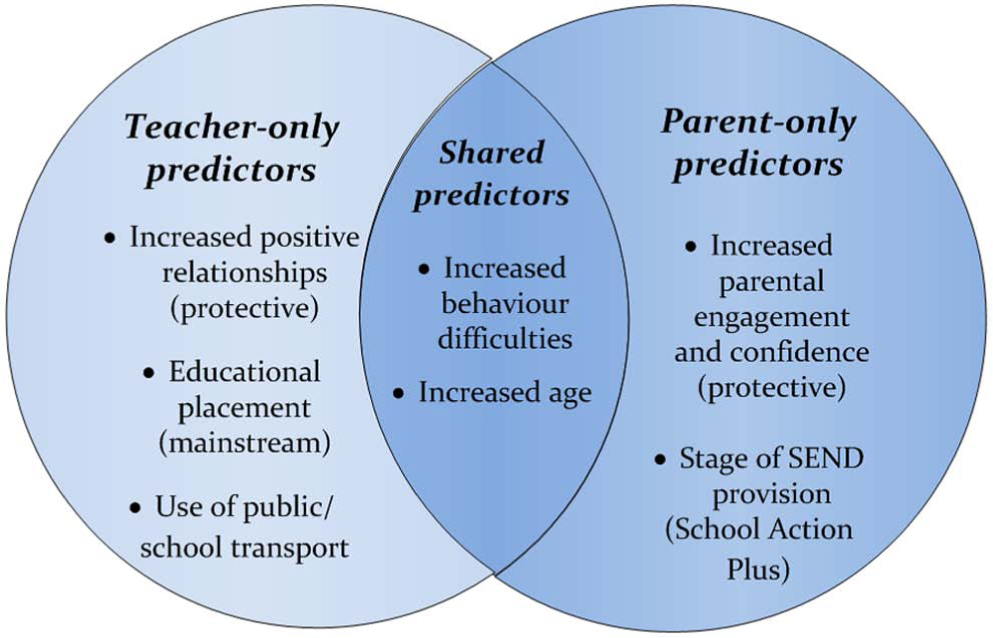
Factors associated with being a victim of bullying in children and young people with ASC.
Discussion
The analysis reported in this study identified a number of salient factors that were able to predict significant increases (risk) or decreases (protection) in exposure to bullying among children and young people with ASC. Consistent with our theoretical framework, these included both contextual and individual factors. Behaviour difficulties and year group demonstrated associations common to both the teacher- and parent-rated models. Positive relationships and attending a special school were associated with a decrease in bullying in the teacher model, with use of public transport to and from school found to predict an increase. In the parent model, being in receipt of SEND provision at the SAP stage (as opposed to having a statement of SEND) was a significant risk factor, and higher levels of parental engagement and confidence were associated with reductions in exposure to bullying. Both regression models predicted large proportions of the variance in the response variable, including a moderate correlation between the teacher and parent ratings (Cohen, 1992), although the latter consistently reported higher levels of bullying. In this final section, we consider the implications of these findings for our developing knowledge and understanding of the processes involved in bullying of individuals with ASC, examine opportunities for intervention that are consistent with our findings and note the strengths and limitations of this study.
Two explanatory variables explained significant proportions of the variance in both the teacher and parent models. The most powerful of these (in terms of the standardised regression coefficient) was the extent of pupils’ behaviour difficulties. In line with Sterzing et al. (2012), but in direct contrast to Sofronoff et al. (2011) and Cappadocia et al. (2012), we found increased externalising difficulties to be a significant risk factor for exposure to bullying. This finding also contrasts with the general bullying literature, which recognises poor behaviour as a correlate of being bullied in only a minority of children (e.g. Hampel et al., 2009). The function of externalising difficulties in influencing bullying may, therefore, be qualitatively different for students with ASC. The frustration and anxiety experienced in relation to social and educational difficulties in school can manifest in sudden emotional outbursts, which may cause students to be ostracised by their peers (Card et al., 2008; Macintosh and Dissanayake, 2006). Indeed, peers can sometimes play an active role in this process; anecdotally, there is evidence of subtle teasing and provocation designed to ‘trigger’ outbursts among students with ASC (e.g. Humphrey and Lewis, 2008). In addition, it is likely that peers may be hesitant or even fearful of approaching a pupil who has exhibited extreme behaviour (Card et al., 2008), and this in turn could be interpreted by a child with ASC as ostracism and bullying.
Year group emerged as the second most powerful association in both regression models, with older children more likely to be bullied. These findings are not consistent with the general bullying literature, which tends to report decreases over time (e.g. Bowen and Holtom, 2010; Dulmus et al., 2004). While Cappadocia et al. (2012) also found that younger children with ASC were more likely to be bullied than older children, they hypothesise that this could be due to parental report being more accurate for younger children. The sustained nature of bullying in this older age group does, however, resonate with the work of Little (2002), who reported higher levels of emotional bullying at age 13 years. As above, we propose a distinct trajectory for individuals with ASC. Younger students have less complex social groupings and may be more tolerant of the differences associated with ASC. As children grow older and become adolescents, social groupings become more complex and tolerance of difference may decrease as a function of the perceived need to adhere more closely to peer group norms (Kasari et al., 2011).
The importance of positive relationships as a protective factor was evident in the teacher model. This supports previous research in this area (e.g. Rotheram-Fuller et al., 2010; Wainscot et al., 2008), particularly one recent study that found levels of social support to be inversely related to bullying among students with ASC (Humphrey and Symes, 2010a). Those students with more robust social networks are less likely to be isolated in school, thereby reducing vulnerability. Second, these networks make them more likely to be able to call on the support of peers who can advocate for them in situations where bullying could occur. Finally, positive relationships with others provide the necessary opportunities for higher quality and frequency of social interactions with peers, which are crucial in helping to build the social skills of students with ASC. This is undoubtedly a reciprocal process; hence, improved social skills are likely to reduce perceived deviation from peer group norms, thereby increasing future opportunities for social interaction and the development of positive relationships (Humphrey and Symes, 2011). It is perhaps surprising that this finding was not replicated in the parent model, given that parents may have a better insight into the peer relationships of their child. However, this may reflect the smaller sample size and therefore reduced sensitivity of the analysis: in this context, replication with a larger sample of parents is warranted.
Educational placement also emerged as a significant association in the teacher model. More specifically, in line with analyses reported by Sterzing et al. (2012) and Reid and Batten (2006), attending a special school (as opposed to mainstream placement) was associated with reduced exposure to bullying. This is a finding of particular significance given ongoing debates regarding inclusion of and inclusive education for students with ASC (e.g. Cigman, 2007). Intuitively, it is perhaps not surprising that children attending special schools are bullied less than their mainstream counterparts – despite the heterogeneity evident in ASC, there is a commonality of needs which would undoubtedly lead to reduced perceptions of difference in specialist settings (remembering that one hypothesis for the increased vulnerability to bullying of those with ASC relates to this issue). However, there may be other salient explanatory factors. Class sizes tend to be much smaller in special schools, with a higher ratio of specialised teaching and support staff who are likely to have received additional training in SEND (Reid, 2011). The increased presence of adults may also serve to reduce opportunities for bullying. Interestingly, however, Reid and Batten (2006) found that parents of children with ASC attending mainstream schools reported that incidents of bullying were dealt with more effectively than those whose children attended special schools. Clearly, further research focusing on this issue is warranted. It is also important to note that this finding should not be taken as evidence to suggest that placement in a specialist setting is more appropriate for students with ASC. Rather, it highlights one of the challenges that needs to be addressed in order to make mainstream school settings more socially inclusive for such students.
The final significant variable in the teacher model was use of school/public transport. This is the first study to establish it empirically as a risk factor for bullying among students with ASC. Our analysis validates the concerns raised in Raskauskas’ (2008) qualitative study, and suggests that unstructured social situations with little or no adult supervision (such as the school bus journey) may represent a setting of particularly increased vulnerability. The finding (and, indeed, that of educational placement addressed above) also provides support for the theoretical framework (Bronfenbrenner, 1979) adopted in this study, as it suggests that contextual factors are as influential as individual differences in determining exposure to bullying. There are obvious practical implications, such as provision of alternative modes of transportation and/or adult or peer chaperones. However, the coefficient associated with this variable was rather small in the teacher model and was not significant in the parent model. As such, this finding should be treated with caution; replication is required.
In the parent model, children in receipt of SEND provision at SAP were reported to experience significantly higher levels of bullying. One factor that distinguishes this group from those with statements of SEND is the level of adult support provided in school. At unstructured times of the day, the lack of direct support from adults for children with ASC at SAP may leave them vulnerable to bullies, as they are more likely to be alone (Van Roekel et al., 2010). It is also feasible that such students are more functionally independent than those with statements of SEND, and so may be more aware that they are being bullied and/or more likely to report it to school staff. Finally, from the point of view of peers, the presence of adult support and/or reduced functional independence of students with statements of SEND compared to those at SAP may lead to qualitatively different causal attributions for behaviour that is seen as provocative or ‘strange’ in social settings. That is, peers may be less likely to bully students with ASC who have statements of SEND because their disability is less ‘hidden’ (Ravet, 2011).
The final issue of note in the parent model was the emergence of parental engagement and confidence as a protective factor. The role of parents in improving children’s social and educational outcomes has, of course, received much attention. For example, studies have established relationships between parental involvement and increased attendance (Epstein and Sheldon, 2002), improved behaviour (Harris and Goodall, 2008) and in particular greater academic attainment (Fan and Chen, 2001; Harris and Goodall, 2008; Jeynes, 2005; Singh et al., 1995; Sui-Chu and Willms, 1996). However, this is the first study to consider a connection between parental engagement and confidence and reduced exposure to bullying. We speculate that parents of children with ASC who more actively engage with their school can influence local policy and practice and are also more likely to report incidents of bullying relayed by their children of which staff may not have previously been aware, given the tendency for some students with ASC to ‘bottle up’ their experiences until they get home (Humphrey and Lewis, 2008); this may also explain the increased ratings given by parents compared to teachers.
Limitations
There are a number of limitations that should be acknowledged in this study. First of all, it was not possible to verify the diagnoses of the children and young people, with a reliance on the veracity of the SENCo nomination. While independent testing for ASC would be ideal, this was not possible, due to large numbers and time constraints. It is hoped, however, that the method selected can be considered rigorous in the light of the professionalism of the teachers involved and their duty to report correctly to the Department for Education. In addition, this inclusion strategy remains more objectively rigorous than the often completely unverifiable recruitment of convenience samples by means of online surveys and support groups/charitable organisations that is typical of a number of key ASC studies in this field (e.g. Little, 2002; Reid and Batten, 2006).
Linked to the above is the lack of information available on levels of impairment among students in the sample. While pupils attending special schools and those at the later stages of SEND provision are likely to experience more significant difficulties, this is not necessarily the case for all pupils, and so, these variables only serve as an approximate indication of impairment.
When exploring behaviour difficulties, it is of note that the subscale used to measure this focused on externalising rather than internalising problems. It is acknowledged that children and young people with ASC encounter high levels of internalising difficulties, such as anxiety and frustration (Simonoff et al., 2008), which can manifest in behaviours more associated with externalising problems. This is something that future research should address by the inclusion of appropriate measurement tools, as was the case in the study by Cappadocia et al. (2012).
A further potential limitation is that we were unable to include student self-report in our design, although this would have proved impossible given the range of age and level of functioning evident in our sample. Finally, the failure to model risk and protective factors longitudinally is also noteworthy, as it precludes a more powerful, causal model, including the possibility of examining developmental cascades (Masten and Cicchetti, 2010) associated with exposure to bullying. This is an issue we hope to address in our future work on this important topic.
Opportunities for intervention
As bullying has complex, multi-faceted roots (Richard et al., 2011; Swearer et al., 2010), approaches to intervention should reflect this. Focusing upon a single aspect in isolation (e.g. developing social skills) is unlikely to yield successful outcomes in the long term. Furthermore, strategies need to be integrated into existing systems and practices in schools if they are to be sustainable, and there is a distinct need to avoid the ‘programme for every problem’ phenomenon (Domitrovich et al., 2010). Thus, interventions should be assimilated within a broader approach designed to facilitate the social inclusion of pupils more generally.
A useful starting point is to build upon what is known about bullying prevention in general terms (e.g. Ferguson et al., 2007; Merrell et al., 2008; Smith et al., 2004). The effects of bullying interventions are not always practically significant and are more likely to influence knowledge and attitudes rather than actual behaviour (Merrell et al., 2008). Of particular note is the finding that programmes which include a component targeting students deemed to be ‘at risk’ produce slightly better outcomes (Ferguson et al., 2007). Whitted and Dupper (2005) suggest that ‘the most effective approaches for preventing or minimising bullying in schools involve a comprehensive, multilevel strategy that targets bullies, victims, bystanders, families and communities’ (p. 169).
In considering the implications of our work and those of others in this area (e.g. Sofronoff et al., 2011; Sterzing et al., 2012), it is worth noting some common themes, including the importance of positive relationships (e.g. this study; Humphrey and Symes, 2010a) and social skills (e.g. Sofronoff et al., 2011; Sterzing et al., 2012) as protective resources, the age-related increase in bullying (e.g. this study; Little, 2002), and the contexts in which bullying of those with ASC is most likely to occur (e.g. this study; Sterzing et al., 2012). These can be used to inform and adapt approaches to intervention as a means of reducing risk and increasing protective factors. There are four key areas for action that are consistent with these findings and the general bullying prevention literature noted above: (a) students with ASC, (b) their peers, (c) teachers and support staff and (d) school culture and climate. Available space prevents detailed discussion of these here, and so, the reader is referred to Humphrey and Hebron (forthcoming).
Conclusion
This study contributes to the existing knowledge base about bullying of students with ASC in several ways. First, we identified a number of risk and protective factors that had not been explored in previous studies (e.g. use of public/school transport). Second, we were able to replicate the effects of a number of variables identified in other research (e.g. educational placement). Third, we were able to clarify the effects of factors that had produced inconsistent findings in earlier work (e.g. behaviour difficulties). Furthermore, several key findings of our study (e.g. the influence of age and behaviour difficulties on bullying exposure) suggest distinct trajectories for students with ASC, which have important theoretical and practical implications. Our study benefited from a very large sample (for the teacher model) that was both geographically and statistically representative, thus allowing for generalisation. As a consequence, we were able to model a greater range of explanatory variables than has previously been attempted, making for a more comprehensive analysis. More broadly, this study demonstrates the utility of the risk, protection and resilience framework in helping to develop understanding of bullying of vulnerable students in school contexts.
Footnotes
Acknowledgements
We are grateful to the parents and teachers who participated in this research.
Funding
This research was funded by the Department for Education, England.
Notes
References
Supplementary Material
Please find the following supplemental material available below.
For Open Access articles published under a Creative Commons License, all supplemental material carries the same license as the article it is associated with.
For non-Open Access articles published, all supplemental material carries a non-exclusive license, and permission requests for re-use of supplemental material or any part of supplemental material shall be sent directly to the copyright owner as specified in the copyright notice associated with the article.
