



Abstract
This study examined the extent to which gender-related social behaviors help girls with autism spectrum disorder to seemingly mask their symptoms. Using concurrent mixed methods, we examined the social behaviors of 96 elementary school children during recess (autism spectrum disorder = 24 girls and 24 boys, typically developing = 24 girls and 24 boys). Children with autism spectrum disorder had average intelligence (IQ ⩾ 70), a confirmed diagnosis, and were educated in the general education classroom. Typically developing children were matched by sex, age, and city of residence to children with autism spectrum disorder. The results indicate that the female social landscape supports the camouflage hypothesis; girls with autism spectrum disorder used compensatory behaviors, such as staying in close proximately to peers and weaving in and out of activities, which appeared to mask their social challenges. Comparatively, the male landscape made it easier to detect the social challenges of boys with autism spectrum disorder. Typically developing boys tended to play organized games; boys with autism spectrum disorder tended to play alone. The results highlight a male bias in our perception of autism spectrum disorder. If practitioners look for social isolation on the playground when identifying children with social challenges, then our findings suggest that girls with autism spectrum disorder will continue to be left unidentified.
Introduction
Although much progress has been made in understanding autism spectrum disorder (ASD), researchers have historically experienced difficulties in identifying and diagnosing girls with ASD without cognitive impairment (Shattuck et al., 2009). Empirical findings suggest that this gap may be due, in part, to an expectation that girls with ASD will appear as solitary on the playground as boys with ASD do (Hiller et al., 2014)—that is, there is a male bias to our expectations. Concomitantly, girls are described as being better able than boys to “camouflage” their symptoms of ASD and to use compensatory behaviors that mitigate their social challenges (Dworzynski et al., 2012; Gould and Ashton-Smith, 2011; Tierney et al., 2016). The word camouflage highlights the importance of the environment. Looking more closely at the way that boys and girls with ASD interact with, or blend into, their natural social environment at school may give us a better understanding of why it has been difficult to identify ASD in girls.
Given that children with ASD without cognitive impairment are often educated in the general education setting, with typically developing (TD) children prominent in the social landscape, schools provide a relevant context to examine sex and gender in ASD populations. Sex refers to male or female biological traits. Gender describes psychological characteristics and social behaviors that are perceived as either masculine or feminine (Jordan-Young, 2010). Sex is a powerful predictor of children’s social organization; TD boys and girls naturally segregate into same-sex peer groups (Fabes et al., 2003; Maccoby, 1999; Mehta and Strough, 2009), and qualitative differences in the ways that boys and girls socialize are widely recognized (Corsaro and Eder, 1990; Goodwin, 2006; Pellegrini et al., 2004). Gender identity becomes more pronounced in school environments, especially within same-sex peer groups (Maccoby, 1988). Similar to TD children, children with ASD also tend to segregate by sex when socializing at school (Dean et al., 2014). More research is needed to examine the extent to which gender-related factors influence the social acceptance of children with ASD at school.
Although most children in elementary school socialize on the playground during break time or recess (Blatchford et al., 2003), boys and girls tend to interact differently. TD boys tend to play in large stable groups; they socialize through activities (Corsaro and Eder, 1990), preferring rough-and-tumble (Corsaro and Elder, 1990; Maccoby, 1988), organized play, and competitive-team games (Pellegrini et al., 2004). Female groups are smaller and more exclusive than male groups (Goodwin, 2006). Girls spend more time in social conversation and build intimacy through sharing secrets (Maccoby, 2004). Within a gender socialization framework, certain ASD-related behaviors may be differentially reinforced or sanctioned in male versus female groups (Tierney et al., 2016). For example, social communication difficulties may interfere with engaging in intimate conversations, but not with playing kickball. Likewise, certain social behaviors, such as playing team sports, may be of more value in male groups compared to female groups (Goodwin, 2006). Consequently, our understanding of how gender influences ASD-related behavior necessitates an examination of the reciprocal, interactive relationships between children and their social environment.
Research suggests that socially constructed gender biases shape the way that ASD-related behaviors are tolerated and perceived (Lai and Baron-Cohen, 2015). Clinical descriptions and research findings have identified gender differences in the way that boys and girls endorse ASD-related behaviors. Reported differences indicate that it may be easier to detect ASD behaviors in boys. For example, research findings suggest that boys with ASD are prone to isolation (Hiller et al., 2014) and have significantly more restrictive interests and repetitive behaviors than girls (Hartley and Sikora, 2009; Hiller et al., 2014; Lord, 1982; Mandy et al., 2012). Likewise, boys with ASD are more likely to show repetitive interests that strike others as unusual (e.g. hand flapping and obsession with train schedules), whereas girls with ASD often show interests that seem more in line with the interests of TD children (Gould and Ashton-Smith, 2011; Hiller et al., 2014; Kopp and Gillberg, 1992). Research findings also indicate that boys with ASD exhibit greater externalizing symptomology, hyperactivity, and inattention compared to girls with ASD (Gould and Ashton-Smith, 2011; Hiller et al., 2014); because teachers are more likely to notice and report concern for overt behaviors (Dworzynski et al., 2012; Hiller et al., 2014; Mandy et al., 2012), a boy is more likely to be identified and to receive intervention services.
Similar findings have been reported in the special education literature, which identified sex as a salient predictor for special education referral and subsequent diagnoses (McIntyre and Tong, 1998; Gregory, 1977). Because boys are more likely to manifest externalizing and disruptive behaviors, they are significantly more likely to be referred for special education evaluation (Dhuey and Lipscomb, 2010). Consequently, girls with disabilities are at risk for having unmet service needs (Bussing et al., 1998) and negative outcomes (Arms et al., 2008). Girls with ASD appear to be following a similar trend. The inability of school personnel to recognize symptoms of ASD has been identified as a significant factor in the misdiagnosis and late diagnosis of children with ASD. Compared to boys with ASD, ASD symptomology is significantly less likely to be recognized in girls (Aggarwal and Angus, 2015). Using a population-based sample of boys and girls who presented with high levels of ASD traits, Dworzynski et al. (2012) examined differences between children who received an ASD diagnosis and children who did not meet the diagnostic criteria. Although ASD trait levels were similar, girls receiving an ASD diagnosis had an additional low IQ or teacher-reported behavior problems. These differences were not evident in the equivalent group of boys. The findings suggest that the current diagnostic criteria and procedures may overlook the female endorsement of ASD symptomatology. The behaviors of girls with ASD, who are more prone to internalizing symptomatology (Mandy et al., 2012; Solomon et al., 2012), are more likely to be tolerated by their teachers with no report of concern (Dhuey and Lipscomb, 2010; Dworzynski et al., 2012; Hiller, 2016; Mandy et al., 2012).
Relative to boys with ASD, girls with ASD are described as having superior interpersonal skills (Hiller et al., 2014; Lai and Baron-Cohen, 2015; Mandy et al., 2014). Clinical reports describe girls with ASD as mimicking the social behaviors of others and appearing able from an observer’s perspective to mask their social deficits, repetitive behaviors, and restricted interests (Attwood, 2006; Kopp and Gillberg, 1992). In an empirical study, Hiller et al. (2014) examined caregiver reports about the ASD-related behaviors their children endorsed (n = 152; 60 were completed for females). Findings indicated that being female was a significant predictor of complex imitation skills, with parents describing girls as being better able than boys to copy the social behaviors of their peers. Yet, despite their relative strengths and use of compensatory behaviors, recent research examined social networks of school-aged children with and without ASD (Dean et al., 2014) and found that girls with ASD experience social challenges that are similar to boys with ASD vis-à-vis social acceptance, reciprocal friendships, and social network status. Gender differences were evident in the way that children with ASD were rejected, thus highlighting a potential bias in our ability to recognize the social challenges of girls. Boys with ASD were overtly rejected, while girls with ASD were neither accepted nor rejected; instead, they appeared to be overlooked and neglected (Asher et al., 2001; Dean et al., 2014). These findings suggest that there are potential benefits to identifying the social behaviors of girls and boys with ASD within their natural social environment at school; moreover, research is needed to examine the extent to which gender facilitates social involvement.
The purpose of this study is to examine the following research questions. (1) To what extent do environmental factors such as gender-related social behaviors and activities play a role in helping girls with ASD to mask their symptoms? (2) Are girls with ASD better at “camouflaging” their symptoms of ASD and using compensatory behaviors to mitigate their social difficulties? (3) Are the symptoms of ASD more obvious and easier to detect in boys?
Methods
Data source
This is a secondary analysis of data drawn from an earlier study (Kasari et al., 2015), a large multisite randomized control trial that compared two types of social skills’ interventions at schools. Participants were elementary school-aged children in first through fifth grades with and without ASD who lived in Los Angeles, Baltimore, Seattle, and Ann Arbor. After meeting criteria to participate in the study, children with ASD were randomized to either the control condition (pull-out social skills’ group) or an experimental condition (peer-mediated social skills’ group). TD children with positive social skills (per teacher nomination) were recruited for the peer-mediated condition. There were two to three TD peers for every one child with ASD in the peer-mediated condition. All participants signed written assent and had written parent consent. The primary outcome data used in this study were collected prior to the start of the intervention. See Kasari et al. (2015) for more information about the original data collection procedures.
Sample
ASD sample
Children with ASD had a confirmed diagnosis of ASD (Autism Diagnostic Observation Schedule (ADOS); Lord et al., 2002) without intellectual disability (IQ ⩾ 70; Abbreviated Stanford–Binet Fifth Edition) and were educated in the general education classroom for a minimum of 80% of the school day. In the original study (Kasari et al., 2015), the ratio of male participants to female participants followed epidemiological reports (4–8:1); therefore, data from all the girls with ASD were selected (n = 24). The male sample (n = 24) was randomly selected from the pool of participants that matched girls with ASD by age, grade, IQ, and school. Random selection of the male group controlled for the potentially confounding effects of school and site differences. The average IQ of the participants with ASD was 94.00 (13.24), which is slightly lower than would be expected in TD populations. Yet, all participants in this sample were fully included in the general education classroom, so despite the potentially confounding effects of IQ, this sample is representative of children with ASD who are educated in general education settings. There were no significant differences between boys and girls on age, grade, cognitive abilities, or ASD symptomology as measured by the ADOS (Table 1).
Descriptive statistics of ASD sample.

df: degree of freedom; ADOS3: Autism Diagnostic Observation Schedule Module 3; SA: Social Affect; RRB: Restricted and Repetitive Behaviors; OT: Overall Total; SB-5: Stanford–Binet Intelligence Scale: Fifth Edition.
TD control group
Peers were randomly selected from a pool of participants matching children with ASD by sex/gender, grade, age, and city of residence. The results of a 2 × 2 (sex × diagnosis) analysis of variance (ANOVA) test indicate that the effects of age (µ = 7.92, σ = 1.22) and grade (µ = 2.8, σ = 1.30) were not significant (Table 2).
Results of a 2 × 2 (sex × diagnosis) ANOVA on age and grade.

df: degree of freedom.
Measures
Eligibility criteria
ASD
The ADOS (Lord et al., 2002) was used to confirm diagnosis of ASD. It is a standardized, semi-structured play-based assessment of autistic symptoms. Based on expressive language ability (Lord et al., 2000), PhD student researchers and post-doctoral scholars who were trained and reliable administered the ADOS Module 3 to all participants. Using the ADOS 2 revised algorithm, scores were converted to the domains of Social Affect (SA), Restricted and Repetitive Behaviors (RRB), Overall Total (OT), and Overall Severity (OS).
Cognitive ability
The Stanford–Binet Intelligence Scale: Fifth Edition (SB-5) is a valid and reliable standardized test that measures intelligence and cognitive abilities in children and adults. We used the abbreviated version, yielding a non-verbal and verbal IQ score. The abbreviated IQ scores are highly correlated with full-scale IQ scores.
Primary outcome variables
Playground Observation of Peer Engagement
The Playground Observation of Peer Engagement (POPE) is a timed interval behavior coding system that yields quantitative and qualitative data and has been successfully applied on public school playgrounds in various peer observation studies (Kasari et al., 2011, 2015; Kasari and Rotheram-Fuller, 2005). Independent and blinded observers watched children with and without ASD on the playground during recess for a minimum of 10 min and a maximum of 15 min. Engagement states and behaviors were recorded in 1-min intervals; an observer watched the target child for 40 s and coded for 20 s. Observers were trained to a reliability criterion of α > 0.80. Two raters randomly and independently coded 20% of the observations, maintaining an average inter-rater reliability of 0.87 (see Kasari et al., 2011, 2015 for more information on observer training procedures).
Three engagement states are the focus of this study: Game (the child is actively playing a game with a peer or peers), Joint Engagement (the child is actively socializing with a peer or peers), and Solitary (the child is alone and not engaging with other children). Engagement states were recorded during each 1-min coding interval, and the engagement state variables describe the proportion of the observation period that the participant spent in each state. When the Engagement states of children with ASD have been reported in prior studies, the Game and Joint Engagement variables were combined to create a “Joint Engage” aggregate variable, and the aggregate variable described the amount of time children were mutually involved in activities with peers, without discriminating between structured games with rules and socializing without structured rules (Kasari, 2015; Kasari et al., 2011). Because of widely reported gender differences in the way that boys and girls play, we examined the Game and Joint Engagement variables separately.
Qualitative descriptions of the students’ social behavior were also recorded during each 1-min interval. After classifying the participant’s engagement state, the observers recorded in an open-ended field note, focusing on the subject’s peer group, the presence or absence of a conversation, the social activity, and the child’s affect. An example of a POPE observation is shown in Table 3.
Example of POPE variables and observational field notes.
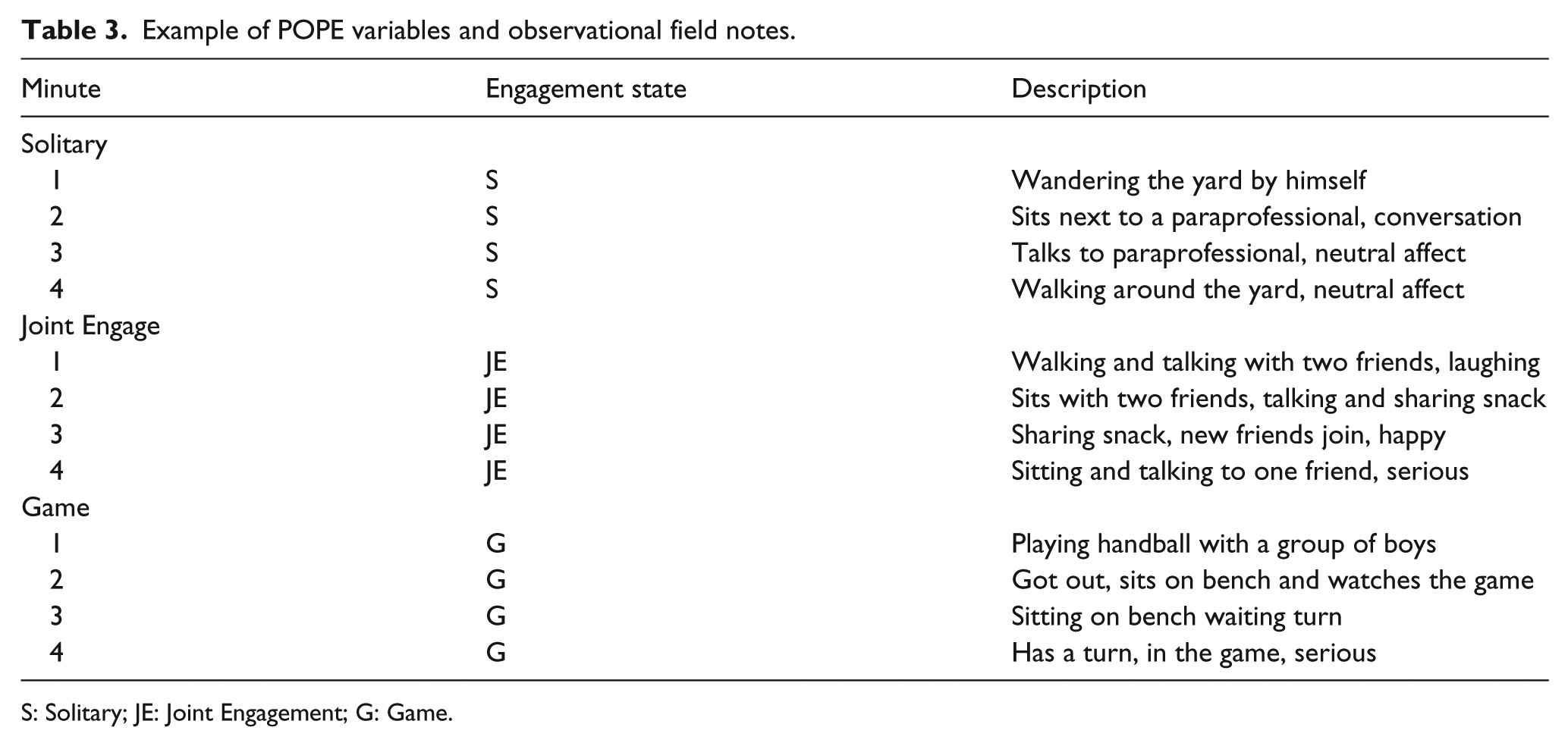
S: Solitary; JE: Joint Engagement; G: Game.
Analysis
We used concurrent mixed methods (QUAN + QUAL), in which quantitative and qualitative data were collected at the same time and analyzed concurrently. Both parametric and non-parametric tests were used since not all quantitative data were normally distributed. The results of the non-parametric tests and parametric tests were statistically similar. Because descriptive statistics will show the mean scores and standard deviations, the final results are based on the parametric tests for ease of interpretation.
For the qualitative analysis, we used an exploratory case study design, with each group representing one case (Girls ASD, TD Girls, Boys ASD, TD Boys). First, we categorized the field notes by engagement state (Game, Joint Engage, and Solitary). Next, we used line-by-line coding at the individual level to identify participant activities during each 1-min interval. Coders were the first author and two student research assistants. All coders were blind to sex, age, grade, and diagnosis during coding procedures. Twenty-five percent of the data were double coded, and coding consistency was above 0.90. Activities listed most frequently during the observation were labeled “primary activities,” such that each participant had primary activities in Game, Joint Engage, and Solitary. For example, if a participant talked for 8 min and tossed a football for 2 min, the primary Joint Engage activity would be talking. The engagement state data were separated by case after the first phase of coding. To determine primary activities at the group level, we counted the frequency that each primary activity occurred within each group and engagement state. To be considered in the comparison, more than one child in the entire sample had to engage in the activity for more than a 1-min interval. Finally, we compared primary activities across cases.
Preliminary quantitative and qualitative results delineated the salient engagement states and the primary activities of each group. We used the findings to create a social profile for each group. With the exception of TD girls playing games, children’s social behaviors were consistent across grade levels. Finally, representative examples from the raw data were selected and used to illustrate the social profiles.
Results
Descriptive statistics of the primary outcome variables are shown in Table 4. Using a 2 × 2 ANOVA, we identified significant between-group differences in Game, Joint Engage, and Solitary.
Descriptive statistics and significant between-group differences on Game, Joint Engage, and Solitary.
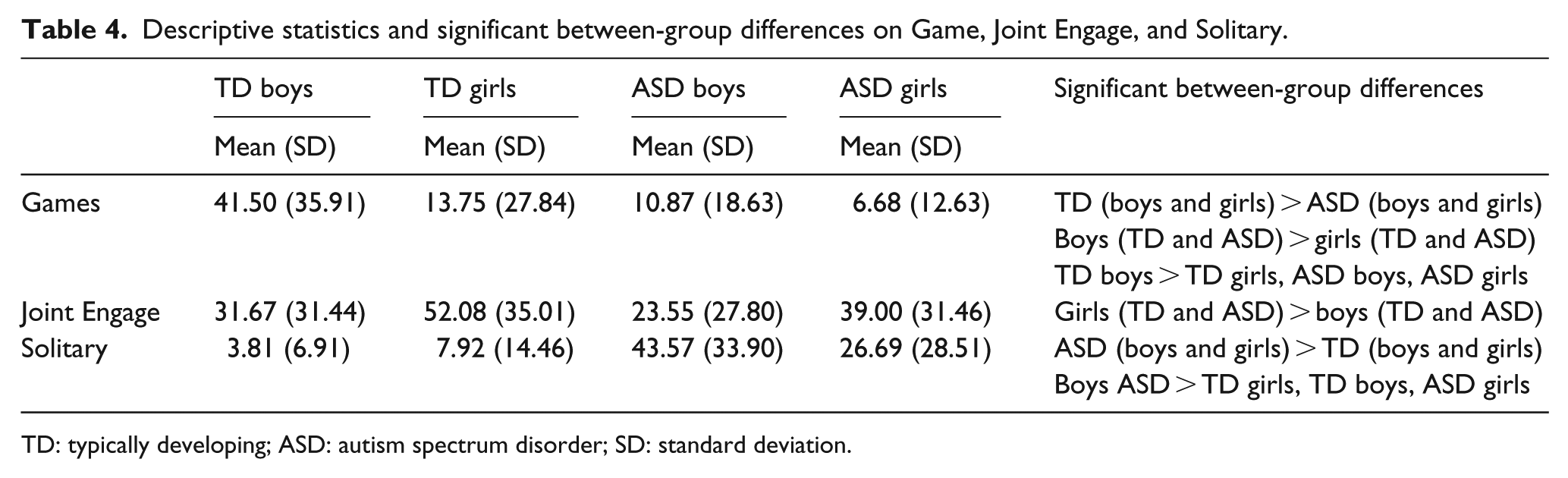
TD: typically developing; ASD: autism spectrum disorder; SD: standard deviation.
Game
There was a significant effect of sex/gender, role, and interaction on Game. Boys play games significantly more than girls (F(3, 92) = 9.52, p = 0.003, ω2 = 0.094), and TD children play games significantly more than children with ASD (F(3, 92) = 13.27, p = 0.000, ω2 = 0.126). The interaction effect on Games indicated that TD boys (F(3, 92) = 5.18, p = 0.025, ω2 = 0.053) spent significantly more time playing Games than all other groups.
Joint Engage
There was a significant effect of sex/gender on Joint Engage, in which girls with and without ASD spent more time in Joint Engage than boys with and without ASD (F(3, 92) = 7.76, p = 0.006, ω2 = 0.078). Role and the interaction were not significant (role: F(3, 92) = 2.71, p = 0.103, ω2 = 0.029; interaction: F(3, 92) = 0.149, p = 0.701, ω2 = 0.002).
Solitary
There was a significant effect of role and the interaction on Solitary. Children with ASD spent significantly more time in Solitary than TD children (F(3, 92) = 37.04, p = 0.000, ω2 = 0.287). The interaction effect shows that boys with ASD spent significantly more time in Solitary than all other groups (F(3, 92) = 4.37, p = 0.03, ω2 = 0.05). The effect of sex was not significant (F(3, 92) = 1.76, p = 0.187, ω2 = 0.019).
Table 5 denotes the primary activities of each case in Game, Joint Engage, and Solitary.
The number of participants within each group (n) and the proportion of the total observation intervals (%) that participants engaged in each activity.
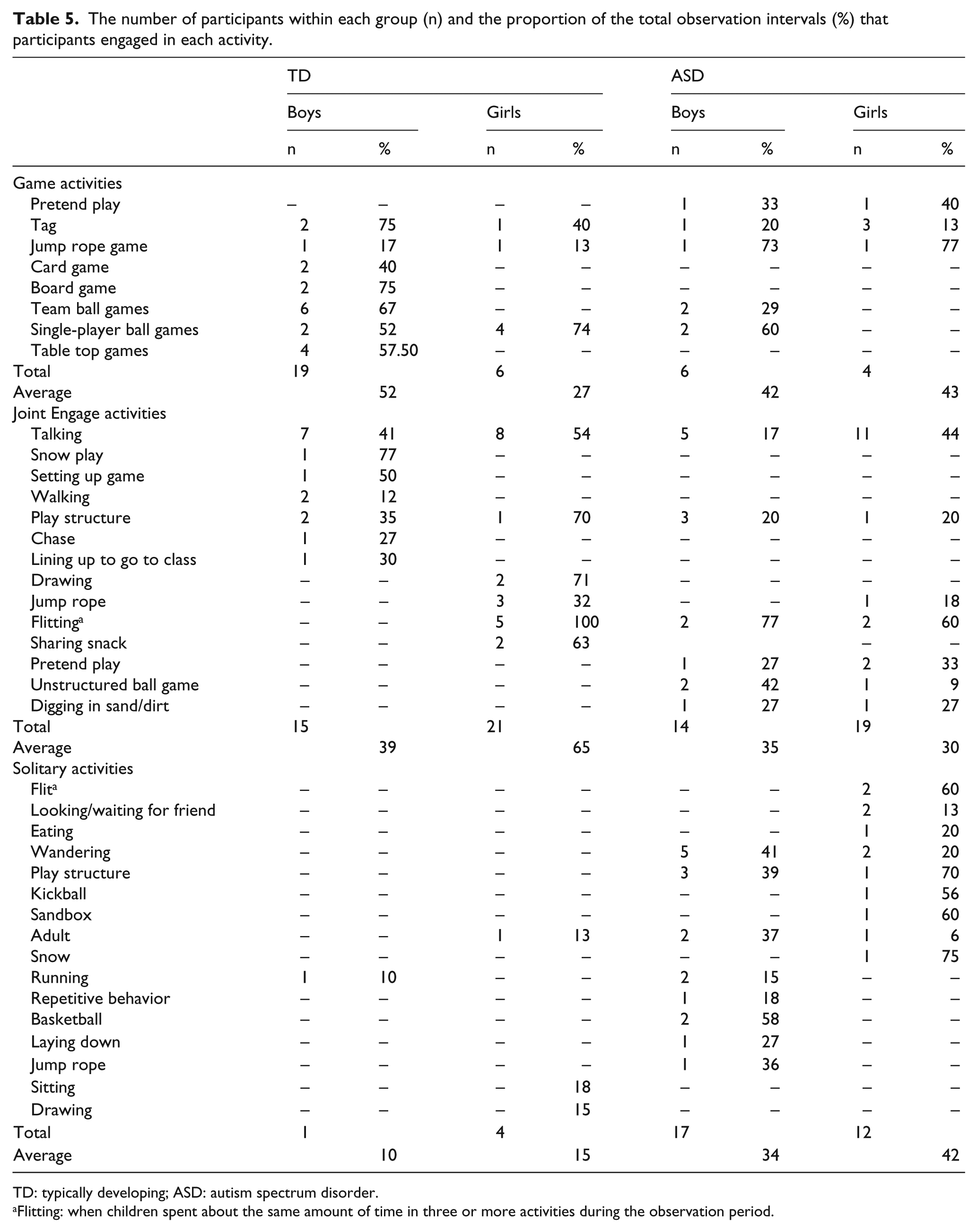
TD: typically developing; ASD: autism spectrum disorder.
Flitting: when children spent about the same amount of time in three or more activities during the observation period.
Social profiles
TD boys
TD boys spent a majority of recess in Game (µ = 41.50, σ = 35.91), and the significant interaction effect on Game indicated that TD boys spent more time in Game than all other groups. TD boys also spent a large amount of time in Joint Engage (µ = 31.67, σ = 31.44). The most salient primary activities were playing team ball games, which boys played for an average of 67% of the observation, and talking, for an average of 41% of the observation. Few TD boys exhibited solitary behavior (µ = 3.81, σ = 6.91); one boy ran alone for 1 min of his observation.
The representative examples below highlight the characteristics of TD boys’ social behaviors. Both examples demonstrate the physical nature of boys’ play. In the first example, the TD boy interacts with peers while playing a structured game with rules throughout the observation. The second example highlights the physical nature of play during Joint Engage.

Each line denotes 1 min of observation.
TD girls
Compared to TD boys, TD girls were less inclined to play games during recess. However, when they did play games, TD girls tended to be older (grades 4 and 5) and to play single-player ball games (e.g. tetherball and four square), rather than team ball games. TD girls spent a majority of recess in Joint Engage (µ = 52.08, σ = 35.01), significantly more than boys with and without ASD, but not statistically more than girls with ASD. The most popular primary activities of TD girls were talking (averaging 54% of the observation) and flitting (averaging 100% of the observation). An activity was labeled “flitting” when a child spent equal amounts of time in three or more activities throughout the observation. TD girls spent very little time in Solitary (µ = 7.92, σ = 14.46), with four TD girls exhibiting primary activities in Solitary, lasting, on average, 15% of the observation period.
The representative examples highlight the fluidity in the social behaviors of TD girls. In the first example, the TD girl moves through multiple activities while talking in a small group, and maintaining Joint Engagement. The second example is representative of fluidity occurring in the Game engagement state. In this example, the TD girl moves back and forth between groups while maintaining Game status throughout the duration of the observation.
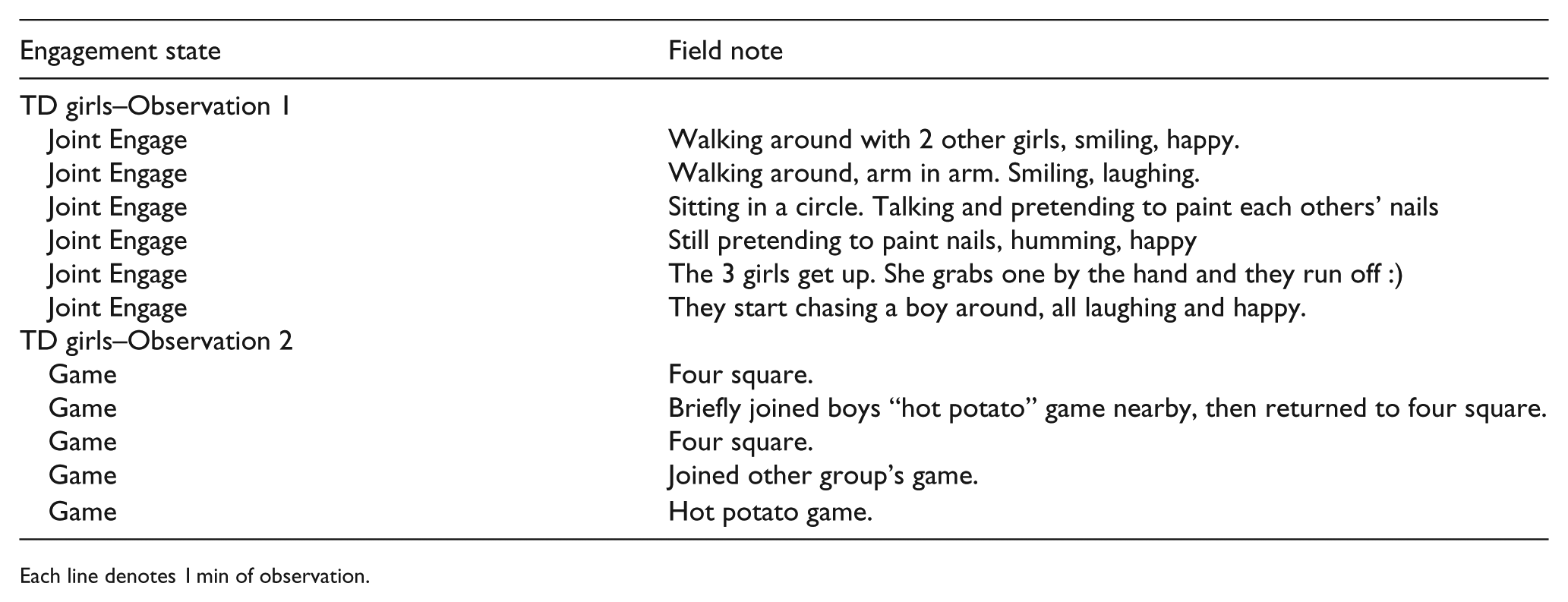
Each line denotes 1 min of observation.
Boys ASD
Boys with ASD spent significantly less time than TD boys in Game (µ = 10.87, σ = 16.63). Although they were less involved, six boys with ASD participated in some structured games with activities for an average of 27% of the observation period. Similar to TD boys, boys with ASD also spent a notable amount of time in Joint Engage (µ = 23.55, σ = 27.80). Solitary was the most salient engagement state for boys with ASD, who spent significantly more time in Solitary than all other groups (µ = 43.57, σ = 33.90). The most popular primary activities of boys with ASD were wandering for an average of 41% of the observation and talking for an average of 17% of the observation.
The following examples are representative of the social behaviors of boys with ASD during recess. In the first example, the boy with ASD is in Solitary engagement throughout the entire observation period. The second example is of a boy with ASD who successfully engaged in a Game throughout the duration of recess. His ASD-related behaviors are obvious; despite his successful engagement, the boy uses repetitive behaviors throughout the observation.

Each line denotes 1 min of observation.
Girls ASD
Girls with ASD spent little time in Game (n = 4; averaging 47% of the observation). Similar to TD girls, girls with ASD spent most of the time in Joint Engage (µ = 39.00, σ = 31.46), and talking was a top primary activity for girls with ASD (for an average of 44% of the observation). Unlike TD girls, girls with ASD also spent a significant amount of time in Solitary (µ = 26.69, σ = 28.51). Their second primary activity was flitting, which appeared in Joint Engage and in Solitary for an average of 60% of the observation in either engagement state.
Unlike TD girls, who are readily accepted into activities with peers, girls with ASD appear to use compensatory behaviors to gain access into peer groups that may mask their social challenges. In the first example, the girl with ASD weaves in and out of Joint Engage and Solitary, highlighting her difficulties maintaining mutual involvement in social groups. The girl with ASD in the second example maintains Game by swinging a jump rope throughout the observation period. Social challenges are evident, however, because she is never given a turn to jump.
Discussion
We used mixed methods to examine playground observations of the social engagement and activities of children with and without ASD at school. Gender differences in social behaviors were evident throughout the sample—TD boys tended to play differently than TD girls, and the social challenges of boys with ASD looked different, and were more obvious, than the social challenges of girls with ASD. Gender-related social norms were evident in the social landscape. From the perspective of untrained observers, such as recess aides and many teachers, male social groups were as conducive to exposing the social challenges of boys, as female groups were to camouflaging girls’ social challenges.
The female social landscape supports the camouflage hypothesis; the fluidity of female social groups created an ideal backdrop to conceal the girls with ASD who were often hovering close by. Regardless of engagement state status, girls with ASD tended to stay in close proximity to social groups and were therefore better situated than boys with ASD to capitalize on social opportunities. Yet, this relative strength has some iatrogenic effects. Scanning the playground environment, as one would expect a playground attendant to do, would be insufficient to identify the social struggles of girls with ASD. From a distance, girls with ASD looked like TD girls. They spent a significant amount of time talking in Joint Engage and weaving in and out of groups. Girls with ASD, however, tended to flit in between Joint Engage and Solitary; TD girls maintained their Joint Engage status while moving from one group to the next. This suggests that while the girls’ social challenges are concealed from playground attendants, they do not appear to be hidden from peers.
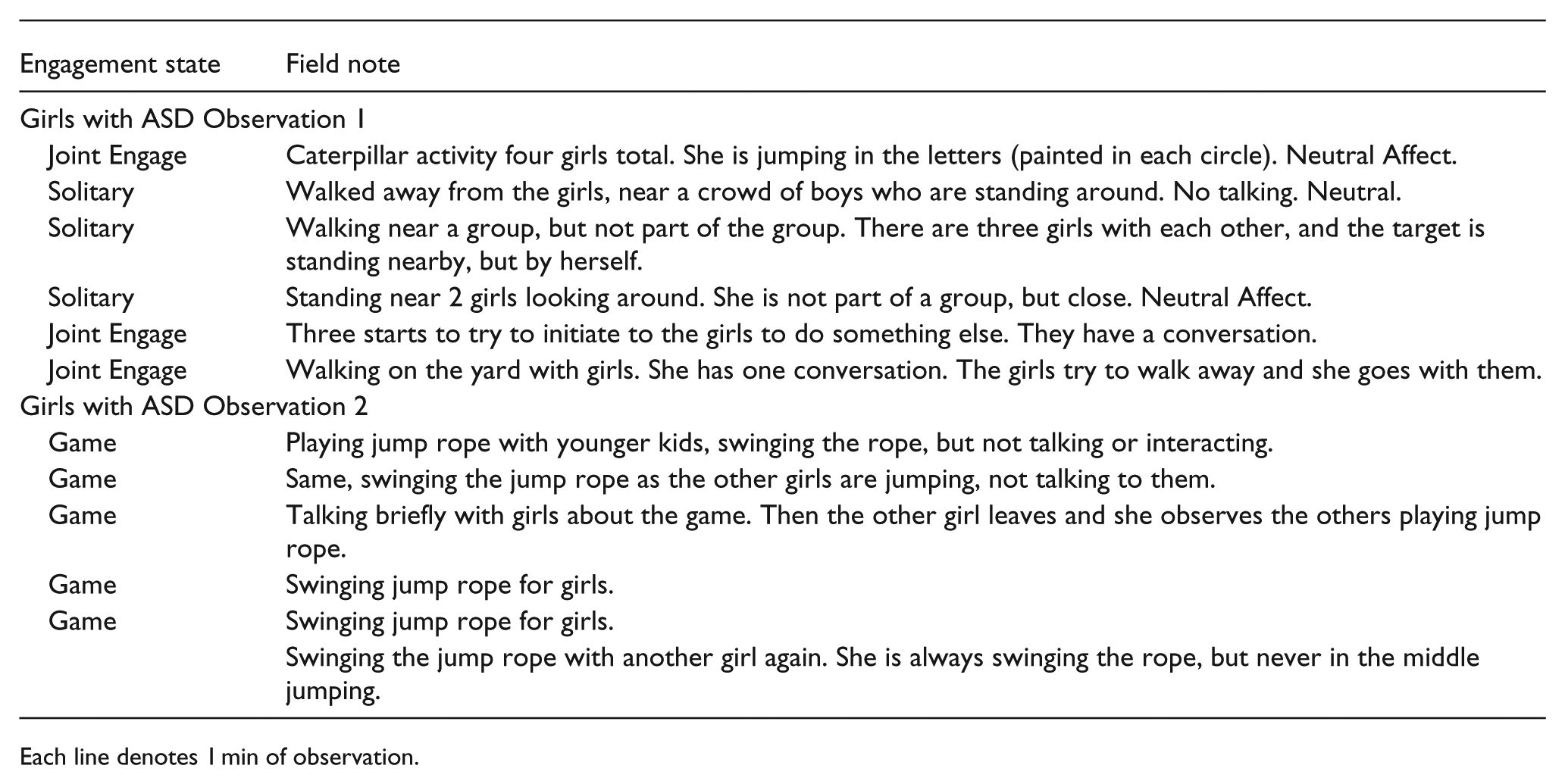
Each line denotes 1 min of observation.
It is the significant proportion of time spent in Solitary, regardless of proximity, that marks social withdrawal or exclusion. Not being able to maintain mutual engagement in activities highlights girls’ difficulties with social synchronization. TD girls use subtle sanctions to enforce group norms and shape social violations (Goodwin, 2006). Given the social deficits related to their diagnosis, it may be difficult for girls with ASD to recognize and interpret social cues (e.g. eye roll, shared glance, giggle, or smirk; Card et al., 2008) and to adjust their own behavior in order to align with group norms (Dean et al., 2013). This lack of ability to conform can mistakenly be interpreted as blatant social violations, putting girls with ASD at risk for relational aggression and exclusion (Crick and Dodge, 1996; Dean et al., 2013; Goodwin, 2006). Consequently, using camouflage to mask social challenges makes girls vulnerable and less likely to receive intervention.
The male social landscape makes it easier to detect the social challenges of boys with ASD. A large proportion of TD boys played structured games with rules or engaged in physically active play. Given the stability and prevalence of games (Pellegrini et al., 2004), it was relatively easy to spot the boys with ASD, who were often wandering alone apart from the game. Given the significant proportion of time spent in Solitary—a stark contrast to TD boys—boys with ASD appeared to have difficulty accessing and independently maintaining involvement in male play groups. So contrary to the social challenges of girls with ASD, scanning the playground environment on a regular basis would be sufficient to identify the social struggles of boys. Therefore, the differential recognition of the social challenges girls and boys with ASD face at school highlights a male bias in our perceptions of children’s peer interactions.
Interestingly, our findings suggest that children with ASD showed some sensitivity to socially constructed gender expectations. In general, girls with ASD engaged in unstructured social activities (Joint Engage) that were similar to TD girls (e.g. talking, flitting), while the proportion of time that boys with ASD spent in Joint Engagement was about the same as TD boys. Compared to girls with ASD, boys with ASD played more structured games with rules, suggesting that the disproportionate amount of time that boys with ASD spent in Solitary may be more indicative of deficits related to ASD (e.g. psychomotor coordination, or turn taking challenges), than of a violation of gender norms. Consequently, physically demanding play may be prohibitive for some boys with ASD. Although gender-related trends in play preferences were evident, we were not able to determine whether the children with ASD received social reinforcement by selecting gender-appropriate social activities.
These results suggest that it is necessary to adjust protocols to reduce gender bias when working with ASD children in educational settings. Gender differences were evident in the way that children without ASD socialized, and because of this, girls with ASD likely have different social experiences than boys with ASD. Considering gender differences in play styles and weighing the social landscape at school may help reduce the male bias in our ability to identify girls with ASD at school. Understanding how children with ASD fit into the social landscape at school is a necessary step when developing social interventions. Additionally, given the male-to-female ratio among children identified with ASD, it is common for one girl to receive social skills interventions with a group of boys, which may limit girls’ ability to develop social skills needed to be successful in female groups (Cridland et al., 2014). The short, interrupted periods of engagement suggest that girls would benefit from working on the quality of their interactions, to learn how to interpret social cues and to adjust their behavior accordingly.
In addition to further work in reducing gender bias, more research is needed to develop and test social interventions that focus on female social skills, to better understand communication breakdowns. Given the relative strengths of girls (e.g. the ability to gain access into peer groups), girls with ASD may benefit from strength-based approaches to support their participation in peer groups (Wilding and Griffey, 2015). The male environment was more physically demanding than the female environment, suggesting that boys with ASD might be more successful if schools facilitated structured play activities without heavy physical demands.
Limitations
There are limitations related to the size and scope of this study. First, we used one observation to assess the playground behavior of children at school. Longitudinal research is needed, using longer observation periods across multiple days and time points over the course of a school year. If girls with ASD have difficulty synchronizing with group norms, it is conceivable that time spent in Solitary will increase over the course of a school year. Second, collecting observation information in conjunction with cognitive measurement and parent, peer, and teacher reports of behaviors may build a more comprehensive understanding of gender differences in the behaviors of children with ASD at school and deepen our understanding about how girls and boys with ASD interpret social contexts and interactions. Moreover, more research is needed to examine the overlay of environmental expectations on biological traits. Examining children’s play preferences and social behaviors through gender socialization theory concomitantly with a biological lens (Knickmeyer et al., 2007) can increase our understanding of children’s social synchronization and the extent to which social acceptance is related to innate preferences (and therefore shared interests) versus social shaping through environmental stimuli. Third, although we were able to make equal group size comparisons, our sample was relatively small, and we did not have enough statistical power to perform a cross-sectional analysis of gender-related behaviors across a developmental span. More research is needed to examine the social behaviors and acceptance of boys and girls with ASD throughout elementary and secondary school. Fourth, there is a difference between being solitary because one lacks skills to engage, versus being solitary because one enjoys time alone. More research is needed to examine the underlying motivations that drive the Solitary engagement of children with ASD at school. Fifth, the TD sample was nominated to participate in the original study because of their prosocial behaviors. More research is needed to examine the social behaviors and social acceptance of children with ASD compared to TD children with varying degrees of social competence. Finally, although our study provides insight into differences in the way that boys and girls with ASD socialize, more research is needed to examine the quality of social interactions, to identify where breakdowns occur, and to design and implement interventions within the children’s real-life school culture.
Conclusion
This study supports the camouflage hypothesis and increases our understanding of the social behaviors of girls and boys with ASD in the natural social setting at school. Past research has described a relative strength in girls with ASD, who are better able than boys to mask their symptoms from adult observers. Being in close proximity to peer groups helped girls to access opportunities for social interaction, but a closer look suggests that girls with ASD were less likely to have the skills necessary to use those opportunities to engage successfully with peers. If practitioners continue to tolerate or overlook subtle social challenges and internalizing behaviors, then camouflage is not protective. In contrast, the conspicuousness of ASD in boys makes it easier for boys to get access to intervention. Compensatory behaviors, therefore, are advantageous only to the extent to which the needs of children who engage in such behaviors are met, either through mutual engagement with peers or through intervention support.
Footnotes
Acknowledgements
The Autism Intervention Research Network for Behavioral Health team includes Connie Kasari and Fred Frankel at Center for Autism Research and Treatment, UCLA; Rebecca Landa at Kennedy Krieger Institute, Johns Hopkins University School of Medicine, Baltimore, MD; Catherine Lord at Center for Autism and the Developing Brain, Weill Cornell Medical College; Felice Orlich and Brian King at Seattle Children’s Hospital, University of Washington; Robin Harwood at the U.S. Maternal and Child Health Bureau. The information or content and conclusions are those of the author and should not be construed as the official position or policy of, nor should any endorsements be inferred by HRSA, HHS, or the US Government. The data used in this study were collected as a part of a larger study, Children with ASD and social skills groups at school: Randomized trial comparing intervention approach and peer composition, which was published in the Journal of Child Psychology and Psychiatry in 2015. The authors received Institutional Review Board’s Approval at the University of California, Los Angeles, the University of Michigan, John Hopkins, the University of Washington, and each of the local school districts from which the data were collected. All participants had written parent consent and signed assent forms prior to participating in the study. This article examines observation data and focuses specifically on the social behaviors of girls and boys with and without ASD during recess.
Funding
This project was supported by the Health Resources and Services Administration (HRSA) of the US Department of Health and Human Services (HHS) under grant no. UA3MC11055, Autism Intervention Research Network on Behavioral Health.