



Abstract
Existing research shows that young adults with autism spectrum disorder have poorer outcomes than their peers with other developmental disabilities in the key areas of independent living, postsecondary education, and employment. However, we understand little about how young adults with autism and their families understand and value outcomes and whether these indicators match their goals and aspirations. We interviewed parents (n = 21) and young adults with autism spectrum disorder (n = 20) about their experiences with the transition to adulthood to understand what they consider to be desirable outcomes and how they seek to achieve them. Understanding these perspectives will help identify areas of need as well as disconnections between service objectives and the goals of young adults and their families. Participants described outcomes as more complex and nuanced than current conceptions and measures account for. They defined and evaluated outcomes in relation to their or their child’s individual abilities, needs, and desires. These findings provide important insight into challenges to and facilitators of desired outcomes, which has implications for programming, service delivery, and policy.
Introduction
Young adults with autism spectrum disorder (ASD) in the United States encounter significant difficulties transitioning out of high school. They fare worse than peers with other disabilities (including speech–language impairment, learning disability, emotional disturbance, and intellectual disability) on indicators of postsecondary education, employment, and living independently (Friedman et al., 2013; Henninger and Taylor, 2013; Howlin and Moss, 2012; Orsmond et al., 2013; Roux et al., 2013, 2015; Shattuck et al., 2012; Wehman et al., 2014). These poor outcomes incur high personal and societal costs, preventing or delaying young adults with ASD in achieving adult milestones. Existing research frames “poor outcomes” relative to population norms and comparison groups. However, it is unclear how current conceptions and measures of outcomes align with the perspectives and priorities of young adults with ASD and their families. This article presents parents’ and young adults’ perspectives about what are desired postsecondary outcomes and how they seek to achieve them in order to understand stakeholders’ values about outcomes, identify barriers and facilitators, and suggest practical implications for the field.
Currently, outcomes reported in research studies are assessed in various ways, most of them quantitative. These include national-level surveys, 1 standardized cognitive and language assessments, 2 quality of life measures, 3 and/or administrative data from systems like Vocational Rehabilitation. Data from these sources may not fully capture the unique experiences of young adults with ASD. Research findings have varied widely from study to study over time, in part due to different data collection methods, differences in cohort characteristics, and inconsistent assessments (Howlin and Moss, 2012). Furthermore, definitions of “poor” and “good” outcomes have varied and “what it means to be successful in adulthood for individuals with ASD has not always been clear” (Henninger and Taylor, 2013: 103).
Importantly, measures may be based on normative assumptions about what constitutes optimal quality of life, with or without an autism diagnosis (Rodogno et al., 2016), and these may not align with the priorities and experiences of transition age youth and families. Several researchers (Henninger and Taylor, 2013; Howlin et al., 2004; Renty and Roeyers, 2006; Rodogno et al., 2016; Ruble and Dalrymple, 1996) have suggested that tools need to be developed that rely less on generalized objective measures and take into account both the unique profile of ASD and the social and environmental factors that influence outcomes. Billstedt et al. (2011) made efforts to remedy this shortcoming by reevaluating a sample from an earlier study (Billstedt et al., 2005), adding measures of the relationship between the person and his/her environment. They found a dramatic difference in several outcomes, suggesting that using different criteria may result in a more optimistic picture. For example, they found an association between regular recreational activities and good/very good quality of life.
Understanding stakeholder perspectives offers valuable insight and guidance toward developing more impactful research that aligns with the priorities of the autism community, namely, research that focuses on improving the daily lives of people with autism (Pellicano et al., 2014a, 2014b) There is a small body of qualitative research about stakeholders’ perspectives on transition that highlights areas of need, identifies shortcomings in current services and supports, and suggests potential solutions. A recent review of studies (Anderson et al., in press) found that poor transition outcomes are a function of several intersecting factors. These include poor person–environment fit, uncertainty about the role of parents during transition, and a lack of comprehensive or integrated services. The review noted that existing interventions tend to focus on individual-level interventions (e.g. social skills training), yet several studies found that stakeholders emphasized the importance of contextual factors and suggested that changes in social and institutional settings could help support individuals with ASD.
Our study collected the perspectives of parents of young adults with ASD and young adults with ASD in order to understand how they view desired outcomes, barriers and facilitators, and identify strategies, services, and supports that may help. 4 Parents are key members of a young adult’s network and often facilitate transition, yet we lack information about their hopes and expectations for their child, how they seek to provide support and what they see as barriers and facilitators to desired outcomes. Furthermore, parents have long expressed concerns about disconnection between their understanding of their individual child’s needs at the time of transition to young adulthood and experts’ priorities and service objectives (Stokes, 1977). Young adults, whose outcomes are at the heart of this inquiry, are rarely included in qualitative research, yet their perspectives are crucial to fully understand the factors that influence their experiences.
Methods
Participants, recruitment, and eligibility
The study was approved by Drexel University’s Institutional Review Board. We used community contacts and snowball sampling to recruit participants and relied on self-report of an autism diagnosis and co-occurring conditions. Participants were parents of young adults with ASD who were aged 18–29 years (N = 21) and young adults with ASD in the same age range (N = 20) who lived in a major metropolitan area in the northeastern United States. There were four parent–child dyads, along with 17 parents and 16 adults with ASD who were not recruited as dyad members. We relied on participants’ descriptions of their child’s or their own impairments, including executive functioning, difficulties with social interaction, and challenges associated with co-occurring conditions. Reflective of the heterogeneity of the autism population, characteristics were wide-ranging, although children of parent participants represented a broader range of autism profiles and included individuals with more significant impairments like intellectual disability and seizures. All young adult participants were their own legal guardian and while we did not independently assess intellectual ability, we screened for comprehension during consent.
Data collection
Participants were interviewed by the lead author or a research assistant. In total, 22 completed interviews in person (10 parents, 12 young adults), 16 by phone (11 parents, 5 young adults), and 3 (young adults) were conducted via email. In-person and phone interviews lasted an average of 90 min, and all interviews followed a semi-structured guide. The guide included questions about employment, postsecondary education, independent living, social relationships, experiences with services, needs for support, and speculation about the future. Interviews were recorded and transcribed. A total of 16 parents and 18 young adult participants also completed an online survey that collected demographic and other information about the participant and, for parents, their adult child. Each participant received a US$50 gift card.
Data analysis
We used an iterative process to create a coding scheme and code interview transcripts. This approach derives from grounded theory (Charmaz, 2006, following methods developed by Glaser and Strauss, 1967), which permits researchers to inductively construct theory through the analysis of data, rather than using data to test predetermined theories. Transcripts were coded using QSR International’s NVivo 11 qualitative data analysis software. Three transcripts were coded by the first and second authors and a research assistant, who then met to discuss results and modify the coding scheme. The remaining transcripts were coded by the first author and a research assistant, who met regularly to review results, generate conclusions, and create a thematic framework of perspectives on young adult transition.
Results
Survey
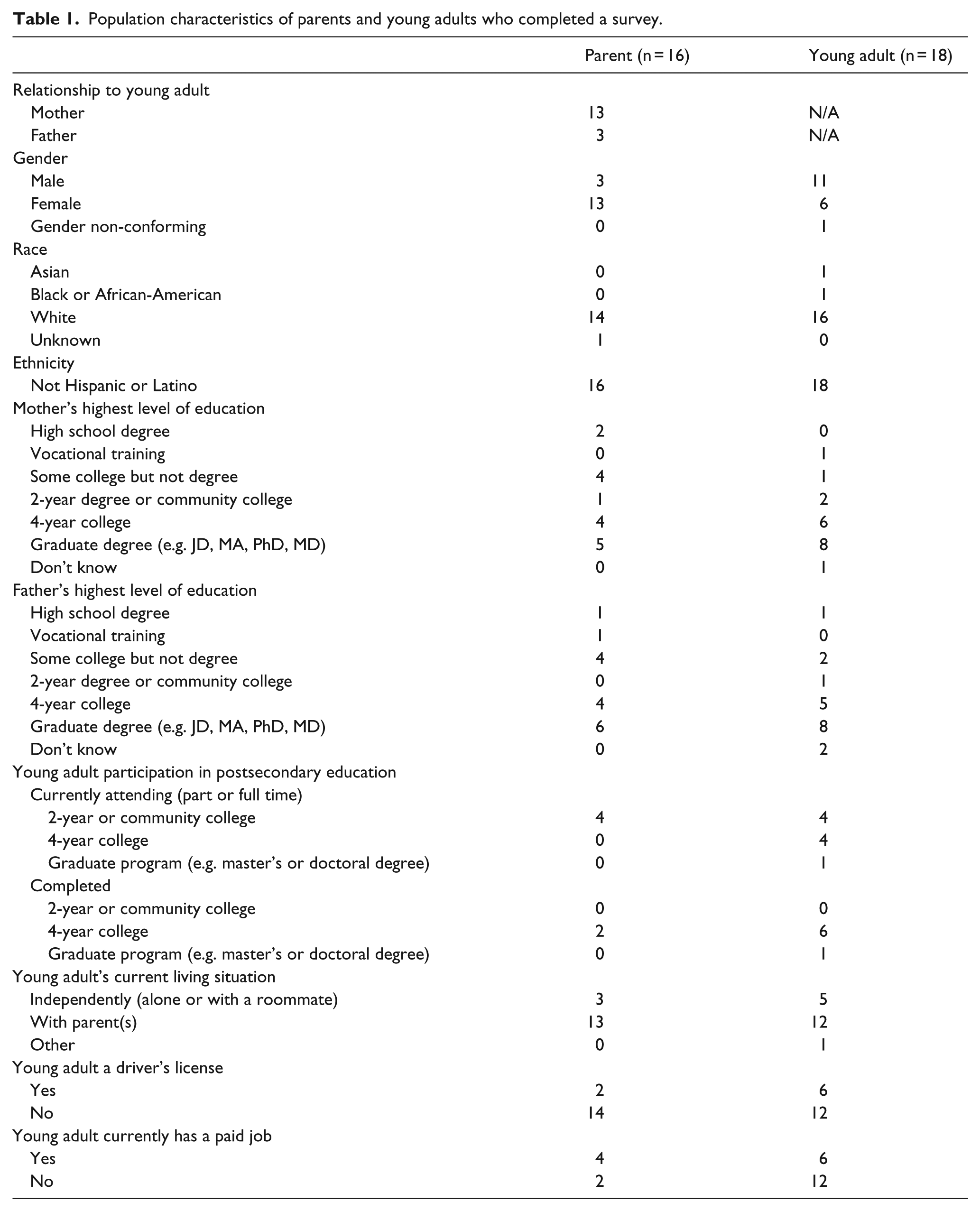
The survey gathered descriptive data about participants (Table 1). In total, 16 parents and 18 young adults agreed to complete the survey.
Population characteristics of parents and young adults who completed a survey.
Interviews
Participants presented a complex, nuanced, and interconnected view of outcomes along with serious and persistent concerns about the transition to adulthood. Our initial coding followed conventions established in the literature, meaning that we began with categories that are often reported as discrete and separate outcomes (e.g. independent living, educational attainment, and employment). However, through data analysis, we found that participants often understood these achievements as interdependent and overlapping, and our categories evolved to reflect this. For example, we added codes for “continuing growth and development,” “stability and security,” and “social recognition” because these were concerns that recurred in interviews. Below, we describe several of these intersecting themes. We argue that parents and young adults in our sample give these themes as much emphasis as traditional discrete life achievements associated with young adulthood. For clarity, we present parent views first, followed by young adult views.
Balancing security and autonomy
Parent perspectives
Parents’ viewpoints on helping their children develop independence clustered into two themes: (1) a desire or acknowledgement of the need for their child to live independently at some point and (2) a belief that transition to greater independence should be approached carefully and with consideration of long-term outcomes and their child’s preferences.
Most of the parents’ adult children lived at home (n = 16) at the time of the interview. The remaining five lived either independently, in a residential community for people with developmental disabilities, or in a college dorm. Most parents wanted their child to live away from home at some point in a situation appropriate for their needs and abilities. If plans were not already underway to make the transition, parents were aware that it was an issue that would eventually need to be addressed since they would likely not always be able to care for their child.
Parents’ primary concerns were for their child’s long-term security, safety, and quality of life, including getting needed support and maintaining their current level of comfort, particularly for young adults with higher levels of impairment. Many were apprehensive about existing supported housing options, such as group homes, and wanted to be able to customize their child’s living situation, including hiring staff of their choosing and/or purchasing a home with other families so that their children could share and consolidate resources. However, these were not options available to everyone, and some had serious concerns about their ability to provide ongoing financial support for their child.
Family relationships were generally seen as a foundation of long-term support and security. In families in which siblings and relatives were involved in the adult child’s life, parents felt more confident that their child would have ongoing support and people watching out for them than those who did not have such a network, or where siblings seemed less willing to assume a supportive role. However, those parents with other children willing to assume caregiving roles were reluctant to place too much responsibility on them. For example, one parent said,
Can we really expect them to be co-guardian and to care for him in case we perish? That’s an awful hard thing to put on another family member saying your life’s going to be composed of full-time caregiving of a sibling. (Parent 13)
The transition to independent living also highlighted the challenges of facilitating their child’s ability and willingness to assume responsibilities and make decisions. While most parents said that their child wanted to live independently, some didn’t think their child understood all that it entails, such as keeping up with daily tasks and self-care. Many parents either did some of these tasks themselves, such as cooking, cleaning, and scheduling appointments, or supervised their child in doing so on their own. Some feared that, left to their own devices, their children might not take on these responsibilities for themselves, and a few were concerned that their child would become isolated if they did not want to socialize or had trouble reaching out to others.
Others said that their child would prefer to stay at home and that the inevitable transition was something they were gradually preparing him or her for. One parent described her son’s reluctance and the family’s efforts to gently push him toward living independently:
[He] has a lot of potential for being someplace that he could be relatively independent and do pretty well. And he knows that’s what we want. He would just as soon stay here … But I said, “No, -----, that’s not what’s best for you.” (Parent 19)
Planning for the inevitable transition away from home was approached carefully. Parents understood this transition as a gradual, long-term process that needed to align with their child’s particular needs, abilities, and desires, which varied widely among participants. They wanted to ensure that their child would be safe but also understood that lasting residential arrangements needed to incorporate their child’s own choices in order for it to be sustainable. Increasing their child’s autonomy could be a source of anxiety, but parents viewed it as necessary for them to gain skills, experience, and, ultimately, security.
Young adult perspectives
For young adults, two primary themes emerged: (1) independence was seen as the ability and opportunity to establish autonomy, both functionally and subjectively and (2) while most had only a general sense of a longer term future, they were aware of the challenges posed by their ASD and desired specific supports to address them.
Young adults noted typical markers of attaining adult status, such as being employed and living away from their parents, as aspirations and also described values such as making their own decisions. For example, a participant described independence as “having more input in how I spend my time, and having a place that I can feel in control of. It means enjoying time with my friends and living more like my peers in their twenties” (Young Adult 14).
A total of 12 young adults lived with their parents. Most wanted to live away from home if they were not already and felt stymied by a lack of employment opportunities and financial independence. Only six young adult participants had a driver’s license, and a lack of transportation was an issue for some living outside of an urban area with public transportation options. Unlike parents, young adults did not discuss a decrease in their parents’ participation through the transition process. When asked who helped them with transition, some young adults credited their parents for guiding them through college and providing them a secure home, but none mentioned parents’ helping with finding employment or facilitating their social life. Yet it was clear that some needed and received significant support from their families. Some participants had received services, such as training in daily living or social skills, but many expressed a wish for more assistance in other things like managing finances and job training. Similar to the concerns expressed by some parents, two young adults were concerned about their ability to keep up with household responsibilities and expressed a desire for support services that would help them manage.
Unlike parents, who were concerned with their children’s long-term well-being, young adults had only a general sense of their goals for the more distant future. They aspired to independence and autonomy, which included milestones such as moving away from home and getting a job. Some identified careers or further education they would like to pursue and a desire for friendships and/or romantic relationships. However, they felt that difficulties related to their ASD, especially social communication, made these goals harder to achieve.
Postsecondary education and holistic support needs
Parent perspectives
Six parents 5 reported that their child had some experience with college. Two were currently attending college—one at community college and one at a four-year college; two had graduated from a four-year college; and two had attended a four-year college but had left without a degree. Their viewpoints on their child’s experiences with college generated three themes: (1) young adults on the spectrum needed more holistic services than were available, (2) parents felt they needed to take an active role in their child’s daily lives in order to help them manage and get through college, and (3) strategies for meeting the student’s needs included organizing supplemental supports and taking fewer courses.
Some parents felt that the services that were available to their child at college were too general and did not meet their needs beyond standard academic accommodations required by the Americans with Disabilities Act 6 (US Department of Justice, 2009). They felt that additional services, such as help with study skills, organization, and socializing, were needed to support their success. Some described their frustrations that staff at disability services offices did not seem to understand autism and felt required to educate the college about the disorder and their child’s needs.
One parent had high hopes when her daughter went to a college that promoted itself as a place that supported students on the spectrum but was disappointed with services once she enrolled:
They made it sound really great … but when we got there, we found out that all of these supports really weren’t there. We kind of had to create them … they had a disability services office, but there wasn’t any special mentoring or anything like that. (Parent 15)
The college did work with the family to arrange private tutors to help her daughter with organization and study skills, which were her biggest challenges, but this mother felt the need to remain actively involved in order for her daughter to get through. In fact, most parents felt they had to play a more active role than they would for a neurotypical student in order to help their child succeed in school. They put a lot of effort into trying to obtain services and wished that the school would share some of these responsibilities.
For some of their children, new social relationships were an added or even greater obstacle than academics. While college provided new opportunities for their children to make connections and develop relationships, it also provoked new anxieties for parents. Some worried about a lack of social engagement, especially if their child lived by themselves and spent most of their free time alone, as a few of them did. One parent saw a potential role for the college to support her son’s social needs:
It would be nice to see these kids have some type of social support even if it was with somebody … checking in with them … they just have nothing at all in place for these kids and … here is my kid who no one is reaching out to at all, who would love a friend. (Parent 21)
Struggles with managing coursework required some young adults to take additional time to get through college. They took lighter course loads to keep up and manage stress. One young man who earned his bachelor’s degree took 5.5 years to finish, although his mother was pleased with the support he received at college. Another young man enrolled in community college experienced significant academic challenges and had only taken one or two classes at a time. He took one basic math course three times before he was able to pass, which required both of his parents and a tutor to work with him on organizational skills, motivation, and coursework. This young man’s father predicted that in order to complete a degree, his son’s path through college would be long and require extensive tutoring. While these were strategies for achieving the goal of a college degree, parents framed them in relation to the perceived norm of completing college in 2 or 4 years and suggested that the extended path their child was taking was an exception that was necessary given their unique difficulties.
Young adult perspectives
In total, 16 young adults reported that they had completed or were currently enrolled in a community or four-year college, and two had completed or were attending a graduate program. Young adults and parents had similar perspectives on the challenges of pursuing college and the desire and need for services. Most students needed academic accommodations, such as extended test taking time, and some used other services, such as tutoring; however, their experiences with accessing these varied. Similar to some parents, several young adults described the services offered by the school as too general or not meeting other needs, such as help with organizational skills. One participant who was hoping to attend college predicted, “if I don’t get the accommodations, there’s no way I can make it—you know, why shell out thousands of dollars for courses when you’re just going to bomb them [sic] because you don’t have the right services?” (Young Adult 1).
However, there was one striking example of services that met the more holistic needs of students with ASD. One participant had attended a college with an extensive autism support program, which she credited with helping her succeed in school precisely because of its focus on meeting a variety of needs for this population. The program offered a broad range of programs and services, including academic support, mentorship, social groups, life skills classes, and summer programs. Most importantly, she described the staff as advocates who understood autism and helped her feel accepted:
[They were] really the only neurotypical people that I have ever met who were so understanding and accepting. They did not judge or distance themselves the way other people in my life do … They did not treat me like I was a freak or that I was different. Everyone there, whether they were autistic or neurotypical, was just understanding and accepting. (Young Adult 11)
Relatedly, several participants described having difficulty finding other students whom they could relate to. The participant quoted above, now in graduate school, described a very different environment in which she did not have any friends and felt isolated. Others established and maintained friendships, though it was hard at first. Several made friends through common interests and getting involved in campus activities. One participant who identified as gender non-conforming found friends among the queer and transgender community. Another described not being able to relate to most people at her elite university, in part because she was a woman of color from a low-income background, though she found some friends.
While navigating college felt challenging yet manageable for some students with ASD, it was not for others. One participant described problems with anxiety, impulsivity, and apraxia and dyspraxia, which prevented him from taking college courses in person. He completed the interview via email and wrote:
College sometimes feels like it was built for students unlike me, but I think this is improving. Online classes make a big difference; I could not have had the success I have had so quickly if online courses were not an option. (Young Adult 14)
Although he was able to participate online, he hoped to eventually take a class in person so that he could have a typical college experience.
For both parents and young adults in this study, success often depended on access to services and the student’s relationships with tutors, professors, offices of disability services, and peers. Parents described the importance of their ongoing active support and advocacy and wanted services that would help their child socially as well as academically. Young adults stressed the need for academic accommodations and the challenges of navigating new social relationships.
Work as a source of engagement and empowerment
Parent perspectives
Interviews revealed that while few of their children had ever worked, almost all parents wanted their children to have opportunities to work in some capacity, regardless of their impairments. Interview data yielded three themes: (1) having opportunities for social interaction, to harness their child’s strengths and interests, and be involved in the community were sometimes seen as more important than financial independence; (2) aligning the type of work and work environment with their child’s needs and desires was crucial to success; and (3) a lack of appropriate or desirable opportunities and insufficient services and supports were major obstacles to finding and sustaining work.
In most cases, work of any kind, whether paid employment or volunteer, was valued for the opportunities it can provide in developing and supporting achievement in several domains—such as self-efficacy, mental health, and building social relationships. These domains were sometimes considered more important than the financial benefits of working. A number of parents in the study felt that full-time competitive employment was not a realistic option for their child due to significant impairments, including intellectual disability, mental health issues, and challenges with social relationships or sensory sensitivities. In these cases, because it was unlikely that their child would be able to fully support themselves financially, most parents emphasized other benefits of employment. They felt that at least some consistent work, even a few hours, was better than having no opportunities at all:
I will be happy if we can get him a job that is 10 to 15 hours a week that is doing something that he likes and … have that be sustained for several years. (Parent 3)
Similarly, after describing the challenges her daughter had finding sustainable employment, this mother had modified her hopes to focus on finding an opportunity that would allow her daughter to engage with the community:
I am … thankful if we can get her at a place where she can volunteer, feel good, do well. Not that that is a long-term solution. (Parent 10)
Parents emphasized the importance of aligning their child’s strengths, abilities, and interests with the type of job in order to achieve satisfaction and success. It was also crucial that the work environment be adaptable, safe, and supportive. What parents considered a successful outcome was relative to their individual child. For example, one parent described how her son excelled at his full-time sales job due to his determination and focus. A parent of a young man with intellectual impairment felt that her son did well and derived satisfaction from his job at a sheltered workshop. As she described, while her son’s job paid below minimum wage, it increased his feelings of self-efficacy:
He is so proud of getting his paycheck. It is not that much … for two weeks, it was sixty five dollars, but he is still very proud of doing it and getting that. (Parent 14)
In some cases, a young adult’s impairments had a significant impact on their choices and experiences of working. While this did not necessarily result in a lack of employment, it often limited a young adult’s options and/or created additional obstacles. One young woman had earned a college degree in education but did not complete her student teaching due to difficulties with interpersonal skills. At the time of the study, she was working 30 h a week as a classroom aide in elementary special education and hoping to find opportunities to work with older children or adults.
Parents described facing multiple obstacles when trying to assist their child with finding and maintaining work, including an overall lack of opportunities for employment or limited options, difficulty in finding positions that matched their child’s interests and abilities, and finding workplaces and people who were welcoming and willing to accommodate their needs. Many parents could imagine a type of work their child could succeed at, but were not sure if or where such opportunities might exist. A number had worked with Vocational Rehabilitation or other social services that provide employment support, with varying success. While some found placements that worked for their child, others described difficulties accessing services and working with counselors, and found the options available to their child too limited. For example, one parent described being disappointed with her daughter’s experience with a supervised job placement at a warehouse. She felt that the work unchallenging, supervisors were neglectful, and her daughter experienced abuse. While young adults without disabilities may also take entry-level jobs that are less skilled than they are able to perform, there was a sense among families that the job opportunities that were available were often “one size fits all” with limited opportunity for advancement.
Many parents had to facilitate employment or volunteering by seeking out opportunities themselves, providing transportation, and making sure their child was prepared for work each day. A few parents had arranged volunteer positions for their child; however, personal relationships were a key factor in whether or not the situation worked. For example, one young man volunteered at an animal shelter, however, other staff members were not willing to work with him when the supportive person was not there. Other positions had ended for a variety of reasons, including seasonal work, changes in the institution or personnel, or when the young adult lost interest or encountered an obstacle. A few parents described their child having one negative experience and refusing to return, ending the volunteer or work position. Parents were disappointed that these attempts failed or that positive work experiences, which were few and far between, ended with nothing to replace them. In addition to better opportunities, parents emphasized that preparation for employment needed to start well before transition, which it often did not, and be more comprehensive.
For these parents, employment for their children meant much more than earning a paycheck—it represented opportunities to develop independence, derive satisfaction and self-efficacy, and engage with the community. If given adequate options and support, most parents believed their child could work in some capacity. There was a wide variety of outcomes among their children, including successful jobs, intermittent opportunities, attempts at working that ended poorly, and a lack of appropriate opportunities.
Young adult perspectives
Two themes on employment emerged from young adult interviews: (1) for those not currently working, there were numerous barriers, yet few facilitators in place to support finding and keeping employment and (2) workplace accommodations were seen as primary facilitators to success, yet they were not always available.
Six young adults currently worked at least part time, and one was participating in an internship program. Of those who were not working, most aspired to have ongoing employment, though not all wanted to work full time. Many described their efforts to find work as hindered by difficulties with social communication, particularly in job interviews. Many felt that they did not say the right things or appear to the interviewer as engaged, such as by not making eye contact. One participant felt that stereotypes of people with ASD made employers more reluctant to hire them, saying, “We are much more competent than people think. If they would only give us the opportunities” (Young Adult 11). For a few, other serious health concerns made work difficult or inaccessible. One young man, who had problems with anxiety, depression, and gastrointestinal issues, described his only experience with getting a job, “I landed a job once, but I forgot to take my medicine that day … so I kind of ran out crying … they fired me after that” (Young Adult 7). Several young adults said that more guidance in the basics of searching for a job and navigating the workplace (e.g. resume writing, interviewing, and social interactions with co-workers) would be beneficial. However, it was unclear how to access such services after high school. One participant also suggested providing training for employers to help them support employees on the autism spectrum.
For those who were working or had worked, the most successful experiences were either at workplaces that fit the young adult’s preferences, such as a quiet environment or having a predictable routine, or that provided accommodations. Primarily, these included the employer’s willingness for the young adult to take breaks when they needed and to learn tasks at their own pace, as well as having understanding co-workers. However, receiving accommodations required disclosing their autism diagnosis, at least to their supervisor, which some young adults were reluctant to do unless it was absolutely necessary. Other challenges may prevent young adults from working or be more difficult for employers to accommodate. For example, one participant who had significant verbal speech and behavioral challenges felt that he would need a lot of support in order to have a typical job.
A few participants felt that self-employment would allow them to circumvent the challenges they had already experienced or anticipated in finding and keeping a job. Although only one participant currently worked doing freelance jobs in computer technology, several were pursuing certificates in software programs, which they said would give them specific skills and the flexibility to work on their own. One participant described being self-employed as the best option for her:
I want to start my own business to be self-employed and not to have to work from a certain time to a certain time. I can create my own working hours and not have to answer to anybody. That would be like my dream to be self-employed. (Young Adult 2)
Young adult participants who were not working described numerous challenges to employment, beginning with interviews, which some had never successfully gotten past. Most wanted to work, yet felt they needed help in securing employment and would need accommodations in order to keep a job.
Discussion
Findings from this study demonstrate that parents and young adults view postsecondary outcomes as complex and integrated concepts rather than discrete, disconnected categories. Living independently, postsecondary education, and work were seen as means to achieving broader goals, not just measurable achievements. For example, most parents and young adults in the study viewed living away from home as an important step to independence. Parents tailored this goal to the needs and preferences of their child and planned a gradual transition, balancing their child’s need for autonomy against the supports they viewed as necessary for security. For young adults, moving away from home was a desired next step that required financial independence, an area in which many experienced significant difficulties. Postsecondary education introduced a new academic and social landscape that students often needed extra assistance navigating in order to succeed. These findings were consistent with other qualitative studies about college students with ASD which found that young adults (Baric et al., 2016; Briel and Getzel, 2014; Camarena and Sarigiani, 2009) and parents (Cheak-Zamora and Teti, 2015; Hedges et al., 2014) emphasized the need for colleges to tailor supports and services for the unique needs of students with ASD.
For parents, having opportunities for their child to work was valued for social benefits or for the sense of self-worth it conferred and not solely as a means to achieving financial independence. Young adults also acknowledged the social and emotional benefits of working but emphasized that financial independence made other goals more achievable. Challenges to employment were significant. That few young adults in this sample worked parallels national-level data that shows that young adults with ASD have low employment rates, compared to the general population, as well as peers with other disabilities (Roux et al., 2015). In keeping with other studies, our participants reported significant obstacles to finding employment, expressed a desire for more services to help with job-seeking, and felt they would have more success in workplaces that were supportive of their needs and would provide accommodations (Hillier and Galizzi, 2014; Li et al., 2013). In a study of supervisors who worked with employees on the autism spectrum, Hagner and Cooney (2005) found that providing accommodations on the job was a successful strategy for meeting both the needs of the employer and employee. However, only a few young adults had worked in a supportive setting. A major concern for parents was a lack of opportunities that fit their child’s abilities, needs, and preferences and, as other studies found (Cheak-Zamora et al., 2015; Hillier and Galizzi, 2014), some felt that their children were steered toward jobs that were underpaid, uninteresting, and for which they may be overqualified.
Both parents and young adults used normative standards for typically developing young adults as a reference point when setting goals. They believed that ASD required them to adjust their expectations and approaches to achieving goals. For parents especially, their goals and expectations were modified in relation to their child’s unique characteristics, abilities, needs, and preferences. They provided more support and took on more responsibilities in helping their child’s transition to adulthood than they assumed they would for a typically developing transition age adult. Young adults’ perspectives were varied. Some felt daunted by the added difficulties their ASD posed, while others struggled initially before finding their way. It was necessary that they understood what unique challenges their disability posed to pursuing and achieving adult milestones in order to identify and utilize strategies to help them succeed.
The responses of participants in this study demonstrate that parents and young adults with ASD share many values relating to outcomes in young adulthood: security and continuity through transitions, education and employment as means of broadening opportunities, and environments where young adults with autism were valued and supported. While most viewed independence as a combination of roles and values, there were sometimes differences in perspectives. For example, parents were more aware of their ongoing role in their child’s transition and had specific concerns about the future, while young adults had more general ideas about their goals for the future and how to achieve them. This generational difference in perspective is hardly exclusive to ASD but added challenges, such as difficulties with social interactions, in addition to other mediating factors, such as financial independence and access to services, complicated transition for these young adults.
While this study does not directly compare the experiences of young adults with ASD to neurotypical young adults, there are clearly some commonalities. Both parents and young adults from this study aspired to similar goals that society expects of young adults, the difference being that having ASD mediated those goals and strategies for achieving them. Furthermore, their understandings of adulthood and independence as inclusive of personal development are consistent with Arnett’s (2000) and Arnett et al.’s (2010) theory of Emerging Adulthood, which recognizes young adulthood as a distinct developmental stage in which adulthood is characterized by self-responsibility, financial independence, and independence in decision-making rather than strictly by the traditional markers of adulthood (e.g. a linear path through higher education, employment, and marriage). However, the difficulties faced by young adults with ASD may complicate or delay entry into adulthood. Poor outcomes after high school increase the risk for poor outcomes later in life (Buescher et al., 2014; Hogan and Astone, 1986; Lavelle et al., 2014), potentially setting young adults up for ongoing struggles.
The finding that young adults and parents see services and supports as inadequate is not surprising, given the significant drop-off in services after high school. This study suggests that services that are currently available may be inadequate in part because they do not align with young adults’ and parents’ priorities and do not offer the kind of help they need to support the transition to adulthood. Overall, both parents and young adults made it clear that supports and services needed to be flexible enough to meet individual needs and be more comprehensive, continuous, and integrated in order to be most useful. However, few services and supports work this way, and it is a challenge for the field to address this need.
This study presents a nuanced understanding of young adulthood for those on the autism spectrum and describes how they conceive of, value, and strive to achieve desired outcomes in key areas. This information is useful because a modified understanding of young adulthood for this population can help us tailor supports to address the unique challenges of this developmental phase, in addition to those of autism. By identifying families’ and individuals’ priorities and what they think would help them, we can examine existing policies and services and make recommendations for change. Our primary focus in this study was not on developing fields for objective measures, but on a qualitative description of how two stakeholder groups define desired outcomes in young adulthood. However, these findings have the potential to inform measures that more accurately capture their experiences and needs by drawing on subjective perceptions of achievement. These findings also indicate that despite numerous barriers, desired outcomes are achievable for some, and offer suggestions and examples of effective facilitators.
Limitations and strengths
As a qualitative study that sought in-depth data from a small group of people living in one metropolitan region of the United States, results do not necessarily reflect the experiences of parents and young adults who differ from our study population. Demographic information collected from the survey showed that income distribution across the sample was broad but all parents were White, non-Hispanic and had at least a high school education. Among young adults, 18 were White, 1 was Asian, 1 was Black, and all were non-Hispanic. Future research should make a greater effort to include a wider demographic and consider a diversity of cultural frameworks and perspectives.
Our study also has important strengths, with practical implications for the field. First, it is timely. There is growing recognition that the transition from high school to young adulthood is a critical and vulnerable period for those on the autism spectrum. The Interagency Autism Coordinating Committee’s (IACC, 2014) most recent Strategic Plan (2013) specifically calls for research on the transition to adulthood, including research on services and developing quality of life measures. Our findings identified key areas of need for improved or more varied supports in educational and employment settings, with implications for developing programs and services related to transition. Our analysis of outcomes as complex and integrated concepts has implications for the development of measures that more accurately capture the experiences and needs of young adults with ASD. Second, this study is one of only a few that examines direct stakeholder perspectives. These viewpoints shed light on discrepancies between assessments that measure and report outcomes categorically and the integrated perspectives and concerns of young adults and their families.
Conclusion
The growing population of young adults on the autism spectrum is characterized by a wide range of characteristics, abilities, and needs. There has been increased attention by researchers on this population, including stated research priorities by the IACC and published research that has focused on identifying and addressing the needs of transition age youth. Furthermore, changes in policy (e.g. new requirements for allocating funds for pre-employment transition services for youth with disabilities under the Workforce Innovation and Opportunity Act, 2014) impact service delivery. These shifts highlight opportunities to learn directly from young adults and their families to ensure that research focuses on what matters to them. Our research demonstrates that stakeholders’ perspectives on postsecondary outcomes for young adults are more complex than current conceptions reveal. This signifies a need for more nuanced assessment tools that can better describe the experiences of young adults and identify needs for services and supports that target and improve outcomes.
Footnotes
Declaration of Conflicting Interests
The author(s) declared no potential conflicts of interest with respect to the research, authorship, and/or publication of this article.
Funding
The author(s) disclosed receipt of the following financial support for the research, authorship, and/or publication of this article: This research was supported by the Organization for Autism Research awarded to the A.J. Drexel Autism Institute.