



Abstract
We examined the role of social motivation and motor execution factors in object-directed imitation difficulties in autism spectrum disorder. A series of to-be-imitated actions was presented to 35 children with autism spectrum disorder and 20 typically developing children on an Apple® iPad® by a socially responsive or aloof model, under conditions of low and high motor demand. There were no differences in imitation performance (i.e. the number of actions reproduced within a fixed sequence), for either group, in response to a model who acted socially responsive or aloof. Children with autism spectrum disorder imitated the high motor demand task more poorly than the low motor demand task, while imitation performance for typically developing children was equivalent across the low and high motor demand conditions. Furthermore, imitative performance in the autism spectrum disorder group was unrelated to social reciprocity, though positively associated with fine motor coordination. These results suggest that difficulties in object-directed imitation in autism spectrum disorder are the result of motor execution difficulties, not reduced social motivation.
Imitation is an important component of early social and cognitive development (Bandura, 1977; Uzgiris, 1981). The natural course of imitation development includes a very early stage in which newborns are capable of producing basic imitative responses, such as tongue protrusions and finger extensions (Anisfeld, 1996; Meltzoff and Moore, 1977; Nagy et al., 2007). Imitation becomes an increasingly frequent part of social interactions during the first year of life, as children copy more conventional vocalizations, gestures, and actions (Elsner et al., 2007; Gampe et al., 2015; Zmyj et al., 2009), and a relative explosion in imitative episodes occurs during the second year of life, paralleling the toddler’s burgeoning linguistic skills and social abilities (Masur and Rodemaker, 1999; Nielsen and Dissanayake, 2004). Early imitative exchanges provide a means for children to learn about the physical world and provide a context to practice and develop skills for interacting with others (Strid et al., 2006; Toth et al., 2006). Hence, early disruptions to imitative development could lead to sequelae affecting the acquisition of practical knowledge and interpersonal skills. Against this background, a number of studies have focused on the possible role of imitation difficulties in autism spectrum disorder (ASD), a condition characterized by early emerging deficits in social communication and behavioral flexibility (American Psychiatric Association (APA), 2013).
The first mention of imitation deficits in ASD was by Ritvo and Provence (1954), who described the inability of a 21-month-old with ASD to engage in “pat-a-cake.” Studies of imitation in ASD grew exponentially in the following decades, with evidence continuing to support the existence of an imitative deficit in this population (Rogers and Williams, 2006; Vivanti and Hamilton, 2014). In a recent meta-analysis of 53 studies, Edwards (2014) found moderate to large deficits in imitative performance among individuals with ASD. While imitation deficits are thus a well-recognized feature of ASD (Edwards, 2014), the mechanisms underlying these difficulties remain unclear (Williams et al., 2004).
The social motivation theory broadly posits that individuals with ASD experience social interactions as less rewarding compared to typical peers, and are consequently less intrinsically motivated to seek out and engage others (Chevallier et al., 2012). Consistent with this notion, numerous studies have documented a lack of social orienting (e.g. Dawson et al., 1998, 2004; Leekam et al., 2000; Leekam and Ramsden, 2006) and reduced visual attention toward socially relevant stimuli, such as faces, in ASD (Frazier et al., 2017) and diminished expressions of pleasure during social interactions compared to in TD children (Chevallier et al., 2012). At a biological level, this difference is thought to be rooted in the aberrant functioning of neural systems involved in processing social rewards in ASD (Stavropoulos and Carver, 2013). This disruption in social motivational processes has been posited to contribute to imitation deficits in this population (Van Etten and Carver, 2015). Evidence from typical development has indeed demonstrated that people imitate more when they are motivated to affiliate or create rapport with a social partner (for a review, see Chartrand and Lakin, 2013). Consistent with this theory, McDuffie et al. (2007) and Ingersoll (2008) found more pronounced imitation deficits for children with ASD when it was spontaneously evoked by the social context, compared to when the imitation was directly elicited by task instructions. TD children, by contrast, performed comparably across spontaneous and elicited imitation tasks (Ingersoll, 2008).
Further research has demonstrated that TD children can be highly selective about who they imitate (Over and Carpenter, 2012), and Bandura (1977) suggests this is due to model characteristics; imitators attend to the actions of positively evaluated models and tend to reject the actions of negatively evaluated models. To test this phenomenon, Nielsen (2006) presented 24-month-old TD children with a series of opaque boxes, each requiring a different action to be performed for the lid to be opened. Children observed the boxes being opened by a model who acted either social and engaging, or detached and aloof. Interestingly, children opened more boxes with a social model than with an aloof model. In a subsequent study, Nielsen et al. (2008) found that imitation among TD children was more accurate when demonstrated by a live model compared to a televised model.
Lending support to the social motivation theory, a handful of studies have found a lack of modulation of imitative responses in children with ASD as a function of social contextual cues. Vivanti and Dissanayake (2014) found superior imitation for TD children in response to a model with direct (vs averted) gaze, while imitation for children with ASD was indistinguishable across these conditions. Similarly, Vivanti et al. (2016) found no differences in imitation in response to a socially engaging model or “neutral” model among preschoolers with ASD, and documented a diminished inclination to imitate actions not relevant to instrumental goals, compared to children with typical development and Williams syndrome. Finally, a number of studies have reported an association between poor imitation performance and social deficits (Ingersoll and Meyer, 2011; Rogers et al., 2003; Vivanti et al., 2016; Zachor et al., 2010) as well as reduced social attention (Gonsiorowski et al., 2016; Vivanti et al., 2011, 2014) in ASD.
An alternative possibility, however, is that imitation deficits in ASD might reflect difficulties in the basic motoric operations involved in the execution of observed actions (Vanvuchelen et al., 2007). Indeed, the ability to plan and generate motor actions is a key requisite skill for accurate imitation (Tessari and Rumiati, 2004), and motor planning and execution difficulties are well-documented in ASD (Fournier et al., 2010). In support of this motor execution theory are findings of an association between fine motor (FM) abilities and imitative performance in ASD (McDuffie et al., 2007; Vanvuchelen et al., 2007), and greater imitative differences between individuals with ASD and controls when to-be-imitated actions are motorically more complex (Rogers et al., 1996; Vanvuchelen et al., 2007).
Rogers et al. (1996) compared the imitation of adolescents with and without ASD during single and sequential action imitation tasks and found universally poor imitation among those with ASD relative to TD controls, albeit with larger deficits with sequential than with single action imitation. Vanvuchelen et al. (2007) similarly found that children with ASD imitated gestural sequences more poorly than TD children and children with language impairments. In Smith and Bryson’s (1998) study, however, children with ASD did not show any greater reduction in imitative performance with sequences of actions, compared to controls. Nonetheless, the task employed by Smith and Bryson was relatively simple (i.e. two- or three-step actions), such that near ceiling-level performance may have masked any between-group differences.
Taken together, these studies support the role of both social motivation and motor execution disturbances in the imitative deficit in ASD. Surprisingly, however, most research to date has attempted to account for imitation difficulties in ASD via a single deficient process. This study therefore sought to extend prior research on imitation in ASD by directly contrasting the social motivation and motor execution accounts of imitative deficits. Our principal aim was to examine how imitative performance by children in each group might be influenced by experimental manipulation of social and motor factors. To this end, we examined differences in object-directed imitation between samples of children with ASD and TD children under each of four conditions arising from the experimental manipulation of social contextual cues and motoric task complexity. As an adjunct test of the extent to which social and/or motor factors determine imitative deficits in ASD, we examined associations between standardized measures of social reciprocity, FM capacities, and imitative performance among the children with ASD only. Consistent with substantial past research (see Edwards, 2014), we expected that children with ASD would show generalized impairments in object-directed imitation, relative to TD children. Both of social motivation and motor difficulties were expected to contribute to imitation deficits among children with ASD.
In accordance with social motivation theory, the social communicative cues of the model were expected to modulate object-directed imitation in typical development, but not in ASD. More specifically, we hypothesized as follows:
1. TD children would show superior imitation when tasks were demonstrated by a socially responsive rather than an aloof model, while children with ASD would imitate similarly across these conditions.
2. Imitative performance in ASD would be associated with deficits in social reciprocity.
Finally, consistent with the motor execution account of imitation deficits in ASD, we expected the following:
3. Children with ASD would show a larger imitation deficit in a condition of high compared to low motor demand and the decrement in performance by motoric task complexity for children in this group would be greater than that observed for TD children.
4. Imitative performance in ASD would be associated with level of FM skill.
Given the inconsistent operational definitions of “imitation” in the literature (Sevlever and Gillis, 2010), it is important to clarify how the term will be used here. In this study, imitation is defined as the reproduction of both the form and end result of a modeled action (also known as “high-fidelity” imitation; Edwards, 2014). This is in contrast to other social learning strategies, including “emulation” (i.e. using different means to reproduce the end results of observed actions) and “mimicry” (i.e. rapid and automatic matching of low-level, kinematic action features; for conceptual reviews, see Sevlever and Gillis, 2010; Vivanti and Hamilton, 2014).
Method
The experimental protocol was embedded within two larger studies; ethical approval was granted for each by La Trobe University’s Human Ethics Committee. Study 1 included children with ASD (n = 35) and TD children (n = 9) recruited between January 2015 and July 2015, and Study 2 comprised TD children (n = 11) recruited between May 2015 and July 2015. No participants overlapped between Study 1 and 2. Due to practical and time constrains, this study only made use of data from standardized measures that were collected as part of the existing protocols of the two larger studies (see Table 1).
Descriptive statistics for standardized measures across ASD (n = 35) and TD (n = 20) groups.

ASD: autism spectrum disorder; TD: typically developing; SD: standard deviation; ADOS-2 CSS: Autism Diagnostic Observation Schedule, Second Edition (Lord et al., 2012) Calibrated Severity Score; SCQ: Social Communication Questionnaire (Rutter et al., 2003); ADOS-2 SA CSS: Autism Diagnostic Observation Schedule, Second Edition Social Affect Calibrated Severity Score; MSEL FM: Mullen Scales of Early Learning (Mullen, 1995) Fine Motor; VABS: Vineland Adaptive Behavior Scales, Second Edition (Sparrow et al., 2005) Fine Motor.
For all scales, higher scores are indicative of more extreme responding in the direction of the construct assessed.
Participants
The participants comprised 35 children with ASD (28 male) and 20 TD controls (13 male). Children were recruited through an ASD-specific community support service or an established University research participant pool. An exclusion criterion was chronological age under 24 months (i.e. the age at which socially motivated imitation emerges; Uzgiris, 1981), with the age of participants ranging between 24 and 71 months (
Children in the ASD group were confirmed to meet the algorithm cut-off score for ASD on the Autism Diagnostic Observation Schedule–Second Edition (ADOS-2; Lord et al., 2012) administered by an independent, research-reliable assessor (n = 2 missing data). This semi-structured observational assessment is considered the “gold standard” measure of ASD symptoms in areas of social communication, as well as restricted/repetitive behaviors. The mean ADOS-2 Calibrated Severity Score (CSS) for the children in the ASD group was 7.97, suggesting moderate to high symptom severity. TD children were screened for the presence of ASD using the Social Communication Questionnaire (SCQ; Rutter et al., 2003)—a caregiver-rated screening measure of ASD symptoms—with no child exceeding the accepted ASD cut-off of 15 (n = 1 missing data).
Procedure and measures
Caregiver-report measures were distributed shortly prior to face-to-face testing sessions, which were completed at the Olga Tennison Autism Research Centre, La Trobe University, or in family homes. Informed consent for child participation was obtained from caregivers at the time of testing. The Mullen Scales of Early Learning (MSEL; Mullen, 1995) was administered by the first author (L.C.) and followed by the presentation of imitation tasks in either the socially responsive or aloof condition (order counterbalanced across participants in each group). This was followed by 10-min of parent–child free-play, following which imitation tasks in the remaining socially responsive/aloof condition were presented. Parent–child free-play was not directly of interest to this study but served to control for potential carryover effects from the first set of imitation tasks to the second. Testing concluded with administration of the ADOS-2 by another examiner.
Object-directed imitation task and experimental procedure
A novel object-directed imitation task was delivered via the Apple® iPad® application Slide & Spin®. Users of Slide & Spin® are presented simultaneously with four on-screen targets that are manipulable using “tap,” “drag,” “swipe,” and “rotate” actions (see Figure 1). Successful maneuvering of each target results in a graphical animation and corresponding sound (e.g. a picture of a lion appears and auditory /roar/ is heard). Slide & Spin® therefore represents a digital adaptation of the classic opaque box task used in previous imitation research (e.g. Nielsen, 2006) whereby a mechanism is activated to open a box and reveal an object. The Slide & Spin® application was chosen for this study, rather than an opaque box presentation, as it offers the addition of visual appeal and multi-sensory feedback which have been shown to promote task engagement among children with ASD (Ingersoll et al., 2003; Neely et al., 2013).
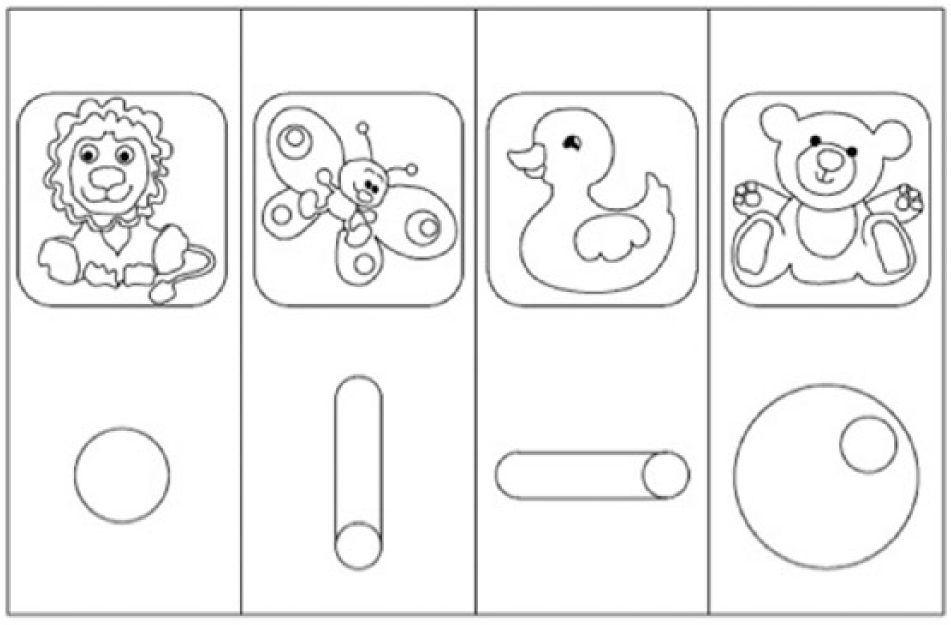
Sample line drawing of Apple iPad Slide & Spin application used in imitation tasks. On-screen targets (from left to right) are “tapped,” “dragged,” “swiped,” and “rotated.” Graphic and accompanying audio present once target is successfully maneuvered.
Imitation tasks were administered while the examiner and child were seated on the floor. The model positioned herself within 1 m of the child, used a verbal marker “Watch me,” and then demonstrated the to-be-imitated actions on the iPad®. Upon completion of the demonstration, the model positioned the iPad® close to the child and said “You can play with it”. The imitation task was delivered across four conditions in a 2 social condition (socially responsive model, aloof model) × 2 motoric task complexity (low motor demand, high motor demand) design. Briefly, these included (1) socially responsive model/low motor demand task, (2) socially responsive model/high motor demand task, (3) aloof model/low motor demand task, and (4) aloof model/high motor demand tasks. The administration order was counterbalanced across participants. Each trial was terminated after the successful completion of the five-action sequence by the child or after 30 s had elapsed (as per Nielsen, 2006).
Socially responsive and aloof model conditions
To increase the opportunity for rapport, the examiner who would be the socially responsive model familiarized herself with each child participant prior to the imitation tasks, through informal warm-up interaction and/or during administration of the MSEL. To minimize the opportunity for rapport, the examiner who would be the aloof model spent minimal time with the child prior to conducting the imitation tasks. During the imitation task demonstration, the socially responsive model smiled, provided a running commentary on her actions (e.g. A lion!), and alternated her gaze between the iPad® and child. The model maintained eye contact with the child and smiled when it was his/her turn. By contrast, the aloof model maintained a neutral expression, did not provide a running commentary, and avoided eye contact with the child, instead maintaining focus on the iPad®. The model averted her gaze when the child imitated and was unresponsive to the child’s social overtures. This manipulation of model characteristics was based on the procedures used by Nielsen (2006) among TD children and more recently adopted by Vivanti et al. (2016) among clinical populations. Following the study of Bandura (1977), it was presumed that socially motivated children would imitate the actions of the socially responsive model more readily than the aloof model.
Conditions of high and low motor demand
Each model demonstrated two imitation tasks—one with low motor demand and another high motor demand—with the latter presumed to be motorically more complex than the former. In the low motor demand condition, the model “tapped” a single on-screen target five times, and in the high motor demand task, the model “tapped,” “swiped,” “dragged,” and “rotated” different targets for a total of five actions. Two slightly different high motor demand five-action sequences were performed (one in each of the socially responsive and aloof demonstration conditions) to control for practice effects; each consisting of the same components (tap, swipe, drag, rotate, tap) but presented in a different order.
The child’s imitative performance for each demonstrated action in each of the four experimental conditions was binary coded (0/1), such that a score of 1 awarded for each correct sequential imitated action, and a 0 was coded for any out-of-sequence or incomplete action. Children could therefore score between 0 and 5 points per condition, with higher scores indicative of more accurate imitative performance.
Social reciprocity
The ADOS-2 was administered to all children with existing ASD diagnoses (n = 2 Toddler Module, n = 19 Module 1, n = 12 Module 2) by an assessor with demonstrated research reliability. Algorithm scores for the social affect (SA) domain were converted into CSS (computed per Hus et al., 2014) to provide an index of reciprocal social behavior for children in this group (Hus et al., 2014).
FM capacities
The FM subscale of the MSEL was administered with children with ASD, providing a direct assessment of FM skill for this group. While it would have been ideal to administer the MSEL with TD children, this was not possible due to constraints of the larger studies. All caregivers completed the FM scale of the Vineland Adaptive Behavior Scales, Second Edition (VABS-II; Sparrow et al., 2005), however, yielding a measure of daily adaptive FM abilities for children with ASD which was also available for the TD group. Given that floor-level standard scores are often reported in samples of children with ASD (Akshoomoff, 2006), raw scores for both the MSEL and VABS-II FM subscales were converted to age equivalence scores, and these were used as an index of FM capacities.
Statistical analyses
Data were analyzed using the Statistical Package for Social Sciences (Version 20.0). A three-way mixed-model analysis of variance (ANOVA) was used with one between-subjects factor of group (ASD, TD) and two within-subjects factors of social condition (socially responsive model, aloof model) and task motoric complexity (low motor demand, high motor demand). Follow-up pairwise contrasts were performed using a Bonferroni correction for multiple comparisons. Next, partial correlations were used to examine associations between social motivation (ADOS-2 SA CSS), FM abilities (VABS-II and MSEL FM age equivalence), and imitative performance (summed across conditions), while controlling for child chronological and developmental age. The alpha level was set at 0.05 for all analyses. Partial eta squared
Results
Preliminary data handling
Imitation data were available for all children in each group (ASD, TD), as were MSEL FM data for all children with ASD. A small amount of data were missing on the ADOS-2 (n = 2 children with ASD, 6%) and VABS-II (
The MSEL FM data for the ASD group and the VABS-II FM data for the TD group were normally distributed. Among children with ASD, ADOS-2 SA data and VABS-II FM data were positively skewed (i.e. many children had low social reciprocity and poor FM abilities). However, square root transformation successfully normalized these distributions. Imitation scores were also positively skewed for children in both groups (i.e. many children had low imitation scores). Here, logarithmic transformation successfully normalized the raw imitation data. Hence, all statistical analysis conducted parametrically on transformed data was appropriate.
Between-group and cross-context differences in object-directed imitation
First, an independent samples t-test was used to confirm the previously reported between-group differences in FM skills for children with ASD and TD children. There was a statistically significant between-group difference in VABS-II FM age equivalence, t(49) = −4.85, p < 0.001, with a large effect size, d = 1.44. This was such that the FM skills of children with ASD (M = 28.66, SD = 0.86) were some 16.55 months behind those of the TD children (M = 45.21, SD = 1.11), despite the groups being matched on chronological age (see Method section). While it would have been ideal to confirm a statistically significant between-group difference in social reciprocity, no common measure was available across the ASD and TD groups. Nonetheless, such a difference was assumed given that no child (n = 2 missing data) in the ASD group had ADOS-2 scores below cut-off for ASD, and no TD child (n = 1 missing data) had SCQ scores exceeding the cut-off (15) for ASD.
To address the principle study hypothesis, a three-way mixed-factorial ANOVA was used to (a) assess group differences in imitative performance (between-groups factor) and (b) differences in imitative performance arising from manipulation of social contextual factors and motoric task complexity (two factors varying within-groups). While statistical analysis was conducted on log-transformed data, means and confidence intervals were transformed back to the original measurement scale (as per Oliver et al., 2008) for presentation in Table 2.
Imitative performance under each of four conditions by children with ASD (n = 35) and TD (n = 20) children.
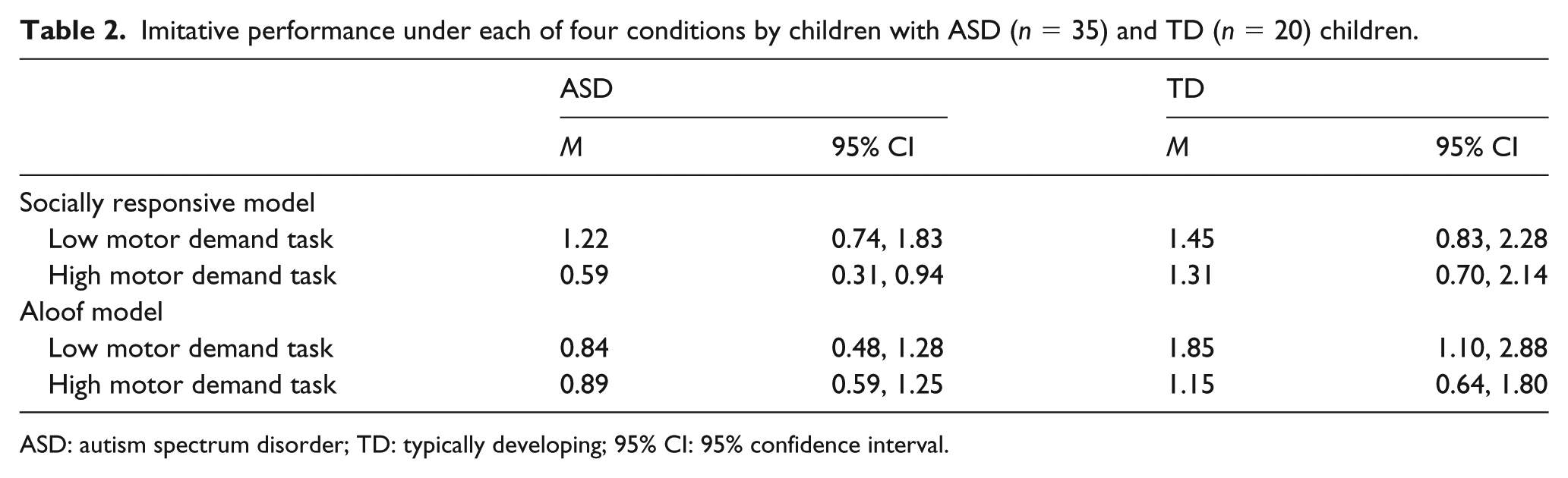
ASD: autism spectrum disorder; TD: typically developing; 95% CI: 95% confidence interval.
Figure 2 shows the mean imitation scores of children with ASD and TD children, and results of the three-way mixed-factorial ANOVA. Bracketed bars marked by the same letter (a, b, or c) indicate significant differences (p < 0.05, Bonferroni’s post-hoc test).
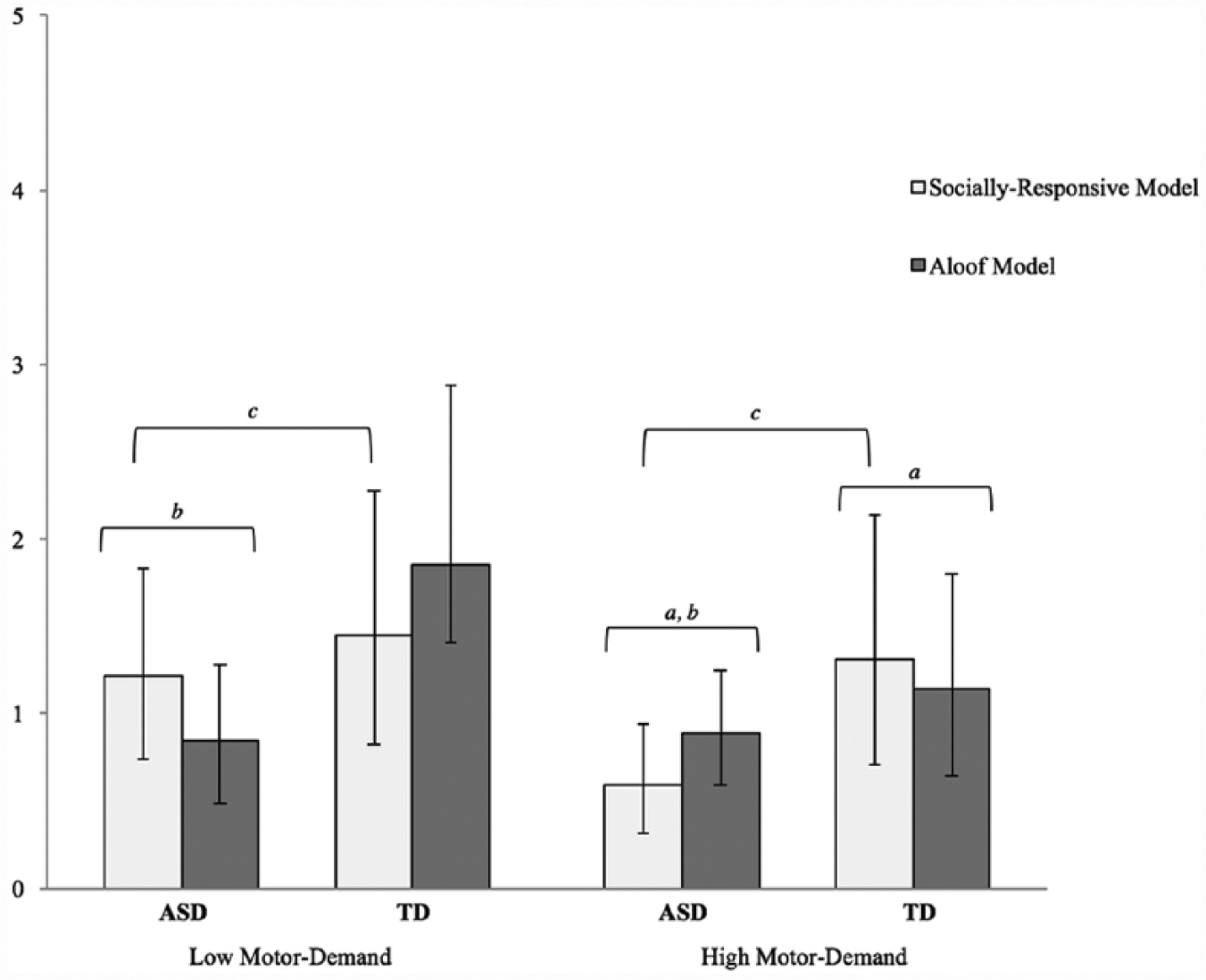
Imitation scores of children with autism spectrum disorder (ASD) and typically developing (TD) children under conditions of low and high motor demand and when demonstrated by a socially responsive and an aloof model. Data—presented in the original raw scale—are group means and error bars representing 95% confidence intervals. Bracketed bars marked by the same letter (a, b, or c) are significantly different (p < 0.05), according to the three-way mixed-factorial ANOVA and post-hoc test with Bonferroni correction.
The main effect of group was significant (F (1, 53) = 5.74, p = 0.020,
There was a significant group × motoric task complexity interaction (F (1, 53) = 5.39, p = 0.024,
The interaction term for social condition × motoric task complexity was significant (F (1, 53) = 4.19, p = 0.046,
Neither the two-way interaction of group × social condition (F (1, 53) = 0.71, p = 0.791) nor the three-way interaction of group × social condition × motoric task complexity (F (1, 53) = 0.01, p = 0.905) was significant.
While the majority of children in each group imitated at least one action, 14% of children in the ASD group and one TD child did not engage in any imitative behavior. 1
Associations among object-directed imitation and other skills for children with ASD
As an adjunct test of the extent to which social and/or motor factors are linked to imitative deficits in ASD, partial correlation analyses were used to assess the size and direction of associations between social reciprocity (ADOS-2 SA CSS), FM capacities (MSEL FM and VABS-II FM age equivalence), and imitative performance, controlling for child chronological and developmental age, within the ASD group only. Child chronological and developmental age were partialled out given that imitation, social reciprocity, and FM skill are all variables expected to grow across development (Young et al., 2011). Following the study of McDuffie et al. (2007), we computed a metric of developmental age by averaging across the Visual Reception, Expressive Language, and Receptive Language—but not the FM—age-equivalent scores from the MSEL. Imitation scores obtained in each of the four experimental conditions were summed to provide a Total Imitation score, with a range of 0–20. A square root transformation was applied to this new Total Imitation variable to correct for positive skew.
As shown in Table 3, the partial correlations between Total Imitation scores and each of ADOS-2 SA CSS and VABS-II FM age equivalents were nonsignificant, indicating that variability in child imitation performance was not associated with variation in social reciprocity or everyday adaptive FM capacities. By contrast, there was a moderate and positive association between Total Imitation scores and MSEL FM age equivalence, such that those children with ASD with superior imitation performance also had greater FM capacities as observed during standardized direct testing, and independent of any common effect of age. Furthermore, inspection of the zero-order correlation between Total Imitation scores and MSEL FM age equivalence (r = 0.47) indicated little effect of controlling for chronological and developmental age on the strength of this association. There were no significant correlations between ADOS-2 SA CSS and either of VABS-II or MSEL FM age-equivalence scores, indicating no association of social reciprocity with everyday/adaptive or directly assessed FM capacity. The partial correlation between MSEL and VABS-II FM age-equivalence scores was also not significant, indicating discordance between everyday/adaptive and directly assessed FM skill.
Partial correlations between total imitation, social reciprocity, and fine motor abilities, among children with ASD, controlling for chronological and developmental age.
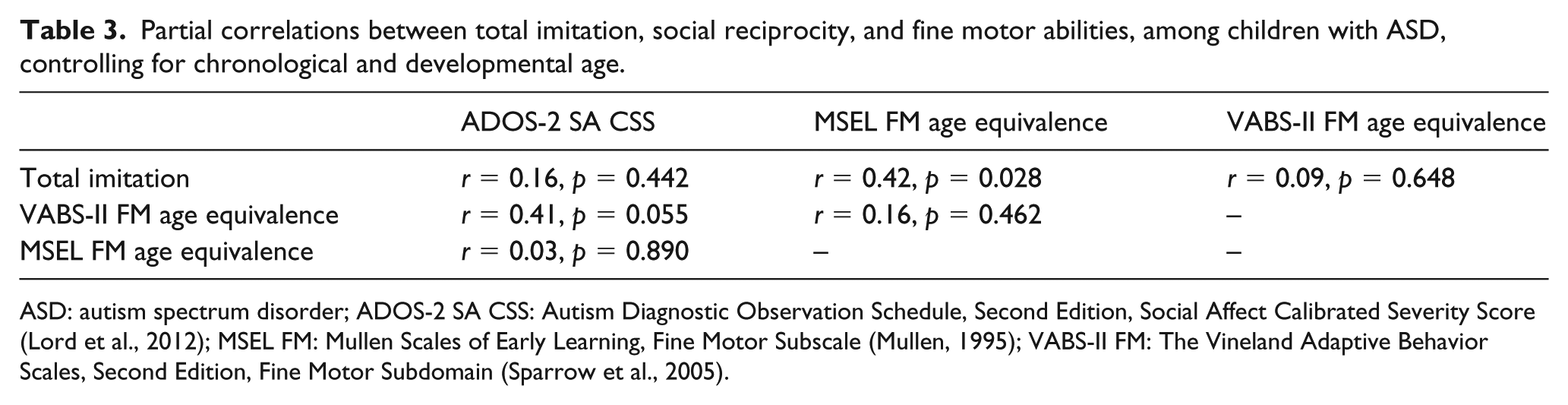
ASD: autism spectrum disorder; ADOS-2 SA CSS: Autism Diagnostic Observation Schedule, Second Edition, Social Affect Calibrated Severity Score (Lord et al., 2012); MSEL FM: Mullen Scales of Early Learning, Fine Motor Subscale (Mullen, 1995); VABS-II FM: The Vineland Adaptive Behavior Scales, Second Edition, Fine Motor Subdomain (Sparrow et al., 2005).
Discussion
This study sought to extend prior research on imitation in children with ASD by directly contrasting two prominent accounts of the difficulties observed in this group. Specifically, children with ASD have been suggested to have poorer imitative performance than TD children due to reduced social motivation and/or motor execution problems (Chevallier et al., 2012; Vanvuchelen et al., 2007). A multistep process was used. First, we examined differences in object-directed imitation between samples of children with ASD and TD children under each of four conditions arising from the experimental manipulation of social contextual factors and motoric task complexity. Next, within the sample of children with ASD only, we examined associations between measures of social reciprocity, FM capacity, and imitation performance.
An ancillary aim was to examine whether the current sample of children with ASD showed impairments in imitation, relative to TD children. While raw imitation scores for the current sample of children with ASD were lower than those of TD children across all four experimental conditions, the performance of children with ASD differed significantly from that of TD children only in the high motor demand task. It is interesting that despite overwhelming evidence of an ASD-specific imitation deficit (Edwards, 2014), children with ASD in this study showed intact imitation of single object-directed actions. In general, therefore, it seems that the magnitude of imitation deficits in ASD depends on the complexity of the imitable actions.
Social motivation and imitative performance
The role of social motivation in imitation in ASD was examined by manipulating social contextual cues within a controlled within-groups experimental design and by examining associations between social reciprocity (as measured by ADOS SA CSS) and total imitative performance. Contrary to our first hypothesis, we found that imitative performance was similar for children with ASD and TD children when tasks were demonstrated by a socially responsive or aloof model. These findings indicate that children with ASD did not show differential sensitivity to the social contextual signals that typically modulate imitation, as the findings of Vivanti and Dissanayake (2014) and Vivanti et al. (2016) would suggest. Furthermore, imitative performance for children with ASD was not associated with ADOS SA CSS, which is in contrast to a number of earlier studies (Ingersoll and Meyer, 2011; Rogers et al., 2003; Vivanti et al., 2016; Zachor et al., 2010) and contrary to our second hypothesis.
The lack of modulation by social contextual cues in TD and the nonsignificant associations between ADOS SA CSS and imitation in ASD may be an indication that in this study, imitation by children (in both groups) served an instrumental purpose of learning about the object—an attractive iPad® tablet. Alternatively, it may be that the lack of differentiated imitation by TD children was underpinned by distinct functions, such as imitation of the socially responsive model to maintain interaction and imitation of the aloof model to initiate interaction. While the same interpretation could also be applied to explain the lack of differential imitation by children with ASD toward the socially responsive and aloof models, this seems unlikely given that a lack of social interest and/or interaction skills is a core diagnostic feature of ASD (APA, 2013).
Motor execution capacities and imitative performance
Turning to the link between motor execution capacities and object-directed imitation in ASD, we manipulated the motoric complexity of the imitation task in the within-groups experimental design and examined associations between FM capacities (as measured by MSEL FM and VABS-II FM age equivalence) and imitative performance. We found that children with ASD, but not TD children, imitated the high motor demand task more poorly than the low motor demand task. Additionally, we found that imitative performance was correlated with MSEL FM skill. These results support our third and fourth hypotheses, respectively, and are broadly consistent with the notion that imitation deficits in ASD become evident as the basic motoric operations involved in the execution of observed actions become more complex (Rogers et al., 1996; Vanvuchelen et al., 2007).
Interestingly, Total Imitation scores were positively correlated with MSEL FM skills, though not with VABS-II FM skills. These conflicting findings and the lack of association between MSEL and VABS-II FM age-equivalence scores has been cited elsewhere (Akshoomoff, 2006) and likely reflect the different FM skills emphasized by each measure (Magiati and Howlin, 2001), as well as the use of direct assessment versus parent report. However, a note of caution is due here given that the MSEL FM subscale contains items where the examiner models target behaviors (e.g. folding paper) for the child to reproduce (Mullen, 1995). It has been argued, therefore, that the MSEL assessment of FM skills is somewhat reliant on imitation (McDuffie et al., 2007), which might have produced inflated associations with Total Imitation scores in this study. Importantly, however, MSEL FM and imitation scores did not show perfect convergence or multicollinearity; hence, it is not the case that these two metrics were measuring the same construct redundantly.
One unanticipated finding was of superior imitation, across both groups, in the low motor demand task relative to the high motor demand task but only when the demonstration was by a socially responsive model. While a nonsignificant group × social condition × motoric task complexity interaction term indicated a similar pattern of performance in ASD and typical development, from inspection of the mean imitation scores it appears that this effect was more robust in the ASD group. It is, therefore, tempting to speculate that the interaction with the social model involved a processing cost detrimental to imitation of more complex actions for children with ASD. This explanation is consistent with evidence that the presence of social stimuli interferes with performance on cognitive tasks in ASD (Dichter and Belger, 2007; Ozonoff, 1995), as well as evidence of more pronounced social-processing difficulties in ASD when tasks are more cognitively demanding (Golan et al., 2007). However, the findings that children in both groups imitated the high motor demand task more poorly than the low motor demand in response to the socially responsive model (but not also when demonstration was by the aloof model), and that of a lack of greater imitation in response to the socially responsive model versus the aloof model presented across motor demand conditions, were not fully consistent with our prediction that demonstration from a social model would result in enhanced performance across motor conditions. Therefore, further dedicated research is necessary to investigate the possible interactive effects of social and motor factors in imitation difficulties of children with ASD.
Study strengths and limitations
The key strength of this study of imitation in children with ASD lies in our use of a novel multistep approach, combining systematic experimental manipulation within- and between-groups and the examination of associations between variables within an individual differences design. Prior to this study, most research had attempted to account for imitation difficulties in ASD via a single deficient process, rather than contrasting predictions from different accounts. Nonetheless, due to a lack of social reciprocity and MSEL FM data for the TD group, we were not able to examine whether the correlates of imitation (or predominant lack thereof) among children with ASD held among TD children or remained specific to ASD. Moreover, while the SCQ scores of this group indicated that social communication skills of the TD children were developing normally, we cannot conclusively determine that TD children had similarly high levels of social motivation. On a related point, the unexpected lack of differentiated imitation by TD children in response to a socially responsive and aloof model did somewhat weaken our premise for considering ASD-specific hypotheses, in this regard. As noted earlier, however, we do not believe the lack of differential imitation by TD children reflected a lack of social motivation in this group. The size of the TD group was disproportionally smaller than the ASD group and smaller than previous studies in this area (Nielsen, 2006; Nielsen et al., 2008); hence, we were likely limited in our power to detect a significant within-group difference in imitative performance across the two social conditions.
There are also several limitations common to our iPad®-based imitation paradigm. First, our object-directed imitation task might not have been sufficiently novel to induce high-fidelity imitation. Information about the afforded properties of the iPad® and four Slide & Spin® targets was exposed during the imitation task demonstration, and this knowledge, coupled with prior iPad® experience, might have guided children’s responses. For example, children might have used a repeated “tap” action in preference to the five-action high motor demand sequence because this was the most straightforward way of activating the visual/aural feedback. Indeed, it has been demonstrated that infants as young as 14 months evaluate the rationality of goal-directed actions and selectively imitate the actions that are most efficient (Gergely et al., 2002; Király et al., 2013). This might explain why we did not observe robust replication of the previously reported imitation deficit in our sample of children with ASD. Nevertheless, our binary coding of each imitable action—where 1 was coded for each correct sequential imitated action, and 0 was coded for out-of-sequence or incomplete actions—did not allow us to explore this possibility. That is, a score of 0 was received when children did not act on the iPad® whatsoever or when they produced different actions to those that were demonstrated. This highlights the importance using non-meaningful gestural tasks when assessing for differences in true imitative abilities (Vivanti and Hamilton, 2014).
Second, successful reproduction of action sequences requires that the imitator consciously formulate an action plan and hold a mental representation of movement sequences on-line in working memory during action execution (Griffith et al., 1999). Thus, it is possible that differences in the imitation of our high motor demand five-action sequence were driven by differences in working memory functioning, rather than motor execution capacities per se. Nonetheless, we find this unlikely in light of recent findings that show intact spatial working memory functions in ASD (Fanning et al., 2017; Morsanyi and Holyoak, 2010; Ozonoff and Strayer, 2001) and also given that differences in imitation by task complexity (Ham et al., 2011) and length (Smith and Bryson, 1998) in previous studies have remained even after controlling for working memory abilities. Third, since imitative behaviors were sampled at a single time point, and across eight natural, albeit relatively contrived experimental contexts, the ecological validity of these findings may be limited.
Our experimental manipulation of model social cues also deserves some consideration. In particular, our measure captured the fidelity of object-directed imitation, whereas social factors might be more relevant for the propensity to use imitation in everyday life (Vivanti et al., 2014). In line with this argument, Nielsen (2006) found that the social disposition of the model influenced the number of boxes opened but had no bearing on the specific actions they reproduced. In Nielsen et al.’s (2008) subsequent study, however, children reproduced the actions of a live model more faithfully than those of a televised model, suggesting that social motivation also plays a role in imitative accuracy. Nonetheless, since imitative propensity was not assessed, it is unknown whether the social communicative cues of the model might have differentially influenced this distinct aspect of imitative behavior in ASD. Furthermore, we tested whether imitation was modulated by the social communicative features of the model. This approach to testing the social motivation hypothesis would have perhaps been more rigorous had we included a condition in which children were demonstrated actions by a non-human agent or a non-responsive (i.e. televised) model (as done by Nielsen et al., 2008). Nevertheless, the results of Nielsen (2006) and Vivanti et al. (2016) suggest that imitation is indeed sensitive to subtle differences in (human) model characteristics, which lends support to the current paradigm.
Furthermore, it is possible that the running commentary provided by the socially responsive model during the imitation task demonstration helped to cue child attention toward the iPad® and the to-be-imitated actions. This enhanced attentional focus could have resulted in a deeper level of encoding and a greater potential for action retrieval, relative to the aloof model condition where no running commentary was provided. There were also differences between the two models in terms of their familiarity. Unlike the aloof model, the socially responsive model familiarized herself with each child prior to the imitation tasks through informal warm-up interaction and/or administration of the MSEL, which may have facilitated imitative learning (Shimpi et al., 2013). Nevertheless, it is unlikely that these uncontrolled differences impacted the current pattern of results, given that we found no differences in imitation by social condition.
Concluding comments
This study sought to extend prior research on imitation in ASD by directly contrasting the social motivation and motor execution accounts of imitative deficits. We found an ASD-specific decrement in imitative performance by motoric task complexity and a correlation between FM coordination and imitation which, taken together, support the notion that motor execution difficulties play an important role in imitation impairments apparent in ASD. The unexpected lack of social top-down modulation of imitation in the TD group precludes drawing strong conclusions about the role of abnormal social motivation in imitation in ASD from our experimental paradigm. Nonetheless, the nonsignificant correlation between social reciprocity and imitation in the ASD group indicates that the severity of impairments in the social domain do not predict imitation deficits in ASD. Finally, an unexpected and intriguing finding was of superior imitation of the low motor demand task, relative to the high motor demand task, when the demonstration was by the socially responsive model. We speculate that there may be a cost associated with processing social information that interferes with imitation of motorically complex actions. However, evidence was not unequivocal, and the possibility of interplay between social and motor factors should be explored in future imitation research.
Additionally, future research should take into account the phenotypic diversity (Wing and Gould, 1979) and heterogeneity in imitation performance within the ASD population (Edwards, 2014) and consider the possibility that imitation difficulties are rooted in different underlying mechanisms for distinct ASD subtypes (see Beglinger and Smith, 2001, for a review of subtyping). In order to move forward and answer such a question, future research needs to go beyond the traditional “comparison group” approach and examine imitation in ASD within an individual differences framework.
Supplemental Material
AUT734063_Lay_Abstract – Supplemental material for Object-directed imitation in autism spectrum disorder is differentially influenced by motoric task complexity, but not social contextual cues
Supplemental material, AUT734063_Lay_Abstract for Object-directed imitation in autism spectrum disorder is differentially influenced by motoric task complexity, but not social contextual cues by Lacey Chetcuti, Kristelle Hudry, Megan Grant and Giacomo Vivanti in Autism
Footnotes
Acknowledgements
The authors thank all participant children and their families for their time and contribution to this research, which formed part of L.C.’s research toward Honors in Psychological Science. They also acknowledge the contribution of Heather Nuske and Darren Hedley who assisted with recruitment and data collection, and thank Jacqueline Maya for her assistance with data collection. This paper was presented at the 2016 International Meeting for Autism Research.
Declaration of conflicting interests
The author(s) declared no potential conflicts of interest with respect to the research, authorship, and/or publication of this article.
Funding
The author(s) received no financial support for the research, authorship, and/or publication of this article.
Notes
References
Supplementary Material
Please find the following supplemental material available below.
For Open Access articles published under a Creative Commons License, all supplemental material carries the same license as the article it is associated with.
For non-Open Access articles published, all supplemental material carries a non-exclusive license, and permission requests for re-use of supplemental material or any part of supplemental material shall be sent directly to the copyright owner as specified in the copyright notice associated with the article.
