



Abstract
Initiating and responding to peers are social communication behaviors which are challenging for students with autism. We reviewed intervention studies set in mainstream elementary schools, which targeted these behaviors and reported on intervention outcomes as well as the resources required for their implementation. A total of 22 studies met the criteria for inclusion. Findings suggest that school-based interventions can increase the frequency and duration of initiating and responding behaviors in elementary school aged students with autism. These interventions were resource-intensive and usually delivered by researchers or teaching assistants away from the classroom. Future research should build on this emerging evidence base to consider interventions which could be implemented by classroom teachers as part of the classroom program.
Keywords
Social communication is a critical skill for success in social environments. Difficulty with social communication is one of the key diagnostic criteria for students with autism (American Psychiatric Association, 2013). Improving social communication behaviors is considered one of the most important intervention goals for these students (Marans et al., 2005; Paul, 2003; Paul et al., 2009). Researchers have identified four pivotal behaviors that impact on the social communication competence of children with autism: verbal initiations, verbal responses, nonverbal communicative attempts, and joint attention (Murdock et al., 2007).
The ability to communicate with peers to initiate and respond is particularly important because of its impact on the development of positive peer interactions (Bauminger-Zviely et al., 2014). In today’s classrooms, social communication between peers is an important part of the learning experience for all students. Teachers use peer conversations as an opportunity to discuss curriculum topics, engage learners, and build a classroom community (Lloyd et al., 2016). As a result, students with autism who have difficulty initiating communication with, and responding to, their peers may be considerably disadvantaged in the classroom setting.
As autism is a heterogeneous disorder, a student’s social communication profile may vary depending on their cognitive skills (Joseph et al., 2002; Paul, 2003), communication and language skills (Bauminger-Zviely et al., 2014), or social motivation (Calder et al., 2013). Overall, students with autism have been found to initiate interactions less often than typical peers (Koegel et al., 2001; Newman and Eyck, 2005). Conversely, some students with higher language skills may over-initiate, carrying on a one-sided monologue when speaking on a topic of interest (Church et al., 2000; Koegel et al., 2001). However, a universal finding is that students with autism, regardless of skill level, may either not respond at all or have difficulty formulating an adequate response to their conversational partner (Carpenter and Tomasello, 2000; Loveland and Tunali-Kotoski, 2005).
Students with autism are increasingly being educated in mainstream school programs and classrooms alongside their neurotypical peers (Humphrey and Lewis, 2008). Schools can select from a range of interventions for teaching social communication behaviors including: (a) child-specific interventions, (b) peer-mediated interventions, (c) comprehensive interventions, (d) collateral interventions, and (e) ecological interventions (McConnell, 2002). To implement these interventions in school settings, however, requires information on the feasibility of employing these interventions in mainstream schools, where the primary focus is on the academic curriculum (Kasari and Smith, 2013). Indeed, the effectiveness of implementing an intervention in a school is considered as important as the effectiveness of the intervention itself (Cook and Odom, 2013). Practical issues may include access to resources such as staffing, staff training, and availability of space required to implement the intervention (Locke et al., 2015). As peers are often involved in social interaction interventions, the selection of peers also needs to be considered.
Social communication in general has received considerable attention in the autism literature. Previous reviews published in the last decade have examined school-based interventions that have addressed aspects of social communication skill difficulties demonstrated by students on the autism spectrum. Bellini et al. (2007) examined the comparative effectiveness of social skills interventions delivered in school-based settings for students with autism. These were conducted in preschool, elementary, and secondary settings and involved interventions implemented both in the classroom and in pullout settings. Garrote et al. (2017) examined a number of studies, which utilized interventions to increase social participation of students with disabilities, including students with autism, in mainstream preschool and elementary classrooms. Whalon et al. (2015) reviewed studies that employed interventions to target peer-related social competence of students with autism in preschool and elementary school settings. Although all three reviews examined interventions that focused on social skills, only Whalon et al. specifically looked at studies that targeted communication behaviors including initiation and response. More importantly, the focus of all three reviews was on the effectiveness of the interventions for students with autism, but none looked at the feasibility of these interventions in mainstream elementary schools or the resources required for teachers to implement these interventions. Therefore, a more targeted review is needed to examine what interventions can practically be implemented by educators in mainstream schools to address social communication behaviors of students with autism when interacting with peers.
The purpose of this review is to provide educators and other professionals with an understanding of the resources which have been utilized in schools to deliver interventions targeted at teaching students with autism to initiate and/or respond to their peers. Specifically, the aims were to document (a) interventions that have been employed in a mainstream school to impact these communication behaviors, either individually or as a comprehensive intervention; (b) the outcomes of these interventions; and (c) the resources required to implement these interventions. Definitions for these behaviors are based on those identified by Whalon et al. (2015). Initiations are defined as spontaneous attempts (verbal/nonverbal) to gain attention, share information, and elicit a response from a peer. Responses are defined as verbal or nonverbal behaviors that share information to a peer following a communicative initiation by that peer.
Method
Literature search
The Preferred Reporting Items for Systematic Reviews and Meta-Analyses (PRISMA) Checklist was used to structure the search process in this review (Moher et al., 2009). A search was conducted in October 2016 using online educational, psychological, and speech pathology databases including PsycINFO, Sage, Eric, and Proquest. Search terms included (“child*” or “student”) AND (“autis*,” or “Asperger” or “PDD”) AND “school” AND “intervention” in combination with (“initiate” or “initiation” or “respond”).
Inclusion criteria
Studies were included if they were published in a peer-reviewed journal in English between 1994 and 2016 and met the following criteria:
Included dependent variables that focused on interactions with a peer and included a measure of either verbal or nonverbal initiations or responses of participants;
Focused on students with autism who were enrolled and received the majority (>75%) of their instruction in mainstream class programs (i.e. a class program in which students with and without identified disabilities are educated together), although they could go out for short periods for special instruction or activities;
Conducted in elementary school settings;
Employed an experimental design to test the effectiveness of an intervention.
Exclusion criteria
Although social interaction encompasses a wide variety of skills, this review specifically examined studies that addressed the social communication behaviors of initiation and response. These skills have been identified as pivotal to communication between students with autism and their peers (Murdock et al., 2007) and comprise the foundation for conversations between students in mainstream classroom (Bauminger-Zviely et al., 2014). In keeping with this focus, studies were excluded if they did not include a measure of initiation or response to peers by students with autism, if they included students in preschool or middle school, or if they were conducted in a special education class or school.
Review process
Figure 1 outlines the complete review process. Initially, 1772 studies were identified from the search. Duplicates were removed, and the titles and abstracts of these studies were screened for suitability by the first author (B.M.S.). In total, 1536 studies were eliminated as not meeting the inclusion criteria because they (a) included other settings in addition to school settings such as home or clinic; or (b) included students who were enrolled in self-contained settings; or (c) primarily focused on students in preschool or middle school or high school; or (d) did not test the effectiveness of a social communication intervention. After reading the full text, 90 more studies were excluded because they (a) did not include measures of initiating and responding behaviors (e.g. Sansosti and Powell-Smith, 2006) or (b) included students with disabilities other than autism or related diagnosis. The screening process was confirmed by a second researcher (A.A.W.) who re-examined studies eliminated and included to ensure they met the selection criteria. In addition, once studies were identified, an ancestral search was conducted of reference lists to ensure no relevant research had been missed. No additional studies were found, leaving 22 studies that met the criteria for the current review.

Flowchart of the search process.
Data extraction
Descriptive data extracted for each study included (a) number of participants, (b) participant’s diagnosis and cognitive level (IQ), (c) social or communication assessments used, (d) dependent variables (i.e. initiating or responding behaviors), (e) type of intervention, (f) outcome (e.g. positive or questionable), and (g) measure. The outcomes of interventions were determined by reviewing the analysis reported in each study as well as the significance and effect size measures, when available. Outcomes were categorized as positive if dependent variables improved for all participants or questionable if dependent variables did not improve for one or more participants. Resource data extracted for each study included (a) implementers and the length of their training, (b) selection of peers, and (c) the setting.
Methodological quality
The methodological quality of the studies was assessed using the McMaster Critical Review Form for Quantitative Studies (Law et al., 1998). This tool has been used extensively in previous systematic reviews and has good inter-rater reliability (Wells et al., 2014). Six questions were selected that had been included in a recent review to determine quality of studies involving students with autism (Westerveld et al., 2016). A seventh question, which asked whether the intervention was described in detail, was also selected. The questions used to determine study quality were as follows:
Is the study design relevant to address the study aim?
Is the sample size described in detail?
Is the sample size justified?
Is there no identified potential sample/subject selection bias?
Is the intervention described in detail?
Are the outcomes measures valid and reliable?
Are the results reported in terms of statistical significance (including effect size)?
Two primary authors rated the studies independently and discussed any discrepancies until 100% agreement was reached regarding determination of measures on study quality. In addition, peer debriefing and an audit trail were used to ensure the trustworthiness of data extraction.
Results
The methodological quality of the studies is presented in Table 1. The quality of the studies varied. All studies incorporated a relevant design, provided valid and reliable outcome measures, and were free of potential sample or subject selection bias. Only four studies provided detailed information about interventions that would have allowed for replication.
Quality appraisal of studies.

Design: MBL = multiple baseline; MP = multiple participant.
All 22 studies employed a single-case design. In total, 15 studies used multiple baseline design, whereas others used a multiple probe, multi element, reversal, AB, or ABAB design. Sample size was described in detail in 17 studies; however, none of the studies justified their sample size. Only three studies provided details of significance and effect size. Overall, the studies met four of the seven selected criteria as detailed in the McMaster Critical Review Form for Quantitative Studies (Law et al., 1998).
As depicted in Table 2, the 22 studies involved 72 males and 6 female students with autism aged 3–12 years. Apart from Bauminger (2007) who reported on 19 participants, all studies included 5 or fewer students. Participants were diagnosed with autism (N = 47), Asperger’s syndrome (N = 15), pervasive developmental disorder not otherwise specified (PDD-NOS) (N = 3), high-functioning autism (N = 14), and autism spectrum disorder (ASD) (N = 3). Participants’ cognitive levels were reported in seven studies with IQ scores ranging from 71 to 128. Studies generally provided only anecdotal descriptions of social communication skills rather than standardized measures that would confirm whether their communication skills were outside the norm and what specific skills needed to be prioritized for intervention. Only three studies included a standardized measure of communication skills using the Vineland Adaptive Behavior Scales (Sparrow et al., 1984). Scores across the 11 participants ranged from 46 to 136 with a mean score of 89. Across the remaining 19 studies, participants were generally described as exhibiting functional verbal communications skills and were able to use language to request and ask and answer questions. Participants rarely initiated communication to peers and had marked difficulties with using language to communicate in social situations.
Descriptive and resource data.
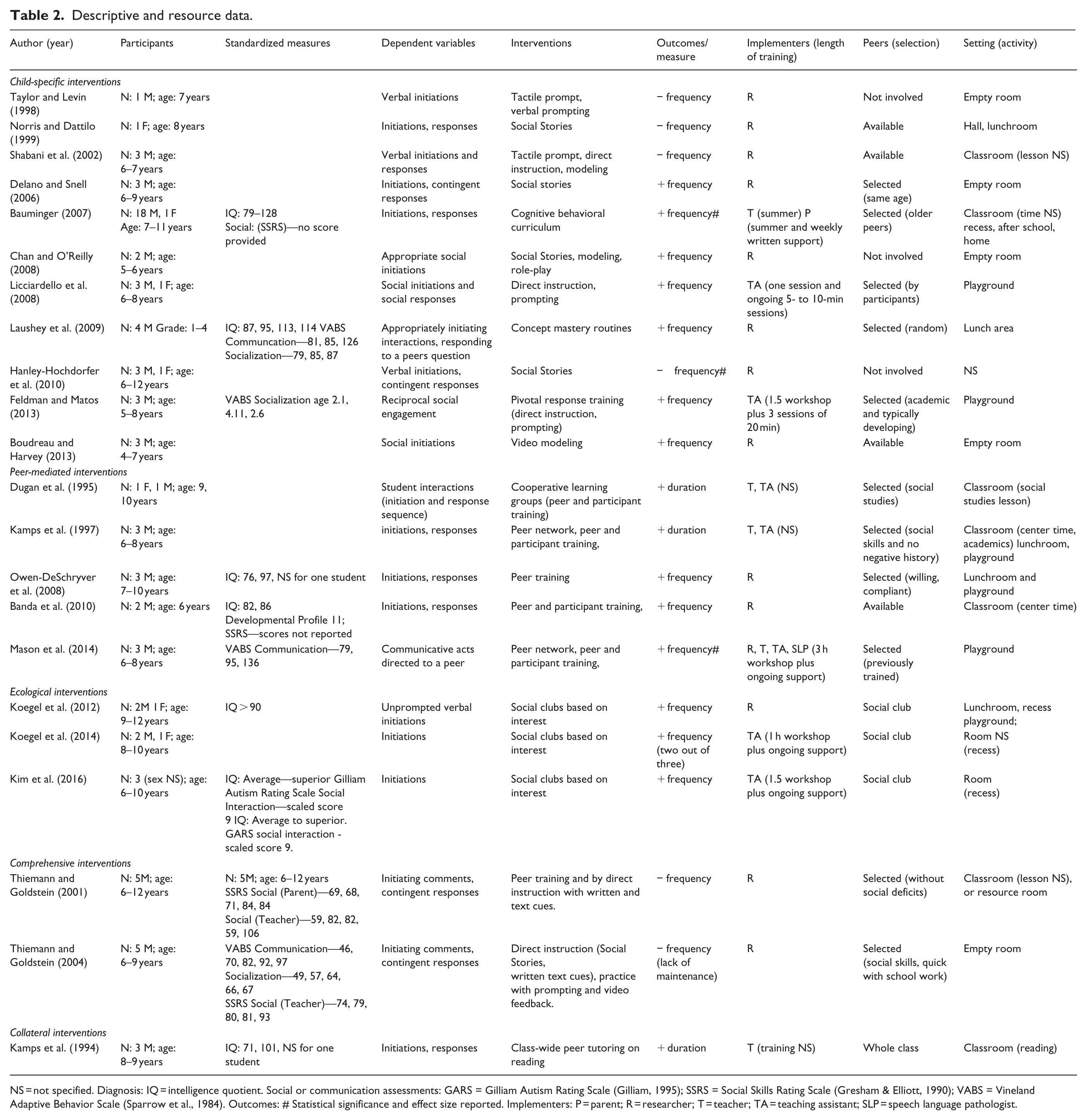
NS = not specified. Diagnosis: IQ = intelligence quotient. Social or communication assessments: GARS = Gilliam Autism Rating Scale (Gilliam, 1995); SSRS = Social Skills Rating Scale (Gresham & Elliott, 1990); VABS = Vineland Adaptive Behavior Scale (Sparrow et al., 1984). Outcomes: # Statistical significance and effect size reported. Implementers: P = parent; R = researcher; T = teacher; TA = teaching assistant; SLP = speech language pathologist.
Interventions
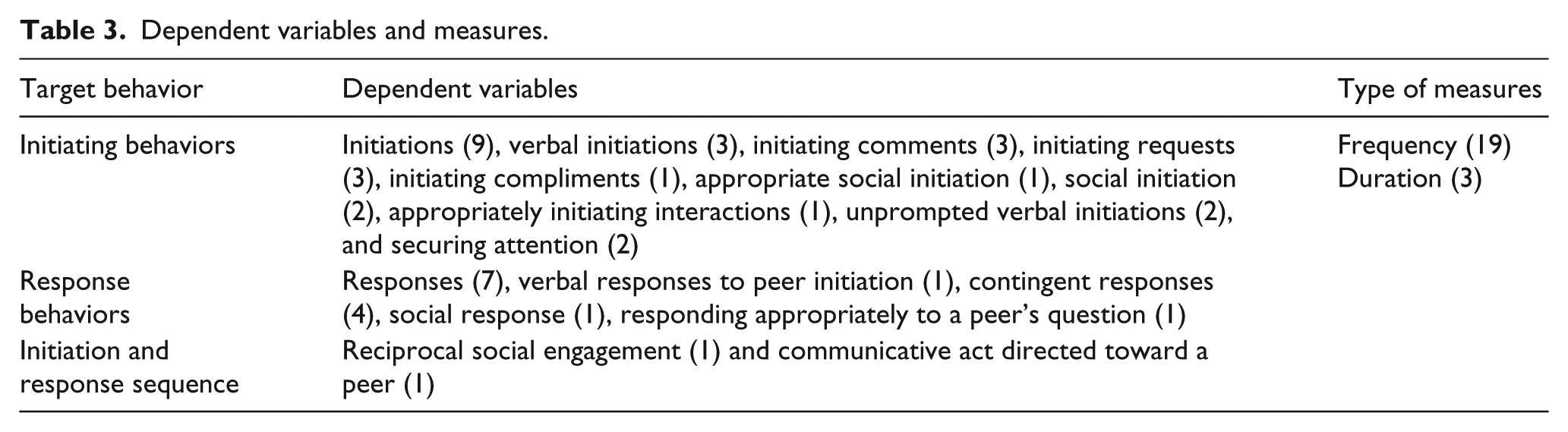
This review examined studies that targeted the behaviors of initiating and responding with peers. Substantial variability in terminology was used to describe these behaviors across the studies. Table 3 provides an overview of dependent variables that were used to measure initiating or response behaviors, and the type of data that was collected for each variable. In total, 19 studies examined initiating behaviors associated with social communication and 14 studies included measures of student’s response to communicative initiation of peers. Two studies measured a combined initiation and response sequence. The majority of studies (19) measured the frequency of initiation and response behaviors, while 3 measured duration of these behaviors. No studies included a measure of the quality of initiation or response behaviors.
Dependent variables and measures.
Child-specific interventions
These are adult-directed interventions which include direct instruction, social skills training, priming, reinforcement, and prompting to teach social communication behaviors. As shown in Table 2, half of the studies (n = 11) used child-specific interventions. A mobile tactile prompt was used in addition to teacher prompting in two studies. Teaching assistants were trained in pivotal response training (PRT), an approach where skills considered pivotal to the development of social communication are targeted during natural activities (n = 1). One study provided a social skills curriculum based on a cognitive behavioral approach and targeted both student’s social interactions and their social cognitive abilities. Visually supported interventions included social stories (n = 4), video modeling (n = 1), and concept mastery routines, where diagrams were drawn to explain social expectations (n = 1).
Peer-mediated interventions
Peers were trained or supported to use instructional strategies in five studies. Peer network studies (n = 2) trained participants and peers in social skills, then organized these students into social groups. A cooperative learning group study was set in the classroom and included training on social skills and social studies curriculum to enable students to work in teams during social studies activities. One study provided training to both participants and peers (Banda et al., 2010) with another training peers only (Owen-DeSchryver et al., 2008).
Ecological interventions
These are interventions where social interactions are supported through environmental arrangements (McConnell, 2002). Three studies organized social clubs for students with autism and their peers based on shared interests such as board games, cooking, and crafts. In two of these studies, teaching assistants were trained to establish and facilitate these clubs.
Comprehensive interventions
Combining two or more interventions, comprehensive interventions were used in two studies. One study trained two target students with autism and their peers in social interaction skills, prompted them to produce these skills during center time activities, and then employed video feedback to discuss their social communication behaviors. The second study trained peers in social skills over 5 days and then introduced direct instruction using written and text cues.
Collateral skill interventions
These interventions are a variation of ecological interventions in that they do not focus directly on teaching social communication skills to students. Instead, they aim to increase student’s communication skills by train students in specific academic or play skills that involve peer interactions and then measure to determine if this has increased their social communication skills as well. One study in this review trained the whole class as reading tutors, aiming to improve both reading and social communication skills.
Intervention outcomes
As shown in Table 2, all studies focused on increasing the frequency (n = 19) and/or duration (n = 3) of the targeted behaviors. None of the studies focused on reducing the frequency or duration of initiations and responses. Positive outcomes for increasing the frequency or duration of initiations and/or responses to peers were reported in 20 of the 22 studies included in this review. However, only two of these studies reported on statistical significance and effect size. In the first of these studies (Bauminger, 2007), 19 students showed a statistically significant increase in the frequency of initiation and responding to peers following the implementation of a cognitive behavioral curriculum. In the second study (Mason et al., 2014), the implementation of a treatment program consisting of multiple components including training of both participants and peers resulted in a large and statistically significant improvement in the frequency of communicative acts (verbal communication directed to a peer) demonstrated by students with autism. The two studies that did not demonstrate a positive effect both utilized social stories as the primary intervention. Two other studies using social stories demonstrated positive outcomes, but both included additional strategies of modeling and role-play or video feedback and written text cues (Chan and O’Reilly, 2008; Thiemann and Goldstein, 2004).
Resources required for implementation
As presented in Table 2, research-related personnel were involved in the implementation of 14 of the 22 studies in this review. Indeed, researchers held sole responsibility for implementing interventions in over half (n = 13) of the studies in this review. Other studies used teaching assistants working alone (n = 4) or with a teacher (n = 3). Teachers held sole responsibility for implementing an intervention in only one study (Kamps et al., 1994). Research staff provided the training in the 11 studies involving school staff. Training consisted of a workshop followed by individual practice and feedback (n = 5). One study of 7 months involved training parents and school staff during the summer holidays; however, the length of the training was not specified (Bauminger, 2007). Three studies did not state the length of training for school staff.
Peers were involved in 19 of the 22 studies included in this review either as social partners or as trained facilitators. In 11 of these studies, selection was based on specific criteria such as positive social skills or behavior, typical development, academic knowledge, age, or previous training in social skills interventions. In two of these studies, teachers selected peers who could complete classwork quickly or catch up later when they missed classwork to participate in the intervention. In one study, peers were selected by the participants with autism. Four studies did not specify selection criteria, but stated that peers were included who were naturally available in the playground or classroom environment. Three studies invited peers to join a social club based on the interest of the target students. Three studies did not include peers in the intervention with participant students interacting with adults.
The settings of the interventions included nonacademic settings such as the lunchroom or playground (n = 8), empty rooms, resource rooms, library rooms, or corridors (n = 6). Seven studies were conducted in classrooms. In these studies, three embedded the intervention into academic activities such as social studies and reading, whereas one studies used center time and facilitated play sessions. Three studies did not specify the classroom activity, suggesting that these interventions may have occurred separate to the usual classroom program.
Discussion
Schools are increasingly expected to consult research evidence when selecting interventions for their students with disabilities (Boardman et al., 2005). When appraising research studies, schools may need to consider not only the outcomes of the intervention but also practical issues relating to the resources required to successfully implement interventions. The results of this review do suggest that interventions set in schools can effectively increase the frequency and duration in which students with autism initiate and respond to communication with peers, with 18 of the 22 studies reporting positive intervention effects. However, schools may struggle to replicate these interventions due to the lack of detail around the implementation of the intervention and the participants’ level of functioning. Social abilities were assessed in only nine of the studies, communication was assessed in only three studies, and IQ scores were reported in only eight studies. Without adequate description of the participants’ level of functioning, it is difficult for educators to know which students with autism would most likely benefit from these interventions.
All 22 studies measured the frequency or duration of these behaviors, while no studies reported on the quality of initiations and responses. This is an interesting finding as communication between individuals in social situations involves much more than a simple exchange of information. It also requires individuals to exchange information about a shared topic for a sustained period (Church et al., 2000; Koegel et al., 2001). In classrooms, in particular, duration and quality of communication behaviors are particularly relevant as teachers are interested in what children talk about rather than how frequently they talk with their peers. Thus, the omission of quality measures may mean that findings lacked social validity within mainstream classroom contexts.
These studies used behavioral interventions (direct verbal or visual instruction, feedback, prompting, and reinforcement), cognitive behavioral interventions, peer and participants’ training on social or academic skills, or the establishment of social clubs around special interests. However, the findings must be cautiously viewed and interpreted as only two of these studies reported a positive statistical significance and effect size (Bauminger, 2007; Mason et al., 2014). Although single-case designs may be considered an appropriate alternative to group designs, there is a clear need for researchers to report effect sizes to provide stakeholders with a better understanding of the practical significance of the study’s findings (Smith, 2012). This is particularly important in school settings, where a significant effort is required to embed interventions in school programs and teachers want to ensure they focus on the strategies that are most likely to make the most difference for both students with autism and their peers.
Considering that this review focused on school-based interventions for students with autism, it was surprising that only six studies involved a teacher. Indeed, researchers were fully or partially responsible for implementation in 14 of the 22 reviewed studies. Utilizing researchers in school settings may fail to consider valuable information on the ecological and social validity of the intervention (Bulkeley et al., 2013). Moreover, it may leave schools wondering whether these interventions could reasonably be implemented without the researchers or by teachers who are responsible for a class of students and who are focused on improving academic performance (Kasari and Smith, 2013).
In the studies in this review, teaching assistants were involved in implementing interventions more often than classroom teachers. Their roles included both primary responsibility for direct instruction, the formation of social lunch clubs, and support for peer-mediated interventions through the delivery of prompts, feedback, and rewards. While teaching assistants were effective in increasing verbal initiating and responding behaviors, their training was conducted by researchers, and the interventions often occurred during times when the teacher was not present. This is concerning given that researchers have repeatedly stressed that teacher assistants should be used to support classroom and teacher practice, as they do not have the qualifications or training to be the sole person responsible for implementing interventions (Butt, 2016; Sharma and Salend, 2016). In addition, exclusion of the teacher from these interventions poses a significant threat to sustained maintenance and generalizability of the outcomes. Future researchers need to provide information for educators as to the cost of using teaching assistants, in terms of training and supervision, or better still, to train teachers to incorporate social communication interventions within their classroom program.
Considering the classroom offers a natural setting for peer interactions, it was also surprising that only a few studies embedded social interventions into curriculum or classroom-based activities. Embedding interventions for students with autism into the curriculum has been recommended by several researchers as a technique to support the integration of social communication goals in the classroom context (Cartledge and Kiarie, 2001; Forgan and Gonzales-DeHass, 2004; Schoenfeld et al., 2008). Literacy is an example of one area of the curriculum that has been used previously to develop student’s social skills (Cartledge and Kiarie, 2001). Interventions utilizing curriculum activities are needed to assist teachers to take advantage of the opportunities and resources already available in their classrooms.
Rather than utilizing the classroom context, interventions were most often employed in the playground during recess or lunch. Although these times may appear ideal for social practice with peers, many students with autism may use this time as a welcome break from socializing, preferring to play alone or simply observe the play of others (Calder et al., 2013; Kamps et al., 1997; Lang et al., 2011). The playground may also lack the structure needed to support social communication with peers with staff largely absent and students expected to be independent in their activities (Mason et al., 2014). Social clubs during recess provide opportunities for peer interactions; however, they require access to space and personnel, which may not be reasonable for many schools (Locke et al., 2015). Another context used in the studies in this review was empty rooms and hallways. Removing students from class to “contrived, restricted, and decontextualized settings” to teach social skills results in reduced generalization and maintenance of these skills (Gresham et al., 2001, p. 340). The classroom presents a natural social context in which students have access to a teacher who knows them well and is currently an underutilized setting for social communication interventions.
In this review, peers involved in interventions were usually those who were naturally available in the classroom or social context rather than selected by teachers. This contrasts with previous research that recommends peer selection based on social competence (Bene et al., 2014; Watkins et al., 2015). While peer selection may be ideal, the use of available peers may be a more feasible and practical approach for teachers.
Limitations
This review had a very specific focus both on the resources required to deliver interventions and on the social communication behaviors that were targeted through these interventions. The skills of initiating and responding were selected as they have been identified as pivotal behaviors in communication between children with autism and their peers (Murdock et al., 2007). Although these behaviors are extremely important, they obviously do not comprise all the skills involved in social communication. Further investigation is needed to examine whether and how school-based interventions impact other aspects of social communication such as social motivation and shared interests. In addition, the conclusions made by this review were limited to the details provided in the published studies about the intervention, setting or researches required. Several studies did not include enough detail to replicate the intervention. However, it has been recognized that authors may omit key details of their methodology or aspects of the intervention because of page limitations required by journals (Cook et al., 2008). Schools considering these interventions may need to seek out manualized versions of these interventions, if available, before choosing intervention approaches. Another limitation is that studies were conducted across a wide range of years (1994–2016) in which diagnostic classification and criteria were revised and changed. Although studies have only been included that reflect the understanding of autism as a spectrum of abilities and needs, a limitation of this article is that the studies in this review may reflect an evolving and changing understanding of individuals diagnosed with autism or related disorders.
Implications
There is a growing need to provide schools with guidelines as to how to feasibly implement effective and sustainable social communications interventions using the personnel and resources available (Dykstra Steinbrenner et al., 2015). The lack of information on teachers’ skills or attitudes in relation to supporting social communication was notable. Thus, it is hard to make specific recommendations for teachers, although the results of the review do suggest that interventions which involve instruction, prompts, and engagement with peers do result in improved social communication skills. Teachers could consider how they could incorporate more activities in their classroom program, which facilitate these elements. It is interesting that none of the studies utilized technology-based interventions. The availability of technology in classrooms has prompted researchers to suggest the use of technology to support communication goals for students with autism (Lofland, 2016). Technology is a valuable resource that is increasingly used in classrooms, is motivating for students, and has the flexibility to promote social communicate and academic learning at the same time.
The results of this review also suggest that researchers and teachers need to work more closely together, to investigate how classroom-based interventions can be implemented by teachers and embedded into the class program, particularly if they are to result in generalizable skills. To achieve this, future researchers will need to work with teachers to develop manualized interventions which standardize approaches while simultaneously allowing the flexibility required by teachers to respond to the individual needs of their students (Kasari and Smith, 2013; Locke et al., 2015) and the demands of the school program. Identifying curriculum activities and related materials which provide opportunities for social communication practice will also need to be explored.
Conclusion
Deciding on effective interventions for students with autism is challenging for schools given the heterogeneity of autism itself, the diversity of interventions available, and the focus of researchers on interventions that require additional resources and staffing. The results presented in this review indicate that initiating and responding behaviors can be addressed in mainstream school settings. The over-reliance on researchers to train staff, make materials, and conduct interventions in these studies means that less is known about the feasibility of applying these interventions to a real-world context. Future research may need to explore options such as embedding social communication interventions into the curriculum as a cost and time-effective solution.
Footnotes
Declaration of conflicting interests
The author(s) declared no potential conflicts of interest with respect to the research, authorship, and/or publication of this article.
Funding
The author(s) received no financial support for the research, authorship, and/or publication of this article.

References
Supplementary Material
Please find the following supplemental material available below.
For Open Access articles published under a Creative Commons License, all supplemental material carries the same license as the article it is associated with.
For non-Open Access articles published, all supplemental material carries a non-exclusive license, and permission requests for re-use of supplemental material or any part of supplemental material shall be sent directly to the copyright owner as specified in the copyright notice associated with the article.
