



Abstract
Qualitative studies within autism research are gaining prominence, yet there is little evidence about the usefulness of particular qualitative approaches in reflecting the perspectives and experiences of autistic participants. This short report serves to introduce interpretative phenomenological analysis as one among a range of qualitative approaches to autism research. We argue that certain features of interpretative phenomenological analysis, including its commitment to an equality of voice and researcher reflexivity, may help to illuminate the experiences of autistic individuals. The procedures of interpretative phenomenological analysis are presented through the lens of 10 studies into autistic people’s experiences, and a case is made for the suitability of this approach within qualitative autism research.
Introduction
The dawn of a ‘new era in autism research’ (Pellicano et al., 2018), rooted in participatory methods, brings new possibilities and challenges for qualitative studies informed by, and responsive to, daily experiences of autism. Accordingly, further attention should be afforded to how qualitative methods can best reflect the perspectives of autistic individuals. This is particularly true in light of the ‘double empathy problem’ (Milton, 2012), whereby possible mutual misunderstanding between non-autistic and autistic people threatens to undermine the authenticity of qualitative autism research. This ‘double empathy problem’ challenges the notion that a lack of empathy resides within autistic cognition and instead suggests that non-autistic people, including researchers, may have difficulties in understanding the experiences of autistic individuals.
Interpretative phenomenological analysis (IPA; Smith, Flowers, & Larkin, 2009) is being increasingly used as an effective tool in illuminating such experiences. IPA is a qualitative methodological approach that views participants as the experts of their own personal and social worlds and seeks to establish an equality of voice between the researcher and the researched. Although IPA can be used solely as a method for analysing data, our focus is on IPA as a methodological paradigm which informs each stage of a study.
IPA requires researchers to consider the impact (both positive and negative) of their own experiences and preconceptions on research design and procedures. Such reflexivity acknowledges potential discrepancies between the participant’s words and the researcher’s interpretation of those words. In this vein, a ‘double hermeneutic’ arises whereby the researcher is making sense of the account of the participant, who is, at the same time, making sense of their own experiences (Smith et al., 2009). Given IPA’s reflexive engagement, its treatment of participants as experts and its attempt to equalise the balance of power between autistic informants and non-autistic researchers (MacLeod, Allan, Lewis, & Robertson, 2017), we argue here that the presence of a double hermeneutic not only makes IPA an effective qualitative approach in autism studies but may also go some way towards alleviating the ‘double empathy problem’ (Milton, 2012) that can so often discredit autism research.
This short report seeks to evaluate the emerging research papers that use IPA to shed light on autistic experiences. However, it is important to preface our discussion by acknowledging that IPA is one of several useful qualitative approaches and that the use of IPA by no means ensures good qualitative research. After outlining how IPA studies are conducted and our search method, the features, suitability and trajectory of IPA in autism research will be discussed through the lens of 10 studies that adopt the approach. In keeping with the findings of Kenny et al.’s (2016) survey of terminological preferences among the autistic community, this short report will use identity-first language, such as ‘autistic people’.
Conducting an IPA study
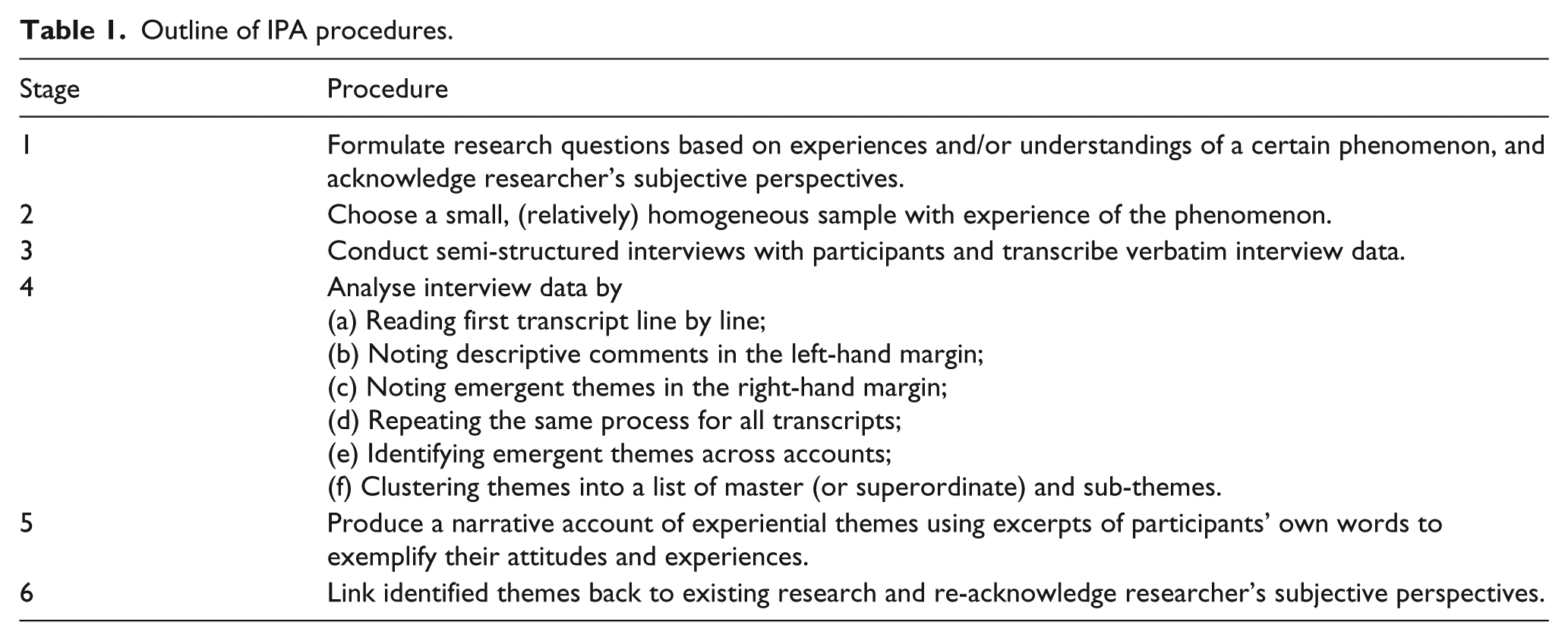
Based on the guidelines of IPA described by Smith et al. (2009), Table 1 provides a basic outline of IPA procedures.
Outline of IPA procedures.
Methods
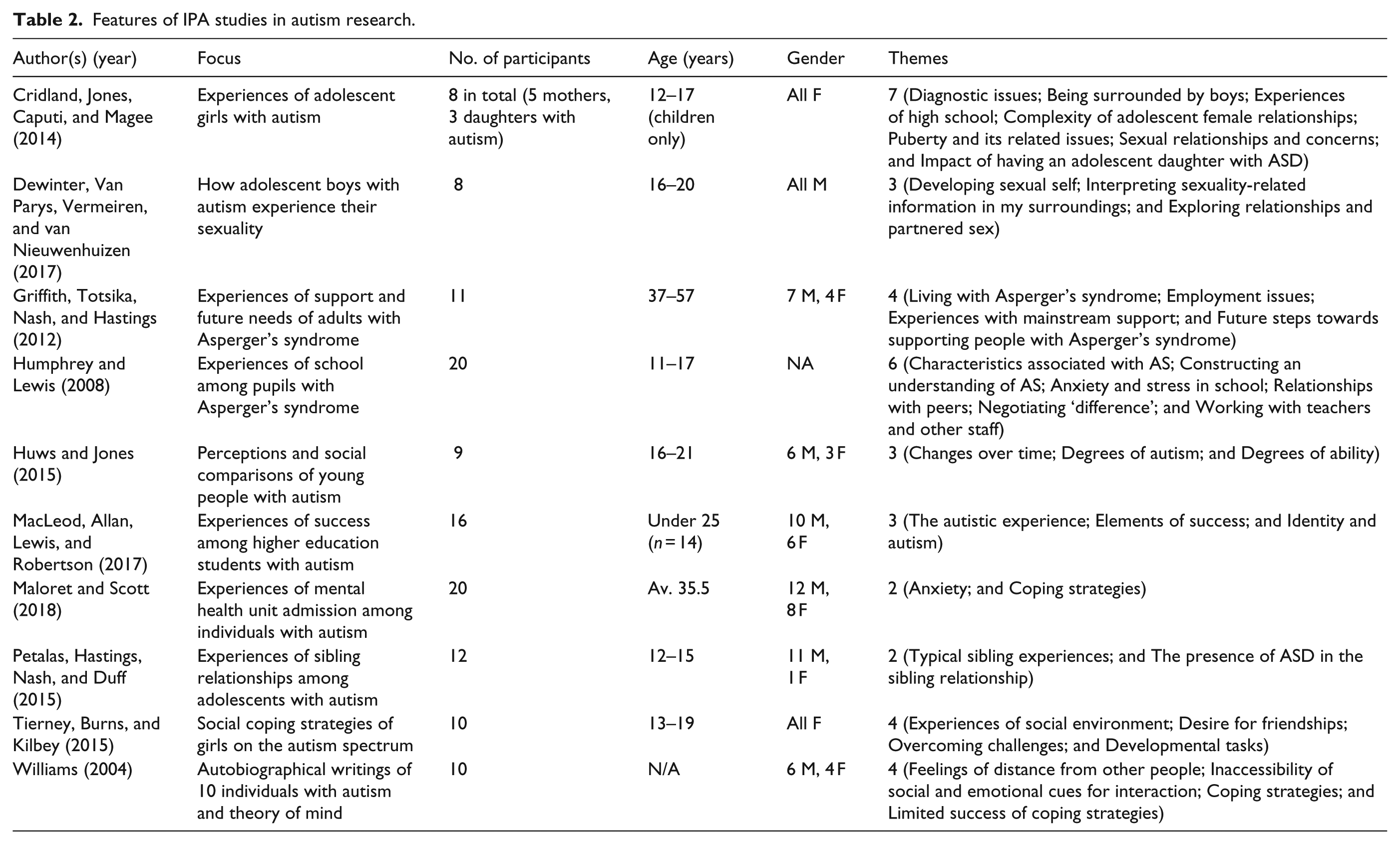
A comprehensive search of the following databases was conducted on 14 March 2018: Web of Science, Education Resources Information Centre, PsycINFO, PubMed and SCOPUS. Only articles from peer-reviewed journals were included in the search. The search term ‘interpretative phenomenological analysis’ preceded each of the following terms: ‘autism’, ‘autistic’, ‘Asperger’s’ and ‘Aspergers’. Overall, 260 studies were found across the five databases. Studies were excluded if they (a) did not use IPA or refer explicitly to autism (n = 173), (b) referred to autism in the broader context of intellectual disabilities (n = 42), (c) did not include first-person accounts (n = 26), (d) did not explicitly reflect on or justify the use of IPA in great detail (n = 6) and (e) used a mixed-methods approach (n = 3). In total, 10 studies were identified as apposite to the aims of this short report. The titles, themes, and demographic features of the included studies are listed in Table 2.
Features of IPA studies in autism research.
Features of IPA studies in autism research
The average number of participants in the studies reviewed was 12, in keeping with the wider body of IPA research (Smith et al., 2009). Unsurprisingly, all the mixed studies in our sample contained more males than females, reflecting the greater representation of males in the diagnosed population. Two studies focused entirely on the experiences of autistic females (Cridland, Jones, Caputi, & Magee, 2014; Tierney, Burns, & Kilbey, 2015) and one study contained solely male participants (Dewinter, Van Parys, Vermeiren, & van Nieuwenhuizen, 2017). Samples were largely described as homogeneous, in terms of age and diagnosis; however, diagnostic homogeneity was rarely achieved and should be given greater recognition in future IPA studies. Papers focused on the experiences of adults, adolescents and children, and the youngest participant was 11 years (Humphrey & Lewis, 2008).
Most common among data collection methods was the semi-structured interview, in which topics and questions are initially guided by the researcher but are responsive to the participant’s answers. Given IPA’s pursuit of insider perspectives, semi-structured interviews give a much-needed voice to autistic individuals (Humphrey & Lewis, 2008), facilitate rapport-building between the researcher and participant (Cridland et al., 2014) and confer agency to the participant with regard to the pace and direction of the interview (Huws & Jones, 2015). Particular adaptations made for autistic participants included using concrete examples (Tierney et al., 2015), identifying an appropriate adult in advance in case of distress during the interview (Huws & Jones, 2015) and providing children with a stop card (Humphrey & Lewis, 2008). Griffith, Totsika, Nash, and Hastings (2012) and Petalas, Hastings, Nash, and Duff (2015) also conducted telephone interviews, while MacLeod et al. (2017) offered three choices of interview format (face-to-face, telephone and synchronous online interview) to cater to individual preferences.
Three studies piloted their interview schedules (Maloret & Scott, 2018; Petalas et al., 2015; Tierney et al., 2015) to ensure the suitability of questions for autistic participants and five studies provided participants with an outline of topics prior to the interview (Cridland et al., 2014; Griffith et al., 2012; Huws & Jones, 2015; MacLeod et al., 2017; Petalas et al., 2015). This may be particularly important for autistic participants, as it allows them time to familiarise themselves with topics before the interview.
Although most of the studies reviewed used semi-structured interviews, a handful of papers employed alternative methods of data collection including written autobiographical accounts (Williams, 2004), diaries and drawings (Humphrey & Lewis, 2008). These different techniques demonstrate a move away from conventional IPA guidelines in recognition that the autistic community may require or prefer different platforms for articulating their lived experience. Humphrey and Lewis’ (2008) use of diaries served as a complementary tool alongside interviews, which elicited more personal information and afforded more time for reflection.
When outlining methods of data analysis, all the studies except one (Cridland et al., 2014) employed the guidelines for data analysis suggested by Smith and colleagues (as outlined above), resulting in between two (Maloret & Scott, 2018) and seven (Cridland et al., 2014) superordinate themes (see Table 1). Dewinter et al. (2017) compiled a descriptive account of each participant to facilitate their search for convergent and divergent patterns across participants, while Humphrey and Lewis (2008) focused their analysis on questions such as ‘what does this experience mean for the person?’ and ‘what is it like to have lived this experience?’ (p. 29).
To improve the trustworthiness of findings, the IPA studies under review used post-interview field notes (Huws & Jones, 2015), reflective logs (Tierney et al., 2015) and research diaries (Dewinter et al., 2017) to document the procedures and initial interpretations of participants’ responses and increase researcher reflexivity. All the studies reviewed used relevant excerpts to validate theme selection and give readers a sense of the participants’ experience. Follow-up meetings and debriefing also took place in many cases to ensure that participants were satisfied with how their responses had been represented and interpreted. Although participant validation is a contentious issue within IPA, and qualitative approaches more broadly, it may be congruous with a more participatory approach to autism research. For instance, in MacLeod et al.’s (2017) study, participants were sent an annotated version of their interview transcript and follow-up interviews were conducted to discuss the potential misinterpretations in analyses. In a similar vein, Maloret and Scott (2018) recruited an autistic member of the local council’s Asperger’s team to review transcripts and identify themes. These two strategies provide the most significant examples on how IPA’s double hermeneutic can heed the call for a ‘new commitment to equality of participation’ (Pellicano et al., 2018).
Suitability of IPA in autism research
MacLeod et al. (2017) validate the use of IPA with autistic students in their suggestion that the sense-making process ‘may require accommodating (or rejecting) an externally imposed identity’ (p. 3). By placing the informant at the nexus of the research and enabling them to participate meaningfully in the sense-making process, IPA necessitates a respect for the participant and their perspective, providing a crucial first step in bridging the ‘double empathy’ gap. Nevertheless, credence should also be given to the professional competency of the researcher, who often brings years of practical experience and should therefore not have to suppress their professional judgement, but allow it to enrich their interpretation of data (e.g. Maloret & Scott, 2018; Petalas et al., 2015). Equally, as an interrogative approach, IPA demands that participants’ responses are contextualised within prior experience and existing literature.
With its small and purposive samples, IPA research does not aim to be generalisable to whole populations, but may illuminate autistic experiences in a way that other qualitative approaches do not. This may be challenging to researchers who have trained in empirical methods that emphasise a positivistic approach to epistemology. While IPA shares many characteristics with grounded theory, which seeks to generate a theoretical explanation of a particular phenomenon or process, the frameworks differ in two key areas. IPA arguably offers the researcher greater flexibility and creativity in the choice of methods and broadly speaking seeks to answer psychological rather than sociological questions (Willig, 2013). In this sense, IPA may provide a more useful framework for understanding how individuals experience autism. However, researchers should keep in mind that the qualitative approach adopted should be guided by the study’s research aims and questions.
While IPA offers great insight into the lived experience of participants, its focus on language as the medium of expression poses a challenge to its use (Willig, 2013). This may be particularly true for research conducted with the autistic community. Dewinter et al. (2017), for example, highlight that limited expressive language and overly formal language of some participants restricted the richness of their data. If IPA is so intrinsically bound to the elicitation of voice, questions may well be raised as to whether it can be a legitimately useful tool for autistic individuals with language difficulties. In this vein, it is acknowledged that while traditional forms of IPA may represent a useful methodological framework for some autistic participants, it will not be appropriate for all, given its reliance on spoken language. Instead, other methods of data collection such as participant diaries and drawings, as well as photo elicitation (King, Williams, & Gleeson, 2017; Stephenson & Adams, 2016), may be increasingly useful methods in IPA studies with autistic participants. Despite the rise in IPA studies in the autism field, only 3 of 33 studies in DePape and Lindsay’s (2016) meta-synthesis of the lived experience of autistic people employed IPA as their analytical framework. By contrast, the majority of studies employed thematic analysis, which indicates that IPA is perhaps not yet recognised as a primary qualitative approach for research with the autistic community.
Recommendations and caveats for future IPA studies in autism research
While IPA is gaining momentum in autism research, it is important not to become overly reliant on methodological labels at the expense of using methods that are appropriate to both the research question(s) and, more importantly, the population involved in the research. Accordingly, we believe that future studies into the lived experience of autistic individuals – whether following an IPA approach or not – should take heed of the following recommendations and caveats. First, along with Dewinter et al. (2017), we call for more careful consideration to be given to finding sensitive, creative and personalised ways of capturing experiences within the autistic community, particularly more visual methods which cater for individuals with no or little productive language. Second, in order to address a possible critique of IPA that the contexts and conditions behind participants’ lived experiences may be absent from the analysis (Willig, 2013), the perspectives of family members and practitioners could also be sought to complement and enrich the accounts of autistic participants, but should never overshadow them.
Third, given the possible temptation to re-describe what participants say rather than interpret and critically engage with their experiences, more emphasis should be placed on producing ‘comprehensive, systematic and persuasive’ accounts (Smith et al., 2009) of autistic lived experience. Fourth, greater reflexivity is required on the part of the researcher, in both engaging with their own experiences and preconceptions, and acknowledging the potential impact of the ‘double empathy problem’ on their research. This will be best achieved when autism research is participatory and involves the autistic community at each stage, from shaping the research questions and designing the methods to the dissemination of results (Fletcher-Watson et al., 2018). These recommendations are not intended to be prescriptive, especially in light of the methodological flexibility of IPA. Instead, they aim to highlight the ways in which an IPA approach could help to illuminate future research priorities for quantitative and qualitative autism researchers alike.
Supplemental Material
AUT823902_Lay_Abstract – Supplemental material for Using interpretative phenomenological analysis in autism research
Supplemental material, AUT823902_Lay_Abstract for Using interpretative phenomenological analysis in autism research by Katie Howard, Napoleon Katsos and Jenny Gibson in Autism
Footnotes
Acknowledgements
The authors would like to thank the reviewers for their insightful comments and suggestions.
Funding
The author(s) disclosed receipt of the following financial support for the research, authorship and/or publication of this article: The first author (K.H.) was funded by the University of Cambridge in association with the AHRC-funded project, ‘Multilingualism, Empowering Individuals, Transforming Societies’ (MEITS). The second and third authors (N.K. and J.G., respectively) were supported by the UK Arts and Humanities Research Council grant ‘Multilingualism Empowering Individuals, Transforming Societies’ (MEITS; AH/N004671/1).

References
Supplementary Material
Please find the following supplemental material available below.
For Open Access articles published under a Creative Commons License, all supplemental material carries the same license as the article it is associated with.
For non-Open Access articles published, all supplemental material carries a non-exclusive license, and permission requests for re-use of supplemental material or any part of supplemental material shall be sent directly to the copyright owner as specified in the copyright notice associated with the article.
