



Abstract
Atypical social communication is a key indicator of autism spectrum disorder and has long been presumed to interfere with friendship formation and first impressions among typically developing youth. However, emerging literature suggests that such atypicalities may function differently among groups of peers with autism spectrum disorder. The current study aimed to investigate the relationship between atypical social communication patterns and first impression sociometric ratings by peers in groups of youth with autism spectrum disorder. Findings suggest that, contrary to typically developing individuals, several forms of atypical communication among youth with autism spectrum disorder are associated with more positive first impressions by others with autism spectrum disorder. This suggests that interventions designed to increase friendships among youth with autism spectrum disorder may benefit from reframing their approach to addressing atypical social communication.
Autism spectrum disorder (ASD) is characterized by atypical social communication (Lord et al., 2018), with differences in social communication patterns (eye contact, facial expressions, gestures, and tone of voice) listed among key indicators in current diagnostic tools (American Psychiatric Association, 2013). Consistent and normative use of social communication behaviors has long been considered a vital factor in friendship formation and initial impressions. Thus, it has likewise been presumed that challenges in these domains influence functional social deficits, such as difficulty making and keeping friends, among those with ASD (Mendelson et al., 2016). While atypical social behaviors are presumed to impact friendship between those with and without ASD (Chevallier et al., 2012; Mendelson et al., 2016), it is important to understand the impact of atypicalities in social behaviors on social relationships among those with ASD. As qualitative reports suggest that individuals with ASD may have different social expectations in regards to friendships (Sosnowy et al., 2018), such atypicalities may provide an index of these differences. Consistent with this idea, recent research highlights novel patterns of interaction among those with ASD (Heasman & Gillespie, 2019b); however, no study has yet examined the impact of such differences on friendship formation in this population.
While atypicalities in behavior have historically been thought to impede social interactions, thus having an adverse effect on first impressions and friendships, Heasman and Gillespie (2019b) suggest that the ebb and flow of “intense rapport, reciprocation and humor” seen in interactions between individuals with ASD may conversely result in effective communication (Heasman & Gillespie, 2019a). Similarly, Klin et al. (2002) found that gaze fixation on the mouth, rather than on eyes, while watching videos of conversations predicted higher social competence in those with ASD. Testimonials of experiences related to social interaction and subsequent atypicalities provided by individuals with ASD (Jaswal & Akhtar, 2019) align with these findings and suggest that atypicalities can serve an adaptive purpose. Such testimonials can help to parse normocentric biases that often influence hypotheses regarding social behavior (Heasman & Gillespie, 2019a). For instance, typically developing (TD) adults form persistent, negative first impressions of those with ASD within seconds of observing stylistic differences in social behavior (Sasson et al., 2017). While individuals with ASD also reported negative first impressions of other adults with ASD, these initial negative impressions did not extend to the desire for interaction with those adults with ASD as it did with the TD adults (DeBrabander et al., 2019). No research has yet examined how the stylistic atypicalities driving these initial impressions relate to impressions derived from actual interactions among groups of individuals who all have ASD.
Normative use of social communication patterns (e.g. eye contact and facial expressions) are related to positive peer relationships among TD individuals (Davidson & Duberman, 1982). Indeed, these aspects of social communication are considered so essential they are included as key diagnostic elements of ASD in gold standard autism diagnostic tools. However, the relationship between these atypical social behaviors and first impression ratings has not been previously explored among youth with ASD. Thus, in the present study, we aimed to explore the impact of social communication atypicalities on first impressions of those with ASD. Specifically, we hypothesized that (1a) greater amounts of atypical vocalizations, (1b) greater amounts of atypical gestures, (1c) less modulated eye contact, and (1d) greater amounts of atypical facial expressions would negatively influence initial sociometric ratings across four dependent variables (social preference, friendship, reciprocated friends, and desire to play again) in peers with ASD.
Methods
Procedure
All data for this study were drawn from the first session of a larger intervention study. Participants in the intervention were clustered into relatively aged-matched groups, wherein they interacted with one another for 1.5 h. At the end of the first session, participants individually nominated other participants as those whom they liked, disliked, and considered to be their friend using pictures of each participant via a standard sociometric nomination procedure. They were also asked how much they would like to play again with each other peer. This was a masked sociometric nomination procedure, as it was administered privately to each individual participant by a research assistant who was blind to study hypotheses, participant condition, and identifying participant information. Furthermore, it was explained to participants that their answers were private and would not be shared with others in the group. These measures limited the influence of potential bias or expectancy effects, as in previous studies that used this procedure (see Mendelson et al., 2016).
Participants
Fifty-five youth (Table 1) with ASD were drawn from the first session of an intervention study (Marro et al., 2019). It was unlikely that participants knew each other previously, as the distance participants traveled from home ranged widely (from one to ~100 miles). Given that adolescents with ASD often experience considerable social difficulties that both begin and intensify during that period (Picci & Scherf, 2015), the larger intervention study from which participants were drawn focused primarily on youth in this age group.
Demographics and clinical descriptives of sample.
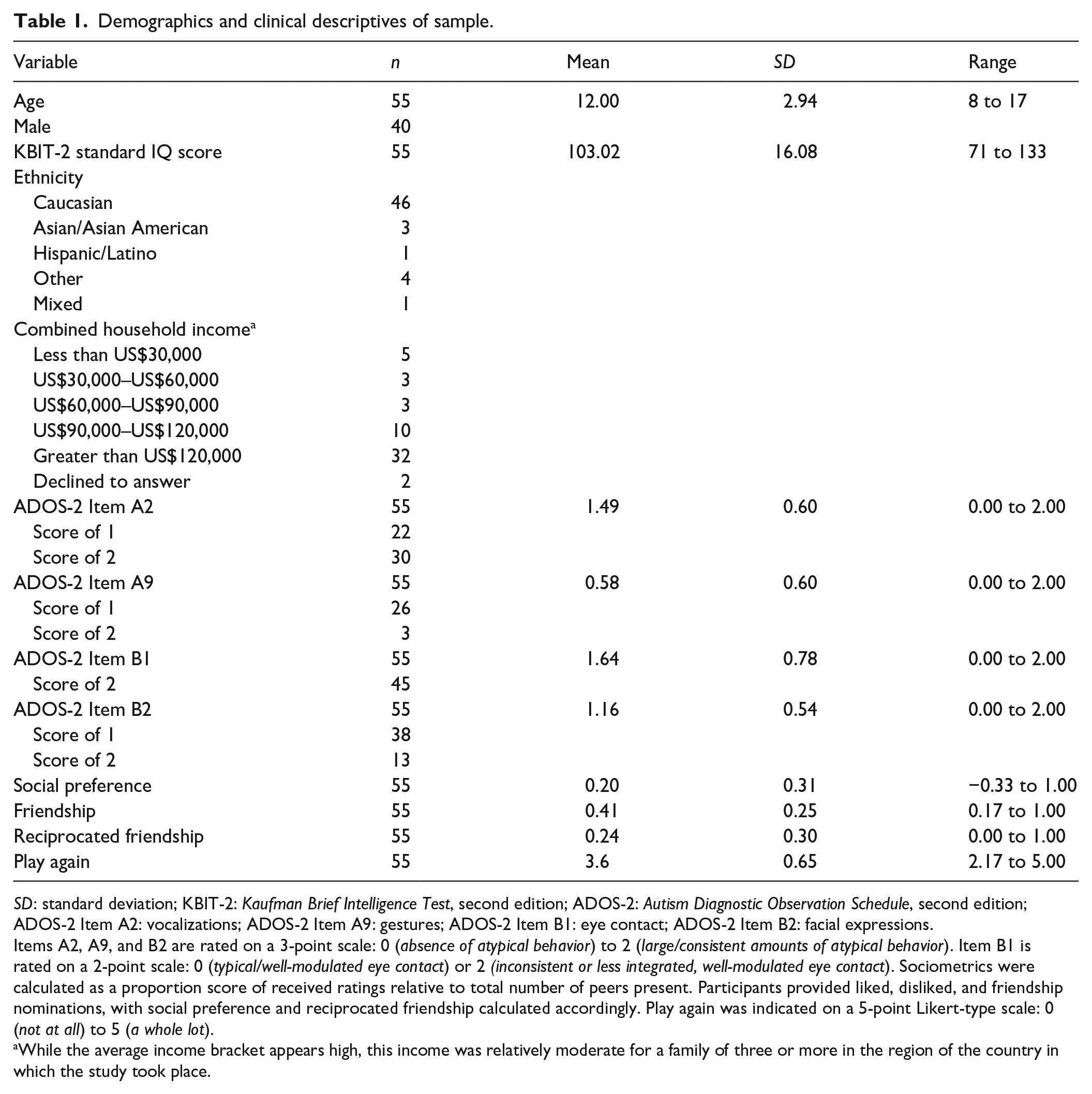
SD: standard deviation; KBIT-2: Kaufman Brief Intelligence Test, second edition; ADOS-2: Autism Diagnostic Observation Schedule, second edition; ADOS-2 Item A2: vocalizations; ADOS-2 Item A9: gestures; ADOS-2 Item B1: eye contact; ADOS-2 Item B2: facial expressions.
Items A2, A9, and B2 are rated on a 3-point scale: 0 (absence of atypical behavior) to 2 (large/consistent amounts of atypical behavior). Item B1 is rated on a 2-point scale: 0 (typical/well-modulated eye contact) or 2 (inconsistent or less integrated, well-modulated eye contact). Sociometrics were calculated as a proportion score of received ratings relative to total number of peers present. Participants provided liked, disliked, and friendship nominations, with social preference and reciprocated friendship calculated accordingly. Play again was indicated on a 5-point Likert-type scale: 0 (not at all) to 5 (a whole lot).
While the average income bracket appears high, this income was relatively moderate for a family of three or more in the region of the country in which the study took place.
Eligibility criteria included IQ ⩾ 70 on the Kaufman Brief Intelligence Test, second edition (KBIT-2; Kaufman, 2004), and meeting diagnostic criteria for ASD on the Autism Diagnostic Observation Schedule, second edition (ADOS-2; Lord et al., 2012). Many of the participants were previously diagnosed with ASD prior to the initial visit; however, all diagnoses were confirmed using the ADOS-2. Psychiatric and medical comorbidities and medications were not considered uniform ineligibility criteria. However, parent-reported severe medical or psychiatric impairment (e.g. associated with active psychotic episodes) that could hinder age-appropriate play or interfere with the completion of study activities, as well as significant hearing, vision, or movement problems that could prevent completion of the study, were exclusion criteria.
Ages at participation ranged from 8 to 17. Participants were divided into eight groups, which were age-matched within a 3–4-year window: Group 1 = 14–17 years (n = 7); Group 2 = 9–12 years (n = 6); Group 3 = 8–11 years (n = 6); Group 4 = 13–15 years (n = 5); Group 5 = 14–17 years (n = 6); Group 6 = 8–11 years (n = 9); Group 7 = 8–12 years (n = 9); and Group 8 = 13–17 years (n = 7).
Measures
KBIT-2
The KBIT-2 assesses both verbal and nonverbal intelligence in children from age 4 through adulthood, using a series of three sections (verbal knowledge, matrices, and riddles; Kaufman, 2004).
ADOS-2
In past literature, the ADOS-2 has been shown to be a reliable and valid measure for assessing ASD symptoms (Lord et al., 2000). The ADOS-2 is the “gold standard” for autism diagnosis in research settings. Modules 3 and 4 were administered by research-reliable examiners for study inclusion (Lord et al., 2012). ADOS-2 items A2, A9, B1, and B2 index atypical vocalizations, gestures, eye contact, and facial expressions, respectively. In Module 4, Item A10 also indicates atypical empathetic and emotional gestures, but was not incorporated into the analyses to harmonize across modules. Atypical vocalizations, gestures, and facial expressions are rated on a 3-point scale: 0 (absence of atypical behavior) to 2 (large/consistent amounts of atypical behavior). Atypical eye contact is rated as either 0 (typical/well-modulated eye contact) or 2 (inconsistent or less integrated modulated eye contact).
Sociometrics
Research indicates that sociometric ratings are reliable and valid depictions of friendships among peers, and, thus, are the gold standard measure of friendship-making and peer relations (Newcomb et al., 1993). After the group sessions, sociometric ratings were collected through a masked nomination procedure, which is commonly used to assess peer friendships (Coie et al., 1982) and has been shown to provide accurate indication of friendship formation in those with ASD (Mendelson et al., 2016).
Pictures of the other participants were provided to aid recall. Participants nominated other participants on four variables: how much they liked and disliked each other, whether they were friends, and whether they wanted to play again with one another. Four distinct sociometric variables were obtained from participants: liked, disliked, friendship, and play again.
Proportion scores (number of received nominations/number of peers in the group) were calculated for liked, disliked, and friend nominations. Liked and disliked have been shown to be distinct constructs (Goldman et al., 1980) and were used to calculate social preference as received liked scores minus received disliked scores for a given individual, as is standard practice in this literature (Coie et al., 1982). For instance, if a child was liked by five peers and disliked by two peers, they had a social preference score of three. Reciprocated friendship was calculated as number of received friend nominations from peers who the participant also nominated as a friend/number of peers in the group. Participants indicated their desire to play again with one another on a 5-point Likert-type scale: 0 (not at all) to 5 (a whole lot).
Data analytic plan
First, sample descriptive statistics and bivariate correlations were examined. Generalized estimating equations (GEEs) were run using SPSS Version 24.0 to explore hypotheses. GEEs are a modification to the general linear model, used to account for nesting within groups (Hanley et al., 2003). Indeed, GEE holds specific advantages over multilevel modeling, particularly when the random effect (i.e. the specific group of peers with whom the child participated) is included in the model solely to account for—but not model—its effect (McNeish et al., 2017). GEE as instantiated in SPSS utilizes the Huber–White–Sandwich (or heteroscedasticity-consistent) standard error estimator, which is robust to potential misspecification of the working correlation matrix. The identity link function was used as well. A model comparison approach was used to adjudicate among unstructured and independent correlation matrices for each model using the quasi likelihood under independence model criterion (QIC; Pan, 2001). Within each model, item level contrasts were examined only when overall Wald χ2 for each item was significant.
To test the hypotheses that more atypical vocalizations (Hypothesis 1a), more atypical gestures (Hypothesis 1b), less modulated eye contact (Hypothesis 1c), and more atypical facial expressions (Hypothesis 1d) would independently predict differences in sociometric ratings across all four dependent variables, the corresponding ADOS-2 items (A2, A9, B1, and B2) were entered simultaneously into GEE for each of the dependent variables (social preference, friendship, reciprocated friends, and play again). Throughout all four GEEs, intervention condition was held constant.
Results
Zero-order correlations among sociometric ratings as well as zero-order polyserial correlations between ADOS-2 items and sociometric ratings are presented in Table 2. In terms of the GEE models, unstructured working correlation matrix structure was the superior model for predicting social preference (QIC = 16.467 vs 28.892), friendship (QIC = 5.475 vs 30.467), and reciprocated friendship (QIC = 6.180 vs 32.092). Independent working correlation matrix structure was superior for the play again variable (QIC = 40.962 vs 44.266).
Zero-order sociometric correlations and polyserial ADOS-2 correlations.

ADOS-2: Autism Diagnostic Observation Schedule, second edition; ADOS-2 Item A2: vocalizations; ADOS-2 Item A9: gestures; ADOS-2 Item B1: eye contact; ADOS-2 Item B2: facial expressions.
Zero-order correlations.
Polyserial correlations.
Correlation is significant at 0.01 level (two-tailed)
A main effect of ADOS-2 Item A2 (atypical vocalizations) on social preference and reciprocated friendship was found (Table 3). Those who scored either 1 (n = 22) or 2 (n = 30) received significantly greater social preference ratings but fewer reciprocated friendships, relative to those who scored 0 (n = 3).
GEE results of ADOS-2 scores on sociometric ratings.
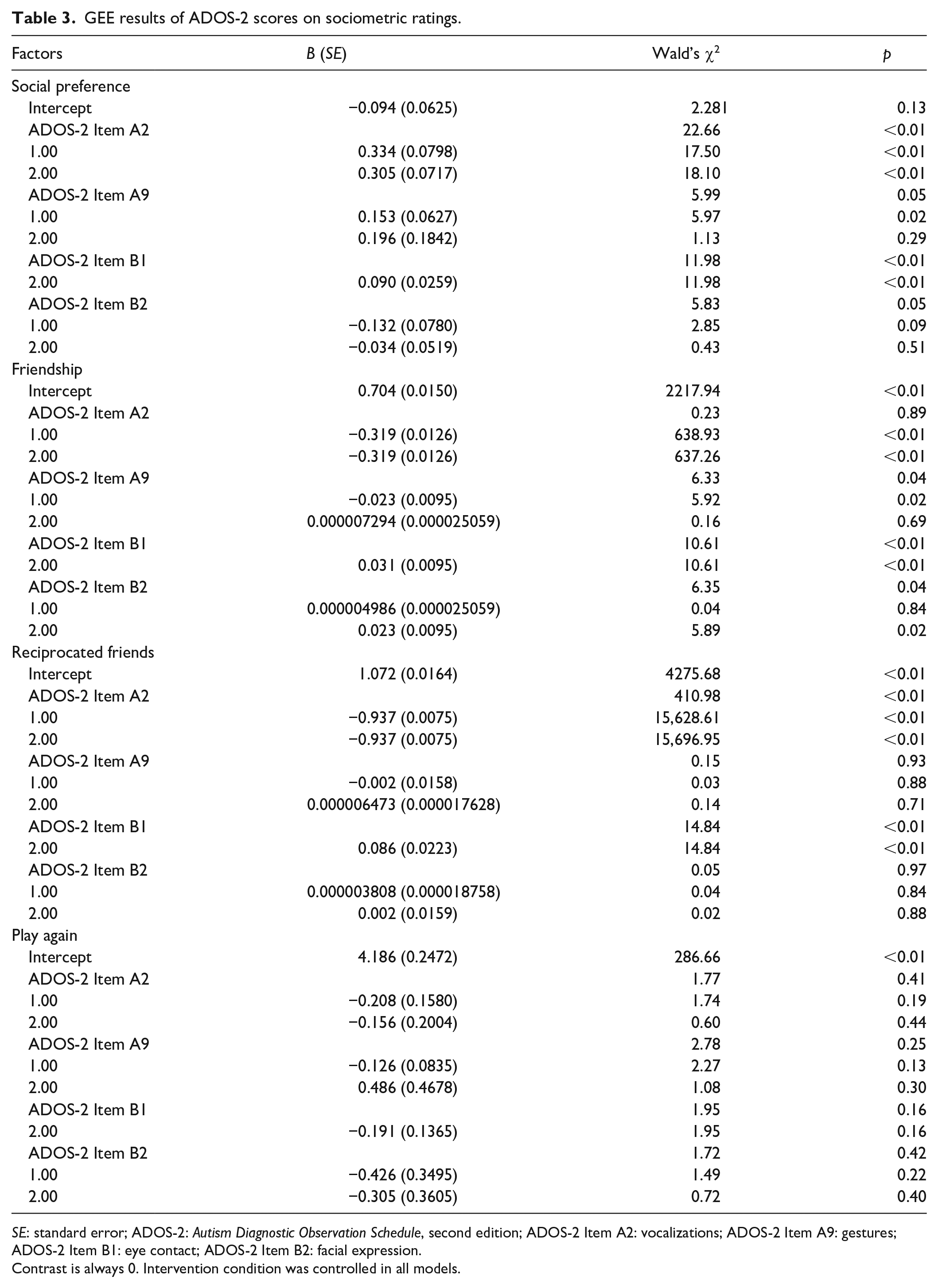
SE: standard error; ADOS-2: Autism Diagnostic Observation Schedule, second edition; ADOS-2 Item A2: vocalizations; ADOS-2 Item A9: gestures; ADOS-2 Item B1: eye contact; ADOS-2 Item B2: facial expression.
Contrast is always 0. Intervention condition was controlled in all models.
A main effect of ADOS-2 Item A9 (reduced use of gestures) on friendship was found. Those who scored 1 (i.e. moderately reduced quantities of gestures; n = 26) received significantly fewer friendship ratings than those with normative gesture use (i.e. score of 0; n = 26).
Main effects of ADOS-2 Item B1 (atypical eye contact) on social preference, friendship, and reciprocated friendship ratings were found, indicating that those who made less well-modulated eye contact (n = 45) had greater social preference and friendship ratings, including reciprocated friendships, relative to those who scored 0 (n = 10).
A main effect of ADOS-2 Item B2 (reduced facial expressions) on friendship indicated that those who received a score of 2 (n = 13) received significantly more friendship ratings, relative to those who scored 0 (n = 4). There were no significant findings for the play again variable.
Discussion
This was the first study to examine the effect of atypical social behavior on first impressions among peers with ASD. Contrary to our hypotheses, our findings suggest that youth with ASD may prefer the friendship of individuals for whom some aspects of their social communication patterns are considered atypical, such as displaying reduced eye contact and facial expressions. These results are consistent with contentions that some atypical social behaviors serve a unique function in ASD (Jaswal & Akhtar, 2019), rather than operating exclusively as deficits.
These findings support the notion that youth with ASD may preferentially seek the friendship of those who engage in atypical social behavior. In a recent study, DeBrabander et al. (2019) found that, while both ASD and TD raters evaluated adults with ASD similarly on personal (e.g. awkwardness) and physical (e.g. attractiveness) characteristics, only for ASD raters did neither characteristics nor disclosed diagnoses have an effect on the rater’s desire to interact again with the individual. Thus, observing atypical social behavior during video segments did not reduce the likelihood of desired contact for raters with ASD. Our findings suggest that experiencing these atypical social behaviors during actual social interaction may in fact increase the likelihood of desired contact for youth with ASD. It may be that youth with ASD are more likely to form friendship with those who display atypical social behaviors because those patterns of interaction function to facilitate in-person communication among those with ASD (Heasman & Gillespie, 2019b). Indeed, this is consistent with recent work demonstrating that adults with ASD, in contrast to TD adults, report a preference for interactions with other adults with ASD after actual social interaction (Morrison et al., 2019). Alternatively, it may be that some aspects of typical social communication are overly-demanding or uncomfortable. For instance, many individuals with ASD subjectively report eye contact to be aversive (Jaswal & Akhtar, 2019), and is associated with increased emotional arousal (Dalton et al., 2005). Here, we found reduced eye contact to be the behavior most consistently related to positive peer outcomes, suggesting that youth with ASD prefer interactions with peers who do not demand frequent eye contact. A similar effect was seen with reduced use of facial expressions.
While youth with ASD may prefer peers who exhibit some atypical social communication, this is not necessarily true for all types and quantities of atypical behavior. For instance, youth with more atypical vocalizations were more preferred—but less likely to reciprocally be nominated as a friend—by peers. Youth with ASD may find it difficult to interpret atypical vocalizations; therefore, while this behavior may present some familiarity (leading to greater social preference), having to interpret this behavior may add to the complexity of interaction (thereby interfering with friendship formation). In addition, those with moderate amounts of atypical gestures received fewer friendship nominations, which suggests that youth with ASD may also have difficulty interpreting interactions from limited information in this communicative channel, leading to reduced friendships.
These findings suggest that interventions designed to increase friendships among youth with ASD may benefit from reframing their approach to addressing atypical social communication. Many such interventions focus on either reducing atypicalities in social interaction (i.e. fewer odd vocalizations; more eye contact) or increasing attention to typical nonverbal social patterns of interactions (i.e. read facial expression). However, if the goal is to promote friendships with like-minded peers—those who also have ASD (Mendelson et al., 2016)—then these interventions may do well to eschew such prescriptive approaches and instead focus on attuning to the level and use of nonverbal social communication that seems most effective with a given peer.
Limitations
A limitation of the current study is the moderate sample size, which is not particularly diverse. Findings, therefore, may not be generalizable across diverse samples or gender. Another potential limitation is that the ADOS-2 only provides a thin slice of clinician-observation. While the ADOS-2 is intended to indicate the capacity to use a given social communication skill if it is present, it still does not represent a completely naturalistic interaction. Therefore, atypical social behaviors observed by clinicians throughout the ADOS-2 may not reliably translate into interactions experienced by peers. In addition, while there appears to be a preference among youth with ASD for peers with greater amounts of atypical behavior, we exclusively explored individuals with ASD. Thus, it is unclear if these findings would generalize to a group which also included TD individuals.
The cross-sectional design of this study poses another limitation, as there may be other factors contributing to the relationship found between atypical social behavior and first impression ratings among peers. Future research should further explore this relationship longitudinally to examine the causality and directionality of this relationship. It is also important to note, given the use of categorical rather than continuous predictors, scores of both 1 and 2 were compared with scores of 0. Therefore, results are more complex than simply interpreting them as a monotonic linear relationship, and each result should be interpreted only in relation to those who had normative use of social behavior (score of 0). No data were explicitly collected on whether participants previously knew each other; however, the geographically diverse sample made it unlikely that participants knew each other prior to the first intervention session. Finally, some range restriction on some of the independent variables also limits applicability more broadly. For example, there were a relatively small number of participants who scored 0 on ADOS-2 items A2 (n = 3) and B2 (n = 4), making the interpretation of typical behavior (score of 0) versus atypical behavior (score of 1 or 2) on first impressions difficult for these particular items. As a result of using ADOS-2 items as categorical predictors, scores of 1 and 2 were compared with scores of 0; however, given the small number of participants who scored 0 on items A2 and B2, effects were likely underpowered for stable estimates.
Future directions
Future studies should further examine friendships among peers with ASD (Jaswal & Akhtar, 2019). Given the relatively small sample size and limitations pertaining to items A2 and B2, it is important for future research to investigate whether these findings are robust in larger and more varied samples. In addition, exploration of actual (observed) peer interactions among those with ASD would provide further insight into how atypical social behavior present in these naturalistic interactions and how the behaviors affect the interactions themselves. In addition, reframing the approach to intervention to support friendships among those with ASD—as well as those without ASD—will involve careful calibration so as to incorporate the social needs and preferences of individuals with and without ASD. Contradictory findings that atypical social behaviors in youth with ASD lead to negative sociometric ratings in non-ASD peers (Sasson et al., 2017) highlight the importance for future research to further investigate the best approach for interventions.
Summary
These findings indicate that atypicalities in social communication (particularly reduced eye contact and facial expressions) by youth with ASD relate to increased initial peer ratings among peers with ASD. This supports contentions that atypical social communication behavior in youth with ASD may not be a uniform deficit but rather can be a means of facilitating social interaction (Jaswal & Akhtar, 2019). Future research should extend these findings to better understand the unique function of social communication atypicalities among those with ASD, and inform interventions aimed at increasing social engagement in youth with ASD.
Footnotes
Acknowledgements
The authors would like to thank all the families who participated in this study, without whom this study would not have been possible. They would also like to thank the research assistants who tirelessly collected and entered data for this project.
Declaration of conflicting interests
The author(s) declared no potential conflicts of interest with respect to the research, authorship, and/or publication of this article.
Funding
The author(s) disclosed receipt of the following financial support for the research, authorship, and/or publication of this article: This work was supported by a Stony Brook University Department of Psychiatry Pilot Grant Program Award, and the Brian A. Wright Memorial Autism Research Fund to MDL.
