




Abstract
The Transporters intervention contains 15 animated episodes that autistic children watch daily for a month and learn emotion recognition through stories depicting social interactions between vehicle characters with grafted human faces, expressing emotions. Its automated, home-based format is cost-effective. This study included four groups of young Chinese children in Hong Kong: two intervention groups (an autism intervention group and an autism + attention-deficit/hyperactivity disorder (ADHD) intervention group), an autism control group and a non-autistic group. The autism + ADHD intervention group was one that had not been separately examined before. In this study, The Transporters episodes were delivered via an App instead of the dated DVD technology. Following The Transporters intervention, both autism and autism + ADHD intervention groups improved significantly and similarly on emotion recognition and were more like the non-autistic group, while the autism control group did not. Learning was generalizable to novel situations/characters. There was no dosage effect, with the standard recommended number of episodes viewed as sufficient for significant improvement. Besides confirming the effectiveness of The Transporters for young Chinese autistic children, this study contributes to the literature/practice by expanding the range of applicability of The Transporters to autistic children with ADHD, which is important given the high co-occurrence rate between autism and ADHD.
Trial Registration:
This study was registered with the German Clinical Trials Register – Deutschen Register Klinischer Studien (DRKS) on 23 December 2018. The Trial Registration Number (TRN) is DRKS00016506.
Lay Abstract
The Transporters App is an intervention programme with 15 animated episodes that teach emotion recognition skills to autistic children between 4 and 6 years of age. Each episode contains a story depicting social interactions between characters in the form of a vehicle, with human faces grafted on to each of them. Each episode teaches a specific emotion in a story context. Autistic children watched at least three episodes at home for about 15 min daily for a month, with parental guidance. Its automated, home-based format is cost-saving and readily accessible. This study translated The Transporters to a Cantonese-Chinese version. Results showed a significant improvement in emotion recognition following viewing The Transporters in a group of Hong Kong Chinese autistic children, between 4 and 6 years of age, with and without attention-deficit/hyperactivity disorder (n = 48) relative to a control group (n = 24). A non-autistic group (n = 23) showed that the autistic children scored lower in emotion recognition pre-intervention. Post-intervention, the autistic children had improved in emotion recognition to the level of the non-autistic children. The autistic children in the intervention groups also generalized their learning to novel situations/characters not taught within The Transporters. There was no dosage effect, with the standard recommended number of episodes viewed being sufficient to achieve significant improvement. This study confirms the effectiveness of The Transporters for Chinese autistic children and contributes to the literature/practice by expanding the range of applicability of The Transporters to autistic children with attention-deficit/hyperactivity disorder, which is important given the high rate of co-occurrence between autism and attention-deficit/hyperactivity disorder.
Keywords
Autism (also referred to as autism spectrum disorder or ASD) is a lifelong neurodevelopmental condition involving significant psychosocial difficulties. Prevalence is estimated now to be 1 in 36 children, including 1% in Mainland China (Elsabbagh et al., 2012; Maenner et al., 2023; Sun et al., 2019). Autism is characterized by social communication/interaction difficulties, repetitive/stereotyped behaviours and a restricted range of interests. In particular, social communication/interaction difficulties are associated with problems in recognizing/understanding emotions and mental states in others (Baron-Cohen, 1995; Berggren et al., 2016; White et al., 2007).
Therapies/interventions often seek to support autistic children in developing their emotion recognition skills, but these can be time-intensive and costly. Modern-day technology-aided intervention programmes offer the promise of cost-saving by reducing the heavy demand for face-to-face professional inputs. These programmes/Apps can be used at home, so they are not restricted to school hours, enhancing their accessibility. They have been found to be effective in improving emotion recognition in autistic people, but outcomes on the generalizability of learning are mixed (Berggren et al., 2016; Lee et al., 2018; Zhang et al., 2021).
Among the effective technology-aided intervention programmes for autistic children, The Transporters animation series is one of the few in which children are able to generalize their learning to novel situations/characters beyond those explicitly taught (Golan et al., 2010). The Transporters teaches emotion recognition to young autistic children aged 4–6 years (Golan et al., 2010). The teaching is delivered via stories of social interactions between characters who are all vehicles (e.g. a tractor, a bus, a tram and a cable car) with human faces grafted onto them expressing emotions. The series is based on the empathizing-systemizing theory, describing autistic children’s fascination with predictable, rule-based systems such as vehicles (Baron-Cohen, 2006, 2008). The series contains fifteen 5-min episodes, each portraying a story to teach one key emotion, namely, happy, sad, angry, afraid, excited, disgusted, surprised, tired, unfriendly, kind, sorry, proud, jealous, joking and ashamed. Worried as an emotion is also taught, and it appears in multiple episodes instead of one. Altogether, The Transporters teaches 16 emotions. Its training protocol requires autistic children to watch at home at least three episodes of The Transporters per day for 4 weeks. The parents may offer some degree of guidance, based on a parental user guide developed for them, to help children focus on the emotions and social situations/events for contextualized learning, if necessary. This automated, home-based format enhances its affordability and accessibility beyond such limiting factors as professional inputs, office hours and clinics/offices.
Previous studies of The Transporters from the United Kingdom, Australia and Israel reported autistic young children achieving significant improvement in emotion recognition post-intervention with large effect sizes (partial eta squared: 0.31–0.56) (Gev et al., 2017; Golan et al., 2010; Young & Posselt, 2012). These large effect sizes were compared favourably with the overall medium effect size of a recent meta-analysis of 17 studies on facial emotion recognition training, in which the above three studies were included (Zhang et al., 2021). One exception was a study by Williams et al. (2012) which found less promising outcomes of The Transporters intervention. One potential reason was the inclusion of some autistic participants with intellectual disability in that study. Thus, the less favourable outcomes are not entirely unexpected, given that the intervention was not originally designed for autistic children with co-occurring intellectual disability (Golan et al., 2010).
There has so far only been one small-scale study of Chinese children using The Transporters in a training study in a face-to-face classroom setting (Yan et al., 2018). This format does not capitalize on the advantage of The Transporters as an automated, home-based intervention. To the best of the authors’ knowledge, there is currently no Chinese study on The Transporters that evaluates its effectiveness with the original format/mode of intervention. One cross-cultural issue on emotion recognition/expression is that Chinese people may lack as extensive a vocabulary to express emotions (Kleinman & Kleinman, 1986). Chinese societies may place less emphasis on the recognition/expression of emotions (Mak & Chen, 2010). Thus, The Transporters intervention may not be as effective for Chinese children compared to children in the West. These views about the Chinese are disputed (Stewart et al., 2010).
Past studies of The Transporters have not systematically examined the effect of co-occurring attention-deficit/hyperactivity disorder (ADHD) in autistic children. In previous studies, ADHD was not an exclusion criterion (Lee et al., 2018; Zhang et al., 2021), and separate analysis of autistic children with and without ADHD has not been conducted to address the above issue. Research into autistic children with co-occurring ADHD found increased emotion recognition difficulties (Jang et al., 2013; Leitner, 2014; Rao & Landa, 2014). Studies investigating the impact of ADHD on the treatment effectiveness of social skills training in autistic populations have also been limited. One study found that autistic children with ADHD showed no improvement in social skills after intervention, while autistic children without ADHD did (Antshel et al., 2011). These findings suggest that ADHD symptoms may negatively moderate social skills training outcomes. Given the limited research data available, there is a clear need for further research to address this issue. Autistic children with ADHD are a sizable subgroup: the prevalence of ADHD in autism ranges between 40% and 70% (Antshel et al., 2016), with a study in Hong Kong reporting a prevalence of 48.5% (Kwok et al., 2017).
The aims of this study are thus twofold: (1) to re-assess the effectiveness of The Transporters in Chinese autistic children in Hong Kong, especially given a possible cultural downplaying of emotion recognition/expression, and (2) to perform a separate analysis of autistic children with or without co-occurring ADHD. We adapted The Transporters to be delivered via an App on different electronic devices, given now that DVD technology is less common.
Methods
Study design
This study comprised a randomized controlled trial (RCT) in which autistic children without ADHD were randomized into an autism intervention group or an autism control group. Furthermore, two additional groups were included: a second intervention group of autistic children with ADHD (autism + ADHD intervention group), and a group of non-autistic children. The latter group was included to test if the autistic participants scored significantly lower than the non-autistic group on measures of emotion recognition pre-intervention. After intervention, the two autistic groups were predicted to be more like the non-autistic group in emotion recognition skills.
Development of The Transporters and control Apps
The Transporters animated series was translated into Cantonese-Chinese, the local dialect spoken in Hong Kong and back-translated for cross-checking. The translated version was finalized by a team of clinical psychologists, psychiatrists and kindergarten teachers for its cross-cultural and linguistic validity with young children in Hong Kong. It was then voice-recorded. The original DVD format of The Transporters was developed into an App for improved accessibility. A Control App was developed in which its fifteen 5-min episodes contained only moving vehicles without grafted human faces and stories associating emotional expressions with social contexts.
Participants
Sample size estimation was conducted based on a priori power analysis. Using the lowest effect size achieved on emotion recognition measures (Cohen’s d = 0.904) from the original first study (Golan et al., 2010), plus provision for intervention underperformance and participant attrition, a conservative sample size of 24 per group was estimated for this study. This sample size is comparable to those in previous studies of The Transporters (Gev et al., 2017; Golan et al., 2010).
Child psychiatrists at a child psychiatric clinic in Hong Kong recruited children aged 4–6 years old with a clinical diagnosis of autism, including some having a co-occurring diagnosis of ADHD. Autism diagnosis was further confirmed using the Childhood Autism Spectrum Test (CAST) (Scott et al., 2002) and the Autism Diagnostic Interview – Revised (ADI-R) (Lord et al., 1994), while the ADHD diagnosis was confirmed using the Diagnostic Interview Schedule for Children – Version IV (DISC-IV) (Ho et al., 2005). An additional inclusion criterion was IQ ⩾ 80. This was verified by administering the short form of either the Wechsler Intelligence Scale for Children – Fourth Edition (Hong Kong) (WISC-IV(HK)) or the Wechsler Preschool and Primary Scale of Intelligence-Fourth Edition (Hong Kong) (WPPSI-IV(HK)), if an IQ score was not available in the participants’ medical records. In total, 89 autistic children were recruited, but 3 withdrew prior to the randomization, and 8 were excluded due to autism diagnosis not being confirmed by the ADI-R. Of the remaining 78 autistic participants, 27 had a co-occurring ADHD, and constituted the autism + ADHD intervention group. The rest (n = 51) were randomized into the autism intervention group (n = 26) or the autism control group (n = 25). In Hong Kong, subsidized education is provided by the Government to all children with special needs/difficulties, such as autism, in social, emotional and behavioural domains. It includes individualized and group training provided by professionals such as special education teachers, speech therapists, counsellors and so on. Frequency and type of training provided vary considerably, depending on individual needs and resource limitations. Thus, all but three participants (4%) in this study had received some form of training previously or currently for their behavioural, cognitive, social and learning difficulties. So, while these various kinds of intervention received by the autistic children were not deliberately planned and executed by this study, the autism control group could be considered as having treatment-as-usual (TAU) in Hong Kong, while the two intervention groups (autism vs autism + ADHD) were given an extra The Transporters intervention in addition to TAU. Yet, none of the autistic participants in this study had any previous exposure to The Transporters intervention. So, there was no issue of any prior familiarity with the animated series.
A group of non-autistic children (n = 23) was recruited from the community. Exclusion criteria included known neurodevelopmental, psychiatric or chronic medical problems, above cutoff on the CAST or the Strengths and Difficulties Questionnaire (SDQ), or IQ below 80. During recruitment, autism + ADHD and non-autistic participants were age- and gender-matched to the autism intervention and autism control groups.
Six participants from the autism control and autism + ADHD intervention groups were later excluded because their IQ was assessed to be below 80. 1 One participant from the non-autistic group was also excluded due to suspected autistic traits observed by the assessors during pre- and post-intervention assessment. Such observation was reported back to the larger research team, who made a collective decision, conservatively, to exclude this participant from the non-autistic group. One participant from the autism intervention group, one participant from the autism control group, and four participants from the autism + ADHD intervention group did not return for post-intervention assessment. Following the intention-to-treat analytic strategy, their missing data were imputed (see ‘Statistical analysis’ section below). Background measures and demographic characteristics of the participants are listed in Tables 1 and 2. Figure 1 shows a CONSORT flowchart illustrating the recruitment and allocation of participants to each of the four groups in this study.
Background measures and the duration between pre- and post-intervention assessment.
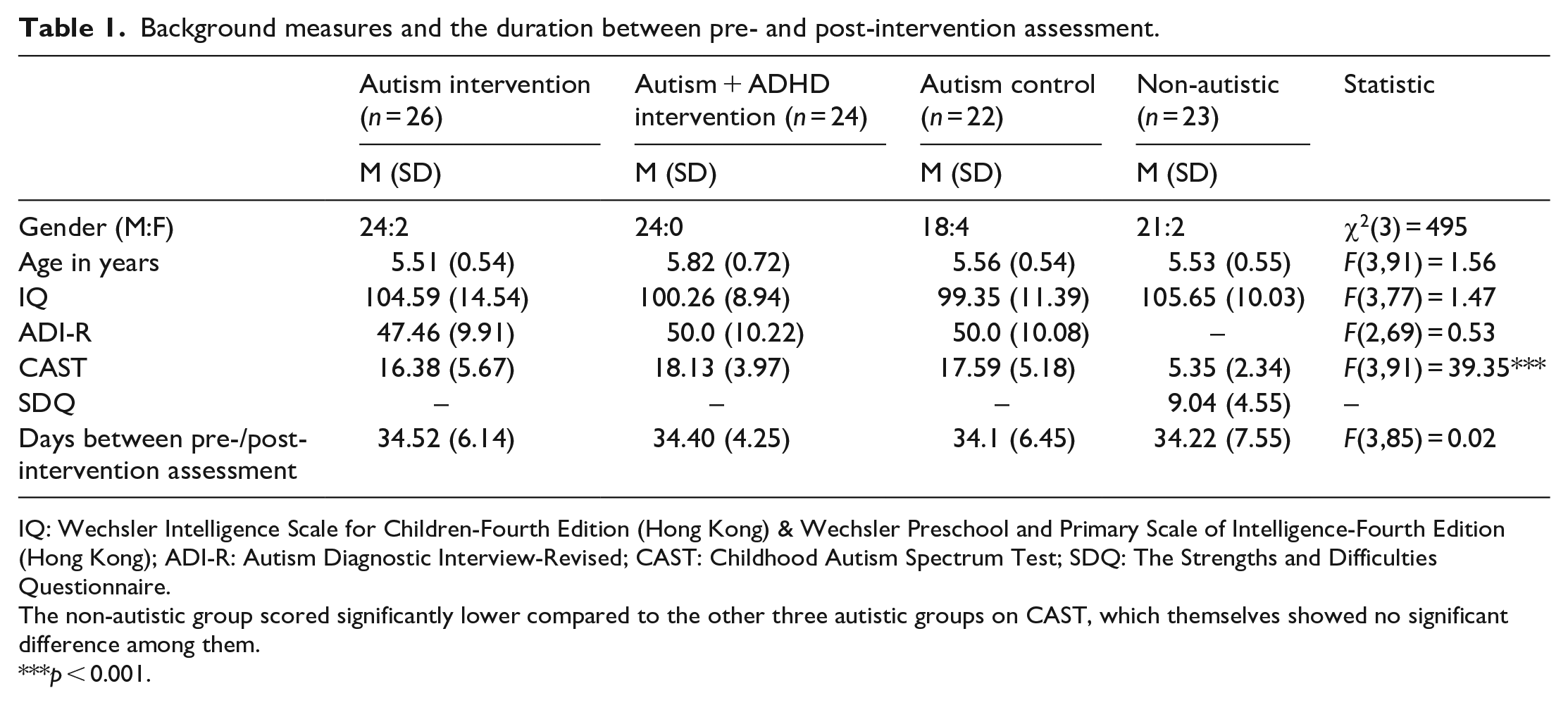
IQ: Wechsler Intelligence Scale for Children-Fourth Edition (Hong Kong) & Wechsler Preschool and Primary Scale of Intelligence-Fourth Edition (Hong Kong); ADI-R: Autism Diagnostic Interview-Revised; CAST: Childhood Autism Spectrum Test; SDQ: The Strengths and Difficulties Questionnaire.
The non-autistic group scored significantly lower compared to the other three autistic groups on CAST, which themselves showed no significant difference among them.
p < 0.001.
Demographic characteristics of the participants.
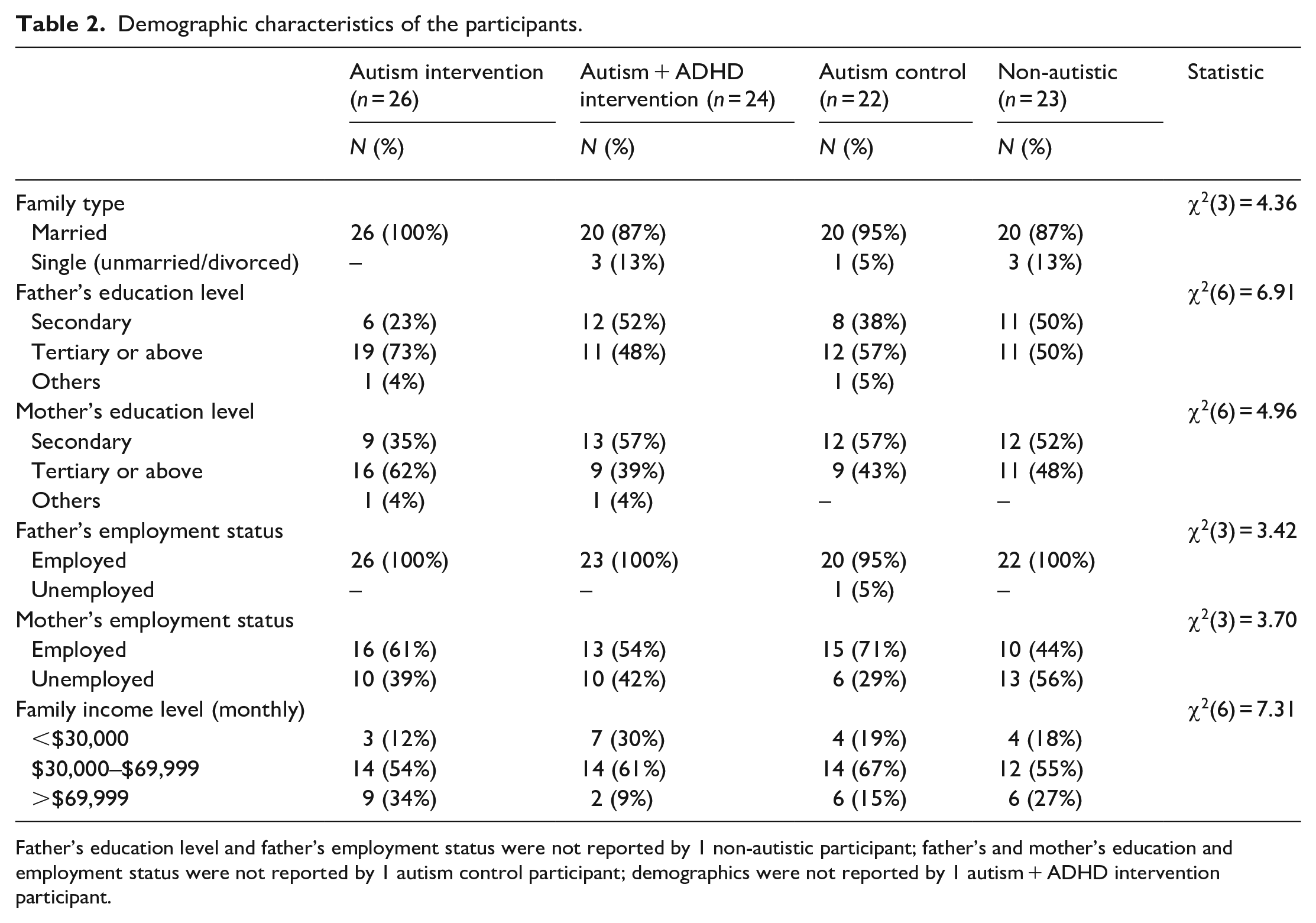
Father’s education level and father’s employment status were not reported by 1 non-autistic participant; father’s and mother’s education and employment status were not reported by 1 autism control participant; demographics were not reported by 1 autism + ADHD intervention participant.
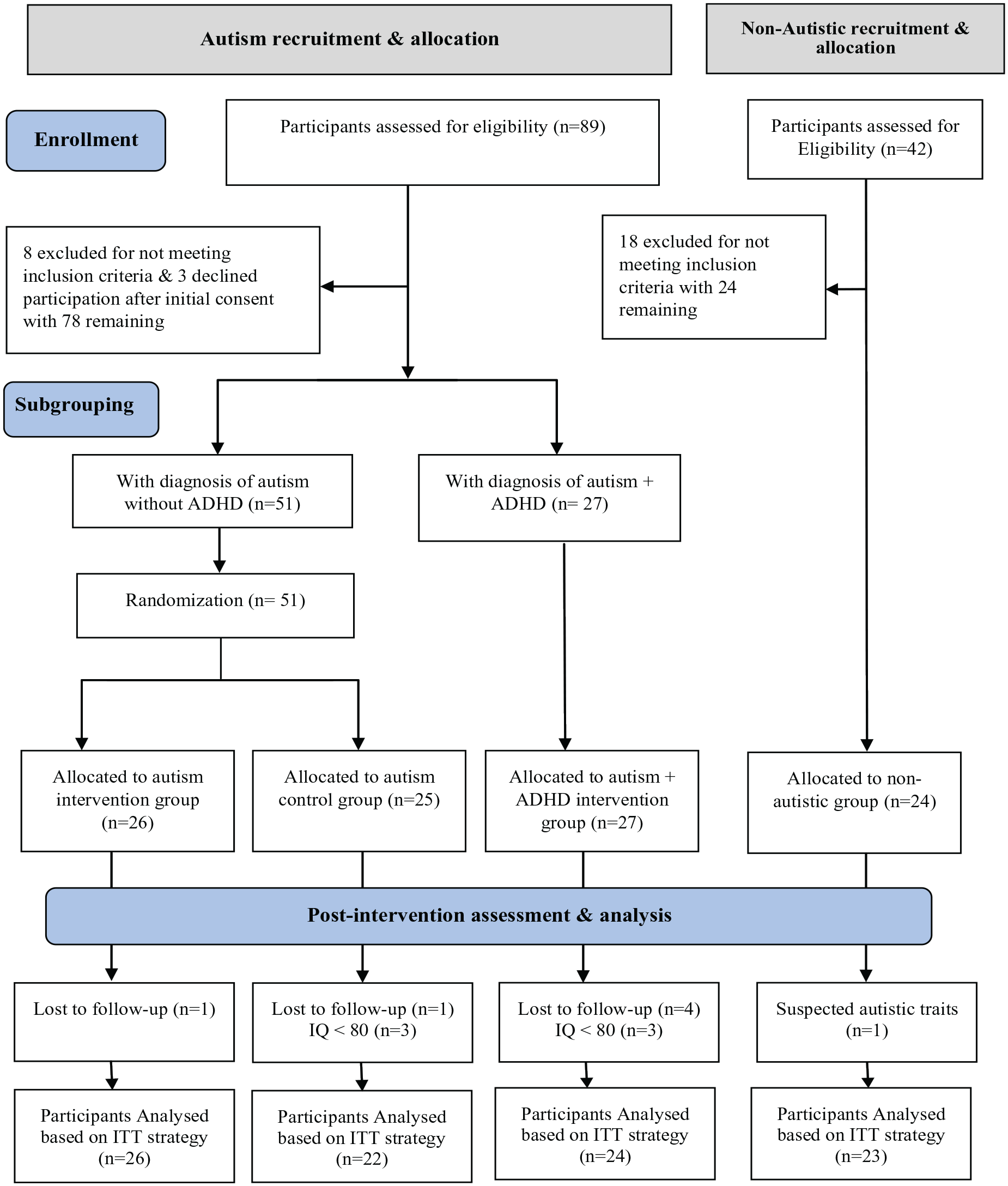
A CONSORT flowchart detailing participant recruitment, allocation and analysis.
Instruments for participant recruitment
Autism Diagnostic Interview – Revised (ADI-R)
The ADI-R is a standardized, semi-structured diagnostic interview for autism based on information from parents or caregivers. Its Chinese version was revalidated in Hong Kong (Lai et al., 2022).
Childhood Autism Spectrum Test – Chinese Version (CAST)
The Childhood Autism Spectrum Test (CAST) is a 37-item parent-completed screening questionnaire on autism, of which 31 items are scored on a two-point scale (Scott et al., 2002). The total score thus ranges from 0 to 31, with a cutoff of 15 for autism (J. Williams et al., 2005). Its Chinese version demonstrated good test–retest reliability and validity in a Chinese population with high sensitivity and specificity (Sun et al., 2013, 2014).
Diagnostic Interview Schedule for Children (DISC-IV) – parent-informant version
The DISC-IV (parent-informant) assesses common psychiatric conditions in children and adolescents, including ADHD. Its Chinese version had been satisfactorily pilot-tested in Hong Kong (Ho et al., 2005).
The Strengths and Difficulties Questionnaire – parent version (SDQ)
The Strengths and Difficulties Questionnaire (SDQ) (Goodman, 1997) is a 25-item parent-completed questionnaire that can be used to assess mental health problems in children and young people aged 4–17 years old, of which 20 items are scored on a 3-point scale, with a Total Difficulties score ranging from 0 to 40. A local validation study suggested a cutoff of 17 as indicating high risk (Lai et al., 2010).
Wechsler Intelligence Scale for Children – Fourth Edition (Hong Kong) (WISC-IV) (HK) and the Wechsler Preschool and Primary Scale of Intelligence-Fourth Edition (Hong Kong) (WPPSI-IV(HK))
The WISC-IV(HK) and WPPSI-IV(HK) are well-established IQ tests with local Hong Kong norms, the former covering children aged 6 years to 16 years 11 months old, while the latter covering children aged 4 years to 6 years 11 months old. A short version of either one of them was administered in this study, depending on the age of the participants.
Outcome Measures: two cognitive tasks of emotion recognition
Two cognitive tasks of emotion recognition used in the original study (Golan et al., 2010), namely, the Emotion Vocabulary Task (ETV) and the Emotion Recognition Task (ERT), were the primary outcome measures. They were translated into Chinese and back-translated for cross-checking. The Chinese version was further reviewed by a team of clinical psychologists and teachers. It was then pilot-tested among a small group of autistic or non-autistic children to examine the cultural and linguistic validity of the translation.
Emotion Vocabulary Task (EVT)
The Emotion Vocabulary Task (EVT) evaluates verbal understanding of various emotions. Children are asked to verbally define 16 Chinese emotion words and give examples of situations that may evoke such emotions. The 16 words represented the 16 emotions taught in The Transporters. In this study, participants’ responses were recorded verbatim and blind scored (i.e. those providing the ratings were unaware of the participants’ group identity) by practising or trainee clinical psychologists following the criteria developed by Gev et al. (2017). Further, each of the five raters scored a randomly selected subset of 12 participants’ responses (three from each of the four participant groups). Fleiss kappa statistics were computed for each of the 16 emotion words. Moderate to very good inter-rater reliability was reported (mean Fleiss Kappa = 0.620, range = 0.465 to 0.867).
Emotion Recognition Task (ERT)
The Emotion Recognition Task (ERT) is composed of three situation-facial expression matching subtasks to evaluate the child’s ability to recognize facial emotional expressions appropriate to the social contexts. Each subtask consists of 16 tests corresponding to the 16 emotions taught in The Transporters. Each test contains a photograph depicting a social situation with a short description and a character showing no facial expression. The participant is asked to point to one of the three video clips portraying a facial expression that best describes how the character in the photograph is feeling. The three ERT subtasks, respectively, named as ERT1, ERT2 and ERT3, represent increasingly demanding levels of generalization. Two parallel versions of the ERT were used respectively at pre- and post-intervention assessment in a randomized order, so that learning at the former assessment would not confound the latter.
ERT1: Level 1 – familiar close generalization
ERT1 represents level-1 generalization, in which participants match familiar situations from The Transporters episodes to a choice of familiar facial expressions of The Transporters characters.
ERT2: Level 2 – unfamiliar close generalization
ERT2 represents level-2 generalization, in which participants match unfamiliar facial emotional expressions of The Transporters characters to unfamiliar situations. Since both the expressions and situations are not shown in The Transporters episodes, this level evaluates the participants’ ability to generalize their learning from The Transporters to unfamiliar situations and facial emotional expressions within a familiar context, that is, The Transporters characters.
ERT3: Level 3 – distant generalization
ERT3 represents level 3 generalization, in which participants match facial emotional expressions of human characters, instead of The Transporters vehicles, to situations in real life. All these were unfamiliar to the participants as they were not depicted in The Transporters episodes. This level is considered the most difficult, since it evaluates the participants’ ability to generalize their learning to human characters and situations beyond those taught in The Transporters episodes.
Procedures
Ethics approval for the study was obtained from The Joint Chinese University of Hong Kong – New Territories East Cluster Clinical Research Ethics Committee (2015.683.T). Written informed consent to participate was obtained from the participants’ parents. To assess eligibility for participation and determine grouping, the autistic participants were first administered CAST, ADI-R and DISC-IV, while the non-autistic participants were given the CAST and SDQ.
Pre- and post-intervention assessment and administration of The Transporters intervention
The two emotion recognition measures (EVT and ERT1, 2, 3) were administered pre- and post-intervention to all four groups of participants. After completion of the pre-intervention, baseline assessment, The Transporters App and the Control App were installed in the preferred electronic devices of the autism/autism + ADHD intervention and autism control groups. Participants were instructed to start watching the recommended number of episodes the same or the next day, that is, a minimum of three episodes (spanning about 15 min) daily in the next 4 weeks (28 days). They could watch more episodes if desired. No intervention was provided to the non-autistic group. To encourage adherence to the intervention protocol, text message reminders were sent to the parents to encourage viewing if there were 2 days of inactivity or less than three episodes viewed per day. Viewing activities were monitored by the real-time logging system of the two Apps.
Post-intervention assessment took place at least 28 days after the pre-intervention assessment, allowing the required number of days to complete The Transporters intervention. There was no significant difference in the mean number of days between pre- and post-intervention assessment across the four groups (autism intervention group: 34.5 days, autism control group: 34.1 days, autism + ADHD intervention group: 34.4 days, and non-autistic group: 34.2 days) (see Table 1). At post-intervention, a short version of WPPSI-IV(HK) or WISC-IV(HK) was administered to 74 participants who reached age 5 but had not undergone a full IQ assessment for educational decision (see Footnote 1 above for the rationale behind this procedure).
In line with ethical requirements, The Transporters series was provided back to participants in the autism control group after post-intervention assessment of all four groups had been completed.
In all assessment sessions with the children, parents were not present in the testing room as a standard procedure.
Statistical analyses
All statistical analyses were conducted using the IBM SPSS Statistics version 22. Adopting the intention-to-treat analytic strategy, all recruited participants were included in analyses, regardless of their subsequent default to intervention and/or post-intervention assessment. Missing post-intervention outcome data were imputed using the principle of ‘the last observation carried forward’. Thus, the pre-intervention data were effectively taken as the post-intervention outcome data. This was a conservative approach which assumed no improvement in participants whose post-intervention outcome data were missing. Such a conservative approach minimizes the risk of an inflated effect size post-intervention. Furthermore, a series of t-tests were performed on pre-intervention age, ADI-R, CAST and outcome measures between those who completed the post-intervention assessment (n = 66) and those who defaulted and did not (n = 6). There was no significant difference identified.
Group comparisons on background and outcome measures at pre-intervention were conducted using a one-way analysis of variance (one-way ANOVA) with group as the between-subjects factor. No significant correlation (r = −0.099 to 0.101) between IQ and the improvement on the outcome measures of EVT/ERT (i.e. differences between their pre- and post-intervention scores) was found. Thus, IQ was not included as a covariate in the subsequent repeated measures analysis of variance (rANOVA) to compare pre- and post-intervention differences on the two outcome measures with group as the between-subjects factor and time (pre- and post-intervention) as the within-subjects factor. 2
Community involvement
There was only one occasion of community involvement in this study. A parent of an autistic child volunteered to perform the Cantonese-Chinese voice-over for The Transporters App, but he was not related to any of the autistic participants of this study.
Results
Background measures
Significant group differences were found on CAST (F(3,91) = 39.35, p < 0.001). A pairwise comparison with Bonferroni correction showed that the non-autistic group had a significantly lower CAST score. Across the three autistic groups, there was no significant difference in ADI-R and CAST, as expected (see Table 1). There was no significant difference between all four groups on age, IQ, family type, parents’ educational level/employment status and family income (see Table 2).
Intervention effects
At Pre-intervention
At pre-intervention, the non-autistic group generally scored higher than the autism intervention, autism + ADHD intervention and autism control groups at pre-intervention on most outcome measures, as expected (see Table 3). Formal testing by one-way ANOVA found significant group differences on ERT2, F(3, 91) = 4.15, p = 0.008,
Mean scores (SD) of the four groups on EVT/ERT at pre- and post-intervention.
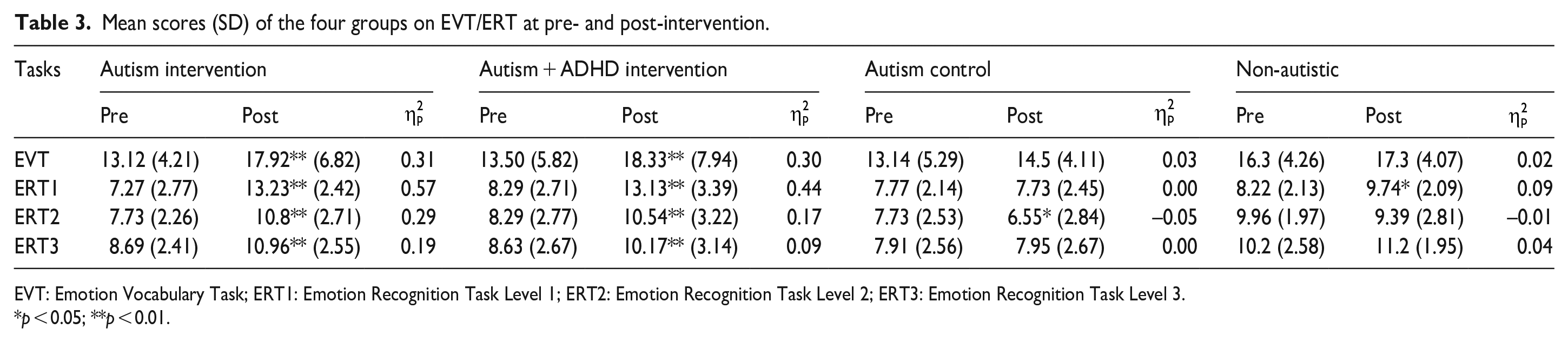
EVT: Emotion Vocabulary Task; ERT1: Emotion Recognition Task Level 1; ERT2: Emotion Recognition Task Level 2; ERT3: Emotion Recognition Task Level 3.
p < 0.05; **p < 0.01.
At post-intervention
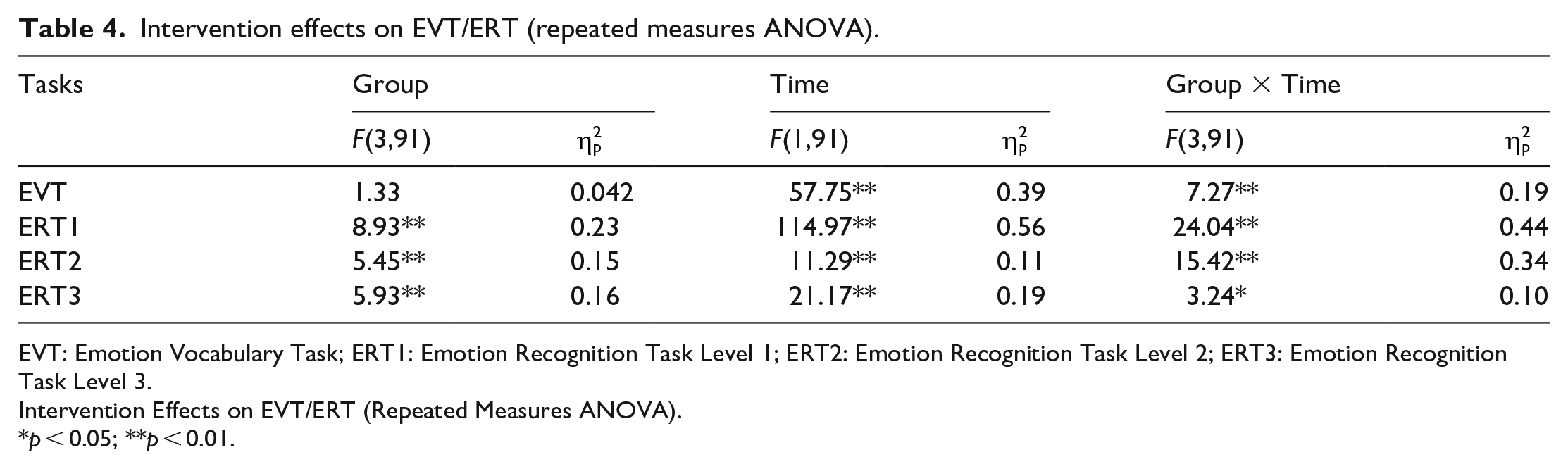
As shown in Table 4, repeated measures ANOVA showed significant main effects of group and time, as well as time by group interaction effects on EVT and ERT1, 2, 3 with generally large effect sizes (partial eta squared,
Intervention effects on EVT/ERT (repeated measures ANOVA).
EVT: Emotion Vocabulary Task; ERT1: Emotion Recognition Task Level 1; ERT2: Emotion Recognition Task Level 2; ERT3: Emotion Recognition Task Level 3.
Intervention Effects on EVT/ERT (Repeated Measures ANOVA).
p < 0.05; **p < 0.01.
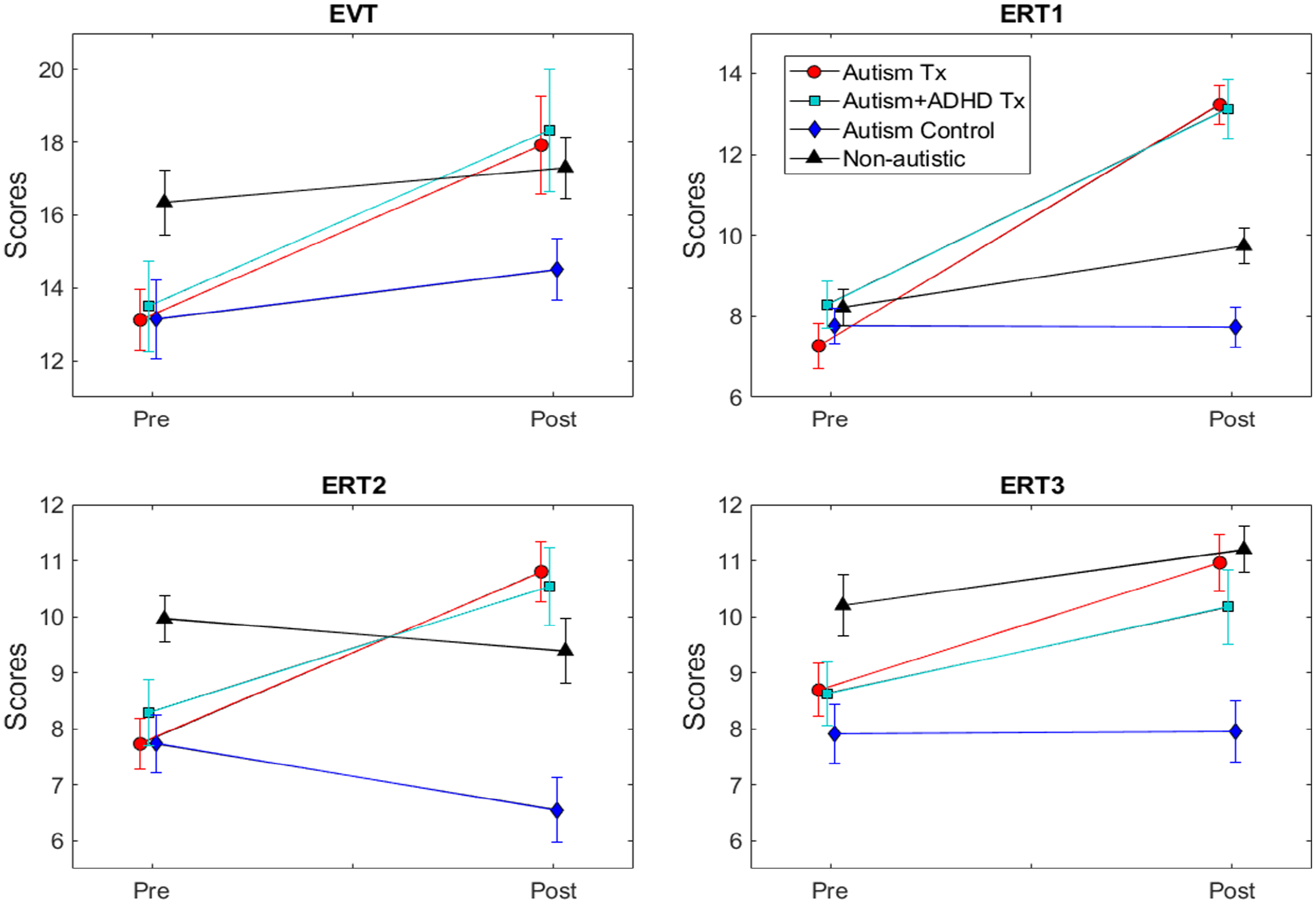
Performance of the four groups on the EVT/ERT at pre- and post-intervention.
Next, analysis on the main effect of time (i.e. between pre- and post-intervention) revealed that the two autistic intervention groups, the autism and autism + ADHD intervention groups, improved significantly at post-intervention on the EVT and ERT1, 2 and 3 with large effect sizes,
At post-intervention, there were significant differences across groups with large effect sizes on ERT1, F(3,91) = 24.37, p < 0.001,
Dosage effects
The autism and autism + ADHD intervention groups were asked to watch at least three episodes of The Transporters daily for 4 weeks (28 days), totalling 84 episodes during the intervention period. The actual mean numbers of episodes viewed for the autism and autism + ADHD intervention groups were respectively 72.72 (SD = 29.69, range = 27–136) and 74.50 (SD = 38.65, range = 16–190). The mean numbers of hours spent for both groups were similarly 6.39 hr. To test dosage effects, correlation was run between the number of episodes viewed and the improvement on the outcome measures of EVT/ERT (i.e. differences between their pre- and post-intervention scores). There was no significant correlation found for the autism intervention group, while for the autism + ADHD intervention group, there was only one significant correlation with EVT (r = 0.40, p = 0.04).
Discussion
The current study aims at evaluating the effectiveness of a Cantonese-Chinese mobile App version of The Transporters intervention among young Chinese autistic children in Hong Kong. It extends previous studies by including a separate intervention group of autistic children with co-occurring ADHD, a subgroup that previous studies have not separately examined. The results show that this Cantonese-Chinese App version is similarly effective with large effect sizes as those of the previous studies in the West in improving emotion recognition (Gev et al., 2017; Golan et al., 2010). This is demonstrated by the significant improvements of the two intervention (autism and autism + ADHD) groups compared to the autism control group on the two outcome measures of emotional recognition. Thus, merely watching moving trains/vehicles in the control condition does not improve the emotion recognition skills of autistic children. Only the illustrative stories with matching facial emotional expressions found in The Transporters episodes led to improvement. The large effect sizes attained in this study compare favourably to other facial emotion recognition training programmes, given the mean medium effect size reported in a recent meta-analysis (Zhang et al., 2021).
The significant improvement of the two intervention (autism and autism + ADHD) groups on ERT2/3 (i.e. unfamiliar close and distant generalization) indicates that learning from The Transporters is generalizable to novel situations and characters. The findings on generalization, particularly up to the more complex level exemplified in ERT3 (i.e. distant generalization), are less frequently reported in existing literature in emotion recognition or social skills training (Berggren et al., 2016, 2018; White et al., 2007). The Transporters focuses on teaching emotions via illustrative contextualized stories in which multiple social situations/events are repeatedly linked to one single facial emotion (Zhang et al., 2021). This training strategy may help the children recognize commonality among the different social contexts, which evokes the same emotion, thus achieving the generalization of learning. In fact, in a review of existing emotion recognition training, The Transporters was among the few programmes using illustrative stories as the teaching media (Berggren et al., 2016; Lee et al., 2018).
Autistic children with co-occurring ADHD are reported to display greater autistic characteristics as well as severer social, cognitive and behavioural impairments, compared to autistic children who do not have ADHD (Scandurra et al., 2019). ADHD symptoms have also been found to negatively impact treatment gains from social skills training that is otherwise effective for autistic children without ADHD (Antshel et al., 2011). Based on this literature, there were some initial concerns that the autism + ADHD intervention group may show smaller intervention gains. Yet, our results show that the performance of this group was as good as that of the autism intervention group on the EVT/ERT, with similarly large effect sizes (
Consistent with previous findings (Golan et al., 2010), there was no significant relationship between improvement in emotion recognition and the number of episodes viewed for both intervention groups (autism vs autism + ADHD) across the outcome measures of EVT/ERT (with only one exception of the autism + ADHD intervention group with the EVT). It should be noted that in order to maintain engagement in the intervention, text message reminders were sent to the participants’ parents if their children watched fewer than three episodes per day for two consecutive days or more. These messages may have created a higher floor effect, raising the minimum number of episodes viewed and thus preventing a potential dose-response relationship to be identified.
The lack of a dose-response relationship can be considered a favourable finding, suggesting that The Transporters is a time-efficient intervention. The mean numbers of episodes watched were, respectively, 73 and 75 for the autism and autism + ADHD intervention groups, spanning about 6.39 hr. This short duration has achieved significant benefits with large effect sizes. More time investment may not be required and may not necessarily bring additional gain.
Limitations
First, this Chinese version of The Transporters retains the Western faces grafted on the vehicles. Despite this, this did not prevent us from finding comparable improvement with similar effect sizes as those of the previous studies in the West (Gev et al., 2017; Golan et al., 2010). Whether the use of Asian faces would provide additional benefits will need to be examined in a future study. Hong Kong is a highly Westernized city, so that Western faces are frequently seen in various media, even by very young children. Second, there is no randomized control group for the autism + ADHD intervention group. We consider the inclusion of this autism + ADHD intervention group in this study as a pilot trial. The current promising results boost our confidence to move to an RCT design with this subgroup of autistic children in a future study. Third, The Transporters intervention focuses on the learning of emotion recognition via illustrative stories with matching facial expressions. It does not go further to prescribe explicitly what the appropriate behavioural responses should be in those social situations. One recent meta-analysis of 17 emotion recognition studies failed to find evidence of improvement in social skills (Zhang et al., 2021). It should be noted that social skills represent a broader class of skills beyond facial emotion recognition. A comprehensive social skills programme should include teaching some appropriate behavioural repertoires to accompany the cognitive learning of emotional recognition from The Transporters. Fourth, the outcome measures of this study are a mixture of emotion-defining and emotion/situational matching tasks. Neither of these tasks allow for free labelling of people’s emotions, for example, person in the video looks ___. Particularly, matching tasks can lead to people scaffolding their answers or selecting options through a process of elimination, essentially making such tasks easier than decoding emotions in real-life situations (Harms et al., 2010). Thus, in future studies, measures of free labelling of emotions should be considered.
Fifth, our outcome measures are also not designed as a timed test, so that there is no time limit set for their completion. Yet, in real life, it is important to identify emotions with speed as they are fleeting and likely parts of a more complex social interaction. In future studies, it may be interesting to add time constraints to our measures or to record completion time. Sixth, future research should consider adding measures to examine how much The Transporters animated series or specifically the moving vehicles appeal to autistic children and if the extent of preference or resistance moderates the effectiveness of the intervention. Seventh, the parents were given a user guide to assist their autistic children in learning from watching The Transporters videos. However, parental assistance was not a variable targeted for investigation in this first trial of The Transporters in Hong Kong, so that no relevant measure of parental assistance was administered. In future studies, examining parental assistance as a moderator/mediator of the intervention should be considered. Eighth, due to resource limitations, this study has not conducted a follow-up assessment on the maintenance of benefits of The Transporters after the post-intervention timepoint. This should be considered in future research. According to a recent review, follow-up data are generally missing in most emotion recognition studies of autistic children (Zhang et al., 2021). Yet, since The Transporters intervention involves parents or caregivers in guiding their children’s viewing of the episodes, there may be a higher likelihood of maintaining its benefits after post-intervention. One recent meta-analysis found that parents’/caregivers’ involvement resulted in improved maintenance of intervention effects (Hong et al., 2018). Ninth, alexithymia, a neuropsychological phenomenon involving difficulties in describing emotions, was not examined in this study. In the future study, this could be examined as a competing hypothesis to autism. Finally, this study had little community involvement. Yet, the original UK study worked with a group of families with autistic children to explore acceptability and preferences in the design of the characters and each scene in the videos, as well as conducted multiple focus groups with parents to explore how the series could be improved (Golan et al., 2010). In future studies, iterations of this Chinese version should be evaluated by stakeholders (i.e. autistic individuals, caregivers, etc.) to determine their acceptability and to identify adaptations that can facilitate learning and their administration or accessibility in any new social contexts or communities.
We conclude that The Transporters is an effective intervention tool for teaching emotion recognition to young autistic children, with or without ADHD, across cultures and that it can now be delivered via an App on different electronic devices, given now that DVD technology is less common.
Conclusion
The Cantonese-Chinese App version of The Transporters is as effective in enhancing the emotion recognition skills of young Chinese autistic children in Hong Kong as its other versions in the United Kingdom, or Israel (Gev et al., 2017; Golan et al., 2010). This study adds to the literature/clinical practice by performing separate analyses of two groups of autistic children, those with or without co-occurring ADHD. This specific design tests concerns on whether co-occurring ADHD may impact participation and treatment gains of The Transporters intervention. Yet, in this study, autistic children with co-occurring ADHD are found to benefit equally. This new finding expands considerably the range of applicability of The Transporters to autistic children, given the high co-occurrence rate between autism and ADHD.
The Transporters is a low-cost intervention, given its modest time requirement of watching just three episodes per day for 28 days (i.e. 84 episodes spanning less than 7 hr) and its automated, home-based format requiring little professional input. These features make it affordable to many families across the world and accessible to multiple families simultaneously, bypassing the constraint of a limited supply of professionals or the requirement that the training is to be conducted within working hours in an office or clinic. The Transporters should be an intervention of choice for emotional understanding, given its effectiveness and easy accessibility. 3
Research Data
sj-sav-1-aut-10.1177_13623613231187176 – for Enhancing emotion recognition in young autistic children with or without attention-deficit/hyperactivity disorder in Hong Kong using a Chinese App version of The Transporters
sj-sav-1-aut-10.1177_13623613231187176 for Enhancing emotion recognition in young autistic children with or without attention-deficit/hyperactivity disorder in Hong Kong using a Chinese App version of The Transporters by Janice Ka-Yan Chan, Theodore Ching-Kong Cheung, Chi-Wai Chan, Fan Fang, Kelly Yee-Ching Lai, Xiang Sun, Helen O’Reilly, Ofer Golan, Carrie Allison, Simon Baron-Cohen and Patrick Wing-Leung Leung in Autism
Supplemental Material
sj-xlsx-2-aut-10.1177_13623613231187176 – Supplemental material for Enhancing emotion recognition in young autistic children with or without attention-deficit/hyperactivity disorder in Hong Kong using a Chinese App version of The Transporters
Supplemental material, sj-xlsx-2-aut-10.1177_13623613231187176 for Enhancing emotion recognition in young autistic children with or without attention-deficit/hyperactivity disorder in Hong Kong using a Chinese App version of The Transporters by Janice Ka-Yan Chan, Theodore Ching-Kong Cheung, Chi-Wai Chan, Fan Fang, Kelly Yee-Ching Lai, Xiang Sun, Helen O’Reilly, Ofer Golan, Carrie Allison, Simon Baron-Cohen and Patrick Wing-Leung Leung in Autism
Footnotes
Acknowledgements
We are grateful to all the children and families who participated in this study. Special thanks should also be accorded to the child psychiatry team at Alice Ho Miu Ling Nethersole Hospital, particularly Dr. Flora Mo and Dr. Caroline Shea, for assistance in participant recruitment, and graduate students in Patrick Leung’s research lab, Ms. Fung-Yee Ching, Ms. Ada Wong, and Ms. Shirley Shen, for assistance in fieldwork.
Funding
The author(s) disclosed receipt of the following financial support for the research, authorship, and/or publication of this article: The current study was funded by a Health and Medical Research Fund (HMRF) granted to one of the corresponding authors, PWLL, from the Health Bureau, Hong Kong SAR Government (Ref No.: 03141486). SBC received funding from the Wellcome Trust 214322\Z\18\Z. For the purpose of Open Access, the author has applied a CC BY public copyright licence to any Author Accepted Manuscript version arising from this submission. The results leading to this publication have received funding from the Innovative Medicines Initiative 2 Joint Undertaking under grant agreement No 777394 for the project AIMS-2-TRIALS. This Joint Undertaking receives support from the European Union’s Horizon 2020 research and innovation programme and EFPIA and AUTISM SPEAKS, Autistica, SFARI. SBC also received funding from the Autism Centre of Excellence, SFARI, the Templeton World Charitable Fund, the MRC, and the NIHR Cambridge Biomedical Research Centre. The research was supported by the National Institute for Health Research (NIHR) Applied Research Collaboration East of England. TCKC received a Garry Hurvitz Postdoctoral Fellowship. Any views expressed are those of the author(s) and not necessarily those of the funder.
ORCID iDs

Supplemental material
Supplemental material for this article is available online.
Notes
References
Supplementary Material
Please find the following supplemental material available below.
For Open Access articles published under a Creative Commons License, all supplemental material carries the same license as the article it is associated with.
For non-Open Access articles published, all supplemental material carries a non-exclusive license, and permission requests for re-use of supplemental material or any part of supplemental material shall be sent directly to the copyright owner as specified in the copyright notice associated with the article.
