




Abstract
This article builds on prior writing on the ophthalmological aspects of climate change to argue that in an age of climate change denial and “post-truth”—which Oxford Dictionaries defines as “relating to or denoting circumstances in which objective facts are less influential in shaping public opinion than appeals to emotion and personal belief”—developing a visual language of climate change becomes of paramount importance. This article suggests that while media representations of climate change may serve to reduce climate change to a stock set of visual clichés certain art may improve our visual acuity of climate change. Accordingly, this article looks at select examples of artwork on the causes and consequences of climate change and considers the capacity of such work to inspire personal and political action.
Keywords
Introduction
A crime usually involves a distinguishable actor or guilty party, an identifiable victim or specific set of victims, and a recognizable injury to that victim or group thereof (see Michalowski, 1985). While some ecological harms have “identifiable actors” with visible damage, such as the Exxon Valdez oil spill in March 1987, the Deepwater Horizon oil spill in the Gulf of Mexico in April 2010, or the Ajka alumina sludge spill in western Hungary in October 2010 (for a discussion, see, for example, Dybing, 2012; White, 2011), many harms to the environment, its ecosystems, its biodiversity, and to human and non-human animal health lack such an identifiable actor—lack either a discrete individual or group (e.g., corporate) perpetrator or a discernable victim or injured party (cf. Caron, 2017). Since the 1990s, green criminology—a perspective within criminology—has endeavored to identify environmental crimes and non-statutorily proscribed environmental harms—to investigate their causes and consequences, as well as the possible responses thereto (see, for example, Brisman, 2014a; Brisman and South, 2017c; Lynch, 1990; South, 1998; South and Brisman, 2013; White and Heckenberg, 2014).
In the last five years, green cultural criminology—what might be called a “perspective within a perspective”—has been concerned, in part, with the way(s) in which environmental crime, harm and disaster are constructed and represented by the news media and in popular cultural forms (Brisman, 2014a, 2015a, 2017a, 2017b, 2017c, In press; Brisman and South, 2012, 2013, 2014, 2015a, 2017a, 2017b, 2017d, 2018; Brisman et al., 2014; Mazurek, 2017; McClanahan, 2014; McClanahan et al., 2017; Redmon, 2018; Schally, 2014, 2018). This has included, inter alia, examinations of: (a) mediated constructions, depictions and representations of environmental crimes, disasters, harms, and risks in the news; (b) “documentary-reality” television series that recreate or reenact “man-against-nature” epics; (c) fictional/science-fictional accounts of environmental harm and conflict over natural resources; and (d) contemporary visions of the demise of planet Earth and its ability to support its biotic and abiotic components—specifically, the cinematic and literary depictions and meaning of different endtime scenarios of environmental catastrophe. With few exceptions (see generally Natali, 2016; Natali and McClanahan, 2017), green cultural criminology has not yet contemplated such constructions and depictions in the visual arts. While visual criminology—which has emerged as part of a broader “visual turn” or “pictorial turn” in the social sciences (see, for example, Solaroli, 2015: 1, 8, 9)—has explored the ethical questions posed by and the moral implications of mediated representations of harm, suffering, violence, and punishment (see, for example, Brown, 2014, 2017; Brown and Carrabine, 2017; Carrabine, 2010, 2011a, 2011b, 2012a, 2012b, 2017, 2018a, 2018b; Valier and Lippens, 2004; see also Schept, 2016)—and has “contest[ed] visuality” by “creat[ing] countervisual projects that interrogate dominant logics and present alternative visions of how the world could be” (Rumpf, 2017: 20)—it has not considered the meanings and significance of images of various crimes and harms to the environment and its ecosystems (cf. McClanahan and Linnemann, 2018). This article is an effort to foster the cross-fertilization of green cultural criminology and visual criminology. It attempts to do so through the particular challenges of representing climate change.
This article begins with a description of the contemporary political landscape—one characterized by climate change denial despite overwhelming scientific consensus that humans are contributing to climate change (see, for example, Brisman, 2012, 2013, 2014b,2015b; Brisman and South, 2015b; McClanahan and Brisman, 2013, 2015; Wyatt and Brisman, 2017). With this backdrop—and given that some US governmental officials have begun to replace “climate change” with “the double C-word” (Editorial, 2017c; Whitman, 2017) 1 —a practice that evokes the preference of virtually every witch and wizard in the Harry Potter novels to refer to “Lord Voldemort” as “He-Who-Must-Not-Be-Named”—this article argues for developing a more articulate visual language of climate change. To support this position, this article considers the polysemy of a particular media depiction of climate change—that of the polar bear. From here, this article examines different works of art representing climate change. Based on this sample—illustrative, rather than exhaustive—this article concludes by suggesting how and the ways in which certain works of art might better reveal the adverse (anticipated) consequences of anthropogenic climate change in order to evoke emotive response and inspire political action.
Climate change in a time of “alternative facts”, “fake news”, and “post-truth”
President Donald J. Trump’s announcement on Thursday, 1 June 2017, that the United States would pull out of the Paris agreement on climate change elicited a wide range of reactions — from cheers from climate science deniers (Baker, 2017) and members of the elected Republican leadership (Davenport and Lipton, 2017; Leonhardt, 2017a; Sack and Schwartz, 2018; Shear, 2017) to disgust, dismay, fear, horror, insult, and shame from those concerned with the future of the planet and our children (see, for example, Editorial, 2017b, 2018c; Friedman and Thrush, 2017; Gillis, 2017, 2018; Han, 2017; McKibben, 2017; Miller, 2017; NRDC, 2017; Schmidt, 2017a; cf. Figueres, 2017). In academic circles—and the public sphere, more generally—discussion has swirled around questions such as: “What next?” and “How should we respond?” (see, for example, Schmidt 2017b).
Part of the frustration has stemmed from the fact that this is a president who promotes “alternative facts” 2 —rejecting the idea of “objective facts” and any version of the truth that does not reflect his worldview (Krugman, 2017a)—a worldview that is very much a mirror of himself. 3 As David Leonhardt (2017b: A23) puts it, for Trump—a president who decries perspectives that he does not share as “fake news” 4 and who demonstrates an “elastic relationship with the truth” (Dowd, 2017b) if not an actual disdain for truth, as well as science 5 —“La vérité, c’est moi”.
Given that we are arguably already living in a “post-factual world” (Sykes, 2017)—in an era of “post-truth” (see, for example, Davies, 2016; Krugman, 2017b; Luu, 2016; Stein, 2017; see generally Greene, 2017; Kakutani, 2016; Martin, 2017; Osgood, 2017)—which Oxford Dictionaries defines as “relating to or denoting circumstances in which objective facts are less influential in shaping public opinion than appeals to emotion and personal belief” 6 —how do we develop and promote a counter-narrative to the “us-versus-them” (Rosenberger, 2017) story told by Trump in his justifications for withdrawing from the Paris accord? How can we reframe climate change as something other than a zero-sum game? How might we offer an answer to Leonhardt’s (2017a) question: “how [do we] develop a more effective political message on climate change?”
Leonhardt (2017a) reminds us that “[p]assion, righteousness and even anger can certainly be useful”, 7 but cautions that “they aren’t enough after a day like yesterday [1 June 2017]”. After all, if President Trump essentially acts like a “performance artist” (Dowd, 2017a; Kruse, 2017; see also Chira, 2017; Goldman, 2015) 8 and if we have come to expect “a certain level of drama” in political decisions and announcements and “roiling theatrics inside the West Wing” (Shechet, 2017), then maybe a more creative and entertaining approach is needed. 9 Accordingly, this article argues that crafting a more articulate visual language of climate change needs to be part of the answer.
This may seem like an odd suggestion given that “[w]e are a show-me species, wired to look for visible evidence of invisible harm” (Rich, 2016) and that the impacts of climate change, such as rising sea levels or shrinking glaciers, are measured in decades, rather than months or days (Schwartz, 2017). Indeed, in earlier work (Brisman, 2014b), I considered whether we might suffer from micropsia, myopia or some other ophthalmological ailment with respect to climate change. In that piece, I referred to climate change as an “invisible crime” on the grounds that while we may intellectually grasp the idea of climate change and have some experience of climate change—or some experience that we attribute to climate change—we do not see climate change or feel it the way we might other discrete environmental “events”, and thus the lag time between emissions and their effects on climate makes it especially difficult to mobilize political will to address the problem. Although people who experience personally the consequences of environmental problems are more likely to express concern (see Running et al., 2017), just because we do not see climate change or sense it the way we might other discrete environmental “events”, such as those noted at the outset, does not mean that there is not a role for “the visual”.
Representing climate change: Polar bears on ice (and on walls)
To be sure, nature photographers and mapmakers have, in many instances, translated or rendered more understandable the process of deglaciation, desertification, and other examples of environmental loss or expansion due to anthropogenic climate change 10 —or depicted nation-states by size according to cumulative carbon emissions and climate-sensitive health consequences (Patz et al., 2007; for a discussion, see, for example, Costello et al., 2009; Mirzoeff, 2014). But as this section endeavors to demonstrate, we need to exercise caution with respect to some visual documentary depictions of phenomena attributed to anthropogenic climate change.
Putting aside the more general need to remember that “most of the media, the political parties, and the repressive power of the state are in the hands of the plutocrats” (Dawson, 2016: 95), 11 consider the “iconic” (Demos, 2016: 96; Oreskes, 2011: 89; Oreskes and Conway, 2014: 28) or “charismatic” (Goode, 2017) polar bear—“[t]he largest of the bear species and a powerful apex predator …. [who has] bec[o]me the poster animal for climate change” (Goode, 2017). 12 While Harvey and Perry (2015: 7) assert that “iconic images (e.g., polar bears, calving iceberg) are used as a totem through which the imminence and significance of global warming are portrayed (DiFrancesco and Young, 2011; O’Neill and Smith, 2014)”, 13 this may not always be the case and some images may fail to convey the proximity and importance of climate change.
For example, on 20 August 2015, Kerstin Langenberger, a German nature photographer and guide who has spent nearly a decade in a number of polar regions, including Svalbard, the Norwegian archipelago in the Arctic Ocean, posted a picture on Facebook 14 of an emaciated—and possibly injured—female polar bear—that had just emerged from the water onto a small sheet of floating ice. Langenberger accompanied her photograph with a statement that seemed to suggest that retreating ice—and the inability to find food—had contributed to this bear’s condition. Within the course of a few days, Langenberger’s post was shared with about 23,000 viewers and had received roughly 2500 comments. 15 While many of the comments expressed concern over the bear’s struggles and suggested that it provided evidence of anthropogenic climate change, some questioned its authenticity. “The Photoshopped [sic] is poorly done, front left leg is a hind leg, so much water is falling off only from behind and it’s like he’s moving fast according to that water falling off of it,” wrote Aimo K. Paniloo. 16 Others asked whether this particular bear might be just old or sick (see, for example, Reilly, 2015). When questioned about the legitimacy of the image, Langenberger asserted that the picture had not been altered. But in some respects, the damage was done. “Not fake but not necessarily representi-tive [sic]”, wrote commenter Max Caruso. “Why tug on uninformed peoples [sic] emotions?” 17
Photographs can “either reinforce or challenge dominant cultural narratives depending on what is included and excluded in the frame, and how the image is captioned”, explain visual criminologists Heith Copes and Jared Ragland (2016: 271). Similarly, Cesraé Rumpf (2017: 21), another visual criminologist, cautions that “[c]ountervisual projects can miss their aim to counter and ultimately embolden dominant logics”. In effect, while Langenberger’s photograph and caption may have evoked sympathy in some and heightened concern in others, by and large, the “is it real?”-or-“is it fake?” debate that the photograph generated served to reinforce the very narrative of climate change deniers, who point to any uncertainty in climate science as reason to delay action. 18
While “the polar bear’s symbolic role has raised awareness” and evoked sympathy, Goode (2016) reports, “some scientists say it has also oversimplified the bears’ plight and unwittingly opened the door to attacks by climate denialists”. Indeed, as Todd Atwood, a research wildlife biologist at the United States Geological Survey’s Alaska Science Center observes, “‘When you’re using it as a marketing tool and to bring in donations, there can be a tendency to lose the nuance in the message,’ [….] ‘And with polar bears in particular, I think the nuances are important’” (quoted in Goode, 2016). In other words, while few scientists question that the loss of sea ice will have a negative impact on polar bears’ population numbers (see Goode, 2016, 2017; Stevens, 2017)—the polar bear may, indeed, become “the Dodo bird of the twenty-first century”, to quote Oreskes and Conway (2014: 28)—one cannot attribute the starvation of one polar bear to the loss of sea ice from human-induced climate change (see generally Oreskes, 2011: 90; Stevens, 2017).
As Robert D. Bullard—the “‘father of environmental justice’”—argues, “‘[f]or too long, a lot of the climate change and global warming arguments have been looking at melting ice and polar bears […] They are still pushing out the polar bear as the icon for climate change’” (quoted in Alcindor, 2017). Given that images of polar bears may seem “too remote” for some (Smith and Howe, 2015: 91)—“outside the experience of the vast majority of the world’s population” (Sheppard, 2012: 3)—and that such images hardly reflect Inuit perspectives (see Smith and Howe, 2015: 91; see Demos, 2016: 88 for a discussion of Indigenous peoples’ efforts to control their self-representation in word and image)—I would suggest that we follow Bullard’s advice and steer clear of the “iconic” and “charismatic” polar bear in our visual attempt to represent the causes, consequences and significance of climate change. Even “Black machine” 19 —a mural painting and installation realized on the Teatro Colosseo in Turin, Italy, in 2015 by NEVERCREW (the Swiss-based duo, Christian Rebecchi and Pablo Togni), which depicts a polar bear whose bottom half is soaked, stained, and glistening with oil (see Frank, 2016a)—is, while visually compelling and stimulating, lacking the depth and degree of sophistication needed. Admittedly, their work avoids the pitfalls of “is it authentic/is it not?” There is no question about “authorial presence” (Smith and Howe, 2015: 94). We know that this is an example of visual art—a mural—not a documentary photograph of a real polar bear. But despite the artists’ suggestion that the bear is swimming in fossil fuels that have melted his/her ice floe, the bear still looks rather impressive/majestic (in comparison to the anemic one photographed by Langenberger) and the billboard-like scale and setting seem to encourage viewers to treat the image as an advertisement: look and move on.
Bullard argues that we should be focused less on struggling animals than poor humans, who have been disproportionately harmed by more severe weather and rising sea levels: “‘[t]he icon should be a kid who is suffering from the negative impacts of climate change and increased air pollution, or a family where rising water is endangering their lives’” (quoted in Alcindor, 2017). And, indeed, South Korean photographer Daesung Lee’s “On the shore of a vanishing island” series 20 would satisfy Bullard’s aesthetic requirements. In these photographs, residents of Ghoramara Island (located in the Sundarban Delta complex of the Bay of Bengal), who have witnessed the disappearance of more than 50 percent of their island since the 1980s due to increased sea level rise and soil erosion, stand alone on tufts of land surrounded by water or sediment revealing exposed roots of plants destroyed by the erosion. Quite literally, the people stand on shaky foundations, often looking away from Lee’s camera—either longingly to the past or apprehensively to the future.
But in many respects, Lee’s photographs simply replace polar bears clinging to shrinking icebergs with people standing on vanishing coasts (see Harvey and Perry, 2015: 7). And for many—at least, for those most responsible for climate change—the image of a brown person standing on a swath of grass and mud in a delta region in West Bengal may seem no less remote than that of a white polar bear on a small sheet of ice in the Arctic: “disposable humanity” (Aguon, 2008; see also Mirzoeff, 2014: 226), in the case of the former, disposable species, in the case of the latter. 21
Thus, how do we represent the causes and consequences of climate change—those that are already being experienced and those that many predict will transpire—without reducing them to a stock set of visual clichés? In “a late-modern, increasingly digital age of distracted attention”, to quote Solaroli (2015: 2), how do we better inspire sustained feelings—not just fleeting bouts of sympathy—about the impacts of climate change? How do we move beyond merely “arousing interest” in order to better reflect the meanings of the effects of climate change? Rather than prescribe a course of action or offer a set of aesthetic requirements, I would like to point to a particularly powerful body of work that succeeds in ways others have not.
Building Worlds and Over the River
The cityscape paintings by the American artist, Jenny Blazing, in her Building Worlds Series, seem to evoke a sense of the familiar—at least initially. For example, Tide (Figure 1), brings to mind Dutch landscapes (e.g., Simon de Vlieger’s Estuary at Dawn (1645), Aelbert Cuyp’s Fishing Boats by Midnight (ca. 1650), William Henry Howe’s Dutch Fishing Boats Off Shore (ca. 1890)), but it could easily be New York City or Montreal. A closer examination, however, reveals that the painting could be any place or many places—not now or in the past—but in the future. Tide is not so much a landscape, but a still life—or a no life—the desolate remains of crumbling structures years removed from the hustle, bustle and consumptive expansion that brought about their demise.

Jenny Blazing, Tide.
Other works, such as Remains to Be Seen (Figure 2), also provoke reflection on the negative impact of our acts and omissions—our behaviors, customs, patterns, and practices—on the Earth. Remains to Be Seen is particularly eerie, conveying an unsettling sense of “uncertainty”—but not in the sense of “doubt” that allows avenues for attack by climate change deniers. Rather, we are not sure whether “Remains to be seen” refers to a prediction—as in, “it remains to be seen what will transpire…”—or to a description, such as, “these are ruins, remains, which we are looking at…”.
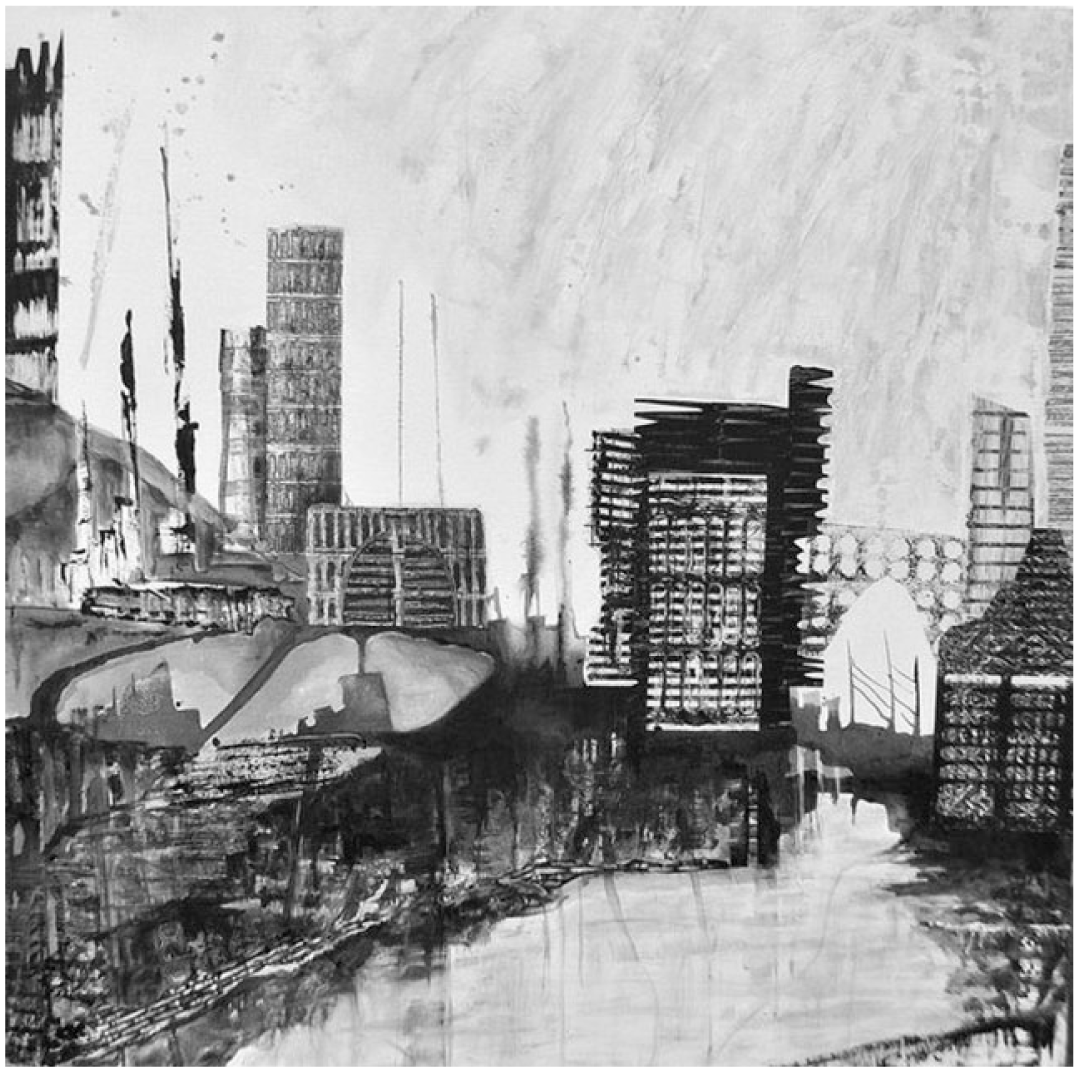
Jenny Blazing, Remains to Be Seen.
In Tunnel Vision (Figure 3), we sense not just loss—which we may experience with images of polar bears—but a feeling of a shared fate—one that we will undergo with many other peoples and countless other species as a result of our narrow-mindedness. Moreover, the piece does not seem to be depicting disasters attributed to proximal causes (such as weather) (see Smith and Howe, 2015: 91). Rather, we experience a sense of movement, progression, and the flow of time—as is especially the case in Eras of Our Ways (Figure 4)—a piece that could as easily be called Eros of Our Ways or Errors of Our Ways.
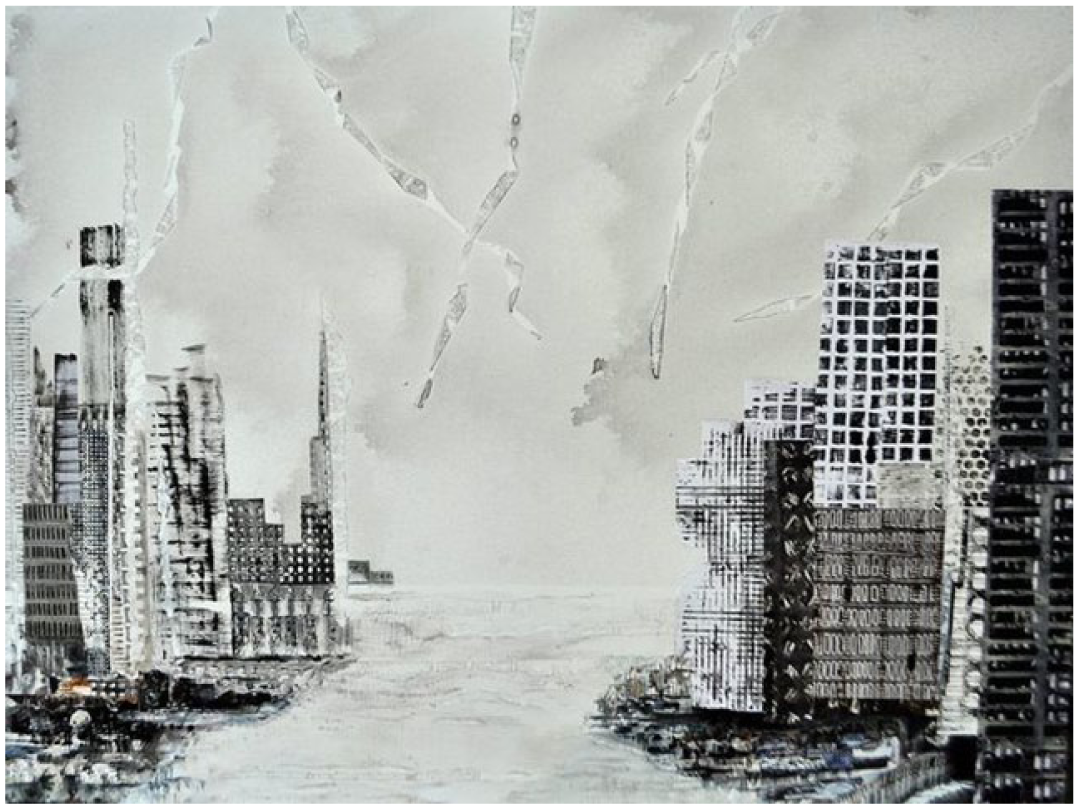
Jenny Blazing, Tunnel Vision.
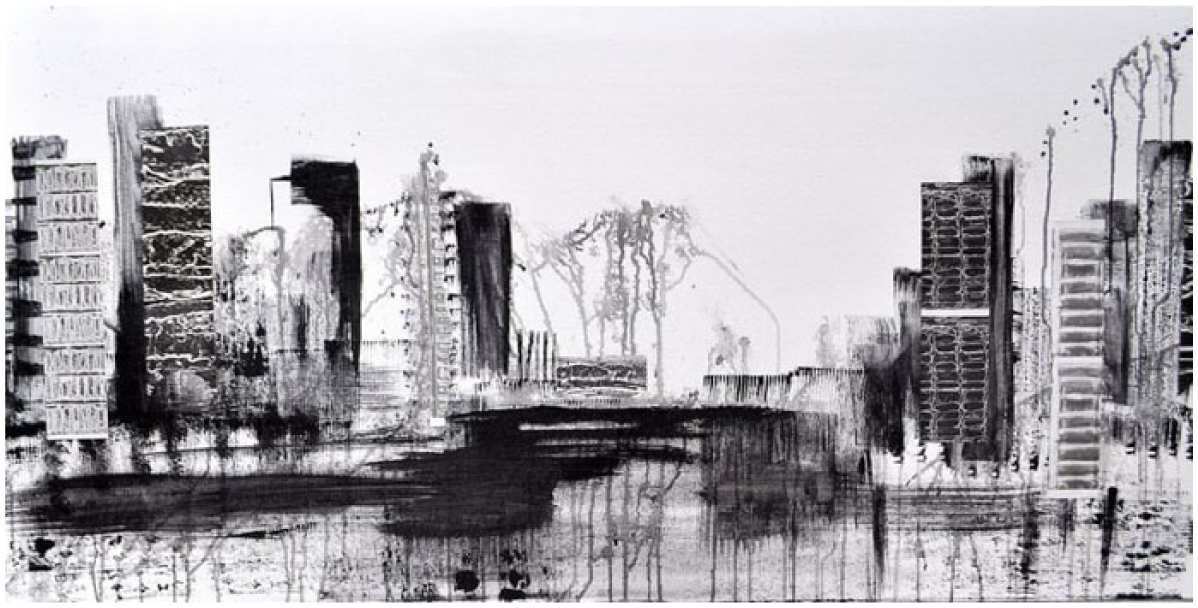
Jenny Blazing, Eras of Our Way.
Finally, Blazing’s creative method and technique help to accentuate the message of her work. As she explains, “my process strategically symbolizes recycling and the preservation of our planet as I construct intricate layers of paint and collage elements using stamped impressions from castoff industrial apparatus including pipette holders, variegated tubing, wire gauze, rubber stoppers, and well plates”. 22 While Blazing’s repurposing of discarded items serves as a not-so-subtle reminder of our profligate ways, she also “harvest[s] elements from images of [her] body of finished paintings and digitally manipulat[es] them to create unique archival collage papers that contribute to each new world”. In this way, all of her acrylic and collage paintings contain the “‘genes’ of their ancestors”. Each painting, then, is a member of a “new generation”, connected to the past (a previous painting), which helps to accentuate viewers’ intergenerational influences and responsibilities: nothing new will come from that which has not already existed, but that which does emerge is dependent on the past and present.
While Blazing’s work successfully underscores what is at stake for all of us and propagates a sense of urgency, one could consider her paintings to be exquisite depictions of a frightening phenomenon—not that dissimilar from Claude Monet’s Impression: Sun Rising (1873), which “reveals and aestheticizes anthropogenic environmental destruction” (Mirzoeff, 2014: 221)—the smog from coal use blanketing the port of Le Havre in Normandy. We take pleasure in the seductive beauty of both artists’ paintings despite—and, in the case of the light in Monet’s work, because of—the environmental damage, degradation, and destruction portrayed therein. And in John Sabraw’s “Toxic Sludge Paintings”, where the artist uses paints made from the metallic run-off collected from polluted rivers in Ohio, we quite literally “love what kills us”, to quote the music group, The Bangkok Five. 23 Accordingly, to feel the full force and underlying horror of Blazing’s paintings (as well as that of Monet and Sabraw), we might contemplate such work with Christo and Jeanne Claude’s Over the River (Project for the Arkansas River, State of Colorado)—an example of art not made.
Over the River was conceived in 1992 and was to include 5.9 miles (9.5 kilometers) of silvery, luminous fabric panels to be suspended in eight distinct areas high above a 42-mile (67.6 kilometer) stretch of the Arkansas River between Cañon City and Salida in south-central Colorado. 24 In January 2017, Christo announced that he was walking away from the project because the terrain—federally owned—had a proprietor with whom he refused to work: Donald J. Trump. “‘[T]he federal government is our landlord,’” Christo explained, “‘They own the land. I can’t do a project that benefits this landlord’” (quoted in Kennedy, 2017). The almost six miles of fabric panels, which would have been erected over the river for two weeks, at a cost exceeding $50 million (funded entirely by the sale of artwork depicting the proposed project), would have brought millions of tourist dollars to the region.
I would suggest that the story of Christo’s “aesthetic refusal as a form of protest” (Kennedy, 2017) illustrates “what J.B. MacKinnon calls change blindness: as the planet’s remaining wilderness is degraded, each generation grows up with an increasingly impoverished view of natural biodiversity, so that human experience itself is undergoing a form of extinction” (Dawson, 2016: 66, emphasis in original, citing MacKinnon, 2013). Here, as the planet becomes degraded, human experience—and the artistic expressions thereof—become endangered and extinct. The world may soon appear like that in Blazing’s paintings—one without polar bears or art or humans.
Conclusion
Naomi Oreskes (2011: 83), the American historian of science, writes Scientists speak to us of the changing chemistry of the atmosphere and its increasing concentration of greenhouse gases. They tell us of the impact these changes have on radiative transfer and the resulting increased heat reaching the Earth’s surface in watts per meter squared. They tell us that some of the carbon dioxide produced by burning fossil fuels is being absorbed by the oceans, lowering the water’s pH. And they tell us they have known all this for a long time. This is all awfully abstract. Who has seen a watt per meter squared? Who has smelled the atmosphere’s changing chemistry? The answer is no one—at least no human. None of us can see or feel or smell the rising carbon dioxide in our atmosphere. If greenhouse gases were purple and the sky were turning from blue to violet before our eyes, we might feel differently about climate change.
Although, as Byravan and Rajan (2017: 109) note, “it is becoming easier to see a climate change ‘signature’” in certain weather phenomena, such as drought, heat waves, or severe storms, 25 Oreskes is correct that we cannot smell, see, or touch rising levels of carbon dioxide in our atmosphere. This does not mean, however, that there is no place for “the visual”—or visual art—on or about the “invisible crime” of climate change. Indeed, as I have argued elsewhere, our failure to see the signs that our climate is changing is playing a part in political inaction on climate change, as well as our reluctance to curb our individual and collective consumptive practices contributing to it (Brisman, 2014b).
For visual art to have an enduring impact—rather than a fleetingly titillating experience—it must evoke feeling and hold meaning. It must speak to that which we find familiar and personal, not to that which we see at cute and cuddly (see generally McKenzie, 2017; Stevens, 2017). It must convey not just loss, but shared loss, connecting the past to our present and our future.
Moreover, as Barnes and Dove (2015: 3) write, “climate change is not just about hotter temperatures and melting ice. It is also about stories and images, myth and reality, knowledge and ignorance, humor and tragedy—questions that are, at root, cultural in nature”. Blazing’s work successfully conveys this message—especially that pertaining to ignorance and tragedy—and to a depleted world. So, too, does the art not made by Christo.
Finally, and as alluded to at the outset, visual criminology’s countervisual photographic projects have endeavored to “reveal dominant discourses” and “elicit alternative viewpoints” (Rumpf, 2017: 33; see generally Demos, 2016: 10–11). A cross-fertilized green cultural criminology and visual criminology—one attuned to the causes, consequences, meaning, and significance of environmental harms—must consider a wide(r) range of media representations. Such a project must examine and highlight images that confront the narrative of denial and that envision a post-lapsarian (indeed, post-mammalian) world owing to humanity’s failure to address climate change.
Footnotes
Author’s Note
Jenny Blazing has granted permission to reproduce her images for this article.
Funding
This research received no specific grant from any funding agency in the public, commercial, or not-for-profit sectors.