




Abstract
We mostly learn about women in prostitution through representation by non-sex-workers: activists, policy-makers, journalists, and academics. What comes through are often hypersexualized and essentialized images of sex workers as either victims or agents. This dichotomy not only essentializes their lives but also undermines women as partners for engagement. Against this background, what could be learned from photographs taken by women in prostitution of their everyday lives? How do they supplement or challenge existing discourses of prostitution? What do the photographers and viewers get out of such an endeavor? And finally, what do the quotidian aspects of life have to do with research on sex work and sexuality in general? These are some of the questions this essay raises through the author’s experience of organizing an exhibition of photographs taken by women in a South Korean red-light district in 2009. The project took place at a time when these women’s lives were undergoing dramatic change at the intersection of neoliberal development and anti-trafficking projects, materialized in the demolition of the red-light district and increasing criminalization of prostitution in South Korea. Between October 2009 and April 2010, 40 of these photographs went on a traveling exhibition “Our Lives, Our Space: Views of Women in a Red-Light District” on the east coast of the USA. This article discusses some of the impact that the exhibition has had on its viewers and the photographers. It concludes by suggesting how a study of prostitution “minus the sex” could point to new avenues of sexuality studies.
Whatever the medium – texts, films, news reports, or government accounts – we mostly learn about women in prostitution through representation by non-sex workers: activists, policy-makers, journalists, and academics. Two main characteristics of these accounts can be summarized as follows. Firstly, they are hypersexualized – their behaviors, experiences, and identities are largely understood through their engagement in the sale of sex, whether as victims or agents, or threats to the social order. Secondly, they are represented as either the powerless victim or the glamorous entrepreneur (exemplified by the film Pretty Woman, but also in plenty of narrative cinema). This dichotomy not only essentializes their lives but also undermines women as partners for engagement (Datta, 2005). Against this background, what could be learned from photographs of their everyday lives taken by women in prostitution? What kind of “voice” comes through these images? How do they supplement or challenge existing discourses of prostitution? What do the photographers and viewers get out of such an endeavor? And finally, what do the quotidian aspects of life have to do with research on sex work and sexuality in general? These are some of the questions this essay raises through the author’s experience of organizing an exhibition of photographs taken by women in a South Korean red-light district in 2009. The project took place at a time when these women’s lives were undergoing dramatic change at the intersection of neoliberal development and anti-trafficking projects, materialized in the demolition of the red-light district and increasing criminalization of prostitution in South Korea.
Between October 2009 and April 2010, a traveling exhibition “Our Lives, Our Space: Views of Women in a Red-Light District” of 40 photographs by women in the red-light district of Yongsan in Seoul, South Korea took place on the east coast of the USA. The photographs came out of the Pandora Photo Project, an offshoot of an oral life-history project with women ranging from 45 to 65 years old conducted by the Courageous Women Research Center, a part of the local nongovernmental organization Magdalena House Community founded in Yongsan in 1986.
1
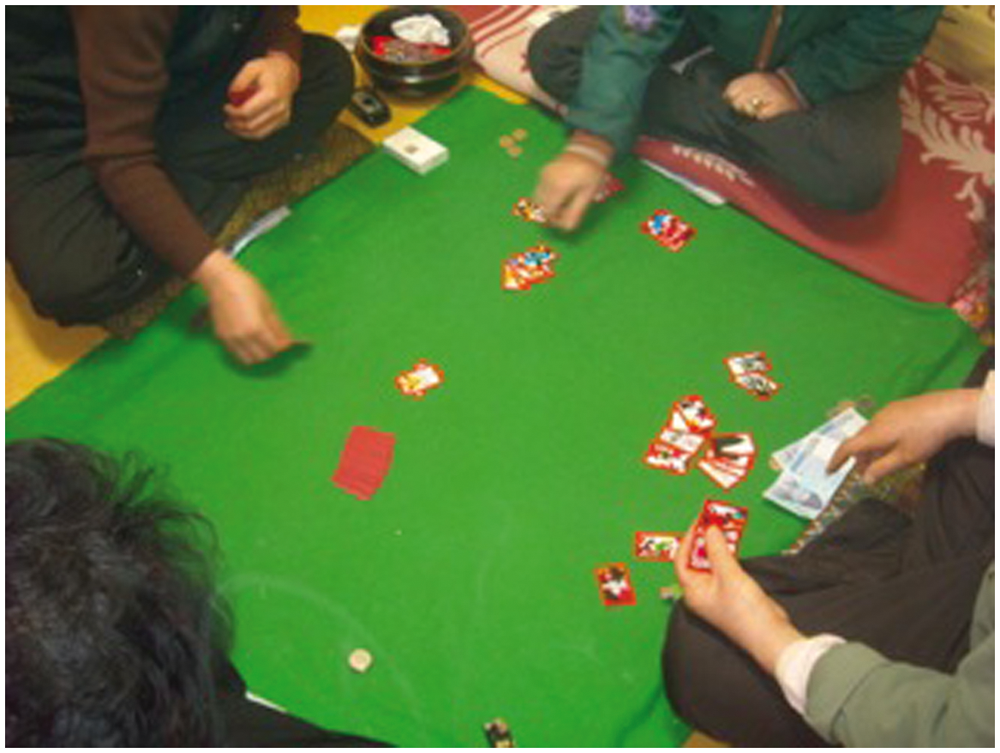
The author and other researchers of the Center wanted to explore the visual medium in addition to oral narratives as a form of communication and conveying the women’s relationship with the space. Between January and July 2009, the photographers took over 2500 photographs. These were shots of their surroundings as they go through their daily lives at home, on their way to work, at work, and at play, and with their friends and co-workers (Figures 1 and 2). They took pictures of themselves sitting around, talking, joking, hanging out with friends, playing cards, eating, getting bored; they took shots of the changing cityscape, the corridors, rooms and backyards of the buildings inside the red-light district, as well as the main streets either flooded by people and neon lights or in an empty darkness. The exhibition was curated through a series of discussions between researchers and photographers. These images of their everyday lives fill the gap between the figure and the person, disrupting the avid drive to turn the prostitute into a symbol, often at the expense of their humanity and complexity. As a whole, the exhibition is a portrait of their lives at the intersection of urban, social, and political restructuring in South Korea. The significance of the exhibition is best expressed in the words of Ms Lee Ock-Jeong, co-founder and director of Magdalena House, and one of the photographers herself:
This is not just a place where transactions between those who sell and buy sex took place. This is also a space that people have lived in for 40 to 50 years, being part of this business, and being part of this area. It’s where they cook for each other, make kimchi for each other, raise each other’s kids, comfort and support each other when they are sick or sad. This is a living space where they have spent their youth and hold dear memories for good times and bad times … I would like to emphasize that these are spaces where ordinary folks live, and not just a space for commercial sex.
2
Night Snack by Cheon Malsun. Our Hobby by Cheon Malsun.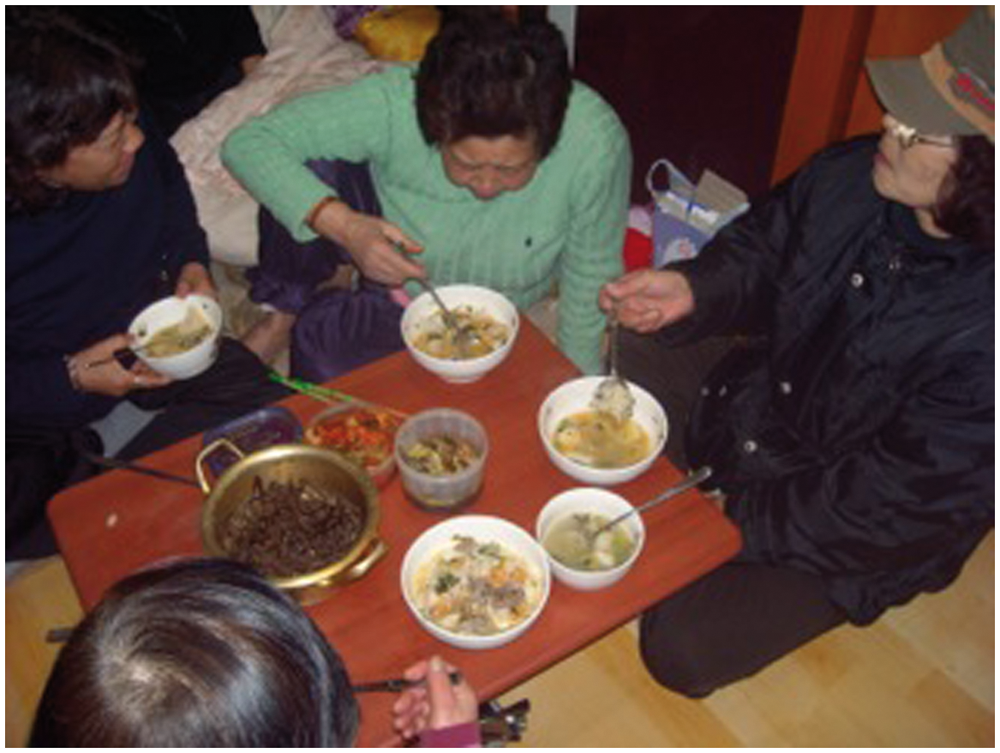
In this essay, I map out the larger context for the 2009 project, namely the discourses of prostitution in South Korea that have shaped the new anti-prostitution laws in 2004, and the impending demolition of the Yongsan red-light district as part of urban renewal in Seoul. I then discuss some of the impact that the exhibition has had on its viewers and the photographers. The essay concludes by reflecting from my own experience in Yongsan to suggest how a study of prostitution “minus the sex” could point to new avenues of sexuality studies.
The figure of the prostitute and prostitution policies in South Korea
Prostitutes have long been constructed as “public women” and therefore targets of regulation. The figure of the prostitute embodies female deviance by making available what should only be private – sex. For those who assume that sex cannot be sold, selling sex means that a woman is giving one’s inner self or private person away to the lesser domain of the market, and thus becomes merely a public woman with no private face (Day, 2007). As “public women,” there is no division between their private and public lives – for what is most private is already commodified and made available in the market place. As Sophie Day suggests from her study of London sex workers, “In effect, prostitutes are not fully human because they lack both a legitimate private and public self” (2007: 40).
Women in prostitution have largely been invisible in Korean history and society, reduced often to mere statistics and stereotypes. This is in sharp contrast to the figure of the prostitute, which has been highly visible in nationalist historiography. In particular, the figure of the prostitute ravaged by foreign aggressors has become an allegory of the nation’s fate as a divided and a subjugated nation, in a range of literary, political and activist discourses (Jager, 1996; Jager, 2003; Moon, 1997). In fact, the figure has operated as a powerful gendered symbol to address fears and desires in the nation’s engagement with foreign “Others.”
In the late 1980s, knowledge about the Japanese military’s forcible recruitment of women for sexual servitude between the late 1930s and 1945 (the Comfort Women) came to propel a transnational redress movement. Between 80,000 and 200,000 of these women were estimated to have come from Korea, colonized by Japan between 1910 and 1945. The Comfort Women issue became a main bone of contention between the South Korean and Japanese governments, nationalists, and activists. The women who were willing to face the stigma of sexual defilement were invited to speak at various forums and tribunals to testify. In these Comfort Women narratives, their innocence brutally violated by Japanese colonizers came to embody authentic victimhood. From having to bury their experiences in shameful silence, Korean survivors of the Comfort System were turned into a symbol of the emasculated nation, and a constant reminder of the colonizers’ inhumanity. 3
Another prominent figure of the prostitute arises out of US military presence in South Korea. The US military began to station in South Korea after the Korean War (1951–1953), standing guard against the communist forces in the East Asian region. The facilities surrounding these US military camps provided the means of livelihood for many South Koreans in the war-torn country. Women who worked as prostitutes in these US military camptowns carry the stigma of both the fallen women and the nation’s traitor, well captured in the derogatory terms “western princesses” and “western whores.” The anti-American military movement in South Korea in the 1990s had as its icon a woman named Yun Keumi. Yun was a 26-year-old woman who worked as a prostitute in one of the US military camptowns. She was brutally murdered by an off-duty GI, Private Kenneth Markle, on 28 October 1992. News of the manner of her death as well as pictures of her dead body circulated and fueled national protests. The National Campaign for the Eradication of US Military Crimes was founded as a result. Yun was revered as “our country’s older sister” by some in this National Campaign. Despite her marginalization to the fringes of Korean society in life, Yun’s brutal death transformed her into an allegory of the masculinist nation.
At the turn of the millennium, when the global discourse of anti-trafficking – largely understood as anti-prostitution initiatives in South Korea – coincided with two tragic brothel fires that killed 19 women and 1 man in the red-light district of Gunsan, Korean women activists launched a campaign for legislation to address the violence of prostitution. The figure of the prostitute as victim of ‘foreign evil’ persists – in the new narrative, prostitution is first of all a product of Japanese colonialism (1910–1945), and then of US military occupation since 1945, subsequently proliferating with the globalization of western sexual mores and capitalism (Cho, 2004, 2005). In this view, prostitution is not indigenous to Korean society and culture, and can therefore be purged.
As symbols in nationalist discourses, they are the rallying points for outcry against foreign encroachment and the struggle for authentic Korean culture; as figures of female deviance in moral and legal discourses, they are “fallen women” who need to be contained and regulated, if not criminalized and rehabilitated; as embodied individuals, however, women in prostitution are targets of exclusion. For many, they are merely characters in news reports about police crackdowns, about the tragic fates that befall young women; they are women who sell sex, selling what is most precious to what a woman can call her very own. Women in prostitution are largely visible only as a cautionary tale to other women, especially the young, about the dangers outside the domestic realm – the home, the family, and the nation.
These ideas inform and are reproduced by policies that directly impact the lives of women in prostitution. Mainstream feminists and women activists have increasingly insisted upon identifying prostitution as a form of violence against women. In the context of a globalizing anti-trafficking discourse, prostitution is understood locally as “sex trafficking” (Cheng, 2011). In South Korea, the effect was a law that provided protection and rehabilitation for victims of “sex trafficking,” but continued to criminalize prostitutes who were not coerced. The Anti-Prostitution Laws in 2004 were passed. The high-handed crackdowns that accompanied the implementation of the laws led to thousands of women in prostitution protesting against the threat to their means of livelihood, but to no avail. In 2005, a small number of these women organized themselves, for the first time in South Korean history, as “sex workers” to actively claim their rights to work. A small faction of feminists supported this discourse of sex work and actively supported the sex workers’ appearance in public forums as well as university classrooms. For mainstream activists who now receive state funding, the production of testimonies of sexual violence and abuse in prostitution affirms the importance of their work. For sex-work advocates, there is a push to emphasize the independence of sex workers in South Korea, and a vigorous study of sex-work theories and activism in other countries such as the US and Taiwan.
In these debates, how those who sell sex actually see themselves and the people around them, the everyday lived reality and complexity of lives in prostitution is largely lost. Most women in sex work perform their work and live their lives in as much anonymity as possible, steering clear from any association with “victim” or “sex-worker” discourses. In other words, the ideologically driven debates divert attention from the human beings whose lives they are trying to shape; but they also further reinforce the marginalization of “the prostitute.”
Yongsan at the intersection of neoliberalism and anti-trafficking projects
The Yongsan red-light district in front of the Yongsan express train station in central Seoul is one of the oldest red-light districts in South Korea. Young girls growing up in the surrounding neighborhood are taught to avoid the area and those women who dress, make up, talk and walk inappropriately. Passersby who want to preserve their decency often quicken their pace when walking by those middle-aged women who work as touts on the streets soliciting customers for indoor sex workers as well as streetwalkers. The police, who have an outpost inside the district, occasionally arrest individual women and may launch massive crackdowns when given instructions to do so from higher authorities. Prostitution has been illegal in South Korea since 1961 under the Prevention of Fallen Behavior Act. Both women and men who engage in any form of prostitution have been liable to prosecution, yet the burden of criminalization has mainly fallen on the women who sell sex. At the same time, the government has also actively regulated prostitution. For example, the more prominent red-light districts in the country have been designated “Youth Prohibition Zones” in the late 1990s. And women in the red-light districts also had to undergo compulsory health checkups to ensure that they were free of sexually transmitted infections until the late 1990s. This kind of legal paradox mirrors the widely circulated notion that prostitution is a “necessary evil” in South Korean society. Part of the human costs of these contradictions is the stigmatization, marginalization, and criminalization of women who embody the “evil” part of the equation.
Yongsan came under increasing scrutiny of the state and the market in the 21st century – both as part of South Korea’s neoliberal development since the late 1990s, and as part of the global anti-trafficking initiative interpreted locally as an anti-prostitution drive.
The state has eagerly provided the infrastructure for corporate capital to redevelop the inner city area into a safe, efficient, and convenient global center. The Seoul Metropolitan Government announced its urban renewal blueprint in 2004, under the then Mayor and current President Lee Myung-bak. In less than a decade, the decrepit buildings of Yongsan red-light district became dwarfed by a brand new express train station attached to a supermall that includes an IMAX theater on one side, and on the other by hyper-modern skyscrapers. Under the current Mayor Oh Se-hoon, another presidential hopeful, the Yongsan district will be redeveloped into an International Business District entitled Archipelago 21 designed by Daniel Liebskind, featuring one of the highest skyscrapers in the world. 4
In addition, beginning in 2007, the Seoul Metropolitan Government started a project, managed by the Department of Women and Family Affairs, to turn Seoul into a “Women-Friendly city”. Adopting the slogan of “Happy Women, Happy Seoul,” the project was said to involve a paradigm shift in urban policy that included introducing “women-friendly restrooms” to “women-friendly workplaces,” “women-only parking spaces” “marked with pink lines giving priority to women,” repairing cracks on roads so that “high heels will not get stuck,” as well as the licensing of more childcare facilities for working women. Women leaders like Park Hyun-kyung, president of the Seoul Foundation for Women and Family, welcomed the initiative for “the everyday safety and convenience of women in using urban space” (Kwon, 2009). Women in Yongsan and other red-light districts, as ineffective producers and consumers, have no place in this vision of a “women-friendly city.” Their safety, convenience, and well-being are therefore not the principal concerns of state and capital (Hubbarb, 2004: 674).
In this process of modernization and neoliberal gentrification, disadvantaged groups are legitimately expelled as having no right to disrupt the progress of the city. Residents, small business-owners, and street vendors across the street from the Yongsan red-light district have already been evicted (Figure 3).
Evicted by Park Hyun-suk. “This used to be the market where we shopped. But now it is demolished”.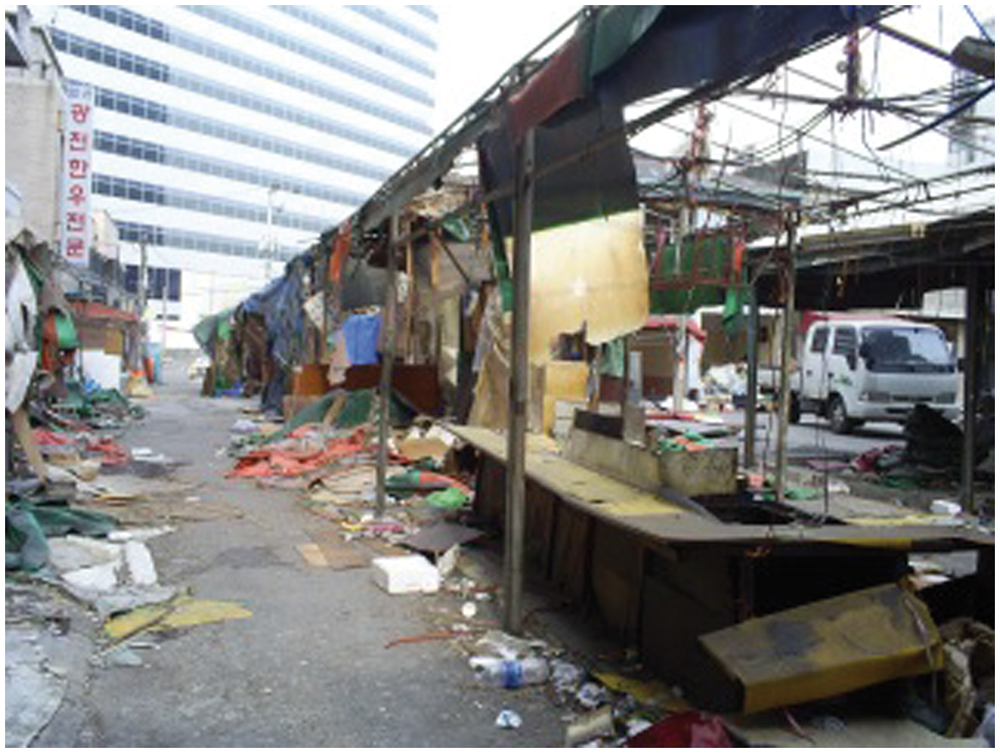
Irreconcilable with the respectable middle-class family ambience and the metropolitan consumption style, these marginal groups are purged from the city center. Phil Hubbarb has observed how neoliberal policies in western cities “valorize the central city (as a space of profitable family-oriented consumption) while forcing prostitutes to work in the less visible (but highly profitable) spaces of the capitalist sex industry,” reinscribing a “virile masculinity” in the process; the neoliberal city therefore “serves the interests of both capital and the phallus” (Hubbarb, 2004: 682).
Just as we started the photo project in January 2009, the National Alliance of Evictees staged a protest demanding just compensation on a building right across from the Yongsan red-light district, and anti-raid police launched a violent crackdown. Five people, including four protestors and one policeman, died in the confrontation and shocked the nation (Figure 4).
Making Way for the Global City by Cheon Malsun. The remains of the burnt scaffold on which protestors confronted anti-raid police on the rooftop of an evicted building, the International Building is in the immediate background.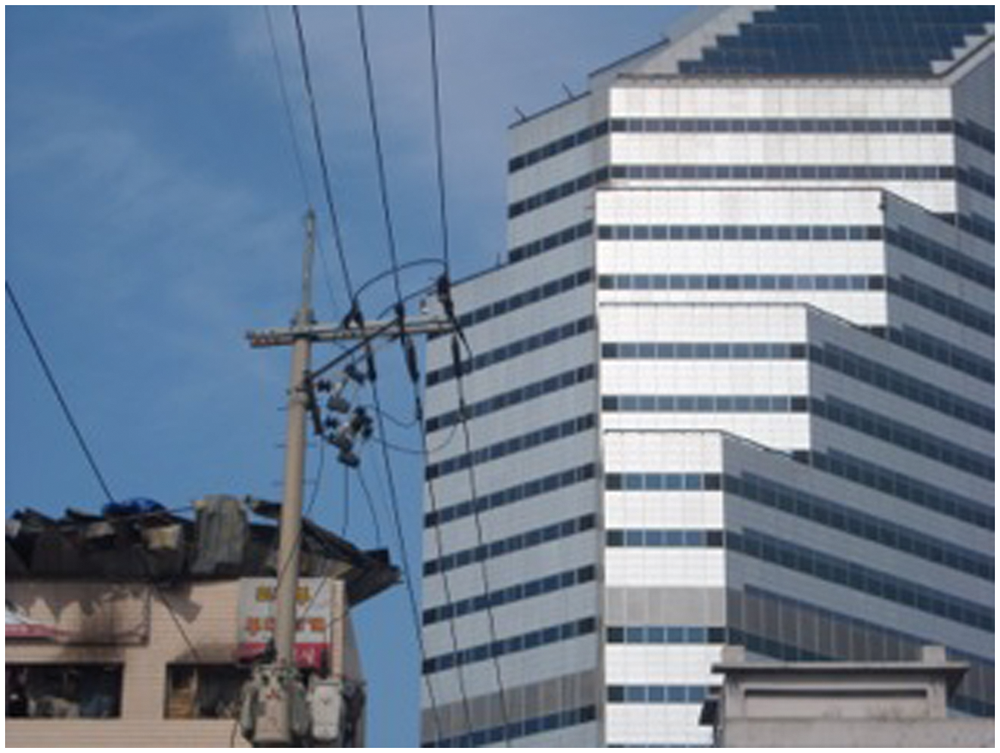
This cast an ominous cloud on the women’s prospects of leaving their homes in Yongsan. For a long while, many of them waited to see if the compensation that landlords received would trickle down to them. They did not see themselves initiating or joining in rallies against unjust compensation or removal from the red-light district. Besides, who would be their allies? Activists who lobbied for the 2004 Anti-Prostitution Laws, which provided state resources for efforts to eliminate prostitution, are dedicated to the removal of red-light distracts – women will no longer be publicly displayed, and solicitation will no longer be blatantly visible in the shoppers’ thoroughfare. A moral eyesore will soon be out of sight even though prostitution was already proliferating in less visible forms (e.g. the internet). Ironically, these laws were hailed by the women’s movement, the Korean government, as well as the US State department as a success in cracking down human trafficking – understood here only as prostitution but not coerced labor as defined by the 2000 United Nations Protocol for the Prevention, Protection, and Punishment of Trafficking in Persons, Especially Women and Children. The increase of penalty and the repeated crackdowns by police on those who continue to engage in the sex trade have made lives difficult for many. Younger women in the red-light district moved to other venues or onto the internet, older women who could no longer deal with the burden of arrest and penalties left the trade. Those who have stayed have found it harder to make a living than ever before. Yet these everyday struggles could only intensify while mainstream women activists call for stronger law enforcement to eliminate prostitution, now largely reframed as “sex trafficking.”
Neoliberal initiative of urban renewal coincides with the clamor to “Stop Trafficking,” making the replacement of the red-light district with tall shiny buildings appropriate for a cleaner city seem like an absolute good. In effect, the lives, communities, histories and futures of women who live in the red-light districts have no place in a city’s modernization project.
The photo project that will be discussed in the next section by no means mediates the effects of these developments on the women’s lives in any significant way. It merely mitigates the impact of such erasure.
The Pandora Photo Project
Against the prevalent discourses of prostitution in South Korea, the Pandora Photo Project that led to the “Our Lives, Our Space” exhibition is distinct in two dimensions. First, it is one of the very few that allows women in prostitution to participate directly in their own representation – by producing and selecting the images, as well as contributing to the narratives. Second, it steers away from any ideological debate about whether sex could be work, and focuses on the everyday lives of women who have lived on the margins of Korean society because of their engagement in commercial sex. In short, it is a project that sets out to document the humanity of the women by putting the tools of representation in their hands.
On 3 January 2009, the Courageous Women Research Center invited eight women to meet and explained that the Pandora Photo Project was intended to provide them a means to document the space they have shared as a community. We provided them with digital cameras, followed by some basic training in photographic techniques, as well as the ethics of taking photographs – such as issues of consent. They would visit Magdalena House every two weeks to upload their photographs, and every month to review the photographs, allowing the women to browse and talk about their own works. The project only gained momentum when the photographs generated avid sharing of stories, gossip, laughter and emotions. One of the photographers, Park Hyunsuk, summed up this development in her evaluation of the project:
I participated because I didn’t want to be marginalized by my peers. My heart wasn’t into it. Then I didn’t want to miss all the small chats about the photographs, so I didn’t miss any of the meetings. I didn’t join the program with much excitement because I didn’t want to recall some of the pain and injury I suffered in the past. But with urban renewal, we are all at risk of losing our home. It is not just a place in which we experienced hardship, it is also a kind of hometown where we got married, set up our families, and brought up our kids. So I wanted to take pictures of the place before it disappears.
The research team organized a meeting with the photographers to report on the exhibition and its responses in the USA. The women were touched by the positive reactions to their works and, more importantly, their lives. Song Bokrae, one of the photographers, said, “I was holding back my tears when I listened to the report. They got to see our reality through the photographs we took. I felt a sense of pride.”
While the photographs show us how personal histories are written onto the space and architecture of the red-light district, the photo project shows us what happens when the means of representation enters the hands of the subjects of representation. Contrary to dominant representation of sex workers, the quotidian details of life rather than the misery or glamour of sex work are central to these women’s portraits of their own living space. This fact alone raises questions about the sexualization of their representation by others, including earnest researchers like myself.
Learning to subtract the sex
My first visit to the Yongsan red-light district was in 1999 when I volunteered as an interpreter for Sunny, the sex worker attending an international sex workers' conference in China in early 2000. Sunny was an independent streetwalker who had her own basement apartment in Yongsan, but she was very close to the owner of a small three-storey brothel that hosted two other women. When we came back from the China conference, the lease of my apartment in Seoul was coming to an end. The first person who offered me a place to stay was the brothel owner. She had an apartment across the main road from the red-light district. I took her offer. For the next few weeks, I would drop by the red-light district everyday to hang out with the women either for lunch or a night snack with cheap Korean alcohol (soju). I came to know the two women working on the second and third floors of the brothel and people in the neighborhood.
When I left in late April 2000, I was sent off with lavish gifts, including as much as $200 cash and a dressy jacket of equivalent worth. I was touched and stunned by the generosity. But secretly, I was abhorred by my knowledge of the number of clients they had to take in order to give me these gifts. The idea that they had sex with men for me made me very uncomfortable. But there was also no way I could reject their gifts without inflicting insult. As Marcel Mauss so clearly articulated, “to make a gift of something to someone is to make a present of some part of oneself” (1954: 12). I needed to see the gift as the giver saw it – as a gesture of goodwill and care from one independent woman capable of expressing such emotions in material terms to another, younger woman, creating a social relationship that is also an exchange of indebtedness. By entering their social world, I acquired the obligation to receive and, therefore, to reciprocate.
I was forced to realize that my view of the gifts as the product of a dozen sexual encounters with strangers, rather than seeing them as the enactment of social relationships, was predetermined by my narrow focus on sex in viewing their everyday lives. Without this transient experience in the red-light district, I might never have realized my tunnel vision.
It is commonplace to think of sex workers only in terms of their sexual transactions and their sexual transgressions (as Kerwin Kaye (2007) points out with male prostitution studies). For those absorbed in the feminist and legal debates of prostitution, the focus is whether the sex is consensual, whether force and violence is involved, and whether the women are victims or criminals. In the midst of these earnest judgments, we often forget that they also have a life – that they eat, joke around, play games, watch TV, and have friends and families, just like most of us do. In other words, considering them only in the image of “public women,” we erase their private lives and a significant part of their personhood.
The exhibition provides a view of everyday life in the red-light district minus the sex such that viewers can gain a fuller perspective on these women’s lives. As Sophie Day says, “Insofar as a prostitute is wholly equated with her work, her private life becomes invisible, even though it might be very similar in practice to other women’s private lives” (2007: 5). Therefore, the exhibition also seeks to bridge not only the gap between the figure of the prostitute and the person, but also between the sex worker and the non-sex-worker.
The lessons learnt here echo some of the major themes that Petula Ho outlined in the introduction to this special issue about alternative sites of storytelling and new ways of knowledge production. The visual medium and collaborative nature of the photo project allowed us to broaden our scope of engagement from sex and related debates first to the more mundane aspects of their everyday lives, and second, to the structural inequalities that marginalize and stigmatize those in prostitution. The former forces us to see what are the more meaningful ways of understanding the lived experience of women in prostitution – sex may not be the most important anchor of meaning-making in their lives. The latter may allow us to tackle larger issues from policy concerns such as urban development, housing support, welfare services and so on to structural inequalities generated by class privileges, inter-regional differences, and neoliberal imperatives of the state and the market. In short, seeing the lives of these women from their own perspective, rather than any ideological position, may be a good starting point.
Footnotes
Acknowledgements
The author would like to thank the organizers and participants of “Women Writing New Scripts: A Symposium on Asian Sexualities and Erotic Justice” held at the University of Hong Kong, May 16–17, 2009, for their support and comments on the first draft of this paper. Heartfelt gratitude to Sik Ying Ho, Carole Vance, Elizabeth Bernstein, Nicole Constable and Henry Em for their support and encouragement to bring the exhibition to different sites.
Funding
The author would like to thank the Korea Foundation Field Research Fellowship for supporting her fieldwork in Korea in 2008–2009, and the Mamacash Foundation for supporting the Oral Life History Project by the Courageous Women Research Center, which served as the foundation for this photovoice project.