



Abstract
This article is a case study of a Second Life region in reference to the prevailing attitudes of sexual conservatism and the growing acceptance of homosexual coupling. The site of Zeus is a contested site of legitimacy in view of tensions regarding masculinity as it applies to sex, sexuality, gender conformity and consumption practices. Furthermore, it is representative of the tensions between an acceptable, albeit conservative gay male identity, and the subversive hyper-sexual and hyper-masculine subject of desire.
Introduction
The following case study of Second Life’s (SL) Zeus is an example of gay male sexuality that exists just below the surface of acceptability. The analysis describes many of the paradoxes of gay male materiality as well as the disjuncture between acceptance and liberty of alternative sexual identities. Located on Gay City Estate, Zeus Gay Club is ‘one of the most popular Second Life gay clubs’ according to its website, ‘having about 700 visitors daily from all over the world’ (Ashdene, 2011). The site also appears in Second Life’s Destination Guide, which is often a good indicator of a space’s popularity (Gay Destinations, 2012). The majority of avatars that visit the site are hyper-masculine in form (female avatars are allowed to visit but they are in the minority) and are consistent with the contemporary ideal of physical attractiveness and hyper-muscularity. Such homogeneity can be conceptualised in terms of the heteronormative and homonormative function of the postmodern gay male, and superficially, Zeus can be seen to reinforce these notions in view of a dominant representation of the physically attractive and masculine gay male subject. However, Zeus simultaneously reveals the subversive aspects of gay male sexuality through its construction as a meeting space and cruising space, as well as in its explicit marketing of gay male sexual services. Being designated as a sexual space (albeit not overtly sexual in terms of nudity and actual sex – it precludes such encounters), Zeus positions the masculinities of the avatars in reference to the various moral panics that are seen as ‘symptomatic’ of an unchecked hyper-masculine sexuality. These issues place Zeus as a contested site of legitimacy in view of tensions regarding masculinity as it applies to sex and sexuality. Furthermore, the site is representative of the tensions between the movements towards an acceptable, albeit conservative, gay male identity that is portrayed in western mass media, and the subversive hyper-sexual and hyper-masculine subject of desire often viewed as antagonistic to gay male acceptance.
Contextualising ‘Zeus’
The potential to embody anything (humanoid or otherwise) is a phenomenon that is available within the digital interface of SL whereby an individual can select a representation of themselves for the purposes of real-time interaction. The opportunities to embody any body is part of the attractiveness and popularity of such platforms – seemingly it is possible to escape into a world of possibility where we can be anything we want. Yet, even within the more subversive spaces throughout SL (ones that are fixated on sexualised interaction), there is a normativity that persists which reiterates mainstream ideological foundations of identity. This is particularly prevalent in gendered representation – avatars tend towards hyper-gendered expression and the excesses of western bodily presentation and adornment, so that bodies are seen to move beyond all biological capacity of attainment. Not dissimilar to the idealised corporeal body of mass culture, the virtual body is pushed to the limits of gendered and sexual success and desirability as the hyper-masculine or hyper-feminine subject. That these representational practices carry over into sexually diverse regions is perhaps unsurprising given that gay and lesbian culture has been in a large way subsumed into contemporary mass culture. It is the tensions that occur as a result of the subversive-normative dialectic that forms the basis of investigation, in the analysis of gendered and sexed bodies on Zeus.
Zeus Gay Club and Concert Hall is located within a region called Gay City Cologne, which caters predominantly for gay males. It is part of a wider region entitled Gay City Estate that has entertainment as well as residential areas for LGBTI-identified avatars. There are no restrictions on who can visit the space, so female avatars can, and do, frequent it. Zeus itself can be categorised as an entertainment precinct (Figure 1), with its principal activities being dancing at the concert hall, shopping at the mall area, and relaxing in its surrounds that feature water sports and social areas typical of a seaside resort.
Monument and club entrance.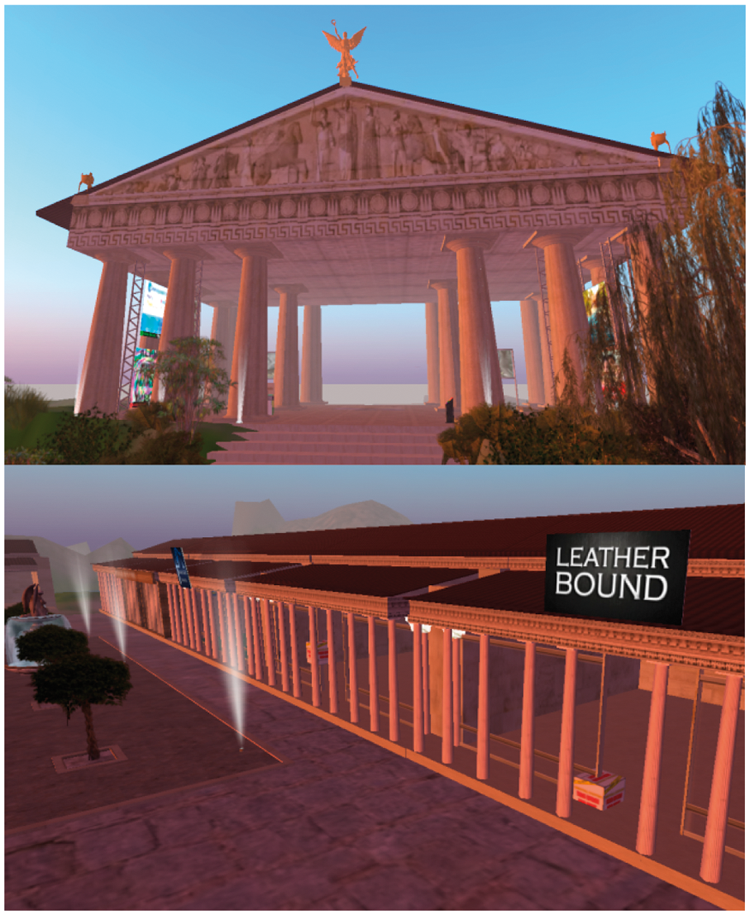
It has a ‘mature’ (more recently revised to moderate) rating, meaning that it is not a space explicitly created for sexual, or other adult-related, content. SL’s ‘M’ rating is explained as follows: Residents in these spaces should expect to see a variety of themes and content. For instance, stores that sell a range of content that includes some ‘sexy’ clothing or objects can generally reside in Moderate rather than Adult regions. Dance clubs that feature ‘burlesque’ acts can also generally reside in Moderate regions so long as they don’t promote sexual conduct, such as through pose balls (whether in ‘backrooms’ or more visible spaces). (Linden and Linden, 2012)
Although it is not an explicitly sexual space, there are many features of the space that categorise it as ‘mature’. For instance, many of the shops contain items that are highly sexualised, such as BDSM toys and clothing, and there are many billboard advertisements that feature sexual products and services, such as pornography. With just about every facet of life in SL commodified, time in-world can be considered as a close replicate of western corporeal life in terms of aspiration and success whereby experiences of the body are closely related to commodified experience, exchange value and desire. Furthermore, SL is a space premised on social interaction as well as a reliance on user-generated content. This highlights the synchronicity between hyper-capitalism, individualism and homogeneity; whilst possibilities are almost endless in terms of SL capabilities of spatial and avatar creation, there exists a surprising sameness throughout the regions even throughout the most diverse and subversive locales.
It is its subversive sameness that situates Zeus alongside other digital spaces such as Gaydar, which reiterate the homogenised, desirable body of mass culture whilst offering sexual proclivities outside of mainstream acceptability. Within Gaydar, the preferred type of gay man is inscribed through its sign-up process, which is further reinforced through marketing and branding. Research conducted by Light, Fletcher and Adam explains that the preferred advertisers of Qsoft (owners of Gaydar) are those ‘whose specific visual and textual representations of sexuality conform to and confirm specific meanings of attractiveness and affluence’ (Light et al., 2008: 306). Where Zeus, and SL as a whole, depart from meeting and dating sites like Gaydar is in the absence of an expected physical interaction. Although Gaydar can be used primarily as a virtual medium for encounters (such as phone and text sex), and SL can certainly lead to real-life hook-ups, there is a departure in expectation between the potential precursor to liaisons as experienced through Gaydar and the non-corporeal platform of SL where it is far less likely that individuals will meet in the physical world, certainly in any immediacy. This lack of reality, in the corporeal sense, means that individuals participate in the knowledge that they can embody a fantasy self with less possibility of being found out, in that they do not live up to their profile, as often happens on dating sites. The digitised representations seen in SL can be read as an individual’s desired form, so that ‘the increasingly impossible dimensions of this idealised form’ become possible through the screen (Campbell, 2004: 162). The ability to embody the idealised self however, renders diversity obsolete in these environments, with nearly everybody conforming to the aspirational masculine ideal.
Normativity and conformity
The site of Zeus illustrates some of the contradictions that abound within the politics and expression of gay male identities in late capitalist western society. Whilst it is a space that allows for the more subversive aspects of gay male sexuality it is, simultaneously, conformist to notions of gender (heteronormativity) as well as materialist notions of homosexuality. The heteronormative is expressed through the representations of masculinity and femininity as being normatively assigned to both male and female avatars.
Male avatars, although often appearing shirtless and displaying a gay male symbolic appearance (as shown in tight-fitting clothing, and colourful attire), are also highly masculine, generally being tall and muscular (Figures 2 and 3). Females, conversely, epitomise femininity, and often appear slight by comparison and are dressed in tight clothes that emphasise curvaceous figures rather than the hard muscularity of male avatars. The female–male binary is upheld with strong signifiers of femininity and masculinity as attached to biological sex and gender categories. In addition to gender norms, the space also represents aspects of homonormativity, which can be described as ‘the construction of social norms that include lesbians and gay men on the condition that they conform to individualist and consumerist economic values and lead sexual lives that mirror the norms of heteronormativity (e.g. long-term, monogamous relationships within specific gender norms)’ (Browne and Bakshi, 2011: 181). This is expressed on Zeus as an attachment to the mass consumerist depiction of the homosexual male: white, middle class, masculine and appearance conscious, but makes an important departure from it in reference to sexual conformity and the heterosexual standard of coupling and monogamy. The moderate/mature rating of the region, as well as its appeal as a niche space, allow it to represent and promote a gay male sexuality that is in a large part disregarded in mass media portrayals, as seen in the more flamboyant attire of the avatar in Figure 3.
Dance-floor, Zeus [F2 from (“Zeus Gay Club,” 2012)]. Dance-floor, Zeus [F2 from (“Zeus Gay Club,” 2012)].
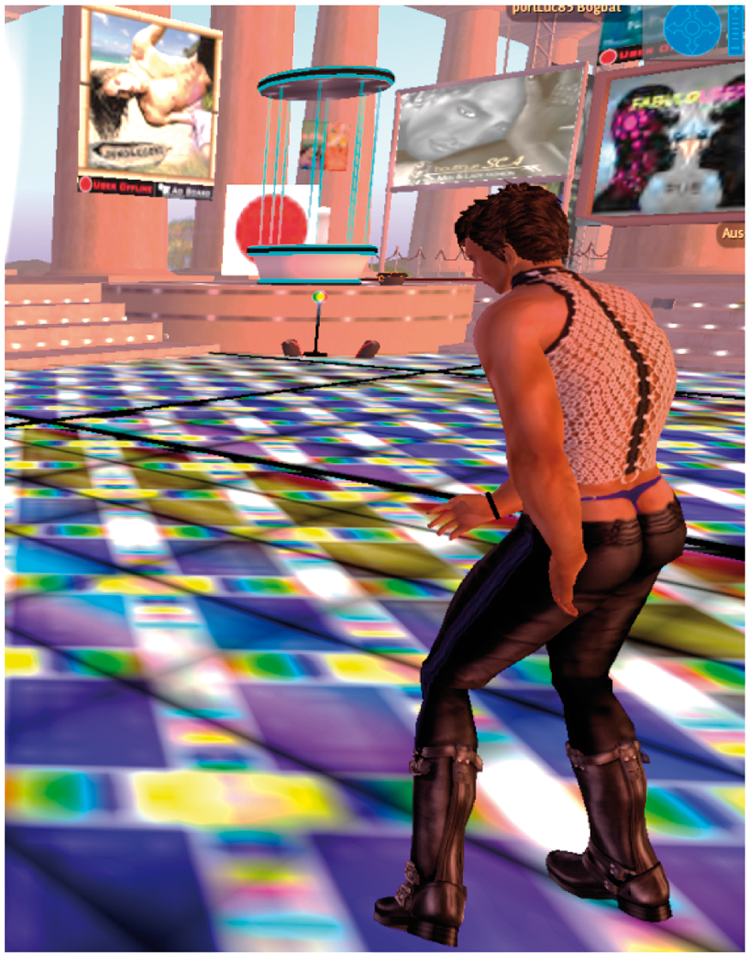
The region of Zeus illustrates the tensions between a representational space of legitimate gay male identity as conforming to the commoditised expression of the body (capitalist masculinity), and that which allows for behaviours contrary to the conservative norm of homosexual conduct (promiscuity and hypersexuality). Michael Warner describes the tension between the two worlds as a hierarchical struggle of power. Utilising Erving Goffman’s terms of the stigmaphiles (those who are stigmatised) and the stigmaphobes (those who are normal), he states: The stigmaphile space is where we find a commonality with those who suffer from stigma, and in this alternative realm learn to value the very things the rest of the world despises – not just because the world despises them, but because the world’s pseudo-morality is a phobic and inauthentic way of life. The stigmaphobe world is the dominant culture, where conformity is ensured through fear of stigma. (Warner, 2000: 43)
For the most part the stigmaphobes have been winning the battle for morality against stigmatised deviance, so that even in the progression of queer acceptance, there is a ubiquitous moralising force regarding acceptable sexual conduct. Spaces of deviance are quickly ushered to the margins and often renounced by the interest groups that should act in their political interest; it is no coincidence that gay movements, in all their successes, have become desexualised in their agenda. The concern is that this homogenising force may marginalise the diversity of identity and expression within the community, thereby becoming a stigmaphobe world for those it should embrace. Of particular interest here is how this force works to organise ideas about strict gender representations and divisions, the control of sexual conduct, and the moral panics regarding the deviant.
It is important to position this discussion in its political and social context given that SL draws heavily upon US norms. Although it is a global medium, user statistics show that participation is located most highly Europe and North America, with Germany and the USA having the highest number of national users as of 2007 (Reuters, 2007. Recent statistics have proven extremely difficult to come by, possibly because of the reluctance of SL’s owners to publish declining user numbers). Although Europeans participate broadly in SL, the political and social context is most closely aligned to the USA thanks to its deregulated economic system (it also relies heavily on US currency as the basis for SL’s Linden dollar). The platform is reflective of neo-liberalism in that the economic system takes prominence over activity whereby deviance is arguably tolerated. The premise behind this attitude is that tolerance of deviance, as well as tolerance of problems, is acceptable ‘as long as said tolerance results in improvements in bottom-line profits’ (Marzullo, 2011: 762). Neo-liberalism works alongside neo-conservatism through the reinforcement of dominant tropes of gender, sexuality and identity, which are played out through debates on morality and dominant value systems. According to Connell, this functions ideologically ‘as a form of masculinity politics largely because of the powerful role of the state in the gender order’ and, in so doing welds ‘exemplary bodies to entrepreneurial culture’ (2005: 1817). This allows for individualism, insofar as the individual conforms to the dominant system, which ultimately produces a homogenised version of gayness and homosexuality largely understood through the framing of hetero-patriarchal politics. Sharif Mowlabocus comments that the homosexual has been turned into a ‘marketable commodity’, yet also ‘sanitised and safe’ to conform to family values (2008: 428). The gay male in mass media depictions has become homogenised and suitable for mass consumption through mimicking the heterosexual standard, whereby ‘Homosexual images are presented in a way acceptable for heterosexual audiences by reinforcing traditional values like family, monogamy and stability’ (Avila-Saavedra, 2009: 8). Moreover, consumption and class assertion have also become characteristic tropes of gay identity through mass communication channels, so that this once subversive identity is now readily subsumed into the heterosexual matrix of acceptability and hegemonic control.
Performing masculinity
Anywhere a body, or an individual, is represented it does so through an adherence to, or opposition to, masculinity. In apposition with historical patriarchy, identity is often formed through an essentialised, yet ubiquitous, framing of maleness through masculinity so that the two terms become inseparable in mass comprehension. Its modern conception has developed from Classical Greek and Roman societies through the Enlightenment and Industrial societies to its modern and postmodern configurations. What has remained through the history of western masculinities is power and access for the male subject: as a full citizen (Classical societies), to own land (aristocracy), to participate in the marketplace (modernist-capitalist societies), and to control women (both sexually and economically throughout). David Buchbinder explains such modes of differentiation are spoken through power: [P]atriarchy ranks and thus creates power differentials even among those who it centralises. In this way, differences among individual men, such as age, physical size and strength, class, wealth, social or political clout, sexual activity or hyperactivity – even penis size – and so on are invested with varying degrees of patriarchal power. It is the aggregation of these elements and their investment of power by patriarchy that we recognise as ‘masculinity’ or the lack of it. (1998: 43)
Contemporary society has in many ways returned to this ideal through the championing of an often unattainable physical form. The active development and display of the male body draws heavily upon the Classical form and mastery of physical beauty and prowess as epitomised in the imagery of Zeus the myth, as well as Zeus the space as seen in Figures 4 and 5.
Zeus Statue. Dance-floor.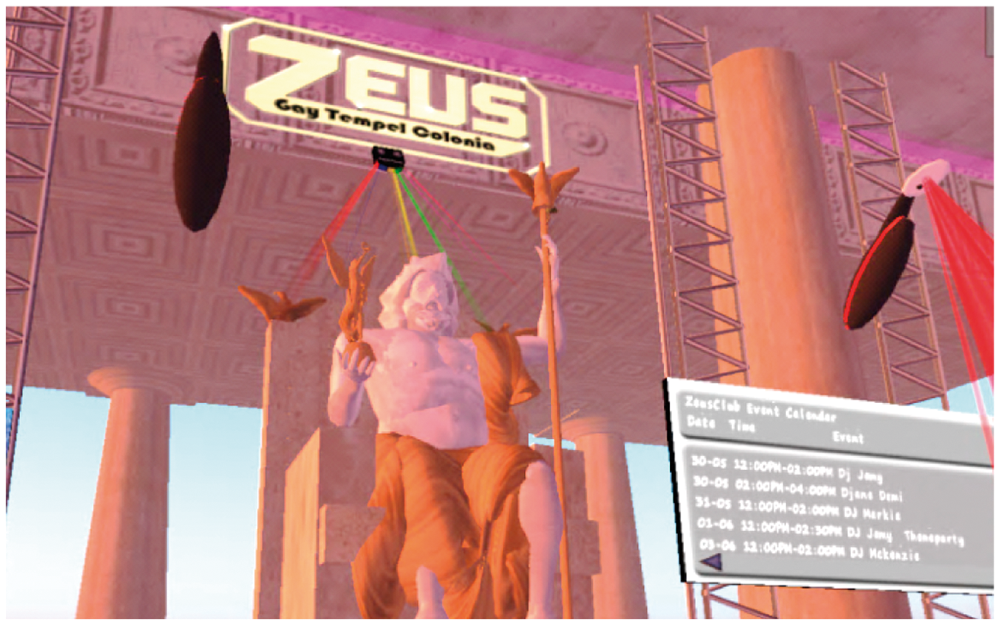
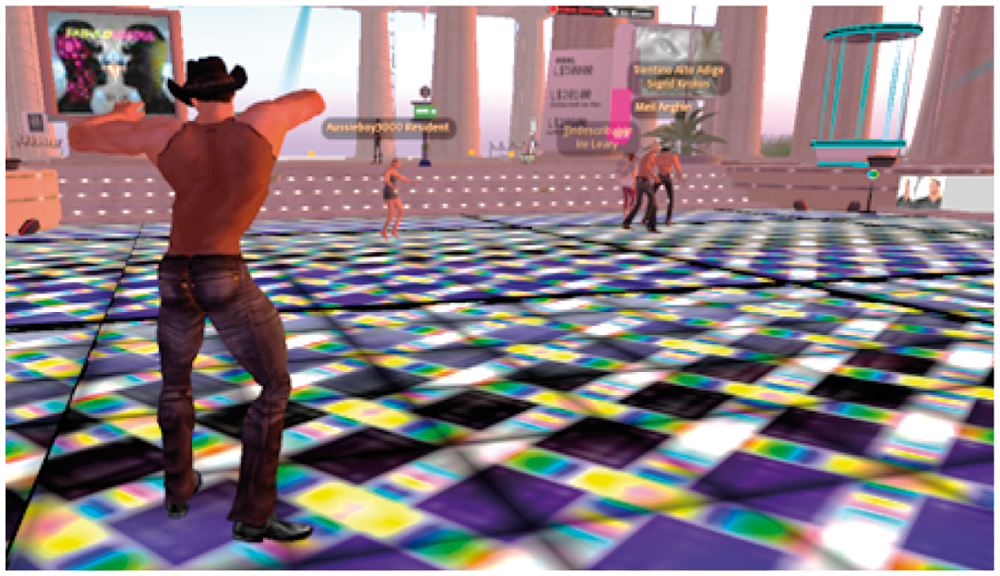
This unachievable body, the pinnacle of masculinity, shows its influence through the popular pursuits of bodybuilding and gymwork. In his analysis of the role of bodybuilding, including the paradox between masculinity and the male gaze, Mark Simpson describes the unease which leads to the acceptance of the sport and the continuing tensions that threaten to position the development, active judgement and tacit approval of the near-naked male form as deviant. He argues: while the appropriation of bodybuilding to buttress the image of an increasingly unstable masculinity appears to have been phenomenally successful, it is itself inherently unstable, its unsavoury past always threatening to gatecrash its new-found respectability and expose masculinity’s own scandalous secrets. (1994: 27)
There is a persistent paradox of the hyper-masculine form in its desperation for heterosexual affirmation that reaffirms not only the historical positioning of Ancient sexuality, but also in the contemporary approval of the male gaze looking upon a desired male form. As Simpson suggests, although the mainstream culture has been resolute in framing the male body as fervently heterosexual, ‘it cannot erase the fact that its use as a way of socialising males into heterosexuality is utterly predicated upon its homoerotic appeal’ (Simpson, 1994: 29). This shows the tenuousness by which modern conceptions of masculinity are based on notions of the homo gaze (appearance and performance for other males). Although underscored with notions of homoeroticism, this gaze is rationalised through a heterosexual identification that contains and controls homosexual arousal.
Within virtual space, there is no corollary to the notion of physical strength. What remains within the virtual performance is the gaze; one encourages others to look upon the body, for it is only the body appearance that holds agency in unfamiliar relationships. Heterosexual, as well as homosexual, males need to present themselves with particular reference to the visual. The virtual environment renders masculinity entirely performative, mainly as a representation of an avatar’s appearance. On Zeus the dance floor acts as the space of spectacle where the body can be displayed in its full performativity. Although dance is commonly associated with femininity and the female body as spectacle, on Zeus the spectacle is the male body. However, it is important to note that the male body is not feminised; it remains a spectacle of masculine beauty. And whilst the avatars that visit Zeus display gay male signification they do not fit passive, nor effeminate, identification. Rather, they display masculine beauty as typified in mass culture. The reliance on gay beauty signifiers is perhaps in a response to the primacy of the visual. In researching gay male chat-rooms, John Edward Campbell (2004) found groups rewriting beauty in response to these mass depictions, and so were able to rework depictions of desire through participation and sharing – a phenomenon that is absent on Zeus.
Bodies on Zeus emphasise the masculine qualities of the male, where the body falls back on signifiers of action and physical competence, rather than flamboyance or submissiveness. For instance, in the selected images, the avatars are proportioned to emphasise height, bulk and strength. They are sexualised in their dance moves, but these movements inscribe action and muscular display – they are far more like the bodies seen at circuit parties than at pop events (see Peterson, 2011). The SL scripts that animate the avatars are set at default movements for gender, so that male avatars walk with larger gaits than females and with more exaggerated movements. This can be changed within the SL environment, but to do so requires either Linden dollars to invest in animating an avatar in a different way to the default, or by mastering the technology itself. Whilst it is possible to reanimate an avatar, gender normativity in reference to movement is generally maintained alongside physical appearance. The only major element differentiating the male avatars on Zeus (presumably homosexual) to others in SL’s non-gay environments is their clothing, or lack thereof. Gay expression abounds in the avatars’ attire, sporting revealing cuts and materials as well as signifiers such as cowboy hats and BDSM wear (Figure 5). It is arguable that such clothing and appearance options feminise the body in its invitation to be looked upon; however, there is a complexity within the adoption of a subject–object position that cannot strictly be explained in terms of femininity. Whilst language often resorts to explaining behaviours through the female/male binary, such as in the assertion that a male who assumes the ‘bottom’ position is passive or somewhat girl-like (similar to the Freudian conception of inversion), these categories are too simplistic in evaluating the performances as seen on Zeus. The avatars are undeniably male (as a presumption of an underlying biological sex category), but they are also masculine. For what they perform, much more so than in heterosexual culture (although this is becoming more commonplace), is a desire to be looked at, applauded and desired in their masculine beauty. Their clothing and attraction of the gaze becomes an extension of the narcissistic self, not in reference to the Freudian-pathological conception of homosexuality, but to the concept of late-capitalist masculinity itself.
Such narcissism on Zeus is predicated upon the heteronormative consumerist ideals of status and power. Hyper-capitalism has seen the expression of this ideal become centred on the body, whereby ‘men are defined now more than ever through their consumption, sexuality and physical appearance’ (Brubaker and Johnson, 2008: 131). Whilst some scholars have offered that this trend has shifted gender distinctions (see Gill et al., 2005), it can be argued instead that the reconfiguration of the male body is a neo-liberalist form of masculinity that both reinscribes and reinforces masculine discourse and hegemony. Rather than being feminised, new masculinities reassert a phallocentrism and differentiation from the female through a gender identity performed for men.
Hardness, in its physical (muscular and phallic) and psychological (mental and emotional toughness) embodiment, is a state of expression for men as a performance of mastery and power. The female object is only a referent: as something of comparison. Because of the contemporary focus on the body as object for men, the opposition to the female becomes even more important for the assertion of masculinity, through hyper-masculinity. There is some suggestion ‘that men are responding to this crisis through increased social space for men’s bodies and emphasis on size, strength and violence as valued components of masculinity in popular culture’ (Brubaker and Johnson, 2008: 132). Gay men have also bought into this notion of success subsumed under hyper-masculinity. In what can be seen as a refutation of the gay male in ‘being in some way or other “like” a woman, fey, effeminate, sensitive, camp’ (Dyer, 2002: 5), there has been a culture of virile queer guys in images, fashion and pornography post-1960s. As explained by Dyer, even in the absence of women, gay men’s sexuality is, at least in part, defined through either an affinity with, or opposition to, notions of femaleness and femininity. The commodified body, and the gaze it invites, are reinscribed as masculine performances by men and for men in a rejection of the feminine (Figure 6).
Dance-floor.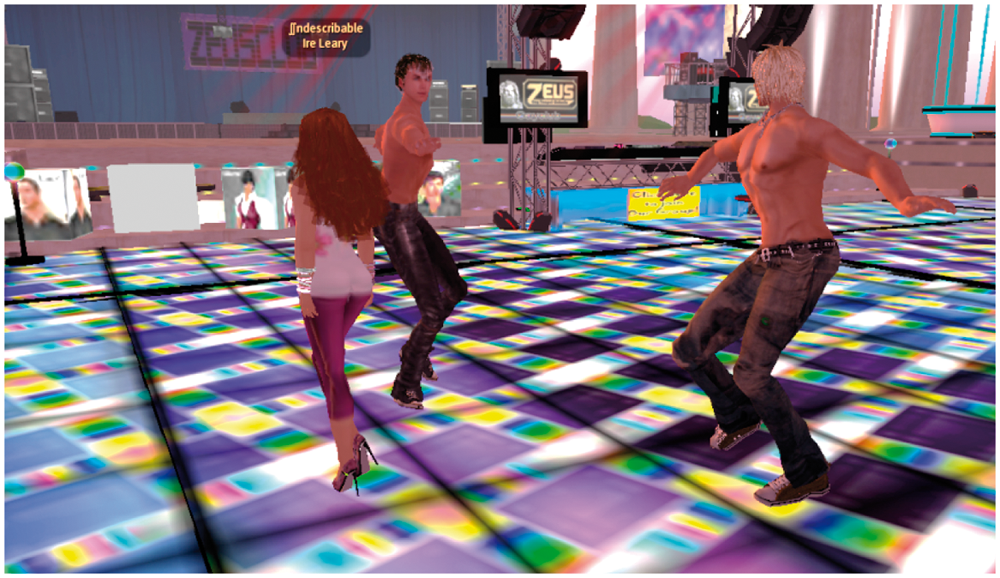
The effeminate male is peculiarly absent. Although there are numerous signifiers of gayness throughout the space (the club environment, the colours, the flamboyant, and often absent, clothing), there is an obvious refutation of representing the self as effeminate. Taken as a fantasy world, Zeus replicates the sexual desires and visions of the male body as mass produced in the gay mainstream. Bodies are tall, muscular and hard; desire and sexual liaisons are predicated upon this masculinity, where the female-object role as per heteronormativity is expressed ultimately through sex itself. In extending heteronormativity to sexual activity, the masculine (and therefore male) role is activated through the penetrative position with the receiving role being delineated as a feminine position. The problem with this dyad is reducing the masculine to ideas of domination as it resonates with heterosexual categorisation. Tim Edwards argues that the issue of domination within gay male pornography is ‘the explicit oppression of certain types of masculinity in these images’ (1994: 88) whereby the less dominant, and therefore less masculine male, is subjected to the more dominant male’s desires. He explains that this positioning of the lesser can be viewed by the broader lens of societal and cultural domination practices that seek to subjugate gender diversity and non-conformity: More significantly still. This process is then juxtaposed with the oppression of male same-sex sexuality at a societal level which is constantly played upon in the pornography as the passive or powerless partner is always perceived as more primarily homosexual while the active or powerful partner’s sexuality is perceived to transgress from straight to gay and, in addition, the gay consumer of the pornography is led to identify with the pre-given gay partner in eroticising the transgressive straight to gay partner due to the camera’s construction of the passive partner as subject and the active partner as object. (Edwards, 1994: 88)
There is an obvious corollary here with any visual media that invites the passive gaze, and therefore delineates the viewer as the homosexual recipient of arousal. virtual environments in 3D however, may challenge this phenomenon by way of passivity being replaced with active participation: if one can embody the more powerful position in a scene that is reminiscent of pornography then the associated power assumptions can be circumvented. However, problems remain regarding the conventions of femininity and masculinity and the location of desire and agency as dictated through the norms of culture and power relations. If, within Zeus, a male wishes to embody the powerful, masculine position, he does so at the expense of another. Masculinity remains caught up in its presumptions: to be masculine means to position the object-of-desire as feminine and a lesser agent in sexual activity. On a broader level, it reinforces the subjugation of the feminine male as too-close-to-female, and therefore external to the privileges of masculinity.
The gay male as consumer
Contemporary discourses of masculine power are often enacted through consumerism. This is particularly apparent in gay male sexualities as part of the urban consumer-class consciousness predicated on both the ability to spend on the body as well as discretionary spending on lifestyle products and services. The space of Zeus reflects this, having a large shopping precinct where one can buy items for bodily adornment as well as those for a leisure-filled lifestyle in-world, such as lighting rigs and DJ equipment. Outside of this precinct, and on various spaces throughout the region, there are many billboards advertising products and services tailored primarily towards the gay male market. The emphasis is on the male body as beautiful in both its sexuality and masculinity, with the important departure from the Classical Greek idealism of male beauty being the commodification of that idealised representation. The body is not simply a product of hard work and physical mastery, as epitomised in Ancient Greece, but is something that can be bought; a commodity related to the mastery of capitalism and market savvy. This is representative of the segmentation and categorisation of the gay market in western capitalist societies, where specifically the gay male market has been identified as ‘a sufficiently large and profitable group to warrant marketers’ attention’ (Sender, 2004: 1). This has attracted a large number of companies to appeal to gay male consumers over the social and political complexities that are present within society. The gay male market is often considered to have a large disposable income and a high investment in personal appearance and status, prompting particular attention from producers of high-end lifestyle products and purveyors of conspicuous consumables. Katherine Sender discusses the idea of discursive categorisation in reference to marketing and advertising in the USA: the gay community … is not a pre-existing entity that marketers simply appeal to, but is a construction, an imagined community formed not only through political activism but through an increasingly sophisticated, commercially supported, national media. (2004: 5)
Although much mainstream media seeks to desexualise the gay market in order for it to be palatable for heterosexual consumers, marketing for gay men within gay media and spaces is often highly sexualised, serving a market outside of the acceptable conservative norm. Zeus is a space for looking and for selling oneself as a gay male body of available sexuality and desire, as shown in the images below. The screenshot in Figure 7 is of a shop advertising highly sexualised gay male clothing, and the shot taken in Figure 8 is of an advertising billboard for various sexual services (such as to seductively animate one’s avatar in intimate encounters).
Billboard advertising gay male clothing. Billboard advertising sexual services.
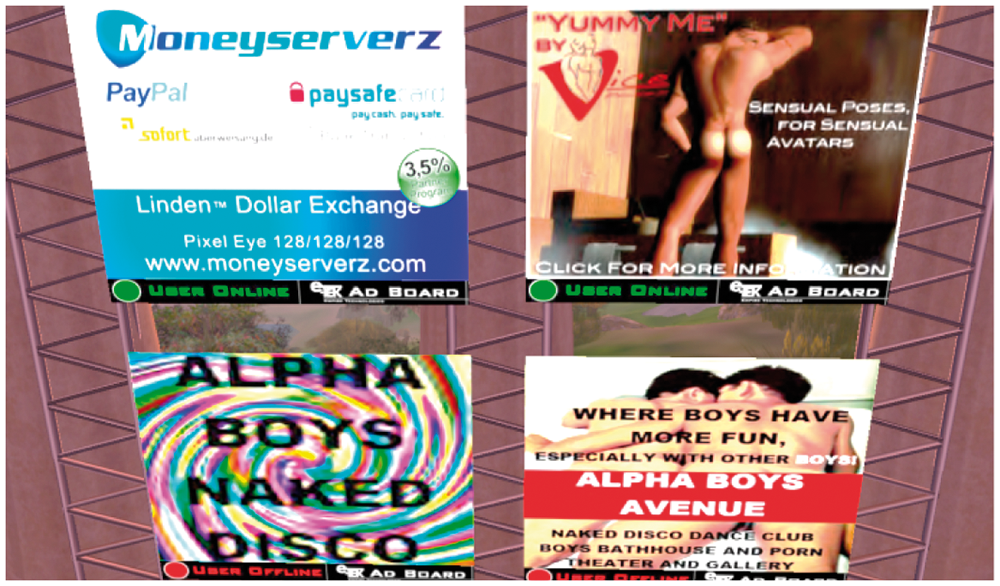
These depictions are anathema to what Sender describes as the publicly acceptable face of homosexuality, whereby ‘[a]nxieties about gay men’s sexuality, embodied in the two stereotypes of the hypersexual, predatory, possibly paedophilic gay man and the promiscuous AIDS victim, have shaped the constitution of the ideal gay consumer’ (Sender, 2003: 332). This ‘ideal’ consumer is seen as either non-sexual or barely sexual, where ‘the ‘charmed’ (or at least less abject) manifestations of homosexuality have become the public face of gayness’ (2003: 333). SL gay spaces such as Zeus represent the more subversive side of gayness that is often rejected in dominant media representations, whilst still reinforcing many of the dominant ideas of male consumerism, especially relating to class, racial and ageist depictions. This subversive market has been reproduced and refined in a way that draws upon the dominant discourses of male homosexuality, ultimately reinforcing dominant representations of male beauty, masculinity and promiscuity that exist as a counter-public to the now acceptable face of homosexuality.
Although the ideal cultivated image of the gay male is one who is ‘affluent, white, male, thirtysomething, gender-conforming, and sexually discreet’ (Sender, 2003: 335), spaces in SL are not bounded by the same appeals to heterosexual conformity and conservatism as gay media in the mass public sphere. Spaces like Zeus, which tailor to this counter-public, are at the boundary of the public/private sphere. Although the space is accessible by anyone with the hardware and software capacity to enter into the world, it has the veneer of privacy, due mostly to the anonymity of identity. This, coupled with the number of regular users of the site, means that on a global scale such spaces remain relatively guarded from the public masses. Tolerance of the wider gay market as well as the niche market of gay sex and subversion points to an acceptance aligned with economic rationalism whereby such identities are permissible in reference to their usefulness in the marketplace. Rob Cover explains that a ‘‘repressive tolerance’’ motif indicates a shift in viewing exploitation, along with many Marxian traditions, in the sphere of production and indicates that exploitative repression occurs also in the categorization of a market identity whereby subjects are encouraged to consume in order to ‘‘fulfil’’ their ostensible identity. (2006: 296)
Moral panics of subversive sex
The night-club space is significant in gay culture, having deep historical and cultural connections with subversive sex practices as defined by the mass public. With roots in the bath-houses and bars of the 1970s such spaces are often considered enclaves for sexual proclivities and alternative practice, being ‘safe’ from judgement, harassment and often violence (see Bérubé, 2008). The connections to subversive sex remain even in the development of progressive sexual politics that have seen greater visibility and acceptance of non-heterosexual coupling. Through digital technology the cultures and practices of non-normative sex often replicate the signifying practices of the corporeal, so that chat-rooms (in text-based communication) and 3-D virtual environments resemble the bath-houses, bars, night-clubs tea-rooms and cottages of the physical world. In researching casual sex in a university environment, premised by activity on the site Uni_cock, Sharif Mowlabocus describes the connection of technology with illegitimate behaviour and the extension of digital culture from and to the physical (2008: 434). Similarly, Zeus is an extension of these cottaging, tea-room or tacit hook-up practices, where liaisons are acted out through the screen, rather than using the screen as a precursor to corporeal sex. Still, such ‘lifestyle choices’ remain outside of the legitimate sphere of sexual practice, particularly given the anonymity and limited temporality of such practices. Furthermore, there are specific connotations to masculinity here, where the anonymity and fleeting nature of sex resonates with an unfettered masculine sexuality that operates outside of ‘gay’ insofar as gay is understood in the mass culture. The anonymity and fleeting-ness of such encounters plays into the fantasy of masculine sexuality, whereby one is not necessarily considered gay but engaging in dangerous or deviant sex, such as in the ‘great dark man’, ‘rough trade’ or sex with heterosexual men.
Other practices of deviance are also reified and expanded through the internet, such as pornography and barebacking. In a 2003 study by Halkitis, Parsons and Wilton, who researched the practice of barebacking among gay and bisexual identified men in New York, 30.7% of respondents indicated that they agreed with the statement that ‘barebacking is popular because of the internet’ – 45.5% of the 448 men surveyed who were familiar with the term ‘barebacking’ indicated that they had participated in the practice in the three months prior to the survey – (2003: 353). The major reason for implicating the internet in the popularity for barebacking was the ease of finding others anonymously and in reference to hook-ups on the internet for casual sex. Importantly, such research also acknowledges the issue of risk-taking behaviours that can be associated with bars, clubbing, alcohol and the rise of crystal-meth in the late 1990s (Dean, 2009: 102). Such risk-taking, as well as the gay pornographic culture of barebacking that privileges ‘raw flesh’ over safe sex, reinscribes a type of hyper-masculinity into gay culture, suggesting that ‘the internet might be productive (not just reflective) of emerging sexual cultures’ (Dowsett et al., 2008: 122). Halkitis et al. suggest that ‘gay and bisexual men perceived numerous psychological and emotional benefits associated with barebacking, including but not limited to feelings of connectedness, intimacy, and masculinity’ (2003: 355). Similarly, Dowsett et al. found in their study of barebacking and masculinity on US internet sites, that masculinity was central to the practice, albeit a different manifestation of the masculine from what is understood through the heteronormative: We found a kind of masculinity in which that articulation of sexuality and gender was exercised in different and unique ways, neither as simply derivative and as replica of heterosexual men, nor as a superficial text and performance through which the palimpsest of ‘real men’ could be seen. (Dowsett et al., 2008: 125)
Dean suggests that barebacking is a subculture unto itself, ‘with its own distinct identities, rituals, and iconography’ (2009: 104). Sex-based cultures embody a different sort of masculinity through practices that reify masculinity through sexuality. Whilst signification can simultaneously connote ‘gay’ as well as ‘masculine’ from extraneous observation, the practices as performed inherent to the culture are far more complex in terms of gendered and sexual performance. This is a specific problem associated with commercialised and subversive spaces and identities in terms of how to position the self and sexuality relative to the normative culture. What is represented and observed on Zeus displays these tensions, whereby there is meaning derived from the commercialised body as well as the meaning derived from the subversive body, which work upon each other to inscribe various sign-values of representation generally iterated through desire (Figures 9 and 10).
Advertising boards. Advertising boards.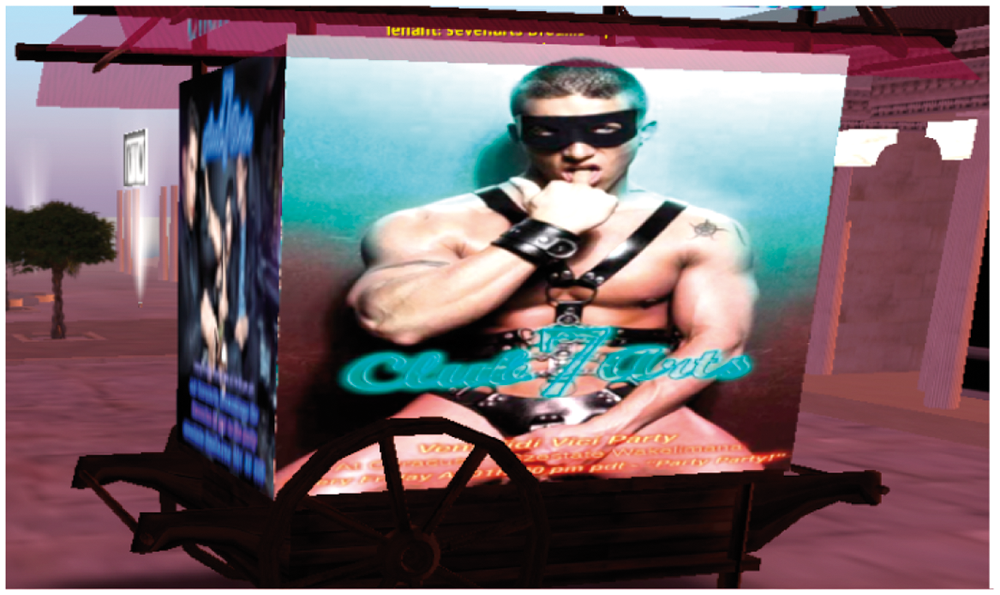
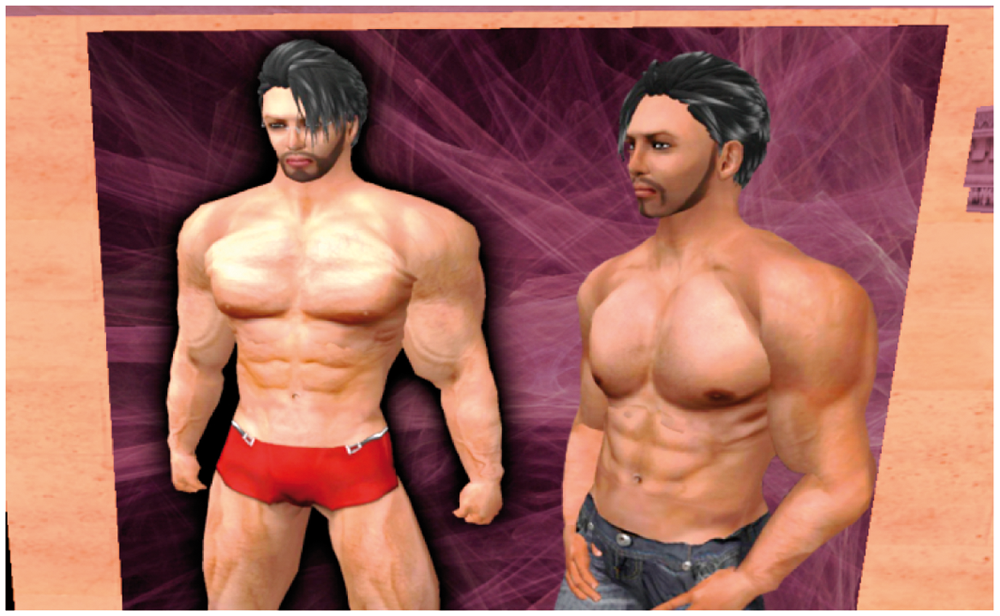
In view of western conservatism, Zeus can be framed as a seedy underbelly of illegitimate behaviour. With particular reference to phallocentrism, the homosexual male is unchecked in its deviance and unstable as an individual agent of desire, signifying the ‘masculine libido incarnate, the dangerous antithesis of family and community’ (Stacey, 2004: 181). The internet, and its associated connotations of deviance, works to produce spaces considered anathema to the ‘normal’ and controlled functioning of society: Control over the body has long been considered essential to producing an orderly work force, a docile populace, a passive law-abiding citizenry. Just consider how many actual laws are on the books regulating how bodies may be seen and what parts may not, what you may do with your body in public and in private, and it begins to make more sense that the out-of-control, unmannerly body is precisely what threatens the orderly operation of the status quo. (Sender, 2003: 333)
Outside of the mainstream acceptance of hetero- and homo-normativity, spaces like Zeus are demonstrative of the supposed dangers of hyper-consumerism and the overly narcissistic attention to the body and its pleasures. However, as put forward by Judith Stacey, such spaces can position male homosexual culture as ‘a potent source of oppositional values and cultural resistance’ (2004: 182). This subculture may well pose a threat to the established order of domesticity and the politics of coupledom, but should not be viewed as a threat on an individual level as a form of deviance and incivility. What is potentially antagonistic to the social order, below the superficial arguments regarding legitimate sexual behaviour (including promiscuity as an assault to monogamy and coupledom, and rampant hyper-sexuality) is the very notion of masculinity itself.
The undermining of constructed gendered positions may well be the source of fear to critics of non-normative sexualities. Masculine subject positions in particular, because of their privileged place in society, are seen as deviant and dangerous when practised outside of the accepted societal frames. With access to power within society, there is the potential for subverting the established conditions of heterosexual males. However, by reinforcing the sexual and relationship dyad, such as through the acceptance of homosexual unions, the hegemonic conditions are maintained. Hyper-masculinity, in its display of promiscuity, power, pornography and phallocentrism, can be seen as dangerous to the power of heterosexual males through the dissolution of the feminine (and female) subject position. The problem with hyper-masculine gay sexuality may be the difficulty in associating a female subject position; if two men are seen as equally masculine, or if masculine men are seeking other masculine men, then there is a problem in demarcating a female, or feminine, position. The relative absence of the feminine on Zeus, or a desire for the feminine as object, renders all male and masculine as object positions and therefore desirable and capable of being dominated by the hyper-masculine subject position. The symbolism of masculinity itself becomes a currency for a masculine sexuality that threatens the male (and supposedly masculine) heterosexual as object. Through projections of penis size, muscularity and physical and sexual positioning (who’s on top as dominant), the gay hyper-masculine subject contests the very notions of masculinity as attached, and defined by, heterosexuality. Moreover, the moral panics associated with the sexual subculture as found on Zeus can be seen as fears of the extension of masculinity in the ‘conviction that audiences respond to pornographic stimuli mimetically, by enacting in real life what they see on film’ reinscribing the fears of heterosexual porn, as applied to the positioning of women (and potential violence to women), onto the practices of (masculine) men (Dean, 2009: 114). Furthermore, there is the repositioning of gay sex as dangerous and harmful, reinforcing the attitudes of the 1980s and 1990s in reference to HIV.
In response to these fears, and as a way of legitimising gay culture, there is a strong movement from gay conservatives to homogenise gay culture and in so doing, position the gay community as conformist. The idea of sexually exclusive partnerships has been sustained in the transformation of sexual liberties within society as applied to marginal sexual communities, to the point where homosexuality has become to some degree legitimised within the boundaries of homonormative behaviour and practice as they mirror heterosexual behaviour and practice. Cover explains that the shift in sexual legitimacy is no longer about the dichotomy of male/female gendered practice or hetero/homo sexual identity, ‘to those which contrast stable couple-like relationships with ‘promiscuous’ sexual liaisons’ (Cover, 2012: 252). This dichotomy produces a dyad of legitimate/illegitimate identity formulated on the policing of desire. This legitimising force is borne out through research which suggests that coupling and monogamy have pervaded gay culture in western societies, with a reported increase in gay youths desiring long-term monogamous relationships, as well as a down-swing in the reported number of sexual partners outside of established relationships (Gotta et al., 2011: 371). This can certainly be seen as the more publicly acceptable face of gay culture in which the hetero-normative standard is closely followed, and it is suggested here that such reports closely follow the gay conservative movement in regards to gay marriage debates.
Concurrently however, and in the acknowledgement of the populist movement towards gay conservatism, there is a thriving culture of subversive practices and behaviours, such as clubbing, bath-houses, barebacking, circuit and other themed parties. Such subversive events and spaces have persisted historically and contemporarily through various attempts at policing desire, and have perhaps flourished as agents of antagonism to such endeavours of legitimising the entire category of gay and/or queer. And this is the space that Zeus and its occupants inhabit. It is a space that acknowledges and reaffirms much of the populist tropes of representation of desire but positions them at the edge of their acceptability. There is a play on desire here in terms of projected desire in relation to masculine embodiment, yet a reaffirmation of what is expected of masculinity and male success. This is perhaps typical of the internet whereby corporeal desires are extended through a re-embodied self of potential detachment from the everyday, yet are often reattached in the commonplace signifiers of gender, sexuality, race and class.
Conclusion
The moral panics that surround gay male sexuality and the internet are variously articulated through the site of Zeus. The displays of sexuality offered remain marginalised even as the majority culture becomes tolerant to a conservative homosexuality. What participation on Zeus represents is a countervailing narrative anathema to conservative standards in terms of sexual desire. It is illustrative of a queer subculture that continues to exist outside of the tolerance and acceptance given in mass media depictions and political discourse in western society. Whilst such acceptance should be applauded in many instances, it must also be scrutinised for its ability to reframe values, mores and ways of being along an arbitrary demarcation of what is acceptable and what is deviant. In the push for equality, especially the recent movement of marriage equality, there is a risk of homogenising queer individuality, lives and partnerships that can produce a new line of discrimination according to coupledom, gender conformity and conservative behaviours. As result, those who prefer to negotiate their lives outside of such normative principles risk being further demonised and their practices delegitimised as deviant, unacceptable and dangerous to greater society. This occurs not only in sexual practice however, and it is this contradiction that the site of Zeus also highlights through the absence of gender difference. Gender conformity is as much an issue of conservative politics as with sexual choice, and the absence of non-conformist avatars within the space suggests an adherence to a hyper-masculine connection with sexual prowess. In associating the masculine ideal with sexual proclivity, the space reaffirms the conditions of gender as established through patriarchal and heterosexist authority as well as reiterating masculine power and agency.
Footnotes
Funding
There was no funding received for this article. The project, of which this study is a part, was PhD research for Edith Cowan University, Western Australia.