



Abstract
The intention of this article is to challenge orthodoxies regarding heterosexuality, which have tended to constitute it as a static monolith and queer as the only potential site for a less oppressive sexuality. By contrast, we consider heterodox possibilities for pleasure and change within the realm of the dominant. We examine three examples – divergence, transgression and subversion – and then consider some terminologies that might flesh out experiential aspects of these examples of social change in heterosexuality. This conjunction offers a means to acknowledge heterosexuality’s coercive aspects while attending to its more egalitarian, less orthodox forms.
The intention of this article is to challenge certain orthodoxies regarding heterosexuality – orthodoxies that have tended, in critical literatures, to constitute heterosexuality as a static monolith, an unvarying, commanding mass, and queer theories, identities and practices as the only potential source for a less oppressive sexuality. By contrast, we wish to consider heterodoxy within heterosexuality by exploring possibilities for non-normative pleasure and change within the realm of the dominant.
What do we mean by ‘heterodoxy’ in this context? In general usage, heterodoxy is that which is at variance with, or that which differs or departs from the accepted, the standard, the status quo, the orthodox (Oxford English Dictionary, 2012), without necessarily being its opposite. Heterodoxy refers to a leaning toward the unorthodox. In departing from the strictly orthodox, it may extend to the dissident, but falls short of heresy. In several recent publications (e.g. Beasley et al., 2012; Holmes et al., 2011), we begin to set out an alternative approach to heterosexuality. This article provides an opportunity to develop and expand that approach. For us ‘heterodoxy’ is an apt term in that ‘hetero’ signifies both ‘difference’ and heterosexuality: it enables thinking about heterosexuality differently, if tentatively. We see our understanding of the heterodox reflected in a line from Leonard Cohen’s song ‘Anthem’: ‘[t]here is a crack in everything, that’s how the light gets in’.
In order to develop an alternative approach to heterosexuality, we first of all discuss in more detail how and why we employ the term ‘heterodoxy’. Following this, we outline three brief examples of departures from the normative. These departures are figured as divergence, transgression and subversion, all of which are more closely detailed in our earlier work mentioned in the previous paragraph. In this article our examples are employed as succinct illustrations aimed at developing a clearer articulation of the term heterodoxy, as well as an initial methodological framework for future work. The examples presented offer a basis for consideration of some phenomenological terminologies that might be helpful for analysis of experiential movements between normativity and heterodoxy. The intention here is to consider not just the degrees to which practices might depart from the normative, but also how these departures are experienced. This conjunction offers a means to acknowledge heterosexuality’s coercive aspects while attending to its more egalitarian, less orthodox forms.
Our discussion is, however, presently limited to English-language sources and western Anglophone contexts. Moreover, the focus is upon sexualities and to a lesser extent gender. Significant discussion of, for example, racialised/ethnic, disability, age and class variations remains beyond the scope of this article. While elsewhere we have given some consideration to these, and aim to attend more closely to them in further work, here we foreground sexualities, gender and the theme of heterodoxy. This focus alone involves a substantial endeavour which can only be broadly outlined in a single article.
Why heterodoxy?
We intend in this article to expand on earlier work in which we challenged the very common account of heterosexuality in critical gender/sexuality scholarship as nasty, boring and normative. Debates regarding this mainly pessimistic characterisation of heterosexuality are outlined in greater depth in Beasley et al. (2012). To summarise, we noted in that account that gender/sexuality scholarship is inclined to focus on heterosexuality’s more negative and disturbing aspects while, at the same time, casting it as uninteresting. Heterosexuality is usually critically conceived as homogeneous and synonymous with heteronormativity (see for example Bhattacharyya, 2002; Carroll, 2012; Dworkin, 2007 [1987]; Heise, 1997; Reis and Grossmark, 2009). Such presumptions play out the antagonisms of the ‘sex wars’, which raged in the 1980s but continue to be both implicitly and explicitly deployed in contemporary sexuality debates. The sex wars involve a dispute over whether sex is primarily dangerous or should be embraced as pleasurable (Duggan and Hunter, 2006). Moreover, in this dispute pleasure is routinely constituted as residing in ‘queer’ – meaning non-heterosexual – sex (Richardson, 2004). The oppositional stances of the sex wars thus leave heterosexuality in a dark, dull corner, its positive potential for joy and social change virtually unacknowledged and unexplored (but see Jackson and Scott, 2001, 2007; Meah et al., 2011).
For us, considering the term heterodoxy means finding fissures in the supposed monolith of heterosexuality, and examining where the light gets in. In doing so, we do not examine important but well-explored aspects of heterosexuality – such as prostitution, sexual violence, sexual trafficking, or cultural representations of heterosexuality –but rather consider less frequented corners. However, before attending to how to undertake potentially heterodoxical research, it is helpful to clarify why we might embark upon this challenge to the orthodox account of heterosexuality as unpleasant and offering no recourse to social change. In this setting, we suggest that it is necessary to challenge the orthodoxy that heterosexuality is homogeneous and synonymous with heteronormativity.
A crucial feature of heteronormativity is that it propounds a hegemonic coherence against which all sexualities – including heterosexual practices themselves – are judged. This expressly requires a suppression of diversity even within heterosexuality (see also Berlant and Warner, 1998: 548; Jackson, 2005, 2006; Richardson, 2004; Seidman, 2005: 40) and a lack of appreciation of its fluid and dynamic aspects (Hockey et al., 2007). Nevertheless, with few exceptions, critical gender/sexuality scholarship continues to conflate heterosexuality and heteronormativity as one and the same. Yet, if heterosexuality is simply equated with heteronormativity, the hegemonic coherence of heteronormativity is ironically upheld. Furthermore, since change is conceived as occurring only at the margins, the majority of the populace can be inferred to be mere robotic conformists condemned to stand outside the gate of historical change. In contrast, our concern is to ‘undo’ heterosexuality, to undo the illusory homogeneity and authority of the heteronorm, in similar fashion to Butler’s ‘undoing’ or ‘troubling’ of gender (Butler, 1990, 2004).
In the relatively rare discussion of non-normative sexual directions in relation to heterosexuality there has sometimes been an inclination to posit ‘queer heterosexuality’. While we employ ‘queer’ to describe a particular approach or mode of theorising, and as usually linked to LGBTI sexualities (Ahmed, 2006a; Richardson, 2004), we deliberately do not use it as an easy synonym or umbrella term for the non-normative. 1 Why not? Why focus on the heterodox rather than the queer?
First of all, there are certain problems attached to the conjunction of queer and heterosexuality. The conjunction has provoked debates about the appropriation of queer for use in relation to heterosexuality (see for example Brook, 1996; Davidson, 2005; Schlichter, 2004). ‘Queer heterosexuality’ looks suspiciously like a push for heterosexuality to ‘have it all’, to be both dominant and marginalised, such that heterosexuality invites itself along to the fashionably cool queer party without having had to pay the dues of marginalisation. Concerns about appropriation of the queer by heterosexual interests sometimes have practical manifestations. Recent (unsuccessful) requests to have a ‘Queer Heterosexuality’ float at the Sydney Mardi Gras, for example, produced controversy in a Facebook discussion over whether renouncing self-designation as heterosexual was necessary to queer identification, and relatedly, whether the ‘exclusion’ of heterosexuals from the rubric of queer sexuality is problematic. 2
Apart from practical political issues about who or what can be queer, there are further reasons to hesitate regarding the appellation of ‘queer heterosexuality’. The radical potential of ‘queer’ to precisely signal the refusal of the homosexual/heterosexual binary, as well as highlighting the uncertainty and permeable fluidity of identity categories, may be said to sit awkwardly, or even incoherently, alongside any retention of a focus on heterosexuality (Beasley, 1999: 82, 88; Butler, 2013 [1997]: 471–472). As Green points out, queer thinking is about ‘radical deconstruction’ and ‘radical subversion’ (2007: 28–29). Queer thinking denotes an ‘opposition to hegemonic norms’, a protest against the ‘normal’ and ‘static, norm-regulated identities’ (Showden, 2012: 8; see also Warner, 2012). 3
By contrast, we would suggest that the broader arena of the non-normative is not inevitably as challenging as that to which the term ‘queer’ can more confidently lay claim. Indeed, the non-normative, as will be outlined shortly, may often include more mundane everyday activities, which are not always self-consciously directed political acts, or inevitably in opposition to the normative (Hockey et al., 2007; see also Note 1 of this article). To obscure the diversity of the non-normative by potentially sloppy over-use of the term ‘queer’ to encompass all sorts of practices not only risks diminishing its vital political significance, but also risks loss of recognition of a variety of more nuanced, fragile moments in analysis of social change. Perhaps the notion of a ‘queer heterosexuality’ might be best considered as a very specific, particularly challenging departure from heterosexual normativity. Our aim, however, is to consider a wider range of departures from the orthodox.
This range includes those departures that might be merely contingently divergent to those which move towards the dissident and even heretical – that is, towards sexualities which might be more clearly aligned with the queer. In short, we wish to make a case for the significance of the term heterodoxy as signalling an extensive variety of non-normative heterosexual possibilities or innovations relevant to broader analysis of social change. Importantly, these innovations may continue to draw upon elements of the homosexual/heterosexual binary and do not presume the collapse of distinguishable sexual identity orientations. In other words, they may involve innovations within heterosexuality but nevertheless resist aspects of heteronormativity.
Instead of heterosexuality looking like a homogenous monolith, in Figure 1 we visualise a framework for considering a range of non-normative elements in the realm of the dominant. At its normative core, where heterosexuality is indeed equated with heteronormativity, we can see what might be termed ‘cissexuality’ – a space where sexed body, gender, sexual orientation, desire, sexual practice and inter-relationality align neatly with what is deemed to be the honoured or hegemonic form of heterosexuality (Harrison, 2013: 12–13; Johnson, 2013: 12).
4
Beyond this are comfortable and unthinking normative options which are perhaps less strictly or entirely aligned with the hegemonic, but which are nevertheless hegemonically satisfactory and ‘do the job’.
5
An example of this ‘good enough’ normativity in a contemporary western setting might be a cohabiting heterosexual couple who remain unmarried. From this point onwards we begin to step into potentially non-normative terrain. In Figure 1, this stretches from ‘divergence’ through to the entirely ‘heretical’.
Heterosexualities – from normative to heretical.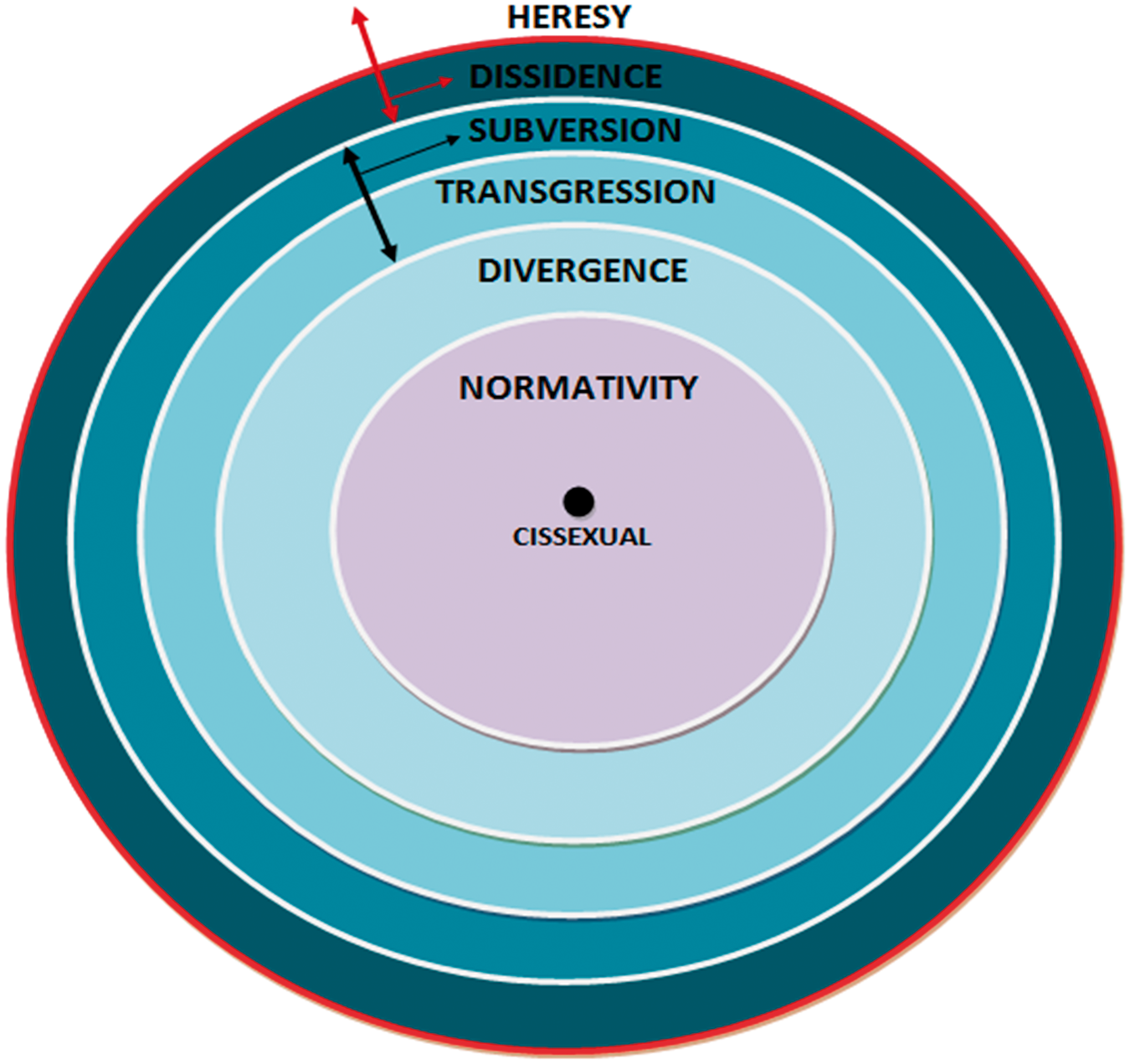
Let us now turn briefly to the three departures from heteronormativity mentioned earlier: divergence, transgression and subversion. We use these examples because all fall short of the more radical possibilities that might be associated with the term ‘queer heterosexuality’. We focus on them precisely to fill out the meaning of ‘heterodoxy’ and to consider the spaces for social change that, to our way of thinking, include much more than radical opposition. The discussion of these examples is necessarily schematic given limitations of space. For similar reasons, we focus on the conceptual/terminological, though there is reference to empirical scholarship and practical illustration. Divergence is closer to the norm than transgression, which in turn is closer than subversion. To diverge involves moving a little away from the norm while remaining within its purview, whereas to transgress involves straying from the straight and narrow path, but without that necessarily being the intention. By comparison, to subvert requires undermining the norm in a more reflexive fashion, although not always radically.
Divergence
Our first departure from the heterodox contests orthodoxies even at the centre of institutionalised heterosexuality – in this case, marriage. The orthodox view in critical gender/sexuality research is that heterosexual marriage is utterly and enduringly boring and normative: it is a bastion of heteronormative privilege. In this context, anti-gay US commentator Paul Cameron, for example, comments that ‘[m]arital sex tends toward the boring’ (Cameron as cited by Dreyfuss, 1999). Cameron’s view is repeated, in general, by critics as well as defenders of heteronormativity. We do not wish to suggest that marriage is in fact a hotbed of exciting heterosexual innovation. However, we do question the way that heterosexual marriage and heteronormativity are so readily and routinely collapsed. We prefer to ask: does heterosexual marriage fall short of thoroughgoing heteronormativity? If marriage is not just a repository for homophobic and sexist imperatives, how might it be better conceptualised and understood?
Our heterodox approach to marriage seeks to challenge the orthodoxy that marriage and heteronormativity are virtually identical. We are concerned here to consider what we have described as divergence from relentless conformity, to recognise that even in the seeming heartland of the heteronorm, the rhetorically effortless identity of marriage and heteronormativity is never quite realised. In a range of gender/feminist and sexualities scholarship, marriage has been positioned as a disciplining institution, as something whose primary function is to naturalise heterosexuality and gender roles. Adrienne Rich’s (1980) landmark essay on compulsory heterosexuality marks the beginning of a clear trajectory of scholarship on sexuality which suggests that marriage is heterosexuality’s premier institution (for example Emens, 2009; Robson, 2009; see also Jackson, 1996: 24). There seems no space here for inconsistency.
In this context, while differences in conceptualisation and opinion amongst and between gay and lesbian thinkers on marriage are often acknowledged (see, for example, Gust et al., 2003; Rimmerman and Wilcox, 2007; Stychin and Herman, 2000; Wintemute and Andenæs, 2001; Wolfson, 1994), heterosexual perspectives remain likely to be treated as singularly hegemonic. Despite some academic accounts of intimacy and personal life that now acknowledge diversity in heterosexual relationships (Beck and Beck-Gernsheim, 2002; Budgeon and Roseneil, 2004), the notion of ‘the heterosexual family’ – singular, uniform – remains commonplace (see Ferguson, 2007: 43 et passim). Yet heterosexual marriage is not one hegemonic structure. Instead we argue the position that (heterosexual) marriage is an institution whose meaning and effects for heteronormativity are dynamic and not entirely certain – a seemingly obvious, yet rarely acknowledged point. We note that acknowledgement of the possibility of inconsistency, the possibility of divergence, the existence of less than complete conformity, is an important means to open the conceptual and empirical gate to a more developed and dynamic account of sociality and social change.
Commentators like Robert H Knight (American conservative writer, activist, and drafter of the US Defense of Marriage Act) argue that enabling same-sex marriage would mean the complete evacuation of its personal and institutional meaning (Knight, 1997). We assert that this wrongly positions marriage as, historically, always and inevitably heterosexual. It is not. Even as it has indisputably policed and protected heterosexuality, marriage has been peopled by sexual subjects who resist categorisation as straightforwardly or merely heterosexual. Such subjects include, most obviously, transgendered spouses (Eskridge, 1996; Ford, 2000) but also include non-normative heterosexualities. A number of matrimonial, divorce, and family law judgments attest to spouses behaving in non-normatively heterosexual ways. The example of a wife who relentlessly badgered her exhausted husband for sex until he sought a divorce on grounds of her cruelty (see Willan v. Willan 1958 and Willan v. Willan 1960, UK, in Brook, 2007: 90–91), suggests the existence of something other than a narrowly ‘straight’, let alone a socially honoured mode of gendered heterosexuality, (even if it appears precisely in order to police the boundaries of acceptability). Similarly, other judgments complicate the assumed concord between reproductive and hetero-sex that characterises marital heteronormativity. Consummation within a marriage, for instance, has been held not to have legally occurred, despite the husband and wife having had a child who was their biological offspring (Clarke v. Clarke 1943, UK, in Brook, 2007: 75). Such examples are hardly routine, but appear as cracks in the institutional masonry of marriage. They represent moments of divergence from the normative (despite not operating as deliberate political protests) which should not be discounted or rendered invisible beneath the generality of marriage as institutional heteronormativity.
Clearly, marriage has exhibited homophobic and sexist tendencies: more than this, the regulation of conjugality has, at certain moments, been primarily dedicated to heteronormative purposes (Brook, 2007). However, marriage does not merely naturalise, reward and protect heterosexuality. If the effect of institutionalised marriage is to preside over and mask a range of identities and practices, vesting them with falsely heteronormative uniformity, rejecting this characterisation becomes politically salient. We envisage here a theorisation of conjugality in which heterosexuality is not always or inevitably complicit in constructing institutional privilege, even though it may be heteronormatively enveloped. This work may require attention to detail, but even in very narrow fissures, light may get in.
Transgression
Beyond the normative core, a heterodox approach is even more significant when considering transgressive possibilities for misbehaviour, lapses and indiscretions as offences against the hetero-norm. These offences may edge towards lawbreaking, without deliberately undermining ‘hetero-law’.
We suggest that it has become an orthodoxy to view queer sexualities as the site of transgressive sex. By contrast, heterosexuality continues to be critically assessed as typically unpleasant and inequitable (Beasley, 2011; Beasley et al., 2012). On this basis it is viewed as of limited theoretical interest and is implicitly equated with political stasis (see Rossi, 2011: 10). Thus, reassessing the link between transgression and heterosexuality becomes important because transgression can be politically significant. Elizabeth Wilson asserts, when discussing the example of a woman using a dildo on her male sexual partner, that no matter how transgressive or ‘queer’ this couple might feel themselves to be, to the world they are just ‘kinky’ heterosexuals. Many other examples of transgression exist, 6 and perceptions of what might be deemed ’kinky’ vary. However, the crucial point here is that Wilson does not think that transgressive experimentation with sexual practices and roles makes any meaningful contribution to social change (Wilson, 1997: 169).
Against Wilson, we argue that transgression can invoke possibilities for politics. ‘Kinky’ or otherwise innovative heterosexual sex is not always or necessarily politically meaningless. To rehearse the catchphrase of second-wave feminism, the personal remains political, and the effects of a range of sexual practices are not necessarily confined to the private. Hence we reconsider innovative sexual (that is, ‘private’) conduct in terms of the political. In this context, the term transgression is especially useful for our investigation of heterodoxy. Transgression in the realm of heterosexuality is not necessarily about decisive ruptures, breaks, or fissures. While it may include a more overt invocation to law-breaking that connects private practices to public politics, it also retains a broader association with ‘wrongdoing’ and ‘wandering’. 7 It becomes possible to consider private sexual conduct, such as innovative hetero-sex, as a potential moment of transgression.
We see transgression as a term that is more about straying from, rather than undermining normative regimes. Heterodox ways of ‘doing heterosexuality’ (Rossi, 2011: 20) require theorisation which moves beyond the simple equation of heterosexuality with heteronormativity. However, if heterosexuality is not a heteronormative ‘closed book’, what might transgression in the realm of the dominant look like?
We have several thoughts on this, but will mention just one for now. In conceptualising a transgressive heterosexuality, it is necessary to attend to the privileging of phallic hetero-masculine sex and, for us, this indicates a necessary confrontation with the abjection of the penetrated. Pro-sex queer theorists have raised doubts about the seemingly self-evident hierarchical relation between the penetrator and penetrated (Thomson, 2011: 243, 250). By contrast with Wilson’s rather disparaging assessment of innovations in penetrative hetero-sex, this seems to us a useful direction when thinking about the meaning of transgression.
Queer theorising unravels stereotypical gendered/sexual alignments such that, for example, the penetrated cannot be presumed to occupy a particular gender or a particular sexual orientation, and is not necessarily located as socially subordinate or sexually abject. For example, Bobby Noble and Ann Cvetkovich draw attention to an active sexual receptivity that defies traditional sexual taxonomies in their discussions of gender queer, butch-femme and gay male ‘bottom’ narratives (Noble, 2007: 161–164; Cvetkovich, 1995: 136–137). In considering transgressive possibilities we must be equally alert to the complex ways in which people occupy and perform heterosexual practices.
Subversion
Our outline of heterodox heterosexuality now moves beyond the transgressive to explore subversive possibilities. Subversion involves a more purposeful, conscious challenge to the orthodox. Where transgression can be an accidental straying from the norm, subversion is more deliberate, even if not undertaken as a deliberately ‘political’ stand. And, while transgression has a more temporary aspect, subversion entails taking a slightly more lasting path. As noted with regard to transgression, subversive challenges to heterosexuality are not limited to merely exotic forms of sexual relating. Diverse forms of heterosexuality can subversively exceed the heteronorm: think of deliberate childlessness for example. However, given limitations of space here, we will just consider one form, which in this case upsets normative assumptions about heterosexuality as always or inevitably assuming cohabiting couple relationships. Although non-cohabitation of partners is not new, nor necessarily revolutionary, contemporary decisions to not co-reside with a partner can signify and produce a reflexive questioning of the centrality of heterosexual relationships in people’s lives (Roseneil, 2005). Non-cohabitation also returns us to an issue raised in relation to transgression in suggesting that some heterosexual couples might ‘undo’ heteronormative accounts of hetero-sex as necessarily equivalent to penetrative penis-vagina sex.
Some non-cohabiting couples subvert hegemonic heterosexual ‘sexual scripts’ (Gagnon and Simon, 2005 [1973]), which designate physical closeness to be a key sign of the commitment, familiarity, privileged knowledge, and active caring that supposedly comprise intimacy (Giddens, 1992: 96–98; Jamieson, 1998: 8; Lasch, 1995: xiii–xvii, 138–140; Smart, 2007). Heterodox forms of non-cohabiting intimacy may include couples living apart together (‘LAT’ – that is, couples who live separately), some of whom live nearby and others in ‘distance relationships’ (see Duncan and Phillips, 2010; Holmes, 2006). Such relationships reveal that proximity does not guarantee intimacy, and intimacy can be maintained without proximity (Baldassar et al., 2007; Holmes, 2004, 2010). All relationships deal with some degree of physical and emotional distance occasionally (Simmel, 1971 [1908]), but some heterosexual couples more obviously subvert hegemonic norms of cohabitation and hence understandings of heterosexual coupledom, commitment and intimacy.
Non-cohabitation can involve deliberate efforts to find more independent or mutual ways of relating (Holmes, 2004). Such heterodox forms of intimacy may well be responses to increased geographical mobility and other practices to which many people are compelled by processes of globalisation (Bauman, 2003; Elliott and Urry, 2010). Non-cohabitation not only potentially involves challenges to the normative heterosexual ideal of legitimate commitment but clearly suggests some questions about what constitutes sexual relationality. Living together is not always sexually exciting or even satisfactory, and living apart does not necessarily reduce sexual pleasure or activity (Gerstel and Gross, 1984: 62–66).
Not cohabiting may sometimes offer more sexual excitement than cohabiting. Not cohabiting can avoid over-familiarity. Being apart often may force couples to communicate better, avoid conflict and enhance romance (Gerstel and Gross, 1984: 74–77; Holmes, 2004). Doing heterosexual relationships differently can bring a feeling of exploration and excitement, or quieter but nonetheless subversive enjoyments, including those mobilised in communications, imaginings and memories. Relatedly, some forms of non-cohabiting intimate heterosexual relationships can also provide heterodox experiences of ‘the sexual’, which subvert the importance usually given to penetrative penis-vagina sex. Doing things differently, even if not challenging the normative in markedly radical or ‘queer’ terms, can nevertheless provide opportunities for pleasure and possibilities for change.
Between normativity and innovation: Considering terminologies/methods for the exploration of heterosexual heterodoxy
Figure 1, used to visualise the non-monolithic diversity of heterosexualities, suggests a terrain of socially situated and embodied practices ripe for empirical research. In keeping with understandings of ‘queer’ as a verb rather than noun, as a range of actions rather than modes of identity or being (Showden, 2012: 9; Sullivan, 2003: 50), our aim is to enable research on heterosexuality to invoke a sense of dynamism and interrelational uncertainty, such that heterodoxy is conceived as processual, as non-normative practices, rather than as a question of ‘types’ of identities or even coherent or ongoing behaviours. Heterodoxy may be temporary, contingent and fleeting, as well as sometimes deliberate, decisive and ongoing. Such different temporalities may exist simultaneously with regard to different practices. In this setting, it becomes crucial to move beyond a schematic plane of heterosexual possibilities (as illustrated in the figure), towards consideration of how we might recognise, conceptualise and research experiential movements between normativity and innovation.
To prepare the ground for such empirically based research we draw upon and reconfigure certain phenomenological terminologies employed within queer postcolonial thinking that might be useful in fleshing out the schematic paradigm so far outlined. These terminologies are chosen as a starting point because they focus on how queer subjects move between normativity and queer possibilities. While they focus on queer trajectories, these terminologies can nevertheless provide a means to grasp how heterosexual subjects might interact with and sometimes move between the borders of normativity and degrees of heterodoxy.
Tulia Thompson (forthcoming) both draws upon and reworks terminologies employed by Sara Ahmed in her book, Queer Phenomenology (2006a). 8 Thompson’s discussion provides a basis for reconsidering these in the setting of heterosexual heterodoxy. Thompson notes that Ahmed’s usage of phenomenological terms tends to construct the experiential through ‘an individualised human body as the vehicle for perception’ (Thompson, forthcoming: 47, emphasis added). This is despite Ahmed’s linkage of sexual/bodily ‘orientation’ with the politics of colonialism. For Thompson, the analysis of queer subjects’ movements between normativity and innovation requires a less Eurocentric, less individualised account: one which is not just perceptual, but more strongly integrates intersubjective, communal, systemic and institutional imperatives (Thompson, forthcoming: 47, 55, 35). In this context, Ahmed’s use of terms like ‘orientation’, ‘lines’ and ‘directions’ as ways to describe the accrued constraining force of social requirements (Ahmed, 2006a: 11, 14–16, 21) may appear as somewhat too linear and individually oriented. We suggest, in the context of developing concepts to aid in researching heterodoxy, that it may be helpful to talk about ‘scenarios’ which emphasize active interrelational contextual location rather than a singular path or line of sight.
There may be similar issues with Ahmed’s employment of the terms, ‘straightening’, ‘stopping’ and ‘disorientation’ (Ahmed, 2006a: 66–67, 92, 139, 140). ‘Straightening’ refers to experiences of being brought back into line with normativity, ‘stopping’ to coming up against social obstacles which impede shifts away from normativity, and ‘disorientation’ to moments in which there is an awareness of other possibilities than the normative. These terms may also tend towards the assumption of an individualised perceptual subject. However, we consider that they do perhaps enable some space for thinking about and investigating heterodoxy empirically. All the same, such terms tend to have a more dramatic and perhaps more oppositional stance – perhaps arising from their particular relevance to and focus on queer subjects. For this reason we prefer the term ‘swivelling’ developed by Thompson (forthcoming: 134) to denote the less radical inclination of many straight and queer people to turn back and forth between normative and heterodox possibilities in relation to sexuality, indicating an active and unceasing modulation rather than the linearity of a queer path which is interrupted – which tends to be the way Ahmed’s terms describe experiential movements.
Why make a point of such terms? For us, they suggest qualitative markers for empirical investigation. It is possible to ask subjects to consider whether they might have felt they were straightened up or stopped in relation to their experience of heterosexuality, whether they felt they were required to swivel back and forth between the accepted and the less orthodox, or whether they ever felt disoriented and had a sense of alternatives with which they were not familiar. Such qualitative markers can provide a means for articulating experiential movements within and across a taxonomy of heterosexual scenarios.
Conclusion
Bhattacharyya’s summative point regarding the social location of heterosexuality – that is, straights ‘are just straight’ (2002: 22) – cannot be all that sexuality scholarship says about the subject. In this context, it is asserted that non-normative possibilities should not be understood as available only at the social margins. Instead, such possibilities may be intrinsic within even dominant practices like heterosexuality. Heterodox ways of ‘doing heterosexuality and heterogenders’ (Rossi, 2011: 20) require conceptual theorisation and empirical scrutiny in ways which move beyond the equation of heterosexuality with heteronormativity. With this aim in mind, how then might heterodoxy be understood and investigated?
Developing the notion of heterodoxy provides a means to critically examine a number of orthodoxies about heterosexuality, enabling exploration of possibilities for change even where these are not self-consciously or deliberately political. In order to undertake this exploration we firstly outlined why heterodoxy might be a useful way of discussing the non-normative, and then used three gradients of dissent to illustrate this – divergence, transgression and subversion. Finally, we turned from these illustrations to a brief account of potentially useful terms drawn from queer postcolonial thought to explore how subjects might experience location within and movement across these gradients.
The conjunction of examining diverse practices in heterosexuality, along with a focus on experiential turning points, is primarily aimed towards the development and use of the term ‘heterodoxy’, but is also intended to signal an initial methodological framework for future theoretical and empirically based work. By this means, we hope to better understand and contest heterosexuality’s coercive aspects while also gaining a better understanding of how more egalitarian forms of heterosexuality might be possible.