



Abstract
This study investigated whether elements of Social Identity Theory (SIT) and Self-Categorization Theory (SCT) appropriately described experiences of bisexual people in terms of accurately predicting the effect of self-stereotyping on well-being. Previous research has indicated that self-stereotyping is protective for members of marginalized groups. This study manipulated prototypicality, or self-stereotyping, to determine whether it affected well-being for bisexual-identified people. Forty-two bisexual participants were told either they were a strong or weak representation of a prototypical bisexual person, after which several well-being measures were taken. Female participants reported significantly higher levels of negative affect in the high prototypic group, indicating SIT and SCT may not operate the same way for bisexuality as they do for other social identities.
Introduction
In considering the health and well-being of stigmatized groups, previous research based on Social Identity Theory (SIT) and Self-Categorization Theory (SCT) has found that well-being increases for members of marginalized groups when they strongly identify with that group (Outten et al., 2009). In particular, this area of research has indicated that self-stereotyping, or the application of traits from a ‘prototypical’ group member to the self, is responsible for the increase in well-being of marginalized group members (Latrofa et al., 2009). While this theory has been tested with groups that are marginalized on the basis of ethnicity, gender, and geographic location, it has not been tested with sexual minority groups, or the bisexual community in particular. The purpose of the current research is to engage in a critical exploration of whether these aspects of self-stereotyping and well-being expand to include the experiences of bisexual people as previous research generated from SIT and SCT would lead one to predict, as well as to explore possible explanatory factors of health disparities experienced by bisexual people. This is accomplished through determining whether manipulating an individual's sense of prototypicality (or level of self-stereotyping) influences well-being outcomes such as positive and negative affect, self-esteem, and stress; other identity outcomes are also measured, including identity certainty and centrality, and feeling of belonging.
Social identity and self-categorization theory
SIT, or the ‘social psychological theory of intergroup relations, group processes, and the social self’, was developed over the second half of the 20th century, primarily by Henri Tajfel and John C. Turner (Hogg et al., 1995: 259). The theory was initially developed by Tajfel in order to study prejudice and discrimination, and was later expanded upon by Tajfel and Turner, among others, in the 1970s (Hogg, 2006; Hogg et al., 1995). SIT states that individuals develop social identities, which are understandings that one belongs to certain groups of people or categories, and those identifications become part of the self-concept (Hogg at al., 1995; Stets and Burke, 2000). When a social identity is activated, individuals begin acting as a member of the group, subscribing to prescribed normative group behaviours, as opposed to acting as a unique individual. This activation is not necessarily a loss of identity, but rather a change in identity perspective. Thus, when social identities are made salient, one's perception of the self and actual group behaviours become normative and stereotypical as each member tries to embody definitive characteristics of the group with which they identify (Hogg et al., 1995; Stets and Burke, 2000).
Turner and colleagues developed SCT to better theorize the categorization process of SIT. Turner asserts that categorization is the foundation of group behaviour (Turner et al., 1987), and through the process of categorization, intergroup boundaries are accentuated as group members begin to perceive their fellow ingroup members as more similar to themselves and to perceive differences between groups to be more distinct. This process is facilitated through group prototypicality and depersonalization (Hogg, 2006; Hogg et al., 1995; Stets and Burke, 2000; Turner et al., 1987). A group prototype is a real or imagined group member that embodies all of the definitive characteristics of the group (Hogg, 2006). For example, the prototypical member for the category of college student may be young, studious, and of above average social economic status. Prototypical members are not considered to be the average group member, as they are to inhabit all of the group's characteristics, but rather a shining example that other group members strive to mimic (Hogg, 2006). It is especially important that prototypes embody the characteristics of the group that clearly differentiate the group from relevant outgroups, and that these central characteristics are positive.
Once a group has a defined prototype, depersonalization can occur. Depersonalization is the process that group members go through to change their identity perspective from that of an individual, or what is referred to as a person identity in SIT, to the group level. Thus, individuals are ‘perceived as, are reacted to, and act as embodiments of the relevant ingroup prototype rather than as unique individuals’ (Hogg et al., 1995: 261). Through depersonalization, intragroup differences are minimized, and intergroup differences are maximized.
Whereas group identities overall are found to be relatively stable, perceived prototypicality is highly dependent upon context. Whether one person perceives they are a prototypical group member or a more peripheral member can change depending on how they feel they relate to other group members in any given context (Jetten et al., 1997). As such, perceived prototypicality is particularly well suited to investigating within an experimental paradigm in that it may be manipulated by presenting an individual with information that alters how they feel they relate to other ingroup members. Indeed, there is a long history within social psychology of randomly categorizing individuals to feel more or less similar to other ingroup members based on minimal information (e.g., Allen and Wilder, 1975); researchers have used this manipulation to explore a wide range of phenomena, including topics related to marginalization such as discrimination (Jetten et al., 1996), and well-being factors such as self-esteem (Jetten et al., 1997). Higher levels of perceived prototypicality have also been found to lead to heightened levels of identification with one's ingroup, even based on minimal information within a laboratory setting (Jetten et al., 1996, 1997).
According to researchers such as Outten and Latrofa, group level identification for members of marginalized groups can help combat the negative mental health effects of minority stress and discrimination by increasing the feeling of well-being. For example, Outten et al. (2009) found that Black participants who had stronger scores in racial identification reported more positive well-being than participants whose racial identification scores were lower. Similarly, Latrofa et al. (2009) found that marginalized individuals compensated for any ill well-being effects by increasing their identification with their marginalized group. Latrofa et al. (2009) in particular found that it was the adoption of prototypical traits, or self-stereotyping, that was particularly effective in increasing well-being for group members. Thus, generally there is evidence to support the notion that group identification, even when one's group is marginalized, can result in positive increases in well-being.
Social identity and sexual identity
As discussed earlier, social identity was initially defined by Tajfel (1972: 292) as ‘the individual's knowledge that he belongs to certain social groups together with some emotional and value significance to him of this group membership’. Many researchers have understood and studied sexual identity as just this – a significant feeling of belonging to a social group. In particular, sexual identity has been studied in this context, separately from sexual orientation. The latter term is often defined as a set of attractions or desires toward others that is determined by a complex array of factors, whereas sexual identity is more often defined as the conscious acceptance of one's sexual orientation and the adoption of a particular group identity label (Worthington et al., 2002).
A variety of work has investigated sexual identity from a social identity perspective, further substantiating the idea that sexual identity operates as a social identity. For example, Worthington et al. (2002) describe the development of heterosexual identity as a social identity process, in which people adopt the heterosexual identity and apply the group norms and behaviours to themselves of that particular social group. Cox and Gallois (1996) state the importance of moving away from older stage models of lesbian and gay identity development, and toward a social psychological perspective of sexual identity – in particular, the perspective of SIT. The researchers utilize SIT as a framework to explain the development of some sexual minority identities as a reaction to marginalization. Other researchers have investigated how a variety of social identities, including sexual identity, intersect one another and can influence health and well-being (Harrell et al., 2012; Meyer and Ouellette, 2009). Thus, as heterosexual, lesbian, and gay identities are understood to operate as social identities, it follows that other sexual identities, including bisexuality, should also function as a social identity.
While it is anticipated that bisexual identity would function as a social identity, certain aspects of bisexual identity may set it apart from other sexual identities or uniquely influence how bisexual identity operates in the SIT framework. For instance, whereas monosexual (i.e. attraction to one sex and/or gender) identities are generally perceived as well-defined groups, the very existence of bisexuality as a legitimate, stable identity is still questioned by those endorsing biphobic, or monosexist, beliefs (Friedman et al., 2014). Bisexual individuals report facing monosexism in heterosexual and gay/lesbian groups, which can lead to feeling excluded from both communities (Friedman et al., 2014; Ross et al., 2010). Further, bisexual individuals also report difficulty in connecting and forming community with other bisexual-identified people (Ross et al., 2010).
As bisexual people may have fewer connections to fellow group members than people in other social identity groups experience within their groups, and as they find their sexual identity contested through monosexist beliefs, it may be more difficult for bisexual individuals to identify both what traits and characteristics would be embodied by a prototypical bisexual group member and to develop an understanding of where they would ‘fit’ within a spectrum of prototypicality. Weinberg et al. (1994) stated that there does not seem to be an agreed dominant profile of a bisexual person, which may increase the difficulty in constructing a bisexual prototype. Recent research has found that individuals who identify as bisexual feel as though the label ‘bisexual’ does not necessarily accurately define their identity experience, which may also influence how bisexual individuals would perceive their own prototypicality (Dyar et al., 2014; Galupo et al., 2014).
Specifically, it may be the case that if there are no identified prototypical traits or behaviours for bisexuality, then bisexual people may have less certainty in whether ‘bisexual’ is an appropriate label to describe their sexual orientation because it is unclear as to what types of traits are encompassed within bisexuality. As social identity theorists postulate that decreasing uncertainty in one's life is a key motivator for assuming social identities, and that this is accomplished through emulating prototypical group-member traits, the lack of clearly identified prototypical examples may further exacerbate uncertainty with the descriptive accuracy of the label ‘bisexual’ (Hogg, 2000). Alternatively, if individuals feel they are more closely prototypical group members, this would be predicted to lead to a decrease in identity uncertainty by the uncertainty reduction theory (Hogg, 2000).
Because of these differences in comparison to other sexual identity groups, it is important to investigate bisexual identity as independent from other sexual identities. For instance, if it were found that ascribing to prototypical traits increases well-being for gay/lesbian individuals, that does not necessarily indicate whether the same would hold true for bisexual people.
Bisexuality and well-being
The current research aims to investigate whether SIT accurately describes identity processes of bisexual-identified people because of the implications for increased well-being discussed earlier. Researchers who have investigated the physical and mental health of bisexual individuals have found disparities between bisexual individuals and their monosexual counterparts. For example, Brennan et al. (2010) found bisexual men (as well as gay men) had higher rates of mood disorders and markedly higher rates of lifetime suicidality compared to heterosexual men. Bostwick and colleagues found higher rates of generalized anxiety disorder for bisexual women than for lesbian women (Bostwick et al., 2010); bisexual women were also found to have reported higher rates of seven out of nine mood and anxiety disorders classified in the Diagnostic and Statistical Manual (Bostwick, 2012). Other researchers have found that bisexual women have a higher likelihood of reporting lower overall physical health than heterosexual women, whereas lesbians do not (Cochran and Mays, 2009). Bisexual women have also been found to be more likely than lesbians to experience mental distress and poor general health, especially in urban areas (Fredriksen-Goldsen et al., 2010). Research conducted by Steele et al. (2009) has also supported these findings – specifically that bisexual women were found to be more likely to report poor or fair mental health and physical health, having a mood or anxiety disorder, and a higher rate of lifetime suicidality than lesbian women. Finally, the results from the US National Health Interview Survey released in 2014 found that bisexual people report higher rates of distress than heterosexual or homosexual people (Ward et al., 2014).
Given the severity of health disparities observed in recent years, it is important to generate further understanding of what factors potentially contribute to the health inequities experienced by bisexual individuals. Identity research from the perspective of SIT has a unique opportunity to help illuminate potential causes of change in well-being for people in marginalized groups, as previous research has indicated stronger identification with one's group and feeling of prototypicality, regardless of the stigmatization of that group, can help serve as a buffer against negative health factors (Latrofa et al., 2009; Outten et al., 2009). The present research aims to determine whether this effect operates similarly for bisexual identity.
The present research
The current study was developed to investigate whether the manipulation of individuals' self-perceived bisexual prototypicality affects feelings of identity uncertainty, self-esteem, positive and negative affect, and stress. Additionally, it was assessed whether the same manipulation in perceived prototypicality affected sexual identity certainty and social belonging in line with research on social identity, prototypicality and identity uncertainty theory. The following hypotheses are presented: Hypothesis 1: Perceived prototypicality will be positively associated with well-being. Specifically, individuals who believe they are more prototypical will report higher positive affect and self-esteem, and lower negative affect and stress compared to individuals who believe they are less prototypical. Hypothesis 2: Perceived prototypicality will be positively associated with identity. Specifically, individuals who believe they are more prototypical will harbour more identity certainty and a greater feeling of social belonging than individuals who believe they are less prototypical. Hypothesis 3: Identity certainty will mediate the relationship between perceived prototypicality and well-being outcomes. Specifically, individuals who harbour greater levels of identity certainty will have higher self-esteem, higher positive affect, and lower levels of negative affect and stress than individuals with less identity uncertainty.
Method
Design
The study utilized a between-subjects experimental design. Participants were randomly assigned to either the ‘high prototypicality’ group or the ‘low prototypicality’ group, where they received false feedback that indicated either high prototypicality or low prototypicality. The outcome variables to be measured included stress, positive and negative affect, state self-esteem (i.e. self-esteem in the current moment as opposed to overall self-esteem), social belonging, and identity certainty and centrality.
Sample
The sample consisted of 42 individuals (33 females, 8 males, and 1 non-binary gender person) who identified as bisexual. Participants were recruited from a university and the surrounding area, with the majority of participants being university students. The age of participants ranged from 18–30, and the average age was 21.1 years. A little over half (52.2%) of the participants were biracial or multiracial, 28.6% were white, 4.8% were Filipino, and the remaining 14.4% were from a variety of backgrounds, including Chinese, Japanese, Korean, Samoan, and Indian. Of the participants who reported religious identification, 38% identified as either agnostic or atheist, 33.3% identified as spiritual, and 16.7% identified as religious. Recruitment focused exclusively on people who identified as bisexual. All of the participants indicated on their demographic form that they self-identified as bisexual.
Measures
The measures included in this study were an identity certainty and centrality measure, the Current Thoughts Scale (Heatherton and Polivy, 1991), the Positive and Negative Affect Scale (Watson et al., 1988), and a social belonging measure adapted from Bollen and Hoyle's (1990) perceived cohesion scale. Additionally, a galvanic skin response sensor was used as a physiological measure of stress. Each of these measures will be considered separately.
Procedure
Participants met individually with a researcher in a laboratory. Upon arrival, participants were given an informed consent form. If the participant consented to further participation, the experiment began. The experimenter, who had been trained to follow a script, introduced the study as a continuation of previous research that investigated personality traits in bisexual people that had already been conducted with many bisexual participants. After introducing the study, the researcher took a baseline GSR measure and then instructed the participant to fill out the false personality inventory. The personality inventory was completely fabricated and is not considered a reliable or valid measure of personality or bisexuality.
After the measure was completed, the research assistant ‘graded’ the participant's responses. In the high prototypicality condition, participants received verbal false feedback that indicated they were a very strong representation of a bisexual personality. In the low prototypicality condition, participants received verbal false feedback indicating they were a weak representation of a bisexual personality. Specifically, participants were told that 95% (high prototypicality) or 40% (low prototypicality) of their personality responses matched that of a previous bisexual sample, and that they seemed to have many of the defining traits and characteristics of a bisexual person (high prototypicality), or very few of these traits and characteristics (low prototypicality). Additionally, they were shown a scatterplot that either depicted them right among all other ‘participants’, or as an outlier. This scatterplot can be found in Figure 1.
Visual feedback participants received as an indication of prototypicality (with low prototypic condition participants receiving the chart with the outlier X).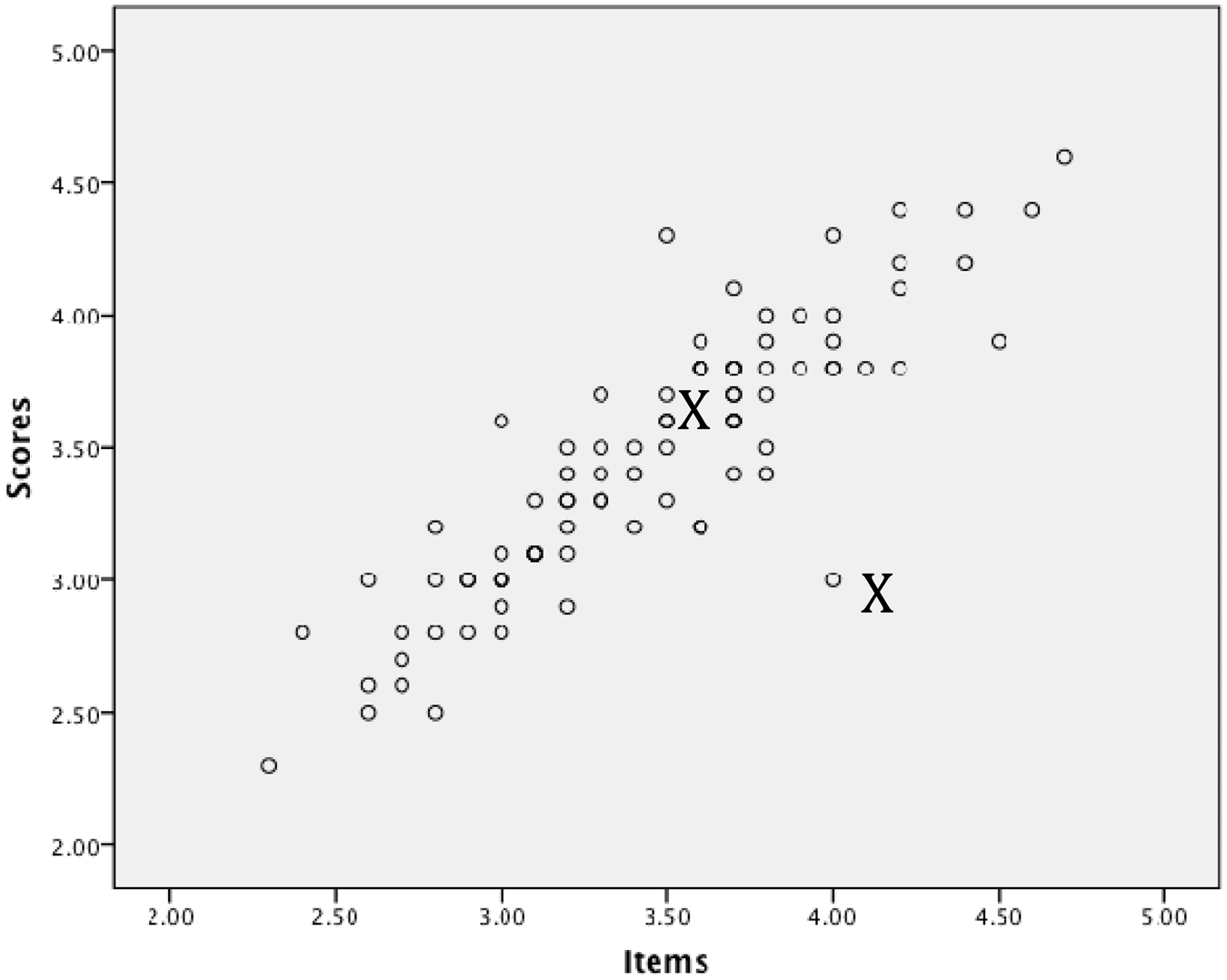
This method of manipulating feeling of prototypicality was used in order to maintain a vague definition of what prototypicality means for bisexual people. As past research has indicated there is no dominant profile for bisexuality, it would be difficult to outline specific traits and characteristics of a prototypical bisexual that all participants would agree upon as being central, defining traits (Weinberg et al., 1994). Additionally, prototypical group members are described as embodying a fuzzy set of features instead of a clear-cut, specific checklist of traits (Hogg, 2006). Thus, the openness of the prototypicality manipulation procedure used served to allow for this ‘fuzzy’ nature of prototypicality.
Immediately after receiving the false feedback, a GSR reading was taken as a measure of stress. The participant then completed the rest of the outcome measures, which were counterbalanced. After the participants completed the outcome measures, they were given a demographic form to complete. When the participants completed all measures, the researcher conducted a check of the manipulation and an assessment as to whether subjects had believed the deception. The manipulation check included two items: participants’ rating on a 1 to 5 scale for how prototypical they were, based on the information they received, plus whether they agreed with the rating. The manipulation check results are reported in the section ‘Results’.
The deception check involved the research assistant asking the participant a series of questions such as, what was the experiment about? Was there anything that stuck out to you as odd about the experiment? A description of the deception check is detailed with the prototypicality manipulation results.
Statistical analyses
In order to test the hypotheses, a multiple analysis of variance (MANOVA) was performed with the Bonferroni correction 2 to assess differences between the prototypicality conditions for the well-being and identity outcome variables (excepting the stress response). Tests of homogeneity of variance for the data were non-significant. A repeated-measures analysis of variance (ANOVA) was used to test the effect of condition on GSR response to include both baseline and post measures. Finally, a mediational analysis was performed to assess whether identity certainty mediated the relationship between experimental condition and the well-being outcomes.
Results
Manipulation and deception check
The participants in the high prototypic condition reported an average prototypicality rating of 4.1, and those in the low prototypic condition reported an average of 2.1, indicating there was a significant difference in level of self-perceived prototypicality (F(1,40) = 71.53, p<.001). Almost all participants stated they agreed with the prototypicality rating. The few participants who were unsure of whether they agreed with the rating reported they did not know enough other bisexual people to determine whether the rating was accurate or not. None of the participants were able to identify the true purpose of the experiment in the questioning after the completion of the experiment, indicating that the use of deception was successful. The most common beliefs were that the study was investigating personality traits among bisexual individuals, or that we were interested in self-esteem and identity for people who identify as bisexual.
Hypothesis tests
MANOVA results for the effect of prototypicality condition on outcome variables.
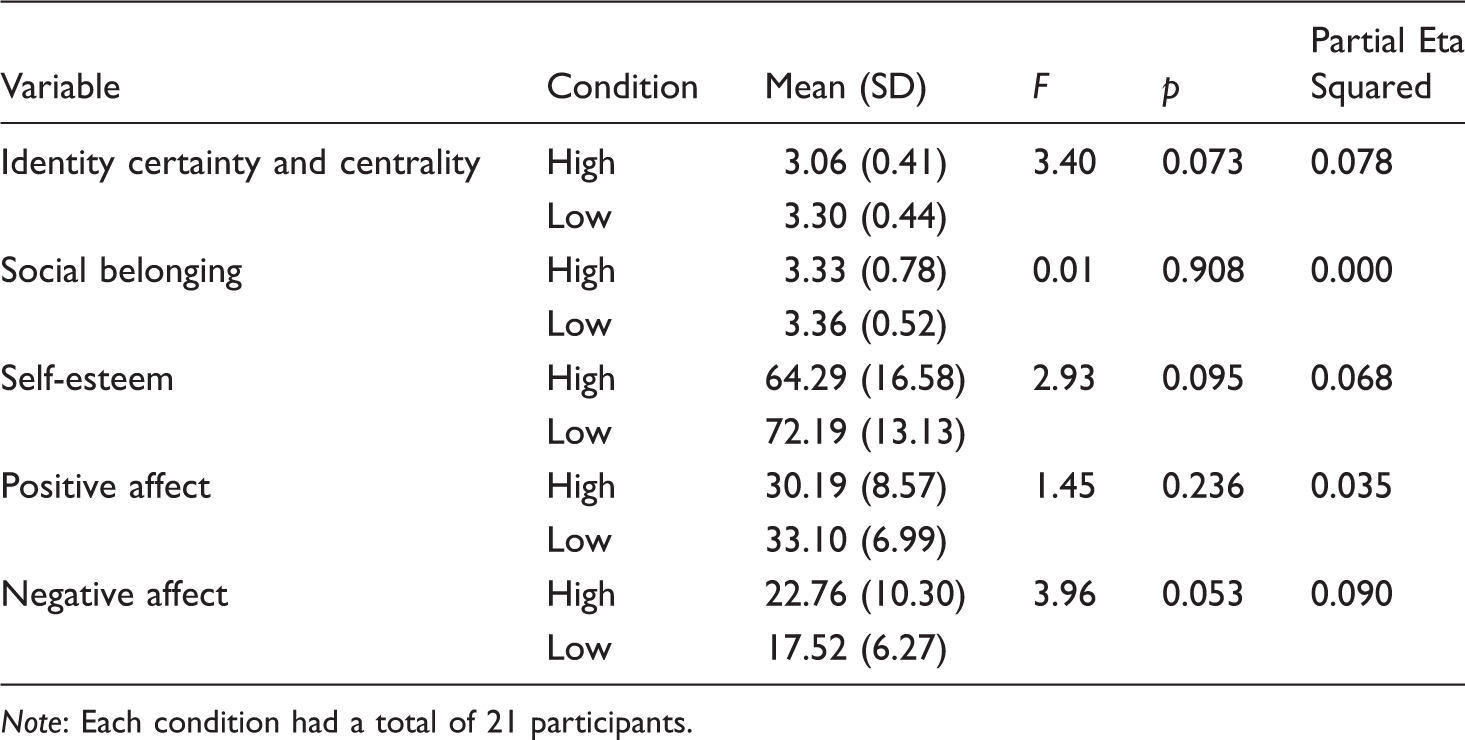
Note: Each condition had a total of 21 participants.
Hypothesis One – individuals who believe they are more prototypical will report higher positive effect and self-esteem, and lower negative affect and stress compared to individuals who believe they are less prototypical – was not supported. In fact, many of the findings were marginally significant in the opposite direction – for the average rating of self-esteem, the low prototypicality group reported marginally higher self-esteem on average than the high prototypicality group. 4 Thus, participants who were told their personality matched that of a ‘prototypical’ bisexual person reported lower levels of self-esteem than participants who were told their personality did not match that of a ‘prototypical’ bisexual person. Participants in the low prototypicality condition had marginally lower levels of negative affect than participants in the high prototypicality condition. 5 Again, participants who were told their personality matched that of a ‘prototypical’ bisexual person reported greater negative affect than participants who were told their personality was not similar to a ‘prototypical’ bisexual person. When the data file was split on the basis of gender to consider each separately, there was a significant difference in level of negative affect between conditions for the female participants. Female participants in the high prototypicality condition reported significantly higher rates of negative affect compared to those in the low prototypicality condition. 6 This means that for female participants in particular, being told that one's personality is a close match to that of a ‘prototypical’ bisexual person resulted in significantly higher rates of negative affect compared to female participants who were told their personalities were not similar to a ‘prototypical’ bisexual person.
As for stress measured by the GSR, there was a significant difference in participants' GSR ratings between their baseline measures taken at the start of the study, and their post measures taken after being given the feedback about their prototypicality. 7 As such, participants demonstrated higher levels of physiological arousal immediately after receiving feedback about their sexual identity in contrast to their level of arousal at the start of the study. There was not a significant interaction between GSR ratings and prototypicality condition. 8 Thus, there does not seem to be a difference in how physiologically arousing the experience was of receiving feedback on one's sexual identity between the two groups.
Hypothesis Two – individuals who believe they are more prototypical will harbour, more identity certainty and a greater feeling of social belonging than individuals who believe they are less prototypical – was not supported. As with the well-being measures, the identity certainty and centrality data trend in the opposite direction. Individuals who were in the low prototypicality condition had marginally higher levels of identity certainty and centrality than individuals in the high prototypicality condition. 9 This indicates that participants who were told their personality did not match that of a ‘prototypical’ bisexual person were potentially more certain of their sexual identity than participants who were told their personality was a close match. Participants’ reports of social belonging did not differ between the low prototypicality condition and the high prototypicality condition. As such, being told that one's personality matches that of a ‘prototypical’ bisexual person or not does not seem to impact feelings of social belonging.
Finally, Hypothesis Three – identity certainty and centrality will mediate the relationship between perceived prototypicality and well-being outcomes – was not supported. A mediational analysis was performed to see whether identity certainty and centrality significantly mediated the relationship between prototypicality and the other dependent measures of self-esteem, social belonging, and affect. However, the first two regression analyses (between condition and identity scores, and then between identity scores and the remaining dependent variables) were not significant. It does not appear that identity certainty and centrality significantly mediate the relationship between prototypicality and the well-being measures for these participants.
Discussion
The purpose of this research was to explore whether the beneficial effects of self-stereotyping on well-being observed with other marginalized groups expanded to bisexual-identified people, as well as to generate more knowledge about bisexual identity and well-being generally. While the sample of this study was relatively small, the results indicate that the question of whether Social Identity Theory and Self-Categorization Theory apply to bisexual social identity processes is worthy of further investigation. The first goal of this research was accomplished through manipulating the perception of prototypicality with a bisexual sample in order to see whether that manipulation affected an individual's feeling of affect, social belonging, identity certainty and centrality, and self-esteem as Social Identity Theory and Self-Categorization Theory would predict.
Since perceived prototypicality is highly contextual, exploring the effect of changes in feelings of prototypicality is possible within an experimental paradigm. With the current research, doing so allowed for some control in how participants perceived their own bisexual prototypicality, which enables the exploration of potential causal links between perceived prototypicality and, in the case of this study, well-being. The importance of this exploration is twofold: (1) to critically engage with assumptions that dominant social theories frequently supported with experimental evidence generalize equally to all people, and (2) to begin to move from documenting the existence of health disparities experienced by bisexual people to attempting to understand what factors are driving these disparities, an action that has recently been called for by bisexual and non-monosexual health researchers (Persson and Pfaus, 2015).
It is important to note that while the feedback of group prototypicality was external in this study, and thus different from applying group stereotypes to the self directly, there is evidence based on the manipulation check that some level of self-stereotyping occurred. Those participants in the low prototypicality group reported a significantly lower level of prototypicality based on the personality feedback they received compared to the high prototypicality group. Further, nearly all participants agreed with their prototypicality rating. This indicates that they adopted and applied the level of prototypicality to themselves.
Since the Social Identity Approach indicates that assuming social identities involves a process of depersonalization, a process in which individual group members attempt to embody the salient features of a social identity as closely as possible, it is necessary – based on this theory – for there to be a group prototype. Hypotheses generated from SIT and SCT would predict that the more one is able to conform to the image of the ideal group member, the more benefits one would receive – in other words, group members who are perceived as more prototypical may have higher levels of positive affect, self-esteem, feeling of belonging, and reduced levels of negative affect, stress, and uncertainty (Hogg, 2006; Luhtanen and Crocker, 1992).
In the context of this study, this would lead to the prediction that bisexual participants who felt they were further from the group prototype would report lower levels of social belonging, positive affect, and self-esteem, and higher levels of negative affect, stress, and identity uncertainty. The results did not support the predictions generated from SIT and SCT, thus indicating that these theories may not be appropriate to use in their current form as a theoretical framework for understanding all processes of bisexual identity. The general research question, whether feelings of bisexual prototypicality, or self-stereotyping, affects well-being and feelings of identity certainty and centrality as SIT and SCT predict, was not supported by this research. For the majority of the outcome measures, there was not a significant effect for the level of self-stereotyping, or perceived prototypicality. This indicates that the benefit of self-stereotyping for well-being found among other marginalized groups may not apply in the same way for bisexual people.
Further, while the overall MANOVA assessing intergroup differences was not significant, there was a significant intergroup difference for female participants' reports of negative affect, and much of the data were trending in a direction that is oppositional to the predictions based on SIT and SCT. Specifically, female participants who were in the low prototypicality group reported significantly lower levels of negative affect compared to female participants in the high prototypicality group.
Both the high and low prototypicality groups demonstrated similar changes in their physiological arousal between the start of the study and immediately after receiving feedback about their sexual identity, meaning whether participants were told their personality matched that of a ‘prototypical’ bisexual person or not did not generate differing levels of arousal. However, there was a significant difference in the level of physiological arousal between the baseline measures and the GSR measure taken directly after participants received feedback about their sexual identity prototypicality; GSR ratings were higher in the post-test. This result indicates that it may be a physiologically stressful or exciting experience to receive feedback about one's identity, regardless of the type of feedback. This potentially makes sense in the light of how little information and recognition there is for bisexuality and bisexual identity (Brekhus, 1996; Ochs, 1996; Yoshino, 2000). Bisexual individuals often experience bisexual erasure, or the prejudicial assumption that bisexuality does not exist or is not a stable, legitimate sexual identity (Rust, 2002; Yoshino, 2000; Yost and Thomas, 2012). In this context, having bisexuality affirmed as a legitimate identity at all may inspire a physiological reaction.
The second hypothesis predicting that the manipulation of prototypicality would lead to differences in identity certainty and centrality as well as feelings of social belonging, was also not supported. In fact, while not significant, the data again trend in the opposite direction that SIT and SCT would predict. Members of the low prototypicality condition actually reported marginally higher levels of identity certainty and centrality in comparison to those who were in the high prototypicality condition. This indicates that whether one feels as though they embody the defining traits and characteristics of a bisexual personality or not does not seem to impact how certain or central that identity is to their overall sense of self, or how strongly they feel they belong to the bisexual community.
Finally, the level of identity certainty and centrality that participants reported did not significantly mediate the relationship between the type of false feedback they received regarding their prototypicality and the rest of the well-being outcome measures. In this study, it appears that the certainty and centrality of a bisexual identity does not buffer or exacerbate the influence of how prototypical one feels on well-being outcomes such as affect and self-esteem.
Possible explanations and future research
The unexpected findings of the present research have led to speculations that can be tested in further research. These explanations pertain to the applicability of SIT and SCT to bisexuality as a social identity, as well as to the applicability of these theories to more ambiguous social identities overall, the potential influence of internalized negative stereotypes about bisexuals, and the possible elements of a bisexual identity that may have confounded the manipulation of prototypicality. I will now address each of these potential explanations.
As the results of this study do not support the predictions generated from SIT and SCT, it is possible that these theories are not expandable to explain identity processes for bisexuality in their current forms. It may be the case that since there is no salient, agreed upon, dominant profile of a bisexual personality, people who identify as bisexual may have a weaker representation of the ‘ideal, prototypical bisexual’ to influence their depersonalization process (Weinberg et al., 1994). This in turn may change how their perceived relationship to that prototype affects variables such as mood, stress, self-esteem, belonging, and identity certainty. As stated previously, while the majority of participants agreed with their assigned prototypicality rating, a few responded that they did not know any other bisexual people and had no way of knowing previously how similar or dissimilar they were in terms of a prototypical bisexual identity. Perhaps this lack of knowledge or consideration of what it means to members of the bisexual community to have all of the defining traits and characteristics of a bisexual person makes it difficult for typical processes of social identity and self-categorization to take place.
Further, the results of this study have possible implications for the efficacy of SIT and SCT to apply to ambiguous social identities overall. Perhaps it is not just being bisexual that makes it difficult for these theories to explain the social identity process, but rather any identity that does not have a salient prototypical representation would have difficulty being explained by SIT and SCT. For example, people who identify as biracial or multiracial could potentially have similar experiences of not being able to identify and relate to the ‘prototypical biracial or multiracial person’, as that is such a diverse group of people and racial identities, and thus may have different social identity processes related to feeling more or less similar to potential prototypes. Research conducted on group entitativity, or how cohesive a group feels to group members, seems to support this notion as well; namely, that groups with higher entitativity have stronger prototypes, and thus people may have stronger identification with that type of group (Hogg et al., 2007). Taking this work a step further, perhaps groups with high entitativity are not only identified with more strongly, but potentially also offer greater benefits for members when that group is marginalized.
The next potential explanation for the participant responses in this study is the possibility of internalized bi-negative stereotypes of what it would mean to be a prototypical bisexual. While this study did not measure internalized bi-negativity, future research should investigate whether or not such prejudice plays a role in social identity processes for bisexual individuals. Bi-negative stereotypes still abound in society. If the participants internalized these stereotypes, then being told one was closer to a prototypical bisexual personality may be associated with feeling as though one also embodies these stereotypes. Thus, if the participants in the high prototypicality condition felt that they were being told that they were confused about their sexuality, just experiencing a phase, being promiscuous, unable to be faithful to romantic partners, or any other of the myriad stereotypes, it could be associated with an increase in negative affect, a decrease in self-esteem, and potentially even a desire to distance oneself from bisexual identity resulting in lower levels of identity centrality and certainty. Past research has found negative consequences of internalized bi-negativity (e.g. Ochs, 1996) and a significant relationship between bisexual identity congruence and internalized bi-negativity (Hoang et al., 2011).
Finally, a third possible explanation for the study results is the possibility that the manipulation of prototypicality is being conflated with another important element of bisexual identity. As bisexual individuals face prejudice and discrimination based on others’ reactions to their sexual identity, many bisexual people have adapted and found strategies for resiliency – to maintain positive identities by finding ways to combat negative messages about bisexuality. One possible maintenance strategy is to embrace the idea of difference. If participants had incorporated this idea of uniqueness into their overall identity, then having that affirmed by being told they are very different from the ‘prototypical bisexual’ could be a positive experience. Anecdotally, many of the participants in the low prototypicality condition were either excited or not surprised by being told that they were different because they either had ‘always known’ that they were different, or because it made them feel that they were unique and special.
Study limitations
The main limitation for this research is that it is a convenience sample from a university setting. While the predominant interest was in how the manipulation would affect younger bisexual people (age 18–30), it would be beneficial to have a greater representation of people from the upper part of that range, as well as to have more variance on level of education since all participants were college-level students. Additionally, as is often the case in research with minority populations, a larger sample could have resulted in greater statistical power.
Conclusion
In sum, it appears that, based on this research, it is possible that SIT and SCT do not apply to bisexual identity in the same way that these theories apply to other social identities. The predictions generated from SCT and SIT were not supported by the data; in fact, for female participants, the result for negative affect was in the opposite direction that SIT and SCT would predict. Being told that one is a more prototypical bisexual appeared to have a negative influence on female participants in terms of negative affect, and a null effect on self-esteem, identity certainty and centrality, social belonging, and positive affect.
Further, it is interesting that the process of self-stereotyping that appears to be helpful for other marginalized groups did not seem to benefit bisexual-identified people in the same way in this study. Since much of the research targeted toward understanding the disparities in bisexual mental and physical health has slated lack of community support as an influential factor for these health disparities (Fredriksen-Goldsen et al., 2010; Ross et al., 2010), the results of this study add another layer to consider. It may be that bisexual people face higher risk for poor mental and physical health not only because they have less access to community support, but potentially also because well-being benefits associated with group self-stereotyping may not be present for the bisexual community in the same way that these benefits are for other marginalized groups.
Finally, while the limitations of this study include a small sample size, this study can serve as an entry point in considering the applicability of SIT and SCT to bisexual identity. While it is a common assumption that well-researched psychological theories will apply to minority groups, this assumption is often false. The unexpected results of this exploratory study function as a reminder of this false assumption. Future research can continue to critically engage with and question the use of these theories in explaining bisexual social identity experiences and the important health implications that follow.
Footnotes
Funding
The author was awarded the Bisexual Foundation Award from the American Psychological Association Society for the Psychological Study of Lesbian, Gay, Bisexual and Transgender Issue to assist in funding this work.