




Abstract
Scholars of sexuality have known for many years that sexual identity claims do not map neatly on to sexual histories. However, many studies continue to use currently claimed sexual identities as the basis for data collection and analysis, which can erase this complexity, particularly in relation to bisexuality. This article identifies four methodological techniques that help to operationalise theoretical sensitivity around the complex relationship between identities and histories. It does so by bringing together life course perspectives and two mixed methods datasets from older people with bisexual histories. Combining life course perspectives with these unusual datasets makes evident the particular way in which moment-in-time perspectives oversimplify sexuality and privilege monosexual identities. A life course approach thus helps to explain a long-standing puzzle in the study of sexuality: the relative under-claiming of bisexual identities compared to the prevalence of bisexual behaviours. Furthermore, it offers methodological tools that facilitate richer theorisations of sexuality more widely.
Introduction
Scholars of sexuality have long argued that sexual identity claims do not map neatly on to sexual histories and have explored the ways in which the claiming of identities is affected by social, geographical, political, gendered, classed, racialised, generational, historical and discursive locations (Foucault, 1976; Gosine, 2006; Kitzinger, 2005; Plummer, 2010; Weeks, 2007). Temporality is increasingly recognised as a significant component of the constitution and mobilisation of sexualities. Halberstam (2005) has argued for a distinctively queer temporality, in contrast to heteronormative time which is argued to be centred on reproduction and so on the future. While this argument is complicated by increases in reproductive normativity among some same-sex couples (Santos, 2013), the invitation to decentre reproduction from life courses and to recognise the possibility of other organising principles to lives is productive. Plummer (2010) calls for attention to the significance of generations in shaping sexualities and for studying sexuality diachronically as well as synchronically. Responding to this, Binnie and Klesse (2012) demonstrate some of the benefits of attending to generation, age and temporality in making visible transnational relationships and differences between LGBTQ activists from countries with different histories. This body of work demonstrates the theoretical inadequacy of using currently claimed terms such as ‘lesbian’, ‘gay’ and ‘bisexual’ as umbrella terms for the complexity, mutability and diversity of human sexuality.
Debates about the desirability or validity of claims to sexual identity are well rehearsed (Butler, 1990; Seidman, 1997; Young and Meyer, 2005) and are therefore not the focus of this article. Instead, this article draws on Weeks’ concept of ‘necessary fictions’ (Weeks, 1995), treating sexual identities as both politically powerful and useful and always oversimplifications of a more complex reality. Sexual identities are thus of interest because of what they reveal about prevalent understandings of sexuality, not because they are expected to map straightforwardly onto sexual history. The claimability of particular sexual identities, such as bisexuality, is of interest because of the psychological and material benefits it can carry for individuals (Rostosky et al., 2010) and the new forms of sexual citizenship it can enable, such as disruptions to coupledom and less dependence on identity claims (Monro, 2015; Richardson and Monro, 2012; Weeks, 2007). The deployment of sexual identities matters because of their material and ideological consequences.
However, maintaining theoretical sophistication about the simultaneous complexity and significance of sexual identities can be challenging in the face of the exigencies of research practice. Many studies continue to use currently claimed sexual identities as the basis for data collection and analysis. Some small-scale qualitative studies maintain theoretical sophistication around identity labels – for example, using participants’ own diverse identity terms and exploring the complexity of their use in practice (King, 2016). However, others do not, for instance using common identity terms such as ‘lesbian’, ‘gay’ and ‘bisexual’ as apparently unproblematised researcher-imposed categories. Respondents’ own currently claimed identity labels may be privileged for political reasons, especially when the sexual practices under consideration have a history of being stigmatised, although this obscures past identities. These methodological choices can lead to theoretical slippage between what is known about the complex nature of sexuality and the design of research instruments and analytic approaches.
This article aims to help address this slippage by presenting four methodological techniques that help to operationalise greater theoretical sensitivity around the complex relationship between identities and histories. It does so by bringing together life course perspectives, more typically used in gerontology and the study of ageing, and questions of (bi)sexual identity. This approach is made possible by datasets from two studies which, unusually, focused on bisexual ageing, rather than on LGBT ageing more generally. Combining a life course perspective with the accounts of older people with bisexual histories makes clear the ways in which moment-in-time perspectives oversimplify sexuality and privilege monosexual identities. A life course perspective thus both illuminates the relative under-claiming of bisexual identities and facilitates richer theorisations of sexuality more widely.
Moment-in-time perspectives privilege the present over the past and this can lead to inadequate theorisations of sexuality, such as: sexual identity being treated as an unchanging, a-historical property-of-a-person; monosexual identities being unintentionally privileged; sexual identity being defined by the gender of someone’s current partner; and inadequate consideration of the wider context within which sexual identities are invoked. This article demonstrates that life course perspectives provide a set of methodological tools for deprivileging the present and that this facilitates a more nuanced theorisation of sexuality. The methodological tools discussed are:
making demographic questionnaires more temporally-sensitive taking a life course perspective on relationship histories using life course perspectives to interrogate individuals’ currently-claimed identities paying attention to the historical context in which identities are invoked and claimed.
The argument of this article relates to debates within this journal about ‘mostly straights’ (Carrillo and Hoffman, 2017; McCormack, 2017) but focuses more towards the middle of an imagined (albeit problematic, as McCormack discusses) continuum from straight to gay – participants in these studies did not identify as heterosexual and had a history of sustained sexual and romantic relationships with more than one gender. 1 As will become apparent, this different location on the imagined continuum generates some distinctive issues as well as some common ones.
The visibility of bisexual identities
Discrepancies between proportions of the population claiming bisexual identities and having bisexual histories have long been a puzzle in the study of sexuality (Monro, 2015; Rodriguez-Rust, 2000). Although relatively high, and increasing, proportions of the population report sexual contacts with more than one gender (e.g. NATSAL3: Mercer et al., 2013), a much smaller proportion claim bisexual identities (Mosher et al., 2005) or allied non-monosexual identities such as ‘pansexual’, ‘bicurious’, ‘mostly straight’ or ‘meterosexual’ (Carrillo and Hoffman, 2017; Greaves et al., 2016). The claimability of bisexuality, as other sexual identities, varies between sub-populations and over time. For example, there is evidence that, currently, more people aged under 25 claim bisexual and allied identities than those aged over 25 and that more young women are doing so than young men (Office for National Statistics, 2016). There is also some evidence among currently young cohorts of bisexual men of decreased investment in sexual identity labels combined with increased acceptance of bisexual behaviours (Anderson and McCormack, 2016). While the experiences of the young are of interest in their own right, there is a danger that their attitudes and behaviours are taken as somehow indicating the future and as thereby more important than the experiences of older people (Bytheway, 1995; Macdonald and Rich, 1984). Increased claiming of bisexuality and allied identities among the currently young may continue as they grow older but it may change as they encounter increased societal pressure to ‘settle down’ or in response to as yet unknown wider political change around sexuality. Thus, the experiences of those who are not currently young need to be given equally serious consideration to those of the young. Across the life course and over the last 50 years, it is clear that (in Anglophone cultures at least) the mismatch between claimed identities and sexual behaviours is greater in relation to bisexuality than it is for heterosexuality or homosexuality (Rodriguez-Rust, 2007).
Claims by individuals to particular sexual identities are one way in which identities are made visible. Modern Western societies increasingly solicit and permit claims to sexual identity in contexts including market research, equal opportunities monitoring forms, feedback on services and policies, academic research and social media interactions. However, identities are also made visible when outsiders ascribe them to other people. These ascriptions take place in contexts such as everyday conversation, traditional and social media and research processes which generalise from self-identity to predefined categories. Both self-claimed and other-ascribed identities are the focus of this article, since both together contribute to the visibility of (bi)sexual identities. Bisexual identities are much less commonly ascribed to others than monosexual ones (Alarie and Gaudet, 2013; Barker and Langdridge, 2008).
If bisexuality and other non-monosexual identities are not visible, then monosexism (Nagle, 1995) is perpetuated and this affects the many people who experience attraction to more than one gender (Mosher et al., 2005). The visibility of bisexuality also matters because it carries the potential of decentring the gender of someone’s desired partner as the lens through which sexuality is understood (Barker et al., 2008; Hemmings, 2002). This creates space for other possible lenses such as preferred sexual activities (Simula, 2015) or other personal characteristics of partners (Crockett, 2010). The claiming of bisexuality also matters because claims to sexual identity play such a significant role in the recruitment of people to research studies, support services and LGBT organisations. Since bisexuality, unlike other non-monosexual identities, is routinely included in demographic questionnaires, there is a particular danger for bisexuality that low rates of participation by self-claimed bisexual people are taken as a proxy for low rates of bisexual behaviour.
Many explanations for these low rates of claiming and ascribing bisexuality have been postulated. These include the ways in which bisexuality can raise profound epistemological and boundary issues which challenge wider thinking about human sexuality (Angelides, 2001; Hemmings, 2002), the prevalence of ‘monosexism’ (Nagle, 1995) and ‘biphobia’ (Barker et al., 2012; San Francisco Human Rights Commission, 2010) and the distinctively fluid nature of some bisexual identities (Diamond, 2008; Klein, 1993). Some writers, often working within the field of critical bisexual studies (Monro, 2015), have argued that bisexuality is commonly (mis)understood in ways that make it a less available identity: as requiring equal attraction to ‘both’ genders and non-monogamy (Alarie and Gaudet, 2013; McLean, 2007); as reifying binary gender (Ochs, 2007); as a transitional or inauthentic sexuality (Barker and Langdridge, 2008); as equating to promiscuity and infidelity (Klein, 1993); as always in the future or the past, never the present (Petford, 2003); and as ‘half gay and half straight’ (Weasel, 1996). The queer project of destabilising all sexual identities is also argued to be particularly destabilising for identities such as ‘bisexual’, which were never previously very stable (Barker and Langdridge, 2008; Gurevich et al., 2007; Monro, 2015).
The present article contributes a further explanation for low rates of claiming of bisexual identities: that thinking about sexual identities and behaviours predominantly through the lens of the current moment tends to make bisexual histories disappear.
Life course perspectives on sexuality
Life course perspectives entail considering a person’s present situation in the light of their past experiences and, sometimes, projecting forwards into their imagined future, rather than focusing mainly on their current experiences (Bengtson et al., 2005). This relatively straightforward change of perspective turns out to have profound theoretical implications for the study of sexuality, as will be discussed.
Foundational texts such as Elder’s (1974) study of the long term effects of growing up during the Great Depression in the United States demonstrated the significance of early experiences to later life, and the crucial role played by historical context in shaping (but not determining) life experiences. Elder’s much-cited articulation of four principles of life course perspectives (Elder, 1994) calls for attention to the ways in which lives are shaped by: (1) the historical context; (2) timing, including whether or not significant life events occur at the expected time within the anticipated life course; (3) the lives of others; and (4) human agency and choice-making. These principles help to illuminate accounts of (bi)sexual identity and history, as will become apparent. More recently, Andrews (2014) has argued for the importance of the imagined future life course in mutually constituting the present and the representation of the past.
Theorists differ in the extent to which they take ‘the life course’ to be a natural phenomenon (albeit culturally, geographically and historically variable). Some treat it naturalistically, using the concept to explore differences and similarities between groups (Jeppsson Grassman and Whitaker, 2013; Komp and Johansson, 2015). Other theorists of the life course, working in a more ethnomethodological or constructionist vein, view ‘the life course’ as an example of human sense-making about lives and interrogate the use of the concept accordingly (Holstein and Gubrium, 2000; King, 2016). The concept of ‘life stages’ – component parts of a life course – is likewise treated naturalistically or as a social construction by different authors. This article draws on the more constructionist tradition of life course studies, considering ‘the life course’ to be something that both researchers and participants draw on in their sense-making. Such an approach has the particular benefit of enabling consideration of life stages without taking heteronormative reproductive life courses as an unconsidered norm.
There is a growing body of literature exploring LGBT ageing (e.g. De Vries, 2007; Heaphy, 2005; Hughes and Cartwright, 2015; Ward et al., 2012; Westwood, 2016. See Fredriksen-Goldsen and Muraco, 2010 for an overview of the North American literature, and, for a rare non-Western study, see Kong, 2012). Some of this literature takes life course perspectives (e.g. Hammack and Cohler, 2009; King, 2016; Rosenfeld, 2003; Traies, 2016) and has thereby contributed to a more temporally-sensitive understanding of meanings and experiences of sexuality. However, this literature focuses on lesbian and gay older people, in part due to reported difficulties in recruiting older bisexual people, who are widely recognised to be a hard-to-reach group (King et al., 2018; Westwood, 2016). As this article will demonstrate, applying life course perspectives to older people with bisexual histories is productive both for the study of bisexuality and for our theorisation of sexuality more widely.
Case studies: Two investigations
This article draws on data from two studies that focused on ageing and bisexuality.
The first study was Imagining Bisexual Futures, a project that explored the ways in which bisexually-identified adults imagined their own future ageing and later life. Fieldwork took place in 2010 in the form of workshops where participants were invited to create pictorial representations of their own imagined futures. Drawings were theorised as incitements to talk, rather than primarily as analytic objects in their own right – analysis therefore focused on the written and spoken comments of participants. For more details of the methodology, analysis and general findings from this study, see Jones (2011, 2012). Four participants in this study were aged over 50 at the time of the workshops (age range 56–66, mean 61), and in this article only these four participants’ responses are considered, in order to enable a later-life life course perspective.
The second study, Looking Both Ways, focused on older people with a history of relationships with more than one gender. The decision was taken to recruit both people who did identify as bisexual as well as those who did not but felt that the term ‘bisexual’ had some salience to their life. Those who did not currently identify as bisexual were included in order to enable careful consideration of any differences between sexual identity, sexual behaviour and sexual attraction, rather than relying on sexual identity as a proxy for sexual orientation. Twelve UK-residing participants were recruited, of whom six did currently identify as bisexual and six did not. Their ages ranged from 51 to 81, with a mean age of 64. 2 Participants were interviewed between 2013 and 2015 on a single occasion and were invited to draw a timeline while giving a life course account of their sexual and gender identities, starting with their birth and ending with ‘today' (the day of the interview). 3 Once participants had reached ‘today' they were invited to imagine what their life might be like at various points in the future. Analysis of the interview transcripts was initially thematic and the timelines were compared to the verbal accounts in order to identify any differences and similarities between the two. Later more fine-grained analysis focused on accounts of changes in sexual identity or sexual behaviour and the underlying theorisations of bisexuality on which they drew. This more fine-grained analysis was then combined with the original analysis of the Imagining Bisexual Futures data to generate the analytic sections that follow.
The following sections characterise four analytic techniques by which life course perspectives can make bisexuality more visible and also raise wider issues in the study of sexuality.
Making demographic questions about sexual identity more temporally sensitive
Life course perspectives are commonly used to generate and analyse qualitative forms of data. However, they also have potential to be applied to the design of quantitative data instruments, such as the demographic questionnaires routinely completed by participants in qualitative and quantitative studies. These questionnaires usually ask about sexual identity as a proxy for sexual orientation (Haseldon and Joloza, 2009). In tick-box or free-response forms, respondents are briefly prompted to identify their sexual identity alongside their gender, ethnicity and other demographic characteristics such as social class and disability status. Questions about sexual behaviour or attraction are much less commonly asked in this routine fashion. Questions about sexual identity are less sensitive to temporality than questions about sexual behaviour, which often have an explicit temporal component (e.g. ‘in the past year’), or sexual attraction, which may incite reflection on lifelong attractions. For example, one US expert panel recommends asking about sexual identity using the formulation: ‘Do you consider yourself to be: a) Heterosexual or straight; b) Gay or lesbian; or c) Bisexual?’ (Sexual Minority Assessment Research Team, 2009: 7–8).
This and similar questions about sexual identity treat sexual identity a-historically, as a (self-claimed) property of a person. The respondent is heterosexual/straight, gay/lesbian or bisexual. This has the effect of privileging someone’s current sexual identity over any alternative sexual identities that they may have claimed in the past. While asking about sexual behaviour or attraction instead of identity would be one way of making these questionnaires more temporally sensitive, collecting data about sexual identity may be important to the focus of some studies.
This was the case for both Imagining Bisexual Futures and Looking Both Ways, so the brief demographic questionnaires used in both studies solicited information on both past and current sexual identities, 4 offering free response boxes next to two items – ‘Current sexual identity’ and ‘Other past sexual identities?’. 5 This minor change to the questionnaire enabled a life course perspective which made changes of chosen sexual identity, and bisexuality in particular, more visible.
Although all participants had experienced sexual relationships with more than one gender over the course of their lives, only 10 of the 16 claimed the identity bisexual as their current chosen identity when they filled in the demographic questionnaire form. Eleven indicated on the form that they had previously used different sexual identity terms than the ones they currently used – the identity they would have claimed would have depended on when they were asked. For example, Alex 6 identified as straight, then as bisexual and now rejects the label bisexual as dualistic and claims ‘pansexual’ instead (as well as ‘pangendered’). Alex’s history of relationships with men, women and other-gendered people remains the same but he would not currently choose the label bisexual to describe himself, whereas a few years ago he would have. Had the questionnaire not asked about previous identities, only his current identify ‘pansexual’ would have been recorded.
Collecting data on past sexual identities enables consideration of how historical period, generation and personal history affect what is claimable. It seems unlikely that Alex would have encountered the label ‘pansexual’ in the 1980s when he had a much more conventional lifestyle and the term was much less used. In the present day, Alex’s understanding and experience of his own and other people’s sexuality and gender has been profoundly changed by the theorisation of gender that he associates with the term ‘pansexual’.
Clearly participants are more likely to name alternative past identities when invited to do so by a separate question. However, five participants did claim unchanged identities, suggesting that adding a question about past identities does not prevent the claiming of unchanged and enduring identities. Furthermore, a neutral position is not possible – demographic questionnaires which ask only for current sexual identities privilege current identities over past ones. This makes bisexual histories invisible if people do not currently claim bisexual identities. It also implies that current sexual identities are unchanging properties-of-persons, which is to do a disservice to the complexity of identity choice.
Demographic questionnaires are one of the ways in which self-identity is routinely made visible, but identities are also ascribed by outsiders and it is to this issue that the next section turns.
Taking life course perspectives on relationships
Current or most recent relationships have a particular significance for the visibility of bisexuality, since someone’s sexual identity is usually assumed on the basis of the gender of any known partner (Barker et al., 2008). Unless someone is publically known to have more than one partner and those partners are of more than one gender, they are unlikely to be read by others as bisexual. For this reason, a life course perspective on relationships has the potential to make bisexual histories more visible.
Elena, a participant in Imagining Bisexual Futures, drew what could be read as a rosy (literally as well as figuratively: the paper she chose to draw on was pink), traditional, heterosexual imagined later life – herself and her husband watching a sunset together, his arm around her, she nestled into his shoulder (Figure 1).
Elena’s imagined later life.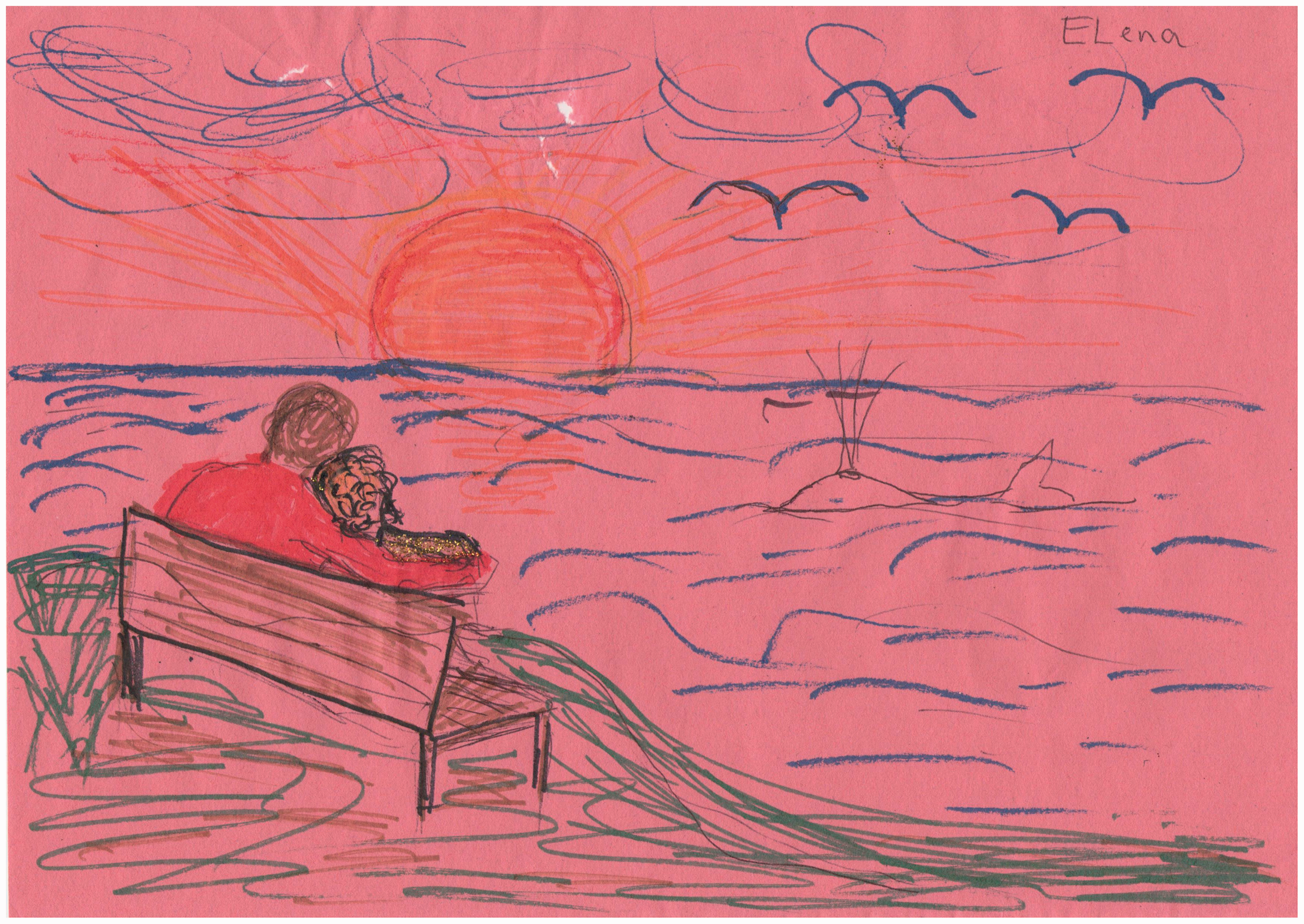
Someone observing her picture, or perhaps encountering Elena and her husband in a social setting, would be highly likely to ascribe a heterosexual identity to Elena. However, in the general workshop discussion afterwards, she said: Elena: Okay, being old, I am sixty six. Two years ago I had a little bit of a heart problem and until then I had my husband and a female lover, my female lover for eight years, both at the same time, and when my heart, everything changed. My female lover became friends, no more sex and she was okay with that. It just was no longer in my picture and I am totally … now with my husband and we have great sex, fine, but for some reason something shifted for me.
Elena’s own identity work here fits with Weinberg et al.’s (2001) findings about high certainty and stability of bisexual identity in later life, despite increased monogamy and increased sex with only one gender. However, a moment-in-time outsider perspective on Elena’s current life would be unlikely to suggest bisexuality as a candidate sexual identity and this is one of the ways in which bisexuality routinely disappears. Enquiring about relationship history makes space for bisexual histories to reappear.
Interrogating individuals’ claimed identities
Elena herself does claim a bisexual identity, but six of the Looking Both Ways participants did not but did have a significant history of relationships with more than one gender. Serially monogamous individuals may be particularly likely not to claim the identity bisexual because they draw on understandings of bisexuality as requiring sexual activity with more than one gender in the same period of time, as the following extract from the interview with Mark suggests.
Mark gave an account of early attraction to other boys and of having a preliminary interview for aversion therapy but deciding not to go ahead. In his late teens and 20s he had sexual relationships mostly with men but sometimes with women and in his late 20s he found his attractions to women increased. In 1982 he met his wife, fell in love and was in a monogamous relationship with her for 30 years. He was aware of the continuing capacity to be attracted to other people, both men and women, but saw himself as choosing fidelity. Five years ago, his wife died suddenly and once he was over the initial bereavement he reported: Mark: Then I started finding very strongly the attraction to men coming back in a completely irresistible way. And it was a bit sort of like Niagara Falls, you’re going over Niagara Falls and there’s no way you can stop yourself going, and I actually was pleased to be going over Niagara Falls and very positive. And I have continued to be very positive about it. It’s almost as if after the death of my wife, it’s like a door slammed shut. The door was women. Mark: I mean it’s funny isn’t it? If you look at my life, you know, basically there’s plenty of evidence of both. I’ve never really, I don’t think I think of myself ‘oh I’m bisexual’, it’s just not, I don’t know. And maybe that’s to do with the limitation in a way I think about the notion of bisexuality. You know, I sort of think of it as having something at the same time, whereas it doesn’t necessarily have to be that, I guess. It could be a limitation of my perception of my sexuality, but it’s never something that I’ve sort of stood and thought. I find it very easy to say I’m gay, and it makes a lot of sense to me, so yeah.
Imogen too recognises the potential applicability of ‘bisexual’ to herself but rejects it on the grounds of what feels right. Her timeline shows her history of relationships with men and women over five decades (Figure 2).
Imogen’s timeline.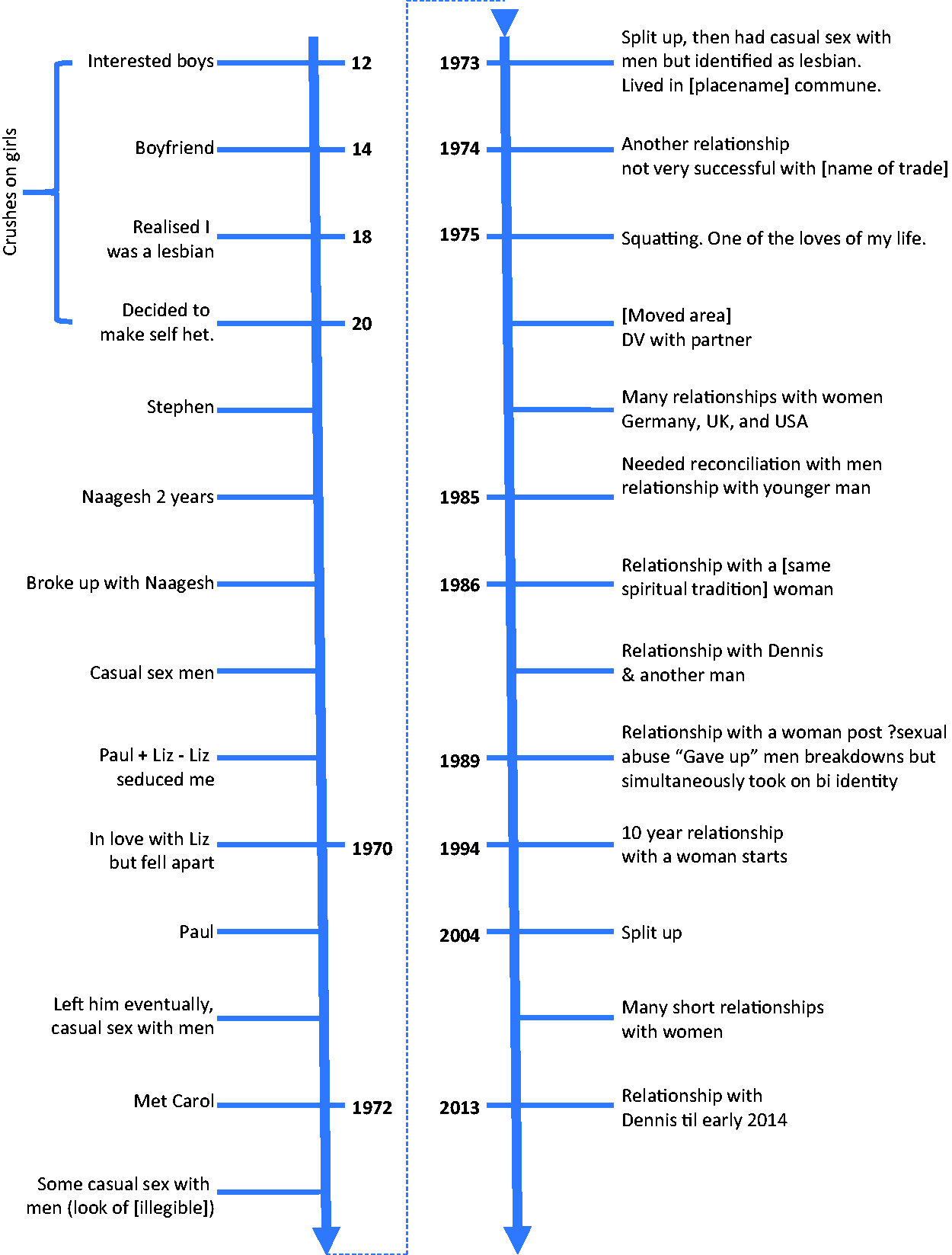
However, she did not claim the identity ‘bisexual’ at all on her demographic questionnaire – she described her current sexual identity as ‘queer’ and her past sexual identities as ‘lesbian’ and ‘heterosexual’. At the beginning of the interview, when asked to describe her sexual identity, she replied: Imogen: Well I identify it as queer. And it means to me that I’m a lesbian who’s also bisexual. I put it like that, I don’t just say I’m bisexual because most of my life I’ve been a lesbian, but occasionally I have a relationship with a man. So I know that you can say you’re bisexual and it can mean any number of things, but it just feels like abandoning my lesbianhood. So I sort of prefer to say that I’m queer and that that means I’m a lesbian, mainly, but with some bisexuality, and that kind of, I know it’s a bit cumbersome but it fits me better.
Such privileging of individuals’ own sense of which identity labels feel most appropriate to them clearly has much to recommend it in terms of people’s right to narrate their own experience, as well as Elder’s life course principle of recognising the significance of choice and human agency. However, an individual’s choice of sexual identity does not occur in an ideological vacuum. Their understanding of what it means to be bisexual (or lesbian, gay, ‘mostly straight’, heterosexual etc.) affects the extent to which they feel that the label is applicable to themselves. If Mark understands bisexuality to predominantly indicate simultaneous relationships with more than one gender, this influences his feeling that the label is not very applicable to himself. Similarly, if sexual identity is determined by predominance of attractions, it makes sense that Imogen uses the label ‘bisexual’ only secondarily. However, as well as respecting participants’ own choice of labels, researchers also have a responsibility to note other possible theorisations of bisexuality, such as those which use attraction as the defining feature rather than behaviour, or those which allow for serial monogamy or attractions which are still strongly towards only one gender. While neither Mark nor Imogen identifies as bisexual, both have a history of sexual relationships with more than one gender which is made more visible by a life course perspective.
Examining the historical context of bisexual identities
Janet claims, from the perspective of the present day, an identity as bisexual (and feminist) that has lasted all her adult life, as her timeline indicates (Figure 3).
Janet’s timeline.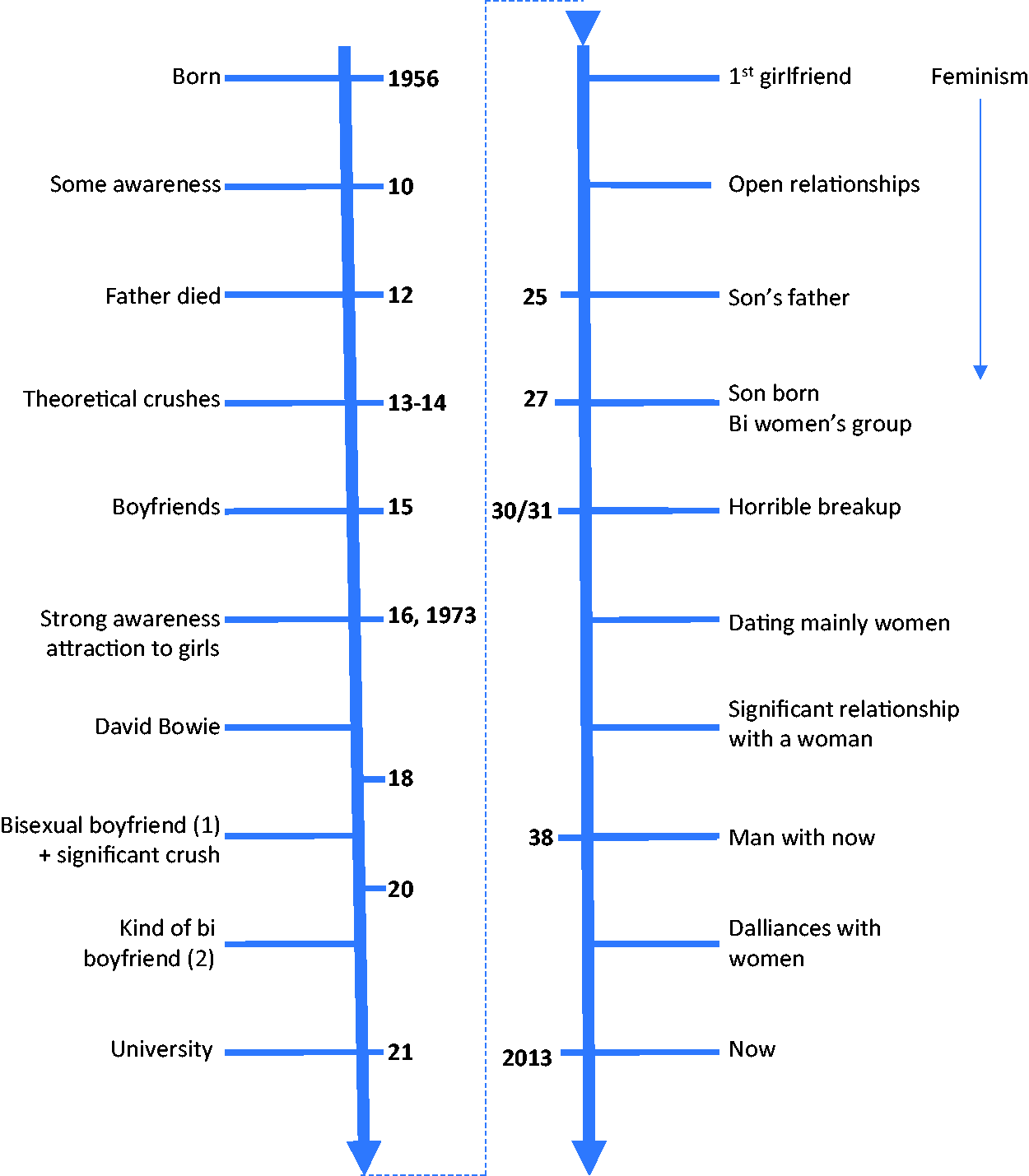
However, her account of her life makes it clear that how easy it was to claim this identity varied at different historical points, illustrating Elder’s first life course principle that the historical context fundamentally shapes lives.
Towards the beginning of the interview, Janet is talking about when she first identified as bisexual somewhere around the year 1973, when she was aged between 16 and 18, and suddenly remembers: Janet: David Bowie! There was David Bowie saying he was bisexual. I thought yes, that’s what I am. And I’d never really, after that I never really, I’ve never really doubted that I was bisexual. So it was then. And to me, because there wasn’t any such thing as a bisexual community, I was in a very conventional suburban school, it was simply that there was like a glamorous creative life out there. And when you were in this creative life, like I intended to be, then you could be bisexual, that’s fine. That was that.
The second historical point which Janet identified as significant in her sexual history was the transition from the 1970s to the 1980s. She characterised the 1970s as a very positive time to be bisexual – she knew many people other than herself who identified or behaved bisexually and described feeling that bisexuality was progressive and the future. But in the 1980s: Janet: That seemed to kind of come crashing down really forcefully. And from the point of view of women it’s because there was a kind of […] feminist ideology which says oh lesbian feminists very radical, lesbian ideology which said no you can’t do that. […] I knew I wasn’t really, I knew I wasn’t lesbian. I knew that I was bi, there was never any doubt. […] And I think I said, might have said, I’ve given up having relationships with men, because that’s what you had to do. You didn’t have to give up wanting it, you just had to give up doing it. And I think I said I’d given this up.
Later, the interviewer pointed to this place on Janet’s timeline and asked her what that had been like. Janet replied: Janet: Oh awful. Awful. Awful. And I remember in that period, so at that point I was also working in a […] feminist organisation. That was really … unbelievable levels of biphobia and […] sometimes people would just say things like ‘yuck!’. One woman did say once ‘yuck’ and I didn’t say anything […] We had equal opportunities monitoring sheets and someone had put ‘bisexual’ on it and she just looked at the word ‘bisexual’ and she said ‘yuck’.
In the present day, Janet does usually feel able to assert the identity ‘bisexual’ in a public forum but reports a degree of wariness. She is talking about a local group for older LGBT people and says: Janet: I thought that it would be a good bit of political intervention on my part to go there and be the bi person, so that people know. And so then I would be a bit psyched up, because it wouldn’t be that I’d just be there relaxing as a normal punter thinking ‘I’m here taking advantage of this, and people are going to necessarily be nice to me’. I’m going there to think, and I still do intend to do this, but so I’m going there to be the bi representative.
Conclusion
A life course perspective is an invitation to analyse from the perspective of the whole of a person’s life so far and into their imagined future. By bringing together rare datasets from bisexual older people and life course perspectives, this article has demonstrated four ways in which such an approach can increase methodological sensitivity and thereby both make bisexuality more visible and enable more nuanced theorisation of all sexualities. Using these tools helps to avoid slippage between what is known theoretically about the complexity of sexuality, and research design and analytic practice.
Firstly, demographic questionnaires can be made more temporally sensitive even though they necessarily over-simplify sexual identities into brief and simple summary data. Adding a question about past sexual identities is a straightforward way of making changes of identity more visible within the format of a brief questionnaire. This has the benefit of making bisexual and allied identities more visible and also of prompting a more nuanced theorisation of sexual identity which recognises that it may change across the life course. This approach furthermore makes it clear that to collect data only on current identities is to privilege the present over the past, which may be a legitimate analytic stance but should not be an unexamined one. The technique of adding a question about past identities could, if relevant to the focus of the study, be extended to other demographic characteristics that are often treated as properties-of-persons but which we know may change over the life course, such as gender identity, social class or racial or ethnic identities.
Secondly, taking a life course perspective on relationship histories plays an important role in making bisexuality and other non-monosexual identities, such as ‘mostly straight’, more visible. It also enables more nuanced work on experiences of LGBT ageing more generally. For example, older people who currently describe themselves as lesbians or gay men who came out relatively late in the life course may be more likely to have adult children who may care for them in later life than those who have identified as lesbian or gay for most of their adult lives. While supportive contact with adult children cannot be assumed for older people who now identify as L, G, B or T (King, 2016; Traies, 2016), if it is present it may be a better predictor of, for example, health outcomes than whether someone identifies as heterosexual or not. Taking a life course perspective on relationship histories may also shed light on later-life issues such as whether those with a longer history as non-heterosexuals are more likely to make testamentary arrangements recognising families of choice (Westwood, 2016).
Thirdly, a life course perspective on identities can create analytical space to allow researchers to recognise that the fact that individuals do not claim bisexual identities does not mean that they do not have a history of relationships with more than one gender. This is not to claim that ‘everyone is bisexual really’, nor is it to argue that researchers’ theorisations of bisexuality should override individuals’ own naming of their identities. At an interpersonal level, it is hard to justify describing anyone using identity terms that are not their own current choice, although research studies routinely do so when they simplify the complexity of individuals’ own descriptions into predetermined categories such as ‘lesbian’, ‘gay’, ‘bisexual’ and ‘transgender’. In the case of older lesbian, gay, bisexual and transgender people, it seems particularly ethically challenging to use terms which are not participants’ own when the times through with they have lived may make those labels very hard-won and fundamental to someone’s current sense of self. Nonetheless, at a more theoretical social scientific level and given the peculiar significance of time to the visibility of bisexuality, it is important to note that privileging people’s current choice of sexual identities tends to silence both bisexual histories and alternative past identities. To privilege the present in this way is also to devalue the past and that leads to a less sophisticated and complete understanding of all sexualities since people live through time, not in the moment in which they interact with a research project. Bisexuality is sometimes characterised as a ‘both/and’ sexuality (Bennett, 1992) to indicate a commitment to exploring tensions creatively and a refusal to take polarised positions on an issue (e.g. Barker et al., 2009). A both/and position on current and past sexual identities and histories is one answer to this conundrum.
Fourthly, this article has shown that paying attention to the historical moments in which sexual identities are claimed and shaped helps to retain theoretical sensitivity. In the case of bisexuality, it is clear that the claimability of bisexual identities is strongly shaped by different historical moments, with David Bowie’s Ziggy Stardust phase and lesbian-separatism affecting bisexuality very differently. The implication of paying attention to different historical formations of sexual identity is that current understandings are also contingent and likely to change. For example, if the increased numbers of young people currently claiming bisexual as their identity (Office for National Statistics, 2016) continue to do so as they grow older, and mid-life serial monogamy does not lead to a preference for monosexual identities, bisexuality may become less invisible in later life. If that is the case, it may in future be possible to examine changes across the life course in the use of terms relating to bisexuality, such as pansexual, ‘mostly straight’, heteroflexible and bicurious, which are currently little used by mid-life and older people.
Research too occurs in a particular historical moment and theorising about sexuality is itself necessarily historically contingent (Foucault, 1976). The period in which these UK-based studies took place (2010–2015) could be characterised as one of unprecedented increased acceptance and normalisation of (some) LGBT identities and behaviours, evidenced by the introduction of legislation such as the Marriage (Same Sex Couples) Act in 2013. This climate of increased acceptance may have increased the claimability of bisexual identities and histories for research participants and will undoubtedly have shaped research questions and analytic foci. If reported significant increases in LGBT hate crime since 2016 (Townsend, 2016) indicate a longer-term trend of decreased acceptance, future research may find very different deployments of (bi)sexual identities.
Future research might also attempt to increase the demographic range of participants. Older people who are black and minority ethnic, less well-educated or aged over 70 are not well represented in either data set, or indeed in research about LGBT ageing more generally. This will undoubtedly have shaped the accounts given and hence the analysis too. Given the challenges of recruiting older people with bisexual histories at all, recruiting a more demographically diverse set of respondents is likely to be very challenging but is a priority.
Employing life course perspectives to make bisexuality more visible carries benefits beyond those to bisexual people and scholars focusing on bisexuality. It helps to challenge monosexism (Nagle, 1995), which also benefits our understanding of the ‘mostly straight’ (McCormack, 2017) and, potentially, the ‘mostly gay’. Life course perspectives on bisexuality also help to deprivilege gender-of-partner as the lens through which sexuality is read (Barker et al., 2008) and this helps to create space for alternative lenses such as sexual preferences (Simula, 2015). They compel consideration of the significance of differences between sexual identity, attraction and behaviour which can be lost when sexual identity is used as a proxy for sexual orientation. Making bisexuality more visible through life course perspectives also raises challenging ethical issues about the privileging of present selves and identities over past ones. While these issues are not easily resolved, acknowledging the tension at least helps to deprivilege current identities as the taken-for-granted research stance.
These benefits lead to the following methodological recommendations to scholars of sexuality. Firstly, consider adding a brief question about past sexual identities to routine demographic questionnaires. Secondly, take a life course perspective on people’s relationship histories, rather than focusing only on current or most recent relationships. Thirdly, respect individuals’ current choice of identity labels but also recognise the ways in which these are shaped by particular understandings and theorisations of gender and sexuality. Fourthly, recognise the historical contingency of claims to sexual identity and the ways in which personal and wider history may shape the labels someone chooses. Employing these methodological techniques helps to retain some of the complexity, mutability and diversity of human sexuality, better reflecting the fact that sexuality is lived diachronically through time, not synchronically in the frozen moment of a research encounter.
Footnotes
Acknowledgements
I would like to thank Lesley Hoggart, Peter Keogh, Mathijs Lucassen, Jane Seale and the three anonymous Sexualities reviewers for their helpful comments on earlier drafts of this article, and special thanks to Jacqui Gabb for reading multiple drafts. I would also like to thank my two co-researchers on the Looking Both Ways project, Kathryn Almack and Rachael Scicluna, without whose enthusiasm the project would never have happened. I would also like to thank Chrissy Alleyn whose brief comment in a corridor in 2008 was the genesis of this article.
Notes
