



Abstract
This article uses British diver and homosexual celebrity Tom Daley as a case study to examine instances of homosexual stereotyping on LGBT internet forum the DataLounge. Through textual analysis, I consider the anonymous discourse relating to Daley in terms of its representational implications. Of interest is how Daley is constructed through this discourse and what such constructions have to tell us about views on homosexuality and a particular well-known homosexual subject. I argue that Daley is objectified and aligned with certain stereotypes within this dedicated homosexual forum via the anonymous comments made about his profession, his body and mannerisms, and his personal life. I nominate certain ‘themes’ to make sense of this discourse, namely: the ‘dancer body’, the bottom, the slut, and the daddy’s boy. In addition to offering insight into how a particular homosexual celebrity is constructed through discourse by his own community, these themes also point to the pressures gay men feel to conform to ‘ideals’, and the consequences of nonconformity, of being a ‘failed representation’ (also known as a ‘stereotype’).
Since its inception, computer-mediated communication has had a reputation for hostile and emotional incidents, more commonly known as ‘flaming’ (see Harrison, 2007) or, within discussion forums, as an act of ‘trolling’ (see Hardaker, 2010; Herring et al., 2002). 1 However the exponential uptake of social media in the last decade (in particular following the launch of Twitter in 2006) has resulted in increasing instances of potentially criminal use of such platforms as channels for hate speech and other forms of ‘grossly offensive communication’ (see Delgado and Stefancic, 2014). A memorable case in point was the Twitter abuse then 18-year-old British diver Tom Daley received after coming fourth in the 10-metre synchronized diving final during the London 2012 Summer Olympics. The abusive messages were attributed to a 17-year-old from Dorset in south-west England and a semi-professional footballer from Port Talbot, South Wales. Neither was prosecuted, despite the latter’s comment containing homophobic references in which the author suggested that as consolation for their non-medal placing, Daley and his diving partner Peter Waterfield could ‘at least … go and bum each other’ followed by the hash tag ‘teamHIV’. 2 Unfortunately, such abuse is part and parcel of the experience of many young gay people online, 3 just like Daley who announced his interest in men in December 2013. More elusive still are offensive comments that are posted via anonymous forums. This article uses Daley as a case study to examine instances of homosexual stereotyping on one such forum, the DataLounge, which is noteworthy as a popular discussion board for LGBT issues. 4 In examining this forum, I also trace the celebrity’s narrative across a number of years. This narrative concerns a discourse of the body that is underpinned by consensus among commentators of Daley’s failure in emulating certain ‘masculine ideals’.
The ‘anonymous problem’ (see Levmore, 2010; Smith, 2000) of online communication has tended to be – and continues to be – viewed predominantly through a legal framework: namely, whether such speech should be protected as free speech and how policy makers can potentially regulate online communication to protect certain groups, the young and the marginalized in particular. 5 This is not my intention here (although I acknowledge that such considerations are perhaps inevitable). Instead, in this present article I consider the anonymous discourse relating to Daley in terms of its representational implications. Of interest is how Daley is constructed through this discourse and what such constructions have to tell us about views on homosexuality and a particular well-known homosexual subject. I argue that Daley is objectified within this dedicated homosexual forum via the anonymous comments made about his profession, his body and mannerisms, and his personal life. To do this I perform a textual analysis of threads that take Daley as their subject and were posted between 2010 and 2014, which I align with key milestones in his public coming-out narrative. My analysis selects and organizes certain statements into themes and ‘scripts’ of the homosexual that serve to demonstrate how the representation of Daley on this popular forum intersects with certain complementary stereotypes of the effeminate homosexual, namely: the ‘dancer body’, the bottom, the slut, and the daddy’s boy. In recognition of the role Daley’s public coming-out narrative has to play in his changing star persona, my discussion of these themes is organized into two parts: before and after acknowledgement of his homosexuality and the news of his relationship with screenwriter Dustin Lance Black (the pair of whom, in October 2015, announced their intention to marry). Black, who is twice Daley’s age and as a ‘sign’ carries an associative discourse of disease that is resultant of a 2006 barebacking scandal, is argued to complicate Daley’s bottom/slut narrative, while also standing as further evidence for the suppositions that surround this young homosexual celebrity and the community expectations constructing homosexuals in general.
Reading discourses of Tom Daley on the DataLounge
Tom Daley rose to international prominence as the youngest athlete (aged 14) from Great Britain to compete at the Beijing 2008 Olympic Games. 6 At the London 2012 Olympic Games, after a disappointing performance in the synchronized platform event (the catalyst for the earlier mentioned offensive tweets), he went on to win the bronze medal in the 10-metre men’s platform event. His star persona and sex-symbol status has since been developed through television programmes such as the celebrity diving series Splash! (2013–present) and travel series Tom Daley Goes Global (2014).
DataLounge is an LGBT internet forum founded in 1995. Its format is a ‘Subject’ by an ‘OP’ (the original poster) followed by ‘Replies’, which are predominantly posted anonymously or pseudonymously (‘Tom Daley’ is a popular ‘author’ throughout the threads included in this study, for example). ‘Threads’ (the combination of the OP’s Subject and its Replies) are generally self-moderated by the posters in the discussion. The quotation used in the title of this article – ‘Shouldn’t Tom Daley be a bottom?’ – is a subject from 2013 (4 December), posted two days following Daley’s announcement in a YouTube video that he is in a relationship with a man, later confirmed to be Academy Award winning screenwriter and gay activist Dustin Lance Black, who is 20 years his senior. The OP’s initial post is accompanied by an image of Daley (see Figure 1) seated with his left leg in the air and the text: ‘Look at this photo from the 2012 Olympics. It’s like he was auditioning for Sean Cody.’ It associates Daley with a bareback gay pornography studio (Sean Cody) and suggests, due to the position captured by the camera, that Daley is not only gay, but further should surely be a ‘bottom’ (the receptive partner in anal intercourse). It is typical of the stereotypical ‘scripts’ employed across the forum to categorize Daley, in this case connecting the rather catlike contours of his body (and in particular, its suppleness, as signified by the spreading of his legs) with bottoming. This is confirmed by those replying to the prompt, Reply 1 who agrees ‘he is a bottom’, and 2 who adds, ‘Yes. Looks like a perfect one built to be fucked all the time.’ 7
For the purpose of this project and its aims, I have identified 20 relevant threads that discuss Daley and which have garnered in excess of 1200 replies, collectively. I draw on these threads in order to explore a number of themes, or ‘scripts’, that help to understand Daley’s construction on this forum, namely: the ‘dancer body’, the bottom, the slut, and the daddy’s boy. To elucidate these themes, I identify recurring signifiers that are employed by participants in their discussions of Daley. I employ textual analysis in the cultural studies tradition, with my selections and subsequent analysis of relevant comments being broadly informed by Foucauldian discourse analysis. As Duane Duncan writes in the context of a study into gay male body identity construction, in this approach ‘social practices are understood to be embedded in discourses that shape, enable and limit the possibilities for action’ (2010b: 22). In this present article, identified DataLounge scripts are also aligned with distinct milestones in Daley’s public life – his coming of age, his coming out, his first publicly recognized homosexual relationship – and by doing so, a shift is observed in the construction of Daley’s star persona. This is most notable before and after the announcement of Daley’s relationship with Black, which offers insight both into the construction of a gay sporting icon 8 and persistent stereotypes of gay identity.
‘Masculine ideals’ versus ‘gay stereotypes’ within homosexual communities
It has been well documented by scholars (see Sánchez et al., 2009; Yelland and Tiggemann, 2003) that there exists widespread concern among homosexual males, who feel a need to emulate ‘traditional masculine ideals’, such as muscularity, strength, athleticism, and aggression (see Drummond, 2003). Further, the sexualized muscular body is not only an ideal within gay social and cultural settings, but also carries a certain ‘gay pride discourse’, as Duncan (2010a) explores in his study of body image dissatisfaction among gay men. Such a discourse, Duncan writes, ‘in which the muscular male body generates both social status and self-esteem’, also assists the gay male in deploying ‘notions of everyday masculinity that imply rationality and control’, becoming a means by which men can resist gendered assumptions about homosexuality (2010a: 437; also see Mercer, 2003 for a discussion of homosexual prototypes), including certain gay stereotypes, such as of the effeminate body or ‘gay voice’, talking with a lisp (see Cover, 2004). Such ideals are also reflected in gay media. Joseph Schwartz and Julie L Andsager’s (2011) content analysis of images published in the highest circulated gay-male-targeted magazines between the years 1967 and 2008, for example, found not only that such images consistently presented models with low body fat levels and high muscularity, but also that the occurrence of images matching this criteria increased over time.
It is unsurprising, therefore, that an Olympic athlete now in his early 20 s, who has appeared in media coverage since the age of nine and who recently came out as homosexual, would be a popular subject of a gay internet forum, especially given research (see Strong et al., 2000) that suggests gay men are significantly more likely than heterosexual men to nominate media as influencing body image ideals. What is perhaps surprising, however, is the decidedly offensive nature of this discourse, which rather than valorizing Daley as the aspirational homosexual male, in fact denigrates him for failing to embody certain ideals. This failure, as it is presented on this forum, will be examined in this present article with regard to certain themes, or ‘masculine flaws’, namely: his supple body and feminine sport (the ‘dancer body’) and its associative assumptions about his sexual practices (the bottom), his mannerisms (the slut), and his choice of partner (the daddy’s boy). In addition to offering insight into how a particular homosexual celebrity is constructed through discourse by his own community, these themes also offer insight into the pressures gay men feel to conform, and the consequences of nonconformity, of being a ‘failed representation’ (also known as a ‘stereotype’).
Profession: The male diver/dancer
In their exploration of the discursive constructions of athletic and non-athletic body norms, Noortje van Amsterdam et al. (2012) employ seven metaphors, of which the Male Dancer (see 2012: 300–303) is the most applicable to Daley. This visual metaphor is used to depict the ‘undesirable male sporting body’, (2012: 302) which encompasses any athletic pursuit that may render the person ‘slender, soft, and smooth’, rather than ‘muscular, strong, and hard.’ (2012: 303. Also see Anderson, 2008 for a discussion of masculine ideals in male competitive sport and their function in reinforcing hegemonic heteromasculinity.) In short, the metaphor describes ‘bodies that transgress the dominant norms’ of masculinity (van Amsterdam et al., 2012: 300).
Other scholars have made similar observations about non-traditional male sporting bodies, in particular those that are seen to produce feminine physiques, such as figure skating, ballet dancing, rhythmic gymnastics, and other pursuits of the male form in graceful movement (see Adams, 2011; Chimot and Louveau, 2010; Haltom and Worthen, 2014). Such sports challenge what Deborah Sarah David and Robert Brannon (1976) call the ‘no sissy stuff’ decree of masculinity. At the heart of this scholarship is that there exist gender-appropriate uses of the body, and that the ‘male dancing body’ (as metaphor for a range of athletic practices) challenges the foundations and masculine ideals on which appropriate male-body use are built. Resultantly, those men who choose to use their bodies in such ways are often ‘connected to a peripheral, failing masculinity or derided as effeminate’, regardless of their actual sexuality (Holdsworth, 2013: 170; also see Burt, 2007). 9 Scholars have concluded precisely this in studies that reveal that males feel societal pressure ‘to resist forms of movement that are counter to the bodily practices of contact sports’ (Polasek and Roper, 2011: 175; see Gard and Meyenn, 2000 for one such study).
I should note at this point that it is not my intention to suggest in any way that Daley is actually gender inappropriate with his movements and use of his body. In other words, I am not seeking to show that he has a ‘bodily habitus’ (see Bourdieu, 1990; also see Judith Butler’s 1997 appropriation of the term) resultant from his training as a diver; that being and doing a non-traditionally masculine sport has meant certain homosexual traits have ‘become internalized as a second nature’ (Bourdieu, 1990: 56). Further, the applicability of the ‘dancer body metaphor’ is limited, due in part to the status of his profession as an Olympic sport, his medal-placing spot on Team GB, and the absence of the pageantry of ballet – of the make-up, the tights, the music, aesthetics over athletics and so on – which is the context of much of the scholarship cited earlier. 10 That said, such a metaphor remains useful as a means of conceptualizing the discourse around Daley-as-diver that has appeared on the DataLounge threads, in particular relating to his body (as made ‘soft’) and his sexuality (as made ‘obvious’) by his choice to dive. In short, I do not seek to show Daley’s identity as subject to how he uses his body, although I am interested in how others have sought to do just that.
The applicability of such a concept becomes clear via examples, which reinforce the foregoing points. In a 2010 discussion (30 December) about another 10-metre platform Olympic diver (Australian Matthew Mitcham, also openly gay), one member, taking the name ‘Tom Daley’, writes: ‘Matthew better watch out, I’m the next hot little bitch of the diving world.’ 11 In the space of 14 words, connection is made between being a diver (‘the next’, ‘diving world’) and being non-masculine (‘little bitch’). This connection is stated more plainly in the responses to a 2012 subject – ‘Famous Swimmers and Divers rumoured to be gay.’ – for which we need not look further than the first two: ‘All of them.’ (Reply 1 (R# hereafter)), ‘That’s like asking which church organists are gay’ (R2). 12 In addition to associations between divers and stereotypes of homosexuality, participants of these forums also nominate certain attributes of Daley personally that are aligned with common homosexual stereotypes.
As discussed earlier, homosexual and heterosexual males share many of the same ideals of masculinity, and therefore, Daley as constructed on this forum would seem to emulate many of the attributes that the gay community (and wider society) believe should be avoided. To draw out examples from a single thread – all discussions of which take place prior to Daley coming out – the 2012 subject ‘Tom Daley – he must be gay, right?’ (4 August) provides good illustration of such anxieties.
13
In the thread, those who support the OP’s hypothesis provide the following grounds to explain how Daley ‘pings’ (R3) the participants’ gaydar and hence, ‘must be gay’: gay voice (‘his lisp is cracking my screen’ (R7)), attention whore (‘He is somewhere between 100% gay, and 100% narcissist. He is obviously 0% straight.’ (R15), ‘He certainly knew how to flaunt his body.’ (R31)), and effeminate (‘That little queen could not appear any gayer if she did a swan dive off the high platform with (diver) Chris Mears’s dick up her ass.’ (R29)) It is worth acknowledging that not all participants support the spirit of the discussion, with a select few describing the discourse created as homophobic: Enough with the Tom Daley threads. Snarking at the dear fellow hysterically starts looking like a creepy insider form of homophobia. (R2) You are all disgusting … Back away with your sweaty palms and your self-loathing homophobia. ‘Ping’ is an awful word. Being gay is not a disability. (R16)
Sexual position: The bottom/slut
In the discussion on the ‘Tom Daley – he must be gay, right?’ thread, a common narrative emerges beyond the theme of speculative sexuality; whereby members discuss the likely sexual practices of the celebrity athlete, namely that he is also obviously an experienced bottom. Taking replies in sequence that engage in such speculation, the following narrative results: I would love to stretch his tight, virgin hole. (R9) [R9], you’re late for that. (R10) Tom has a warm, moist, chlorine scented and inviting anus … (R14) That face is like a ray of sunshine! How could you not fuck him if he presented his hole?? (R32) He’s gonna get some prime dick in his lifetime. (R2) … I would fuck that wet, chlorinated hole out the frame! (R30) Hopefully he’s minimizing the number of thick cocks he takes up his ass. He’ll have to maintain the elasticity of that sphincter for several more years so that it will keep closing up tight. He doesn’t want to take on too much water when he’s diving. (R32) [R32], he probably takes salt water baths. They make the man-cootch get it’s tightness back. (R33) I wonder what his hole tastes like … (R35) He’s fortunate that after he finishes diving competitively he will still have many men who care for him and wish to penetrate him. (R51) Christ, the delightfully delicious dirty little things I’d do to Daley’s butthole. (R61) Lucky boy, he’s gonna get buttfucked a lot in his life. (R63) His little slut-pussy needs to be worked over something HARD. (R66) i’d love to taste that slut’s supple hole. (R68) beautiful slut. (R69) I wonder if his girl friends stick dildos up his ass (R72)
19
In his study of 18 men who identify as ‘bottoms’, Trevor Hoppe found two dominant, mutually constitutive sets of sexual scripts these men invoked in their bottom narratives: ‘first, that bottoms are men who desire to produce pleasure for their partners; and second, that bottoms are men who desire to submit sexually to their partners’ (2011: 193). Such scripts are mobilized and exaggerated in the DataLounge participants’ conceptualization of Daley’s bottom narrative. On this exaggeration, while I acknowledge the potential for such examples to be read as a form of fantasy, I suggest that nevertheless there remain certain inescapable representational implications to the discourse on Daley – such as those in the earlier quotations – much of which is grounded in a critique of the athlete’s identity in the real world. For while the selection of comments comes in response to a range of subjects and visual stimuli (including suggestive images and a striptease video), 21 their collective meaning is plain: Daley is a diver (‘wet, chlorinated hole’) ‘made for’ being fucked, and a ‘little/beautiful slut’ with an appetite for cock rivalling that of a power bottom porn star (‘Johnny Rapid’). Yet his construction as a ‘power bottom’ is without the agency that scholars such as John Mercer (2012b) have inscribed the term. Instead of ‘an autonomous sexual adventurer’ that ‘orchestrates sexual situations’ to ‘satisfy his need for anal sex’, (Mercer, 2012b: 220) Daley is instead merely a receptacle (a ‘cootch’, a ‘slut-pussy’) who is ‘lucky’ to have men who wish to have his hole ‘worked over something HARD’; one worth ‘tasting’, granted; one to ‘spend days cumming in’ and to do ‘delightfully delicious dirty little things’ to, yes; but one ultimately with limited use beyond his ability to dive and to bounce on dick, which are in some ways, one and the same (as I explored earlier); and one who will need ‘men who care for him and wish to penetrate him’ once he can no longer ‘keep closing up tight.’ Much like the ‘smooth bodies’ in classical dance (see Fisher, 2007: 54), it would seem that within the discourse around Daley-as-diver/Daley-as-bottom, while just aged 18/19 over the period of the given replies, already the ‘slut’s supple hole’ is becoming too experienced and ‘kinda loose’, a ‘gurl’ who makes ‘silly faces’, and has to minimize the ‘number of thick cocks he takes up his ass.’ All of which makes sense, for here, Daley is an object.
In the final section of this article, I would like to consider threads authored after December 2013, when Daley came out. This final section provides a point of contrast to the discourse of Daley-as-bottom already outlined – all of which occurred prior to the announcement of his relationship with Black, who is 20 years his senior. I argue that a new discourse emerges following the Daley/Black announcement, and that this has something valuable to tell us about the construction of Daley, and of homosexuality, on this online forum.
Daddy’s boy
Those who had argued for the ‘obviousness’ of Daley’s homosexuality perhaps felt validated on 2 December 2013 when in a YouTube confessional video he announced that he had been in a relationship with a man since earlier that year.
22
(While at the time Daley insists he is ‘of course’ still interested in girls, he later comes out as a gay man.) Further, while not named in this video, it is also revealed that the man in question is 39-year-old Dustin Lance Black. As has been shown, the DataLounge discussion of Daley prior to confirmation of his homosexuality had tended toward a certain ‘discourse of the body’, of the ways in which Daley’s body, voice, and mannerisms were used by participants to explain something about his sexual identity and practices, which tended to be framed by broader stereotypes of homosexual effeminacy. (Return to Figure 1, for example, an image that was for many emblematic of Daley, and certain ‘themes’ I have nominated to help organize these discussions: dancer body, bottom, slut.) In this final section I nominate a new theme (daddy’s boy) to help understand discussions that took place after this celebrity’s public announcement of homosexuality, which is as much an extension of my earlier themes as it is a break from them.
Image of Tom Daley posted to the DataLounge.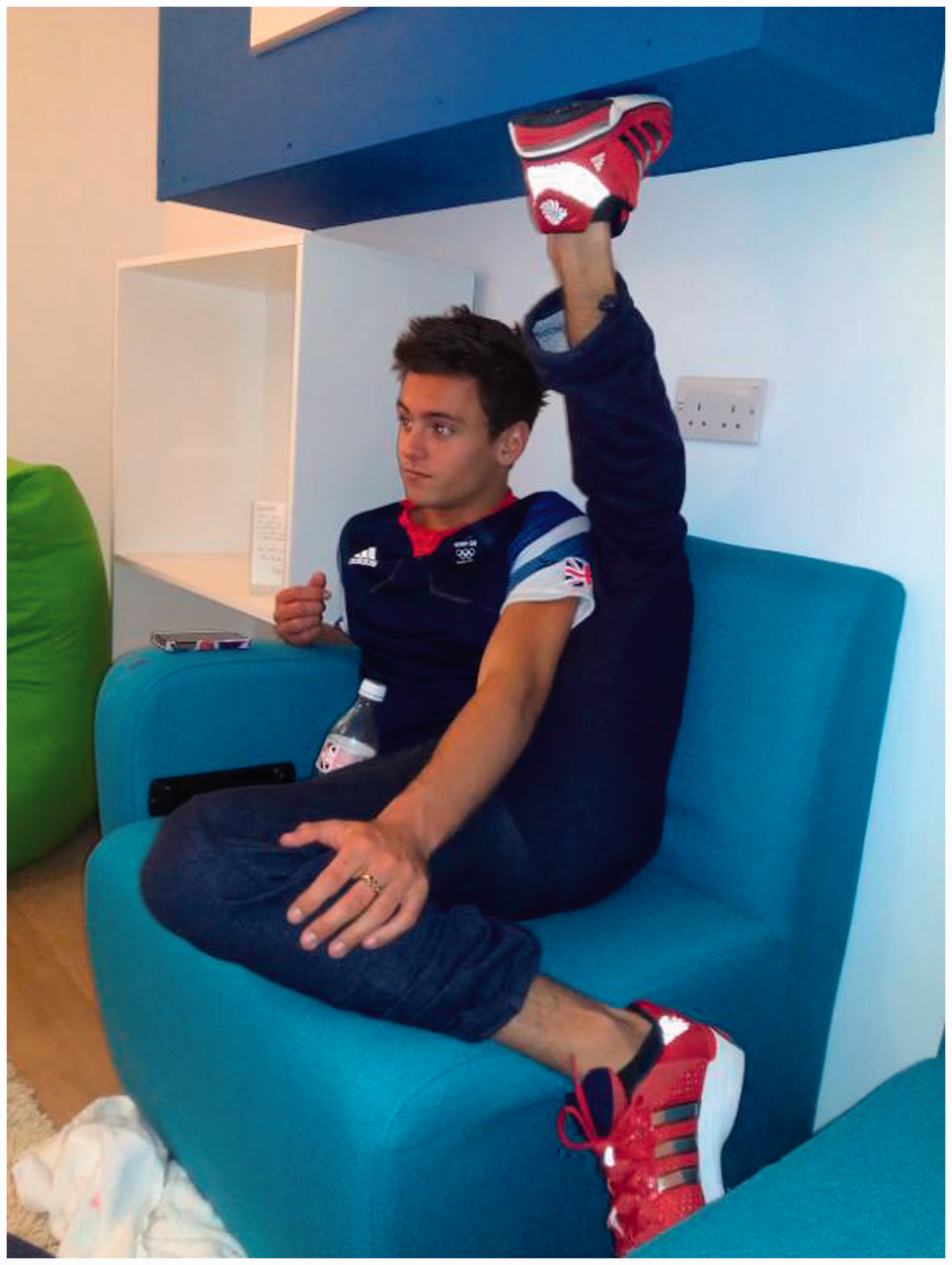
Over the course of my survey of discussions of Daley on the DataLounge, it became clear that this December 2013 announcement complicated matters: offering both complexity and simplicity to Daley’s more surface traits and their connection with homosexual stereotypes. From 2 December 2013 Daley suddenly begins being conceptualized in relation to this announcement and his relationship. Two contrasting comments posted on the date of the announcement and that appear on the same thread help illustrate this new discourse: It’s a special day today learning that Tom Daley’s perky pussy is indeed being penetrated by male cock. God bless. (R74) He’s had so many loads up that ass that he sneezes and blinks cum. Kids today are uninhibited. Stupid whores. (R77)
23
My selection of the loaded terms ‘daddy’ and ‘boy’, which suggest the binary of ‘father/son’, is deliberate. As John Mercer notes in his examination of the older male in gay pornography genres, the term ‘daddy’ is suggestive of a taboo sexuality, yet its exact meaning is ‘mutable’ (2012a: 320). ‘Daddy’ refers simultaneously to positions that include: ‘a macho older gay male, a dominant “master” in sado-masochistic sexual play, and to the sexual role of a domineering and potentially aggressive father figure in the enactment of abuse fantasies’ (2012a: 320). All three meanings are present in discussion of the pairing on the DataLounge, while the knowledge that Daley had lost his biological father to cancer in 2011, aged 40, seems to fuel interest in the ‘abuse fantasies’ explanation in some discussions, eroticizing the taboo of intergenerational desire.
In line with such ‘abuse fantasies’, immediately apparent in the wake of the announcement is a more serious tone across the forum. Daley is still eroticized, but now this eroticism comes with some casting Daley/Black in accordance with a victim/predator narrative. In a thread titled ‘Men who date teenagers less than half their age (male or female)’, for example, one participant writes: ‘I would rather see [Daley] explore his sexuality with a peer that has similar experiences and perspectives than a decades-older predator manipulating an obvious power disparity’ (R18, 4 December 2013), 24 while others associate the pair with HIV, a gesture reminiscent of the potentially illegal ‘teamHIV’ tweet referenced at the start of this article. In response to the subject: ‘How can we break up Tom Daley and DLB?’ (4 December 2013), for instance, Reply 2 reads: ‘Wait until first outbreak.’ 25
There is a certain irony to the newly serious tone of the discussions that are posted in the critical moment following Daley’s announcement, particularly given the rather offensive, and potentially ‘predatory’, nature of earlier discussions – some of which take place while Daley is underage in some jurisdictions, with fetishized readings of his body from 2010. 26 Also interesting are the ways in which the Daley/Black relationship complicates previous constructions of Daley(-as-bottom). For example, the bareback images from 2006 depicting Black being fucked bareback, complicate the Daley-as-bottom scripts explored earlier, as shown in a 2014 thread in which the OP nominates Daley as part of the subject ‘Celebrity Twinks that are rumored to be Tops’ (28 May), to which Reply 2 reads: ‘Tom Daley? A top? Puh-Leaze! He’s a blushing little girl who just wants to be dominated.’ The reply perhaps symbolizes a desire to keep Daley and certain traits of his voice, body, mannerism and profession, ‘anchored’ (see Barthes, 1982: 38–41) to a monolithic conception of the bottom identity. As another reply reads on the same thread, ‘twinks who top … it just ain’t right’ (R7). 27
Responding to the subject ‘Anyone else grossed out by Dustin Lance Black’ (19 May 2014), one of the replies offers insight into the Daley/Black partnership, and its implications for the discourse on the DataLounge forum, which will serve as the final example: I don’t find DLB attractive, but he’s a screenwriter – I’m not supposed to find screenwriters attractive necessarily. DLB has done some dumb shit, but dating Daley is not one of the dumb things he’s done. (R23)
28
Conclusion
This article offers insight into discourse on a gay celebrity pre- and post-coming out, and how certain factors (such as a relationship with an older man) impact on the discourse created. I nominate certain ‘themes’ to make sense of the discourse on Daley that appears on the DataLounge, namely: the ‘dancer body’, the bottom, the slut, and the daddy’s boy. Also revealed are certain community expectations and anxieties around the homosexual subject and his body. The offending tweet referenced at the start of this article, in which associations are made between Daley as diver and bottom (‘bum’), and with disease (HIV) was authored by a more traditional masculine subject, a footballer in South Wales. What this study demonstrates is that views such as those expressed in this abhorrent tweet are actually not far removed from the types of categories and stereotypes of Daley’s homosexuality that have been cultivated over a number of years by anonymous members of a marginalized (online) community to which Daley supposedly belongs.