




Abstract
Positive personal gain after adverse life events and traumas is known as posttraumatic growth (PTG). Several factors are suggested to promote PTG after stressful events, including type of trauma, in addition to younger age and female gender. Although conflicting findings exist, studies suggest that there may be less growth associated with personal traumas (i.e., physical or sexual assault, accidents) and more growth associated with shared traumas (i.e., disasters, loss). We examined whether certain types of war-related traumas are associated with more PTG in a sample of 203 Iraqi students living in Turkey who had experienced severe war-related traumatic events. They were assessed in group sessions, using a self-report battery that included the Post-Traumatic Growth Inventory and War Trauma Questionnaire. War experiences were categorized into three types of trauma: trauma to self, trauma to loved ones, and adversity. Growth was measured by the Turkish version of the Post-Traumatic Growth Inventory. Adversity-type events positively predicted growth, whereas trauma to self predicted growth negatively. Males and females showed a different pattern of relationship with growth. Correlations of growth with younger age and adversity observed in females were not seen in males. Our results show that different trauma types may lead to differing levels of growth, and this difference may be more pronounced when gender is taken into account.
Although traumatic or distressing events can cause long-lasting psychological symptoms, many survivors may experience only mild or transient problems after horrible experiences, and some may even emerge stronger. They may report an increased interest in spiritual matters, increased maturity, improved social relations, or a new and healthier lifestyle after a traumatic life event. Benefiting in some way from a stressful experience is called posttraumatic growth (PTG) or stress-related growth in the stress and coping literature (Carver, 1998; Park, Cohen, & Murch, 1996; Tedeschi & Calhoun, 1996). Resilience is a closely linked concept that should be distinguished from posttraumatic growth. The first refers to a return to original level of functioning after adversity, whereas the second refers to a gain or acquisition of a higher level of functioning after such events (as in the case of recovering from certain infectious diseases where the immune system is strengthened and more resistant to illness than before). Studies that include an examination of predictors of PTG have found several factors, including type of trauma, that may have an effect on the development of PTG. Although differing methodologies and varying classification of traumas make direct study comparisons difficult, some research suggests that there may be less growth associated with personal traumas, that is, man-made traumas targeting an individual (physical or sexual assault, accidents), and more growth associated with shared traumas that target a community in addition to the individual (such as disasters). Explicating the relationship between trauma type and PTG is an important component in understanding the positive psychology of trauma exposure. The aim of this study is to examine differences between personal and nonpersonal traumas in terms of their growth-producing potentials.
Studies examining the relationship between trauma type and growth in adolescence are few (Meyerson, Grant, Carter, & Kilmer, 2011) and show that sexual harassment is associated with less growth than trauma due to natural causes. Ickovics et al. (2006) examined 328 adolescent girls (age 14–19), half of whom were pregnant at study baseline. PTG was lowest among those with interpersonal problems (defined as relationship problems, separation, sexual harassment, or rape), whereas PTG was highest among those who defined pregnancy or loss of a loved one as their most distressing experience. Taku et al.’s study (2007) examined 312 Japanese university students. Self-trauma, which included severe illness and accident, related to lower growth than bereavement. Shakespeare-Finch and Armstrong (2010) studied 97 adults (mostly university students) with three types of trauma (bereavement, sexual assault, and traffic accident). The bereaved group had higher growth scores than the other two groups. It is possible, though, that this is due to the fact that bereavement is a universal human experience and not necessarily a trauma (unless the death was violent or sudden). Finally, in two studies from Turkey (Dürü, 2006; Karancı et al., 2012), natural disaster survivors reported higher growth than accident survivors. Although the majority of reviewed literature suggests that type of traumatic event does seem to matter for growth to occur, as of yet there is no convincing explanation of why some events should cause more (or less) growth than others. Social and cultural factors, which influence how the trauma is handled by the individual after the trauma, may explain the differences between trauma types in terms of their relationship to growth.
Gender and age are also related to PTG. In two meta-analyses, each examining over 70 articles (Helgeson, Reynolds, & Tomich, 2006; Vishnevsky, Cann, Calhoun, Tedeschi, & Demakis, 2010), females are reported to show overall higher rates of growth after adverse events than males. In Helgeson et al.’s study (2006), younger age was found to predict higher growth.
An entire generation of young people in Iraq has grown up knowing nothing but war and unrest. Starting in 1980–1988 there was the First Persian Gulf War (Iran–Iraq War), followed by the Second Persian Gulf War (1990–1991), then the No Fly Zone War (1991–2005), and finally the Third Persian Gulf War (2003–2011). At least 100,000 people were killed in Iraq as a direct result of the wars, and civilians living in different parts of Iraq were subjected to different types of trauma. Iraqi minority groups, such as Kurds and Turkmens, have experienced both the ravages of war and discrimination for being ethnic minorities. Although the Kurdish Northern Iraq has been relatively stable and conflict-free during most of the last decade, the Turkmens have a long history of being discriminated against and are still being persecuted in most parts of Iraq, including mostly Turkmen areas. Turkmens are the third largest ethnic group in Iraq (after Arabs and Kurds) and reside primarily in Kirkuk, Mosul, Erbil, Diyala, and Baghdad. Turkmens have been part of Iraq since the 7th century, and throughout have maintained a Turkish affinity, including retaining Turkish linguistic abilities. All Turkmen are Muslim, with about 60% Sunni and 40% Shia. The Turkmen population was 500,000 at the 1965 census. It is unclear how many Turkmen currently live in Iraq, since Turkmen ethnicity was not allowed on the most recent census.
The Turkish government provides scholarships for 100 Iraqi Turkmen students annually, which allows them to study in Turkey, but requires them to return to Iraq upon degree completion. These scholarships are administered and controlled through the Turkmeneli Association, an NGO which was established in 1996 with the main aim of preserving the Turkmen culture and identity. Through its three offices in Ankara, Kirkuk, and Erbil, and with the help of agreements with the Turkish government, it helps young Turkmens continue their university education in Turkey. Scholarships cover accommodation and other living expenses, plus travel to Iraq twice a year. Scholarship candidates are required to pass approved qualifying tests (similar to the university entrance exam in Turkey plus a Turkish language test). More male than female Turkmen students come to Turkey, reflecting traditional gender roles in Iraqi Turkmen society. Since the Turkmens share cultural characteristics of most Turkish people, the majority do not experience much trouble in adapting to daily life, except perhaps in improving their spoken Turkish. In addition, most Turks are sympathetic to the Turkmen cause, so there is always help available in adapting to Turkish culture. Because of their situation in Iraq, many of these students do not want to return to their home country and try to remain in Turkey by extending their education through graduate and postgraduate opportunities or marrying a Turkish citizen to secure citizenship. In addition, most experience constant worry about their loved ones who are still in active war zones.
Studies focusing on trauma types and growth in civilian war survivors are few (Kira et al., 2013; Levine, Laufer, Hamama-Raz, Stein, & Solomon, 2008; Powell, Rosner, Butollo, Tedeschi, & Calhoun, 2003). The purpose of this study was to investigate the relationship between the war experiences of Turkmen youth living in Ankara and posttraumatic growth, focusing mainly on the type of traumatic event experienced. We hypothesized that different trauma types would differentially relate to growth; in particular, traumas of a more personal nature would lead to lower levels of growth. We also hypothesized finding more growth among females than males.
Method
Procedure
All known Iraqi Turkmen students studying at various universities in Ankara were invited to take part in a survey of mental health. All the students were reached through the Turkmeneli Association. All subjects were notified and invited to come to the Turkmeneli Association to complete study questionnaires. There were two sessions (1 week apart) that they could attend. One of the investigators (MMK) is an Iraqi Turkmen and had credibility within the Iraqi Turkmen student network. Volunteering students self-administered paper-and-pencil interviews in which they answered questions about sociodemographic information, war-related events that they experienced in Iraq, posttraumatic growth, and symptoms of PTSD and depression. Two of the authors (CK and MMK) were present during these data collection sessions. Though students were Iraqi, they all spoke Turkish (as is required in the universities). All subjects who volunteered to participate in the study gave written informed consent. The study was approved by the Ethics Committee of Hacettepe University in Ankara.
Measures
One section of the questionnaire collected basic demographic variables related to the participant as well as his/her family members.
Trauma exposure was assessed with the War Trauma Questionnaire (WTQ), a scale in Turkish, which was designed by the researchers (including MMK, who is an Iraqi Turkmen war survivor) for this study. The WTQ asks participants about their exposure to 31 types of war-related events since 2003 (each coded as 0 = did not happen, 1 = happened), ranging from severe traumas (e.g., rape, torture, personal exposure to horrifying scenes), to nontraumatic, but still disruptive events (e.g., having to migrate due to ethnicity, religious discrimination). We grouped the 31 war-related traumatic events into three categories: (a) trauma to self (13 items), (b) trauma to loved ones (six items), and (c) adversity (12 items). The number of traumas in each category was summed to produce three measures.
Posttraumatic Growth Inventory (PTGI; Tedeschi & Calhoun, 1996) is a widely used questionnaire designed to measure positive change after adverse events. The original questionnaire has 21 items and a 6-point scale, which was translated into Turkish by the first author, who is fluent in both languages (Kılıç, 2004). In this study, a 4-point Likert scale (0 = not relevant, 1 = a little, 2 = a lot, 3 = very much so) was adopted instead of the 6-point scale in the original for ease of administration and to correspond with other scales. In the Turkish version, one item (“My priorities about life have changed”) was dropped since two other items (“new interests” and “establish a new path”) partly covered the same concept. Of note, the same item was also dropped in another study where PTGI was used on a culturally comparable (i.e., Muslim) sample (Powell et al., 2003). The Turkish PTGI version had high internal consistency (Cronbach’s α = .91; Kılıç, 2010). PGTI has been shown to have high reliability in Arabic (Kira et al., 2013) and Chinese (Jin, Xu, & Liu, 2014). In the current study, subjects were instructed to think about the changes that they observed due to their war-related experiences after 2003, and to respond regarding the change in that area compared to prewar status. The total PTGI score (range 0–60) was our main outcome variable.
Traumatic Stress Symptom Checklist (TSSC) is a 23-item, self-rated questionnaire in Turkish that assesses both current traumatic stress (17 items) and depression (six items) on a 4-point scale. When used with a cutoff score, both 17- and 23-item versions have been shown to predict DSM-IV PTSD in earthquake survivors in Turkey (Baş oğlu et al., 2001). The internal consistency of both versions was high (α = .92 and .94 respectively). We used the total score of the 17-item version (PTSD symptoms only) of the TSSC as the first outcome variable in our analyses.
Data analysis
To test the hypotheses, we used bivariate Pearson correlations to identify age and gender effects on the dependent variables. We then conducted multivariable linear regression analyses, in which the dependent variable was mean total PTGI score (continuous), and the explanatory variables entered simultaneously were age, gender, the subscale scores of the three event types, and PTSD symptoms. Missing values were handled by excluding cases pairwise (they were not replaced by the mean). We also added a Gender x Age interaction variable among explanatory variables, since correlation analyses suggested a gender effect on the relationship between age and PTGI.
Results
Participant characteristics and trauma types by gender.
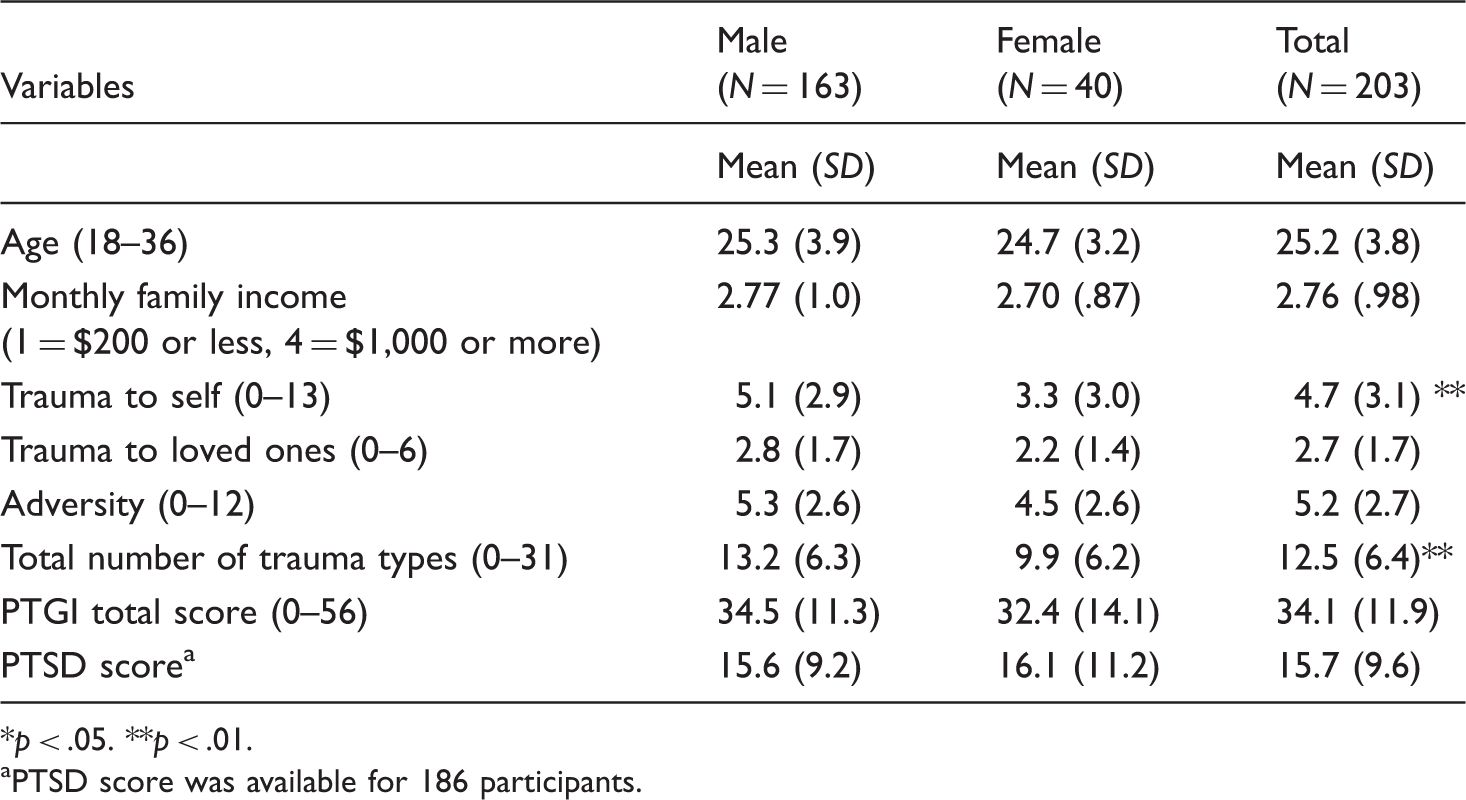
p < .05. **p < .01.
PTSD score was available for 186 participants.
Typical traumas experienced by gender.

p < .05. **p < .01.
Bivariate (Pearson) correlation of PTGI with study variables by gender.
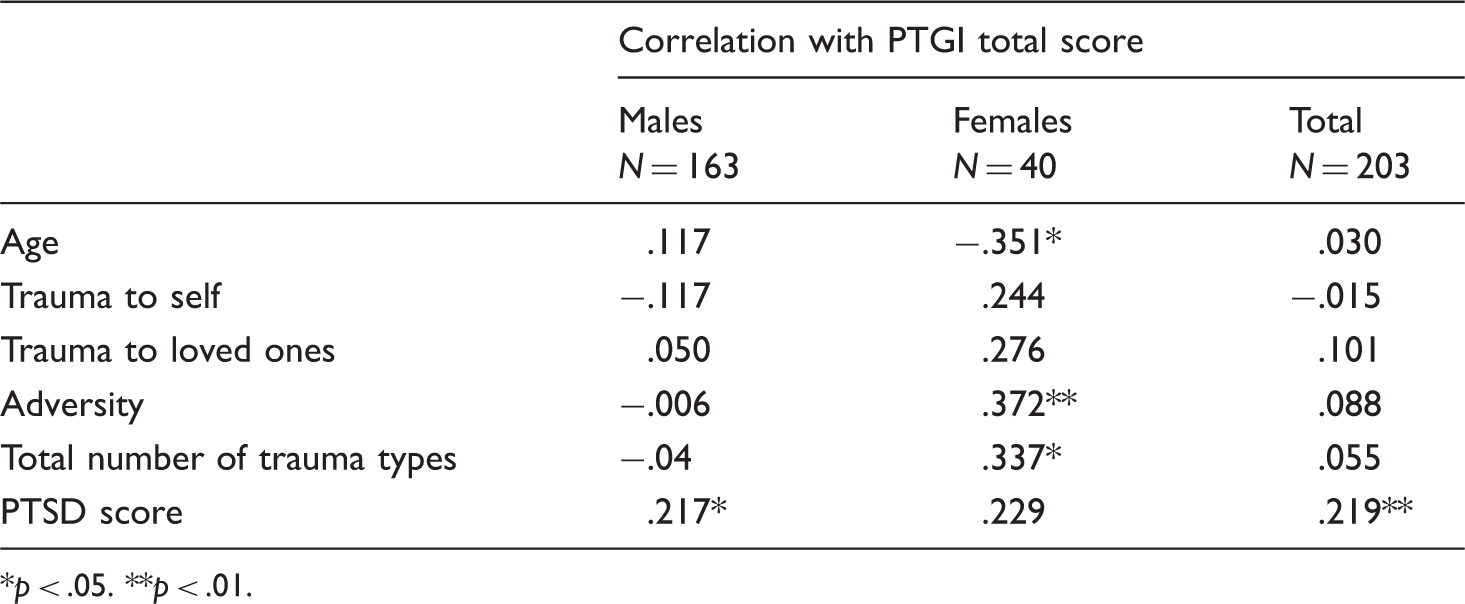
p < .05. **p < .01.
Multiple regression model of prediction of PTGI by study variables.
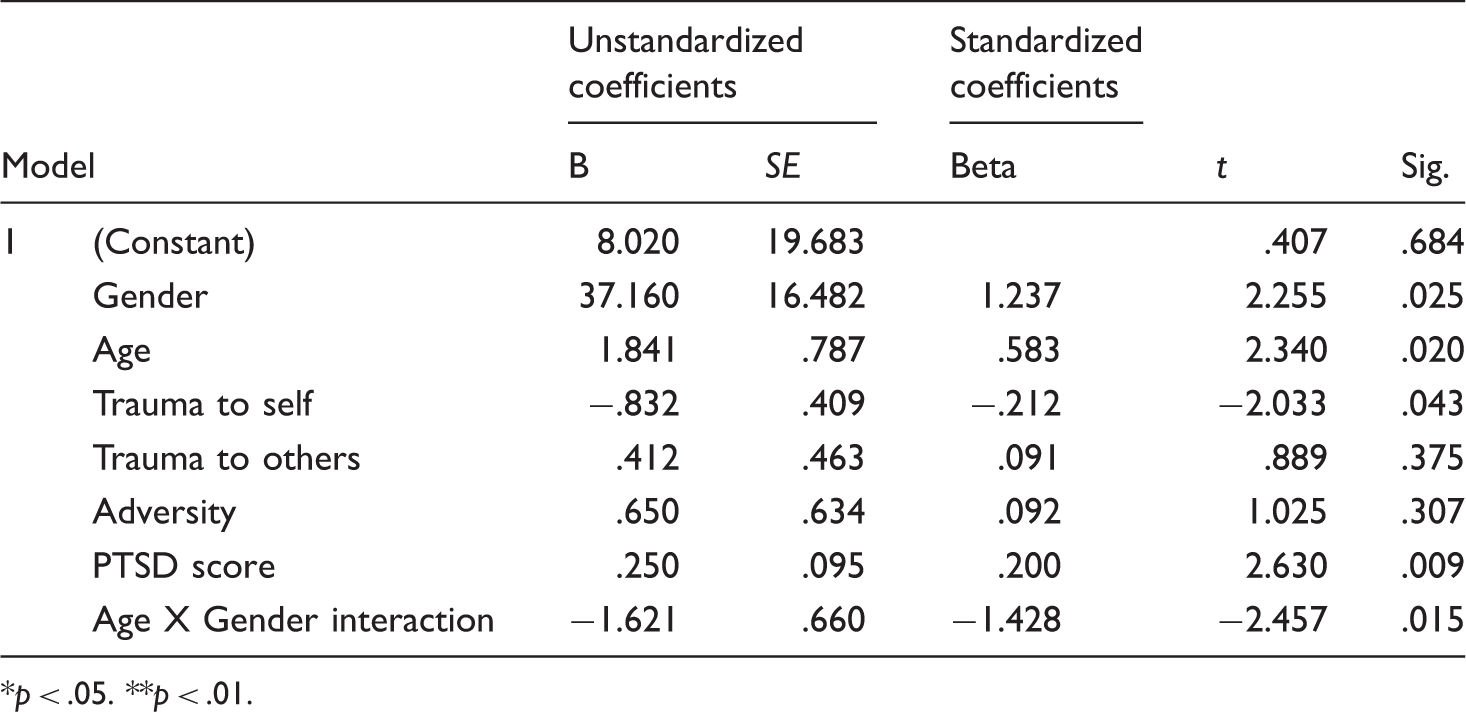
p < .05. **p < .01.
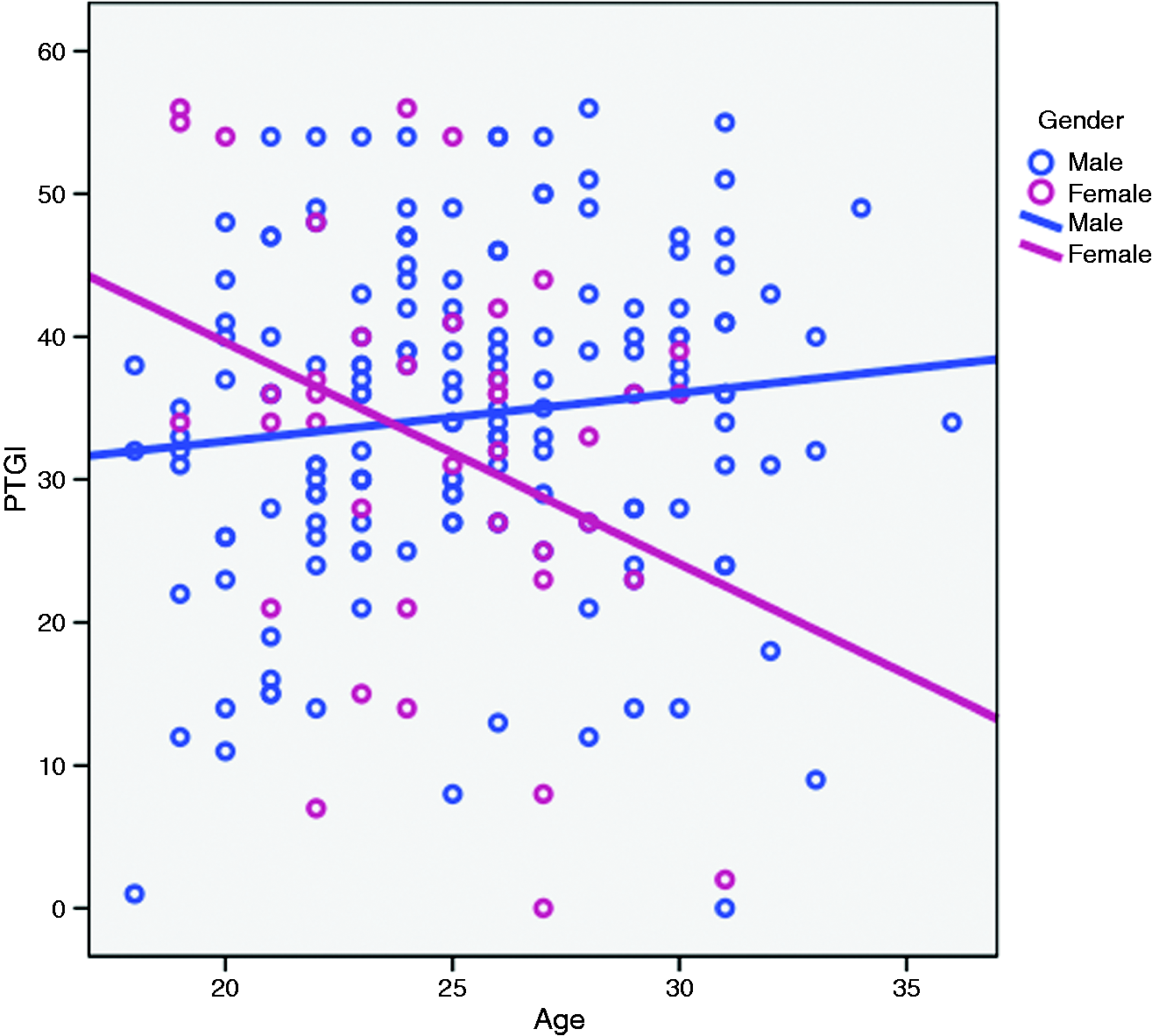
Relationship of age and PTGI score by gender.
Discussion
Although positive outcome after adverse events has been well-studied, little is known about this phenomenon among civilians who suffer severe distress in a war zone. One of the expected findings of this study is the high rate of trauma exposure. One third of the sample reported being held at gunpoint, and one half reported witnessing killings. Of several severe traumas, there were gender differences for only a few; which means that most of these horrible traumas were experienced by young men and women alike. Our results suggest that war trauma can lead to positive growth experiences even in very young people. When compared to studies conducted in Turkish samples using the same PTGI measure, the mean PTGI score in our sample (34.1) was similar to that found among emergency medical staff (İnci & Kılıç, 2015), and much higher than that found among earthquake survivors (Eren-Koçak & Kılıç, 2014; Kılıç, 2004).
Our findings support the hypothesis that the relationship between growth and different types of war-related adverse events is not uniform. Although adversity event types were significantly positively correlated with growth for females, in a multivariate model including all trauma types, age, gender, PTSD, and an Age x Gender interaction, of the traumas, only trauma to self was negatively related to PTGI score, with PTSD positively related and a significant Age x Gender interaction. Thus, trauma to self seems to “block” growth, while neither adversity nor trauma to loved ones was related. Although we did not have a specific severity measure, when we divided the sample into three groups using a proxy for severity (less than 10 events, 11–15 events, and more than 15 events), PTGI scores did not differ between the three groups, suggesting that trauma type—not severity—is the issue. Another factor that may influence growth is the way in which the trauma is handled by the individual. For example, both disclosure and social support after the trauma experience have been found to be related to growth (Taku, Tedeschi, Cann, & Calhoun, 2009; Tedeschi & Calhoun, 2004). Trauma to self include events such as rape, being kidnapped, torture, or being held at gunpoint, and these experiences may not be easy for young people to share with others. It is possible that trauma to self hinder the growth process through inhibiting disclosure, or by destroying the social network or diminishing means of reaching social networks.
Interestingly, there was a positive relationship between PTSD symptoms and growth in our model. Thus, even the negative aspects of PTSD did not “block” growth. This is in line with the original conceptualization of growth by Tedeschi and Calhoun (2004), who state that “posttraumatic growth and distress are essentially separate dimensions, and growth experiences do not put an end to distress in trauma survivors.” In fact, in a meta-analysis on the relationship between growth and psychopathology (Helgeson et al., 2006), growth correlated positively with PTSD and negatively with depression. That the differential prediction of posttraumatic growth by different trauma types (especially trauma to self) is independent of PTSD severity provides additional evidence that the relationship between trauma types and growth is not related to clinical severity.
Although we did not find a gender difference in terms of mean PTGI scores, there was an Age x Gender interaction in our multivariate model: PTGI score declined with age in females. The literature on PTG in young people is still scarce, but Tedeschi and Calhoun (2004, p. 4) have suggested that “younger people will report more growth than much older people, since the young may be open to the learning and change of this process to a greater degree than the old, who might have already learned their life lessons.” This does not, however, explain why the same is not true for males. It may be speculated that females may be more introspective at younger ages and therefore may be better able to incorporate traumatic experiences into their changing sense of self. It is also possible that, given the religious and conservative structure of Turkmen families in which younger females are more protected by their families, younger Turkmen females have more social support than do older females. This more supportive environment may be conducive to more posttraumatic growth. These results, however, should be taken with a note of caution, since the number of females in our sample was small. Caution is also required in generalizing these results to other cultures. There is no comprehensive study comparing PTG across cultures; however, national and religious affiliations seem related to posttraumatic growth, as illustrated in a recent study where total PTGI scores were higher in American versus Japanese and more religious versus less religious university students (Taku & Cann, 2014). Although we did not have a comparison group, our observation was that the Turkmen sample was more religious than what would be observed in young Turkish samples. Given this distinction, it is noteworthy that the finding of PTGI scores declining with age in females was not observed in a recent study on young paramedics in Turkey (İnci & Kılıç 2015). Whether these differences are due to the type of distressing event (i.e., trauma to self vs. natural disaster or trauma to others) or to cultural differences is not known and deserves further research.
Our study has important limitations that should be addressed in future work. The assessments were cross-sectional; therefore, we cannot claim causality between related variables. We did not assess when the posttraumatic growth occurred; thus, it is possible that growth measured at the time of study may have been affected by events after the war-related trauma experience of our subjects. We did not include an assessment of perception of severity of the events by the participants. Although we tried to include all Turkmen students in Turkey, the final sample is not representative of all young Iraqi war survivors, and we do not know how Turkmen youth still living in Iraq or youth of Kurdish and Arabic origin are doing. Our results do shed some light on the understudied group of young Iraqis of Turkmen ethnicity living in Turkey and their particular war-related issues. A further limitation is the low number of females in the sample. This is a reflection of the conservative religious structure of the Turkmen population in Iraq. Parents prefer to keep their daughters close by, and when they do send them to Turkey, some may also migrate along with their daughters (among our sample, half of all females had at least one family member in Ankara, compared to one in four among males). Nevertheless, the lower number of females means that our gender results should be intepreted cautiously. Future studies should ideally compare Turkmen youth still living in Iraq (ongoing risk) to those living in Turkey as well as to Arab and Kurdish youth and include more comprehensive assessments of perceived and actual social support, sharing/disclosure of trauma, and the reaction to disclosure.
Conclusions
We have shown that young civilian Iraqi war survivors have experienced a large number of traumas, and the occurrence of trauma to self events is an important factor in determining whether the stressor will lead to growth or not. More specifically, experiencing trauma to self (perhaps more private ones) relates to lower growth, even in the presence of PTSD symptoms. Our findings may have significant clinical implications for those who work with trauma survivors. Future research should assess the relationship between disclosure, social networks, and growth as a step in developing a positive psychological approach for trauma survivors.
Footnotes
Funding
The author(s) received no financial support for the research, authorship, and/or publication of this article.