



Abstract
The present study examined the relationship among acculturative stress, social problem solving, and depressive symptoms among 107 Korean American immigrants. Hierarchical regression analysis showed that acculturative stress significantly predicted depressive symptoms controlling for different domains of acculturation. With regard to the role of social problem solving, among the five dimensions of social problem solving (i.e., positive problem orientation, negative problem orientation, rational problem solving, impulsive/careless style, and avoidant style), negative problem orientation and impulsive/careless style significantly predicted depressive symptoms. Avoidant style significantly interacted with acculturative stress, indicating that avoidant style is associated with depressive symptoms when acculturative stress is high. The study underscores the impact of culture as well as severity of stress on the relationship among acculturative stress, coping, and depressive symptoms among Korean American immigrants.
Keywords
Introduction
The prevalence of depressive symptoms among Asian American measured by the Center for Epidemiologic Studies Depression Scale (CESD) and the Geriatric Depression Scale have ranged from 33.1% to 35.6% (Kim, Park, Storr, Tran, & Juon, 2015). However, Asian Americans are less likely to seek treatment for depressive symptoms compared to European Americans, and, thus, symptoms tend to be persistent without being detected and treated for a long period of time (Lee, Xue, Spira, & Lee, 2014; Lee, Martins, Keyes, & Lee, 2011; Kalibatseva and Leong, 2011). In particular, immigrant populations are more vulnerable to being under-recognized and under-served due to language and health system barriers, as well as cultural factors (Lee & Farran, 2004; Park & Rubin, 2012).
Compared to other Asian American groups, the Korean community has a higher percentage (74%) of foreign-born immigrant adults (2010 Census) and reported the highest depression scores (14.37) on the CESD compared with Chinese (6.93), Japanese (7.30), and Filipino (9.72) (Kuo, 1984). In a recent meta-analytic review (Kim et al., 2015), the prevalence rate of depression measured by CESD for Korean Americans (33.3%) was significantly higher than for Chinese (15.7%) and Japanese (20.4%) Americans. The rates of depression among first generation Korean immigrants in the US are even higher, ranging from 29% to 71% (Lee & Farran, 2004; Park & Rubin, 2012), representing an important target group for research and care for depressive symptoms.
Acculturative Stress and Depression
Acculturation stress is one of the potential explanations for the elevated prevalence of depression among Korean immigrants. Acculturative stress is defined as the stress experienced by migrants during the process of acculturation. Acculturation is a complex and dynamic process of cultural change experienced by an individual or group as a result of contact with different cultures (Moyerman & Forman, 1992; Berry, 2003) which occurs in the context of identity, language, practices, and values that reflect heritage and host cultures (Berry, 2003; Kim, 2008; Miller, 2010). During this process, migrants may adopt their heritage and host cultures to different degrees in the various domains, and thus, they may practice some traditions of the host country but still completely identify with the values of their country of origin. Acculturative stress arises when migrants attempt to resolve problems or conflicts surrounding the issues of incongruent cultural aspects of heritage and host societies (Berry, 2003; Turner & Avison, 2003).
According to Berry (1997), in the process of cultural adjustment, immigrants may prefer one of the four acculturation orientations: integration that is characterized by having a bicultural orientation, assimilation that occurs when individuals adapt to the host culture but do not maintain their heritage culture, separation that refers to a preference of maintaining their heritage culture but not adapting to the host culture, or marginalization that occurs when individuals do not interact with either the heritage or host culture. Research has indicated that the acculturation orientations either enhance or decrease one’s psychological well-being depending on differential exposure to risk factors and subsequence experience of acculturative stress (Ayers, Hofstetter, Usita, Irvin, Kang, & Hovell, 2009; Hwang & Ting, 2008; Park & Rubin, 2012). The acculturation orientations may also affect the level of acculturative stress by determining how much they interact with their heritage and host communities and the resulting culture shift (Rudmin, 2009). In spite of the interrelationship between acculturation orientations and acculturative stress, the attitudes toward the culture of origin and the new culture, which are the two dimensions that categorize the four acculturation orientations, have rarely been considered when the impact of acculturative stress on depression is examined. In the present study, the degrees to which individuals adopt the host culture and retain their heritage culture would be considered as covariates to establishing the impact of acculturative stress on depressive symptoms in Korean immigrants.
Korean Americans are the fifth largest Asian American subgroup, and about 1.4 million Koreans now reside in the U.S., with more than a 30% increase in population over the past decade (U.S. Census Bureau 2010). Main stressors associated with acculturation in Korean immigrants include language barriers and social isolation, as well as difficulties in socioeconomic adjustment, family relations and role adjustment, and sense of marginality (Oh, Koeske, & Sales, 2002; Park & Rubin, 2012; Choi, Kushner, Mill, & Lai, 2014). More than 70% of the Korean Americans speak a language other than English at home and 40% of Korean households are identified as “linguistically isolated” (Shin & Robert, 2010), suggesting that majority of Korean immigrants may experience language barriers and other challenges related to the language inefficiency. Indeed, Korean immigrants tend to reside in ethnic enclaves located in large cities partly due to language barriers (Palaniappan et al., 2010), which may facilitate their sense of social isolation. The acculturative stressors may contribute to and interact with one’s overall stress burden and act as both chronic and acute stressors (Hwang & Myers, 2007), leading to psychosocial and health problems for Korean immigrants (Ayers et al., 2009; Hwang & Myers, 2007; Oh et al., 2002; Park & Rubin, 2012).
Stress-resistant factor: Social problem solving (SPS) model
A transactional model of stress conceptualizes stress as a function of a combination of stressful life situations and coping processes, and has attempted to identify cognitive and behavioral factors that decrease the negative impact of stress (Lazarus & Folkman, 1984). Social problem solving (SPS) model (D’Zurilla & Nezu, 2007; D’Zurilla, Nezu, & Maydeu-Olivares, 2004) of stress suggests that SPS influences the relationship between stress and psychological health by identifying and selecting a set of coping responses. According to contemporary SPS theory, the effectiveness of coping with stressful problems is largely determined by two partially independent dimensions: problem orientation and problem solving style (D’Zurilla et al., 2004; Nezu, Nezu, & D’Zurilla, 2013). Problem orientation is the set of cognitive-emotional schemas that represent a person’s generalized beliefs or attitudes about problems in living. The problem orientation consists of positive problem orientation (i.e., view problems as a challenge that can be solved) and negative problem orientation (i.e., view problems as threats and demonstrate poor self-efficacy). Problem solving style refers to the set of cognitive, affective, and behavioral coping activities to deal with stressful problems. There are three types of problem solving styles: rational problem solving style, impulsive/careless problem solving style, and avoidant problem solving style. The model suggests that positive problem orientation and rational problem solving style are adaptive in dealing with problems and decrease the negative impact of stress on psychological outcomes, while negative problem orientation, impulsive/careless style, and avoidant style are maladaptive and exacerbate the detrimental effect of stress.
Research studies on SPS have demonstrated that negative problem orientation, impulsive/careless style, and avoidant style significantly predict depression, anxiety, substance abuse, aggression, and suicide attempts (Nezu et al., 2013). In particular, negative problem orientation appears to be a significant predictor of anxiety and depression, even when controlling for levels of psychological stress and self-reported major life events. Furthermore, SPS has been proposed to be a significant moderator in the link between stressful life events and subsequent psychological outcomes (Becker-Weidman Jacobs, Reinecke, Silva, & March, 2010; Bell & D’Zurilla, 2009). Specifically, negative problem orientation exacerbated the impact of life stress on externalizing symptoms among college male students (Bell & D’Zurilla, 2009). In addition, high positive and low negative problem solving orientations made treatment to reduce suicidality among the adolescents more effective (Becker-Weidman et al., 2010). In spite of established research on the relationships among stress, SPS, and psychological distress, research examining SPS with immigrants who are experiencing acculturative stress and depression is extremely limited.
Stress, Coping, and Culture
Culture plays an important role in evaluating and dealing with problems and distress. People employ coping strategies when the particular coping styles are perceived as allowed and appropriate in their cultural context (Chun, Moos, & Cronkite, 2006). Members of collectivistic cultures, including Asians, who value communal goals and group/interpersonal harmony tend to control and change themselves or endure their distress to fit group or other needs (Markus & Kitayama, 1991). With cultural influence, Asian Americans are more likely to use so-called indirect or passive coping including emotion focused acceptance, social withdrawal, and avoidance (Chun et al., 2006; Bjorck, Cuthbertson, Thurman, & Lee, 2001; Chang, 1996) which is consistent with the cultural norm of avoiding conflicts and preserving interpersonal relationships. The indirect or passive coping is compared with active, direct, or problem focused coping strategies that are commonly reported to be used by European Americans (Chun et al., 2006; Bjorck et al., 2001; Chang, 1996). Western cultures emphasize and value individuals’ uniqueness, autonomy, and assertiveness (Markus & Kitayama, 1991), and thus, the coping strategies focusing on controlling or modifying the environment to fit their own personal needs may be preferred by European Americans.
However, studies concerning cultural variation in coping have shown contradictory findings. For example, a study showed that East Asian Americans including Korean, Chinese, and Japanese college students tend to use acceptance, religious coping and avoidance strategies more compared to European Americans who are more likely to use problem focused or active coping strategies (Bjorck et al., 2001). However, in a study that examined ethnic differences in the use of coping strategies, Korean older adults used more problem focused coping and active coping strategies, as well as avoidant coping styles than European Americans (Lee & Mason, 2014). In addition, there are inconsistent findings regarding the impact and effectiveness of coping styles. A study of Korean immigrants in Canada that utilized the transactional model of coping demonstrated that frequent use of problem focused coping styles had better mental health effects, whereas the use of emotion focused coping was associated with higher levels of depression in the face of discrimination (Noh & Kaspar, 2003), which is comparable to patterns reported among people of Western culture. However, another study conducted by the same research group reported that forbearance coping (i.e., minimization or concealment of problems or concerns) or emotion focused coping, but not confrontational or problem focused coping, are effective in reducing the link between discrimination and depression among Southeast Asian refugees residing in Canada (Noh et al., 1999).
Researchers explained the inconsistent findings by the cultural influence on coping, as well as the ethnic support and resources. Specifically, forbearance or emotion focused coping may have diminished depression of South Asian refugees (Noh et al., 1999) because the coping styles were more congruent with their culture that focuses on exercising self-regulation rather than affecting a change on the environment, particularly when they have limited social and psychological resources and strong ethnic identity. However, for the sample of Korean immigrants (Noh & Kaspar, 2003) who were more resourceful and stable in the U.S. than the Southeast Asian refugee sample, problem focused coping was more beneficial than emotion focused coping. Additionally, emotion focused coping was not associated with depression in people with sufficient ethnic social support. Similarly, a study of Chinese international students (Wei, Liao, Heppner, Chao, & Ku, 2012) reported that use of forbearance coping increased psychological distress, particularly when acculturative stress was high.
These studies are in line with the view that the effectiveness and functionality of the coping styles are determined by many factors, including the nature of the stressor, personal resources, social contexts, and the cultural congruence (Lazarus & Folkman, 1984). In particular, the association between active or passive coping styles and depressive symptoms in the context of acculturative stress may be a function of the combination of cultural influence and other moderating variables, such as the level of stress. However, studies identifying the factors that influence the effect of acculturative stress and coping in Korean immigrants are rare.
The present study was designed to examine whether the coping strategies that fit well in Western cultures can be applied and transferred to Korean immigrants who experience depressive symptoms resulting from acculturative stress. Further, it proposed to clarify the role of active and passive coping in the relationship between acculturative stress and depressive symptoms of Korean immigrants and identify the factors that moderate the effect of coping. Specifically, the present study aimed to 1) establish the impact of acculturative stress on depressive symptoms in Korean American immigrants, after controlling for the attitudes toward the culture of origin and the host culture, 2) examine the association of the different domains of the SPS which include both active and passive coping strategies with depressive symptoms of Korean immigrants, and 3) investigate the interaction between the different domains of SPS and acculturative stress.
Methods
Participants
A total of 107 Korean American immigrants residing in East Coast metropolitan areas participated in the study. Korean American immigrants were defined as people born in Korea and residing in the U.S. at the time of the study. Because there is evidence that those who migrated before and after the age of 16 have significantly different adjustment experiences (Noh & Avison, 1996), this study included only those who migrated to the U.S. at the age of 16 or older.
The study was approved by the Institutional Review Board of Drexel University. Participants were recruited through local Korean churches, Korean Saturday schools, Korean tennis clubs, and personal contacts. After being given permission from the pastors of the churches, the principals/directors of the schools, and the leaders of the tennis and soccer clubs, potential participants were approached and provided information about the study. For potential participants who were interested, the interviewer conveyed relevant information and received informed consent. Then, they were given a packet of questionnaires with a manila envelope to place the completed surveys in. For potential participants wanting to complete the questionnaires at home due to time limitation, they were given the questionnaires and a return envelope with a postage stamp. Refreshments and snacks were provided for participants.
Measures
All the measures used in the study had been previously translated into Korean. The Korean versions demonstrated adequate levels of reliability, reported in subsequent sections.
Demographic information
Background information of participants, such as gender, age, marital status, employment status, length of U.S. residence, level of education, and monthly household income were included in the questionnaire.
Acculturative Stress Index (ASI; Noh & Avison, 1996)
Acculturative stress was measured using the Acculturative Stress Index (ASI). It was first developed for the Korean Mental Health Study, which was a two-wave panel study of life strains and mental health in Toronto, Canada. The ASI is a 31-item self-report measure to assess the degree to which subjects perceive their current life experiences as stressful in the process of resettlement in the U.S. in five main areas: 1) social isolation (e.g. “I am not able to find someone I can confide in”), 2) sense of marginality (e.g. “I have few, if any, opportunities to participate in American politics”), 3) difficulties in socioeconomic adjustment (e.g. “The job experience I had in Korea is not recognized in America”), 4) difficulties in family relations and concerns with children (e.g. “I feel that my relationship with my spouse would be better if we were living in Korea”), and 5) language barriers. Responses were scored on a 4-point scale ranging from “never” (0) to “very often” (4). High internal consistency reliability of .91 was reported in prior studies (Noh & Kaspar, 2003). In the current sample, the reliability coefficient was similarly high (alpha = .91).
Vancouver Index of Acculturation (VIA; Ryder, Alden, & Paulhus, 2000)
The VIA was used to assess the two dimensions that categorize the four acculturation orientations. The VIA is a 20-item, self-report measure and consists of two subscales that separately assess the degree to which an individual acquires host cultural tendencies and maintains heritage cultural tendencies. As recommended by the instrument developers, wordings were changed to fit Korean American immigrants. Sample items used in the present study include “I often participate in Korean cultural tradition” for maintenance of heritage culture and “I enjoy social activities with typical American people” for adoption of host culture. The responses ranged from 1 (strongly disagree) to 9 (strongly agree). Internal consistency coefficients for the current study were .85 for the 10-item Korean culture (heritage culture) subscale and 0.89 for the American culture (host culture) subscale.
Asian Values Scale-Revised (AVS-R; Kim & Hong, 2004)
The AVS-R, a 25-item self-report measure was used to assess adherence to Asian cultural values. The AVS-R was developed based on the 36-item Asian Values Scale (AVS; Kim, Atkinson, & Yang, 1999). Kim and Hong (2004) used the Rasch model to change the 7-point anchor of the AVS to a 4-point scale (1 = strongly disagree, 2 = disagree, 3 = agree, 4 = strongly disagree). In addition, they removed 11 items from AVS that were found to be redundant with other items or to reduce the measures’ construct homogeneity using fitness statistics. Sample items for the final version include “One should not deviate from familial and social norms,” “Educational failure does not bring shame to the family,” and “The ability to control one’s emotions is a sign of strength.” In the present study, Cronbach’s alpha was .84 which is similar to the reliability (alpha of .80) obtained in the original sample (Kim & Hong, 2004).
Center for Epidemiologic Studies-Depression Scale (CES-D; Radloff, 1977)
Depressive symptoms were measured by the CES-D Scale. The CES-D is a 20-item self-report measure of the frequency of depressive symptoms experienced during the past week. Examples of items include “I felt sad,” “I felt that everything I did was an effort,” and “My sleep was restless.” Responses are scored on a 4-point scale for each item: 0 = rarely or none of the time (less than 1 day), 1 = some or a little of the time (1–2 days), 2 = occasionally or a moderate amount of time (3–4 days), and 3 = most or all of the time (5–7 days). Responses to the four positive affect items are reverse-coded and scores on the CES-D range from 0 to 60, with higher scores indicating more severe depression. The Korean version of CES-D (CES-D-K) was first translated by Noh, Avison, and Kaspar (1992) and validated by Cho and Kim (1998) with a Cronbach’s alpha of .89, and a test-retest reliability of .68. In the present study, it yielded a Cronbach’s alpha of .86.
Social Problem-Solving Inventory Revised (SPSI-R-Short Version; D’Zurilla, Nezu, & Maydeu-Olivares, 2000)
The short version of the SPSI-R is a 25-item multidimensional measure developed from the SPSI-R, a 52-item self-report inventory based on the theory of SPS and factor-analytic studies. The measure has five subscales, Positive Problem Orientation (PPO; e.g., “Whenever I have a problem, I believe it can be solved.”), Negative Problem Orientation (NPO; e.g., “When my first efforts to solve a problem fail, I get very frustrated.”), Rational Problem Solving (RPS; e.g., “When I have a problem to solve, one of the things I do is analyze the situation and try to identify what obstacles are keeping me from getting what I want.”), Impulsivity-Carelessness Style (ICS; e.g., “When I am attempting to solve a problem, I act on the first idea that occurs to me.”), and Avoidant Style (AS; e.g., “I prefer to avoid thinking about the problems in my life instead of trying to solve them.”). Research has found the SPSI-R to have strong internal consistency (range of alpha coefficients of .79 –.95 across the five scales) and test-retest reliability (estimates of .93 and .89 for the total score over a 3-week period among two different samples), as well as strong structural, concurrent, predictive, convergent, and discriminant validity (D’Zurilla et al., 2000). The Korean version of SPSI-R was translated and validated by Choi (2002). She reported test-retest reliability ranging from .64 to .89 and internal consistency from .63 to .79 for subscales of the SPSI-R. In the present study, Cronbach’s alphas for PPO, NPO, RPS, ICS, and AS were .74, .81, .82, .87, and .83, respectively.
Data Analysis
Out of 120 people who were recruited and given the questionnaires, 112 returned questionnaires. After excluding 5 questionnaires with incomplete information, 107 were included in the data analysis. Among the 107 participants, 56 were recruited from two Korean churches, 31 were from tennis and soccer clubs, 11 were from a Korean school, and 9 were from personal contacts.
The relationships between demographic variables and the main outcome variables of the study were conducted using ANOVA, as well as descriptive and correlation analyses. Prior to the main analyses, it was tested whether the data met regression assumptions of linearity, homoscedasticity, and normality. The analyses showed that there was no violation of the assumption of linearity or residual homoscedasticity. However, the results indicated a significant departure from normality; skewness was 1.47 (SE = 0.26) and kurtosis was 4.52 (SE = 0.51) with the Kolmogorov-Smirnov test being 0.09 (p = 0.08). Thus, a square-root transformation of the dependent variable (depressive symptoms) was used, which resulted in a decrease in the skewness (0.08, SE = 0.26), kurtosis (0.31, SE = 0.51) and non-violation of normality.
Main hypotheses were tested using hierarchical multiple regression analyses. For moderating analyses, the predictor (i.e., acculturative stress) and moderator variables (i.e., five dimensions of SPS) were standardized before computing the interaction terms to reduce multicollinearity. To explore the nature of the significant interaction, the relation between the predictor (i.e., acculturative stress) and dependent variable (i.e., depressive symptoms) was plotted when levels of the proposed moderator (i.e., avoidant style) were one standard deviation below and one standard deviation above the mean for that variable.
Results
Preliminary analyses
The participants consisted of 55 (51.4%) men and 52 (48.6%) women. The average age of the sample was 44.7 years (SD = 8.43) and the mean number of years living in the U.S. was 15.68 (SD = 10.65). The majority of respondents were married (93.7%) and had completed college or higher education (88.4%). Income was relatively evenly distributed across five levels; less than $25,000 (14.0%), $25,000–$50,000 (27.9%), $50,000–$75,000 (17.4%), $75,000–100,000 (11.6%), and over $100,000 (29.1%). The mean score of the depression scale (CES-D-K) was 12.43 (SD = 8.88), with 36% of participants reporting the cutoff score of 16 or higher. The mean score of 32.21 (SD = 14.05) on acculturative stress (ASI) placed an average frequency of immigrant stress between “sometimes” and “often.” The average respondent “agreed” slightly toward traditional values with the average total scores of 63 (SD = 6.08) for AVS-R and 64 (SD = 11.61) for heritage domain of VIA.
ANOVA and correlation analyses showed that only the level of education was significantly related to depression (F [2,103] = 5.20, p = .007). Therefore, education was controlled for in the regression analyses. The comparison among recruitment places indicated that there were no statistically significant differences observed for any of the dependent or independent measures across recruitment places.
Means, Standard Deviations, and Correlations of the Study Variables
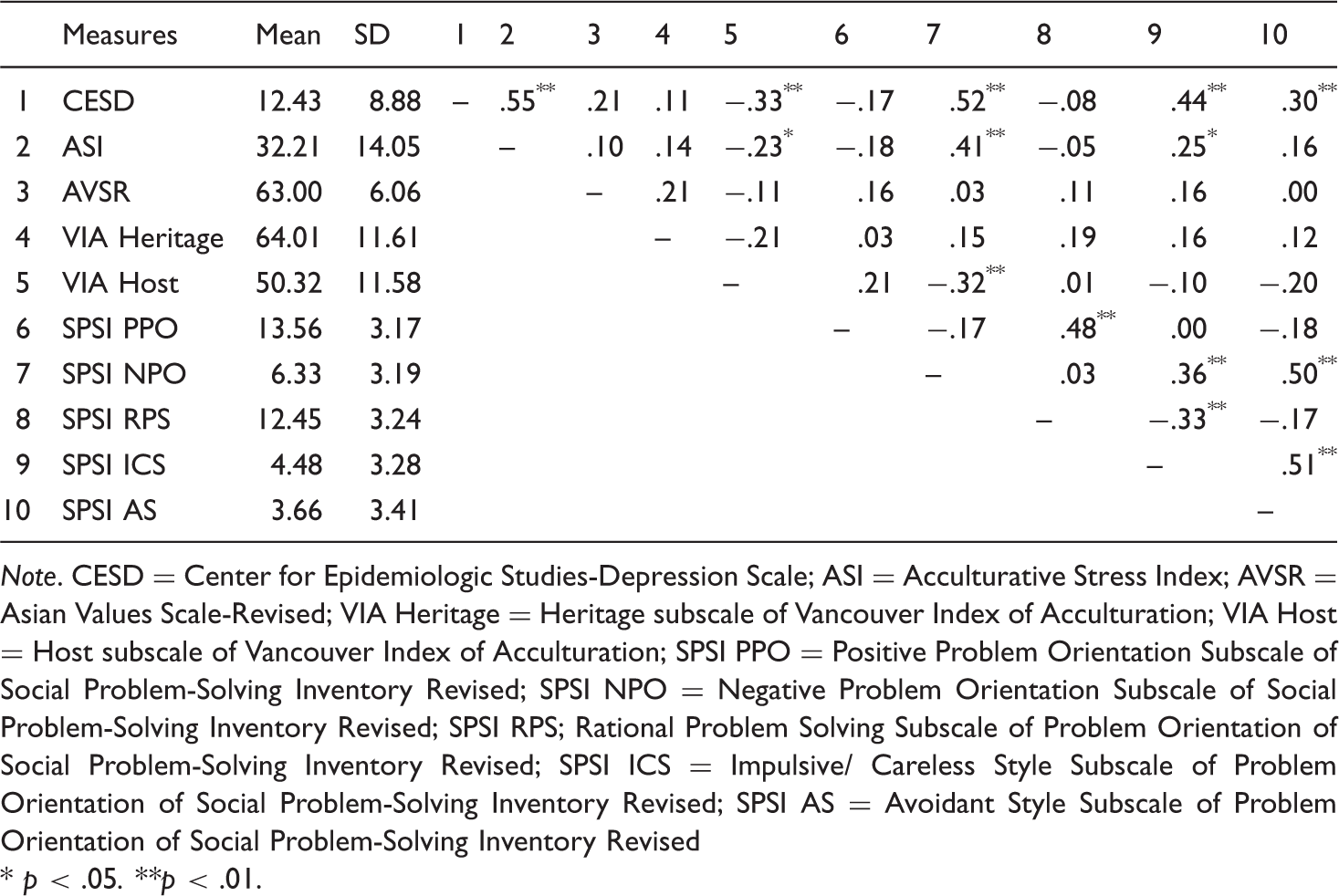
Note. CESD = Center for Epidemiologic Studies-Depression Scale; ASI = Acculturative Stress Index; AVSR = Asian Values Scale-Revised; VIA Heritage = Heritage subscale of Vancouver Index of Acculturation; VIA Host = Host subscale of Vancouver Index of Acculturation; SPSI PPO = Positive Problem Orientation Subscale of Social Problem-Solving Inventory Revised; SPSI NPO = Negative Problem Orientation Subscale of Social Problem-Solving Inventory Revised; SPSI RPS; Rational Problem Solving Subscale of Problem Orientation of Social Problem-Solving Inventory Revised; SPSI ICS = Impulsive/ Careless Style Subscale of Problem Orientation of Social Problem-Solving Inventory Revised; SPSI AS = Avoidant Style Subscale of Problem Orientation of Social Problem-Solving Inventory Revised
* p < .05. **p < .01.
Impact of acculturative stress on depressive symptoms
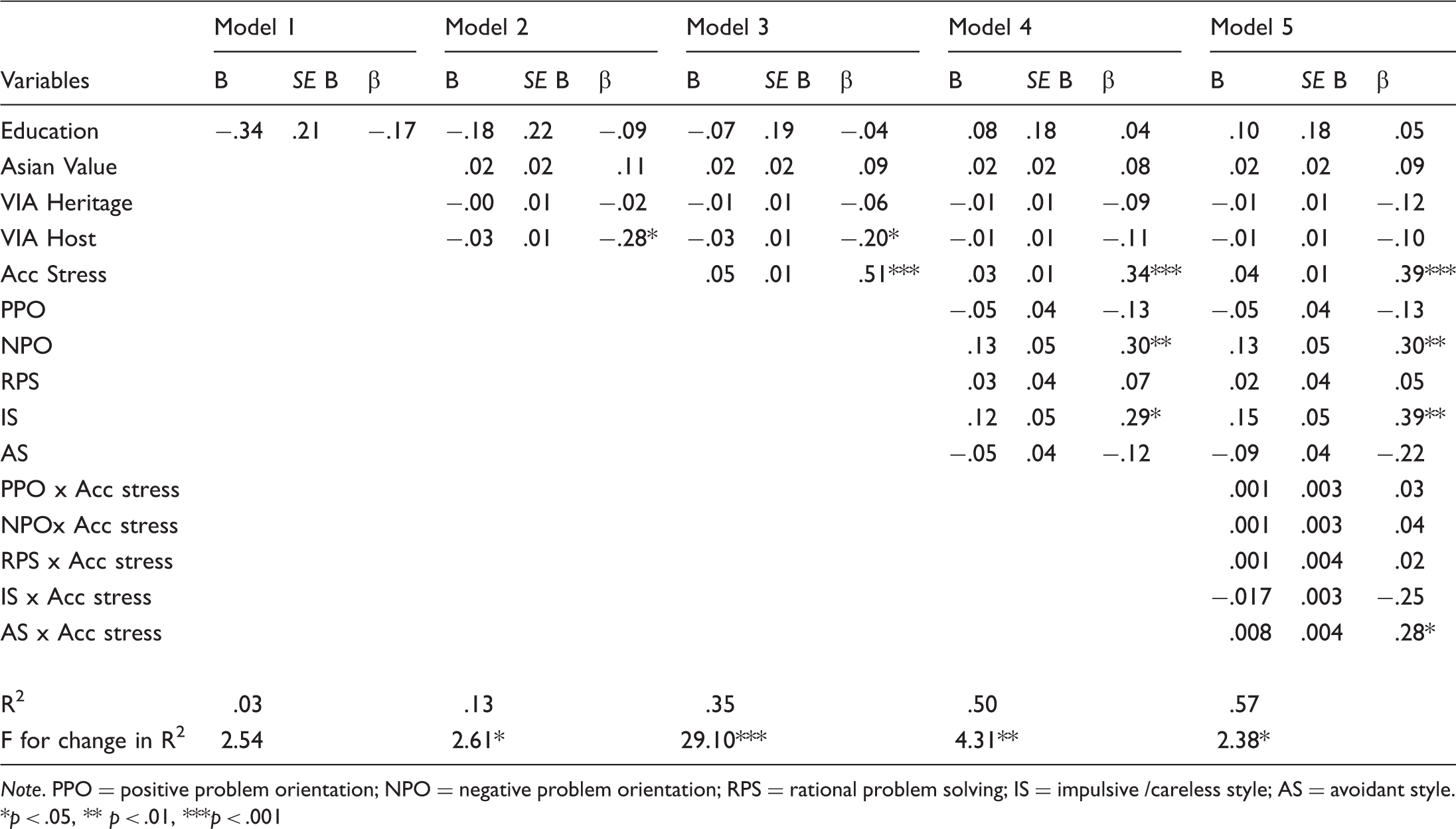
Hierarchical regression analyses to predict depressive symptoms
Note. PPO = positive problem orientation; NPO = negative problem orientation; RPS = rational problem solving; IS = impulsive /careless style; AS = avoidant style. *p < .05, ** p < .01, ***p < .001
Social problem solving as a predictor of depressive symptoms
The dimensions of SPS were entered in Step 4 of hierarchical regression analyses in Table 2 to test the hypothesis that PPO and RPS would be negatively and NPO, ICS, and AS would be positively associated with depressive symptoms. Tests of multicollinearity were conducted for dimensions of SPS and yielded a low level of VIF ranging from 1.69 to 2.08. The results of the hierarchical regression indicated that, as hypothesized, dimensions of ineffective problem solving, NPO (B = .13, SE B = .05, 95% CI = [.035, .227], β = .30, p = .008) and IS (B = .12, SE B = .05, 95% CI = [.025, .205], β = .29, p = .013), significantly predicted depressive symptoms. However, PPO and RPS were not associated with depressive symptoms. AS did not predict depressive symptoms either.
Social problem solving as a moderator of the effect of acculturative stress on depression
To test the moderating role of SPS, interaction terms were created using the centered predictor and moderator variables and were entered in Step 5 of hierarchical regression analyses. A significant acculturative stress by problem solving interaction would provide evidence for a moderating role of SPS. Results (Table 2) demonstrated that only AS significantly interacted with the acculturative stress to predict depressive symptoms (B = .008, SE B = .004, 95% CI = [.000, .015], β = .28; p = .041). As Figure 1 illustrated, the impact of acculturative stress on depressive symptoms is greater when AS are high rather than low.
Plots of interaction effects between SPS (AS) and acculturative stress on depressive symptoms.
Discussion
The present study found that acculturative stress predicted depressive symptoms above and beyond different domains of acculturation including adherence to cultural value, maintenance of heritage culture, and adaptation to host culture. This finding is consistent with previous studies indicating that acculturative stress is a more significant and direct risk factor than acculturation orientations for depressive symptoms in Korean American immigrants (Ayers et al., 2009; Oh et al., 2002; Park & Rubin, 2012). However, it is noteworthy that a low level of adaptation to the host culture, but not other domains of acculturation, remained as a significant predictor of depression even after acculturative stress was entered in the model. This is consistent with the studies suggesting that acquiring or developing mainstream cultural practice is essential to enhance psychological well-being of Korean immigrants in the U.S. (Ryder et al., 2000; Yoon, Lee, Koo, & Yoo, 2010). Similarly, a meta-analytic review reported that acculturation to host culture, compared to acculturation toward heritage culture, has more significant association with negative mental health including depression among Asian Americans (Yoon et al., 2013).
Due to their noticeable appearance and limited English language skills, Asian immigrants may have been an easy target of discrimination (Yoo, Steger, & Lee, 2010). Thus, low level of adaptation of mainstream culture with the limited ability to navigate mainstream systems may cause fear of rejection and a sense of insecurity in this population (Lau, Fung, Wang, & Kang, 2009). In addition, with the Asian value of collectivism, it may be important for Korean immigrants to contribute to communal goals of society and have the sense of achievement as a society member. However, those who are less adapted to the host culture may feel a lack of sense of belonging or self-worth, which leads to an increased vulnerability to depressive symptoms. This pattern of relationship between low levels of adaptation to host culture and depressive symptoms may be different in the societies that endorse stronger biculturalism or multicultural policies than the U.S. such as Canada (van Oudenhoven, Ward, & Masgoret, 2006).
Main findings regarding the role of SPS suggest that certain types of problem solving strategy predict depressive symptoms or serve as a vulnerability factor in the link between acculturative stress and depressive symptoms. Specifically, negative problem orientation and impulsive/careless style were associated with depressive symptoms of Korean American immigrants. Avoidant style, another problem solving strategy that has been considered as maladaptive in dealing with emotional distress, did not predict depressive symptoms. Instead, the avoidant style significantly interacted with acculturative stress to predict depressive symptoms. The significant interaction between avoidant style and acculturative stress indicates that avoidant style is associated with depressive symptoms depending on the stress level. With low levels of acculturative stress, an avoidant style does not predict depressive symptoms. However, avoidant style aggravates the impact of acculturative stress when the stress level is high.
The results that negative problem orientation and impulsive/careless style predict depressive symptoms are highly comparable to the patterns reported among diverse European American populations (Nezu et al., 2013), indicating that these strategies are ineffective in dealing with emotional distress regardless of cultural influence of collectivism. However, the avoidant style which is considered to be congruent with the collectivistic culture does not necessarily have a negative impact among Korean immigrants, particularly, when stress level is low. As discussed earlier, Asian Americans including Koreans are less likely to attempt to achieve control over the problems and change situations when they face problems. Thus, they are less likely to utilize direct confrontational approaches to solve problems. Instead, they have a tendency to apply the strategy of “wait and see,” as they attempt to restore harmony and interdependence with the surrounding situation (Phillips & Pearson, 1996; Uchida & Kitayama, 2009). Since acculturative stress may be related to factors that are beyond their own personal capacity to handle (e.g., social discrimination) applying the strategy of “wait and see” current situation to a certain degree may be a strategically, as well as, culturally appropriate option for Korean immigrants. Thus, when acculturative stress is low, avoidant style does not have a negative impact on their psychological outcomes. However, when stress is high and they need to be more flexible to utilize different resources to deal with increased stress, adherence to their cultural pattern of avoidance may become ineffective and cause depressive symptoms. The moderating role of stress level in the impact of indirect/passive coping on distress is consistent with the study reporting that the use of forbearance coping was not significantly associated with psychological distress of Chinese international students when acculturative stress was lower (Wei et al., 2012). In sum, the problem solving strategies established as maladaptive (i.e., negative problem orientation, impulsive/careless style, and avoidant style) in dealing with emotional distress of diverse populations in Western cultures have a similar impact on depressive symptoms of Korean immigrants in the U.S. However, the effectiveness of avoidant style in dealing with acculturative stress of Korean immigrants appears to be more culture related and situationally determined, and thus, should be considered in the cultural and situational context such as level of stress.
Positive problem orientation and rational problem solving are not associated with depressive symptoms of Korean immigrants. This is consistent with the previous research indicating significant relationship between depression and social problem solving: depression has been associated with negative problem orientation, impulsive/careless style, and avoidant problem solving style, the strategies conceptualized as maladaptive, but not with positive problem orientation or rational problem solving style, the strategies conceptualized as adaptive (see D’Zurilla & Nezu, 2007 for a review). Positive problem orientation and rational problem solving style have been found to be significantly related to more adaptive behaviors, positive mood, better life satisfaction, and higher level of subjective well-being (see D’Zurilla & Nezu, 2007 for a review). Thus, it is possible that positive thinking about problems or rational problem solving strategies may be related to positive mood or functioning of Korean Immigrants.
The findings of this study have several clinical implications. First, given that acculturative stress is an important predictor of depressive symptoms above and beyond acculturation level, treatment efforts may need to address acculturative stress to decrease the level of depression in this population. Effective treatments may include general stress management training and developing specific strategies to cope with specific areas of stress (e.g, social isolation or family conflicts). More importantly, the finding that social problem solving is an important predictor of depressive symptoms as well as a moderator in the relationship between acculturative stress and depressive symptoms may warrant interventions focusing on problem solving style. Specifically, problem solving therapy that focuses on helping clients to decrease negative orientation on problems and inhibit impulsive actions or avoidant behaviors in dealing with problems, particularly when stress level is high, may need to be integral aspects of intervention to address depressive symptoms in Korean American immigrants.
This study has several limitations that need to be addressed and improved upon in future studies. First, the present study recruited participants from Korean organizations, such as Korean churches, Korean schools, and Korean sports clubs. However, these people may be different from those who do not belong to Korean affiliated organizations. For example, the two groups may differ in terms of social support which can play an important role in acculturation processes. Therefore, caution should be used in generalizing the findings to a larger Korean population. Future studies that gather data from more broad geographic areas and include 1.5 and/or 2nd generations may provide a broader understanding of the effects of acculturative stress and social problem solving on depressive symptoms in Koreans living in the U.S. Second, the current cross-sectional design precludes causality or the direction of relationship among acculturation level, acculturative stress, SPS, and depression. Future studies need to employ a prospective and longitudinal design to elucidate the temporal relationship among these factors. Third, the findings of this study are based on self-report measures. However, self-report measures may have difficulty capturing participants’ actual ability to implement the effective problem-solving skills in their real life situations (D’Zurilla & Maydeu-Olivares, 1995). Future studies utilizing performance-based measures to assess problem solving skills in real stressful environments may be useful in providing a clearer picture about the role of SPS in the impact of stress on psychological problems including depression.
Footnotes
Acknowledgements
We want to thank to all participants in this research and the leaders of Korean American community organizations who helped with the research.
Declaration of Conflicting Interests
The author(s) declared no potential conflicts of interest with respect to the research, authorship, and/or publication of this article.
Funding
The author(s) received no financial support for the research, authorship, and/or publication of this article.