



Abstract
By imposing non-Inuit ways of doing within households and communities, colonization has created a rift between generations and impacted the transmission of Inuit practices and knowledge. Inuit care-providers continue to support their fellow community members with individual and collective approaches to wellbeing. The objectives and design of the current project were developed with community members who play an active role in mobilization and wellness. Inuit and non-Inuit research assistants conducted 14 individual interviews and 2 group interviews (total of 19 participants) with key informants involved in community wellness work. Then an Elder (third author) shared her knowledge regarding traditional practices. In this study we describe three underlying principles regarding wellness practices as well as five approaches and the mechanisms by which these approaches seem to impact personal and collective wellbeing. This study highlights how Inuit culture and knowledge can support children, family and community wellbeing in the ways of being together and of taking care of each other. The study responds to an expressed desire named by our partners to document Inuit approaches as well as the principles and practices underlying such approaches and how they are related to self-determination.
Introduction
Indigenous peoples around the world have rich traditional knowledge and practices that have contributed to personal and collective wellness throughout history. Colonial policies and practices implemented over centuries have hindered personal and collective wellness, ruptured relational networks, and created gaps in knowledge transmission regarding parenting and traditional wellness practices (Zamparo & Spraggon, 2005). Inuit of northern Canada have relatively recently been exposed to such colonial practices. The rapid rate of social transformations experienced over the past 60 years have a tremendous impact on livelihoods and wellness (i.e., Bjerregaard & Curtis, 2002; Dasen, 2000). Research suggests that strong social support, secure family relationships and participation in cultural activities serve as protective factors and contribute to Inuit wellness in the face of these social transitions (Fraser et al., 2015; Kemp & McRae, 2016). Community members have remained committed to addressing community wellness through a variety of approaches (see Fraser et al., 2019; Gombay et al., 2016; Healey et al., 2016). However, Inuit have largely been excluded from health planning, research and service provision (Cameron, 2011). Inuit wellness practices have not been widely supported or disseminated (Inungni Sapujjijiit, 2003) and hence may be difficult to define and diffuse amongst those with decision-making power. Those who decide the criteria and laws that establish one's ability to intervene and to assess what programs to fund do not necessarily have the same epistemologies and practices as the Indigenous peoples the interventions and programs are meant to support.
When individuals in Indigenous communities define what wellness means to their members, intervention and prevention initiatives are much more likely to succeed (Inungni Sapujjijiit, 2003). Moreover, research clearly indicates that wellness approaches are most effective when communities have decision-making power in choosing the degree to which they are active (Gombay et al., 2016). It is therefore of interest to document how Inuit define wellness, and the approaches they feel support wellness within their communities as a means of reorganizing services and programs in culturally appropriate ways.
Only a few articles have explored notions of wellness among Inuit. Such publications suggest that Inuit wellness concepts encompass social determinants of health, including aspects of the environment, education, employment, health services, culture and language and mental wellness (Inuit Tapiriit Kanatami, 2014). Wellness is generally understood as an experiential process that is fostered and transmitted through “doing together”, performing actions experienced as being congruent with cultural identity and in the company of friends and family (Kral et al., 2011). Individual wellness is linked to family wellness, with family defined as extended kinship including various important relationships (i.e., sauniq, and birth god mothers). Moreover, being on the land, reconnecting to Inuit culture, reconnecting with family and friends and having strong communities have been documented as ways of strengthening the identity and self-mastery of youth dealing with today's complex world (Fraser et al., 2015; MacDonald et al., 2013). Despite these few publications, very little has been written about Inuit wellness practices. In this article we build on interviews with key informants of Nunavik to explore wellness practices and conceptualization of wellness in the region.
Context of research
Inuit in Canada live in four regions named Nunatoqaq, Nunavut, Nunavik, and Nunatsiavut. Nunavik is the northern region of the province of Quebec and home to over 13,700 people. Populations in its 14 communities (including non-Inuit inhabitants) vary between 230 and 2,700. Communities are accessible from the South only by plane.
Traditionally, families consisted of approximately 30 individuals that travelled between summer and winter camps relying on hunting, fishing, harvesting and sewing skills for their livelihood (Abbott et al., 2003). In the early 1900s, certain Inuit families had settled in or near trading posts, religious missions and whale hunting sites engaging in trade with recently arrived foreigners (Abbott et al., 2003). Kinship networks were significantly threatened when epidemics of smallpox, and tuberculosis brought by settlers initially eradicated entire families. By the 1940s and 1950s, many Inuit were in a precarious position as the fur and whaling trades had diminished. Some moved to permanent settlements in search of employment; while others relocated to enrol their children in school—the only way to receive the government financial assistance that permitted access to needed food and medical supplies. From the 1950s through the 1970s, sled dogs were killed by the Royal Canadian Mounted Police (RCMP) which led to the loss of traditional hunting-based livelihoods and the possibilities of nomadism (Qikiqtani Truth Commission, 2014). In the 1950s, treatments for tuberculosis had become available, though were offered only in the South, resulting in the separation of children from their parents and communities with some never returning home. Government and church-run residential schools and day schools contributed significantly to the breakdown of family kinship structures (Condon, 1990). Children attending such schools were forbidden to speak their own language or practice their own culture (see www.legacyofhope.ca). Such separations have had lasting intergenerational consequences for individuals and families, especially on the transmission of knowledge and ways of living. With the professionalization of services, and the transmission of southern knowledge through school settings, Inuit knowledge regarding wellness and health has largely been left to the informal community settings. That having been said, there is growing interest in developing culturally safe and appropriate services in northern Quebec, and institutional administrators as well as directors work to improve the relevance of services. As examples, the provincial government established article 37.5 of the Youth Protection Act, allowing Indigenous communities to develop their own youth protection services within their territories.
Over the past 10 years, our research team, Pitutsimajut—led by the second author (SF), has been working alongside community partners in the field of health and wellbeing across Nunavik. The action-research platform was initiated by regional leaders who wished to better understand the challenges to inter-organisational collaboration and community self-determination in regard to child and family support and services. Together the researchers and partners developed research protocols to explore these questions using different methodologies. As part of the platform, community partners wished to write and disseminate the ways in which Inuit conceptualize and practice “Inuit wellness practices” and the way in which these practices may influence wellness. Doing so would help community members articulate the practices that have been transmitted through generations, in order to better support the cultural adaptations of institutional services, and support communities in their own community-led services. Such an articulation of their approaches would also help community members to write funding requests, explain their practices to government agents and professionals, and share with the next generation of community support agents.
Method
The objectives of this participatory study, developed by Inuit partners, were to: 1) explore Inuit conceptualizations of wellness; 2) document wellness practices that are carried within communities; and 3) explore the mechanisms by which such practices influence wellness. As a non-Indigenous research team, we were explicitly asked by partners to focus on practices or approaches that support wellness rather than on more theoretical questions regarding conceptualizations of wellness. The research team and community partners were interested in meeting with key informants: people who are identified in their community as developers or facilitators of activities or approaches that support wellness.
The interview guide was developed iteratively following pilot interviews and with the support of an Inuk youth who also participated in identifying key informants, conducting interviews and analyzing data. Interviews were conducted in 5 communities. A snowball methodology was used to recruit participants. We started by asking community organizations who they felt could offer knowledge regarding wellness and wellness practices. We then approached the recommended individuals to share information on the study. A total of 14 individual interviews and 2 group interviews (2 and 3 participants) were conducted (total of 19 participants). Participants were between the ages of 20 and 65. Three of the individual interviews were conducted in English with non-Inuit workers who were identified by Inuit as allies that support community members in their wellness practices. All other interviews were conducted in English and Inuktitut with Inuit community members and were approximately 1-hour long. Nine individual interviews and the two group interviews were co-conducted by an Inuk and a non-Inuk research assistant working together. Five individual interviews were conducted by a non-Inuit researcher. Participants were asked to speak about their experience with community mobilization, with prompts to explore the challenges they faced and the supports they found. Interviews were transcribed and read in their entirety on multiple occasions. One of the Elders who guided the research team (third author) was invited by the research team to give a talk during a conference on indigenizing social work (Louisa Cookie, community member and third author). The conference was recorded for the purpose of this study for additional material.
The principal investigator (PI) and two research assistants inductively double coded the interviews. Once the themes emerged, we returned to the data to extract verbatim that corresponded to the different themes, modifying the names to ensure confidentiality. For validation purposes, we made summaries of the findings and shared them with co-researchers and other key informants, including our Elder guide (third author) to receive their feedback. We also went through data that had been gathered during community consultations (open to the public) held by our partners that explored ways in which community members wished to see services adapt. We examined whether our analysis took into consideration all the material gathered in the consultations. The material is now being used by an Inuit committee to develop training for Inuit and non-Inuit workers in the field of youth and family services.
The data is co-owned, and accessible to both the Nunavik Regional Board of Health and Social Services (NRBHSS) and the PI (second author). The principal investigator stays in possession of the data for logistical reasons. The project was approved by the NRBHSS and the PI's primary institution's ethics committee.
Results
As will be made obvious in the following sections, colonization and ongoing colonialism have impacted individual and collective wellness. This is an underlying reality that permeates all principles and practices of wellbeing.
Participants felt that colonization influenced people's sense of personal confidence, which then influenced everyday actions. As an Inuk key informant explained, people sometimes wondered whether they had the knowledge to speak up or to make decisions for themselves and for others: They don’t feel good enough, to try to start something for themselves. They might say I’m not good enough for this. I did drugs, I did alcohol. We’re affected by suicide. Stigma is stopping everyone. (Community member)
Some participants explained that colonization was not a thing of the past. They felt it influenced both the way people felt about themselves, and the systems that were currently in place to support families and communities. These systems did not always make sense to people in their ways of functioning and of supporting wellbeing.
It is in this context of colonialism and decolonization that the principles and practices that are believed to support health and wellness are articulated. First, we address three underlying principles regarding wellness practices that emerged from the interviews. Then we discuss different approaches that support wellness, as expressed by participants, along with the mechanisms by which they seem to impact upon personal and collective wellbeing.
Principles
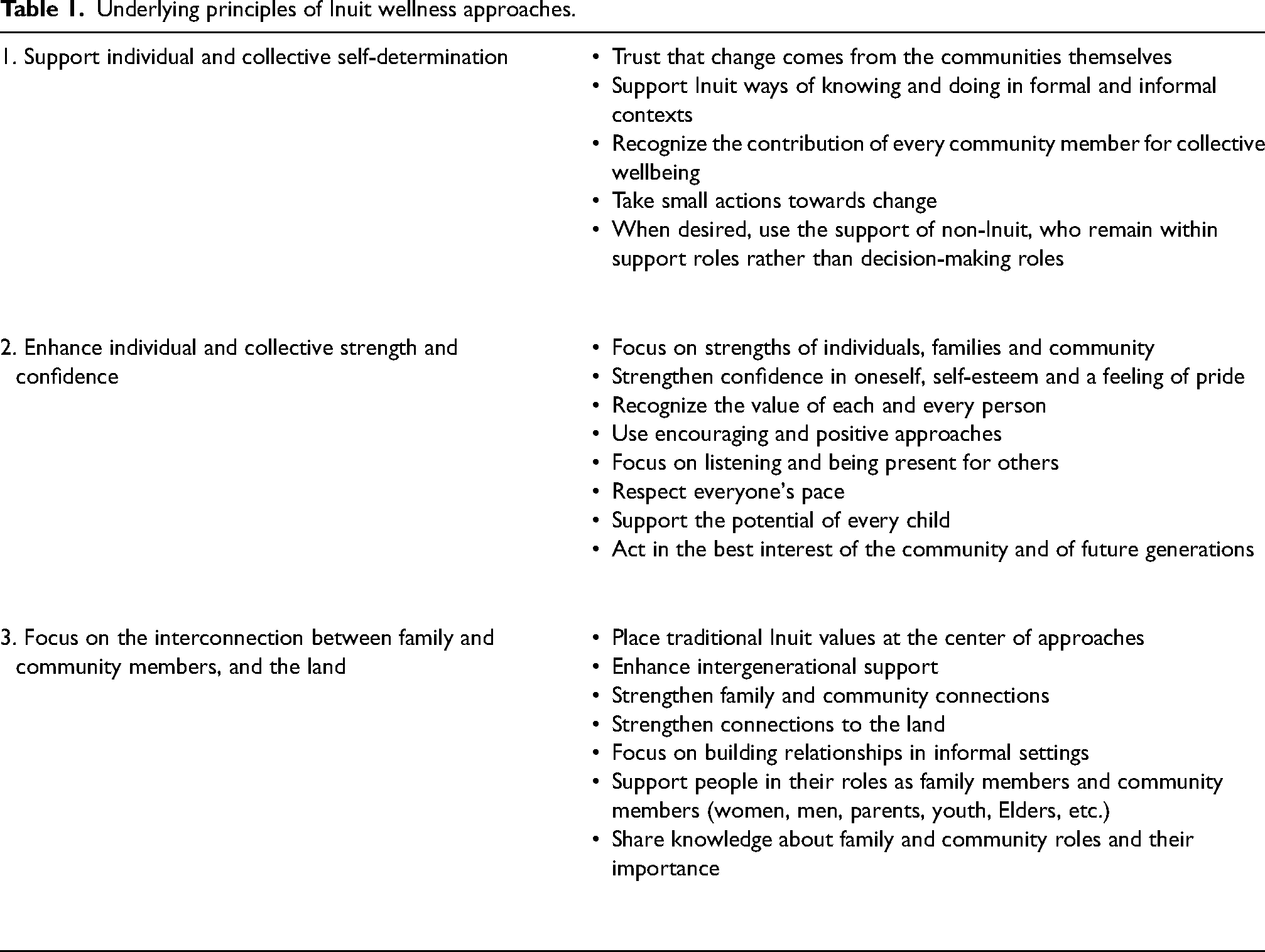
Support individual and collective self-determination.
Community members were seen as having the solutions for community issues: “Ok, we need to find solutions, we can’t just expect people from the outside to come and like fix it for us, we need to do it for ourselves” (Community member). Many participants expressed that it was essential to trust that communities have the ability and knowledge to move forward. Collective strength and cultural knowledge were described as key to moving away from colonial dependency and dynamics, and towards community wellness.
According to participants, it is not only community leaders that have the ability and the responsibility to care for others. All community members were seen as having something to contribute: “people are seeing that they have to be responsible to change the community” (Community member). This shared responsibility means that approaches and practices towards wellbeing cannot always be structured and governed within institutions and organizations. The following comment is an example of how a community member supports other community members: I was volunteering to bring in some kids to my home to teach them like twice a week, to do some beading or sewing or whatever. We said to each other that we should try to invite kids that are neglected in a way from their parents or their family. (Community member)
Another participant shared what she told to community members during a meeting: I said “Inuit people, you’re not gonna be silent anymore. We know our community, we’re the ones who know. Not outside people. They’re here for helping us. So your silence stops. Say everything, what you want to say when we have meetings”. Because we were so silent for so many years. (Community member)
Within this colonial context with deep impacts, it was understood that a process of individual and community healing could take time, meaning that every small action towards change counted as a form of success and should be celebrated. All participants felt that Inuit should be the drivers of these changes. However, informants explained that non-Inuit could play a role in supporting and accompanying communities: We ourselves have to move to get up and do something for our community to become healthy, it is not the outside sources that will heal the community, it has to be the community itself. We can get support from the outside sources, but it has to start in the community. (Community member)
Overall, participants spoke of two fundamental aspects of Inuit wellness approaches that supported this process of self-determination: 1) using strength-based approaches and 2) approaches that focus on building and acknowledging connections to family, community and the land.
Enhance individual and collective strength and confidence: A strength-based approach.
Pride of being Inuk was central to conceptualizations of wellness as can be understood through the words of Elder Louisa Cookie: “We are strong, we are a strong culture; we are survivors”. Many participants explained how this strength and resilience was an inherent part of being Inuk. Inuit have had to adapt and survive in climatically challenging environments. The psychosocial difficulties experienced within communities today, including alcohol misuse, violence and suicide, were described as direct impacts of colonization and colonial practices. Participants explained that for people to be well, they had to understand the impacts of historical traumas and slowly build the confidence inherent to being Inuk. We know that trauma and all that has happened, but we need our people to kind of get off of that […] And I know these social problems are difficult, but because we come from a strong line of people that persevere despite having nothing in the harshest conditions, we are able to sit here instilling that pride again to say “you cannot let a situation define you as a person because you come from a line of strong people… all of this in the middle that's just kind of… it's a passage”. Trying to do that with the family strengthening I think that's what's gonna happen, it's going to instill, give back the power to the people so that they can start giving back the power to their kids, that strength that is still there, […] we just have to make sure that our people believe that they are strong. (Community member)
The challenges here were described as being transitory. Strengthening one's confidence was seen as a way to support someone experiencing these challenges. Doing so required a non-judgemental and non-stigmatizing approach. Participants used a positive, strength-based approach rather than a problem-based approach in the interactions with community members. For example, a participant explained: “I wanted to do a more positive work for the community and teach the people around me to be more positive and healthy. I have known so many cases of violence that could have been prevented with education and I want to do that kind of work to help people” (Community member).
Being present for others, showing a caring attitude and practicing active listening allowed for this strength-based approach: But I think some of the highlights are really… just really kind of the connections you can make with people and kind of walking with people through their stories, walking with people and helping people make their situation a little bit easier. […] I mean often it's so complex and it's so difficult, but I think what you can offer is just validation, listening, really letting people know that you see them and you hear them, I think that's a lot of the job. (Non-Inuit ally)
In this strength-based and positive approach, individuals supported others by respecting where each is at in their personal life, the motivations and the needs. Older community members who were known to support family and community wellness tended to accompany younger community members to develop their strengths and self-esteem. An Elder explained that each individual was born with a gift and it was important to support him or her in reinforcing these gifts: If you look at this child, what do you see? […] It's the strength. We only look at what's on the outside. But he is strong, if you just look at the face, the strength in this child carries… it will carry his life further, they used to say. (Louisa, community member)
As the above participants explained, by targeting the strengths of the youngest and encouraging the development of their natural qualities at their own pace, it was possible to ensure a better collective future: We want a healthy community to make sure our children are strong individuals, leaders, future leaders. We are not saying like “Ok you got to become doctors” it's just so that we support every child to their full potential that we say: “This is what he is capable of, and this is what he needs in order to achieve that” and we are going to make sure that we are going to deliver that. (Community member)
Another participant spoke to one of the youth interviewers: … to have a better Nunavik, we need these (youth leaders), we want you guys to become leaders. It is their choice to be what they want, but we are encouraging them to have goals […] So, encouragement in finding goals should be done so that our youth can move forward. (Community member)
The strength-based approach encompasses a variety of practices as described through these narratives which are not an exhaustive account of the practices that can be used.
Focus on the interconnection between family, community members and the land.
Many participants felt that collective strength came from traditional knowledge transmitted from generation to generation. An Elder explained that, traditionally, the family structure and interpersonal relations were at the core of culture: I was born when they still had Inuit towns and we lived in igloos. I lived at that time with very strong Inuit values. We had our system, living system, that was very strong … And sometimes we lived in tents, we were never in the same area for too long. Like we had to move from one place to another so they called us nomads. […] You can see that everyone tried their best to be good to their neighbours, to whoever passed through. (Louisa, community member)
Louisa depicted how respect, honesty, humility, reciprocity and sharing were the foundation of living and being together as Inuit. She highlighted that these reciprocal relationships naturally take place on the land. She described how the transmission of these values from generation to generation allowed for the creation and sustainability of a strong system of connectedness and support where individuals were concerned with the wellbeing of others. Louisa explained how colonization and ongoing colonialism impacted these values and relationships. Like many other participants in this study, Louisa felt that these values were still present even if weakened. In the following passage, a non-Inuit ally described how he is a witness of Inuit coming together during challenging moments: Like when someone dies like this, the family from all over Nunavik, Montreal or even Nunavut, when there's family from Nunavut, they all come. They all wait for them for the funeral. Like if there's missing one aunt or one family member, they don’t do the funeral. They wait for that person to come in. So it just shows that it's still here, like it's in the culture as well, get together… (Non-Inuit ally)
This interconnection between community members, often described as “getting together”, is the cornerstone of individual and collective wellbeing. Approaches meant to support wellness must reinforce family and community connections, as well as relationship with the land. As an example, a non-Inuit ally described the success of summer camps on the land as a wellness practice: “it's building relationships with people in the community which is a huge part”. An Inuk participant described how an event that brought people together impacted those who were present: “That was good. It was like we were friends, family”.
Also, a participant described how it was in informal contexts that these connections could take place and be strengthened, as opposed to more structured interventions: It could be just… nothing special, organized, just coffee or tea or juice or hot chocolate with cookies or something. And people could sit together or just like pass their emotions, and it will be a welcoming place just to process and then after when you want to leave, you leave. There's no action taking or no like intervention as much, but then just offering that support. (Non-Inuit ally)
Supporting family and community roles is a fundamental component of supporting wellness. Each individual, within Inuit family and community connections, whether man, woman, child, parent, Elder, was described as having specific knowledge that is needed to ensure individual and collective wellbeing. Part of promoting wellness is supporting individuals in recognizing and taking on these roles, developing pride associated with said roles and sharing their knowledge with others. Each person was seen as an essential component of a large web of relations and wellness includes feeling one's role and connection with others, as illustrated by a community member: The women teach the girls how to dry fish, everything, and they practice. They used to have medicine when they were sick, to look at those things. […] And the boys go hunting with the men. (Community member)
Table 1 summarizes the three principles and the multiple components of approaches that support individual and collective wellness.
Approaches
We have organized the variety of practices described by participants around five different approaches to help understand the way in which people describe the mechanisms by which they impact wellbeing. Each approach has specificities, however, the principles mentioned in the previous section can be practices across all approaches. Moreover, the approaches are not necessarily separate. Indeed, a practice can include multiple approaches. It is also important to note that these types of approaches are based on our own characterization and were not necessarily named in this way by the participants. However, they have been discussed and validated with key stakeholders.
Underlying principles of Inuit wellness approaches.
Traditional and cultural approaches.
Participants describe how traditional and cultural approaches created spaces for youth and families to reconnect with the land, culture and language. Knowledge transmission was seen as being at the heart of these approaches. Described practices included going on the land, camping, hunting, and picking berries, as well as picking tea leaves or grass for basket making. Among other practices centered on knowledge transmission, the following were mentioned: sewing, arts and crafts, knitting, throat singing, language teaching, and having informal spaces to have tea and coffee together. Different examples were offered by participants, including summer camps for youth on the land: The way it works is that we pair two or three kids with a guide. They go for at least 1 week or 2 weeks, on the land. […] you’re a guide, she's a guide, I’m a guide, we’re all bringing 2–3 kids. So the plan is maybe to send over 100 kids. […] They go fishing, they go hunting, they go beluga hunting, depending… net fishing, berry picking, they do basket making or… Depending for girls or boys. Stuff like that, depending on which guide. So the best is to find like the two kids to pair with the right guide for them. (Community member)
Traditional and cultural activities were described as ways to enhance individual and collective identity: recognizing the value of family and community roles, supporting pride of being Inuk, creating a sense of belonging to the community, recognizing the value and the importance of each person.
Mentorship and consultations with Elders.
Mentorship and consultation with Elders were described as essential when fostering individual and community wellness. These approaches focused on intergenerational knowledge exchange. As can be read in the following comment, Elders traditionally had the responsibility of guiding individuals and families to ensure their wellbeing: If this person decides not to love, Elders used to come by and talk to them, “Something is happening with you. What is going on?” Other people don’t have to know anything about it. It's between the Elder and him. “What is happening with you? We just realized somebody noticed that you are not loving your family as much as you should be”. So right there and then if he is distressed or angry or whatever, men used to take him out and help him to get rid of the anger so that he hangs on to love for his family. (Louisa, Community member)
Colonization impacted the role of Elders in communities; however, Elders are still recognized as holders of precious knowledge from their accumulated life experience: Elders, they are very wise. And they are, to me, very knowledgeable and experts themselves so, we try, with our project we try to have Elders as much as possible. (Community member)
Mentorship and consultation could be offered by people who are not Elders but who take on leadership roles either formally or informally. Support could be offered to encourage youth to become leaders, or to offer counsel regarding marriage or parenting. The following account speaks directly to the role that mentors can play with youth in recognizing their gifts and developing their strengths for individual and collective wellness: When we see potential [in someone], we will say: “Ok, we need someone to do this kind of thing” so we take them. We try not to overwhelm them because you can crush that because you just have high expectation and then, because they are growing, they are going to stumble and sometimes when you have too high expectations, they stumble a lot like: “iiiish, I’m not cut out for this”. What the youth don’t understand is that it's just normal, so we try to say: “You know what, that was really not fun but you needed that passage to really understand that as you get older you know how to get out of these kind of things”. So, we do a lot of talking. (Community member)
Participants explained that youth could be encouraged to become leaders when adults proactively reached out to them and encouraged their participation in decision making, when they used positive reinforcement with youth and when they validated the ideas and suggestions that youth had. Mentorship and consultation could be done via traditional and cultural activities and other practices.
Group support and healing.
Group support and healing were other approaches that were described. Such approaches aimed to create sharing spaces dedicated to the expression of feelings and emotions, which could bring individual and community healing. Participants explained that an important step in wellness was recognizing the individual and collective challenges people faced, including alcohol and drugs misuse, violence, sexual abuses and suicide, and discussing these challenges in an honest way. In this sense, spaces had to be offered to enable community members to express themselves. Such spaces could take different forms: For group facilitation, you need a staff [in your organization] that believes in what they are doing, not for the money, with their heart, people that are not shy to talk about things, like we talk about anything like we talk about family problems, we talk about sexual problems, we talk about violence, like not to be shy to talk about it to the community. You need persons that are willing to do that. (Group Interview with community members)
As with Elder mentoring and counselling, group support and healing could be done via traditional and cultural activities and it appeared to be stronger this way. This common connection to the land facilitated expression as well as connections between group members: It's to go on the land, reconnect with the land in some way, in our own ways, with each person. Then after a hard day, sit down for a supper, after supper talk about things, talk about life. I think our theme will be finding words, so that we may know how to express ourselves. […]. We hear that we also need to be civilized when we speak up, to be kind. But here [in the community] it's hard to be like that with so much anger, explosive emotions. Usually when we see a person being like that and being difficult, we try to walk away and try not to connect with that person too much in the future. But it's different on the land. (Community member)
Discussions with participants suggested that group support and healing help improved interpersonal communication and strengthen healthy relationships. Also, these practices helped people recognize the connection they already have with others as well as the responsibilities they held towards one another.
Community activities and resources.
Another approach to supporting wellness that was described was organizing and hosting community activities. This helped create “safe spaces” and resources for individuals and families. It provided spaces and opportunities for people to come together. As the following testimony illustrates, community activities enabled people to connect. A participant described the organisation she worked for: We are recognized as a community organization, we are recognized as a place where we gather people, where we gather pregnant woman. Children and mothers come here, Elders, Elders really look up at our activities. I find out that people, when they need to meet, as a team, community involvement, they ask to come meet here so we find that ok. (Group Interview with community members)
Community activities and resources respond to people's basics needs by offering a place to stay, to eat, and to share and learn. Community activities and resources also stimulated action and helped people develop their skills, which, as we saw earlier, were key components of wellbeing: I like education, I brought that to our organization. I like planting, I brought that to the organization. So that people understand that this is your house, the organization is like your house as well. Make it your house, treat it like your house and then bring what you’re strong in to our organization. (Non-Inuit ally)
Community kitchens, celebrations of kids’ birthdays, sports, Elder's gatherings were some examples of community activities that enhance family and community networks. Shelters, soup kitchens, family houses, and youth centers are some examples of community resources.
Explicit education-oriented prevention and promotion activities.
Finally, another approach described to respond to individual and collective wellness were the more explicit education and promotion activities. By “explicit”, we refer to the fact that people provided direct messages and information to other people regarding specific subjects in order to encourage changes in habits. Educational activities at times touched on specific subjects such as pregnancy or child development, alcohol and drug misuse, violence, suicide, smoking, health care, and HIV. Certain participants spoke of the importance of also informing people about their rights and the different existing systems, tools, services and programs in the community from which they could benefit. For some, telling the history and traditions of Inuit is a way to educate and to promote wellness by restoring strength and confidence.
Thus, it was felt that explicit educational prevention and promotion activities could help community members learn from the individual and collective pasts, as well as help maintain a balanced and healthy life. These approaches may have been influenced by public health practices of government institutions. Participants provided several examples that correspond to this type of approach and here are two examples. The two following accounts illustrate how Elders can participate in these activities: For Valentine's Day we did healthy relationships campaign. We made like a big community dinner and we invited all couples to come. So people came in twos and then we did a small talk about what a healthy relationship is, we did the wheel of abuse, we had a big wheel of abuse and we passed it around and told people about it. Then we invited an Elder, to speak about relationships in Inuit communities and what traditionally it looked like. We talked about the beauty of what a healthy relationship looks like from an Inuit perspective. It was really successful. (Non-Inuit ally)
Like we were doing a great thing about promoting life and life is important. We did a walk. Then we did a feast that we organized at the community center. Then we wanted an Elder to speak out, to give some… like even a story or a storytelling. (Non-Inuit ally)
These quotations highlight again the importance of positive approaches focused on change and being together.
Figure 1 summarizes the different approaches described by participants and the objectives of these approaches.
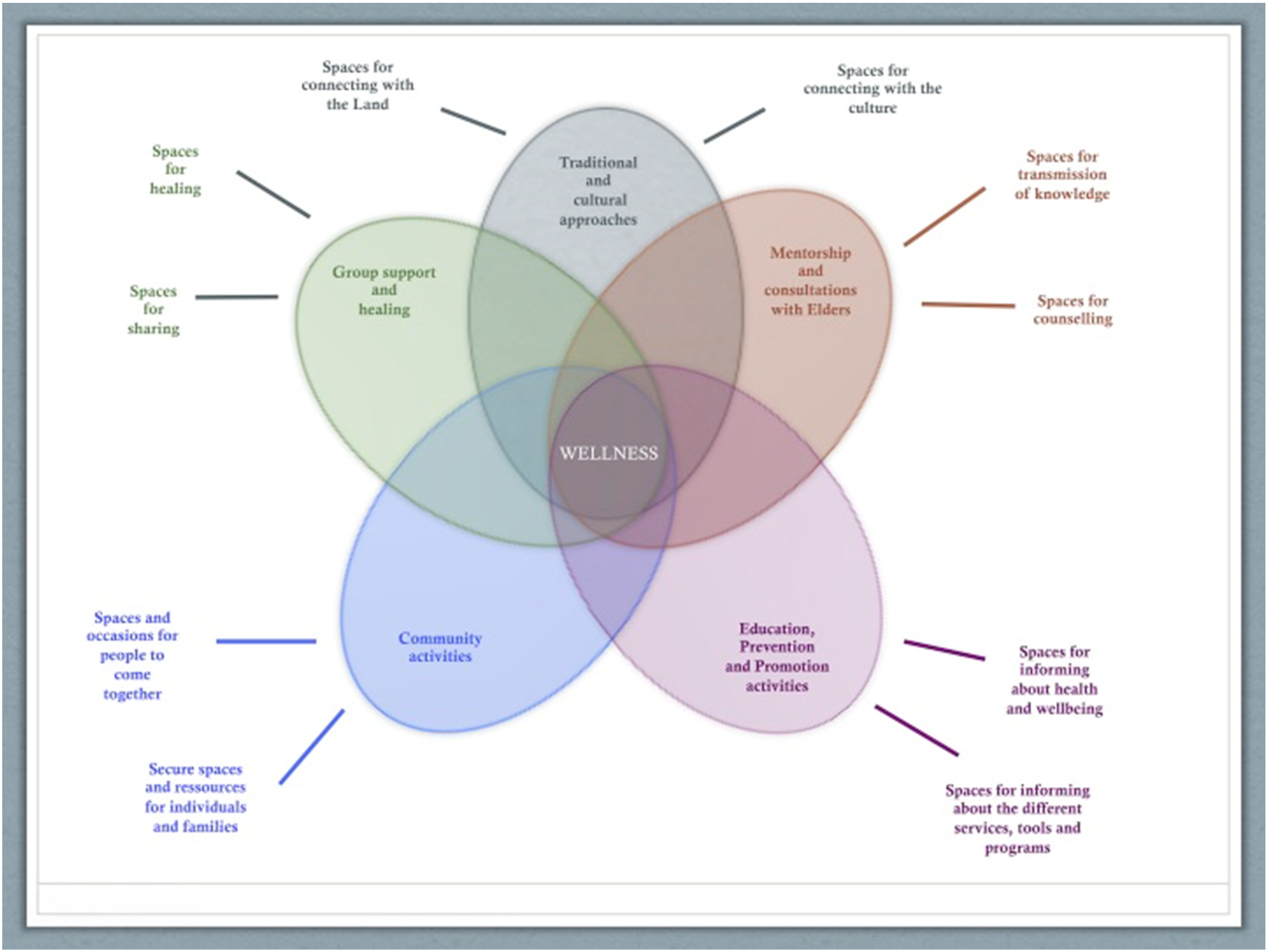
Wellness: The intersection of multiple approaches.
Discussion
The purpose of this study was to explore conceptualizations of wellness and document the approaches that support wellness in Nunavik. From the participants’ description of their practices, we interpreted their understanding of wellness. We then validated it with key stakeholders. According to participants, wellness minimally involves:
A feeling of belonging and connection to the people, the land, and culture; A feeling of having a role, value, and meaning within families and communities; A sense of personal and cultural identity (feeling Inuk); The possibility to receive and transmit knowledge; The ability to support the wellbeing of oneself and others; The ability to think positive and move forward despite challenges and trauma; The ability to express feelings in a healthy way; Self-esteem and confidence in oneself and others; Having strong relationships.
This study was conducted in the specific region of Nunavik. However, there are similarities with conceptualizations of wellness and the various practices as described by Inuit from other regions of the globe including Nunavut, Alaska and Greenland. For example, in Nunavut, studies have described how family and community connections are at the heart of Inuit wellbeing (Healey et al., 2016; Kirmayer et al., 2011; Kral et al., 2011; Kral & Idlout, 2012; Waddell et al., 2017). Moreover, traditional knowledge and its transmission are often described in studies in Arctic health as being elemental to wellbeing (Healey & Meadows, 2008; Kral et al., 2011; Kral & Idlout, 2012; Waddell et al., 2017). The three principles described in this study echo the concepts of Inuit Qaujimajatuqangit (IQ), endorsed by the Nunavut government. Inuit Qaujimajatuqangit (IQ) means “that which Inuit have always known to be true” (Tagalik, 2010). IQ introduces the notion of cultural safety where, by respecting and practicing its principles, one strengthens cultural continuity, stability and wellbeing. From an IQ perspective, personal wellbeing is intrinsically linked with a strong sense of identity and belonging, an understanding of one's roles in relation to the collectivity, and an appreciation of the strengths and skills of each individual. Similar principles were observed by Fletcher et al. (2021) in Nunavik, where concepts such as Saimatsianiq, being at peace with oneself and with others, and Ilitarijaujutsianiq, being recognized for one's strengths and skills, are two conditions for wellbeing.
Furthermore, our study suggests that being on the land facilitates expression, as well as connection, between group members. Prior to colonization, the people of the North held and transmitted customs, traditions and spiritual beliefs based on their environment, and the relationship with the land, allowing them to maintain harmony among all living beings (Napoleon, 1996). Connection to the land and nature continues to be at the heart of Inuit ways of being, doing and knowing (Kawagley, 1996; Kawagley, 1990; Barnhardt & Kawagley, 2005). In this sense, it is not surprising that the participants of our study mentioned that they find it easier to express themselves when they are on the land. Being on the land helps foster the pride of being Inuk.
Regarding the concept of engagement in collectivity, Elders are consistently spoken of as holding key knowledge. This has also been described in past studies conducted in Northern Canada (Dunham, 2008; Kral & Idlout, 2012; Kral et al., 2011; Waddell et al., 2017). According to Kral and Idlout (2012), having positive role models and mentors allows Inuit to see and experience positive ways of being and doing. Re-establishing intergenerational ties is described as an essential component of individual and collective wellbeing. Similarly, a study conducted in Igloolik on youth and resilience shows how intergenerational mentorship improves youth's capacity to cope with the adversities of contemporary life (Kral et al., 2014). Research with Elders in Nunavut, Nunavik and Labrador suggests that youth resilience can be fostered by supporting their sense of self-worth and competence (Korhonen, 2007). Resilience has systemic, collective, or communal dimensions (Kirmayer et al., 2011) and being mentored by Elders would contribute to the resilience and wellbeing of youth. Indeed, this study highlights the importance of future generations in all projects and programs. Children and the next generations are a motivation to work together towards collective wellness. If communities are well, then children are well, and vice versa. This invites all workers to be conscious of the long-term impacts of actions and interventions on youth and their environments. Throughout consultations and discussions with Inuit partners, this was often described as a point of tension between Inuit and non-Inuit workers. Indeed, Inuit felt that non-Inuit workers were not always reflective regarding the larger impacts of their interventions (especially youth protection oriented services) on families, on communities, on culture and on the future of the children they work for. They felt that non-Inuit workers tend to make decisions based on a momentary situation (Sukait Committee & Pitutsimajut, 2020).
Conclusion: Recovering Inuit ways of supporting one another
Colonization brought along systems and institutions that are not built on Inuit values and relationships and, as such, are not necessarily adapted to Inuit worldviews. By imposing non-Inuit rules and ways within households and communities, colonization created a rift between generations and eroded Inuit practices and knowledge of wellbeing (Waddell et al., 2017). Community members throughout Nunavik continue to support their fellow Inuit with individual or collective approaches, however these approaches constantly have to be justified and they are difficult to integrate with the institutionalized system of care. For centuries, people interacted in ways that protected collective harmony. Individuals had important roles and responsibilities to contribute to the group. These roles were respected and valued. With the arrival of colonial institutions and through new policies, roles related to “psychosocial help” were used to speak of individuals who have credentials within these institutions (Tagalik, 2010).
The results of our study are consistent with the principles highlighted by the Qikiqtani Truth Commission (2019) in order to move beyond the colonial policies and practices that have been in place for so long. Participants of this study and the multiple individuals that have been consulted by our immediate partners have shown active involvement in supporting the global wellbeing of their people and offering their knowledge and experience in the adaptation of services offered by both Inuit and non-Inuit. Through our exchanges with participants and partners we understand that, in large part, solutions to the social, family and individual issues can be found in Inuit culture and knowledge, in their way of being together and of taking care of each other. These ways of being and caring are profoundly relational and inscribed within an intergenerational perspective focused towards the future. As Williamson and Vizina (2017, p. 46) say, “the past cannot be divorced from the future”, and the specific expressions of traditional knowledge and cultural practices reaffirm Inuit worldviews and are central to a process of self-determination.
That having been said, there are many barriers to truly being able to practice these ways of healing and being (Fraser et al., 2019). Such barriers include self-doubt that stems from the ongoing exposure to non-Inuit ways that are generally put forward above and beyond Inuit ways. Another barrier is the challenge of finding sustainable funding opportunities without the administrative burden related to funding applications and reporting (Fraser et al., 2019). In their process towards self-determination, we have repeatedly observed how Inuit are asked to explain and justify the actions and interventions they undertake to help youth, families and communities. This is true for funding applications, governmental support and policy changes, and it means telling government agents, directors, and workers what are the Inuit ways.
Finding the right words and justifications in a process of self-determination
Documenting Inuit ways of being, doing and caring for each other within communities is a strange undertaking in the sense that it does not escape a certain form of colonialism, or, at least, of westernization. By this, we mean that the mere process of interviewing, organizing and writing the knowledge is a western way of doing and learning. By doing so, there is a certain “loss in translation”, not only in language but also in the way we organize our thoughts. Through our experience and the stories of partners, we have come to understand that knowledge and practices take place in actions and interactions. They are a natural part of being. Defining these practices and knowledge through language and categories can be difficult. Like other researchers (Kral et al., 2011), we had difficulty finding ways of organizing and describing complex and holistic visions of wellbeing and of human experiences and practices. Categorizing and describing has been described by our partners as a “White” way of doing. While doing this exercise, we consistently reflected on “why” we were doing this work and “for who”. The reality is that even in this process of attempting to decolonize services, we consistently are faced with structures that replicate power dynamics between Inuit and non-Inuit.
Despite its clear imperfections and challenges, this process of documenting and sharing a way of describing Inuit knowledge and practices has been described by our partners as useful in their own work of sharing their knowledge and values. This categorization that has been undertaken and supervised by our Inuit partners is meant to support them in the process of being heard by those that currently have decision-making power regarding funding and policies.
The participants that shared their experiences in this study and the partners that have validated the work highlight the importance of Inuit knowledge and practices being at the core of a process of decolonization. They explain that non-Inuit who come to work within communities must be able to take on support roles, roles as allies where Inuit are guides and directors of these services and programs. As long as non-Indigenous logics are used to evaluate and fund programs, Inuit and other Indigenous peoples will constantly be confronted with colonial barriers to practices and valuing Indigenous forms of knowledge. Thus, we recognize that this paper is an attempt to inform non-Indigenous peoples of Inuit ways and practices in an imperfect way until non-Indigenous peoples come to hear and learn from Inuit through other modes of sharing and learning.
Supplemental Material
sj-docx-1-tps-10.1177_13634615211056830 - Supplemental material for Inuit wellness: A better understanding of the principles that guide actions and an overview of practices
Supplemental material, sj-docx-1-tps-10.1177_13634615211056830 for Inuit wellness: A better understanding of the principles that guide actions and an overview of practices by Marie-Helene Gagnon Dion, Sarah Louise Fraser and Louisa Cookie-Brown in Transcultural Psychiatry
Footnotes
Acknowledgements
We would like to acknowledge the contribution of all participants and collaborators in this process including the Regional Board of Health and Social Services, the Family Houses of Nunavik, the key informants, Jennifer Hunter, Lea Plourde Leveillé and especially late Audrey Fleming, for her time, her care and her vision.
Declaration of Conflicting Interests
The author(s) declared no potential conflicts of interest with respect to the research, authorship, and/or publication of this article.
Funding
The author(s) disclosed receipt of the following financial support for the research, authorship, and/or publication of this article: this work was supported by the Canadian Institutes of Health Research (grant number IAW-151694).

Supplemental material
Supplemental material for this article is available online.
References
Supplementary Material
Please find the following supplemental material available below.
For Open Access articles published under a Creative Commons License, all supplemental material carries the same license as the article it is associated with.
For non-Open Access articles published, all supplemental material carries a non-exclusive license, and permission requests for re-use of supplemental material or any part of supplemental material shall be sent directly to the copyright owner as specified in the copyright notice associated with the article.
