



Abstract
Universities and teacher employment bodies seek new, cost-effective ways for graduating classroom-ready teachers. This study involved 32 final-year preservice teachers in an innovative school–university partnership teacher education programme titled, the School-Community Integrated Learning (SCIL) pathway. Data were collected using a five-part Likert scale survey with extended written responses. Survey results showed that preservice teachers involved in the SCIL pathway learnt more about the teaching profession, which extended their usual university coursework. Furthermore, written responses suggested ways for advancing their understandings to ensure preservice teachers receive a quality school experience towards readiness for teaching.
Keywords
Introduction
Reviews into teaching and teacher education emphasise the importance of ensuring early-career teachers are well supported. Many current reviews (Carter, 2015; Teacher Education Ministerial Advisory Group (TEMAG), 2014) recognise the shortcomings of initial teacher education, as preservice teachers may not have the opportunity to experience a whole school year. Carter encourages schools to be more active with initial teacher education, particularly with ‘carefully crafted school-based learning experiences’ (p. 37). However, universities are challenged constantly to find innovative ways for advancing preservice teacher education, particularly with calls for more practical teaching experiences before they enter the profession (TEMAG, 2014). Despite more time in schools suggested by all key stakeholders, usually no extra funding is provided to cover additional costs. When in the profession, induction and mentoring programmes for beginning teachers appear as important steps in their development; nevertheless, teacher attrition continues, which necessitates new ways of thinking about teacher preparation and induction.
This article presents research about an extended school-based experience designed to support final-year preservice teachers to make the transition into their first year of teaching. Specifically, it investigates the cost-effective ‘School-Community Integrated Learning’ (SCIL) pathway for preparing and inducting final-year preservice teachers into the teaching profession. Findings within this Australian-based study may be applied to other countries involved with initial teacher training. Indeed, the purpose of the research is to determine how an innovative volunteer programme (e.g. SCIL) prepares preservice teachers for the teaching profession.
Literature review
There is ample evidence that beginning teachers are challenged when first entering the profession. Internationally, some challenges that appear consistent over the last three decades include classroom management (e.g. behaviour management and organising resources), planning for teaching and communicating with parents (Aitken & Harford, 2011; Veenman, 1984). In addition, these challenges can be exacerbated in schools located within lower socio-economic areas, where retaining teachers can be more difficult (Castro, Kelly, & Shih, 2010; Ewing, & Langley Smith, 2003; Ingersoll, 2004). Consequently, education departments (e.g. Ingersoll & Strong, 2012; NSW Government Education & Communities, 2012) have adopted induction programmes to assist beginning teachers in their transition to the profession.
Experienced school staff are crucial for educating early-career teachers (preservice teachers and beginning teachers) into the profession, particularly through well-structured induction programmes that cater for individual needs (Stanulis & Floden, 2009). These programmes are intended to build teaching capacity within a profession that contends with multiple demands and emotional issues, necessitating teacher resilience (e.g. Castro et al., 2010; Keogh, Garvis, & Pendergast, 2010). Despite the increase in induction programmes for beginning teachers (e.g. Bartlett & Johnson, 2010), they continue to leave the profession at high financial costs (e.g. Brill & McCartney, 2008). For instance, Darling-Hammond (2010) outlines that in the United States, beginning teacher attrition costs approximately US$2.1 billion per year and it is reasonable to assume that such costs may be proportional elsewhere. Shakrani (2008) breaks down these attrition costs across various American states and highlights induction and mentoring as ways to retain teachers. Yet, costs may also be high when considering induction programmes for beginning teachers. For example, the Top of the Class Report (House of Representatives Standing Committee on Educational and Vocational Training (HRSCEVT), 2007) recommends ‘investing a sum equivalent to 10 per cent of a beginning teacher’s salary towards the cost of a twelve month induction program for that teacher’ (p. xvii).
Some countries are allocating considerable funds for induction and mentoring of beginning teachers. ‘Japan’s program is unique in that it invests over US$12000 per beginning teacher per year for beginning teachers, which equates to approximately US$220 million per year’ (Kearney, 2014, p. 11). Even so, mentoring is considered as ‘a cost-effective method of training and developing staff’ (Hobson, Ashby, Malderez, & Tomlinson, 2009, p. 210). Notwithstanding recognition of embedding well-informed induction programmes, Aitken and Harford (2011) conclude that ‘The real challenge, however, lies in providing the necessary supports and professional development structures and opportunities for all teachers that will enable them to carry out their roles effectively’ (p. 355). Indeed, more cost-effective ways of thinking about inducting early-career teachers into the profession need to be explored, especially the notion of commencing the process earlier.
It is suggested strongly that teacher induction must be formalised with desirable university–school partnerships (Vong & Wong, 2009). Induction and mentoring should be ‘part of a teacher development continuum’ with calls for more research around teacher induction programmes (Wang, Odell, & Schwille, 2008, p. 147). Researching and understanding key issues facing beginning teachers can assist preservice teacher education programmes to advance their coursework towards addressing such issues (Hudson, 2012a). For instance, Wang et al.’s review ‘shows that beginning teachers prefer lesson observation and lesson-based discussion as components of induction’ as they ‘see issues and problems through a classroom-management frame’ (p. 147). Other research (Aitken & Harford, 2011) indicates that early-career teachers need induction programmes that address classroom management issues, assist in facilitating interactions with staff and cater for the varied nature of individual school cultures. In fact, classroom management, incorporating behaviour management, is emphasised constantly as a major concern for early-career teachers (Gavish & Friedman, 2010; Goddard & Goddard, 2006; Hudson, 2012a). It is argued in this article that preservice teacher education programmes can commence the induction process during the final year of university education towards alleviating many of these concerns.
Additionally, there are teacher education reviews that emphasise the need for more concentrated efforts in key curriculum areas such as literacy, numeracy and science. For example, Masters (2009) outlines studies showing that preservice teachers believe ‘they are insufficiently prepared in terms of their knowledge of mathematics’ (p. 62) and argues that ‘beginning teachers should be familiar with, and be beginning to develop, a repertoire of evidence-based teaching strategies (e.g., for the teaching of reading)’ (p. viii). Preservice teacher education must consider the initial preparedness issues that beginning teachers face in these key curriculum areas as they enter the profession. Yet, compounding the issues for induction are reviews that point to problems with preservice teacher education. For instance, one Australian review (HRSCEVT, 2007) highlights that persistent problems in preservice teacher education can be attributed to ‘a fragmented approach’, ‘inadequate funding’ for educational research and teacher education, ‘lack of investment in building the partnerships that would help bridge the gap between theory and practice, particularly for practicum’ and inadequate policies to facilitate a continuation of teacher development from university to the school (p. xxi). Indeed, reviews (e.g. TEMAG, 2014) have articulated the need to have classroom-ready teachers with considerable recommendations to advance initial teacher education.
Keeping in mind beginning teachers’ challenges, constraints in teacher education and review recommendations that target subject specificity, this study aims to investigate a new cost-effective programme for teacher education titled the ‘School-Community Integrated Learning’ (SCIL) pathway as a way to prepare and induct final-year preservice teachers into the teaching profession. The research question was how can an innovative volunteer programme prepare preservice teachers for the teaching profession?
Theoretical and conceptual frameworks for this study
The theoretical and conceptual frameworks have implications for conducting a study. The theoretical framework used in this study involves constructivism where reality and meanings are socially constructed (Vygotsky, 1978). There is an assumption that participants in this study have constructed meaning from their social engagement within the schools and classroom settings. There is a further assumption that multiple realities exist and the participants have their own individual realities about their preparation for teaching. As an interpretive approach, data from participants in this study are ‘elicited and refined hermeneutically, and compared . . . with the aim of generating one or a few constructions on which there is substantial agreement’ (Denzin & Lincoln, 2011, p. 104). The meanings from participants will be elicited through a survey design that draws upon a conceptual framework.
The conceptual framework for this study draws upon the literature and focuses on particular personal–professional skills; an understanding of the system requirements of the particular school and system to which they belong; consolidated teaching practices to support student development; the ability to manage student behaviour; and the skills to reflect and refine practice to ensure teachers’ development and positive student outcomes. The conceptual framework is further illustrated within the following five subheadings.
Personal–professional skill development
As a beginning teacher, both personal and professional skills and understandings are required to transition successfully into the profession. Although often alone in the classroom with students, teaching is a profession that relies on teamwork to ensure a successful education for students. Planning in teaching teams, working with specialist teachers and aides is an essential practice for teaching (Australian Institute for Teaching and School Leadership (AITSL), 2015). For a beginning teacher, the particular collegial relationships essential to teaching may have been short-lived or piecemeal in their teacher preparation programme. Hence, a sustained and supported induction into teaching that assists the development and understanding of collegial relationships can promote beginning teacher development (Hudson, 2012b). The personal–professional role of the teacher can expand beyond the confines of the classroom and school into the broader community.
Understanding the extended role of the teacher can be overwhelming for a beginning teacher who may have completed only 80 days of school experience in a 4-year degree (Hudson, 2012b). Teachers’ understandings of how to develop relationships with parents and carers can assist students’ educational prospects (Pillen, Beijaard, & den Brock, 2013). Confidence, clear communication and enthusiasm for teaching are required if teachers are to be effective. The first few weeks of teaching can be daunting, and demonstrating such attributes may be a challenge (Wong & Wong, 2009). Beginning teachers require the support of an effective mentor teacher who can provide feedback, build confidence for teaching and listen to the concerns and celebrations of their mentee (Kortman & Honaker, 2004).
System requirements
Entering any profession means gaining an understanding of the system requirements. In Australia, upon entering the teaching profession, there are policies that exist at a school, state and federal government level. School-level policies include the aims of the school, whole school planning and behaviour management models, and health and safety policies including creating a safe learning environment (Kearney, 2014). Furthermore, in each schooling system, there are the various roles and duties of staff. As a beginning teacher, an understanding of all the policies and requirements of the teaching profession may be overpowering. As part of the mentoring process, a mentor teacher can select the policies and prioritise them on a need to know basis for the mentee (Hudson, 2012b).
Teaching practices
Understanding the importance of clear, concise communication skills that are age-appropriate and relevant to curriculum is essential for the beginning teacher (Aitken & Harford, 2011). Through clear teacher communication students can effectively be guided as they assimilate information and experience activities that develop deep knowledge of concepts. The use of metalanguage by teachers allows students to understand the usage of such terms extending their comprehension and vocabulary (Geoghegan, O’Neill, & Petersen, 2013). Planning, implementing and assessing quality teaching experiences that promote higher-order thinking can engage and motivate students for learning (Harcombe, 2011).
Teachers need to take the time to acquire the content knowledge required for teaching, and this is particularly the case for beginning teachers who may be delivering content for the very first time. Following the acquisition of content knowledge, the planning of teaching strategies that meet the variety of learners and learning styles in a diverse classroom is essential. Well-planned hands-on learning experiences that challenge student thinking require considerable thought on behalf of the teacher as implications for lesson delivery are realised. Plans for setting up the classroom, monitoring student progress, dealing with educational problems as they arise and gathering evidence through formative and summative assessment are skills required by effective teachers (Aitken & Harford, 2011; Harcombe, 2011; Hattie, 2003).
Student behaviour
Managing student behaviour is an area that is noted to be of concern to beginning teachers (Caldwell & Sutton, 2010). Although, as part of teacher preparation, managing student behaviour is taught within universities, the most effective learning for managing student behaviour occurs in the classroom during practicum (Rudney & Guillaume, 2003). With only two to four classrooms visited during practicum in a 4-year Bachelor of Education course, a beginning teacher has not had the opportunity to experience the vast range of student behaviours that occur in differing school contexts. Many teacher preparation programmes traditionally have university coursework followed by a practicum, which often occurs around the middle of the school year. First-year teachers may not have experienced or have an understanding of how to establish effective classroom management from the beginning of the school year. Creating classroom rules and routines and the development of a positive classroom climate may have been discussed as part of university coursework but not experienced during practicum. Hence, the first time a beginning teacher may initiate strategies to manage student behaviour from the start of the school year may be in their initial year of teaching (Hudson, 2012b; Kiggins, 2007).
Reflection on practice
The importance of teachers reflecting on their own practice to improve teaching and student learning is well documented (Caldwell & Sutton, 2010). Through on-going reflective practice, teachers can grow and develop to improve their pedagogy as well as the engagement of students in the class (Schön, 1987). Preservice teachers are taught about reflective practice and provided with models and strategies in their teacher preparation courses in both university coursework and during practicum. During practicum, it is an opportunity to not only reflect on practice but also share ideas, thoughts and new viewpoints with their mentor teacher. Mentor–mentee conversations should continue during the induction and mentoring processes for continual growth and improvement of teaching after graduation (Hudson, 2012b). Figure 1 outlines the conceptual framework for this study. There is an assumption that each factor is interrelated.

Conceptual framework for the study.
Context
As discussed previously, traditional models of preservice teacher education are noted as university coursework ‘with block practicum placements in schools occurring on either side of [the] university semester’ (Graham & Thornley, 2000, p. 235). In 2009, the SCIL pathway was developed in partnerships with school principals (Hudson & Hudson, 2013). The SCIL pathway was designed for final-year preservice teachers so that they could be placed in schools starting on the student-free days in January (the beginning of the Australian school year) to volunteer 3 days per week until university commenced (end of February). Once university commenced, preservice teachers attended university classes and visited their school 1 day per week, continuing at the school to complete two final-year practicum experiences and a 4-week internship. It was recommended that preservice teachers change the grade level and teacher for the second practicum experience to ensure a variety of classroom experiences were achieved. In brief, preservice teachers who participated in the SCIL pathway had the opportunity to be involved in the school setting continuously throughout the school year. It is important to note that because of work and family commitments, the SCIL pathway was presented as a voluntary option for final-year preservice teachers and not a compulsory part of the BEd primary programme.
After stakeholders’ approval, further discussions were held to ascertain the roles and responsibilities for involvement in the SCIL pathway and how the SCIL preservice teachers may participate in the schools. Funding to pay mentor teachers was available for the two final practicum experiences as these required formal assessments, but no funding was available for the voluntary programme. This was decided upon by teachers who nominated to be part of the programme as paperwork and reports were not required for mentor teachers to complete. Furthermore, mentor teachers could volunteer to have SCIL pathway preservice teachers without pressure from school or university staff. The workloads of the preservice teachers need to be considered because once university commenced they would need to meet the requirements of their coursework. Thus, it was decided the SCIL pathway would be a non-teaching experience with preservice teachers participating in suggested activities outlined to the mentor teachers through university documents. Suggested activities included preservice teacher involvement in setting up the classroom, student assessments, planning and monitoring the implementation of teaching plans and other aspects noted in the conceptual framework (e.g. Figure 1).
The SCIL pathway was viewed as a partnership arrangement between the university and schools. It was therefore essential that those involved had a clear picture of how the preservice teachers, schools and mentor teachers would be supported. Information packages were sent to volunteer mentor teachers and information sessions were held for interested preservice teachers. Preservice teachers were allocated classes and mentor teachers before the conclusion of the Queensland school year, in readiness for the first visits at the beginning of the next school year (late January). The university coordinator stayed in regular contact with the school site coordinators to ensure the preservice teachers were fulfilling their SCIL commitments and attending their allocated schools.
Participant demographics
Preservice teachers from two campuses at one Australian university were involved in this case study. The campuses differed from each other in demographics. One campus was located in a large capital city while the other in a smaller low socio-economic regional community. Hard copy surveys were provided to preservice teachers, which were anonymous and confidential when returned by post or submitted to university office staff (not involved in the project) in sealed envelopes. There were two surveys deleted as incomplete responses. From the 32 final-year preservice teachers completed surveys (14 from the smaller campus), 75 percent were under the age of 22 years and 25 percent were mature-aged students. There were 7 males and 25 females whose teaching classes varied from Preparation (around 5 years of age) to Year 7 (about 12 years old).
Data collection and analysis
This single-case study uses a survey research design with extended written responses for data collection and analysis. There were 32 final-year preservice teachers engaging in the SCIL pathway. Schools and classrooms provided a discernible context for the social interaction between the participants (preservice teachers), teachers and school students. As an interpretive case study, the analytics included participant perceptions of their learning while engaged in the SCIL pathway. These perceptions were gathered through a five-part Likert scale survey and extended response questions, developed from the five aforementioned areas emerging from the literature (Figure 1; also Hudson & Hudson, 2013). Extended response questions included the following: (1) What activities did you undertake during the SCIL pathway programme? (2) What aspects of schooling and teaching were you able to observe or be part of specifically as a result of being in school at the start of an academic year? (3) What were you able to observe or be part of that you have not had an opportunity to do in previous school experiences? (4) What roles/responsibilities did you take on in the classroom? (5) What specific skills do you think you developed or enhanced as a result of this programme?
Ethical approval was attained from the governing university. Descriptive statistics were analysed using SPSS 20. Analysis involved collating agree and strongly agree responses for percentages (%), mean scores (M) and standard deviations (SDs) across each of the survey items under the five aforementioned categories. Extended responses were analysed in relation to the survey results and used to substantiate and/or provide further information around the results, which is indicative of an explanatory design (Denzin & Lincoln, 2011). The survey was completed at the conclusion of their SCIL pathway experience and prior to them commencing their practicum. This allowed for the responses to relate to the SCIL experience only. The first author (S. H.) devised the SCIL programme; thus, to negate the limitations of an evaluative study including a potential conflict of interest, two other researchers were also involved in the data collection and analysis.
Findings and discussion
The results are analysed and discussed within the five categories, namely, personal–professional skill development, system requirements, teaching practices, student behaviour and reflecting on practice.
Personal–professional skill development
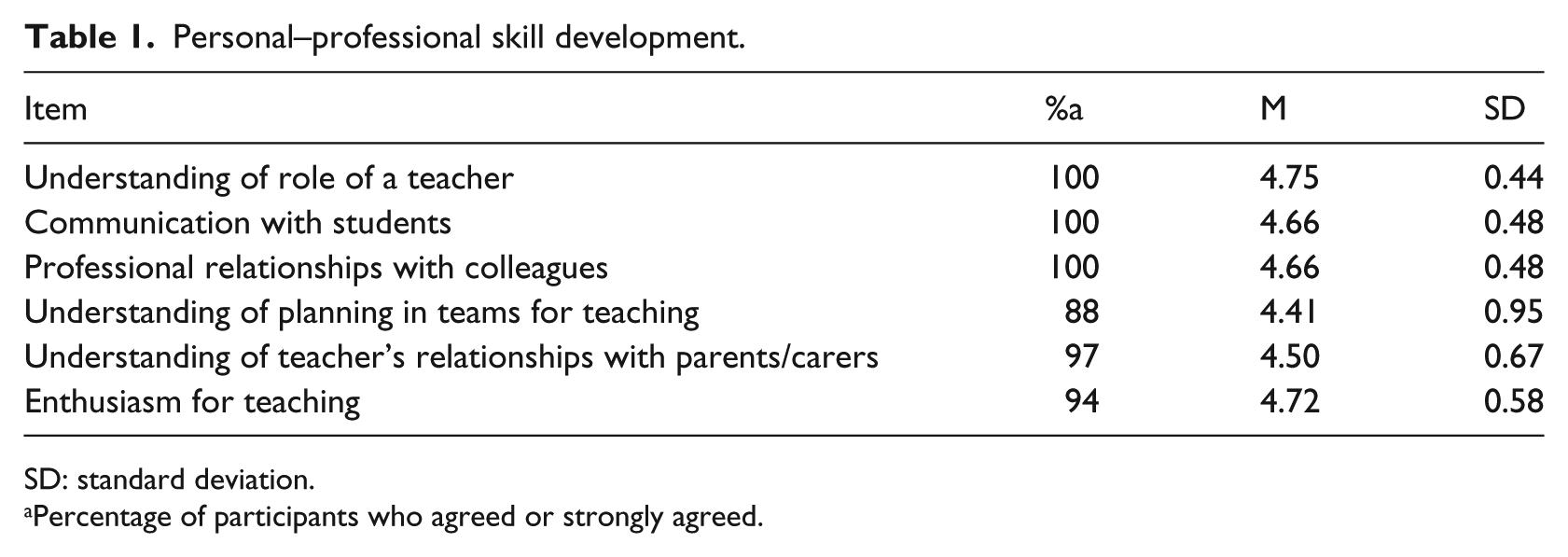
From their SCIL pathway experience, all 32 final-year preservice teachers agreed or strongly agreed they understood the role of the teacher, could communicate with students and had developed professional relationships with their colleagues, and most indicated that they had gained personal–professional skill development (Table 1).
Personal–professional skill development.
SD: standard deviation.
Percentage of participants who agreed or strongly agreed.
It appeared that starting school visits at the beginning of the school year provided these final-year preservice teachers with a more comprehensive understanding of the teacher’s role. The SCIL pathway participants reported they had a range of beneficial experiences beyond usual practicum that helped to develop them personally and professionally. Participating in the student-free day provided a broader understanding of the variety of teaching tasks required as part of the profession and the ways staff work together to create a school community: I saw all the school planning, I also saw how to set up a first day which was great. I got so many ideas. (Preservice teacher (PST) 1) The information I learned from the pupil free days alone was invaluable. It increased my understanding of not only curriculum changes, but how the school community works. (PST31)
SCIL participants noted they were able to visit other classrooms to see the various roles of other teaching staff in the school. Activities such as visiting support classrooms, attending curriculum meetings, participating in inclusive education training, and meeting and speaking with parents all contributed to a broader understanding of the many roles a teacher has in a school community. Connecting with a variety of mentors in various parts of the school supported the preservice teachers to learn how the different parts of the school community work together to support student learning. As suggested by Kortman and Honaker (2004), positive relationships with a range of mentors enable both personal and professional growth for the preservice teacher. For example, in this study, one preservice teacher commented about visiting other areas of the school: Becoming involved in the learning support unit was beneficial as I now have had lots of experience working with students with ASD [Autism Spectrum Disorder] and have observed how different classroom teachers adapt lessons to support students with ASD. It also made me understand the different roles of a teacher in a school. (PST19)
Although the majority of final-year preservice teachers noted they had experiences that included being part of professional development, 13 percent reported they were undecided or disagreed they had developed an understanding of planning in teams for teaching (Table 1). This may have been due to the varying experiences in each school context. Some preservice teachers reported they did not have the same opportunities as others and university organisers needed clearer communication between participants. One preservice teacher (PST12) said, ‘Ensure better communication between the site coordinator, mentor teacher and preservice teacher (PST) on a weekly basis to ensure requirements are being met and better support for the PST’.
University lecturers worked with school partners to establish contexts conducive for the preservice teachers to learn; yet it was also important that there was space for the preservice teachers to be challenged to enable them to develop the initiative and problem-solving skills to work successfully within the profession. Opfer and Pedder (2011) propose that teacher professional learning can occur in multiple ways to achieve similar learning results. While some preservice teachers looked for specific support, the university organisers were also aware of a need to encourage initiative when and where possible.
System requirements
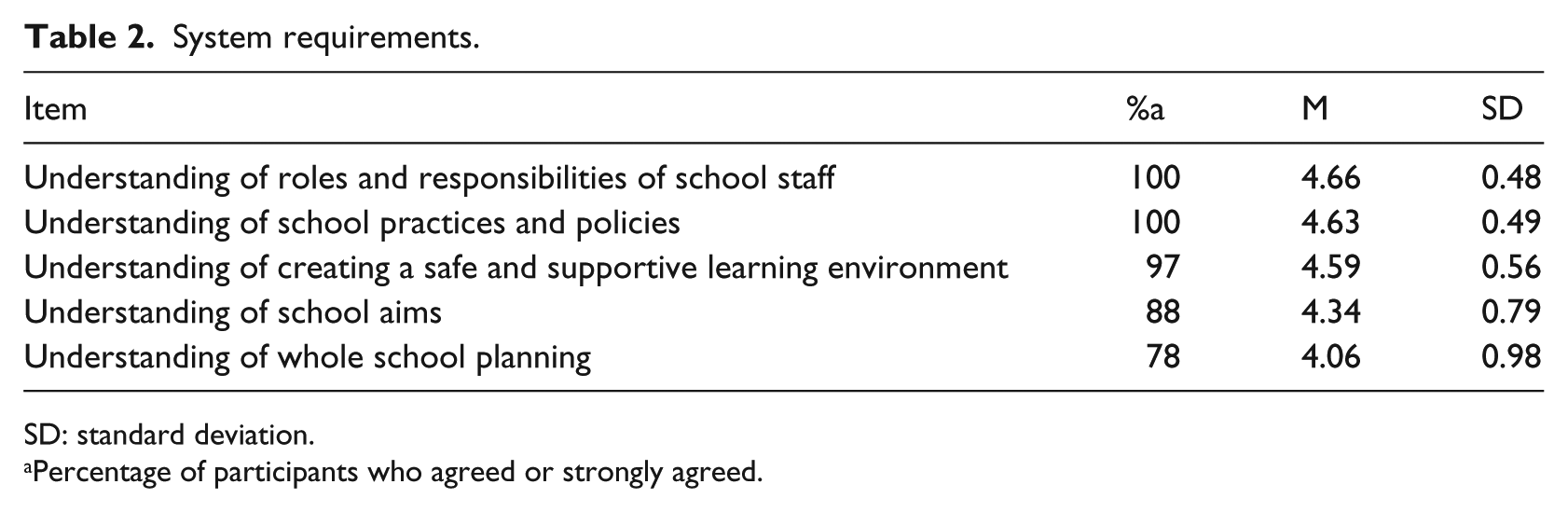
All the participating preservice teachers indicated that the extended time in schools provided by SCIL gave them an understanding of the roles of school staff and the practices and policies within their allocated school. The survey data further indicated that an understanding of creating a safe and supportive learning environment and the school aims was supported by the SCIL experiences (percentage range = 78%–100%; Table 2).
System requirements.
SD: standard deviation.
Percentage of participants who agreed or strongly agreed.
Although many of the preservice teachers noted in the written responses that they were involved in whole school planning, statistical results showed that 22 percent indicated they were undecided or disagreed they developed an understanding of this area. Again, this seemed to be a result of participants’ differing experiences. Similar to practicum, the level of support provided by the mentor can impact the preservice teachers’ learning and experience (Hudson, 2012b). For instance, two preservice teachers commented about the need for willing and capable mentors: ‘I think that teachers selected need to be good mentors for the preservice teachers’ (PST3) and ‘Supervising teachers need to be proactive in explaining how and why they do certain things’ (PST10). Despite the differing experiences provided by some mentors, the majority of the final-year students reported productive experiences, which included opportunities to be a part of whole school planning. Many noted that planning opportunities were a benefit of the SCIL pathway. A typical response was I got to be a part of whole school planning and PD [professional development] sessions prior to school starting. I was involved in preparing the classroom, getting to know the students, running records for each student, PAT-M and PAT-R (Maths & Reading testing), arrangement of classroom activities and lessons and organising team teaching things. This was most beneficial to me. (PST8)
Teaching practices
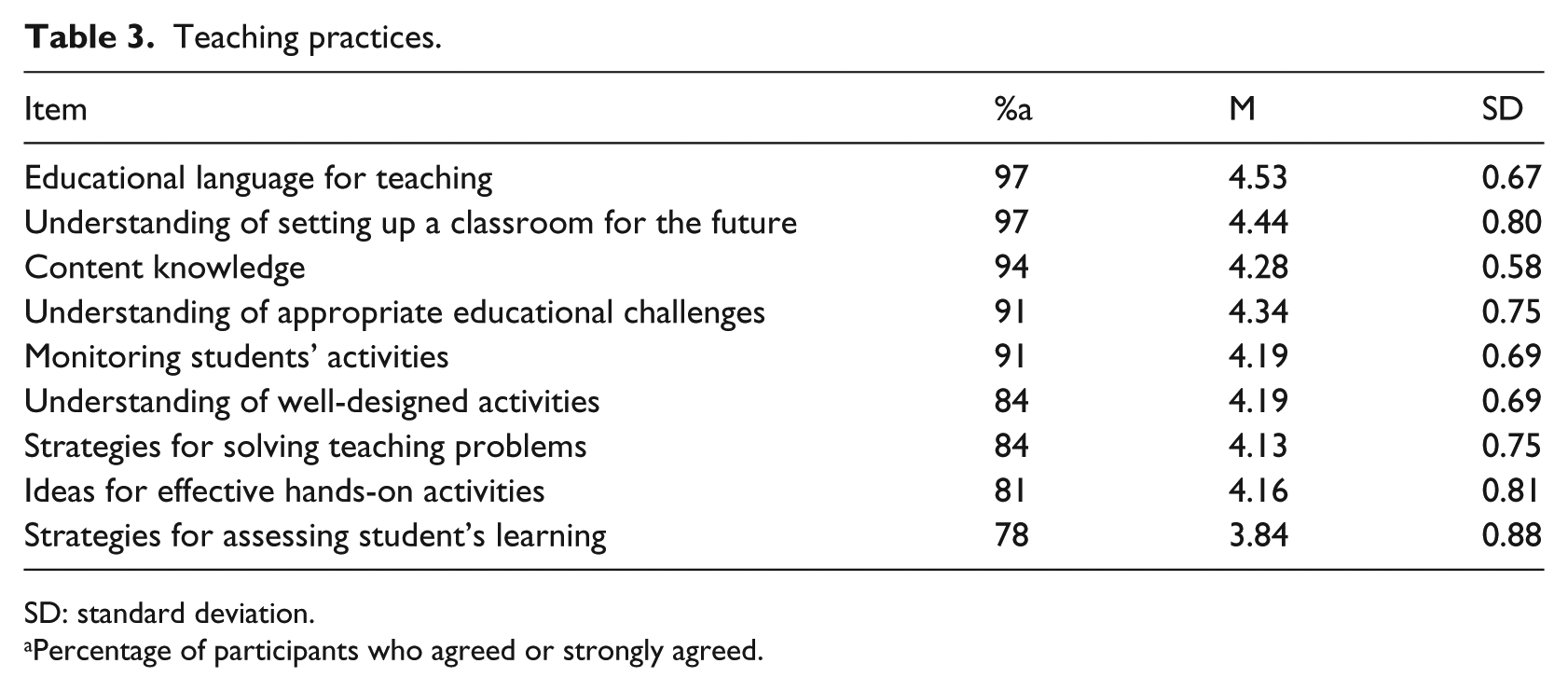
A total of 80 percent or more preservice teachers noted they had developed understandings and skills for teaching in eight of the nine survey items (Table 3).
Teaching practices.
SD: standard deviation.
Percentage of participants who agreed or strongly agreed.
Understanding how to set up the classroom from the beginning of the school year was reported to be of particular benefit to the final years, who suggested they would not have had this knowledge without the SCIL pathway. Knowing how to set up their classrooms included a range of skills that they felt were beneficial, for example, SCIL allowed me to work with small groups, administer numeracy and literacy tests to stream/assess students. I got to experience how to initiate literacy and numeracy rotations from the beginning of the school year which was invaluable. (PST10)
Effective literacy and numeracy teaching is high on the agenda of essential skills and understandings for Australian graduate teachers (see AITSL, 2015). The data suggested the SCIL pathway provided opportunities from the beginning of the school year in literacy and numeracy that may not otherwise be experienced in regular practicum programmes. The opportunity to connect with schools over the full school year provided preservice teachers with a wide range of teaching and assessment strategies for core literacy and numeracy development. The SCIL experience directly responds to Masters’ (2009) advice that teacher education graduates require such preliminary core skills, with the TEMAG (2014) emphasising the need to have work-ready graduates.
The final-year preservice teachers indicated they had developed skills and understandings in most of the nominated teaching practices; however, 22 percent of the participants were undecided or disagreed they had skills and understanding in the strategies for assessing student learning (Table 3). The written response data suggested that many of the preservice teachers had opportunities to observe the following: individual assessment, spelling assessment, planning of unit assessment, mathematics level assessment, aligning assessment, literacy and numeracy assessment and creating a unit assessment. However, not all of the preservice teachers had opportunities to participate in assessment, which may have influenced their responses. Assessing students’ learning is an important teaching practice and is linked closely to the teaching and learning processes. It would be beneficial for volunteer pathways and programmes to consider how opportunities can be targeted so that participants can observe and gain experiences in designing assessment practices and analysing student data.
Student behaviour
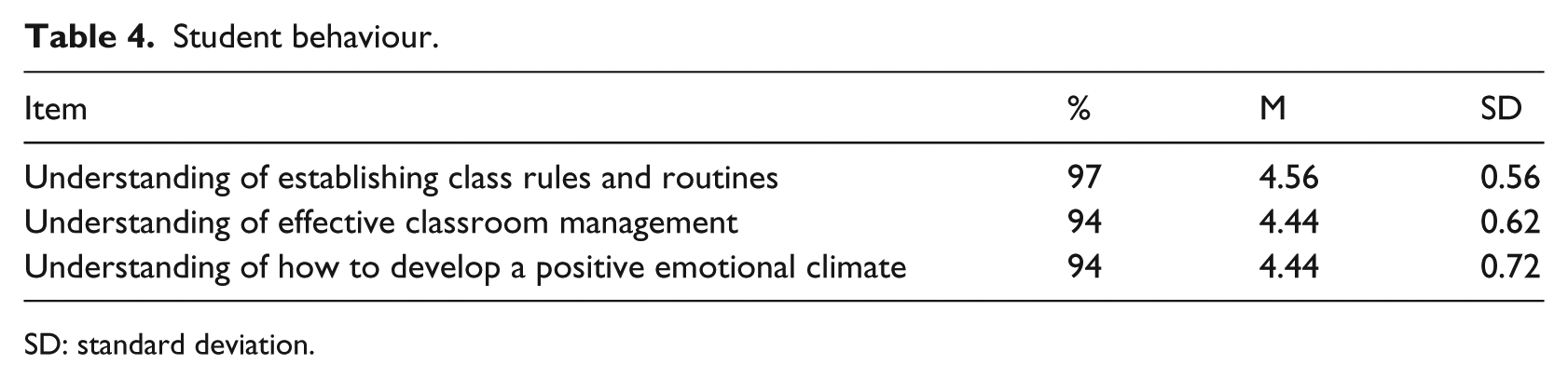
Managing student behaviour is often recorded as an area where preservice teachers and beginning teachers report a lack of confidence for teaching. In all, 94 percent or more of the preservice teachers agreed or strongly agreed they had developed skills and understandings for managing student behaviour (Table 4).
Student behaviour.
SD: standard deviation.
Establishing classroom rules and routines is not often observed by preservice teachers from the beginning of the Australian school year due to the scheduling of practicum in the middle of school terms. The SCIL preservice teachers reported it was beneficial to see the implementation of classroom management and how establishing rules and routines impacted classroom climate and student behaviour, for instance, It was so useful to see how to establish class rules and routines, especially with students who have never been to school before. By strategically planning everything from day one I realised that it can minimise poor student behaviour and create a positive classroom climate. (PST16)
In establishing a positive climate for learning, it is also important to get to know the backgrounds of the students and it may help to meet the parents/carers of the students. Some preservice teachers noted that they met the parents/carers on the first day and this experience impacted their approaches to managing student behaviour. To illustrate, one SCIL preservice teacher noted that The first day – meeting and greeting students and parents/carers helped me to have a better understanding of the students’ backgrounds. I asked the parents questions about their children. Interesting, but this helped me understand the children better and I think I approached behaviour management in a different way. This improved the classroom climate – just knowing the backgrounds of the students. I hadn’t been able to do this before. (PST32)
Most of the preservice teachers’ responses were positive; yet, some suggested a need to observe a whole school approach to behaviour management. Indeed, there were limitations to the preservice teachers’ experiences depending on individual school management, as noted by one final year: I think selection of schools that have a strong whole school management approach would be beneficial. My school seemed to be more individualised and teachers were a tad isolated from management. This didn’t set a good model of how a good school should run. (PST15)
Reflection on practice
Reflecting on practice can help to develop teaching practices (Schön, 1987). On the three items noted on the survey, 90 percent or more of the preservice students claimed they developed their reflective practices as a result of the SCIL pathway (Table 5).
Reflection on practice.

SD: standard deviation.
As part of the SCIL experience, some preservice teachers commented they reflected with their teacher regularly, for example, ‘I got to debrief, share ideas and discuss approaches on a regular basis. It was more relaxed and frequent than just being on prac’ (PST12). However, there were two preservice teachers where a preferred experience of observing a teacher set up a class did not eventuate as the school leaders assigned the preservice teachers to other tasks, for instance, I was quite disappointed that we were denied the opportunity to see a teacher set up and begin the school year. We were separated from the school community to undergo training to implement student testing. Therefore we missed the setting up and introduction stage of a beginning year. I want to add I’m totally supportive of this program. (PST28)
Observing a teacher set up a classroom at the beginning of the year was valued by other preservice teachers; yet despite having opportunities such as undergoing further training, preservice teacher preference was around understanding how to prepare the classroom from the start of the year. Preservice teachers noted that SCIL afforded them the opportunity to reflect with other teachers in the school and speak with school executives. Although these experiences may have been possible during practicum, one preservice teacher commented that she was particularly surprised at the opportunity. Indeed, it seemed beneficial when a whole school approach to mentoring was adopted: ‘I felt part of the school chatting and debriefing with teachers but I was also surprised we had opportunities to discuss teaching matters with the deputy principal’ (PST14).
This study investigated the SCIL pathway and how it may prepare and induct final-year preservice teachers. The majority of preservice teachers claimed they gained skills and understandings for teaching in the five conceptualised categories (Figure 1) as a result of the SCIL pathway. In particular, all of the preservice teachers felt SCIL extended the following: understanding the role of the teacher, communication with students, professional relationships with colleagues, understanding the roles of school staff and understanding school practices and policies. As a limitation to this study, these preservice teachers may have developed skills and understandings while on practicum. Nevertheless, practicum in Australia does not usually commence on the first day of the school year; therefore, understandings around establishing classroom rules and routines along with setting up literacy and mathematics programmes would not normally be part of coursework for preservice teachers. Indeed, there may not be another opportunity to understand how a classroom is established before they enter the profession the following year.
The inconsistency in the experiences of some participants needs to be addressed with better communication of the anticipated activities and outcomes of the SCIL pathway. While it is expected that preservice teachers will have varying experiences as a result of the different ways schools can be organised and run, close partnerships and communication between schools and university staff were essential. Selection of enthusiastic school communities and positive mentor teachers along with the development of clear and open communication appeared essential for SCIL to operate successfully. Further research can include the following: (1) how SCIL pathway activities may contribute to beginning teachers’ understandings of the first year of teaching; (2) recorded observations of preservice teacher activities during the course of a SCIL pathway; (3) triangulating data sources from school staff and preservice teachers and (4) the use of the survey and written response questionnaire in other school–university contexts.
Conclusion
The SCIL pathway was presented as an innovative, cost-effective approach for inducting and preparing final-year preservice teachers. SCIL was organised purposefully to benefit preservice teachers and school communities. The results indicated the SCIL pathway as a move towards enhancing teacher preparation (TEMAG, 2014). In this study, preservice teachers believed this volunteer programme allowed them to observe and participate in school activities from the student-free days at the beginning of the school year and continue this association through all school events over the full year, components of which aim to facilitate classroom-ready teachers. These final-year preservice teachers appeared eager to demonstrate their contributions to the profession. The SCIL pathway simulated an early induction for preservice teachers, particularly as they engaged with school communities and started to understand the complexity of school environments during one school year. The SCIL pathway involved no additional financial costs to universities, although it has meant additional time for the university coordinators to establish and maintain these relationships.
Confronted with the conflicting demands of more practical teaching experiences and budget reductions, the SCIL pathway was presented as a way to prepare preservice teachers for the teaching profession. This study has sought the preservice teachers’ perspectives on the events that supported their professional learning within varying subsystems that influence their work. Being a part of a school community for the entire school year enabled the final-year preservice teachers to further understand the profession. Such an experience responds directly to criticisms of teacher education as disconnected from school experience and addresses agendas that are working towards joint engagement between schools and higher education to improve preservice teacher education. Indeed, SCIL may assist in reducing beginning teachers’ challenges by addressing some constraints in teacher education. The SCIL pathway targets review recommendations around specific subject areas (e.g. literacy and numeracy; Masters, 2009). The SCIL pathway is over and above university coursework and relies on preservice teachers’ voluntary willingness for extended school engagement. As a significant contribution to teacher education, universities and schools can analyse SCIL as an early induction for adoption through their own university–school partnerships.