



Abstract
This article introduces and defines the notion lingua receptiva (LaRa) as a mode of multilingual communication in which interactants employ a language and/or a language variety different from their partner’s and still understand each other without the help of any additional lingua franca. The quintessence of lingua receptiva is discussed in terms of pragmatic, psycholinguistic and language psychology approaches to multilingualism. Moreover, the occurrence of this mode is documented across various language families throughout time and in various discursive intercultures which it creates. Furthermore, three central characteristics are discussed, namely ideological barriers resulting in asymmetry, ‘inference-making’ mechanisms and the function of idiomatic expressions. Finally, lingua receptiva is compared to other multilingual modes, especially with English as lingua franca.
Keywords
1 Defining ‘lingua receptiva’
Receptive multilingualism is a mode of multilingual communication in which interactants employ a language and/or a language variety different from their partner’s and still understand each other without the help of any additional lingua franca. Their mutual understanding is established while both recipients use their ‘passive’ knowledge of the language and/or variety of their interlocutor(s). The field was already established in 1952 when Voegelin and Harris distinguished intelligibility among dialects due to close genetic relationship, and stated that ‘an informant’s comprehension of another dialect could provide an index of dialect distance …’ (Casad, 1974, p. 52). In later studies, this phenomenon has been conceptualized as ‘intelligibility of closely related languages’ (Casad, 1974, 2005; Ethnologue, n.d.; Wolff, 1964), ‘semicommunication’ (Haugen, 1981; Zeevaert, 2007) or ‘intercompréhension’ (Grin, 2008). This mode has also been described as ‘receptive multilingualism’ (Braunmüller, 2007; ten Thije & Zeevaert, 2007).
In contrast to previous approaches, we will elaborate especially on the receptive component, which is crucial in grasping the notions of understanding and misunderstanding. In actual fact, we operationalize these specific receptive mechanisms and, in order to do so, we introduce a new notion, namely lingua receptiva (abbreviated LaRa). By definition, lingua receptiva is the ensemble of those linguistic, mental, interactional as well as intercultural competencies which are creatively activated when interlocutors listen to linguistic actions in their ‘passive’ language or variety. The essential point is that speakers apply additional competencies in order to monitor the way in which hearers activate their ‘passive knowledge’ and thus attempt to control the ongoing process of understanding.
Lingua receptiva has a long-standing tradition not only within multicultural Europe, but throughout the world, yet it has been largely ignored or suppressed as a result of homogenizing language policies of European nation-states in the 19th and 20th centuries. However, lingua receptiva communication continues to occur in various multilingual niches. In this article we will, for the first time, systematically relate processes of understanding and misunderstanding to research on multilingual communication across various language families as well as in different sociocultural settings in Europe and Asia.
First, we define the notions of hearer–speaker dichotomy with respect to LaRa. Next, we summarize the quintessence of lingua receptiva from pragmatic, psycholinguistic and language psychology approaches to multilingualism. Then, we describe the occurrence of this mode across various language families throughout time and the discursive intercultures it creates. Subsequently, we discuss three features that are crucial to unravelling the notion of lingua receptiva: ideological barriers resulting in asymmetry, ‘inference-making’ mechanisms and the function of idiomatic expressions. Finally, we compare lingua receptiva with other multilingual modes, especially with English as lingua franca, and comment on the unique features of LaRa.
2 Hearer’s LaRa – speaker’s LaRa
In LaRa, we distinguish between hearer’s and speaker’s components which themselves follow a distinctive system of competencies. The hearer’s component of LaRa consists of all processes that actualize and intensify the hearer’s competencies. These linguistic means comprise nonverbal signals that steer the speaker’s production, prosodic elements expressing the whole range from agreement to disagreement, formulaic expressions (for example, ‘I don’t understand’, ‘What do you mean?’, ‘What?’), echo questions and other linguistic elements. On the other hand, the speaker’s LaRa lists strategies such as reformulations, repairs (Rehbein, 1984), recapitulations, rephrasings and other types of meta-discourse elements (e.g. Bührig, 1996; Kameyama, 2004). Accommodation processes, in particular, lead to lexical and morphological adaptations towards what speakers imagine hearers would be able to understand better in their recipient language (Braunmüller, 2002). In conclusion, these creative verbal elements within LaRa are often the result of receptive multilingual discourse, which is why their analysis will provide new insights into the emergence of contact varieties (e.g. Matras, 2009; Matras & Bakker, 2003).
All the elements mentioned above occur in communication under normal conditions and can be observed on the surface of communication, both mono- and multi-lingual. What calls for extra attention, however, is the fact that these elements are used to signal and to mediate processes of intercomprehension in lingua receptiva. It is the mental component of such underlying processes of understanding that is not applied as ‘default element’ (Zeevaert, 2004) but rather signals that additional deeper understanding processes are activated in order to anticipate and/or overcome potential non-/misunderstanding. In particular, both speaker and hearer activate the following elements to address various language dimensions:
- additional devices of segmentation and phonological adaptations
- morphological and syntactic meta-knowledge derived from a ‘closely related language’
- syntactic and semantic parsing and re-activation of cognates and other interrelated structures (see section 3)
- illocutionary and pattern knowledge based on overall communicative knowledge (see section 3)
- inference-making processes that draw on constellation-based, contextual, semantic or rather propositional dimensions (see section 6.2).
To summarize, these additional mental and linguistic activities are used on the basis of a ‘passive’ language to enhance processes of reconstructing the speaker’s plan in order to establish a hearer’s plan (e.g. Rehbein, 1977; Rehbein & Kameyama, 2003), as will be explained in the next section. It should be emphasized that inferences can be seen as mental activations in multilingual communication.
3 Understanding/comprehension revisited
The kernel concept of lingua receptiva is the process of understanding across languages and varieties. There are two disciplines which deal with this phenomenon: multilingual communication theory and language psychology and psycholinguistics.
Gumperz and his colleagues focused on understanding and especially misunderstanding in intercultural discourse (e.g. Gumperz, 1982, 1992; Gumperz & Roberts, 1991; Hinnenkamp, 2000). They observed that many misunderstandings can be detected in discourse so, methodologically speaking, they cannot be identified on the morpho-syntactic or lexical level alone (e.g. Allwood & Abelar, 1984; Allwood & Simonot, 1984; Bremer et al., 1996; Roberts, 1996). Despite the fact that this research tradition stems from interactional socio-linguistics and pragmatics, it could be argued that a similar line of argumentation that favours discourse analysis should be applied to lingua receptiva. More recent literature on intercultural discourse focuses on processes of ‘successful’ communication and to what extent linguistic means contribute to intercultural understanding (e.g. Bührig & ten Thije, 2006).
Discourse is the medium in which understanding and misunderstanding emerge. As elaborated in previous studies of Functional Pragmatics, reception of speech actions in discourse can be conceived as stages of understanding. These stages describe the process of ‘percolation’ as executed by the hearer (see, for example, Ehlich & Rehbein, 1986; Kameyama, 2004; Rehbein & Kameyama, 2003; ten Thije, 2003a). These stages have been summarized as follows:
assessment of the constellation (based on preceding discourse knowledge)
formation of the hearer’s expectation
perception of the linguistic elements of utterance, illocutionary and propositional act (in order to be able to proceed to the active hearer’s construction and co-construction of the whole speech action)
formation of the hearer’s plan (reconstruction of action focus, schema formation, plan of received speech action; and further processes)
adoption of the plan (of the received speech action).
The quintessence of the speaker–hearer plan formation lies in the fact that each interactant is a speaker as well as a hearer in the string of discourse. In receptive multilingual discourse, this alternation is bi-directional since the ‘turn-over’, or a production-to-comprehension switch of LaRa, occurs between speaking in one language (the speaker’s role) and understanding in the other (the hearer’s role). An experimental investigation by Rehbein (1987) disclosed how non-understanding in L2 blocks speech production in the same language, whereas understanding in L1 facilitates production in L2. It is obvious that lingua receptiva does not run this ‘blockage’ risk since the speakers produce L1 speech actions. Yet, successful understanding presupposes reaching stage (IV): in other words, all interactants must be able to form a hearer plan in their ‘passive’ language, and adopt it (stage (V)) as a precondition for the follow-up step in discourse.
Beerkens (2010) applied this model in a study on German–Dutch receptive multilingualism. Based on discourse empirical findings, she adapted this model by including the assessment of receptive competencies of both speaker and hearer in stage (I). Consequently, stage (V) was enriched by an additional step, i.e. whether the adopted plan corresponds with respect for the anticipated receptive competencies.
Another application of this model is discussed in Rehbein and Massakowa (forthcoming). In a study on multilingual Turkish–Kazakh discourses of exchange students, they found that some processes of understanding can be blocked at stage (III), whereas others are percolated to the next stages to attain understanding. In this processing, the hearers (re-)activate language typological knowledge as well as knowledge from different discourse and grammatical resources (see section 6). It is not assumed that average speakers are aware of language typology, yet research has shown that psychotypology or ‘perceived language distance’ plays a role in multilingual interaction (de Angelis, 2007; Kellermann, 1977, 1995).
Language psychology and psycholinguistics contribute to the conceptualization of lingua receptiva in a number of ways. An established research tradition has shaped the model of understanding as an active mental process of construction (Bühler, 1934; Carroll & Freedle, 1972; Clark & Haviland, 1977; Freedle, 1977; Hörmann, 1976). Furthermore, the model of speech comprehension and speech perception has been developed (Clark, 1996). Another approach conceptualizes the active linking of sentence structure to discourse structure through the hearer (van Berkum, Zwitserlood, Hagoort, & Brown, 2003). Perception in cross-linguistic settings is considered to be a non-automatic process due to various aspects of parsing that range from phonemes and morphemes to morpho-syntactic and syntactic categories (van Gompel & Pickering, 2007). The latter is crucial since understanding processes can be blocked at an early stage unless respective knowledge is activated in the construction process of the hearer (c.f. Ingram, 2007, p. 345; for an overview, see Pisoni & Remez, 2005). Moreover, the speaker’s perception of the hearer’s response influences the construction process of their utterances (Schober & Brennan, 2003). According to Pickering and Garrod (2004) syntactic structures of comprehension pre-determine syntactic structures of production due to discourse. It would be plausible to assume that this alignment by discourse is also true in situations in which multiple languages are involved as is the case in receptive multilingualism. The turn-over takes place in the comprehension-to-production switch when primed structures, lexical items or morphemes are compared. From this point of view, setting up learners’ grammars from a hearer’s perspective could be promising, as it was done in ‘Rezeptive Grammatik’ for learners of German (Fabricius-Hansen & Heringer, 1988).
In sum, psycholinguistic research demonstrates models of understanding construction that are in line with the speaker/hearer-plan formation as discussed above within the pragmatic approach. To be more precise, both psycholinguistic and pragmatic models encompass the following activities, such as:
- Developing a deep network of expectations of what will be said (by the speaker) based on (common) presuppositions – see stages (I), (II), (III)
- Creating the reception of components of the utterance, the propositional and the illocutionary act by activating knowledge of various linguistic and interactional repertoires – see stage (IV)
- Co-constructing an interpretation of the utterance in its various components of the whole speech action – see stage (V).
Given the two approaches, it should be mentioned that in addition to the processes discussed, a whole range of discursive components comes into play: the speaker’s objectives, the genre of discourse, discourse patterns, turn-taking, formulaic expressions, topic-comment-processing, etc. All these mental, interactional and linguistic dimensions shape the hearer’s actions (Dascal, 2003; Holtgraves, 2007).
4 Communicative constellations of linguae receptivae
Occurrences of linguae receptivae appear to be manifold. Globalization in Europe is historically determined by structural mobility that has led to various potentially multilingual conflict constellations. Therefore, linguae receptivae occur in border regions, in institutional discourse (such as in the workplace, on television, in educational settings, health care discourse, sales talk, meetings, etc.) and in cross-generational communication within and across languages families. These distinct communicative constellations are influenced by ideologies, historical beliefs and attitudes on the one hand and language policies on the other.
There are several constellations which are based on contact-and-conflict situations of multilingual communication. With respect to linguae receptivae, we may refer to the great European language families, such as Romance languages, Germanic languages, Slavic languages, Finno-Ugric languages, Turkic languages, Indo-Iranian and Semitic languages as well as some languages which are in close contact with them (for example, Basque, Albanian). In previous studies, the concept of language family, starting from the Scandinavian and Germanic varieties (Braunmüller, 2002; Haugen, 1962, 1981; Zeevaert, 2004) and Romance languages (Conti & Grin, 2008; Jensen, 1989), has been regarded relevant for the investigation of successful intercompréhension. For instance, it has been claimed that within the family of Romance languages, sufficient comprehension could be established in 30 to 50 hours of explicit language training (Blanche-Benveniste, 2008; Grin, 2008, p. 94; Janin, 2008). Constellation-specific elements that can have both positive and negative effects on intercompréhension are also discussed in Berthele (2007a, 2008). Receptive multilingualism occurring in and mediated by the broadcast media has been researched in the Czech and Slovak context (Kompasová, 1999/2000; Nábělková, 2008; Zeman, 1997, 2008).
Cross-generational multilingual communication includes settings where members of the elder generation converse in a minority/immigrant language with their children who respond in the majority language (Fishman, 1991, 2004; Spolsky, 2004). In Europe, immigrant languages such as Turkish have been affected by language attrition, language loss, contact-induced change and creative languageing (Rehbein, 2001, 2007; Rehbein, Herkenrath, & Karakoç, 2009; Schmidt, Köpke, Keijzer, & Weilemar, 2004; Yağmur, 1997). As an example of a study on cross-generational conversations in Turkish as an immigrant language and German as a majority language, we refer to Herkenrath (this volume) (see also Afshar, 2007 for German–Persian intergenerational LaRa). Moreover, cross-generational constellations can also be observed in Turkish as a majority language and Arabic as the language of understanding in Antioch/Southern Turkey and in multilingual Kurdish–Turkish settings in many regions of Turkey.
Further, Turkish and Azerbaijani interactants exercise receptive multilingualism in border regions (Sağın-Şimşek & König, this volume). Constellations of this type often benefit from a mediator, which activates common knowledge between the languages, just as Latin does for European or Persian does for Middle East constellations in historical contexts. Calvet (1996) and Wurm, Mühlhäusler, & Tryon (1996), in particular, show the worldwide realization of the LaRa potential in various contact constellations. Moreover, several constellations of receptive multilingualism may be linked by ‘chains’ of mutually intelligible varieties which spread across vast linguistic areas (Voegelin and Harris, 1951). As corners of such an ‘intelligibility chain’, Kazakh and Turkish being relatively distant languages are of interest because, contrary to language-typological expectations, receptive multilingualism is still effective (Rehbein & Massakowa, forthcoming).
An overview of the diversity of multilingual constellation demonstrates how receptive multilingualism is practised across language families. For instance, university students from different cantons in multilingual [diglossic] Switzerland converse with their French-speaking fellows in German while listening to them speaking French and vice versa (Serra, 2010; Werlen, 2007). In Finland, in municipalities that have a Swedish-speaking minority, the authorities are required to understand their clients who speak Swedish whereas these clients must follow their interlocutors’ instructions in Finnish (Rontu, 2010). In Estonia, at least in some parts of the country, there seems to develop an Estonian–Russian LaRa, as is often the case in other post-Soviet states (see Verschik, this volume). Multilingual African situations exemplify cross-generational constellations in which typologically distant (both minority and immigrant) languages are spoken within families (Agoya, forthcoming). Finally, Wurm et al. (1996) discuss multiple bi- and tri-lingual intercultural constellations in which bi-directional bilingualism across language families takes place.
In conclusion, it is justified to claim that the old criterion of ‘intelligibility of closely related languages’ (Chaoju & van Heuven, 2009; Gooskens, 2007; Schüppert & Gooskens, this volume) is a too restrictive notion. Moreover, ‘intelligibility’ is not a feature inherent to languages but to multilingual (LaRa-)communication as dynamic process. Consequently, receptive multilingualism also includes all those language constellations in which speakers and hearers communicate by alternately employing different languages as vehicles of speaking and of understanding.
5 Discursive interculture(s) and cultural apparatus
Although LaRa has been largely ignored or suppressed throughout the 20th century due to the language policies mentioned above (Rindler Schjerve, 2007), receptive multilingualism has led and still leads to an intercultural discourse. Koole and ten Thije (1994, 2001) refer to it as discursive interculture(s) where new forms of understanding are construed and misunderstanding, failure, problems and deficit of communication are transcended. ten Thije (2003b) distinguishes seven features for the emergence of discursive interculture(s). These features are summarized as follows: (1) interlocutors have enduring contact within a collective; (2) they have linguistic competencies in various languages; (3) their interaction is determined by superordinate institutional purposes; (4) their interpersonal contact is not unique, but has a repetitive character; (5) achieving institutional purposes depends on the extent to which interlocutors are capable of coping with the multilingual constellation; (6) the choice of language for their contact is not completely fixed by the language policy of the organization and participants have a certain action space to develop new discourse structures; and (7) the communicative setting itself arises from and is related to supranational developments. Based on this list of characteristics, one could estimate which social constellations could be felicitous for LaRa communication. Examples of discursive interculture(s) are cross-border settings (such as Dutch–German, Danish–Swedish) as well as cross-generational LaRa within family discourse (such as Turkish–Kurdish).
Discursive interculture implies interactive construction of a discursive common ground, as well as aspects of the common ground that are already available (Koole & ten Thije, 2001, p. 583). This interactive construction has been conceptualized as the notion of cultural apparatus (Rehbein, 2006). The latter helps interactants routinize action practices, thought structures, pattern knowledge, forms of imagining, social experiences and fixed emotional structures that are collectively changed and communicatively adapted. In terms of LaRa, the cultural apparatus can be applied creatively by the speaker and/or the hearer. The former multilingual Habsburg Empire can serve as an example of these practices since its multilingual layout also demonstrates a long tradition of how receptive multilingual discourses formed specific new forms of understanding among the participants by means of the cultural apparatus’ creativity. All in all, the continuous praxis of LaRa discourses may add up to new stable forms of discursive intercultures as creative outcomes that are ‘both original and of value’ (NACCCE, 1999).
6 Characteristics of lingua receptiva
6.1 Ideological components of asymmetrical understanding
The conditions under which interlocutors are able to use lingua receptiva in an effective way are not at all clear. In this respect, it is interesting that the activation is not symmetrical: as previous studies confirm, speakers of Danish activate knowledge of Swedish easier than their Swedish counterparts activate Danish (Schüppert and Gooskens, this volume). The same holds true for German–Dutch (Beerkens, 2010) and Turkish–Azerbaijani (Sağın-Şimşek & König, this volume) constellations where speakers of one language are more apt to use lingua receptiva based on their language attitudes than those of the other. Thus, although the ‘close relationship’ is respectively identical, the employment of the common linguistic knowledge is far from being the same. Negative attitudes may block comprehension in one direction while the other direction is still active. Ideological reservations against languages and their speakers permanently reinforce or reflect languages’ inequality (Irvine & Gal, 2009).
6.2 Inferences and linguistic repertoires
Lingua receptiva relies heavily on inference making, a mechanism that has not yet been sufficiently explored. Second and foreign language learners are aware that ‘inference making’ is a relevant skill that helps to process text and discourse. Receptive multilingualism is no exception, and inference making is essential to all constellations. It should be emphasized that inferences can be seen as mental activations in multilingual communication. A number of studies report on other aspects of inferencing, such as activation in bilingualism (Grosjean, 2008, 2010), LaRa communication (Rehbein & Massakowa, forthcoming) and the connection between understanding and inferencing in reading texts (Berthele, 2007a, 2007b).
Harvey Sacks’ (1985) chapter on the ‘inference-making machine’ investigates a conversational type-based mechanism which is used by interactants to make inferences from the preceding to the follow-up utterance, and vice versa. Although the data comes from monolingual American-English conversation, such a ‘machine’ which connects seemingly unconnected utterances supposedly also operates in lingua receptiva.
Singer (2007, p. 343) states that ‘virtually every aspect of language comprehension is inferential’. This implies that the process of inference is based on ‘world knowledge’ rather than linguistic knowledge, so that receptive multilingualism can draw on this shared competence without having to make extra efforts for the lack of genetic proximity between languages.
Paradis (1994, 2004) illustrates two types of understanding strategies of bilinguals by means of a schema which is also relevant for lingua receptiva. According to this schema, with one strategy, understanding is achieved at a cognitive level via perception of all formal linguistic components of the utterance (phonological, morphological, syntactic, lexical), which is a non-modular strategy. With the other strategy, the hearer immediately draws inferences separately, module by module, from one linguistic component of the received utterance to the other and thus achieves the cognitive level without having reconstructed every linguistic component in detail but in a modular way (Piccaluga & Harmegnies, 2008, p. 193).
It should be mentioned that the ‘inference-making machine’ comprises not only formal linguistic knowledge, but also common institutional knowledge, discourse-type knowledge, pattern knowledge and, last but not least, linguistic knowledge of a language family type and language contact type in order to construct understanding. As far as societal knowledge is concerned, inference making in lingua receptiva communication can be blocked or modified by the intervention of ethnic or other prejudices (see section 5).
According to Gumperz (1971, 1995), speech communities are based on language repertoires of conventionalized social styles. Misunderstandings arise when interactants, within the same interactive frame, draw, by means of contextualization cues, incompatible inferences from repertoires or interpret them in incompatible ways. Extending Gumperz’s theory, Lüdi states that a broad range of multilingual repertoires is available for the multilingual speaker, contrary to the monolingual speaker (Lüdi, 2006, 2007; Lüdi, & Py, 2009). In receptive multilingualism, the interactants make alternating use of their diverse linguistic repertoires. An advantage of repertoire theory, one could argue, is that the linguistic knowledge of the linguistic varieties multilingual interactants have at their disposal is not absolutely compartmentalized, as many grammatical theories suppose. Instead, these linguistic repertoires are in constant interaction and future research will focus on differences between the hearer’s activation of and the speaker’s access to their respective multilingual repertoires.
6.3 Idiomaticity in multilingual communication
Idiomaticity is particularly crucial in second and foreign language modes of multilingual communication. According to the investigation of Roberts (2005), the English-as-a-foreign-language speaker avoids idiomaticity (formulaic expressions), although, as corpus linguistics shows, this is characteristic of everyday common understanding (Corrigan, Moravcsik, Ouali, & Wheatley, 2009; Sinclair, 1991). In receptive multilingualism, however, it is just the mutual familiarity of common speech formulae which bridges the way between languages and varieties. This is definitely true of Turkish–Azerbaijani communication where the languages, as a result of their close contact for centuries, demonstrate a vast common stock of speech formulae. In fact, this applies to multilingual communication in many linguistic areas, such as the Southern Balkans to Macedonia (Albanian, Macedonian, Balkan and Turkish). In general, multilingual corpora with various LaRa pairs should be made available for research (Rehbein, Herkenrath, & Karakoç, 2007; Schmidt, 2006).
7 Lingua franca, LaRa and other modes of multilingual communication
Having analysed the characteristics of lingua receptiva, we would now like to have a closer look at the constellations where it can be effectively applied. In most constellations, both lingua receptiva and lingua franca (LF) or, rather, linguae francae are available for multilingual communication. In pertinent literature on lingua franca (Alptekin, 2010; House, 2003; Seidlhofer, 2004; Seidlhofer, Breiteneder, & Pitzl, 2006, p. 5), one distinguishes between top-down (fulfilling functions in various professional domains) and bottom-up (used by speakers from all levels of society in practically all walks of life) applications of ELF. In situations of the first type, the use of English underlies native-like norms (ELN: English of a native-like competence). Another typical occurrence of this mode is English in ‘informal settings’ as a vehicle of communication among groups of non-native participants, as a lingua franca in a strict sense (ELF).
It is mostly true that groups as well as individual interactants have the option to choose between English as lingua franca (the global language for international communication) and the regional lingua franca (ReLF). Other languages, such as French, German, Italian, Russian or even Turkish function as ReLF: ‘As regards language of international communication, we are well aware that most people would today opt for English. However, some could well choose French, Spanish, Portuguese, Mandarin or any other language’ (European Commission, 2007, p. 7). Given the broader list of options for multilingual communication, it is crucial to make these modes comparable in a systematic way. The latter can be approached in terms of the different relationships of the languages involved. Consider the following eight modes of multilingual communication (see, for example, House & Rehbein, 2004 for use of this term):
foreign language usage
second language usage
English as lingua franca communication in informal settings
receptive multilingualism (LaRa)
immigrant language talk
code-switching
code-mixing
‘pure’ bilingualism (i.e. from early childhood).
Based on this list, it is possible to make some comparative remarks on lingua receptiva versus other modes and to explain its unique characteristics. We will now consider the comparative dimension using the table below (Table 1).
General overview of modes of multilingual communication (without the help of a third party). ‘ELF’: English as lingua franca; LaRa: lingua receptiva; ‘TL’: target language; ‘L1’: native, first or source language; ‘L2’: second language; ‘… >…’: predominance relation of orientation on interactant (speaker/hearer).
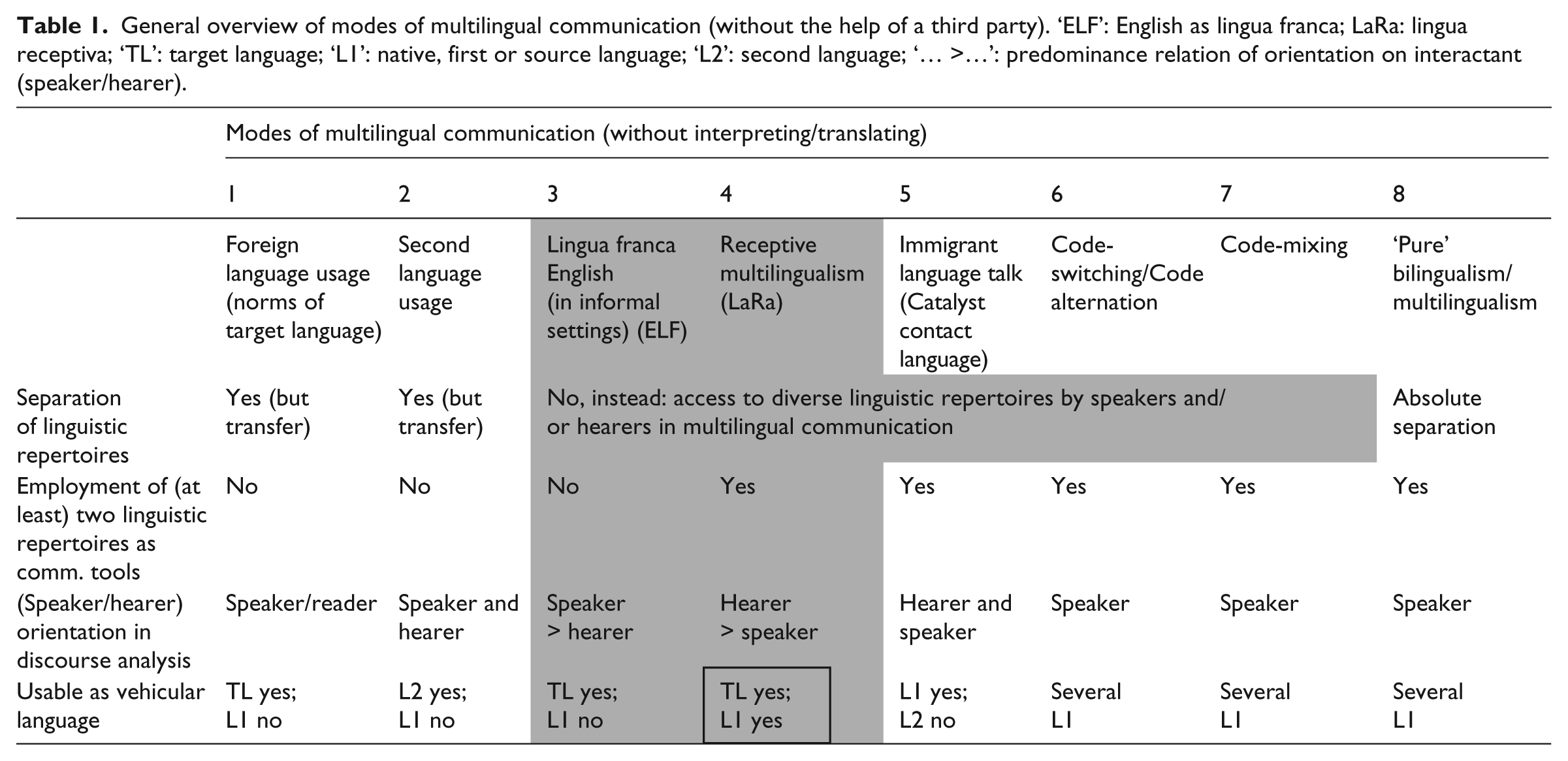
First of all, neither foreign nor second language modes incorporate the multilingual basis of the learners, which presupposes the separation (with potential for transfer) of linguistic repertoires. Lingua franca in informal settings, immigrant languages and code-switching (Backus, 1996) as well as code-mixing (Matras & Bakker, 2003), on the other hand, integrate diverse linguistic repertoires to a certain extent and thus implement the core concept of receptive multilingualism. To put it differently, these modes (3 to 7) do not separate linguistic repertoires, which results in enrichment rather than in a reduction of plurilingual sources.
Considering the multilingual quality within this group, it is clear that lingua franca still employs one linguistic repertoire as communicative tool whereas all the other modes (4 to 7) use at least two at the same time.
Another important dimension of multilingual communication presupposes the involvement of both speaker and hearer in terms of various language uses. Code-switching and code-mixing alike focus on speaker-oriented linguistic activities. In contrast, speaker and hearer are involved in modes of lingua receptiva and immigrant languages, with hearer-dominant focus in the former and both speaker–hearer orientation in the latter. Yet, immigrant talk has a relatively restricted use and cannot be used as a vehicular language which implies that this mode is not widely used as a communicative means for multilingual interaction either by native or non-native speakers (in contrast to ‘pure’ lingua franca where no native languages are involved).
Considering the fact that English is still commonly used as a lingua franca, it is necessary to make an explicit comparison between this mode and lingua receptiva. As has already been mentioned, ELF in some settings relies on the diversity of linguistic repertoires and adheres to one repertoire as communicative tool. In respect to the processes of understanding, ELF and LaRa both incorporate speaker and hearer but differ in preferential succession towards the two: the former presupposes a focus on speaker with the latter focusing on hearer.
Finally, in analysing the potential of both modes for use as vehicular languages, it is claimed that in ELF the target language (global English) exclusively functions as a vehicular language while involved L1s do not. What concerns LaRa, both L1s are indeed the target languages and collaboratively function as vehicular.
Shifting the focus back to application of these modes in respect of multilingual communication, it is evident that LaRa has far-reaching potential for successful understanding in certain constellations.
It should be borne in mind that the suggested mode of communication can be used in combination with other complementary modes. In ELF, one could rely on acquired repertoires which are ‘safe’ from the speaker’s perspective. Yet, in LaRa, the interactants use L1 to verbalize what they would not be able to verbalize in ELF. In actual fact, plurilingual repertoires are activated ‘on the stage’ in the process of adaptation to the other L1 and thus become available for both speaker and hearer. Both modes of multilingual communication proceed without the mediation of a third party, which implies low-cost communication and should thus be subject to further investigation as far as processes of understanding are concerned.
8 Quintessence and potential of lingua receptiva
The quintessence of LaRa integrates psycholinguistic, language psychological, pragmatic as well as socio-linguistic approaches to processes of understanding in multilingual communication. The notion of lingua receptiva encompasses a broader category than previously discussed: semicommunication, intercomprehensibility and intelligibility of closely related languages. LaRa represents an ensemble of multiple competencies that are applied by the interactants both in the speaker and hearer position (production-to-comprehension switch). LaRa draws on the inference-making machine, available plurilingual repertoires and the idiomaticity that exists between the languages involved (both typologically close and genetically unrelated). It has been demonstrated that LaRa is an effective mode in various multilingual constellations and thus has potential for solving communicative problems both by overcoming ideological asymmetries and establishing discursive interculture(s). It also promotes the idea of cultural and linguistic diversity in addressing two languages simultaneously: speakers of community languages (i.e. minority and immigrant languages), for instance, maintain or even revitalize their first language and yet could be integrated into ‘dominant’ society once LaRa becomes an accepted mode of communication. Finally, LaRa has been compared to other multilingual modes and it has been concluded that this mode has far-reaching potential for achieving congruent understanding in various multilingual constellations, applied alone or in combination with other modes.
Footnotes
Acknowledgements
We thank Daria Bahtina and Ivika Rehbein-Ots for making suggestions regarding the English formulations.
Funding
This research received no specific grant from any funding agency in the public, commercial, or not-for-profit sectors.