




Abstract
The nature and extent of the impact of language transfer in majority–minority language contexts have been widely debated in both second- and heritage-language acquisition. This study examines four linguistic areas in three oral narratives collected from Egyptian and Palestinian heritage speakers in the United States (namely, plural and dual morphology, possessive constructions, and restrictive relative clauses), with a special focus on how the second language (English) influences the structure and use of these areas in connected discourse. In addition, the study examines the relationship between second-language transfer and the incompleteness and attrition of heritage Arabic. The findings show that heritage speakers have various gaps in their knowledge of the examined areas, particularly in forms and patterns that diverge from their counterparts in their dominant L2. The results also suggest that transfer effects are restricted to specific forms that are marked (e.g. broken plurals), infrequent (duals), or characterized by processing difficulty (as seems to be the case with the dependencies in the relative clauses). Moreover, transfer effects are intimately related to both the attrition and incomplete acquisition of the speakers’ knowledge of the four areas under study. The implications of the study for heritage language research are discussed.
Introduction
Heritage speakers are bilinguals, typically first- or second-generation immigrants, whose acquisition of the first (heritage) language was interrupted or attrited at some stage of their language development. As a result, they often fail to reach age-appropriate linguistic competence in the L1 in comparison to their monolingual (nonheritage) L1 counterparts. Although many heritage speakers may have systematic exposure to their L1 in the early years of their lives, their L1 abilities often start to decline after they are exposed to a second, typically more dominant language (L2) at or before school age. The relationship between the shift to the L2 and the subsequent loss of different aspects of the L1 may implicate a number of factors, one of which is L2 transfer, that is, the direct effect of the properties of the L2 on the L1. Although L2 transfer has the potential to shape the outcome of heritage-language acquisition (HLA), there is an intense debate about the nature and extent of its impact (Altenberg, 1991; Cook, 2003; Cuza & Frank, 2011; Montrul, 2010; Pavlenko, 2004).
A number of researchers have argued that L2 transfer is a natural consequence of the contact between a dominant language and a minority language. Studies dealing with the L2 effects on HLA have been largely informed by theoretical debates originating in second-language acquisition (SLA) concerning the role of the L1 on the acquisition of the L2. It has been argued that several of the crosslinguistic influences found in heritage languages (HLs; e.g. simplification, avoidance) can be attributed to the effects of the dominant language (L2) just as the dominant language (L1) is responsible for these same processes in the case of SLA (Altenberg, 1991; Jarvis, 2004; Jarvis & Pavlenko, 2008; Montrul, 2008, 2010; Montrul & Ionin, 2010; Pavlenko, 2000, 2004; Pavlenko & Jarvis, 2002). For example, the evidence emerging from a number of studies involving both heritage-language speakers and L2 learners suggests that the dynamics of dominant-language transfer from the L1 to the L2 in the case of SLA are somewhat comparable to those found between the L2 and the L1 in the case of HLA, with the major difference mainly being the direction of the influence (Montrul, 2010; Montrul & Ionin, 2010).
The effects of the L2 on the HL have been approached from three different perspectives. 1 According to one account, L2 influence on the L1 may be considered as a consequence of incomplete acquisition (Montrul, 2008, 2010; Montrul & Ionin, 2010). Bilinguals who fail to acquire the home language completely (i.e. incomplete acquisition) often do not fully master different linguistic aspects of their HL with the same accuracy as do their monolingual peers. This is particularly true when the dominant language spoken by the heritage speakers lacks these aspects. In such a case, it is expected that certain linguistic features will likely transfer from the dominant and more frequently used language to the less dominant, less frequently used one, which is the HL in the present context. Another account suggests that L2 transfer serves as a fill-in task for the lost or attrited linguistic information (e.g. Altenberg, 1991; Altenberg & Vago, 2004; Andersen, 1982; Cuza & Frank, 2011, among many others). As heritage speakers rely more and more on the L2, different elements of the L2 system may replace similar features of the HL and some of them become part of the HL system. A third view indicates that transfer effects are a phenomenon on its own which is not necessarily related to the incomplete acquisition or attrition of the L1 (Pavlenko, 2000, 2004).
Moreover, as several researchers have observed, the L2 transfer effects seem to be selective in the sense that they influence particular linguistic domains, areas, and categories. For example, a number of researchers have argued that the linguistic forms that fall within the domains that have been characterized as part of the narrow syntax (in the Principles and Parameters sense of the term) and the syntax proper are less vulnerable to transfer effects (and to attrition in general) than those involving the syntax interfaces with morphology, discourse, and pragmatics (Montrul, 2010; Sorace, 2004, 2005; Tsimpli & Sorace, 2006) where the vulnerability may have to do with the mapping from syntax proper to other interpretive components such as phonology, morphology, semantics, and pragmatics. A number of studies have shown that areas in such domains as the syntax-semantics component are also susceptible to dominant-language transfer (Cuza & Frank, 2011). These debates have focused on a number of languages, particularly within the Germanic, Romance, and Slavic families, but, as far as we know, research on transfer effects in the context of heritage Arabic has not received significant attention despite the large number of Arabic-speaking immigrants, particularly in Europe and North America.
This article seeks to contribute to our understanding of possible transfer effects in heritage Arabic in particular and on HLs in general within the framework of the discussion about the incomplete acquisition and/or attrition of HLs. The purpose of the study is to provide a descriptive account of transfer effects from English to Arabic in the oral narratives of heritage speakers and to identify some of the ways in which L2 transfer is manifested in two areas of Arabic morphology (plural and dual morphologies) and two areas of Arabic syntax (possessive constructions and restrictive relative clauses). As we discuss later, the four areas selected in this article may display interesting patterns of crosslinguistic influence because they are simultaneously similar to and different from comparable forms in English. We aim to examine how these forms are used in connected discourse, how this use reflects L2 effects, and how L2 transfer bears on the HLs.
The study involves heritage speakers of the Egyptian and Palestinian dialects of Arabic. Speakers of these two dialects are highly represented in the Midwestern university where this study was conducted and among the population of Arab descent in the United States (The Arab American Institute, 2009). 2 Most Arab heritage speakers learn their dialects natively in the home and some may continue to use it with their family members and close social networks even after their exposure to English. Arabic dialects have no official status in the Arab world. Moreover, they do not have a standardized script, which partly explains the relatively small number of publications in colloquial Arabic, except in some literary works. Many heritage speakers are exposed to the standard variety of Arabic at some point in their education or in other contexts (mosque, TV, music, movies, books, etc.). Standard Arabic is the official language and the medium of formal education, formal business transactions and documents, administration, Islamic religious services, arts and culture, and the media (especially documentaries, oral news reports, and printed news or news read from a script). It is not the language typically used in the home, in casual daily interactions, or in spontaneous unscripted speech. Standard Arabic is to some extent uniform across the Arab region, with variations limited to choices of lexical items, expressions, and borrowings (Ibrahim, 1997; Parkinson, 1996).
This linguistic situation has direct impact on heritage speakers of Arabic, who are mostly exposed to their parents’ variety of colloquial Arabic in the home. Since dialectal Arabic is generally neither written nor used in major media channels, heritage speakers have limited access to the variety with which they are familiar and therefore have little chance to practice it outside their homes or immediate community. Moreover, because most community language programs (such as Arabic programs run by mosques or community organizations) focus on Standard Arabic, there is no formal literacy in colloquial Arabic. This is in addition to the fact that their strong command of English places no pressure on them to use their heritage dialects in the public sphere (Shiri, 2010). According to Shiri (2010), the majority of Americans of Arabic descent command English well and use it extensively both inside and outside their homes. One consequence of the general reliance on English is the replacement of the HL, namely, Arabic, with the dominant language, namely, English, in everyday communications and even at home. The current study focuses on the transfer effects of English as they appear in the oral production of heritage speakers of the Palestinian and Egyptian dialects.
Linguistic areas under study
Plural nouns and adjectives
Plural nouns and adjectives are derived in Arabic either concatenatively or nonconcatenatively (McCarthy, 1979). Concatenative derivation involves simple
3
single compositional suffixation strategies of the types shown in (1) and (2) where a plural morpheme is attached to the edge of the stem, usually the singular form: (1) mudarris → mudarrisiin “teachers.m” (2) mudarrisa → mudarrisaat “teachers.f”
In most spoken Arabic dialects, the suffixation of -iin to singular nouns and adjectives derives their sound masculine plurals, whereas attaching the suffix -aat to singular nouns and adjectives produces their sound feminine plurals. For example, in (1), the addition of the suffix -iin to the singular masculine noun mudarris “teacher.m” derives the plural form mudarrisiin “teachers.m,” and the addition of -aat to the singular feminine noun mudarrisa “teacher.f” in (2) yields the plural form mudarrisaat “teachers.f.” The concatenative plural strategy is not different from what one finds in other languages, such as regular English plurals, and involves the simple process of attaching a plural morpheme to a singular base. It is analyzed by ‘a relatively simple discovery procedure’ (McCarthy, 1981, p. 373). This suggests that concatenative plural morphology may pose little difficulty to native and heritage speakers alike, as it requires the productive addition of a suffix to the singular noun.
On the other hand, nonconcatenative derivation involves such processes as reduplication, infixation, morphologically governed ablaut, and suprafixation (McCarthy, 1981, p. 373). The application of these derivational processes to singular Arabic nouns and adjectives generates broken plurals, as illustrated in (3) and (4).
(3) kitaab → kutub “books” (4) maktab → makaatib “offices”
The derivation of Arabic broken plurals requires knowledge of the root, a vocalic melody, a template, and a mapping system that maps the root and the vocalic melody onto the template. This may explain the fact that Arab children learn these forms late in their language development (Omar, 2007; Ravid & Farah, 1999).
If their use of plural nouns is influenced by their L2, heritage speakers are expected to differ from monolingual Arabic learners with respect to broken plurals. While L1 learners aged over 5 tend to replace one broken plural template for another (Omar, 2007), heritage speakers who are influenced by English, which displays mostly regular pluralization techniques, are expected to overextend the regular plural morpheme(s) to broken plurals.
Dual nouns
In addition to the categories of singular and plural, some spoken Arabic varieties, including the Egyptian and Palestinian dialects, have the dual category, which refers to two people, things, places, and so on (besides the dual that is found in most dialects to refer to body parts and time). In most Arabic dialects, the dual is formed simply by the affixation of -ein to the singular noun, as in (5): (5) Saff → Saff-ein “two classes”
Although the formation of dual seems to be simple in both Egyptian and Palestinian Arabic, heritage speakers may have difficulty using dual forms because English does not mark the dual morphologically but periphrastically through a “modifier + noun” structure, as in (6).
(6) Saff → tnein Saff/Sfuuf “two class/classes”
If transfer is at play in the use of dual nouns, we would expect heritage Arabic speakers to form the dual by using English combinations (e.g. two + plural noun) instead of forming it by the standard suffixation process used in Arabic.
Construct state versus analytic genitive
The construct state is a noun + noun phrase (N + NP) sequence known in Arabic as iDaafa.
4
The first noun in this sequence is the construct head (muDaaf), which typically does not carry any (in)definiteness overtly (Benmamoun, 2003). The second NP, often called the genitive noun (muDaaf ?ilay-hi), typically carries the (in)definiteness feature of the whole construct phrase (Benmamoun, 2003). Thus, the (in)definiteness of the whole construct phrase is determined by the genitive noun, as can be seen in the difference between (7) and (8) below: (7) daftar l-walad notebook the boy “the boy’s notebook” (8) daftar walad notebook boy “a boy’s notebook”
In example (7), the construct phrase is definite because the genitive noun l-walad “the boy” is made definite by the addition of the definite article l- “the.” In (8), however, the phrase is indefinite simply because walad “boy” is indefinite.
Since the construct state is analyzed as a single constituent, adjectives modifying either the construct head or the genitive noun must follow both, as in (9) and (10): (9) beit l-bint l-kbiir house.m the-girl the-big.m “The girl’s big house” (PA) (10) beit l-bint l-kbiiri house.m the-girl the-big.f “The house of the big girl” (PA)
The adjective l-kbiir “the big” modifies the construct head beit “house” in (9), whereas l-kbiiri describes the genitive noun l-bint “the girl” in (10). In both examples, however, the position of the adjective remains invariably at the end of the construct phrase. The construct state expresses different genitive and partitive relationships, including, among other things, possession, part–whole relationships, quantity, and comparison (Brustad, 2000; Holes, 2004).
Similar to the construct state, the analytic genitive construction also expresses a wide range of possessive relationships. However, the analytic genitive utilizes a genitive particle to express these relationships. The genitive particle intervenes between the two elements of the analytic genitive. Egyptian Arabic uses the possessive particles bitaaʕ and bitaaʕit depending on whether the genitive head is masculine or feminine, respectively, whereas Palestinian Arabic uses tabaʕ or taaʕ irrespective of the gender of the construct head (Brustad, 2000; Mohammad, 1999). Example (11a and b) illustrates the use of the possessive particle in the analytic genitive form: (11) a. l-maktab bitaaʕ l-muhandes b. l- maktab tabaʕ/ taaʕ l-muhandes the-office belonging to the-engineer “The engineer’s office”
A number of studies have shown that the analytic genitive is favored over the construct state in certain structures, including those containing foreign or borrowed words, duals, multiple nouns, and modifying adjectives (Brustad, 2000; El-Tonsi, 1982).
If we analyze the construct state and the analytic genitive forms taking into account the issue of language transfer, we would expect that the former would be more difficult for heritage speakers than the latter simply because English has no forms identical to the construct state in terms of agreement and word order. On the other hand, the “NP of NP” constituent in English is in different ways similar to the analytic genitive.
Restrictive relative clauses
Restrictive relative clauses in Arabic can be definite or indefinite depending on whether the relativized determiner phrase (DP) is definite or indefinite (Aoun, Benmamoun, & Choueiri, 2010). Definite relative clauses are typically introduced by the relative complementizer lli “that/which/who” (or l- in Palestinian Arabic) (Cowell, 2005; Mitchell, 1978). On the other hand, indefinite relative clauses may not occur with a complementizer (Aoun et al., 2010). Sentences (12) and (13) provide illustrations of these two types of relative clauses: (12) saafer maʕ š-šab lli bjištiʁil bi-l-maktabi. Traveled.3s.m with the-young man who works in-the-library “He traveled with the young man who works in the library” (13) saafer maʕ šab bjištiʁil bi-l-maktabi. Traveled.3s.m with young man works in-the-library “He traveled with a young man who works in the library”
The complementizer lli is present in (12) because it follows the definite noun š-šab “the young man,” whereas it is absent in (13) because the relativized lexical head šab “a young man” is indefinite.
Restrictive relative clauses in Arabic varieties also vary depending on whether the object or the subject is relativized. One significant difference between object relative clauses and subject relative clauses is that the former requires the resumptive strategy, that is, the presence of a clitic pronoun that is coindexed with the relativized lexical head, whereas only the gap strategy is permitted in the latter (Aoun et al., 2010). The difference between subject- and object relative clauses can be illustrated by comparing sentences (10) and (11) above with examples (14) and (15): (14) ʔakalt t-təffaaħa lli laʔeit-ha bi-t-tallaaži ate.1s the-apple that find.1s-it in the refrigerator. “I ate the apple that I found in the refrigerator” (PHS) (15) ʔakalt təffaaħa laʔeit-ha bi-t-tallaaži ate.1s apple found.1s-it in-the-refrigerator. “I ate an apple I found in the refrigerator” (PHS)
In both (14) and (15), the resumptive pronoun -ha is used to mark the site of the relativized lexical head in the relative clause. The resumptive strategy is used in both Palestinian and Egyptian dialects in nonsubject positions (Aoun et al., 2010; Mitchell, 1978; Mohammad, 1999). In both dialects, the resumptive pronoun agrees with its antecedent in gender and number.
Restrictive relative clauses in both dialects differ from their counterparts in English in a number of respects. First, whereas in Arabic, a relative complementizer can only appear after a definite DP, this restriction is not present in English. Moreover, while object relativization in English allows for the dropping of the relative complementizer, object relativization in some Arabic dialects requires the use of a resumptive pronoun in the position of the antecedent (Aoun et al., 2010; Hamdallah & Tushyeh, 1998). Although other differences exist between English and Arabic dialects with respect to relatives (see Hamdallah & Tushyeh, 1998), we limit our focus in this article on the complementizer and the resumptive strategy. It is expected that these differences between English and Arabic with respect to the deployment of the relative complementizer and resumptive pronouns would trigger transfer effects from English to Arabic in the narratives of heritage speakers.
L2 transfer effects are more likely to emerge in these four areas because they are simultaneously similar to and different from comparable forms in English. For example, the dual is marked by a distinctive morpheme in Arabic, whereas in English, it is marked by a plural morpheme or by a “modifier + noun” strategy (e.g. “two actors”). The use of the latter strategy by heritage speakers may underscore the influence from English. Likewise, restrictive relative clauses in Arabic and English are structurally similar with relativized noun fronted to the left edge of the sentence and followed by the relative clause. However, while object restrictive clauses in Egyptian and Palestinian Arabic require the resumptive pronoun strategy to index the site of the relativized noun, English clauses do not. A consistent omission of the resumptive pronoun in heritage Arabic restrictive clauses may signal transfer effects from English wherein this strategy is not as prevalent. The same applies to Arabic plurals and the possessive constructions, which differ from and simultaneously converge with corresponding forms in English.
Language transfer studies
The study of language transfer has been motivated by SLA research, which by definition deals with the acquisition of language by learners who already know another language or have been/are being exposed to another one. The debate about the relationship between the L1 and the L2 has fruitfully benefited from the developments in research on language acquisition and theoretical linguistics (Gass & Selinker, 2008; Lardiere, 2007; Odlin, 1989; Schwartz & Sprouse, 1996; Unsworth, 2006; White, 2003). Since the late 1970s, there has been a tendency to view the role of transfer as dependent on contexts and linguistic features (Gass & Selinker, 2008; Odlin, 1989). In other words, L1 effects are neither always at play nor always absent; they appear selectively in different contexts and implicate different linguistic features. Therefore, it became important to investigate when, how, and why L2 learners incorporate features from their L1 into their L2.
The relationship between L1 and L2 in the context of SLA, which is shaped by a dominant minority language situation, has recently been extended to HLA where a similar relationship has been observed between the heritage minority language and the dominant majority language. The similarities between L2 and HL in terms of transfer effects from the dominant language have been empirically uncovered in recent research on HL (Montrul, 2008, 2010; Montrul, Foote, & Perpiñán, 2008). For example, in a study involving L2 learners and Spanish heritage speakers, Montrul (2010) discovered that, unlike the native controls, both L2 learners and heritage speakers show similar effects of transfer from English in the areas of Spanish clitic left dislocations and differential object marking. Thus, they were less accurate than the native controls in recognizing (un)acceptable sentences involving dislocations and differential object marking—both structures are unavailable in English.
According to Seliger (1996), language transfer from L2 to L1 occurs alongside language attrition, both of which are marked by the functional dominance of the L2 in terms of use by bilinguals. The linguistic trajectory of heritage speakers, which typically involves stable exposure to the HL in early childhood, decline in use at or before school age (possibly due to limitations in input and interaction), and eventually, extensive reliance on the L2 in everyday communications suggests that L2 becomes the dominant language for many heritage speakers. The link between L2 dominance and language attrition has been widely documented in HLA, especially in the areas of morphology, lexicon, and syntax interfaces with morphology, discourse, and pragmatics (e.g. Anderson, 1999, 2001; Albirini, Benmamoun, & Saadah, 2011; Au, Knightly, Jun, & Oh, 2002; Bolonyai, 2007; Fenyvesi, 2000; Montrul, 2011; Montrul et al., 2008; Montrul & Potowski, 2007; Polinsky, 2005, 2008, 2011; Silva-Corvalán, 2003). This also suggests that the influence of the dominant language becomes progressively more visible with age, especially in light of diminishing input/use and more extensive reliance on the dominant language (Domínguez, 2009; Montrul, 2008; Pavlenko & Jarvis, 2002).
The effects of transfer may take different forms, including simplification and overregularization (Albirini et al., 2011; Altenberg, 1991; Cornips & Hulk, 2006; Klee, 1996; Montrul, 2004, 2010; Montrul et al., 2008; Polinsky, 1997), borrowing (Altenberg, 1991; Pavlenko, 2000; Pavlenko & Jarvis, 2002), avoidance (Albirini et al., 2011; Pavlenko, 2004; Rothman, 2007), omission (Moag, 1995; Montrul & Bowles, 2009; Polinsky, 2008; Song, O’Grady, Cho, & Lee, 1997), restructuring (Pavlenko, 2000, 2004; Schmid, 2002; Seliger & Vago, 1991), convergence (Pavlenko, 2000, 2004), and misinterpretation (Montrul & Ionin, 2010). For example, Cornips and Hulk (2006) report that heritage speakers overgeneralize the unspecified, default value of nonneuter for the Dutch definite determiner, which is acquired early by monolingual children. Albirini et al. (2011) found that Egyptian heritage speakers avoid using the subject–verb–object (SVO) word order even in contexts where verb–subject–object (VSO) is preferred, possibly because the latter form does not exist in English and/or is syntactically more complex. Rothman (2007) observed that the Brazilian heritage speakers of Portuguese lack the target knowledge of the distribution of inflected versus noninflected infinitives that the native speakers have acquired. He attributes this inaccuracy to the interference of English, the dominant language, which has no inflected infinitives. Polinsky (2007, 2008) reported that heritage speakers tend to omit four of the six case markings used by native Russian speakers, thus restricting case-marking use to the nominative and accusative cases.
Turning to Arabic as a HL, El Aissati (1997) examined the knowledge that Moroccans living in the Netherlands possess of different linguistic areas. One of these areas is plural formation. The participants were provided with a list of singular nouns and were asked to give their plural forms. The results indicate that, unlike Moroccan monolinguals, the heritage participants use the suffixation strategy for regular and irregular plurals. Bos (1997) tested Moroccan heritage children’s comprehension of complex clauses involving three agents (e.g. “The lion which the monkey kisses is hitting the bear”). The findings indicate that the heritage speakers were less accurate than their monolingual peers in terms of VSO sentences but not SVO sentences. Moreover, they performed best on sentences where the head noun is the subject of the main clause and the relative clause, whereas their monolingual counterparts performed best on sentences in which the main noun is the object of the main clause and the subject of the relative clause. Using an oral narrative procedure, Boumans (2006) compared Moroccan immigrants and monolinguals in terms of the use of the synthetic and analytic constructions of expressing possession. He found that the immigrant speakers showed a notable preference for the analytic construction compared to those residing in Morocco. As Boumans suggests, all of these trends in the Moroccan heritage Arabic may be attributed to the influence of Dutch as the dominant language.
In the present study, we focus on an underresearched heritage population, namely, the heritage speakers of the Egyptian and Palestinian dialects of Arabic, using naturalistic data collected from three experimentally elicited oral narratives. The purpose of this study is to investigate (a) the general features of the heritage speakers’ knowledge of plural and dual morphologies, possessive constructions, and restrictive relative clauses and (b) the effect of language transfer on their knowledge of these areas. In addition, we examine the theoretical basis of this type of transfer and its relationship to the incomplete acquisition and attrition of heritage Arabic and HLs in general.
The study
Participants
Forty heritage and native speakers of Arabic participated in this study. Twenty of the participants were heritage speakers of Egyptian and Palestinian Arabic, 10 from each group. Seven of the Palestinian heritage speakers were born in the United States, and the other three were born overseas but moved to the United States at the ages of 3, 6, and 7. On the other hand, nine of the Egyptian heritage speakers were born in the United States, and the 10th subject moved to the United States in the same year she was born. The Palestinian heritage group consisted of four males and six females, compared to six males and four females in the Egyptian heritage group. The participants in the two groups were undergraduate college students at the time of the experiment, ranging in age from 19 to 23 (average age = 20;6). According to self-report, all of the Palestinian heritage speakers still speak Arabic at home, whereas only eight of the Egyptian heritage speakers still speak Arabic at home.
Twenty native speakers formed the comparison groups, 10 from each variety. All of the 20 native speakers came to the United States as adults and after having completed high school in an Arab country. Arabic was the language of instruction in these schools. The Palestinian control group consisted of six males and four females, ranging in age between 24 and 42 (average age = 28;2). The Egyptian control group contained four males and six females with an age range between 23 and 34 (average age = 29).
Tasks
The study focused on naturalistic data that may allow us to examine language transfer both quantitatively and qualitatively. To attain this goal, we asked participants to complete three elicited oral production tasks. The first task involved an oral description of a series of 16 pictures, detailing the story of a boy, his dog, and his lost pet frog (Mayer, 1969). This story has been widely used in a number of studies of child learners (Berman & Slobin, 1994) and heritage speakers (Polinsky, 2008) for crosslinguistic comparison. The speakers had to describe the events of the story as displayed in the pictures until they reached the end, where the boy finds his lost frog.
The second task involved an elicited narrative of Aladdin’s story. Since all of the subjects were familiar with this story, they were asked to narrate the story from memory and in as much detail as possible. For the third task, the subjects were asked to speak about themselves and their family in an open-ended format. The subjects were given 30 min to complete the three tasks. However, most of the subjects finished the tasks before the 10-min time allotted for each. Each subject was tested individually in a quiet room, and their narratives were audio recorded with a digital recorder. Prior to completing the tasks, the subjects had to complete a questionnaire about their language use and background.
The participants completed the three tasks and the questionnaire in a single session, following this order: frog story, Aladdin’s story, and self-and-family narratives. Although the subjects were instructed to use their dialects in completing the tasks, no specific instructions were given to them with regard to avoiding the use of English or Standard Arabic. We thought that this flexibility was necessary to ensure that the participants complete the tasks (i.e. their resort to English or Standard Arabic becomes a survival strategy). At the same time, this technique allowed us to examine the extent of their reliance on English and Standard Arabic to complete the tasks, some of the gaps in their proficiency in their respective dialects, and the appropriateness of their double-coded utterances.
Data analysis and results
Each of the recorded narratives was transcribed verbatim on paper and then typed as a separate Word document. Before we started coding the data, we made sure that the grammatical features of interest in this study were well represented in the data. Once these features were identified, we counted the tokens and types of these features in obligatory contexts, that is, contexts in which a particular form is required for the sentence to be grammatically and/or pragmatically acceptable. Each token was assigned “1” point when used correctly in context and “0” when used incorrectly. In addition to counting the correct and incorrect instances, we also coded and then analyzed the patterns of errors across token and types.
A summary of the data obtained from the three narratives appears in Table 1. Following Polinsky (2008), we counted the number of words per minute as an overall indicator of the fluency of the speakers in each of the four groups. As the table shows, the speakers in the two control groups were more fluent than their heritage counterparts. Thus, the average word production time per minute was about 87 for the Egyptian control group, compared to 43 for the Egyptian heritage speakers. Likewise, the Palestinian native speakers were able to produce about 97 words per minute, compared to the 77 by the Palestinian heritage speakers.
Summary of the narrative data.

The notable difference in the rate of word production between the controls and the heritage speakers may be an indicator of their unequal Arabic fluency and proficiency. Moreover, the overall level of proficiency for the Palestinian heritage group seems to be higher than that of the Egyptian heritage group, which is apparent in their superior fluency (Table 1) as well as their better mastery of most of the forms under study (see below). 5 The following sections will focus on four linguistic forms that may display transfer effects in the language knowledge of these speakers, namely, plural and dual morphology, possessive constructions, and restrictive relative clauses. We will quantify the patterns of use for each of these features and also address some of their main characteristics, as they appear in the narratives.
Plural formation
Arabic plural morphology employs a simple suffixation system to derive sound plurals and a complex system of roots and patterns for deriving broken plurals. Table 2 summarizes the distribution of sound (regular) plural forms versus broken (irregular) plurals in the narratives of heritage speakers:
Distribution of correct and incorrect plural forms in the narratives.
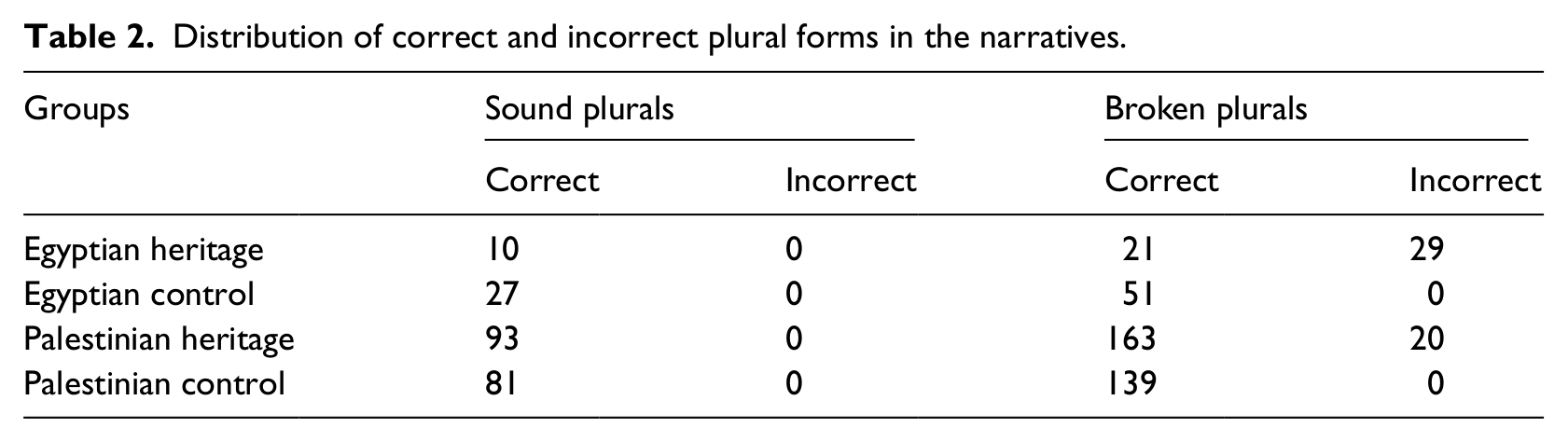
As Table 2 shows, heritage speakers in this study, both Egyptian and Palestinian, seem to have no problem with sound plurals. In fact, their performance is error free. On the other hand, a notable gap in the proficiency of heritage speakers, particularly the Egyptian group, appears in the area of broken plural formation. The varying accuracy rates of the four groups in terms of broken plural formation are demonstrated in Figure 1 below.

Accuracy percentages in terms of broken plural formation.
The Egyptian heritage speakers were accurate less than half of the time (43.14%) in identifying the correct broken plural forms, compared to an 85.37% accuracy rate for the Palestinian heritage speakers. Both groups, however, display non-native-like accuracies in terms of plural formation compared to their native counterparts. A one-way analysis of variance (ANOVA) showed a significant difference between the four groups in terms of their knowledge of broken plural formation rules, F(3,39) = 20.050, p < .0001. Post hoc comparisons using Tukey’s honestly significant difference (HSD) tests showed that the Egyptian heritage group differed significantly from its control counterpart (p < .0001) and from the Palestinian heritage group (p < .0001). However, no significant difference was found between the Palestinian heritage and control groups.
An error analysis was conducted to investigate the types of errors made by heritage speakers in terms of plural use in obligatory contexts (Figure 2).

Heritage speakers’ error types and percentages. The category other refers to random words that do not display a particular pattern.
An examination of the types of errors made by the heritage groups reveals four general patterns. First, both Egyptian and Palestinian heritage speakers seem to extend the use of sound morphology, especially the sound feminine form, to broken plurals. This can be illustrated in examples (16) and (17).
(16) hallaʔ baaxud xams *Saffaat Now take.1s.m five classes.pl.f. “Now, I am taking five classes” (PHS) (17) D-DifDaʕ ʔiddaa-l-u waħda min *D-DifDaʕaat li-l-walad The frog gave-to-him one of the-frog.pl.f. to-the-boy “The frog gave the boy one of the frogs” (EHS)
In examples (16) and (17), the sound feminine plurals Saffaat “classes” and D-DifDaʕaat “frogs” are derived from the singular nouns, Saff and DifDaʕ, respectively, whose plural forms are Suffuuf and DafaaDiʕ, respectively. Although broken plural morphology applies to the majority of the Arabic nouns, heritage speakers tend to generalize the feminine sound plural morphology to broken plurals. The overgeneralization of the feminine sound plural to the broken plurals in this study is consistent with the findings of Omar (2007) and Ravid and Farah (1999), which indicate that sound feminine plural form is learned earlier than the other forms and is often applied to irregular plurals because of its simplicity.
Another consistent pattern of errors in the narratives of heritage speakers is the use of singular nouns for broken plurals, as can be seen in (18) and (19).
(18) laʕu *D-DifDif naymiin Found.3pl the-frog sleeping.3p.m “They found the frogs sleeping” (EHS) (19) bi-buSSu ʕala D-DifDaʕ maʕ *DifDaʕ ktiir ASP-look.3pl on the-frog with frog lots “They are looking at the frog (who is) with lots of frogs” (EHS)
Heritage speakers seem to use singular nouns in contexts where a broken plural is required. This suggests that the use of the singular form instead of the plural is not motivated by the speakers’ unawareness of the need for plurals in these contexts but by their inability to recover or derive the correct broken plural forms on the basis of the singular form that they already know. Further support for this conclusion comes from the fact that the participants consistently used the correct sound feminine and sound masculine plurals when they were needed. In other words, it is only when the context in a sentence requires a broken plural noun that heritage speakers deploy singular forms. This again points to difficulties in their mastery or in their knowledge of the root and pattern morphology system.
A third important pattern of errors relates to the heritage speakers’ frequent shifting to English or to Standard Arabic for the correct plural forms, as illustrated in examples (20) and (21): (20) ʔana ʕind-i talaata ʔaxawaat.
6
I at-me three sisters “I have three sisters” (EHS) (21) bi-nsawwi dinners la-ʁazzei maθalan ASP-make.1pl dinners for-Gaza, for example “For example, we make dinners for Gaza” (PHS)
In examples (20) and (21), the speakers insert the Standard Arabic ʔaxawaat “sisters” and the English dinners instead of the respective dialectal forms ʔixwaat/xawaat and ʕašayaat. It is possible that speakers resort to this form of borrowing (or code-switching) not because they cannot recall the singular forms of these words from their lexicons but because they may find difficulties with retrieving the corresponding heritage colloquial plural forms. This interpretation can be explained by the fact that some of the switched/borrowed words are introduced in the singular somewhere else in the narratives of the speakers. Moreover, a number of frequent words (such as ʕaša “dinner”) are expected to be part of the lexicons of heritage speakers because they may be used on daily basis in their homes. Thus, the shift to Standard Arabic or to English is largely triggered by the need to find substitutes for the correct broken plural forms, which may not be part of the lexicons of some of these speakers.
The last pattern of plural-formation errors concerns the replacement of one broken plural template with another, as in (22) and (23): (22) xad waaħed min l-dafdaan btaaʕ-hum took.3s.m one of the-frogs of-them “He took one of their frogs.” (EHS) (23) ywadʕu ʕeilət l-DafaaDiiʕ w-byeržaʕu greet.3p family the-frogs and-return.3p “They greet the family of the frogs and return.” (PHS)
In both (22) and (23), the speakers use the wrong broken template to pluralize the singular noun DifDaʕ “frog,” which results in the substitution of the correct form DafaaDeʕ with the incorrect dafdaan and DafaaDiiʕ, respectively.
With the exception of the last strategy, all of these error types are forms of simplification, avoidance, and borrowing, which may be considered as markers of L2 transfer (see Montrul, 2010, for further discussion). The last technique, however, indicates that at least some heritage speakers are aware of the distinction between sound and broken plurals, but their knowledge of broken plural formation may have eroded or was never fully attained (a case of incomplete acquisition) or both. For example, studies focusing on the acquisition of Arabic plurals show that Palestinian and Egyptian children have difficulty with broken plurals even at the age of 5 (Ravid & Farah, 1999; Omar, 2007). Heritage speakers, most of whom shift to English at or before the age of 5 (kindergarten), may therefore have acquired English before their acquisition of broken plural forms was complete.
Formation of dual nouns
Although the formation of the dual seems to be simple in both Egyptian and Palestinian Arabic (because it involves the systematic addition of a single suffix, namely, -ein), heritage speakers seem to find difficulty in using dual forms in their narratives. Table 3 below summarizes the distribution of correct and incorrect dual forms in the narratives of the speakers in the four groups.
Distribution of correct and incorrect dual forms in the narratives.
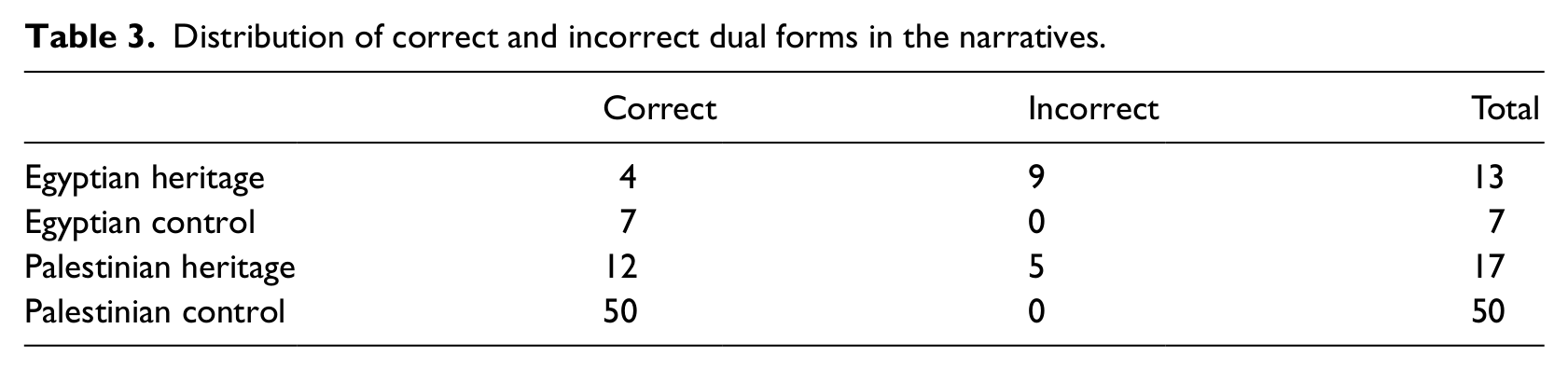
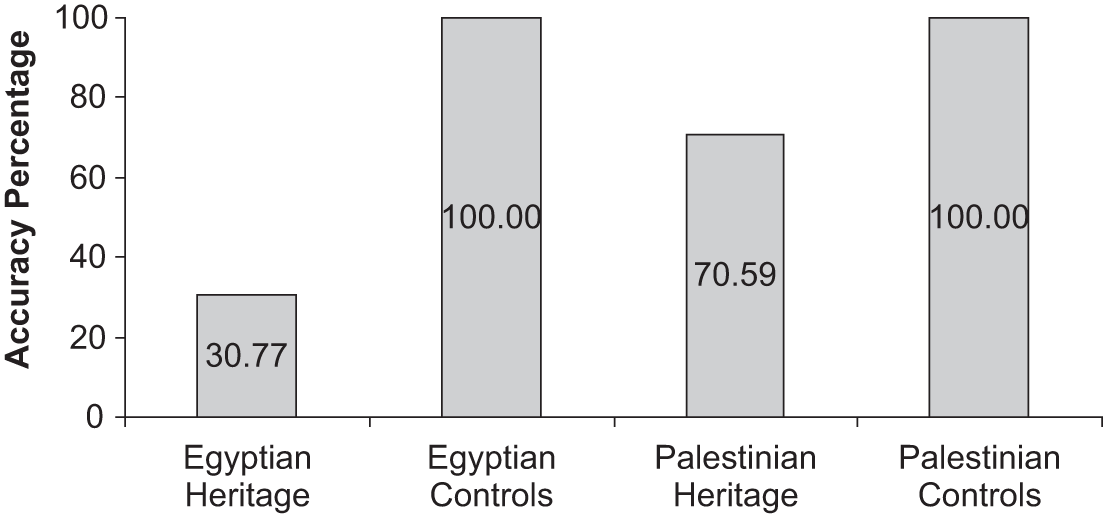
The two heritage groups displayed notable gaps in their formation and use of dual nouns, which is reflected in their overall accuracy on the dual (Figure 3). Although the accuracy percentages of the Egyptian and Palestinian heritage speakers were 30.77% and 70.59%, respectively, the performance of the two control groups was error free. A one-way ANOVA test revealed a significant difference between the groups with regard to the dual formation, F(3,27) = 10.250, p < .0001. Post hoc analysis using Tukey’s tests indicated that the Egyptian heritage group differed significantly from the Egyptian control group (p < .01) and only marginally from the Palestinian heritage group (p = .07). No other significant differences were found between the remaining groups.
Accuracy percentages in terms of dual formation.
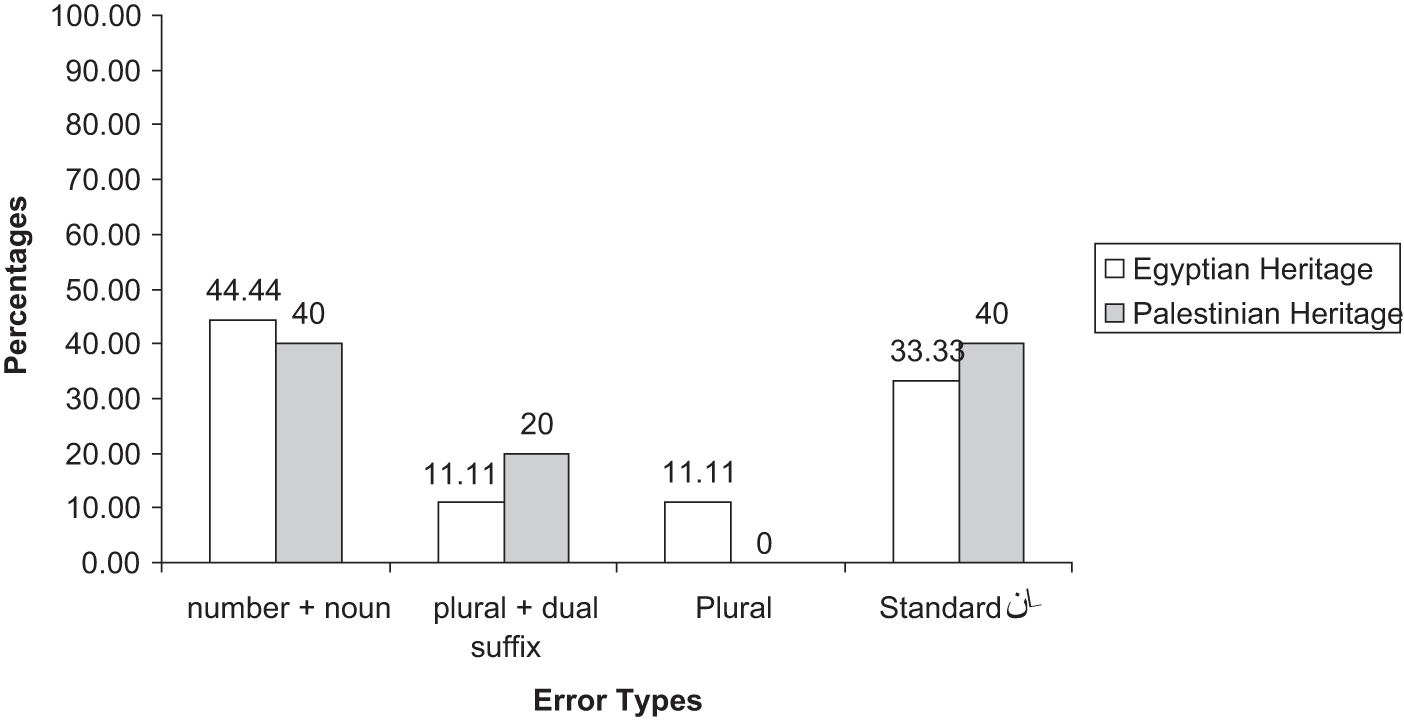
An error analysis was performed to examine the patterns of errors and their potential reflection of L2 effects in dual formation and use (Figure 4).
Error types and percentages on dual formation.
The following sentences outline the four types of errors that the heritage participants had with respect to dual formation: (24) ʕind-ha *tintein banaat at-her two.f. girls “She has two girls” (PHS) (25) ʕind-i ʔixwatein At-me sisters.dual “I have two sisters” (EHS) (26) l-walad w-l-kalb laaʔi D-DifDaʕiin w-kamaan fi kitiir DifDaʕ Siʁiir the-boy and-the-dog finding the-frogs and-also there many frog little “The boy and the dog found the two frogs and many little frogs” (EHS) (27) nsaafir ʔila misr kul Seif or Seifaan Travel.1pl to Egypt every summer or summers.dual “We travel to Egypt every summer or every two summers [every other summer]” (EHS)
In example (24), the speaker is basically using the rules of English to form the Arabic dual, thus placing the feminine number tintein “two” before a plural noun banaat “girls,” thus producing a structure equivalent to the English phrase two sisters. The speaker in (25) adds the dual suffix -ein to a plural noun, rather than a singular noun. Even though the speaker seems to recognize the concept of the dual (which is evidenced by his use of the suffix -ein), his substitution of a dual noun by a plural form points to the influence of English, which pluralizes dual nouns. A similar pattern appears in (26), where the speaker attaches the sound plural morpheme -iin to the singular noun DifDaʕ “frog,” which results in the ill-formed plural noun DifDaʕiin* (the plural of DifDaʕ is the broken plural DafaaDeʕ). The last example is interesting because the speaker resorts to a dual form used almost exclusively in Standard Arabic, namely, Seifaan “two summers.”
In general, the performance of the heritage speakers on dual nouns is intriguing if we consider the simple concatenative nature of the rule for forming dual nouns. The difficulty that heritage speakers have with the dual may have to do with the relative infrequency of this category, which is clear in Table 3. We should also point out that crosslinguistically the dual pattern is marked compared to the singular and plural patterns, another factor that may explain our finding (e.g. Corbett, 2000; Ravid & Hayek, 2003). As was the case with plural formation, the patterns of errors in the case of dual formation may not be explained by a single factor. It seems that heritage speakers are aware of the concept of the dual in Arabic but have difficulty deploying it through the standard suffixation process used in their L1. This suggests that the dual as a distinct category may have been attrited due to lack of use after their shift to English. The participants use a number of strategies to fill in this gap in their L1 grammar, some of which are based on their dominant L2 (e.g. “number + noun”).
Construct state and analytic genitive
The construct state and the analytic genitive constructions express similar possessive and partitive relationships. However, if we analyze the construct state and the analytic genitive forms taking into account the issue of language transfer, we would expect that the former would be more difficult for heritage speakers than the latter simply because English has no forms identical to the construct state in terms of agreement and word order. On the other hand, the “NP of NP” constituent in English is in different ways similar to the analytic genitive. This hypothesis is actually confirmed in our data. Let us first look at the distribution of the construct state and the analytic genitive in the narratives of the four groups.
As Table 4 demonstrates, the heritage speakers pattern with the native controls in terms of the distribution of the construct state and the analytic genitive in their speech. For example, the heritage groups and the control groups use the construct state to express possession more frequently than the analytic genitive. Likewise, the use of the possessive particle bitaaʕ by the Egyptian heritage and native speakers is proportionally similar to the use of tabaʕ or taaʕ by the two Palestinian groups. 7 The distribution of the possessive constructions in this study differs from that reported by Boumans (2006), where the analytic genitive is deployed predominantly in the narratives of the Moroccan immigrants in the Netherlands.
Distribution and frequency of the construct state and analytic genitive.
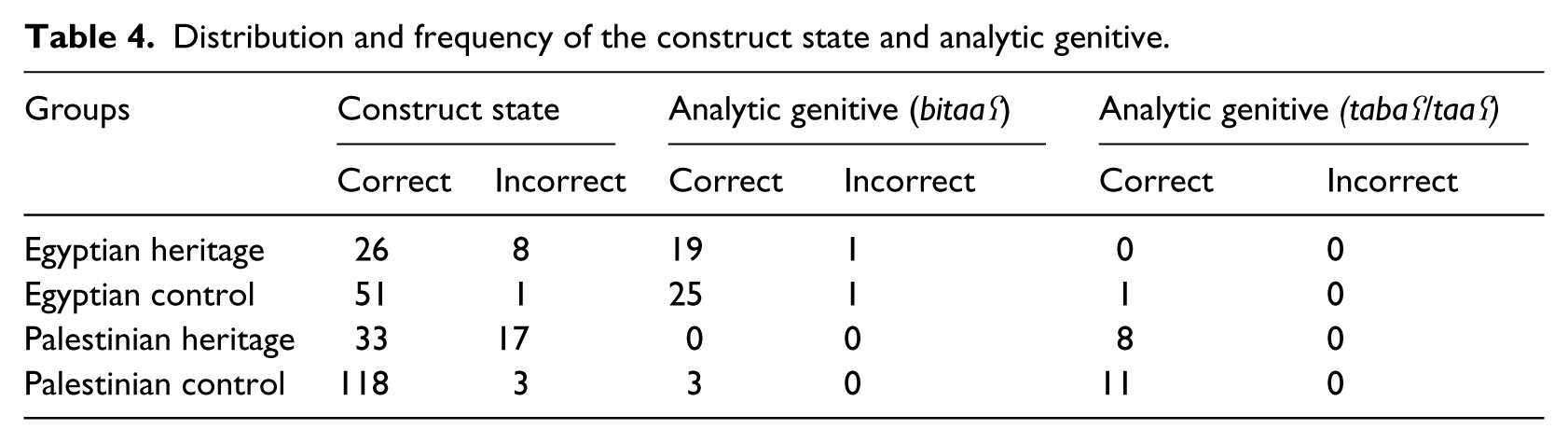
However, while heritage speakers are also similar to native speakers with respect to their native-like use of the analytic genitive (which was confirmed by a one-way ANOVA test; F(3,26) = .465, p = .71), they seem to find major problems with the use of the N + NP sequence. Figure 5 shows the difference between the accuracy percentages of heritage speakers and native speakers on the N + NP sequence.

Accuracy percentages in terms of the N + NP construct state.
The native speakers’ use of the construct state in the narrative was almost error free (98.08% for the Egyptian group and 97.52% for the Palestinian group). The few mistakes made by the native speakers were mostly due to hesitations, as can be seen in example (28): (28) lamma Siħi mən n-noom, liʔi žarra ...*l-žarra l-ʔazaaz When awoke.3s.m from the-sleep, found.3s.m jar ... the-jar the-glass “When he waked up, he found a jar ...the jar of the glass” (PHS)
After using word žarra “jar” correctly in its bare form, the speaker in (28) reuses it in its definite form as part of the construct phrase l-žarra l-ʔazaaz “the jar of the glass.” The addition of the definite article to the construct head, namely, l-žarra “the jar,” renders this form grammatically unacceptable because the construct head typically may not carry definiteness overtly (Benmamoun, 2003).
On the other hand, both heritage groups seem to find difficulty with the formation and proper use of the construct state (76.47% for the Egyptian group and 66.00% for the Palestinian group). A one-way ANOVA revealed that the four groups differed significantly with regard to the use of the construct state, F(3,37) = 4.989, p < 01. Multiple comparison using Tukey’s analyses showed that the Egyptian heritage group differed marginally from its control group (p = .064) and that the Palestinian heritage group differed significantly from its control counterpart (p < .05). No significant differences were found between the two heritage groups or the two control groups.
A close examination of the types of errors made by the Egyptian and Palestinian heritage speakers points to several nonnative trends in their narratives. These trends can be grouped into three main categories. A first major gap in the heritage speakers’ knowledge about the construct phrase seems to be due to how the definiteness works in this phrase, as examples (29) and (30) illustrate: (29) ʔana ba-šuuf-hum ʕind l-ʕamaaraat l-žaamʕa I ASP-see-them at the-buildings the-university “I saw them in the university buildings” (PHS) (30) huwwa raaħit l-beit r-raʔiis he went the-house the-president “He went to the house of the president [king]” (EHS)
In both examples, the speakers attach the definite marker to the head of the construct state, which is not allowed; only the second member (dependent) of the construct state can carry the definiteness marker. In both, the heritage speakers are aware of the N + NP sequence and the order of the members of the construct state. However, for the major part, they have difficulty with how the definiteness features are realized in the context of the construct state possibly due to its infrequent use or due to the fact that English does not have an equivalent form with the same morphophonological properties and restrictions. It is possible that heritage speakers treat the two members of the construct state as independent nouns, as is the case in some English possessives, while native speakers treat them as a single unit, essentially a single word (Benmamoun, 2000). The construct state forms a single (prosodic) unit with the attendant interdependency of its two components in terms of features, such as definiteness (see Benmamoun, 2003, for a detailed account).
Although heritage speakers seem to use code-switching effectively in their narratives (see also Albirini et al., 2011), the combination of Arabic and English words in construct phrases seems to pose a challenge for them when the insertion of the English element does not meet the requirements of this specific structure. The difficulties of combining Arabic and English words in construct phrases appear in examples (31), (32), and (33): (31) kintiš ʕaažba Sfuuf science was.1s-NEG liking classes science “I did not like the science classes” (PHS) (32) ʔəxuu-ya fi l-gaamʕa university of Illinois brother-my in the-university university of Illinois “My brother is in the University of Illinois” (EHS) (33) ʕawza tudrus mažisteir pharmacology wanting.3s.f study.3s.f masters’ pharmacology “She wants to pursue a master’s degree in pharmacology” (EHS)
Although the speaker in (31) succeeds in forming a well-structured construct state following the rules of Arabic, she fails to add the definite article to the English word science, which occupies the genitive noun position and which should be definite in this context. In examples (32), the speaker repeats the construct head university in Arabic and English. This type of error may be caused by the speakers’ correct recognition of the possibility of using multiple nouns in building construct phrases and yet their uncertainty about the way this sequence is realized. It is also possible that they construe the phrase University of Illinois as a single noun. The last sentence is interesting because the speaker generates a structurally sound sentence. However, the construct phrase is pragmatically improper here simply because speakers of Arabic often use prepositional phrases for academic degrees and disciplines in which they are granted. A more accurate rendering of this sentence would be ʕawza tudrus mažisteir fi l-pharmacology “She want to pursue a master’s degree in pharmacology.” This suggests that, although heritage speakers may be competent in the formation of construct phrases, they may not necessarily know about the contexts in which they are used.
A third and last pattern concerns the use of the demonstrative with construct phrases. This pattern appears only in the narratives of the Palestinian heritage group. Although the Palestinian heritage speakers pattern with their native counterparts in the use of demonstratives in general, some of them displayed gaps in their use of demonstratives with the construct state. This can be shown in the contrast between sentences (34) and (35), which were produced by two Palestinian heritage speakers: (34) ʔižoo la-žizʕ š-šažra haada came.3p.m to-trunk the-tree this.m “They came to this trunk of the tree.” (PHS) (35) ʔiħna bi-l-ʕuluum l-faDaaʔ fii *haaði nəSS s-sini we in-the-sciences the-space in this.f half the-year “We are in the space science [class] this semester” (PHS)
While a demonstrative can occur optionally before or after NPs (e.g. haada S-Saff or S-Saff haada “this class”) in Palestinian Arabic, when it is used with a construct phrase, it typically follows both elements of the phrase (as in (34)). These rules, however, are not observed in (35), as the speaker places the demonstrative haaði “this” before the construct phrase nəSS s-sini “literally, half year.” This again suggests that, although heritage speakers have general knowledge about the form and distribution of the construct state, they have some gaps in their knowledge of its exact structure, function, and use. As noted above, this may be due partly to the influence of English, which does not have a corresponding form, and partly due to the effects of L1 attrition. In fact, as Seliger (1996) argues, the influence of the L2 tends to concur with the attrition of the L1, which seems to be the case here.
Restrictive relative clauses
In this study, we examined the structure of restrictive relative clauses, particularly with regard to the use of the complementizer (in definite vs. indefinite clauses) and the resumptive pronouns (in object vs. subject clauses). Relative complementizers in Arabic can only appear after a definite DP, unlike their English counterparts, which are not affected by the (in)definiteness of the relativized DP (Aoun et al., 2010). A resumptive pronoun is required in the position of the antecedent of object relative clauses (Aoun et al., 2010; Hamdallah & Tushyeh, 1998). Table 4 summarizes the distribution of restrictive relative clauses in the oral production of the four groups.
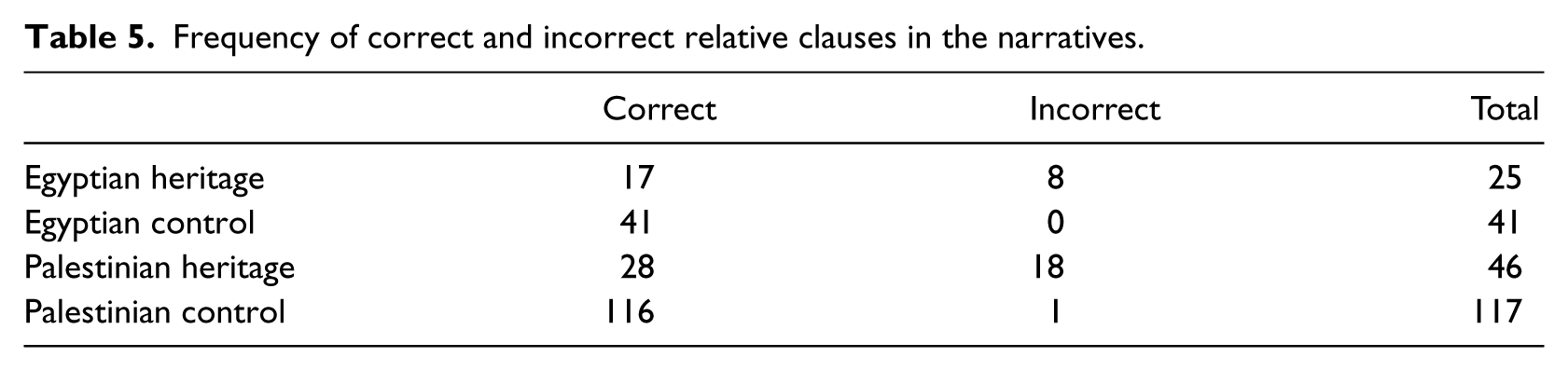
As Table 5 shows, the heritage speakers differed from their native counterparts in terms of the frequency and accuracy of their relative-clause usage. Thus, whereas the Egyptian native speakers produced 41 relative clauses, all of which are grammatically accurate, their heritage counterparts produced a fewer number of relative clauses (29), only 17 of which are grammatically correct. Similarly, the Palestinian native speakers generated 117 relative clauses, with only 1 erroneous occurrence, compared to 46 by their heritage counterparts, who produced 18 grammatically incorrect relative clauses. A one-way ANOVA showed a significant difference between the four groups in terms of their use of restrictive relative clauses, F(3,36) = 5.415, p < .01. Post hoc analyses showed that the Egyptian heritage group differed significantly from its control group (p < .05) and that the Palestinian heritage group differed marginally from its control counterpart (p = .076). No significant differences were found between the two heritage or control groups.
Frequency of correct and incorrect relative clauses in the narratives.
With respect to both definite and indefinite relative clauses, the heritage speakers were less accurate than the native speakers, who performed almost at ceiling (Figure 6). The performance of two heritage groups seemed to be inconsistent in both types of clauses. Thus, the performance of the Egyptian group fluctuated between 62.50% accuracy rate on the production of definite clauses and 70.59% on indefinite clauses. On the other hand, the Palestinian group had an accuracy rate of 72.00% on the definite clauses and 47.62% on the indefinite ones. A repeated-measures ANOVA was conducted to analyze the effects of relative-clause definiteness on the performance of the four groups. The results of the test displayed no significant effect of definiteness on the performance of the participants, F(1,20) = .767, p = .392. However, a major significant effect of group, as the between-subjects variable, was found, F(1,20)=15.437, p < .0001; the two heritage groups performed less accurately on both the definite and indefinite clauses than the two control groups did.
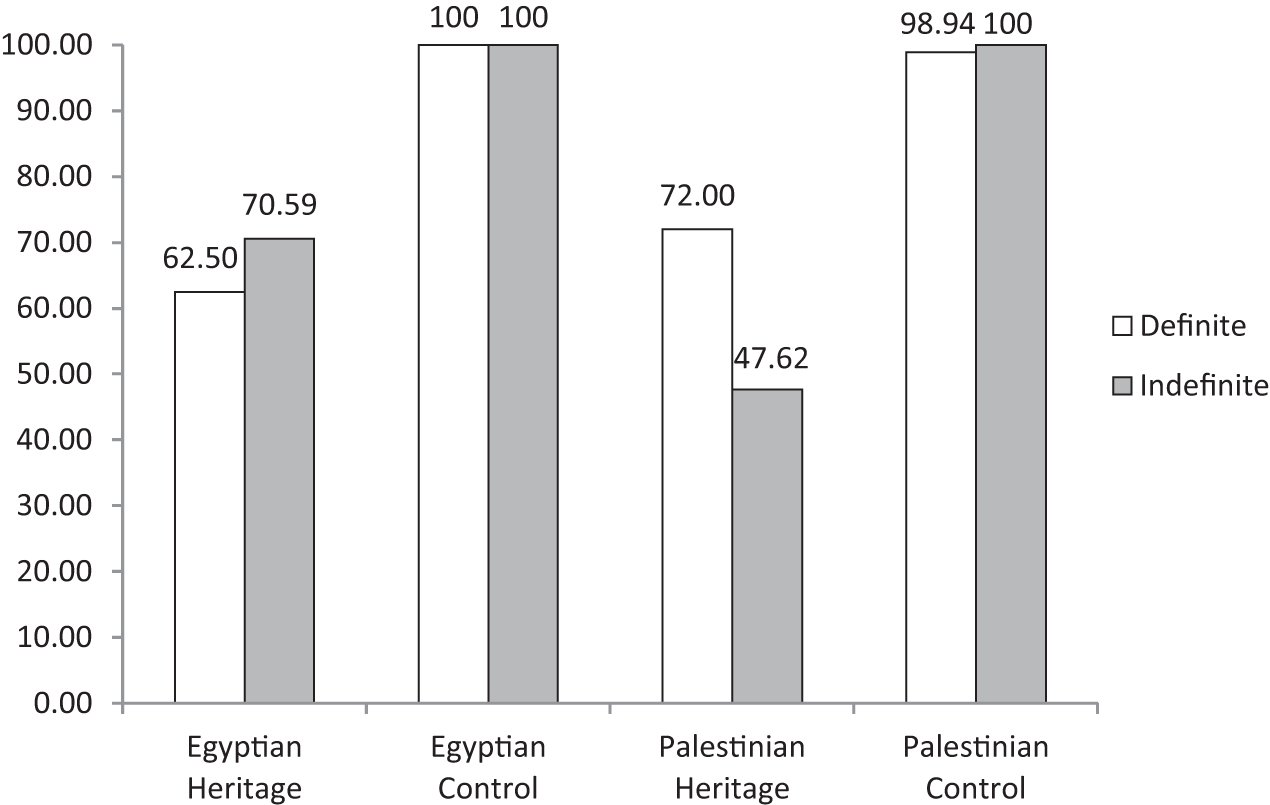
Accuracy percentages in terms of definite versus indefinite relative clauses.
The error analysis explains why the heritage speakers’ performance was somehow comparable on definite versus indefinite relative clauses. In fact, the predominant error pattern with respect to definite versus indefinite clauses concerns the absence of the complementizer in definite relative clauses or its presence in indefinite relatives, as in examples (36), (37), (38), and (39): (36) btikdar tSiir maʕa l-bint tħib maʕu maSaari can.2s become with the-girl likes.3s.f with-him money “You can be with the girl that likes the one who has money” (PHS) (37) Dimn l-ʔasbaab ʕalaaʔ d-diin kaan ʕaayez ykuun ʔamiir ʕašaan yiggwwiz among the reasons Aladdin was.3s.m wanting be.3s.m. prince because marry.3s.m ʔamiira princes “Among the reason that made Aladdin want to become a prince is to marry a princess” (EHS) (38) kaanit dayman tžiib baskoot lli baħəbb-o ktiir was.3s.f always bring.3s.f biscuit that like.1s-it a lot “She always brought biscuits that I liked a lot.” (PHS) (39) Tələʕ min maħall lli kaan fi-i left.3s.m from place that was.3s.m in-it “He left from the place in which he was” (PHS)
In examples (36) and (37), the speakers drop the complementizer (lli or l-), even though the relativized DPs l-bint “the girl” and l-ʔasbaab “the reasons” are definite. On the other hand, the complementizer lli was added to the indefinite relative clauses in (38) and (39), where it should not occur. 8 These examples show that heritage speakers are aware of the existence of definite and indefinite relative clauses in their dialects but do not have a full grasp of the structure of these two clause types and the restrictions on the distribution of the complementizer.
A second error type related to definite relative clauses in particular concerns the replacement of the default relative complementizer lli with wh-phrases, such as wein “where?” and šu “what.” Examples (40) and (41) exemplify this type of errors: (40) ktiir min ʔaSħaab-i ʕaayšiin bi-l-ʕamaara *wein ʔana ʕaayeš hallaʔ many of friends-my living in-the-building where I live now “Many of my friends live in the building in which I live now” (PHS) (41) yəhtammoo bi-l-ʔašyaaʔ *šu biSiir b-falasTiin be interested.3p.m in-the-things what happens in-Palestine “They are interested in the things that happen in Palestine” (PHS)
In (40), the speaker uses of the wh-phrase wein “where” after the DP l-ʕamaara “the building.” This sequence results in an ungrammatical sentence, equivalent to the English sentence Many of my friends live in the building where I live now. A similar scenario happens in (41), where the addition of the wh-phrase šu “what” generates an unacceptable sentence but is equivalent to the English sentence they are interested in the things which happen in Palestine. In other words, the construction of these sentences is based on or is influenced by comparable structures found in English.
Unlike their somehow comparable performance on definite versus indefinite clauses, the performance of the heritage groups on object versus subject relative clauses was notably different. As Figure 7 shows, the two heritage groups displayed better accuracies on subject relative clauses (90% for the Palestinian group and 78.95% for the Egyptian group) than on object relative clauses (53.33% for the former and 48.15% for the latter). A repeated-measures ANOVA was conducted to examine the effect of clause type (object vs. subject) on the performance of the four groups. The results revealed a significant main effect of clause type, F(1,20) = 14.672, p < .01; object relative clauses posed greater difficulty to speakers than subject relative clauses. The analysis also showed a main effect of group, F(1,20) = 18.760, p < .0001; the heritage groups performed less accurately on both types of clauses than the two control groups. There was also a positive interaction between clause type and group, F(1,20) = 7.563, p < .01; the difference between the groups is more pronounced in object relative clauses than in subject relative clauses.
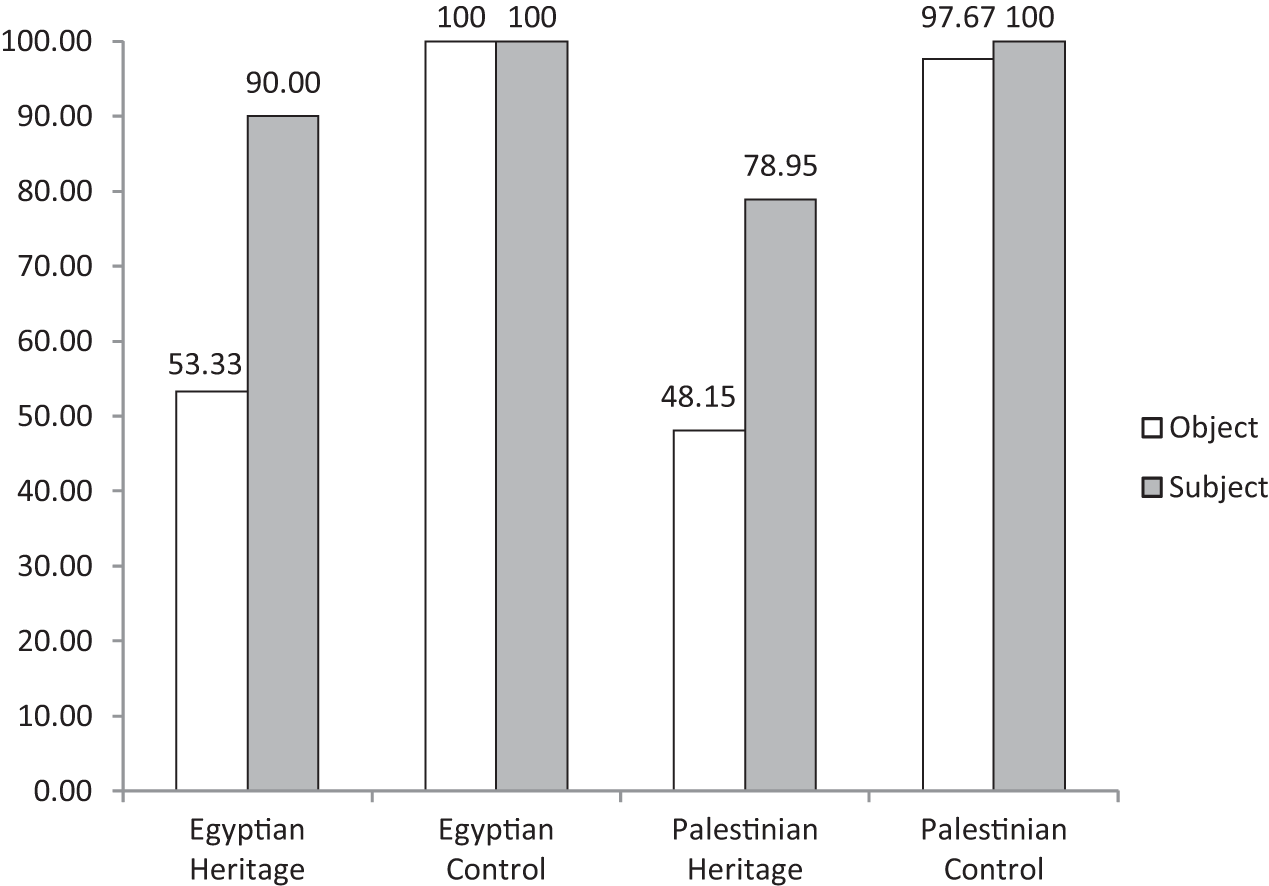
Accuracy percentages in terms of object versus subject relative clauses.
The main error type with respect to object versus subject clauses concerns the dropping of the resumptive pronoun in obligatory contexts or using a resumptive pronoun that does not match its antecedent in number or gender. These erroneous uses of the resumptive pronoun are illustrated in examples (42), (43), (44), and (45): (42) l-žinni xalla-h ynaʔʔi tlət ʔašyaaʔ lli bəddu yyah the-genie let.3s.m-him choose three things that want.3s.m it.m “The genie let him choose three things that he wants” (PHS) (43) ba-sawwi- l-projects lli huwwi yaʕTiini ʔiyya-h ASP-do the-projects that he give-me it.m “I do the project that he gives me” (PHS) (44) l-žinn ʔall-u ʔaddi-hal-lak ʔay ħaaga lli ʔinta ʕaawiz
9
The-genie told-him give.1s-it-you any thing that you wanting “The genie told him that I give you any thing that you want” (EHS) (45) miš mətzakkra šu hummi l-təlaati lli saʔal NEG remembering.f what they the-three that asked.3s.m “I do not remember what are the three things that he asked [for]” (PHS)
In examples (42) and (43), the speakers use the resumptive pronoun -h “him/it.m” to refer to nonhuman plural antecedents, namely, ʔašyaaʔ “things” and l-projects “the projects.” The use of a singular masculine pronoun in reference to the relativized singular feminine noun creates a gender mismatch between the pronoun and its antecedent. This could indicate some problems with establishing long-distance dependencies. In (44) and (45), however, the speakers drop the resumptive pronoun altogether, thus leaving the position of the relativized DP in the relative clause empty. As noted above, in Arabic objective relativization, a gap is not allowed in the position of the relativized DP. Therefore, the dropping of the resumptive pronouns in these contexts results in ungrammatical sentences.
Overall, heritage speakers seem to have mastered different aspects of the restrictive relative clauses. The two areas where gaps in their knowledge clearly appear are in the deployment of the relative complementizers and the resumptive pronouns. However, while their use of the complementizer is characterized by inconsistency, their difficulties with the use of the resumptive pronoun strategy seem to be systematic. The inconsistent use of the relative complementizers may not be attributed to L2 effects because speakers recognize the distinction between definite and indefinite relative clauses, but they seem to have problems with determining the specific contexts for the distribution of the complementizer across these two clauses. This gap may have to do with the effects of L1 attrition. On the other hand, the consistent omission of the resumptive pronoun as a marker of syntactic dependencies may be attributed to the influence of English, where the gap strategy predominates.
Discussion
The results of the current study present a complex picture of transfer effects within the examined areas, namely, plural and dual morphologies, the construct state, and restrictive relative clauses in the speech of Egyptian and Palestinian heritage Arabic speakers. Although transfer effects seem to play a clear role in some areas and in very specific ways, sometimes their presence cannot be separated from other factors such as incomplete language acquisition or attrition. The intricacy of teasing apart the role of language transfer from other factors in the latter case may be due to the very nature of HLA where several factors seem to play a role in shaping the knowledge that the heritage speakers converge on.
The influence of the L2 in the current study takes three interrelated forms: borrowing, avoidance, and simplification. Probably the most visible form of L2 transfer in this study is borrowing, which seems to occur particularly with infrequent and marked L1 forms. In this case, speakers may borrow corresponding elements from the dominant language to replace the target HL forms. According to Corder (1983), borrowing is the hallmark of transfer effects because it makes up for problematic areas of the minority language and may eventually become part of this language.
In the current study, heritage speakers often realize dual nouns periphrastically through the English “number + noun” structure or through the use of sound plural forms, rather than through the use of the dual morpheme. Since the dual as a single lexical–morphological unit does not exist in the dominant English language and is a crosslinguistically marked and infrequent category, speakers resort to borrowing corresponding forms from English that are semantically similar to the Arabic ones but which result in grammatically or pragmatically inaccurate structures. Similarly, unlike English, most Arabic dialects do not use wh-phrases, such as wein “where” and šu “what,”, as relativizers. The heritage speakers’ use of these wh-phrases as relativizers in the current data generates English-like, but grammatically unacceptable, structures. Thus, borrowing in this context is not always successful and may result in unique structures that do not belong in the L1. Within Pavlenko’s (2004, p. 47) typology, these forms of borrowing are referred to as loan translation and morphosyntactic restructuring because they involve the incorporation of L2 rules based on the literal translation of the target forms.
In addition to borrowing from the L2, transfer effects sometimes take the form of language shift or avoidance, which is realized by moving away from particular L1 structures to ones that are similar to those found in the L2. For example, heritage speakers drop the resumptive pronoun in contexts that require its use (i.e. object relative clauses). The resumptive pronoun strategy is replaced by the gap strategy, which is the predominant strategy in English. The shift to the English-like strategy may be due to the processing simplicity of the gap strategy in comparison to the resumptive strategy (i.e. L2-like structures may be cognitively easier to access because of the dominance of the L2 grammar system, Jiménez, 2004).
The third pattern of L2 transfer is simplification. Simplification refers to the process of regularizing irregularities or replacing complex structures and forms with ones that are simpler or easier to process, especially when similar simple structures are found in the L2. The use of simplification strategies has been widely documented in SLA, HLA, and pidgins and creoles (Montrul, 2010; Sebba, 1997; Sharwood Smith, 1983; Zobl, 1980). For example, sound plurals in Arabic are formed by the relatively simple concatenative plural strategy, which is similar to that found in regular English plurals, unlike broken plurals, which are formed by nonconcatenative methods involving a complex root and pattern system. Heritage speakers rely predominantly on the concatenative strategy possibly not only because it is simpler but also because it is similar to the one found in their L2. In this respect, heritage speakers differ from monolingual Arab children aged over 5 who tend to substitute one broken form for another (Omar, 2007).
In most cases, however, transfer effects seem to be linked to or triggered by attrition (e.g. Altenberg, 1991; Andersen, 1982; Corder, 1983; Seliger, 1996). Heritage speakers seem to master different aspects of the four forms examined in this study. However, they lack different constraints and features about their structure, functions, or use in context. For example, although heritage speakers are less accurate in using the construct state (which is a non-English-like structure) than in using a similar English-like form (i.e. the analytic genitive), the fact that they can put the constituents of the construct state in the right order points to their knowledge of at least the word order aspects of the structure but not the combinatorial constraints restricting the co-occurrence and codependency of its two members (e.g. treating the two elements of the construct state as independent nouns, Benmamoun, 2000). This type of inaccuracies may be due to infrequent use and subsequent attrition (Pavlenko, 2004; Schmid & Köpke, 2004). Likewise, some speakers seem to identify the dual as a category distinct from the singular and the plural, which explains their use of the “two + noun” and “plural + dual morpheme” structures. Nonetheless, their inaccurate use of this form, which sometimes involves borrowing from the L2, may be because they have lost aspects of its formation or use. In this respect, L2 transfer may be considered as a consequence of the attrition of this L1 form.
Apart from their connection to L1 attrition, the effects of L2 are sometimes intertwined with the incomplete acquisition of certain forms. For example, in terms of plural formation, studies focusing on the acquisition of Arabic plurals show that Palestinian and Egyptian children may have difficulty with broken plurals even at the age of 5 (Ravid & Farah, 1999; Omar, 2007). Heritage speakers who have shifted to English at or before the age of 5 (kindergarten) may not have completely acquired all of the Arabic broken plural forms, which may explain their notable inaccuracy with regard to broken plural formation compared to sound plural formation. This explanation, however, requires to be verified though longitudinal studies investigating how the L2 intercepts L1 development. Likewise, heritage speakers have better mastery of subject relative clauses than object relative clauses. It has been crosslinguistically found that children acquire and command subject relative clause much earlier than they acquire and command object relative clauses (Givón & Shibatani, 2009; Jisa & Kern, 1998). The speakers’ unbalanced performance on object versus subject relative clauses therefore suggests that they may have not acquired object clauses completely before they shifted to English. This may explain their reliance on the L2-based gap strategy instead of the resumptive pronoun strategy.
Transfer effects are therefore related to both the attrition and incomplete acquisition of heritage speakers’ knowledge of the four forms under study. Moreover, they are not bound by domain (morphological or syntactic); rather, they are shaped by general crosslinguistic factors related to the influence of the dominant language on the minority language, which supports previous findings on language transfer in both SLA and HLA (Cuza & Frank, 2011; Lardiere, 2007; Montrul, 2010; Montrul & Ionin, 2010; Odlin, 1989; Schwartz & Sprouse, 1996; Unsworth, 2006). However, they seem to be restricted to specific forms that are typically marked (e.g. broken plurals and duals), infrequent (duals), or characterized by processing difficulty (as seems to be the case with the dependencies in the relative clauses). The limited and area-specific effects of the L2 in this study support previous findings about the nature and scope of language transfer in general and HLs in particular (e.g. Bolonyai, 2007; Cuza & Frank, 2011; Fenyvesi, 2000; Kim, Montrul, & Yoon, 2009, 2010; Montrul, 2010; Montrul et al., 2008; Pavlenko, 2004).
We conclude the article by discussing the heritage speakers’ shift to English or Standard Arabic forms. The shift to English was often in the form of whole lexical items, which may be motivated by lexical retrieval problems or certain morphological gaps (e.g. broken plurals). In the case of Standard Arabic, however, heritage speakers often borrow target morphemes (e.g. dual morpheme) in addition to words (e.g. relativizer). To understand this use, we need to keep in mind that most heritage speakers are exposed to Standard Arabic at a later stage of their language development, mostly in formal settings in schools and colleges. In other words, Standard Arabic is an L3 for many of them, even though some of them may see it as similar to their dialects. The incorporation of these elements may be considered as a case of L3 transfer. In other words, their word- and morpheme-level shifts may be caused by difficulties with certain forms, which they replace with corresponding elements from the L3 (which is a case of borrowing).
To conclude, L2 influence seems to transpire in very specific forms and scopes. However, for the most part, it does not work independently of other factors involved in heritage-language development. We think that transfer effects are largely a consequence and a manifestation of the incomplete acquisition and attrition of HLs. Thus, it is not always easy to disentangle L2 effects from these important factors in HLA. As noted above, this may have to do with the very nature of HLs where many cognitive, developmental, and social factors are at play. We suggest that carefully designed longitudinal studies that focus on specific aspects of the language development of heritage children may be needed to potentially isolate the role of each of these factors in shaping heritage speakers’ knowledge of different linguistic phenomena.
Footnotes
Acknowledgements
We would like to thank the participants in the study. We are grateful for Eman Saadah for her help with the data collection. We would also like to thank the two anonymous reviewers for their constructive feedback and suggestions. All remaining errors are ours.
Funding
This research received no specific grant from any funding agency in the public, commercial, or not-for-profit sectors.