



Abstract
Aims and objectives/purpose/research questions:
The purpose of this study was to examine syntactic awareness skills in English, among two groups of children: native Chinese speakers and native Slavic (L1) speakers. Both groups were second language English (L2) speakers. Their syntactic awareness skills were compared to a matched sample of L1 English speakers.
Design/methodology/approach:
Eighty-six third grade students participated in the study, matched between language groups on the basis of age and gender, as well as academic achievements and word reading levels.
Data and analysis:
L1 English and L1 Slavic groups performed significantly better on the syntactic awareness task than did the L1 Chinese group. A close examination of specific syntactic constructions revealed that the L1 Chinese group did not perform as well as the other groups on past tense constructions, which do not exist in Chinese but do exist in Slavic languages. However, there were no between-group differences on superlative and comparative constructions, which exist in all three languages.
Findings/conclusions:
The results contribute to our knowledge about cross-linguistic influences between English, Slavic, and Chinese, showing that L1 Slavic facilitates the learnability of L2 English, while L1 Chinese impedes the learnability of L2 English.
Originality:
The originality of the study lies in the comparison of children from three different L1 groups, matched with respect to reading level. The examination of languages that are typologically different in their syntax is unique.
Significance/implications:
The results highlight the importance of taking the specific language backgrounds of L2 learners into consideration.
Limitations:
The current study did not include an assessment of L1 language proficiency among participants.
Introduction
Bilingualism and second language acquisition are well-researched topics, presumably because most of the world’s population speak more than one language (Baker & Jones, 1998; Bialystok, Craik, & Luk, 2012; Chakraborty, 2015). To speak a language proficiently, one must be familiar with the linguistic rules of the language and be able to use them efficiently (Bialystok, 2001; Kohnert, 2013). One linguistic process that is especially important in obtaining language proficiency is syntactic awareness. However, few studies have examined syntactic awareness and even fewer have specifically addressed this skill among children.
Syntactic awareness
Syntactic awareness is the ability to understand the internal grammatical structure of a sentence (Bentin, Deutsch, & Liberman, 1990; Tunmer & Hoover, 1992). It is a complex, multi-componential ability, which makes a significant contribution to literacy skills such as word learning (Ehri & Wilce, 1980). Moreover, a recent study on adolescent students showed that syntactic awareness was significantly associated with reading comprehension, with syntactic knowledge serving as a mediating variable between the two (Brimo, Apel, & Fountain, 2017).
Syntactic awareness is a metasyntactic skill. Different tasks measure metasyntactic skills, each of which is associated with different demands, such as grammatical judgment, word-order correction, oral cloze, and sentence correction (e.g. Bentin, Deutsch, & Liberman, 1990; Gaux & Gombert, 1999). For example, in grammatical judgment tasks, participants are asked to decide which sentences are correct or incorrect in terms of their grammatical structure. This type of task can be presented orally or in writing. In oral cloze tasks, participants hear a sentence with a missing word and are required to provide a word in the correct grammatical form. In sentence correction tasks, participants are presented (either orally or in writing) with grammatically incorrect sentences and asked to provide the correct form. In the word order correction task, the words in a sentence are presented in jumbled order and must be rearranged. In a recent theoretical paper, Simard, Labelle, and Bergeron (2016) created a framework designed to distinguish between syntax-related tasks, while classifying the type of abilities measured by each task. The current study employed the oral cloze task, which recruits syntactic awareness skills while creating few attentional demands.
Performance of bilingual individuals and L2 learners on syntactic awareness tasks
Several studies examining the performance of L2 learners on syntactic awareness tasks have found that bilingual children achieve lower scores than do native monolingual English speakers. Da Fontoura and Siegel (1995) compared the reading development in English of normally achieving Portuguese-Canadian children to matched L1 English speakers. The only differences between the groups involved a syntactic awareness task, on which the Portuguese-Canadian group had significantly lower scores than the monolingual English speakers (Da Fontoura & Siegel, 1995). Similar results on the same oral cloze measure were found when native English speakers were compared to bilingual Arabic-speaking (Abu-Rabia & Siegel, 2002), bilingual Italian-speaking (D’Angiulli, Siegel, & Serra, 2001), and Punjabi L2 English-speaking students (Chiappe & Siegel, 1999). However, another line of studies demonstrated an advantage for bilingual students on syntactic awareness tasks requiring high levels of attentional control (Bialystok, 1992, 1999, 2007). Furthermore, Davidson, Raschke, and Pervez (2010) found that bilingual five- to six-year-olds who spoke both Urdu and English at home outperformed their monolingual English peers on a task requiring detection of grammatically incorrect sentences. However, no significant differences were found between monolingual and bilingual children in the ability to detect grammatically correct sentences.
The role of language distance in successful acquisition
Linguistic distance, defined by quantifying the distance between linguistic structures at the lexical or morphological level, is one of many components that may differ between languages. The degree to which a L1 facilitates or impedes the learning of a L2 (Schepens, van der Slik, & Hout, 2016) is defined as learnability. It has been shown that the larger the linguistic distance between a L1 and a L2, the lower the learnability of the L2 (Schepens, van der Slik, & Hout, 2013a, 2013b). Strong evidence in this area comes from a recent study on 8,754 adult immigrants (ages 18 to 65 years) from 33 mother tongue backgrounds spoken in 67 countries, who had learned Dutch as an additional language. This study examined the impact of the morphological complexity of their L1 and L2 on their speaking proficiency scores in Dutch. It was found that adult language learners whose first language (L1) had a less complex morphological feature configuration than Dutch had greater difficulty in acquiring Dutch the less complex their L1 was in relation to Dutch (van der Slik, Hout, & Schepens, 2017).
Other research has examined the role of linguistic distance in learning a third language (L3). A recent large-scale study investigated whether the linguistic distances of a diverse set of previously acquired L1s and L2s predicted the learnability of an additional language (L3 Dutch) among adults. The results demonstrated that the closer the L2 was to the L3, the higher the learnability of the L3. Indeed, it appears that learning a L3 becomes more difficult when the L1 or the L2 are lexically distant and morphologically less complex (Schepens, van der Slik, & Hout, 2016).
Transfer and grammatical categories
An important question involves the extent to which L2 morphology or syntax knowledge is affected by L1. Several approaches have been tried in addressing the influence of L1 knowledge on L2. One approach is the Feature Reassembly Hypothesis (Lardiere, 2008, 2009, 2013), according to which difficulty in L2 grammatical acquisition is related to the extent to which formal features have already been ‘packaged’ in the L1. Furthermore, learners must acquire knowledge of the appropriate conditioning environment for expressing a certain feature, which may differ from that of the L1. If a universal grammatical meaning (e.g. plural, past state or event, definiteness) is expressed by one configuration in the native language (L1) and by another configuration in the second language (L2), this would constitute a morphosyntax–semantics mismatch and would arguably present additional difficulty in L2 (Slabakova, 2009). An example provided by Lardiere (2013) to illustrate this situation involves the case of native (Mandarin) Chinese speakers acquiring plural marking in L2 English or vice versa. In English, plural marking is obligatory on count nouns that denote ‘more than one’ references, but is indiscriminate. In Chinese, plural marking is optional and restricted. It is prohibited in certain contexts in which it is required in English, such as quantified contexts, such that learners must distinguish between optional and obligatory cases and consider additional syntactic and semantic restrictions.
A recent study investigated transfer of the specific grammatical category of gender, examining development of the ability to grasp gender assignment and agreement in 102 bilingual English-Greek and German-Greek children and 35 monolingual Greek children (10 to 12 years of age). Specifically, the effect of gendered L1 (German) versus non-gendered L1 (English) on gender-related grammatical abilities in L2 Greek was examined. The results revealed that monolinguals performed at a higher level than both bilingual groups, and the German-Greek bilinguals performed at a higher level the English-Greek bilinguals, particularly on gender assignment tasks. The researchers demonstrated a positive cross-linguistic influence from L1 German, a gendered language, to L2 Greek. The researchers concluded that while gender-related grammatical abilities are acquired early in monolinguals, sustained exposure to Greek appears to be important in bilingual development of these skills, and German-Greek bilinguals profit from the grammatical encoding of gender in German (Kaltsa, Tsimpli, & Argyri, 2017).
The results of studies investigating syntactic awareness among bilinguals and monolinguals are inconsistent, which may be due to several reasons. First, there is no consensus regarding the specific skills that constitute syntactic awareness, such that different studies have used different measures to assess this construct. In addition, some studies have examined the performance of L2 English students from different language backgrounds as a group, whereas other have looked at L2 English students from a specific language background. In both cases, the different language background might have influenced performance on the syntactic awareness task.
Syntactic differences between the Chinese and English languages
In English, inflectional affixes indicate grammatical aspects of a word, such as its tense (e.g., the suffix ‘ed’ indicates past tense) or plurality (Erbaugh, 1992). Another characteristic of English grammar is the presence of regular and irregular formations. In regular formations, base morphemes retain their orthographic forms following affixation. In irregular formations, the base morphemes undergo orthographic changes. The syntactic system of Chinese is very different from that of English. The Chinese languages are ‘isolating,’ in that grammatical functions are not marked by inflections, as they are in English. Words in Chinese are immutable and not marked for subject agreement, tense, grammatical gender, number, or case (Campbell, 2000). All the Chinese languages are very similar syntactically, although they differ significantly from one another phonologically. Given the focus of the current study on syntactic aspects of other languages in comparison to English, Cantonese and Mandarin were combined under a single Chinese language category. Comprehension of past, present, and future in Mandarin depends on lexical items such as time adverbials (e.g., yesterday, next week, some time ago), viewpoint aspect morphemes (le ‘termination or completion,’ zai ‘ongoing state or event,’ etc.), and discourse context tracking. Since English has dedicated tense morphemes, comprehension of temporality does not crucially depend on aspectual, lexical, and adverbial means. Therefore, the English–Mandarin temporality contrast can be described as a form–meaning mismatch, suggesting that acquisition challenges can be expected. L1 Chinese learners tend not to mark the past tense morphology in English. This is explained by Slabakova (2015), who proposes that this learning situation, especially when Mandarin is the L1, can be significantly complicated if a universal grammatical meaning is not expressed by any overt morphosyntactic forms. Languages differ systematically from one another in that various aspects of meaning can be lexically or contextually expressed in some, while they are morphologically marked in others.
Syntactic differences between the Slavic and English languages
The syntactic system of the Slavic languages is more complex than that of the English language. For instance, nouns, which can be feminine, masculine, or neutral, are represented in six declensions, while adjectives are represented in one. Numbers (singular and plural) are distinguished, as is gender, by inflectional endings on stems. Furthermore, there are six case endings: nominative, accusative, genitive, dative, instrumental, and locative. Verbs are distinguished by three major conjugations: first, second, and third persons, in the singular and plural forms. Main verbs agree in person and number with their subjects. Adjectives agree in person, gender, and case with the noun they modify.
Syntactic awareness and constructions: Past tense
Goad, White, and Steele (2003) examined the production of English verb morphology among adult learners of English (L2) from a Mandarin (L1) background. The researchers focused on the affixation of past tense (-ed) and on words in the third person singular (-s) to explore whether L1 constraints would influence L2 morphosyntax production, as Mandarin employs no verb affixation to mark tense and person. Their results showed that despite mastering tense and person morphologies in a grammatical judgment task, participants were not able to produce these same markings of morphosyntax as accurately as they were able to judge their correct or incorrect use. Notably, while intuition might indicate that regular forms should be mastered faster than irregular forms, L1 Mandarin speakers were significantly more accurate in producing irregular verb forms (which tend to involve word-internal shifts, for example see and saw) than regular forms (which involve the affixation of the morpheme -ed to the end of a verb base). The researchers attributed this finding to structural constraints of the L1, namely that Mandarin does not employ affixation of consonantal units or clusters to the end of a prosodic word.
The relationship between L1 and L2 was further studied by Basnight-Brown, Chen, Hua, Kostic, and Feldman (2007), who examined the effect of L1 on the processing of verb inflections in L2 English. The researchers studied two groups of bilingual individuals (Serbian-English and Chinese-English) and a group of monolingual English speakers with respect to cross-modal priming during a lexical decision task. The study involved priming with regular (high versus low resonance) and irregular (nested [drawn – draw] versus shifting [bought – buy]) verb forms. Though Serbian resembles English in that it is an alphabetic language with an inflectional morphology, the monolingual English group exhibited facilitation effects for all four types (two regular and two irregular) of verb primes, while the bilingual groups demonstrated different profiles. Both bilingual groups exhibited facilitation on both types of regular verb primes, but the Serbian group also exhibited facilitation on irregular nested (the more orthographically similar verb forms) primes, while the Chinese group exhibited no facilitation on any irregular primes. However, participants in the Chinese group made significantly fewer errors under irregular prime conditions than they made under regular prime conditions. The authors concluded that the phonological and orthographic features of the L1 contributed to these findings. Specifically, the results reflected differences between the Serbian language’s alphabetic orthography and inflectional system, which produce phonologically and semantically similar inflected words, and the Chinese language’s non-alphabetic orthography and non-inflectional morphology, which produce visually similar words with little or no phonological or semantic similarity.
The current study
A review of the studies described above suggests that bilingual or second language learners from different L1 backgrounds may present different patterns of syntactic awareness acquisition in L2, with both theoretical and practical implications. Given the important role of syntactic awareness in language acquisition, the aim of the current study was to study these differences in depth. In particular, the study examined two language groups, Chinese, as a representative of languages with less inflected grammar, and Slavic, as a representative of those with a highly inflected grammar system. Through their comparison, particularly with respect to syntactic awareness skills, the study provided an opportunity to assess the advantages and the difficulties experienced by speakers of each language group when learning English as a L2. Participants in each of the two aforementioned L1 groups were compared to monolingual English-speaking participants using an oral cloze task with two central aims: (1) to examine whether there were any differences between Chinese L2 English and Slavic L2 English third-grade students on a measure of syntactic awareness in English, as compared to native English speakers; (2) to examine the role of L1 in the acquisition of syntactic awareness constructions in L2 English; specifically, to investigate whether syntactic awareness differences were related to distance effects between L1 (Slavic and Chinese) and L2 English.
We predicted that scores on the syntactic awareness task would be higher for the Slavic-English bilingual participants than for the Chinese-English bilingual participants. The distance (in terms of morphosyntax characteristics) between English and Slavic is closer than that between English and Chinese. Our second hypothesis was that the L1–L2 distance effect would be more facilitative when the L1–L2 distance was small. We predicted that Slavic-English bilinguals would perform better on English past assignment tasks than would Chinese L1 bilingual participants. Thus, the Slavic L1 participants, who have a past marker in their L1, were expected to perform in a similar manner to the native English speakers, while the Chinese L1 participants, who do not have a past marker in their L1, were expected to perform differently from the native English speakers. No differences were expected between the groups with respect to constructions that exist in all the three languages.
Method
Participants
A total of 86 children participated in this study. All were third grade students who had attended Canadian schools since kindergarten and had been educated in English in school. The participants were classified into language groups based on their native language status. L2 students were defined as students whose first spoken language at home, to their parents, siblings and grandparents, was not English. Most of the students with L2 English had immigrated to Canada, although some were born in Canada but did not speak English until they began to attend school. There were 33 Chinese L1 children (Mandarin, Cantonese) and 10 Slavic L1 children (Russian, Bulgarian, Serbian, Polish, Croatian). The children in this study all attended schools in a single district in Canada, in which students with L2 English received the same classroom instruction as those with L1 English-speaking children. The sample represents L1 English and L2 English speakers from a wide range of socio-economic backgrounds.
Measures
We examined reading using two standardized measures: the Wide Range Achievement Test-3 (WRAT3) reading subtest (Wilkinson, 1993) and the word identification subtest of the Woodcock-Johnson Reading Mastery Test – Revised (Woodcock, 1987). Syntactic awareness skills were assessed using the oral cloze task (Siegel & Ryan, 1988; Willows & Ryan, 1986).
Wide Range Achievement Test-3 (Wilkinson, 1993). The reading subtest (blue form) of the WRAT is an individually administered, standardized oral reading test. Each child was required to read as many words as possible from a list of 42 unrelated words, ranging from very frequent (e.g., cat, book, tree) to relatively uncommon (e.g., collapse, municipal, egregious). Testing was discontinued when a participant made 10 consecutive errors. The number of correctly identified letters and words was transformed into a percentile score.
Woodcock-Johnson Reading Mastery Test – Revised (Form G) (Woodcock, 1987). In the word identification subtest of this test participants were asked to read as many words as possible from a list of increasingly difficult words (e.g., dog, must, because, island, process). Task administration was discontinued when all items of a given level were incorrect.
The oral cloze task (Siegel & Ryan, 1988; Willows & Ryan, 1986). In this task, which was designed to assess grammatical sensitivity, participants were asked to provide the missing word in each of 11 sentences that were read to them. Participants were first asked to listen to the examiner read the 11 sentences, each of which had a missing word, and then to provide for each sentence a word that would create a semantically and syntactically well-formed sentence. The maximum score on the task was 11. The items could be classified into six categories, based on the missing word in each sentence: (1) past tense: regular forms – items 1 and 11, irregular forms – items 5, 6, 10; (2) comparative and superlative: items 2 and 4; (3) conjunction: item 3; (4) preposition: item 9; (5) pronoun: item 7; and (6) past participle: item 8. Table 1 presents the constructions of the English version of the oral cloze task that are relevant to each of the languages examined in the current study.
Constructions of the oral cloze task in English and their presence in the Chinese, English, and Slavic languages.

V: Structure that exists in L1 syntax.
=: Structure that does not exist in L1 syntax.
Procedure
Trained graduate students administered the tasks at the schools. All tasks were administered individually.
Design
To control for differences in reading level, we only included students who were classified as normally achieving readers based on performance equal to or above the 30th percentile on the WRAT3 reading subtest (Wilkinson, 1993). To control for differences in reading level above the 30th percentile, which could also potentially influence syntactic awareness skills, we matched the three groups with respect to WRAT3 reading subtest scores. Specifically, as all of the children in the Slavic language group performed above the 60th percentile, we matched the Chinese language group to this reading level as well. We then selected 43 children from the same schools and classrooms who spoke English (L1) at home and whose reading levels were above the 60th percentile. Table 2 presents the means and standard deviations for age, WRAT3 reading subtest score, and Woodcock-Johnson word identification subtest (Woodcock, 1987) score in the three language groups.
Distribution of children by language status, age, and gender, following matching for reading level.

As evident in Table 2, the groups did not differ significantly from one another with respect to age, gender, or either of the word reading measures.
Analyses
An analysis of variance (ANOVA) was conducted to investigate the effects of L1 language structure on the syntactic awareness task. In addition, repeated measures ANOVA was conducted to compare the three groups with respect to two specific constructions. Effect sizes were calculated using partial eta squared with interpretation, using the following guidelines, in the speech-language pathology literature (e.g., Fiestas & Pena, 2004: 0–.10 = negligible; .10–.25 = small; .25–.50 = moderate; .50–.80 = large; .80–1.00 = very large).
Results
The first objective of this study was to examine whether or not there were any between-group differences in English language syntactic skills. Table 3 presents mean scores on the syntactic awareness task for each of the three language groups.
Mean scores on the syntactic awareness measure in each of the language groups.

Note:
Means with * indicate significant difference from the Chinese group at .05.
Means with ª indicate significant difference from the Chinese group at .001.
An ANOVA was conducted, with language status (L1 English, L1 Slavic, L1 Chinese) as the fixed factor and syntactic awareness task score as the dependent measure. Tukey post hoc tests were used to determine significant differences between the three groups. The language groups differed significantly from one another on the oral cloze task, F(2, 82) = 8.50, p < .001, η² = .17, with the Chinese language group showing significantly lower scores than the L1 English and the Slavic language groups. There were no significant differences between the L1 English and L1 Slavic groups on the oral cloze task.
The second aim of the study was to examine whether the syntactic structure of the L1 affected performance on an English syntactic awareness task. Two constructions from the oral cloze were chosen: past tense and comparative and superlative. Past tense is a construction that exists in the English and Slavic languages, but not in Chinese. Five items (one regular and four irregular forms) in the oral cloze task assessed the past tense construction. Comparative and superlative constructions exist in all three languages and were assessed in two task items. The second aim was addressed by examining whether or not the past tense and comparative and superlative items elicited significant between-group differences. The results are presented in Table 4.
Mean percentage of past tense and comparative and superlative constructions by language group.

Means with * indicate a significant difference from the Chinese group at .05.
Repeated measures ANOVA was conducted to compare the performance of the three groups for each of the two types of construction. Both the English language and the Slavic language groups performed better than the Chinese language group on items that required knowledge of the past tense construction. The three groups performed similarly on items addressing the comparative and superlative construction.
Figure 1 presents the performance of the three language groups on the two constructions.
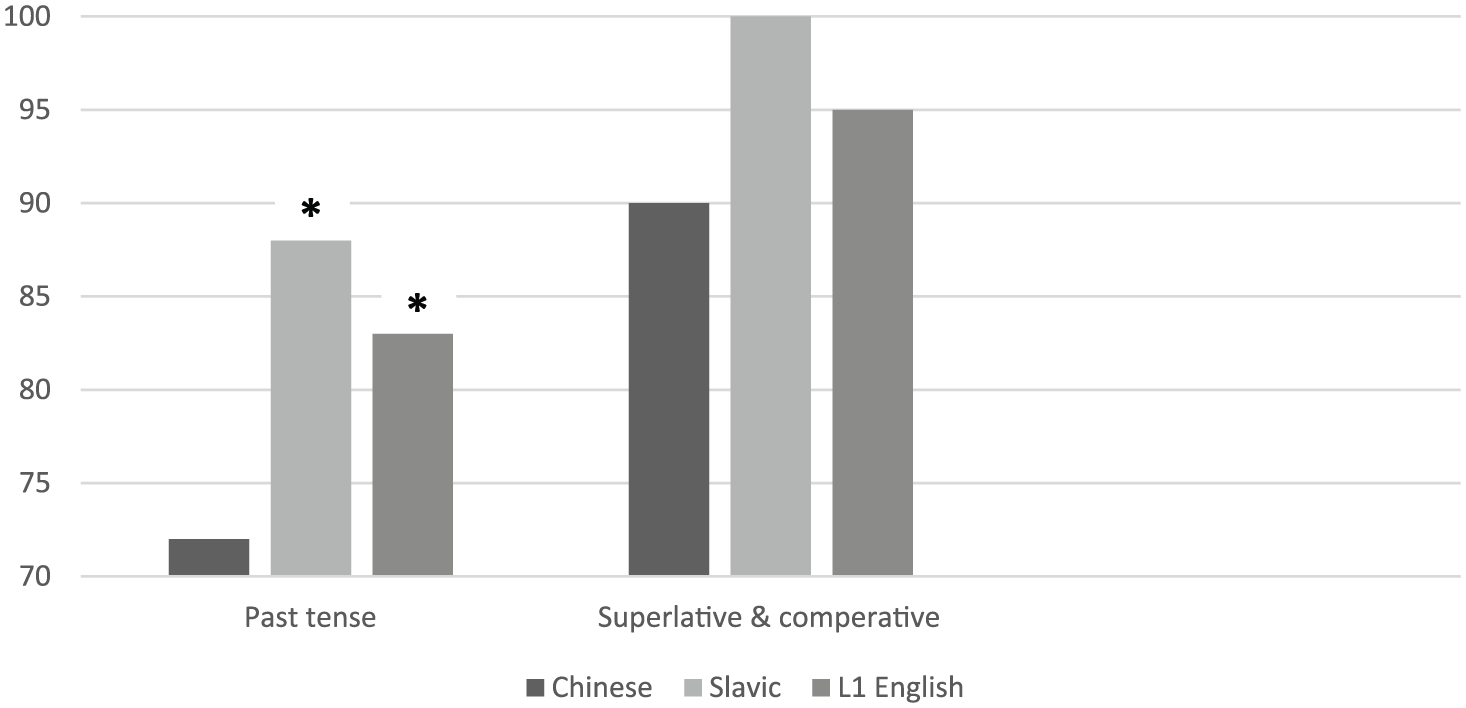
Mean percentage of correct answers for past tense and comparative and superlative constructions in each of the language groups.
Figure 1 demonstrates the similar performance levels of the L1 English and L1 Slavic groups on the two constructions, with a slight (but not significant) advantage of the Slavic group over the English group. Also shown is the lower performance of the Chinese group on past tense constructions, alongside similar (slightly but not significantly lower) performance on comparative and superlative constructions.
Discussion
As mobility across countries grows, it is becoming increasingly important to understand the development of second language acquisition both theoretically and practically. The current study focused on syntactic awareness skills, which contribute significantly to oral and written language. The first objective of the study was to examine whether or not there were differences in English syntactic skills among third graders in three language groups: Chinese-English speakers, Slavic-English speakers, and monolingual English speakers. The two L1 groups were compared to the L1 English speakers. All children were normally achieving readers who were matched with respect to word reading level, and had received similar reading instruction. The results showed significantly lower scores on the syntactic awareness task in the Chinese-English group than in the other two groups. This finding suggests that despite their intensive exposure to English as the language of instruction, syntactic awareness in English was not as well-developed in the Chinese-English group, even for children who placed above the 60th percentile in English word reading.
The results are consistent with our prediction that differences would be found between the groups, and that both the monolingual group and the L1 Slavic-English group would perform better than the L1 Chinese-English group. These findings are somewhat consistent with those of previous studies. Portuguese-English bilingual children in Canada scored significantly lower on the oral cloze task than did monolingual English-speaking children, even at higher grade levels including the fourth, fifth, and sixth grades (Da Fontoura & Siegel, 1995). In another study, first-graders from Punjabi-speaking families also scored lower on the oral cloze task than did monolingual English-speaking children (Chiappe & Siegel, 1999) as well as Italian-speaking L1 children (D’Angiulli, Siegel, & Serra, 2001) and Arabic-speaking children (Abu-Rabia & Siegel, 2002). However, other studies have demonstrated an advantage for bilingual students on syntactic awareness tasks (Bialystok, 1992, 1999, 2007; Davidson et al., 2010). In the current study, the Slavic-English speakers achieved scores that were similar to those of the L1 English speakers, showing that the specific L1 must be taken into account, as it may influence the development of syntactic awareness skills in L2.
The second objective of the study was to examine whether or not there were significant differences between the three groups on specific constructions in the syntactic awareness task. Two types of construction were addressed: past tense constructions, which exist in the English and Slavic languages but not in Chinese, and comparative and superlative constructions, which exist in all three languages.
As expected, the L1 Chinese-English group experienced difficulties with items involving past tense features, as compared to L1 Slavic-English and L1 English speakers. Specifically, native Chinese learners omitted markings in the past tense morphology in English. Interpretation of these results is based on the assumption that this learning situation would constitute a morphosyntax–semantics mismatch (Slabakova, 2009). This finding is consistent with previous results. Lardiere’s (2007) fossilized speaker Patty provided the -ed marker in around 34% of obligatory contexts, while Yang and Lyster’s (2010) instructed learners provided 55–63% of past tense markings in oral (pretest) production and 65–73% in written production.
Meanwhile, items involving the comparative and superlative constructions, which exist in all three languages, yielded similar scores across all language groups. This result appears to demonstrate the existence of negative and positive cross-linguistic transfer, supporting the possibility that L2 learners are more sensitive to syntactic awareness structures that are common in their L1 language. The results are somewhat consistent with previous studies on cross-linguistic influence from German to Greek on gender-related grammatical abilities among bilinguals. Specifically, German encodes grammatical gender but English does not, and German-Greek bilinguals performed better on Greek gender assignment and agreement tasks, as compared to English-Greek bilinguals (Kaltsa, Tsimpli, & Argyri, 2017). Therefore, we can conclude that the closer the L1 is to the L2, the higher the learnability of the L2. In our case, learning a L2 becomes more difficult when the L1 is morphologically less complex.
The critical question arising from these results is, why did normally achieving readers in the Chinese-English group demonstrate such difficulty with the oral cloze task in the English language? This question is particularly interesting in light of the results showing similar performance levels in the Slavic-English and native English groups. One explanation is related to possible interference caused by the grammatical structure of the Chinese language. In this sense, the findings support the existence of negative transfer, and strengthen the hypothesis that positive and negative transfer can occur in syntactic awareness, as in other lingual skills (Goldstein & Bunta, 2012; Odlin, 2005). Furthermore, typological similarity or overlap between languages leads to positive cross-linguistic influences (Ard & Homburg, 1983; Kellerman & Sharwood Smith, 1986).
Beyond these findings, it was interesting that the Slavic-English group achieved significantly higher scores than the Chinese-English group on the oral cloze task, even performing slightly (although not significantly) better than the L1 English speakers on the examined constructions.
The results of the current study support previous findings showing that increased morphological complexity of L2, as compared with L1, results in lower L2 learnability (Schepens et al., 2013a; van der Slik, Hout, & Schepens, 2017). Specifically, the findings may be related to the complexity and to the heavily inflected structure of the Slavic languages, in comparison to English. Thus, it may be that knowledge of a language with complex morphology can facilitate the learnability of L2 English. In accordance, children in the Slavic-English group had higher learnability of L2 English, which made learning syntactic awareness in English easier for them, in comparison to the Chinese L1 group.
Several theoretical and practical implications arise from the results of the current study. To begin with, it is important to consider the specific components involved in any given task used to measure syntactic awareness. There is much value in tasks that assess multiple components of syntactic awareness, which enable the examination of performance involving a wide range of lingual structures. However, it should be noted that scores on tasks of this type can only shed light on a general ability, rather than a specific component. Meanwhile, studies that focus on one construction alone (e.g., past tense, preposition) can only shed light on the abilities and developmental patterns related to that specific construction.
Different assessment tasks and task demands might explain the inconsistent results in the field of syntactic awareness in general, and specifically the findings indicating that bilingual individuals and L2 learners perform better than monolingual individuals on tasks requiring greater attentional control (Bialystok, 2001). In accordance, an important implication of this study involves the L1 of the L2 learner, the syntactic characteristics of which should be taken into consideration and compared to those of the L2 in order to better understand how the development of syntactic awareness skills in L2 will be affected.
The findings of this study highlight the need to provide children from different language backgrounds with direct support, in accordance with the characteristics of their L1. Although participants in the Chinese-English group developed above average reading ability, they still struggled with specific items on the syntactic awareness task. Thus, direct support should target grammatical constructions of the L2 that do not exist in the L1. Future studies should further examine the learnability of constructions that exist in L2 and do not exist in L1, in order to learn about and address potential learner challenges.
The current study did not include an assessment of L1 language proficiency among participants. Future research should investigate the development of syntactic skills among children from different language backgrounds who are learning English as a L2. Special attention should be given to negative and positive transfer from L1 to L2. In addition, the transfer of other domains that are assumed to have close linguistic distances between Mandarin-English and Slavic-English bilingual individuals, such as articles, is important in further understanding the roles of proficiency, linguistic distance, and learnability.
Footnotes
Acknowledgements
The author would like to thank the principals, teachers, and students of the North Vancouver School District for their support and participation in this study and to Elenita Tseng for assistance with data collection and entry. In addition, the author would like to thank Linda S. Siegel for granting access to the data base as well as her ongoing valuable support and insights in the process of this study. Furthermore, the author would like to thank Professor David Share for his insight in the writing and the analysis process of of this study.
Declaration of conflicting interests
The author(s) declared no potential conflicts of interest with respect to the research, authorship, and/or publication of this article.
Funding
The author(s) disclosed receipt of the following financial support for the research, authorship, and/or publication of this article: This research was supported by a grant from the Natural Science and Engineering Research Council of Canada to Linda S. Siegel.