



Abstract
This article examines the competence of heritage speakers of Portuguese living in Germany with respect to clitic placement in Portuguese by comparing their performance with that of monolingual speakers of the same age (7–15 years of age) in a test designed to elicit oral production data. The results of the study indicate that the heritage speakers go through stages in the acquisition of clitic placement that are similar to those of monolingual acquirers even though they take longer to attain the target grammar.
1 Introduction
Heritage bilingual speakers (HS) have received particular attention in the field of language acquisition only in the last 20 years (Montrul, 2002, 2008, 2010; Pires & Rothman, 2009; Polinsky, 1997, 2006, 2008; Polinsky & Kagan, 2007; Rothman, 2007, 2009; Schoenmakers-Klein, 1989, 1997; Silva-Corvalán, 1994; Valdés, 1995, 2000). HSs are typically second- and third-generation migrants, who grow up in the country of migration. The host language develops commonly as their dominant language, while the language of origin, their parents’ language, is their heritage language (HL). HSs acquire their HL like monolinguals and simultaneous bilinguals, that is, through their inborn faculty of language, triggered by naturalistic early exposition to the HL; nevertheless, they differ from the other two groups with respect to the quantity and quality of the input they receive from their HL. As Polinsky and Kagan say, “their heritage language begins in the home, and often stops there” (Polinsky & Kagan, 2007, p. 369). Commonly, these speakers have no (or very limited) formal education in their heritage L1 and show low literacy skills. In opposition, the majority language is the language of schooling and socialization. Most daily interaction occurs in the majority language.
Despite the common factors that define heritage bilinguals, they are not a homogeneous group. The level of proficiency in the HL may vary from ‘very low’ to ‘highly proficient’ given that it may be influenced by a variety of linguistic and extra-linguistic factors. The onset of exposure to the majority language can occur at the same time as the exposure to the HL (simultaneous bilingualism) or only later (successive bilingualism). The majority language can be totally excluded from the domestic environment, it can be used at home but only among siblings or it can be used in parallel to the home language by the parents. There are also other factors, like language attitudes and motivation, which influence the maintenance of the heritage language inside a migrant family or community (Hakuta & Pease-Alvarez, 1994). Furthermore, not all HSs have the opportunity or the wish to attend HL programs, so there are huge differences in formal education and literacy among HSs. As stated by Rothman (2009), “without adequate academic support of the heritage language during the school years, heritage speakers often miss the chance to acquire literacy skills in the language” (Rothman, 2009, p. 157).
In general, HSs tend to show differences in language competence in comparison to monolingual speakers of the same age (Pires & Rothman, 2009). Hence, some authors argue that heritage bilinguals have undergone L1 attrition (Montrul, 2002, 2008; Polinsky, 1997, 2007, 2008; Silva-Corvalán, 1994). Polinsky (2008), for instance, demonstrates that HSs of Russian who live in the USA reanalyze the grammatical gender system of Russian by reducing the three-gender-system.
The deficiencies shown by the HSs regarding their HL competence led some authors to propose that the acquisition of an HL equals L2 acquisition. L2 learners rarely achieve complete native-like competence in all domains of their second language (Hyltenstam & Abrahamsson, 2003). They differ from native speakers in several domains of the grammar. Hence, some studies propose that HSs fail to achieve native-like competence in the same grammatical domains as L2 learners (e.g. in flexional morphology, as described in Montrul, Foote, & Perpiñán, 2008). A question that continues to be open to debate and needs more research is whether transfer from the stronger language plays the same role in heritage language acquisition as in L2 acquisition. Montrul and Ionin (2010), for instance, show in their study on transfer effects in the interpretation of definite articles by Spanish heritage speakers that the HSs exhibit transfer from the majority language, English, but they also demonstrate that crosslinguistic influence is selective. Their results show evidence of transfer in the interpretation of definite articles in generic but not in inalienable possession contexts.
Another factor that is common in L2 and HL acquisition is variation in the quality and quantity of the input in the target language. HSs are exposed to a restricted number of contexts and interlocutors (Montrul, 2010), in contrast to the input that a monolingual child receives during the acquisition process. It is almost consensual that the quality and quantity of input plays a central role in language acquisition; however, how much input a child needs in order to develop native competence remains an open question. Following Chomsky (1986), the child acquires its native language on the basis of little evidence. However, empirical research with hearing children of deaf parents has shown that there is a minimal baseline of input that these children need in order to develop productive competence in their spoken L1 (Sachs, Bard, & Johnson, 1981). Schiff-Myers (1988), for instance, shows that these children need a minimum of 5 to 10 hours per week of interaction with non-deaf people (Schiff-Myers, 1988, p. 54). The same conclusion applies to bilingual children. De Houwer (1999) emphasizes that the bilingual child needs sufficient input from both languages in order to develop native-like proficiency in both.
The HS generally receives intensive input from his/her heritage language until the age of three years, but the input decreases progressively from this age. Therefore, an important question in heritage language research is to investigate if the reduction of exposure to the HL influences its acquisition.
Another important variable is
Pires and Rothman (2009) point to another variable that may influence the development of heritage languages: the factor
Pires and Rothman (2009) argue that certain linguistic properties are only present in the standard norm, which is acquired in school, and are almost inexistent in the colloquial norm. Consequently, the heritage speaker who is not (or only marginally) exposed to the standard form does not have the opportunity to acquire these grammatical aspects. The contrast between standard and colloquial norm is especially expressive in the case of Brazilian Portuguese (BP), where we can find a high degree of variation in many grammatical domains, such as the verbal morphology, the clitic system, the subjunctive or the inflected infinitives. In the case of inflected infinitives, the authors argue that BP colloquial dialects no longer instantiate inflected infinitives (see also Pires, 2006), but this grammatical issue is taught at school and BP monolinguals show full competence of them in comprehension/grammaticality judgment tasks (see Rothman, 2007). In contrast, Brazilian HSs who live in the USA, studied by Rothman (2007) and Pires and Rothman (2009), show insufficient knowledge of this property. The authors explain this deficit by arguing that “mismatches between heritage and monolingual native grammars are not in all cases the result of qualitative distinctions between the process/mechanisms of native acquisition in both cases, but rather the result of exposure to significantly distinct primary linguistic data” (Pires & Rothman, 200, p. 236). Brazilian HSs in the USA have not been sufficiently exposed to the standard norm, where inflected infinitives occur.
The present study aims at analyzing the knowledge of the syntax of clitic placement in European Portuguese (EP) by heritage children who live in Germany, through an elicited production test. The results of the heritage children are compared with those of Portuguese monolinguals of a similar age span. The aim of the study is to determine whether young second-generation immigrants who acquire Portuguese as HL develop identical knowledge of the Portuguese clitic system as Portuguese monolinguals, and if not, why. Furthermore, the role of the majority language, German, is discussed. In our approach to cliticization in EP, we will adopt the current framework of Principles and Parameters theory, the Minimalist Program as outlined in Chomsky (2001) as well as some key ideas of Distributed Morphology (Halle & Marantz, 1993). The article is organized as follows. Section 2 describes clitic placement in EP and word order in German; Section 3 presents the hypotheses, the methodology and the participants. Section 4 presents the results of both informant groups, which are discussed in the last section.
2 Pronominal objects in EP and German
In EP pronominal objects are realized as clitics, in other words they are unstressed forms that are invariably displaced to a position that is adjacent to the verb carrying main inflection (they either immediately follow the verb or immediately precede it, depending on the syntactic context). German, on the other hand, lacks pronominal clitics: its pronominal objects are free forms, which can be strong or weak depending on the position they occupy and on their information status (on the distinction between strong and weak pronouns, see Cardinaletti and Starke, 1999). In this section, we briefly describe the two systems.
2.1 Pronominal clitics in EP
Pronominal object clitic placement is one of the most complex aspects of the grammar of EP. Normally, object clitic pronouns occur in enclitic position: (1) a. Ele viu he saw-her / he her saw ‘He saw her.’ b. Demos gave-her the book / her gave the book ‘He gave her the book.’
Proclisis occurs in the following contexts (Barbosa, 1996, 2000): I. Subordinate clauses introduced by a complementizer: (2) Eu duvido que ele I doubt that he her see. ‘I doubt it that he saw her.’ II. Whenever the following elements precede the verbal complex within the minimal Complementizer Phrase (CP) that contains it: (3) Wh-phrases: Quem who him saw ‘Who saw him?’ (4) Non-specific indefinite Quantifier Phrases (QPs): a. Subject: Alguém / algum aluno Someone / some student him saw ‘Someone / some student saw him.’ b. Object: Alguma coisa some thing to-him said but not know the what ‘Something they told him, but I don’t know what.’ (5) Negative QPs: a. Subject: Nenhum aluno no student SE forgot of-the book ‘No student forgot the book.’ b. Object: Nada nothing to-you can say ‘There is nothing I can tell you.’ (6) Universal QPs: a. Subject: Todos everyone SE forgot of-the book ‘Everyone forgot the book.’ b. Object: Tudo everything to me refused ‘They refused everything to me.’ (7) Determiner Phrases modified by Focus particles: a. Subject: Só o Pedro only the Pedro him saw ‘Only Peter saw him.’ b. Object: Só isto only this to you can say now ‘I can tell you only this.’ (8) Sentential negation and negative adverbs: O João não/nunca the João not /never her saw ‘João never saw her.’ (9) Aspectual adverbs: O Pedro já / ainda the Pedro already / still him saw ‘Pedro already / still saw him.’
In general, clitic placement is not sensitive to the status of the pronominal object: the clitic is subject to the same restrictions regardless of whether it is a direct object (see 4a), an indirect object (see 4b) or a reflexive pronoun (see 6a).
The complexity inherent to this phenomenon raises interesting problems for acquisition. This is why it is particularly suited to the topic at hand. Moreover, this system is radically different from the pronominal system in German. We turn to this matter in the following section.
2.2 Word order in German
In contrast to EP, German lacks pronominal clitics and only has weak and strong pronouns.
Additionally, EP and German show different patterns of word order. German is a verb-second (V2) language, which means that the second position of the clause is occupied by the finite verb and only one constituent is in the first position. In addition, German is an SOV language, as witnessed in subordinate clauses introduced by an overt complementizer (den Besten, 1983) and in compound verb forms in main clauses, where the finite verb moves to second position, but the non-finite form remains in sentence-final position.
Whereas verb position is very strict in German, the order of the other constituents is relatively free and largely conditioned by discourse factors related to information structure (Haider & Rosengren, 2003). In this sense, the position of the object pronoun in relation to the verb depends on (i) the pragmatic status of the object (e.g. whether it is a topic or bears contrastive focus); (ii) on the type of pronoun (strong versus weak); and (iii) on the type of sentence (main or subordinate clause). If we combine these criteria, the following sequences are possible: I. The (strong, focus-stressed) pronoun precedes the verb in the second position of the main clause. (10) a. him saw Pedro at that time ‘Pedro saw him at that time.’ II. The pronoun immediately follows the verb in second position in the main clause: b. Pedro sah Pedro saw him at that time ‘Pedro saw him at that time.’ III. The pronoun follows the verb (which is in the second position of the main clause), but other constituents (e.g. the subject) are between the verb and the object pronoun. c. Damals sah Pedro At that time saw Pedro him ‘Pedro saw him at that time.’ IV. The (strong, focus-stressed) pronoun immediately precedes the verb, which is in the final position of a subordinate clause: d. Ich glaube, dass Pedro damals I think, that Pedro at that time him saw ‘I think that Pedro saw him at that time.’ IV. The pronoun precedes the verb (which is in the verb-final position of a subordinate clause), but other constituents are between the verb and the object pronoun. e. Ich glaube, dass Pedro I think, that Pedro him at that time saw ‘I think that Pedro saw him at that time.’
In sum, German object pronouns have little in common with Portuguese object clitics. In German, the position occupied by object pronouns is largely determined by information structure (whether the pronoun is a topic or focus). The object pronoun may occur in different positions, which are not necessarily adjacent to the finite verb. In EP, an object pronoun must be an unstressed form that is adjacent to the verb carrying main inflection (either immediately following the verb or immediately preceding it, depending on the syntactic context). In order to focus a (direct or indirect) object pronoun, EP must resort to clitic doubling as illustrated in example (11): (11) Ele viu-me a mim. He saw-me to me ‘He saw me.’
3 The present study
Even though there are several studies on the acquisition of clitics in EP (see Costa & Lobo, 2009; Costa, Lobo, & Silva, 2009; Duarte & Matos, 2000; Duarte, Matos, & Faria, 1995; Silva, 2007, 2009), we know of no systematic quantitative study of the enclitic/proclitic alternations in child speech. The articles by Costa and Lobo (2009), Costa, Lobo and Silva (2009) and Silva (2007, 2009) show that monolingual preschool children (between 3 and 6 years old) go through an initial stage in which they omit clitics. Subsequently, they gradually start producing clitics. In spite of this, little is known about the alternations between proclisis and enclisis in child speech. Silva (2007) reports attested mistakes in clitic placement between the ages of 3 and 6.5 consisting in the use of enclisis in the context of elements that trigger proclisis in the adult grammar. Similar observations are made in Duarte, Matos and Faria (1995) and Duarte and Matos (2000). These authors claim that, at initial stages of acquisition, monolingual children generalize enclisis. It is only later (at the age of 4) that proclisis is acquired.
These authors also note that, to a lesser extent, the tendency to use enclisis in contexts where the standard grammar would use proclisis is also found in the casual speech of older children and adult speakers. However, this phenomenon is sporadic in the adult grammar. In embedded clauses selected by bridge verbs, such as dizer ‘say’ or achar ‘think’, the alternation between the two orders is more productive. 1
Given what we have said thus far, the main research questions of the present study are, first, to determine the extent to which the HSs deviate from monolinguals in aspects of the core grammar of Portuguese; second, to check if heritage children, who acquire EP in contexts of reduced input, follow the same pattern of acquisition as monolingual Portuguese children; and, third, to examine the role of transfer from German.
Taking into account these research questions, we can draw the following hypotheses concerning heritage speakers. If the results regarding clitic placement are similar in both research groups, we may conclude that, as far as this particular aspect of the grammar is concerned, competence in the HL is native-like. If, on the other hand, the HSs differ from the monolingual controls, there are different hypotheses to consider depending on the divergent patterns actually found. The first one concerns the role of the host language. As shown in the previous section, EP and German display very distinct patterns of object expression. In this particular case, the majority language does not display clitics and the placement of the (strong or weak) object pronoun is governed by factors that do not play a role in Portuguese. This means that there is not a particular position (enclitic or proclitic) that would be favored by a German speaker. Therefore, if the HSs produce sentences with cl-V order where enclisis is required and V-cl order where proclisis is the only option, a case for transfer can be made. Moreover, since in German other constituents may occur between the object pronoun and the verb, as shown in examples (10c) and (10e), ungrammatical cases with an expression intervening between the clitic and the verb could be interpreted as evident instances of transfer from German.
If a consistent pattern of deviance is found, there are two hypotheses to consider: (a) the deviant cases attested are instances of enclisis in contexts that require proclisis in the target grammar; (b) the deviant cases attested are instances of proclisis where enclisis is required in the target grammar. Hypothesis (a) would strengthen the theory that the HSs follow the same pattern of acquisition as the monolingual children, given that monolingual Portuguese children tend to overuse enclisis in the initial stages of clitic production. In this case, the divergent behavior of the HSs would be attributed to the drastic reduction in the linguistic input that characterizes the development of the HL. If (b) is attested, then the HSs would exhibit the opposite pattern of the one found in monolingual children, who never produce proclisis when enclisis is required. These findings would indicate that the HSs do not acquire Portuguese in a native-like fashion.
3.1 Participants
A total of 24 Portuguese children aged between 7 and 15 years participated in the present study. The biographic information about the heritage speakers was collected through interviews. First the participants were interviewed alone with the researcher. This interview was tape-recorded and transcribed in a current word program. After the test session, the parents were also interviewed in order to complete missing information. The group of HSs includes 12 children/teenagers, aged between 7 and 15 (mean = 10.83; standard deviation [SD] = 2.62). All of them grew up in Germany, four live in South Germany, in a small town near to Stuttgart, seven live in the North (Hamburg) and one participant (HS_4) had returned to Portugal one month before the testing session. Nine participants were born in the host country, while the other three immigrated before the age of 2. The participants share the common characteristics of heritage speakers. In eight cases both parents are first generation migrants. In the other four cases, one parent has grown up in Germany, married someone who was living in Portugal and took the spouse to Germany after their marriage. In these couples, one parent is a heritage speaker of Portuguese, but the other is a late L2 learner of German; therefore, Portuguese is the preferred language used with the children. Portuguese is the predominant language at home in every case. It is the language spoken by parents and other members of the family in their daily interactions with the child. The parents who are themselves heritage speakers of Portuguese tend to use more German with their children; however, all these bilingual parents said that they also use Portuguese, especially in the presence of the spouse. The parents have lower-middle-class jobs; no one is unemployed. None of the parents have a university degree. The parents who grew up in Germany have concluded the 10th grade of secondary school and completed a professional training degree. The first generation parents have a lower school grade, having concluded elementary school in Portugal (6th or 9th grade).
All participants said that German was the language they feel more comfortable with and that they know better. Actually, the majority language is spoken at school, with friends and in other daily contexts outside home. All participants are normally integrated in the German school system. Four children are still attending elementary school; the other eight participants are in upper secondary school grades. When asked about their schooling progress, all parents described their children as normal students, without specific difficulties that might be related to their German proficiency. Actually, out of the eight participants who are attending a secondary school, five are at the Gymnasium, the most demanding German school type.
The Portuguese input that these speakers receive is mainly on an oral basis. They speak Portuguese with their parents, their siblings and with other family members, like grandparents, uncles, aunts and cousins. There is a relatively large community of Portuguese migrants in Hamburg and Stuttgart, which allows HSs to have contact with other Portuguese speakers outside their family. The church also plays an important role, since all participants attend the Portuguese mass on Sunday and are enrolled in catechism. The speakers also have intensive contact with Portuguese during the summer holidays annually spent in Portugal, in the home village of their parents. The contact with Portuguese through TV is less frequent than one might suppose. Even though the parents have access to Portuguese TV through cable or satellite dish, most children said that they hear the Portuguese TV newscasts together with their parents over dinner, but they don’t have the habit of watching Portuguese TV series. 2 Therefore, the amount and type of exposure to oral Portuguese is very similar in all participants of this group.
The access to the so-called ‘academic language’ (Cummins, 2000), for example through exposure to written European Portuguese, is restricted to the Portuguese courses that the participants are/were attending, since no participants read Portuguese literature or newspapers/magazines outside the classroom. Out of the 12 HSs, 10 are enrolled in courses of formal instruction in Portuguese language; however the type of course and the number of years of instruction differ significantly. Mainly, two types of Portuguese classes can be taken. The Portuguese–German bilingual school 3 offers bilingual instruction in German and in Portuguese, through an education model in which a German and a Portuguese-speaking teacher work as a team teaching some subjects together. Approximately 50% of the curriculum is taught bilingually, comprising a total of 12 hours per week (Duarte, 2011, p. 77). Furthermore, in Germany, Portuguese migrant families have the possibility of sending their children to special programs of instruction for heritage children. The programs are organized by the network “Teaching Portuguese abroad” 4 of the Instituto Camões and sponsored by the Portuguese Ministry of Education. These extra-curricular classes take place in the afternoon or Saturday morning, approximately four hours per week. 5
The participants differ in their exposure to formal instruction in Portuguese. Three children attend the bilingual Portuguese–German school (HS_2, HS_5, HS_8). Two participants have no schooling in Portuguese (HS_1 and HS_12) and two others have attended the extra-curricular Portuguese classes for one year, but are no longer enrolled in it (HS_7 and HS_11). The other participants started to attend the Portuguese classes for Portuguese immigrant children at the age of 7, on an average of three hours a week, and are still enrolled in it (HS_3, HS_4, HS_6, HS_9, HS_10). Since it is very difficult to control which contents the heritage speakers have acquired in the Portuguese classes and which level they have attained, we decided to define the degree of formal learning by measuring the amount of hours of formal instruction in Portuguese up until the moment of the interview. For each participant, the estimated amount of instruction in Portuguese was calculated on the basis of the formula – hours per week x 40 weeks per year (excluding holidays) x number of years enrolled in Portuguese classes.
Other factors may influence the proficiency of bilingual children in their heritage language, such as language attitude, motivation, and identity. The role of these variables has been studied in heritage language research mainly from a sociolinguistic and pedagogical perspective; however the extent to which these factors may influence the linguistic competence of HSs remains an open question (see Geisherik, 2004; Kong, 2011, for two studies on, respectively, Russian and Korean HSs in the USA). These factors were not explicitly controlled in the present study, but all participants showed a very positive attitude towards their heritage language, which has a strong emotional charge.
Table 1 shows the age, gender, amount of exposure to formal instruction (according to the formula presented above) and level/type of German school of the group of HSs.
Group of heritage speakers.

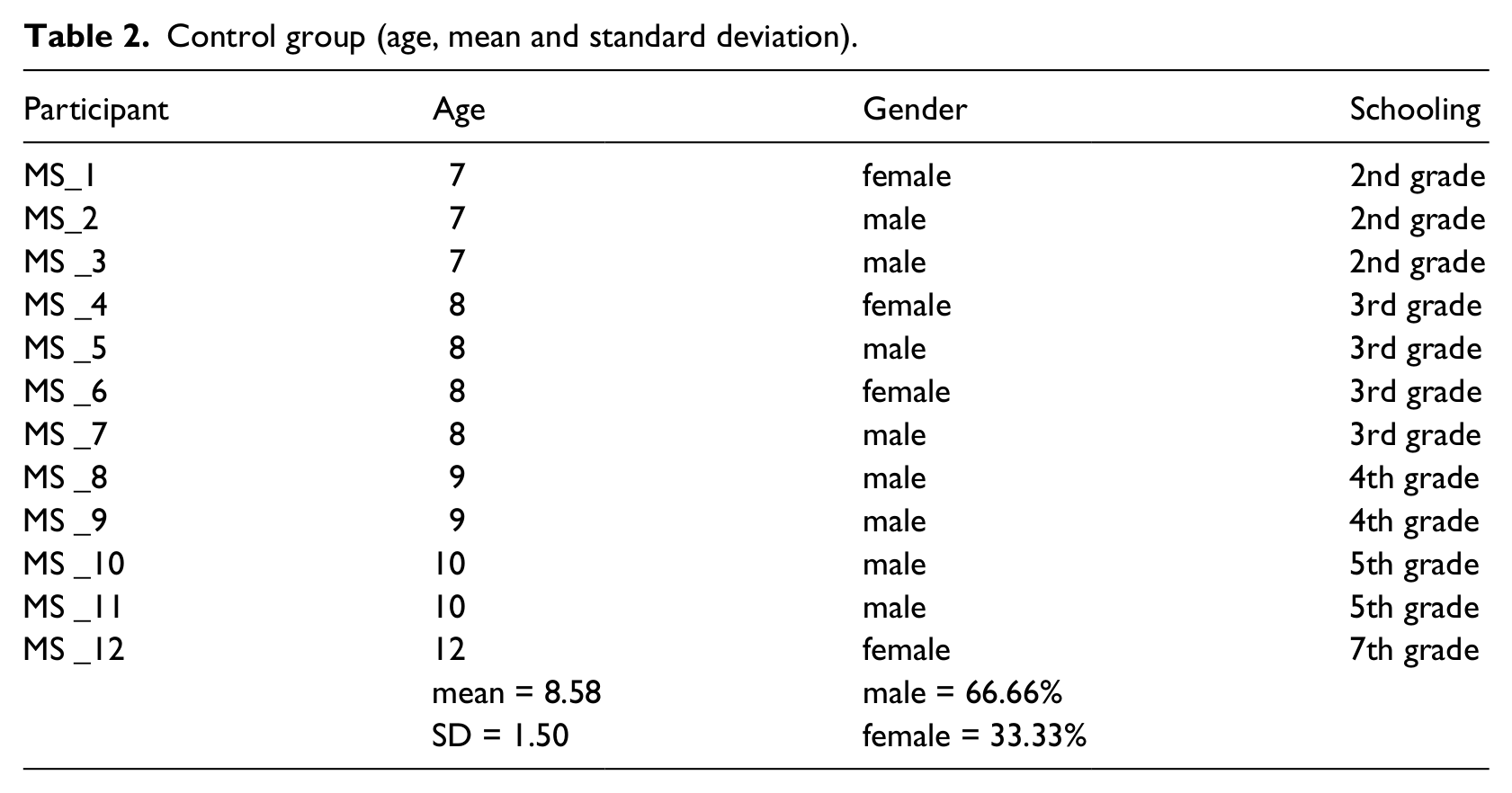
The control group is made up of 12 monolingual speakers, aged between 7 and 12 years. The mean age of this group is 8.58 (SD = 1.5), so it is slightly lower than the HS group. The members of the control group and the HSs are from the same region in northern Portugal, a small village on the coast. They also have similar socioeconomic status, belonging to lower-middle-class families. The participants in the control group attend public schools. They were all born in Portugal and never left the country. They study English as a foreign language at school, but they don’t speak any other language. Both groups integrate female and male participants, however – randomly – the control group has more male participants (66.66%) than the group of heritage speakers (41.66%). Their age, mean and standard deviation, gender and schooling are represented in Table 2.
Control group (age, mean and standard deviation).
3.2 Methodology
Clitic placement was tested by an oral production task, performed in a silent room. At first, the children were told that they would see a story on the computer screen involving a dialogue between two characters, a Portuguese boy and a foreign girl who had trouble constructing Portuguese sentences. The task of the child was to help the girl construct sentences from a set of words given in random order. The interviewer read the boy’s sentences aloud, assuming the role of the boy, and the child was to assume the role of the girl, thus “helping” her put the words together. The set of words composing each sentence was shown on the screen and the child had to construct the sentence and say it aloud. There were no limitations of time.
The test contains 18 sentences out of which 16 contain clitics: 12 in contexts of proclisis and 4 in contexts of enclisis. The proclitic constructions involve three different conditions (4 sentences each): (i) constructions with sentential negation and negative adverbs, as in Ainda não
Before testing, there was an oral interview focusing on biographic and sociolinguistic questions designed to define the profile of each participant.
4 Results
The central aim of this study is to test whether the participants know the rules of clitic placement in Portuguese, specifically in contexts of proclisis. Consequently, the results will focus on the correct use of clitics in the three contexts that require proclisis (negation, subordinate clauses, sentences with aspectual adverbs and nonreferential quantifiers).
First the results of the monolingual controls will be presented. Figure 1 shows the accurate use of proclisis (in percentage) per individual.

Proclisis: percentage of accuracy (monolingual control group).
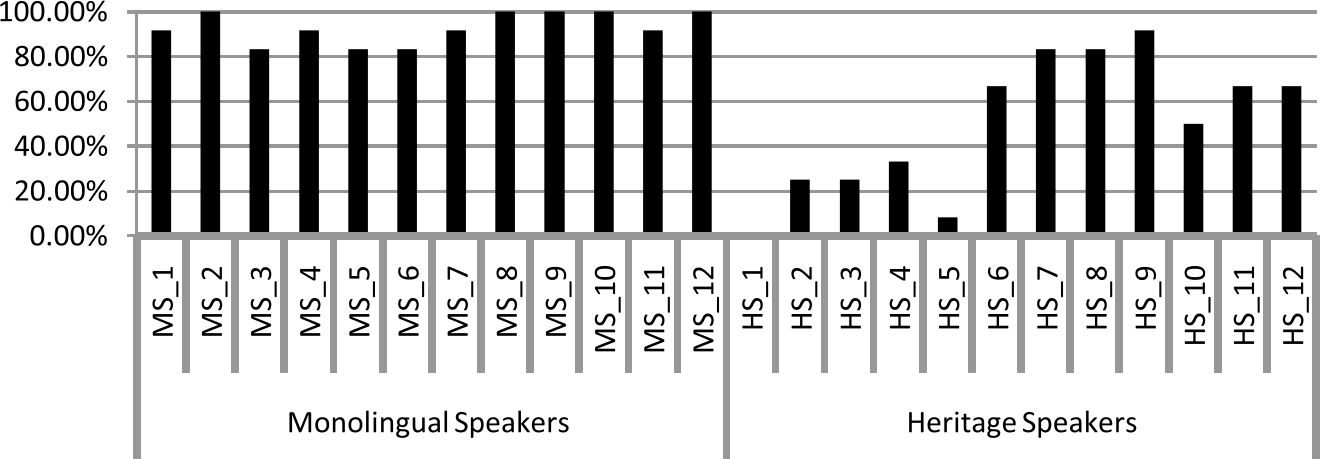
The average of accurate use of proclitic pronouns is about 93.1%, (83.3%–100%), the standard deviation is 6.97. Five monolingual children use proclisis in all proclitic contexts, four use proclitic pronouns in 91.7% of proclitic contexts and the other three, in 83.3% of proclitic contexts. The data show that monolingual children have a very robust knowledge of proclisis, even though there is some variation. Seven children use enclisis instead of proclisis in at least one context. Figure 2 shows the raw values of accurate use of proclisis per condition.

Accurate use of proclisis per condition (raw counts) – monolingual control group.
The analysis per condition shows similar results in conditions I and III and slightly lower scores in condition II among the 12 monolingual controls. Regarding the first condition (I. Negation), enclisis is produced instead of proclisis in two out of the 48 sentences. One participant fails to produce proclisis in the sentence “Não
The results concerning the contexts of enclisis are very clear. No monolingual child produces proclisis in contexts of enclisis.
Now we turn to the HSs. Figure 3 shows the percentage of accurate proclisis production in the HS group.

Proclisis: percentage of accuracy (heritage speakers).
The average of accuracy is about 50% in this group. However, inter-group variation is much higher in the case of the HSs than in the monolingual controls. The percentage of accurate use of proclitic constructions varies between 0 and 91.7% (standard deviation = 30.99). One child does not use proclitic pronouns at all (HS_1), four produce less than 35% of proclitic constructions (HS_2, HS_3, HS_4, HS_5) and one speaker uses proclisis in half of the proclitic contexts (HS_10). On the other hand, three heritage speakers show results which are very close to the average of accuracy of the monolinguals: two participants use proclisis in 83.3% of the contexts (HS_7, HS_8) and one participant produces 91.7% of proclitic pronouns (HS_9). Contrary to the monolingual controls, no HS uses proclisis in all required contexts. Figure 4. shows the accurate use of proclisis por condition.
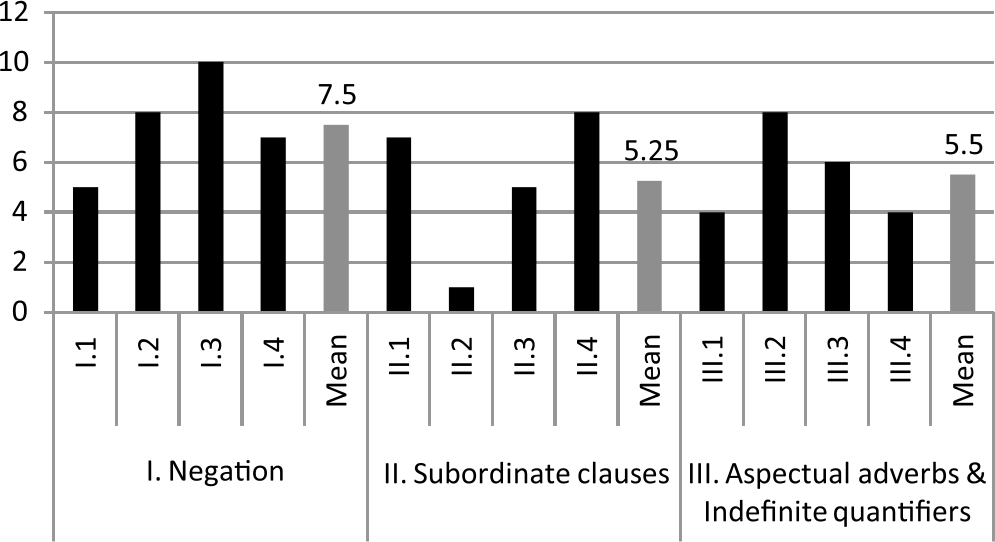
Accurate use of proclisis per condition (raw counts) – heritage speaker group.
Even though the HSs score lower than the monolingual controls, the tendency of accuracy per condition is very similar in both groups. Also in the group of HSs, the condition with the lowest average of accurate proclitic realization is condition II. Again, the most problematic context is sentence II.2, with the bridge verb “achar” (‘think’). Only one HS produces proclisis in this context. The most robust condition is the first one (I. Negation), even though the average of ungrammatical clitic placement is much lower in this case, compared to the results of the monolingual speakers. The HSs do not produce proclisis in 18 out of the 48 given contexts. The most problematic context is sentence I.1 “Não
As in the Monolingual Group, no participant of the HS Group produces proclisis in contexts that require enclisis. This similarity between the two groups is rather striking and constitutes evidence against transfer from the majority language. In German, pronouns do not occupy a fixed position relative to the verb carrying main inflection. Therefore, no particular pattern is expected to occur if transfer applies. Moreover, in German a pronoun may appear in absolute initial position followed by the verb in second position. Thus, the fact that no participant of the HS Group uses cl-V order in initial position constitutes an argument against transfer. Finally, no HS produces sequences in which the clitic pronoun is not adjacent to the verb. As discussed in Section 3, the realization of sentences with constituents between the verb and the clitic could be interpreted as an effect of transfer from German word order, since in German the object pronoun does not have to be adjacent to the verb. Figure 5 presents the averages of accuracy in both groups.
Proclisis: percentages of accuracy (both groups).
A non-parametric Mann-Whitney test reveals a highly significant difference between both groups (Z = -3.748, p < 0.001), but the inter-group variation among the HSs is so high that it is necessary to relate the results with extra-linguistic factors that might influence the proficiency of the participants in this particular grammatical domain. The two independent variables that were controlled in this study are
Concerning
A new statistical test was run in order to compare the average of accurate production of proclitics in both subgroups. The results show that the younger HSs use proclisis only in 26.4% of all contexts (SD = 23.23), while the average of accuracy is about 73.6% in the group of the older HSs (SD = 15.28). A non-parametric Mann-Whitney confirms that there is a highly significant difference between both subgroups (Z = −2.589, p = 0.009). The younger heritage children show considerable difficulties in the production of proclitic constructions. Only a 10-year-old boy (HS_6) scores slightly higher than the other participants of this subgroup (66.7%). On the other side, in the group of the older HSs, only the 12-year-old participant HS_10, scores slightly lower (50%). The other participants vary between 66.7% and 91.7% of accurate use of proclitic pronouns. These results indicate that the variable
In order to test the influence of the variable
Variable exposure to formal instruction.

The subgroup with little (or no) exposure to formal instruction presents a mean of 54.2% of correct production of proclisis. Surprisingly, the intermediate subgroup (participants with 240 to 1140 hours of formal instruction) scores lower than the first subgroup with an average of 37.5%. In the case of the third subgroup (the participants with most exposure to formal instruction) the mean is about 58.3%, that is to say, it is slightly higher than in the other two subgroups. In general the mean values are very close in the three subgroups. A Kruskal-Wallis test confirms that there is no statistical difference between the three subgroups concerning the variable
A closer look to the data shows that the youngest participant (7 years old), who did not attend a heritage language class, has the lowest result (0% of proclisis), but the oldest speaker, who also did not attend any kind of classes, scores significantly higher (66.7%). This individual comparison suggests that the variable
5 Discussion
Summing up our results thus far, we reach the following conclusions:
As regards clitic placement, the HSs do not have the same level of proficiency as the MSs of the same age. The HSs show an average of accurate results of 50%. The MSs, by contrast, display an average of accuracy of 93%.
The HSs use enclisis in contexts of proclisis; the converse is not attested at all.
Age appears to be the key factor: the younger HSs reveal significantly lower rates of accurate results than the older HSs.
Formal instruction does not have a significant impact on the different levels of accuracy evidenced.
Even though there are no quantitative studies of clitic placement in the acquisition of EP by monolinguals, it has been observed that children tend to overgeneralize enclisis in early stages of acquisition (Duarte & Matos, 2000; Silva, 2007). Thus, the results of our study confirm the hypothesis that the HSs follow the pattern of monolingual acquirers, in other words they start by overgeneralizing enclisis and then they acquire the contexts that require proclisis, even though they do it at a slower pace than the MSs. The differences detected between the younger HSs and the older ones indicate that the contexts of proclisis are eventually acquired, but at a delayed stage when compared to monolinguals. Our hypothesis is, thus, that the HSs take longer to acquire the grammar of clitic placement, because they are exposed to reduced input, but the strategies used in the process are identical to those of the MSs. This is also confirmed by the detailed analysis of proclitic use per condition. The HSs tend to score lower in contexts where the monolingual controls (and adults in general) also show some variation in EP, namely in subordinate clauses selected by bridge verbs.
At this point, the question that arises is why enclisis is the pattern that is generalized and not proclisis. Overgeneralization of one pattern over another is not surprising if something like the Subset Principle is a guiding strategy in acquisition. This principle, originally proposed by Berwick (1985), states that the learner “must select the smallest possible language compatible with the input at each stage of the learning procedure” (Clark & Roberts, 1993, pp. 304–305) and is designed to capture the fact that children do not seem to make use of negative evidence. By positing the grammar that generates the smallest possible language compatible with the trigger experience, the acquirer is able to rely on positive evidence only in the process of convergence towards the target grammar. Since a language that only has enclisis or proclisis is a subset of a language that possesses both patterns, it is not surprising that the child should start by overgeneralizing one pattern. Notwithstanding this, the question that arises is why enclisis is the generalized pattern and not proclisis.
One first hypothesis to consider is whether the option for enclisis is due to frequency effects. In order to verify this hypothesis, an automatic search was carried out on the Linguateca Speech Corpus Museu da Pessoa. 6 In a total of 6501 occurrences of clitics, 3380 tokens of enclisis (52%) and 3121 (48%) tokens of proclisis were attested. Even though enclisis is more frequent than proclisis, the difference between the two is insignificant. Therefore, we conclude that frequency is not the relevant factor.
It seems evident that the answer to the question why enclisis is the overgeneralized pattern in acquisition depends on the theory of clitic placement in the adult grammar. The literature on the syntax of pronominal clitics in EP is abundant and a number of different theories have been proposed within the framework of Principles and Parameters theory (see Barbosa, 1996, 2008; Costa & Martins, 2003; Duarte & Matos, 2000; Duarte, Matos & Gonçalves, 2005; Madeira, 1992; Magro, 2008; Martins, 1994; Raposo & Uriagereka, 2005; Rouveret, 1992; Uriagereka, 1995). Here, we will follow the set of proposals that assume that, in the syntax, the clitic is placed to the left of the functional head that contains the verb, enclisis being derived in the post-syntactic component of the grammar (see Barbosa, 2008; Costa & Martins, 2003; Magro, 2008). Thus, in the syntax, we have the following configuration: (12) Syntax: [CP cl [
These authors assume the model of Distributed Morphology (Halle & Marantz, 1993). In this model, the terminal nodes of the syntactic derivation (morphemes) are bundles of abstract syntactic features relevant only to syntax, with no phonological or syntactic information. It is only at the moment of Spell Out that the phonological matrices of each morpheme (the Vocabulary Items) are inserted. At the moment of ‘Vocabulary Insertion’, the hierarchical structure generated by the syntax is linearized and there is a small set of operations that may alter the order of the morphemes generated by the syntax. (13) X*Y → [[Y] X] (* indicates the adjacency relation)
Barbosa (2008) proposes that enclisis in EP is the result of merger of the clitic to the Morphological Word that immediately follows it (which is formed by the terminal nodes dominated by T: the verb and its affixes): (14) cl*[TV+T] → [[TV+T] cl]
This process is blocked from applying in a set of well-defined syntactic contexts, namely whenever the verbal cluster is preceded, within the minimal CP that contains it, by sentential negation, non-referential QPs, certain adverbial operators or an overt complementizer (see the references cited for the details of the analysis).
If indeed the target grammar behaves as just described then the option for enclisis by the child means that the child starts out by assuming a grammar in which the clitic is subject to LD and that it is only later that he/she acquires the contexts in which the operation is blocked. This strategy is similar to the one adopted in the acquisition of irregular inflectional morphology cross-linguistically. To give an example drawn from English, it is a well-known fact that children go through a stage in which they overgeneralize -ed suffixation in forming the past tense of verbs (to the effect that they say breaked instead of broke). It is only at a later stage that they come to know that the existence of an irregular form for a given verb blocks -ed suffixation – in obedience to the principle of morphology known as the Blocking Principle (Andrews, 1990). Our proposal here is that a somewhat similar process is at work in the case of clitic placement: the child starts by assuming a grammar that has a rule of LD and over-applies the rule; it is only later that he/she comes to acquire the contexts in which this operation is blocked.
Thus, in the same way that children acquiring English go through stages in which they use two or more past tense forms for a given verb, such as broke and breaked, children acquiring EP go through stages in which they use both enclisis and proclisis in structurally similar contexts. Crucially, this happens only in the contexts of proclisis in the target grammar, not in the contexts of enclisis.
Coming back to the HSs, the fact that even the older participants score lower than the monolingual controls indicates that clitic placement remains a vulnerable aspect in the grammar of heritage EP; however, our results show no evidence of a non-native acquisition process.
7 Conclusions
This study is a contribution to the understanding of the knowledge of the grammar of heritage EP by focusing on clitic placement, a particularly complex issue of EP grammar.
We have observed that the HSs of Portuguese living in Germany who are 7–15 years old present a great deal of variation in their production of sentences that require proclisis in the target grammar. In this respect they clearly differ from the MSs with the same age. The results show that, by the time they are 7 years old, monolingual children show robust knowledge of the patterns of clitic placement. In the case of the HSs, their performance is strongly dependent on age. On average, the older HSs show higher levels of accuracy than the younger HSs. This points to the conclusion that the contexts of proclisis are eventually acquired, even though the whole process takes longer and is delayed.
The other conclusion of this study is that the HSs go through the same stages in the acquisition of clitic placement as monolingual acquirers, that is, they start by overgeneralizing enclisis and then they gradually acquire proclisis. In fact, all of the mistakes that were attested were cases of enclisis in contexts of proclisis; we didn’t find a single occurrence of proclisis in a context of enclisis. We presented a hypothesis of explanation of this phenomenon that relies on the analysis of Barbosa (2008). We argued that this option for enclisis reflects a strategy that is in accordance with the Subset Principle: the child starts by assuming the grammar that generates the smallest possible language that is compatible with the trigger experience. In the framework adopted, such a grammar is the one that assumes that the clitic is subject to a rule of LD. Then, by sufficient exposure to positive evidence, the child fixes the contexts in which this rule is blocked. In the case of the HSs this process is delayed and takes longer precisely because it requires sufficient exposure to positive evidence. Our hypothesis is that delayed acquisition is due to reduced input data.
Finally, this study has also shown that formal instruction in Portuguese has little effect on the process of acquisition of this particular aspect of the grammar of Portuguese.
Footnotes
Funding
This research was funded by a grant awarded to the Centro de Estudos Humanísticos da Universidade do Minho by the Fundação para a Ciência e Tecnologia. We are grateful to FCT, the Portuguese Council for Research, which supports our research center (CEHUM / University of Minho).