




Abstract
Research question:
We evaluated whether the processing of two-digit numbers was determined by the direction of reading in the two languages of bilingual individuals.
Methodology:
A group of Arabic (L1)/Spanish (L2) proficient bilinguals performed a comparison task with Arabic digits, Arabic number words and Spanish number words while the unit–decade compatibility effect was evaluated.
Data:
Participants showed a regular compatibility effect with Arabic digits. However, no compatibility effect was observed when they performed the task with verbal numbers, regardless of whether numbers were presented in Arabic or in Spanish.
Conclusion:
The similar pattern of results across the bilinguals’ two languages suggests that the direction of the reading (right-to-left in Arabic and left-to-right in Spanish) did not influence the processing of verbal numbers.
Originality:
This is the first study in which the unit–decade compatibility effect has been explored with Arabic/Spanish bilinguals.
Significance:
The main point to highlight from this study is that bilinguals are not influenced by the reading direction of their languages when they process two-digit verbal numbers.
Keywords
Introduction
There are two main views to explain the way multidigit numbers are represented and their magnitude retrieved when individuals process them (Nuerk, Moeller, Klein, Willmes, & Fisher, 2011, for a review; Moeller, Huber, Nuerk, & Willmes, 2011, for a computational modelling approach). From a holistic perspective (e.g. Dehaene, Dupoux, & Mehler, 1990), multidigit numbers are unitary entities holistically represented in a single space where they are linearly ordered. On the contrary, from a decomposed view, decades and units of multidigit numbers are separately processed and both contribute to access to magnitude information, for example, in a number comparison task in which participants decide the larger of a number pair.
Two models are included within this perspective: the strictly decomposed model proposes that separated comparisons of decades and units suffice to perform a number comparison task (Nuerk, Weger, & Willmes, 2001); while the hybrid model indicates that decades and units are processed along with the overall magnitude to decide the larger of two-digit number pairs (Nuerk & Willmes, 2005). The major source of evidence to support the decomposed view of multidigit processing comes from the unit–decade compatibility effect (compatibility effect for short) (Nuerk et al., 2001). When participants perform a comparison task with pairs of two-digit numbers, their responses are faster when the decade and unit of one number are larger than those of the other number (compatible trials, i.e. 79–68, 7 > 6 and 9 > 8) relative to number pairs in which the decade of one number is larger but the unit is smaller than those of the other number (incompatible trials, i.e. 74–68, 7 > 6 but 4 < 8). Within the decomposition view (e.g. Nuek & Willmes, 2005), the compatibility effect reflects separate but interactive comparisons of the decade magnitude and the unit magnitude. These comparisons are assumed to activate the corresponding correct response. In compatible trials, the activation of decade and unit comparisons converge to select the correct response, while in incompatible trials, unit comparisons and decade comparisons guide to a different response, thus increasing the time needed to select the correct response.
Although the decades and units of multidigit numbers seem to be separately processed, the relevance of each digit varies across languages depending on the inversion property (Nuerk, Weger, & Willmes, 2005; see Klein et al., 2013, for a review). This linguistic property refers to the order of decades and units in two-digit number words relative to the order of the digits in Arabic numbers (decade–unit order, e.g. 79). There are languages with an inversion property, such as German, in which all two-digit numbers between 21 and 98, with the exclusion of multiples of 10, follow the unit–decade order; e.g. 79 = neunundsiebzig, literally, ‘nine and seventy’. That is, in German, number words are written in reverse order (unit–decade structure) relative to Arabic digits (decade–unit structure). Other languages, such as English, Spanish or Italian, do not follow the inversion property so two-digit number words and Arabic digits follow the same structure (decade–unit order; i.e. 79 = setenta y nueve in Spanish, literally, ‘seventy and nine’).
As we have indicated, the relevance of decades and units when individuals process multidigit number words depends on whether they are written in a language with the inversion property. For example, the compatibility effect used to corroborate the separate processing of decades and units is sensitive to the inversion property. When German participants perform two-digit comparisons with number words, they show regular compatibility effect (Macizo, Herrera, Paolieri, & Román, 2010; Nuerk et al., 2005). However, when participants are speakers of non-inverted languages such as English (Macizo, Herrera, Román, & Martín, 2011), Spanish (Macizo & Herrera, 2008, 2011) or Italian (Macizo et al., 2010), the compatibility effect is not found. The absence of compatibility is expected if participants focus on the decade due to computational constraints: when the compatibility effect is studied, the overall distance between the two numbers in compatible and incompatible trials has to be matched. To compute the overall distance, the unit distance has to be added to the decade distance in compatible trials while the unit distance has to be subtracted from the decade distance in incompatible trials. Hence, the decade distance has always to be larger for incompatible trials relative to compatible trials to be able to subtract the unit distance. Therefore, by virtue of these computational constraints, if participants mainly focus on the decade, they should be faster to make decisions on incompatible than compatible trials, an outcome that would be consistent with the distance effect (the response time decreases as the numerical distance between two numbers increases (Moyer & Landauer, 1967)). Hence, the absence of the compatibility effect results from the balance of two opposing effects. The processing of the decades causes faster response times on incompatible trials, while the processing of units produces slower responses on incompatible trials (Nuerk et al., 2005).
If the salience of decades and units during the processing of two-digit verbal numbers depends on the language, one question to pose is how bilingual speakers would process them. This question has been addressed in previous studies and the answer seems to be that proficient bilinguals are not influenced by the linguistic structure of either their first (L1) or second (L2) language. Macizo, Herrera, Román, and Martín (2012) evaluated the compatibility effect with German/English bilinguals (L1/L2, respectively). When they performed the number comparison task with Arabic digits, a regular compatibility effect was obtained. However, no compatibility effects were observed when the bilinguals performed the task in their L1 or L2. This observation suggested that proficient bilinguals were not affected by the superficial structure of their languages. If more proficient bilinguals were sensitive to the linguistic properties of number words, they would present a regular compatibility effect in German (a language with the inversion property) and no compatibility effect in English (a language without the inversion property).
In the current study, we continued exploring how bilingual speakers process two-digit verbal numbers. In Macizo et al.’s (2012) study, there were no between-language differences in the processing of number words by proficient speakers of two languages whose structure favoured the greater salience of units (German) or decades (English). In that case, between-language variability on the relevance of units and decades was determined by the inversion property, present in German and absent in English. However, it might be possible that cross-linguistic variability in the processing of verbal numbers would be found when other linguistic differences are considered, such as the reading direction in the two languages of a bilingual individual.
The reading direction of letters and numbers in western cultures is from left-to-right, while in cultures that use Arabic scripts the reading is from right-to-left. In the case of two-digit number word processing, this difference in the reading system implies that Spanish speakers process the decade digit first while the unit is the first digit to be processed by Arabic speakers.
There is previous evidence showing that reading direction determines the spatial representation of numbers (Shaki, Fischer, & Petrusic, 2009; Zebian, 2005). For example, in a parity task in which participants decided whether a single digit was odd or even, Shaki et al. (2009) observed that Canadian participants (left-to-right reading) were faster with left-side responses to small numbers and faster with right-side responses to large numbers (the spatial–numerical association of response codes, SNARC effect (Dehaene, Bossini, & Giraux, 1993)). On the contrary, Palestinian participants (right-to-left reading) presented the opposite SNARC effect with faster left-side responses to large numbers and faster right-side responses to small numbers. Similarly, Shaki and Fischer (2008; see also Fischer, Shaki, & Cruise, 2009) asked Russian–Hebrew bilinguals to read a paragraph in Russian or in Hebrew and, afterward, to perform a parity task. The bilinguals exhibited the regular SNARC effect after reading in Russian (left-to-right script) but the SNARC effect was reduced after reading in Hebrew (right-to-left script).
These studies indicate that the reading system exerts a strong influence on the cognitive processing of numbers. In the current study, we evaluated whether the reading direction influenced the decomposed view of two-digit verbal number processing. To this end, we gathered evidence of the way proficient Arabic/Spanish bilinguals processed two-digit number words. The Arabic language, like German, has the inversion property since in both languages the units of two-digit number words are read first (Ganayim & Ibrahim, 2014).
On the other hand, in Arabic and Spanish, the order in which two-digit verbal numbers are visually presented is the same: the decades are displayed on the left while the units are displayed on the right. Hence, the visual presentation of two-digit numbers follows the same decade–unit/left–right order when they are presented in Arabic digit format (i.e. 79), in the Arabic language (تسعة وسبعين; literally ‘seventy and nine’) and in Spanish language (i.e. setenta y nueve). However, the reading system varies across these languages. The direction of the Spanish reading is from left-to-right, while the reverse right-to-left reading applies in the Arabic language. Thus, while the decades of two-digit verbal numbers are read first in Spanish the units are read first in Arabic. The difference in the reading pattern of Arabic and Spanish number words might determine the possibility of language-dependent effects when bilinguals process two-digit number words in their two languages.
To evaluate this point, Arabic/Spanish bilinguals performed a number comparison task while the unit–decade compatibility was evaluated. Importantly, the task was performed with Arabic digits, Arabic number words and Spanish number words. We expected that the compatibility effect would interact with the format in which the numbers were presented. We predicted a regular compatibility effect when bilinguals processed numbers presented in Arabic digits as it has been observed previously with Arabic speakers (Ganor-Stern & Tzelgov, 2011) and with bilingual speakers of several language pair combinations (German/English, Italian/German) (Macizo et al., 2010, 2011, 2012). Hence, the decades and the units would contribute to perform the comparison task with Arabic digits.
More relevant to our purpose were the predictions concerning the compatibility effect with number words. If participants were sensitive to differences in the reading direction of their two languages, the compatibility effect would be language-dependent. More specifically, a regular compatibility effect would be observed with Arabic number words, which would indicate that units are more relevant in that language because, in the Arabic script, the units are read first. Conversely, no compatibility effect would be found in Spanish, which would show the greater role of decades in this language in which the decades are read first. On the other hand, if participants are not influenced by the reading direction (right-to-left in Arabic, left-to-right in Spanish), two-digit verbal numbers would be similarly processed in the bilinguals’ two languages.
Method
Participants
Thirty-two Arabic/Spanish bilinguals (18 women and 14 men) studying at the University of Granada served as participants. They were paid for their participation. Their mean age was 26.97 years (SD = 5.39). Before performing the actual experiment, the participants were asked to complete the language experience and proficiency questionnaire (LEAP-Q (Marian, Blumenfeld, & Kaushanskaya, 2007)). This questionnaire is a tool to evaluate the language proficiency of bilinguals and multilingual individuals. The reliability and validity of the questionnaire has been established in previous studies (Marian et al., 2007). All participants reported learning Arabic as their first language (L1) and rated Spanish as their second language (L2) at the time of testing. The self-assessed L2 proficiency ratings on speaking, oral understanding and reading are reported in Table 1. These scales ranged from 0 (no proficiency) to 10 (perfect proficiency). The participants were balanced bilinguals with similar high fluency in L1 (8.47, SD = 1.19) and L2 (8.48, SD = 1.23).
Language experience and proficiency in L1 (Arabic language) and L2 (Spanish language) of participants in the study.

Note: Mean scores and standard deviation (in brackets) of Arabic/Spanish bilinguals of the study of their two languages. The self-report ratings in speaking, understanding and reading ranged from less to more in a ten-point scale for each dimension.
Design and materials
A 2 × 3 design was used, in which the unit–decade compatibility (compatible and incompatible) and the number format (Arabic digits, Arabic number words and Spanish number words) were manipulated within-participants.
Compatible and incompatible two-digit number pairs were the same as those used previously in our laboratory (see Macizo & Herrera, 2008, 2010; Macizo et al., 2010). These trials were between-decade comparisons of number pairs between 21 and 98. The compatible condition and the incompatible condition were assigned 120 trials each. The stimulus groups in compatible and incompatible trials were equated in their absolute distance, unit distance and problem size (mean value of the two numbers in a given number pair). In addition, compatible and incompatible trials in Arabic and Spanish number words were matched in word length and number of letters (see Table 2). A series of t-tests revealed that all these measures were similar in compatible and incompatible trials (all ps > .05). The only difference between conditions was observed in the decade distance, which is due to the necessity of equating the overall distance (see Introduction). 1 Decade and tie numbers were not included. In addition, a set of 60 fillers were also used with pairs of numbers from identical decade (decade distance = 0) (e.g. 78–76). Hence, the 300 number pairs (120 compatible trials, 120 incompatible trials and 60 filler trials) were presented in each number format (Arabic digits, Arabic number words and Spanish number words).
Characteristics of stimuli in the study.
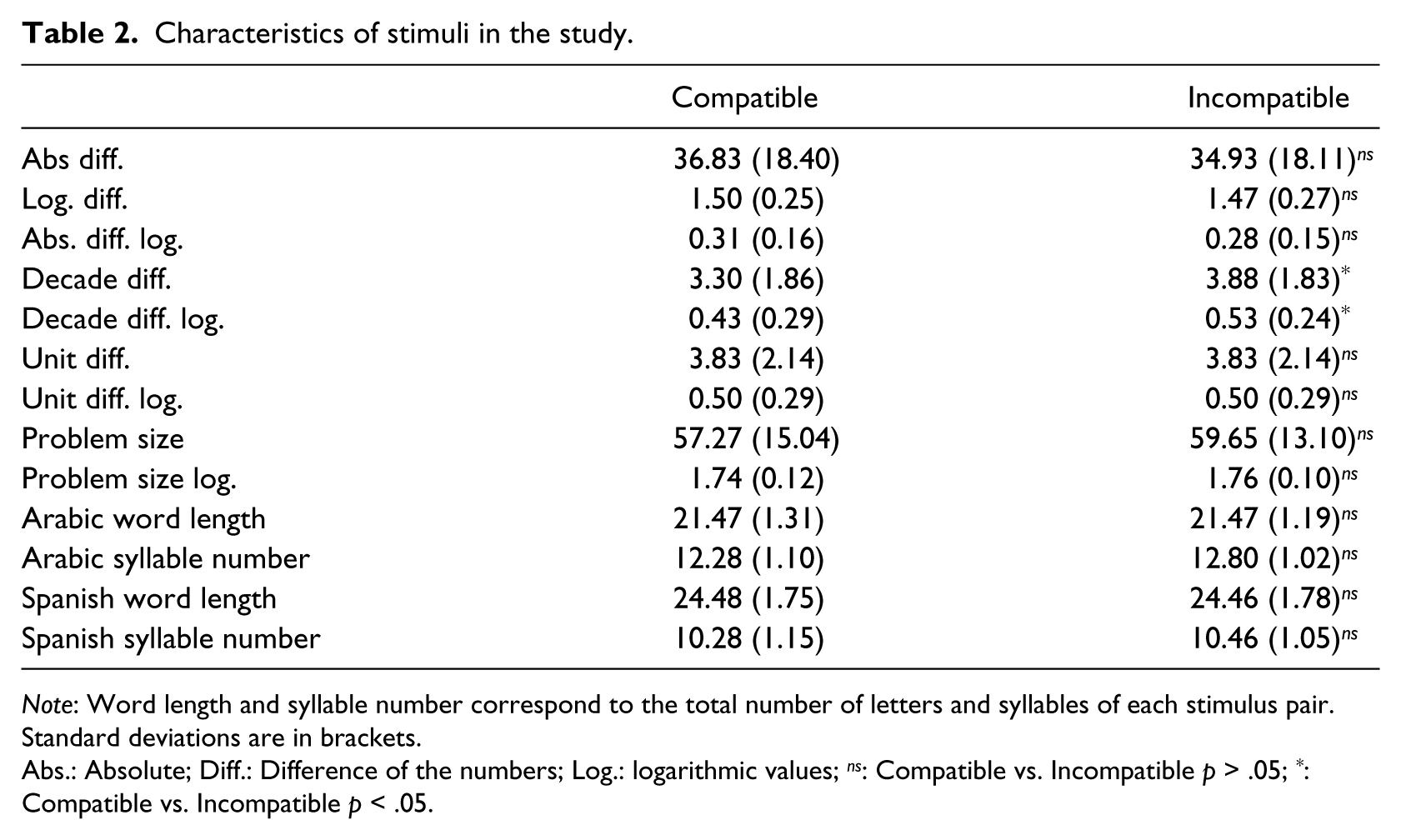
Note: Word length and syllable number correspond to the total number of letters and syllables of each stimulus pair. Standard deviations are in brackets.
Abs.: Absolute; Diff.: Difference of the numbers; Log.: logarithmic values; ns : Compatible vs. Incompatible p > .05; * : Compatible vs. Incompatible p < .05.
Procedure
The participants performed three number comparison tasks (Arabic digits, Arabic number words and Spanish number words). All participants began with the Arabic digit comparison task and they continued with the verbal comparison tasks. The order of the two verbal comparison tasks (Arabic number words and Spanish number words) was counterbalanced across participants.
The experiment was controlled using E–prime experimental software Version 1.1 (Schneider, Eschman, & Zuccolotto, 2002). Participants were tested individually. They were seated approximately 60 cm from the computer screen. Stimuli were presented in lower-case black letters (Courier New font, 48 point size) on a white background. At this viewing distance, one character subtended a vertical visual angle of 1.91 degrees and a horizontal visual angle of 1.67 degrees. In each trial, one number was presented above the other in the middle of the screen and participants had to indicate the larger of two numbers by pressing the correct response key on the keyboard with the top key if the top number was the larger and with the bottom key if the bottom number was the larger. In half of the trials the top number was the larger and in the rest of the trials the bottom number was the larger. Each number pair was presented until the subject’s response. The interval between the response and the next number pair was fixed to 500 ms. Participants were instructed to read the two numbers and to respond as quickly and accurately as possible. For each task, four stimulus lists were created in order to counterbalance the spatial presentation of the two numbers (top/bottom) and the response hand (right/left). So, across lists a given larger number was assigned to: (a) top presentation/right-hand response (U key), (b) top presentation/left-hand response (Y key), (c) bottom presentation/right-hand response (N key) and (d) bottom-presentation/left-hand response (B key). Each participant saw only one list. The lists were counterbalanced across participants so they were presented an equal number of times in the experiment. Each list was divided into two blocks of 150 trials each (120 experimental trials and 30 filler trials). There was a five minute break between blocks. Block order was counterbalanced across participants and number pairs were randomized within blocks for each participant.
Results
The incorrect responses (2.71% in the Arabic digit task, 3.94% in the Arabic number word task and 3.37% in the Spanish number word task) and RTs (reaction times) exceeding a criterion of 3 SD for an individual participant’s mean were excluded from analysis (11.65%). We correlated RTs and number of errors over the six (3 number format × 2 compatibility) cells of the design. We found positive correlations (r = .61) (see Fias, Brysbaert, Geypens, & D’Ydewalle, 1996; Macizo & Herrera, 2008). Thus, a possible speed–accuracy trade-off was discarded, and errors were not separately analysed.
An analysis of variance (ANOVA) was carried out on RT data with compatibility (compatible trials, incompatible trials) and number format (Arabic digits, Arabic number words and Spanish number words) as within-participant factors and the order of verbal tasks (Arabic–Spanish vs. Spanish–Arabic) as a between-participants factor. The main effect of order of verbal tasks was not significant, F < 1. Moreover, the order of verbal tasks did not interact with compatibility F < 1 and the compatibility × number format × order of verbal task second-order interaction was not significant (p = .20). Thus, the order of verbal tasks was not considered any further.
The difference among Arabic digits (891 ms, SE = 23), Arabic number words (1307 ms, SE = 26) and Spanish number words (1235 ms, SE = 22) was significant, F1(2, 62) = 134.32, p < .001, η2P = .81, F2(2, 476) = 2116.01, p = .15, η2P = .90. The main effect of compatibility was not significant, F1(1, 31) = 2.17, p = .15, η2P = .06; F2 < 1. However, the compatibility × number format interaction was significant, F1(2, 62) = 17.00, p < .001, η2P = .35, F2(2, 476) = 10.82, p < .001, η2P = .04.
When participants performed the comparison task with Arabic digits, they were faster in compatible trials (872 ms, SE = 23) relative to incompatible trials (911 ms, SE = 24), F1(1, 31) = 50.23, p < .001, η2P = .62, F2(1, 238) = 15.54, p < .001, η2P = .06. When participants performed the task with Arabic number words, there were no differences between compatible trials (1311 ms, SE = 25) and incompatible trials (1302 ms, SE = 28), F1(1, 31) = 2.23, p = .15, η2P = .07, F2(1, 238) = 3.27, p = .07, η2P = .01. Finally, with Spanish number words, the difference between compatible trials (1241, SE = 21) and incompatible trials (1230, SE =23) was not significant, F1(1, 31) = 1.48, p = .23, η2P = .04, F2 < 1 (see Figure 1). Moreover, a close look to the effect sizes associated to the compatibility effect showed large effect size in the Arabic digit condition (η2P = .62), while the effect size was very small in the Arabic and Spanish number words conditions (η2P = .07 and η2P = .04, respectively). Hence, the difference between compatible trials and incompatible trials explained a large amount of RT variance in the Arabic digit condition while the compatibility effect was negligible in the two verbal number conditions (Arabic and Spanish number words).
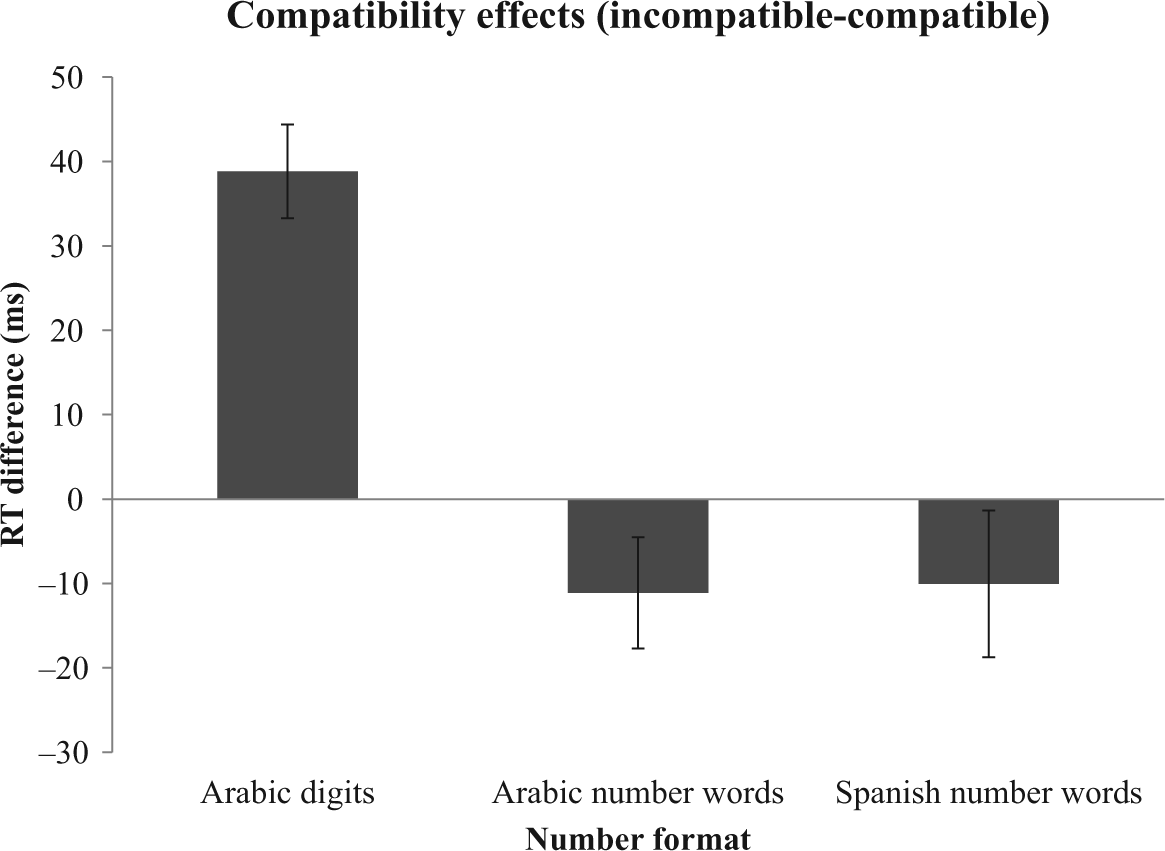
Compatibility effects (incompatible trials minus compatible trials) on the mean reaction times (RT, in milliseconds) and standard error bars as a function of number format (Arabic numbers, Arabic number words and Spanish number words).
Further analyses were performed to evaluate possible differences in the compatibility effect (difference between the incompatible condition vs. compatible condition by participants) among the three numerical formats (Arabic digits, Arabic number words and Spanish number words). The compatibility effect depended on the format, F(1, 31) = 17.00, p < .001, η2 = .35. The difference between the compatibility effect with Arabic digits and Arabic number words was significant, F(1, 31) = 36.57, p < .001, η2 = .54. Similarly, the difference between the compatibility effect with Arabic digits and Spanish number words was significant also, F(1, 31) = 25.67, p < .001, η2 = .45. However, there were no differences between Arabic number words and Spanish number words in the compatibility effect, F < 1.
In addition, to determine the contribution of decades and units when participants processed two-digit numbers across the three numerical formats, additional analyses were performed with reaction times as the dependent variable across formats (Arabic digits, Arabic number words and Spanish number words), with compatibility as a categorical predictor and the decade distance and unit distance as continuous predictors.
The outcome of this analysis showed significance in the format × decade distance interaction, F(2, 472) = 27.30, p < .001, and the format × unit distance interaction, F(2, 472) = 4.76, p = .008. Multiple regression analyses were performed for each format separately with RT as the predicted variable and the decade distance and unit distance as predictors.
When bilinguals performed the task with Arabic digits, the regression analysis was highly predictive (R = .81, adjusted R2 = .65). The decade distance was a significant predictor (standardized beta coefficient estimate, b = −0.78, p < .001) and the unit distance was significant also (b = −0.34, p < .001). In the comparison task with Arabic number words, the regression model (R = .44, adjusted R2 = .18) showed significant the decade distance only (b = −0.42, p < .001) while the unit distance was not significant (b = −0.09, p = .47). Finally, when bilinguals performed the comparison task with Spanish number words, the only significant predictor in the regression model (R = .70, adjusted R2 = .49) was the decade distance (b = −0.70, p < .001), while the unit distance was not significant (b = −0.08, p = .42).
Discussion
Previous studies have demonstrated that proficient bilinguals are able to code two-digit verbal numbers without the influence of the linguistic format in which they are written (decade–unit order in English vs. unit–decade order in German) (Macizo et al., 2012). The current study aimed to evaluate whether differences in the pattern of reading across the bilinguals’ languages determined the processing of verbal numbers. As we will discuss below, the answer seems to be negative.
In this study Arabic/Spanish bilinguals compared the magnitude of two-digit number pairs presented in three formats: Arabic digits, Arabic number words and Spanish number words. The unit–decade compatibility effect was taken as an index of the way in which two-digit numbers were processed. A regular compatibility effect was observed when bilinguals processed Arabic digits. They were faster when number pairs were compatible (79–68) relative to incompatible trials (74–68). As we indicated in the introduction, the observation of a compatibility effect corroborates the existence of a component processing of two-digit numbers in which decades and units are separately processed (Nuerk et al., 2001). Therefore, the bilinguals seemed to process decades and units of two-digit numbers when they performed the comparison task with Arabic digits. Moreover, the results of the regression analyses showed the decade distance and the unit distance to be relevant, which suggests that decades and units were separately compared and they were relevant to perform the comparison task. The separated processing of decades and units produced the unit–decade compatibility effect; that is, in compatible trials the activation of decade and unit comparisons converged to select the same response, while in incompatible trials, unit comparisons and decade comparisons guided to different responses, thus increasing the time needed to select the correct response.
To our knowledge, this is the first study in which a compatibility effect with Arabic digits in Arabic/Spanish bilinguals is found, and the finding is in line with previous work in which the same effect is observed regardless of the languages spoken by the participants (Macizo & Herrera, 2008; Nuerk et al., 2001). However, the compatibility effect interacted with the format in which numbers were presented. Hence, although a compatibility effect was obtained with Arabic digits, when Arabic/Spanish bilinguals processed verbal numbers in their two languages, the compatibility effect was absent irrespective of whether they performed the comparison task in L1 (Arabic) or L2 (Spanish).
If we consider that the Arabic language has the inversion property so the structure in which two-digit Arabic numbers are written follows the unit–decade order (Ganayim & Ibrahim, 2014), it is surprising that the participants of the current study did not show the unit–decade compatibility effect. In fact, monolingual speakers of other languages with the inversion property, such as German, show the effect when they perform the comparison task in that language (i.e. Macizo et al., 2010).
Moreover, there is previous evidence showing that children are sensitive to the linguistic structure of multidigit verbal numbers (Klein et al., 2013; Mann, Moeller, Pixner, Kaufmann, & Nuerk, 2012). Mann et al. (2012) evaluated the hundred unit compatibility effect with German children from grade two to four. There were hundred unit compatible trials in which the hundred and units were compatible (412–957 where 4 < 9 and 2 < 7) and hundred unit incompatible trials in which the hundred and units were incompatible (871–326, where 8 > 3 but 1 < 6). The results showed that the hundred unit compatibility effect increased with age. The authors explained this pattern of results as being due to the inversion property. In German, units are written right after hundred (i.e. 321 ‘dreihunderteinundzwanzig’ meaning ‘three-hundred-one-and-twenty’). Hence, if participants processed the unit, it would produce the hundred unit compatibility effect.
Furthermore, Klein et al. (2013) observed the same effect with German children, while Italian-speaking 3rd graders did not show the hundred unit compatibility effect. Again, this pattern of results indicates cross-linguistic influences on the processing of multidigit numbers. Italian is a non-inverted language, so the unit would be less relevant since hundreds and decades are processed first (i.e. 321 ‘trecento-vent-uno’ meaning ‘three-hundred-twenty-one’).
Together, the current study contrasts with previous evidence indicating that individuals are sensitive to the linguistic structure of verbal numbers in the language they speak. However, the absence of the compatibility effect in L1 (Arabic language) and L2 (Spanish language) supports the idea that proficient bilinguals are not affected by the specific linguistic properties of the languages they know. Macizo et al. (2012) also showed that proficient German/English bilinguals were unaffected by the unit–decade compatibility when numbers were presented in languages that differed in the inversion property (unit–decade order in German and decade–unit order in Spanish number words). The relevance and contribution of this study rest on the similar pattern of results irrespective of the direction used to read in Arabic and Spanish. The right-to-left reading direction in Arabic favoured the relevance of units since they are processed first when participants read written number words. The opposite occurred in Spanish, in which decades are encountered first and thus they would be more relevant. However, bilinguals were not sensitive to these cross-linguistic differences when they processed two-digit number words.
After arriving at this pattern of results, the questions remaining to be answered are why bilinguals did not show the compatibility effect in their two languages and what is the implication of this finding for models of two-digit number processing. Several explanations might be offered. The absence of the compatibility effect might be due to the fact that bilinguals processed two-digit number words holistically, so they were not influenced by the compatibility of separate comparisons of decades and units. In fact, the lack of the compatibility effect has been interpreted as evidence for the holistic processing of two-digit numbers (Ganor-Stern, Pinhas, & Tzelgov, 2009). For example, Ganor-Stern et al. (2009) observed compatibility effects when numbers were simultaneously presented, and not when a serial presentation was used, suggesting that when the numerical task requires the maintenance of information (the magnitude of the first number that appeared in the serial presentation), the decades and the units are not separately processed (although see Moeller, Klein, & Nuerk, 2013, for opposing evidence on this issue). Nevertheless, in the current study, numbers were simultaneously presented so they should have been processed in a decomposed manner and the compatibility effect should have been observed.
A second alternative for the lack of compatibility effect with verbal numbers is that decades and units were separately processed but that bilinguals did not experience conflict when they encountered incompatible trials. In the bilingualism literature, there is abundant evidence showing that bilinguals are less susceptible to interference relative to monolingual speakers in conflicting situations such as the Simon task (Bialystok, Craik, Klein, & Viswanathan, 2004). This advantage is usually interpreted as due to the continuous experience of bilinguals at managing conflicting information (i.e. the non-target language) when they communicate in a target language (see Bialystok & Craik, 2010, for a review). However, this explanation does not seem to account for the complete pattern of results observed in the current study. Although bilinguals did not show the compatibility effect with verbal numbers, they did so with Arabic digits.
In our opinion, the absence of a compatibility effect (with verbal numbers in the current study) does not preclude the proposal of a decomposed processing of two-digit numbers. It might be possible that the weight assigned to decades, units and overall magnitude varies depending on the numerical format, which might explain the presence or absence of compatibility effects. A similar proposal is offered by Liu, Wang, Corbly, Zhang, and Joseph (2006) who assume a continuum between the processing of the holistic magnitude and the processing of the decade and unit magnitude according to the weight assigned to the decades and the units in a given situation which, in turn, would rely on attentional and perceptual factors. The separate processing of decades and units would be more easily performed with written numbers relative to Arabic digits due to the physical space between the decade word and the unit word (e.g. ‘seventy nine’) and participants would focus on the decades since they sufficed to perform the comparison task with between-decade number pairs. Moreover, the results we obtained in the regression analyses agree with the idea that the weight of decades and units vary across numerical formats. The units and decades were both relevant when participants processed Arabic digits. However, the decade distance but not the unit distance contributed to performing the task when numbers were presented in verbal format (Arabic language and Spanish language). The current pattern of results cannot elucidate whether or not the overall magnitude was also accessed when participants performed the comparison tasks. However, in our opinion, overall magnitude would be easily accessed with Arabic digits relative to verbal number words since the two constituent digits were physically close in the first case and they could be easily processed as a single perceptual entity (79 relative to the verbal format ‘seventy nine’). Future research might shed light on this issue. Nevertheless, the main point to highlight from this study is that bilinguals are not influenced by the reading direction of their languages when they process two-digit verbal numbers.
Footnotes
Funding
The author(s) disclosed receipt of the following financial support for the research, authorship, and/or publication of this article: This study was supported by the Spanish Ministry of Economy and Competitiveness (Grant PSI2012–32287) and by the Programa de Generación de Conocimiento Científico de Excelencia de la Fundación Séneca, Agencia de Ciencia y Tecnología de la Región de Murcia (research project 08741/PHCS/08).