




Abstract
To date, the vast majority of research on the linguistic abilities of heritage speakers has focused on young adults whose heritage language is no longer developing. These adults began their journey as bilingual children acquiring the heritage language with the majority language simultaneously since birth or sequentially, as a second language. If longitudinal studies are not always feasible, linking research on the structural development of bilingual pre-school children with research on young adult heritage speakers adds a much needed perspective to understand the initial state and the end state of heritage language development. The purpose of this study is to connect the beginning of heritage language development with its ultimate attainment by comparing the expression of subjects in Spanish in 15 school-age bilingual children and 29 young adult heritage speakers, all of them simultaneous bilinguals with English as the dominant language and Spanish as the weaker language. The oral production of null and overt subjects by child and adult heritage speakers was compared to that of age-matched monolingual speakers in Mexico (20 children, 20 adults). To provide a wider context the study includes a group of 21 adult immigrants, who could also potentially influence the input to the heritage speakers. The results confirm that discourse pragmatic properties of subject expression in Spanish are vulnerable to incomplete acquisition and permanent optionality in child and adult bilingual grammars.
Heritage language acquisition is a type of early bilingual acquisition that takes place in a specific sociolinguistic environment. The heritage language is a socio-politically minority language, acquired as a first language during the first years of life, as in sequential bilinguals, or simultaneously with the majority language since birth, as in simultaneous bilinguals (Montrul, 2008; Polinsky, 2006). The acquisition of heritage languages deals with the developmental stages and outcome of learning a heritage language from childhood to adulthood, as well as the wax and wane of the heritage language in response to input factors (Montrul, 2016).
The vast majority of young adult heritage speakers in the United States are unbalanced bilinguals with stronger command of English than of the heritage language, and in the past two decades there has been keen interest in understanding the linguistic outcome (i.e. ultimate attainment) of heritage language acquisition. The particular emphasis has been on the weaker language of young adults who have achieved a stable level of bilingualism (Benmamoun, Montrul, & Polinsky, 2013a, 2013b; O’Grady, Kwak, Lee, & Lee, 2011; Sekerina & Trueswell, 2011), especially to explain why heritage speakers exhibit systematic gaps in vocabulary, morphological knowledge and in certain discourse pragmatic interfaces compared to fluent bilinguals and native speakers of the same language raised monolingually in a majority language context (Benmamoun et al., 2013a, 2013b; Laleko, 2010; Montrul, 2016; O’Grady et al., 2011; Rothman, 2007). To address these questions, the linguistic competence of heritage speakers has been compared to that of age-matched monolingual and bilingual speakers, monolingual children and older adult bilinguals comparable to the parental generation (Chung, 2013; Montrul & Sánchez-Walker, 2013; Pascual y Cabo, 2013).
Another interest has been to identify the factors that may explain the slower and halted development of the heritage language when compared to the development of the majority language in the same bilingual individuals. Very often, heritage languages exhibit systematic simplification and structural changes. Silva-Corvalán (1994, 2014, 2016), Polinsky (2006), Montrul (2008), and O’Grady et al. (2011), among others, consider that insufficient input and use of the heritage language during childhood contribute to incomplete acquisition, or better yet acquisition without mastery (Montrul, 2016), of several aspects of the language. Although some researchers consider the term “incomplete acquisition” imprecise when applied to heritage language acquisition in general, and unfortunate for possibly inviting value judgments on the speakers and their grammars (Kaltsa, Tsimpli & Rothman, 2015; Otheguy, 2016; Putnam & Sánchez, 2013; Pascual y Cabo & Rothman, 2012), they do not deny that heritage speakers exhibit linguistic characteristics worth explaining. 1 Other factors that may also contribute to divergent outcomes in heritage language acquisition and that can co-exist or not with incomplete acquisition or actual attrition, are the quality of the input due to ongoing diachronic change (Lohndal & Westergaard, 2016) as well as majority language transfer (Montrul & Ionin, 2012), as well as frequency and complexity of particular structures (O’Grady et al., 2011). I have stressed (Montrul, 2002, 2008, 2016) that the best way to show that a grammatical property was not mastered by a certain age is to conduct longitudinal studies of bilingual children as they develop their heritage and majority languages from birth to adulthood, a certainly daunting task that nobody has yet undertaken. And to evaluate whether the input is different, the child-directed speech should be examined as well. Except for Silva-Corvalán’s (2014) longitudinal study of two bilingual siblings from approximately ages 1 to 6 in the two languages and the quality of the heritage language input, other existing longitudinal studies (Anderson, 1999; Merino, 1983) have spanned a couple of years in childhood, have focused only on the heritage language, and have not analyzed the parental input. See Montrul (2016) for more extensive discussion.
To date, the vast majority of research on the linguistic abilities of heritage speakers has focused on young adults whose heritage language is no longer developing. These adults began their journey as bilingual children acquiring the heritage language with the majority language simultaneously since birth or sequentially, as a second language. If longitudinal studies are not always feasible, I argue that linking research on the structural development of bilingual pre-school children with research on young adult heritage speakers adds a much needed perspective to understand the initial state and the end state of heritage language development. For example, an area that continues to attract significant attention in Spanish and other pro-drop languages in acquisition and attrition is the expression of null and overt subjects (Carvalho, Orozco, & Shin, 2015; Kaltsa et al., 2015; Otheguy & Zentella; 2012; Paradis & Navarro, 2003, Sorace 2005; Tsimpli, Sorace, Heycock, & Filiaci, 2004, among others). Silva-Corvalán (2014) found that the mastery of the pragmatic constraints on subject expression in Spanish lagged behind in the bilingual children studied. Interestingly, the children displayed some of the same patterns attested in the adult heritage speakers reported in Silva-Corvalán (1994), a finding that points to an important connection between bilingual children and adults. By comparing monolingual children and bilingual children, and child and adult heritage speakers, we gain more insight into the developmental route of this particular phenomenon in Spanish in contact with English. At the same time, if early bilingual acquisition is the beginning of the bilingual development of heritage speakers, whereas examining the linguistic characteristics of adult heritage speakers represents their ultimate attainment, the natural question that arises is what happens in between the beginning and the end? To answer this question we must also look at school-age children, since the onset of school marks the beginning of language shift and the change of balance for most bilingual children whose heritage language is not supported at school (Hurtado & Vega, 2004).
In this article I attempt to connect the beginning of heritage language development with its ultimate attainment by comparing the production of null and overt subjects in Spanish in school-age bilingual children and young adult heritage speakers, all of them simultaneous bilinguals with English as the dominant language and Spanish as the weaker language. I investigate whether the pattern of acquisition of the pragmatic constraints on subject expression in adult heritage speakers can be traced back to developmental patterns exhibited by school-age bilingual children. The results of the production of null and overt subjects by child and adult heritage speakers are also compared to those of age-matched monolingual speakers in Mexico. Finally, and to provide a wider context, I also examine whether a group of adult immigrants may exhibit attrition, which could also potentially influence the input to the heritage speakers.
Child bilingualism and heritage language acquisition: What is the connection?
Since the 1980s, important research has been conducted on bilingual first language acquisition in Europe (Deuchar & Quay, 2000; Ezeizabarrena Segurola, 2011; Meisel 2001, 2007; Müller & Hulk, 2001), Canada (Genesee, 1989; Genesee, Nicoladis & Paradis, 1995), the United States (Bolonyai, 2007), Hong Kong (Yip & Matthews, 2006) and Australia (Döpke, 1992). Most of these studies have focused on children growing up in bilingual professional families. Serratrice (2002) studied a child—Carlo—the son of an American father and an Italian mother living in Scotland. Even though Carlo is reported to be bilingual in Italian and English, Italian is a heritage language in this case because it is not the language of the wider speech community. Similar examples are the Hungarian-speaking child studied by Bolonyai (2007), the Spanish-speaking child from the United Kingdom described in Deuchar and Quay (2000), and the German-speaking child from Australia studied by Döpke (1992). The fact that one or the two home languages spoken by these bilingual children is a minority language in the wider community makes them heritage speakers (Montrul, 2016), although they have not been called heritage speakers in the literature. The term is now beginning to be applied to them as well (Kupisch, 2013).
Because early linguistic development by age three or four in bilingual children has been generally found to be balanced and on schedule in each language (Genesee, 1989), it may be implicitly assumed that simultaneous bilingual children end up knowing their two languages very well into adulthood, but this is not always the case. When children realize that their home language is a minority language and it is not spoken beyond the home, they often switch to the majority language spoken by their social group (Kerswill, 1996). De Houwer (2009, p. 3) describes the child studied by Von Raffler-Engel (1965), who grew up in Florence, Italy. His mother always addressed him in Italian and his father, who was American, in English. The parents spoke English to each other but because the child’s broader environment was Italian-speaking, the child refused to speak English despite the parents’ best efforts. Consequently, the child’s Italian was much stronger than his English.
For theoretical and clinical reasons, the study of simultaneous bilinguals has prioritized the pre-school period, tracing the emergence and independent but parallel development of the two languages (Meisel, 2007; Paradis & Genesee, 1996). Although simultaneous bilingual development in childhood may lead to fluent and balanced bilingualism in adulthood when the two languages are supported by input and are used frequently, this pattern of development and ultimate attainment is not the most common in bilingual children of heritage languages. A more typical pattern is what Silva-Corvalán (2014) reported (see Figure 1): some children show parallel and balanced bilingual development until about age 3 or 4, with divergence after ages 5 to 6 when they begin to attend school in the majority language and significant exposure to the majority language increases. After age 5 to 6 the majority language takes over in dominance, and the development of the heritage language slows down, stagnates, and even regresses in specific grammatical areas (inflectional morphology, vocabulary, etc.). These general tendencies, however, do not imply that achieving balanced bilingualism after age 4 is not possible in heritage speakers (see Kupisch, Belikova, Özçelik, Stangen, & White, forthcoming); it is just apparently not very common in the United States.

The bilingual development of the two children.
Although the relationship between young bilingual children and young adult heritage speakers may be obvious—after all, bilingual children are future heritage speakers or heritage speakers who started as bilingual children—only recently have there been attempts to link the early linguistic development of bilingual children with the linguistic abilities of young adult heritage speakers. Silva-Corvalán (2014) is the first study that makes a connection between early development in simultaneous bilingual heritage speakers and the linguistic outcome of young adult heritage speakers (Silva-Corvalán, 1994). Silva-Corvalán’s study of two Spanish–English bilingual siblings living in Los Angeles revealed that from the onset of production and up until age 3, the children showed independent and age-appropriate development of both English and Spanish morphosyntactic structures and did not differ from the development of the same structures in the monolingual acquisition of English and of Spanish. After age 3, when Spanish clearly became the weaker language in the two children, they began to display incomplete development and structural influence from English as compared with monolingual norms in some specific structures (Figure 1). Silva-Corvalán’s analysis focused on the same grammatical areas investigated in Silva-Corvalán’s (1994) study of three generations of Mexican immigrants in Los Angeles—the Tense-Aspect-Mood (TAM) system, the copulas ser and estar, pragmatic distribution of null/overt subjects—to allow comparison of the child and adult bilinguals. According to the results of Silva-Corvalán (2014), the copulas exhibited target-like and robust development, while aspects of TAM and the null vs. overt subject expression in topic continuity contexts did not fully develop when input and use of Spanish fell below 25 to 30% after age 3;00. This amount of input was not sufficient for full development of the grammatical areas examined well into age 5;11. The TAM system developed by the siblings was comparable to that of second and third generation Spanish–English bilingual adults who have not received formal education in Spanish (Silva-Corvalán, 1994), and so was the inconsistent mastery and misuse of overt pronouns in topic continuity contexts. Silva-Corvalán’s data add substantial support for the argument that the processes of simplification and loss attested in adult bilingual Spanish are most likely the consequence of an interrupted process of acquisition between the ages of 3;0 and 5;0, when more intensive exposure to English reduces exposure to and use of Spanish.
By comparing young bilingual children and young adult heritage speakers we are comparing the early stages of bilingual development and ultimate attainment, as illustrated in Figure 2. But what we are missing is a closer look at what happens during the school-age period, which is a time of significant language development as well, in both monolingual and bilingual individuals. In fact, the study of adult heritage speakers is highly informative as to the importance of this period in bilingual language development.
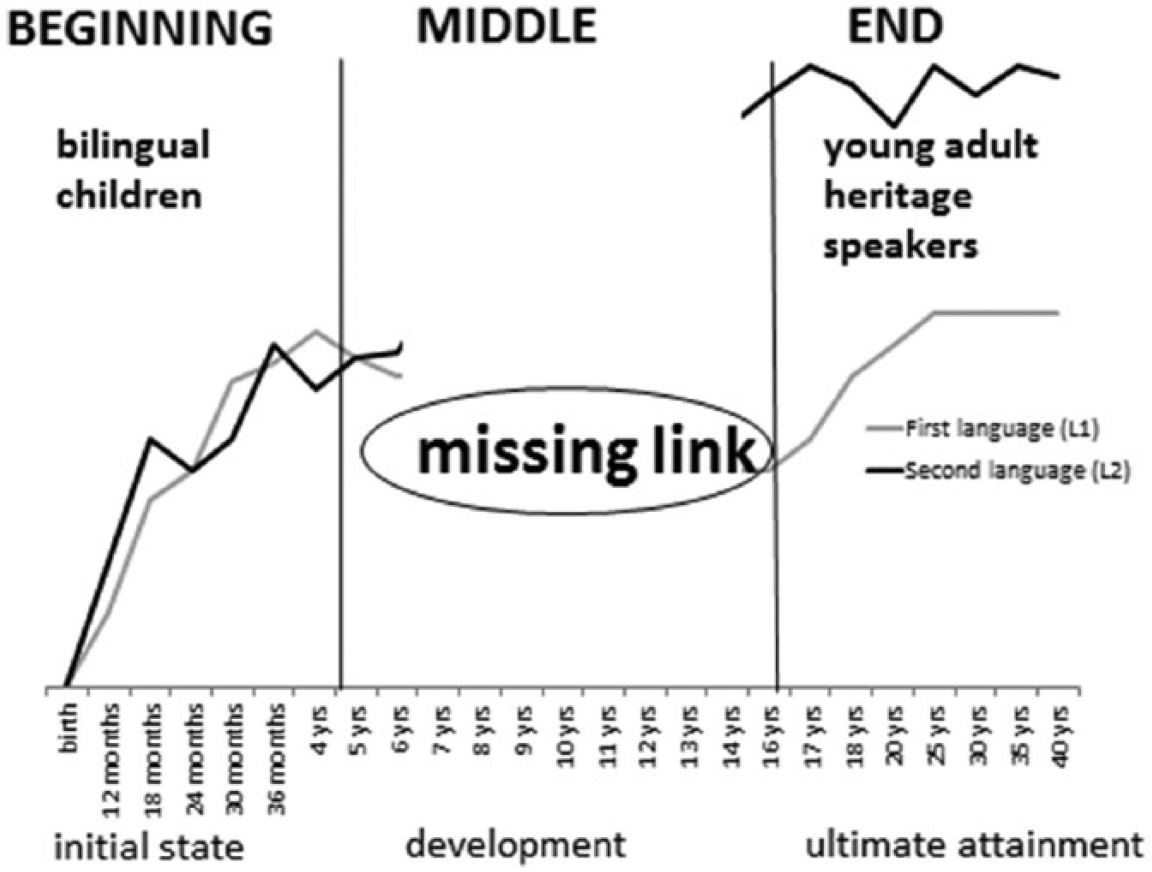
The early stages and the ultimate attainment of subtractive bilingualism in minority language speaking bilinguals.
In order to understand heritage language development more fully, we must investigate the link between early bilingual acquisition in pre-school and adult heritage speakers of college age. One promising way to connect the dots is by studying in more detail what happens to the heritage language during the entire school-age period, from 5 to 17 years of age, an understudied period in monolingual and bilingual development. If longitudinal studies spanning several years are difficult to impossible to carry out, short-term longitudinal studies and cross-sectional studies comparing school-age bilingual heritage speakers and adult heritage speakers are more feasible. Recent examples are O’Grady et al. (2011), Polinsky (2011), and Montrul and Sánchez-Walker (2013). O’Grady et al. (2011) found that the school-age Korean heritage speakers in the United States were more accurate on scope of disjunction under negation in Korean than adult heritage speakers of Korean. Polinsky (2011) also found that school-age heritage speakers of Russian were more accurate on comprehension of relative clauses in Russian than adult heritage speakers. O’Grady et al. (2011) and Polinsky (2011) found evidence of attrition over the lifespan for the adult heritage speakers. Lack of schooling and exposure to advanced language may perhaps underlie the level of language regression observed in the adults in these studies. By contrast, Montrul and Sánchez-Walker (2013), who studied accuracy on production of differential object marking (DOM) in Spanish heritage speakers, found that the school-age children were less accurate than the adult heritage speakers, who were also quite inaccurate. The non-mastery of DOM in young adults was seemingly related to patterns found in earlier stages of bilingual development. Thus, comparing the linguistic knowledge of heritage speakers and school-age bilingual children provides another possibility to address potential attrition or incomplete acquisition of specific grammatical properties of the heritage language. The study presented in this article continues this important line of research by bringing new data from school-age bilingual children, young adult heritage speakers and adult immigrants (the parental generation) on the expression of null and overt subjects in Spanish.
Null and overt subjects in Spanish
The expression of null and overt subjects in null subject languages is assumed to be regulated by morphosyntactic and discourse pragmatic factors and has received significant attention in child and adult bilingualism (Paradis & Navarro, 2003; Silva-Corvalán 1994, 2014; Sorace, 2005; Toribio, 2000). For example, the use of null and overt subjects in Spanish is relevant to establish reference in discourse. When there is no switch in reference between a series of sentences, null subjects are appropriate to establish topic continuity and overt subjects are pragmatically infelicitous, as in (1). By contrast, overt subjects are appropriate when there is topic shift and a different referent is introduced, as in (2). Null subjects are pragmatically illicit or infelicitous in these switch reference contexts (examples from Silva-Corvalán, 1994, p. 148). 2
(1) Pepe no vino hoy a trabajar. *Pepe/?él/Ø estará enfermo. same reference Pepe no came today to work Pepe/?él/Ø will be sick ‘Pepe did not come to work today. He must be sick.’ (2) Hoy no fui a trabajar. Pepe/él/*Ø pensó que estaba enferma. switch reference today I no went to work Pepe/él/*Ø thought that I was sick ‘Today I did not go to work. Pepe/he thought I was sick.’
Several studies have shown that bilinguals who speak a null subject language tend to overproduce overt subjects (especially pronouns) in topic continuity contexts (Sorace, 2004). One explanation for such overuse of overt subjects emphasizes the influence from English (Montrul 2004, 2006), an overt subject language. Because the use of null and overt pronouns in discourse engages the syntax-discourse interface, an alternative explanation for the overuse of overt pronouns is the complexity of such interface in pro-drop languages: bilinguals resort to the overt subject option because it is linguistically less complex (Silva-Corvalán, 1994; Sorace, 2005). In the context of Spanish in New York, where many Spanish-speaking bilinguals also overuse pronominal subjects, Otheguy and Zentella (2012) proposed that both contact from English and dialect leveling are at play in these changes. Interestingly, comprehension studies of monolingual children in Mexico show that 6- to 12-year-old children tend to overuse null subjects in switch reference contexts, the opposite pattern found in bilingual grammars, and only when they are about 13 to 14 years old do they use null and overt subjects as adults (Shin & Cairns, 2012). Therefore, monolingual children also experience developmental difficulties with the discourse pragmatic properties of null and overt subjects, at least in comprehension. If the discourse pragmatic properties of null and overt subjects take so long to converge on the adult grammars in a monolingual environment, such a phenomenon is likely to remain underdeveloped in bilingual contexts where children use Spanish less than the majority language (Silva-Corvalán, 2014).
In the next section, I present a study addressing whether potential incomplete acquisition of pragmatic constraints in young adult heritage speakers relates to developmental patterns exhibited by school-age bilingual children.
The study
In this study, oral production data from 35 school-age children (20 Mexican speakers and 15 simultaneous bilinguals) reported in Montrul and Sánchez-Walker (2015) are compared with data from 60 adults (29 simultaneous bilingual heritage speakers, 20 Mexican native speakers, 21 Mexican immigrants), as shown in Table 1 (children) and Table 2 (adults). Because the child and adult heritage speakers were of Mexican origin, the control groups were recruited in Guanajuato, Mexico.
Information about the child participants.
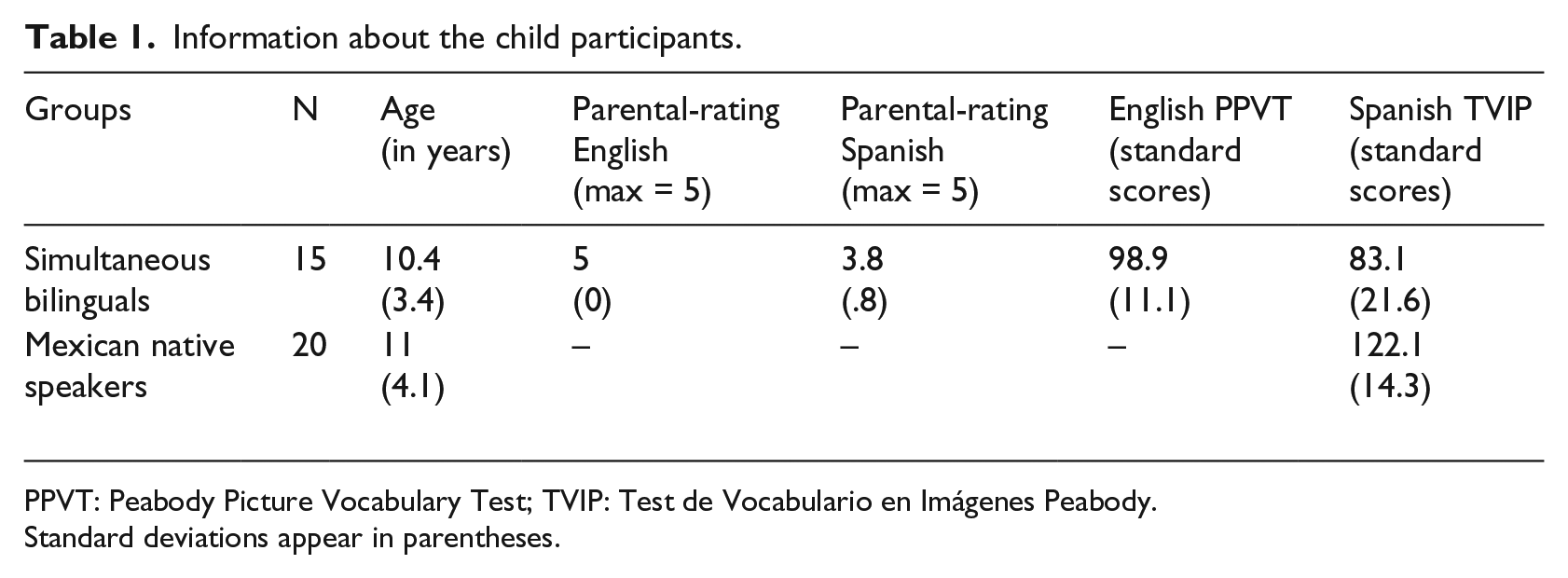
PPVT: Peabody Picture Vocabulary Test; TVIP: Test de Vocabulario en Imágenes Peabody.
Standard deviations appear in parentheses.
Information about the adult participants.
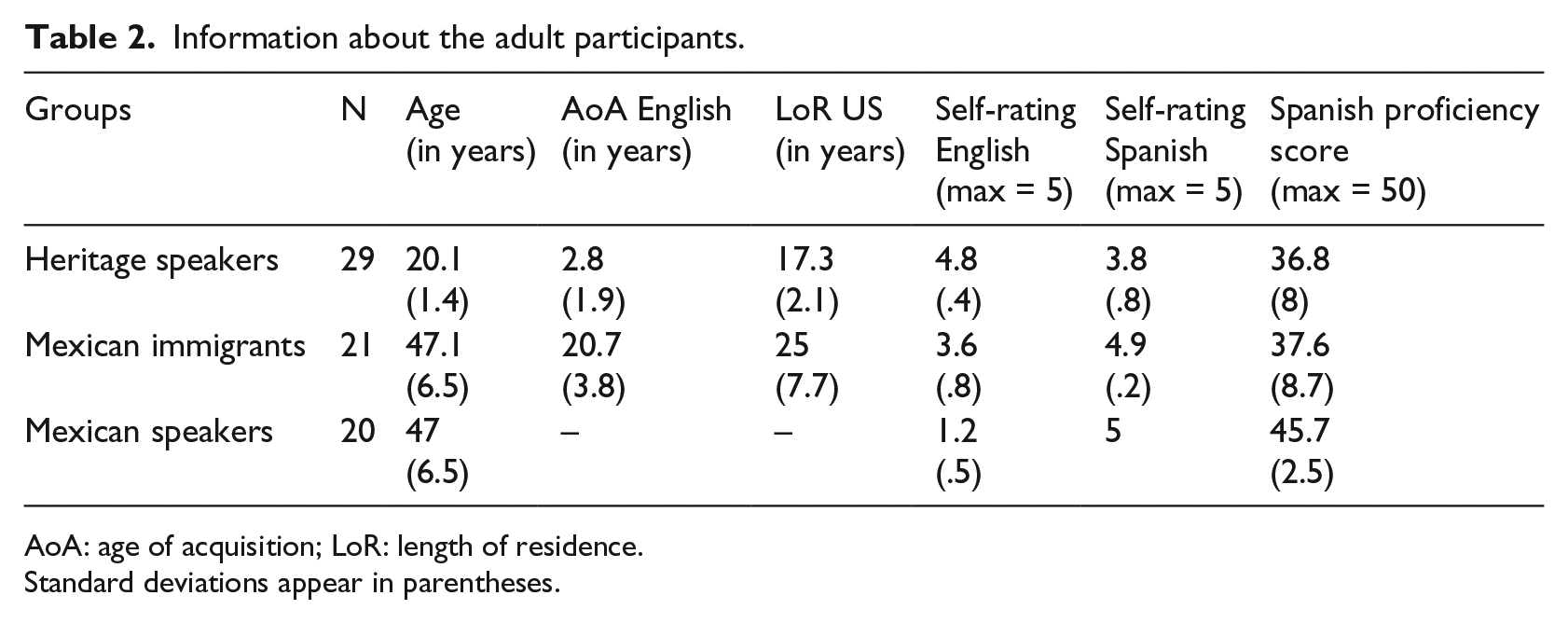
AoA: age of acquisition; LoR: length of residence.
Standard deviations appear in parentheses.
The parents of all the children completed a short language background questionnaire eliciting information about the children’s linguistic abilities, and the parents of the bilingual children were asked to report on use of Spanish and English. In addition, the bilingual children were administered the standardized Peabody Picture Vocabulary Test–Revised (PPVT–IV) and the Test de Vocabulario en Imágenes Peabody (TVIP), standardized with Puerto Rican and Mexican populations. The children in Mexico also took the TVIP in Spanish. The bilingual children were significantly less proficient in Spanish than in English as per parental assessments (t(15) = 4.8, p < 0.0001) and PPVT and TVIP scores (t(15) = 9.54, p < 0.0001). The bilingual children differed from the Mexican children on TVIP scores (t(35) = 25.51, p < 0.0001).
The 29 heritage speakers consisted of young adults ranging from 18 to 28 years (mean 20.6), all born in the United States to Mexican parents (mother and father). They were exposed to Spanish since birth and to English between birth and age 5 (mean 3.8). One of them had completed college and the rest were college students at a large university in the United States. All of them attended from elementary, middle school and high school in the United States. Only 34.4% received some Spanish instruction through a bilingual program; for all the others the main language of instruction was English. Eighty percent had instruction in Spanish as a foreign language in middle school and high school.
The other comparison group consisted of 21 adult immigrants, who emigrated to the United States after age 18 and had been residing in the country for several years (range 8–37 years, M = 25.9 years). They were between 25 and 58 years old at the time of testing (M = 45.4 years), and they have completed elementary school only (n = 5), high school only (n = 6), and college (n = 10). Finally, a group of 20 Mexican native speakers tested in Guanajuato, matched in age (range 40–61 years) and SES to the adult immigrant group, was included. Although the level of education of this group also ranged from elementary school only to graduate degree, this group was more skewed toward speakers with elementary education only (n = 13), while of the remaining seven, three had completed high school, one some college and three had a graduate degree. Thus, if differences between the speakers in Mexico and the immigrants are found, it cannot be due to lower level of education and instruction of the adult immigrants.
The adult participants completed a lengthy language background questionnaire, with questions about their proficiency self-assessments in English and Spanish, and about frequency of language use throughout early and late childhood, adolescence and adulthood with their parents and other relatives. They also completed a written Spanish proficiency test consisting of a cloze passage with 20 blanks and a 30-item multiple choice vocabulary test. The maximum score was 50. Table 2 summarizes basic descriptive information of the adult groups.
According to one-way ANOVAs the three groups differed on their self-ratings in English (F(2,69) = 124.7, p < 0.0001), self-ratings in Spanish (F(2,69) = 19.6, p< 0.0001), and written proficiency in Spanish (F(2,69) = 8.39, p< 0.0001). The heritage speakers rated their English higher than their Spanish (paired samples t-test, p < 0.0001), while the two other groups rated their Spanish higher than their English (paired samples t-tests, both groups p < 0.0001). The heritage speakers differed significantly from the Mexican speakers and the adult immigrants in their self-ratings of English and Spanish (all p < 0.0001). In terms of Spanish proficiency, the adult immigrants did not differ from the heritage speakers (p > 0.90), but both groups differed from the Mexican speakers (p < 0.05). Thus, for the heritage speakers English is the dominant language. For the immigrants, Spanish is still the dominant language as per self-ratings, but their written proficiency in Spanish did not differ from that of the heritage speakers.
All participants were provided with 14 colored pictures of the children’s tale Little Red Riding Hood and were asked to look at the pictures and narrate the story in Spanish and in the past, with as much detail as possible. The research assistant who administered the task could see the pictures. All the oral narratives were audio recorded, transcribed and coded for analysis. 3 In this article, we focus on the rate of null and overt subjects and the distribution of subjects in two pragmatic contexts: same reference and switch reference.
Since the narrative is in the third person, it mostly elicits third person subjects. The few first and second person pronouns produced were not included in the analysis. Counts and percentages of verbs with subjects were calculated for each participant, as well as counts and percentages of types of subjects, including lexical noun phrases (NPs), and null and overt subject pronouns. Licit and illicit or redundant uses of lexical subjects, pronominal subjects and null subjects in same reference and switch reference contexts were also calculated. For example, overt subjects were considered redundant when they referred to the same referent mentioned in the previous sentence (a context where a null pronoun would be felicitous) (see (3)), and they were considered correct if they were used when there was a change of referent in the discourse, or to establish emphasis (see (4)).
(3) . . . (4) ‘. . . ‘ (5) Similarly, null subjects were considered illicit when there was a change of referent in the story line, and the participant used a null subject, making the context ambiguous or unclear. Ahí el leñador oyó los gritos de Caperucita Roja y Ø [el lobo] se la comió. (participant 5) ‘There the woodcutter heard the screams of Little Red Riding Hood and Ø [the wolf] ate her.’
However, there were some null pronouns that appeared to be licensed by the researcher and participant’s shared knowledge and joint attention to the story (see note 3), as in (6). These task-related null subjects in switch reference contexts occurred in both monolinguals and bilinguals. They were less than 2.4% of all the data and were excluded from the analysis.
(6) Después vino then came a hunter and saw the wolf Ø found-3rd-pl her grandmother ‘Then a hunter came and saw the wolf. They found her grandmother.’ (Participant 311) (In the picture the hunter comes in with a dog, thus the third person plural in the second sentence can refer to the dog and the hunter.)
The data from the school-age children and the adult data by the region of the monolinguals (Mexico) and the bilinguals (United States) were compared statistically to test whether the monolingual children differ in development from the monolingual adults on the one hand, and to what extent the bilinguals are similar to the monolingual children on the other. We also compared the child and adult heritage speakers, and the heritage speakers with adult immigrants. The following specific research questions were considered for the analysis.
Do child and adult heritage speakers of Spanish produce more overt subjects in Spanish than child and adult speakers in Mexico?
Do child and adult heritage speakers exhibit more difficulty with the pragmatic constraints on overt subjects than the pragmatic constraints on null subjects?
Do adult immigrants from Mexico produce more overt subjects than native speakers from Mexico, a potential sign of attrition?
Figure 3 displays the rate of overt subjects produced by all the groups.
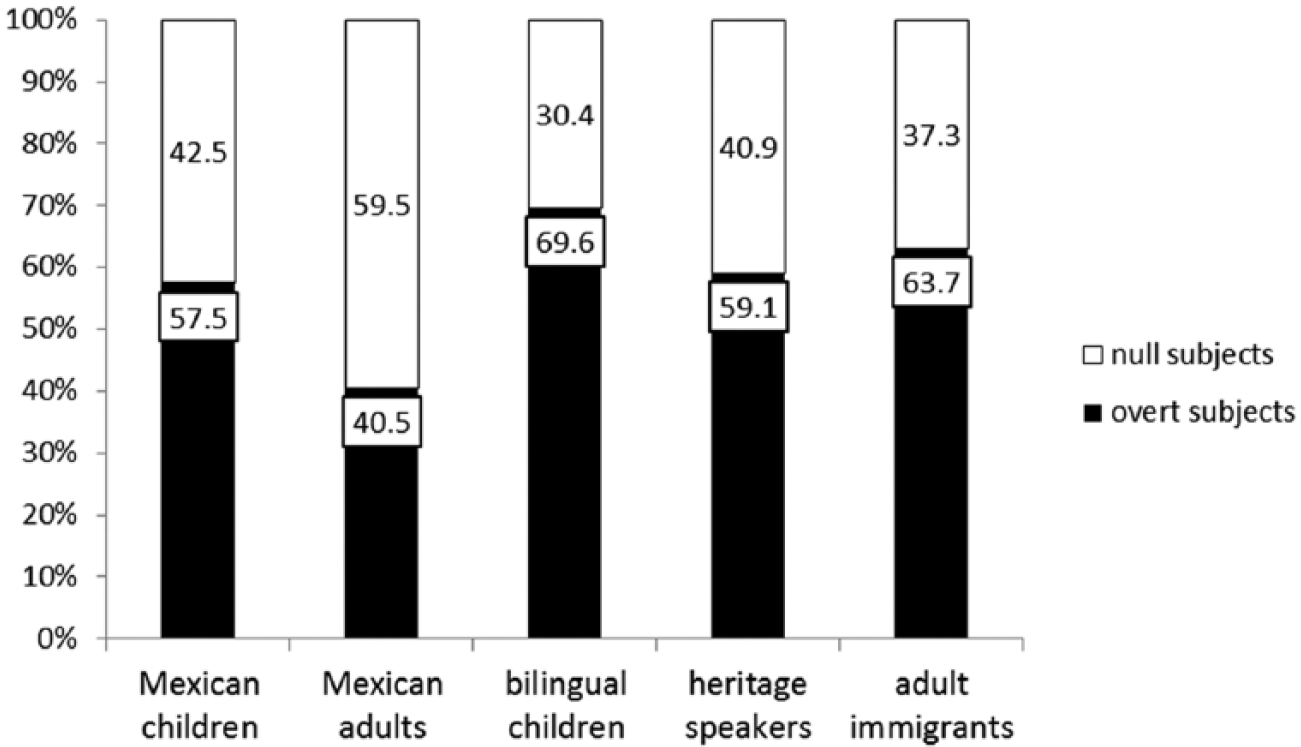
Rate of null and overt subjects in the monolingual and the bilingual groups.
As can be seen in Figure 3, the school-age Mexican children produced significantly more overt subjects (17%) than the adult Mexican speakers, and the difference was significant (t(40) = 4.23, p < 0.023). This suggests that 11-year-olds have not yet reached the adult distribution. A one-way ANOVA comparing the monolingual and bilingual groups was significant (F(4,100) = 3.69, p < 0.008), but Tukey post-hoc tests indicated that the main statistical difference was between the Mexican adults and all the other groups. The three bilingual groups produced more overt subjects than the monolingual Mexican children (children 12.1%, heritage speakers 1.6%, and immigrants 6.2%); the four groups did not differ statistically (F(3,109) = 1.26, p = 0.29).
Figure 4 (Mexican speakers) and Figure 5 (bilingual speakers) compare pragmatically felicitous and infelicitous uses of lexical, pronominal and null subjects in same reference and switch reference contexts. In same reference contexts null subjects are felicitous and overt subjects are not: the school-age children from Mexico produced more infelicitous uses of overt subjects (4.1% lexical, 6.3% pronominal) than the adults (1.9% lexical, 2.3% pronominal) (F(1,39) =3.42, p = 0.04). In switch reference contexts, lexical and pronominal subjects are felicitous and null subjects are pragmatically illicit. The monolingual Mexican children produced more illicit null subjects than the adults (5.9% vs. 1.4%, F(1,39) = 3.42, p = 0.04).
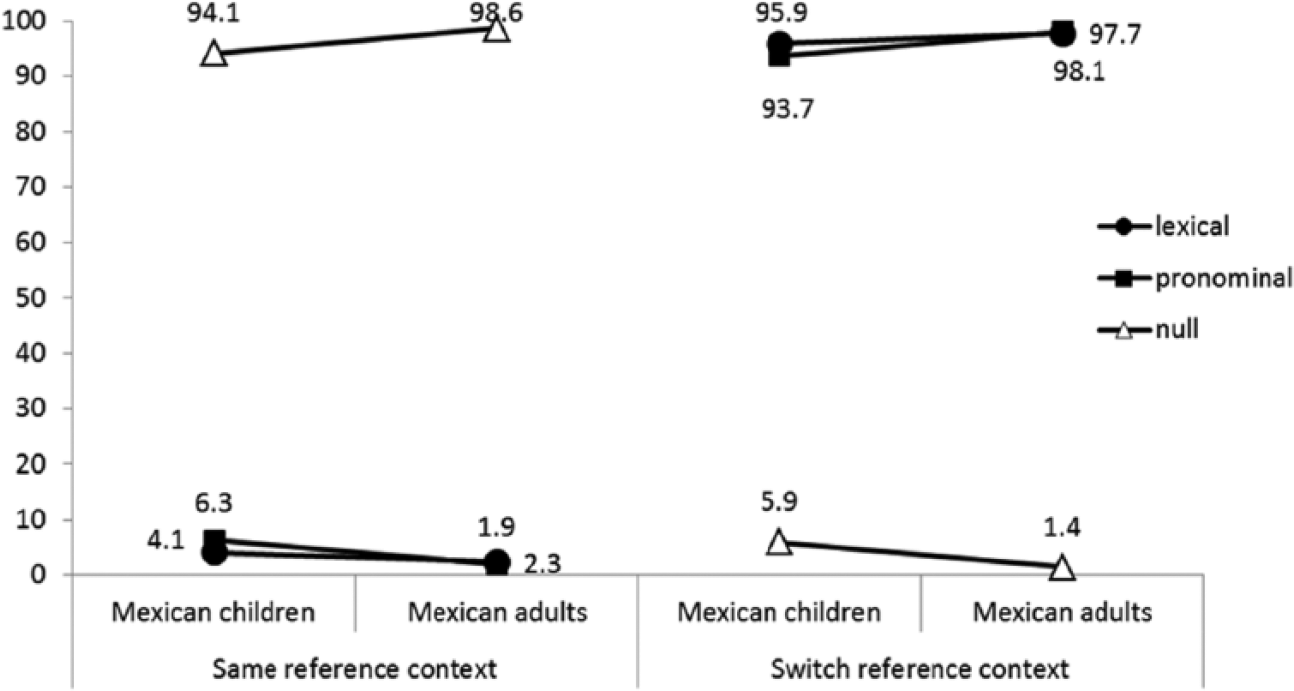
Mexican speakers’ rate of lexical, pronominal and null subjects in same reference and switch reference contexts.
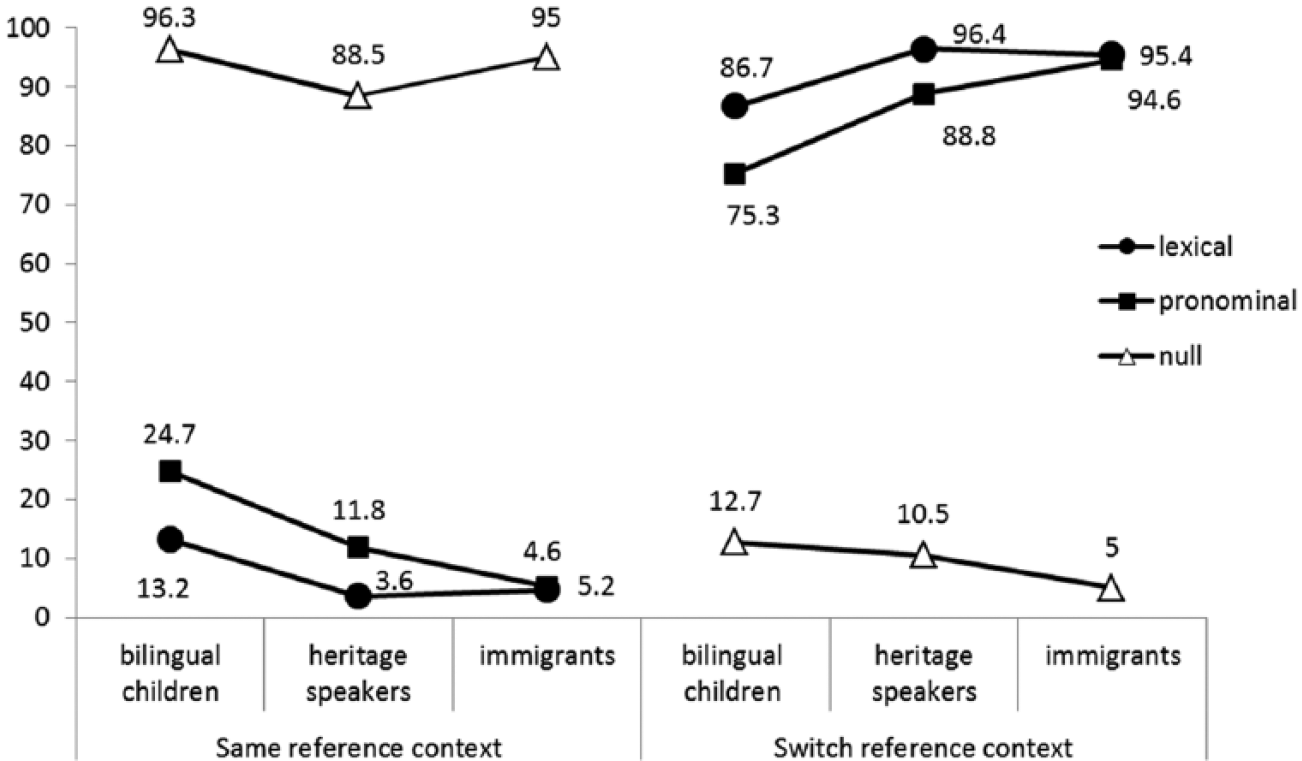
Rate of lexical, pronominal and null subjects in switch reference contexts.
Figure 5 shows the results of the bilingual groups. In same reference contexts, the bilingual groups differed from each other on redundant uses of lexical (F(2,69) = 6.54, p < 0.0001) and pronominal subjects (F(2,69) = 3.54, p < 0.041), largely due to the fact that the bilingual children produced significantly more pragmatically illicit overt subjects (24.7% and 12.2%) than the heritage speakers (11.8% and 3.6%) and the adult immigrants (4.6% and 5.2%) (Tukey, p < 0.05). Compared to the less than 2.3% of illicit overt subjects produced by the Mexican adults in Figure 4, the immigrants in Figure 5 have a higher rate of overt subjects in same referent contexts (more than 4.6%). Yet, it is much lower than the rate produced by the bilingual children (24.7%) and in the heritage speakers (11.8%).
In switch reference contexts, where overt subjects are felicitous, the child and adult heritage speakers produced twice the rate of illicit null subjects (12.7% and 10.5%) compared to 5.9% produced by the monolingual children in Figure 4. The bilingual groups differed on accuracy rates of lexical (F(2,69) = 6.54, p < 0.0001) and pronominal subjects (F(2,69) = 6.54, p < 0.001), largely due to the lower accuracy of the bilingual children, who differed from the heritage speakers and the adult immigrants (Tukey, p <0.05). The adult immigrants produced 5% of illicit null objects, more than half the rate of the child and adult heritage speakers. The 5% overuse of overt subjects by the adult immigrants was largely due to six individuals, and not to the entire group. (The range of redundant pronouns in these six individuals ranged from 4% to 23%.)
Discussion
The aim of this study was to attempt to connect the dots between the bilingual development of simultaneous bilingual children and adult heritage speakers. To place the results in a wider context, I examined the rate and the distribution of null and overt subjects in an oral narrative task administered to school-age bilingual children, young adult heritage speakers, adult Mexican immigrants and age-matched school-age children and adults from Mexico. Comparing the linguistic behavior of child and adult bilinguals allows us to see whether many of the apparent grammatical differences found in young adult heritage speakers and native speakers in the country of origin can be traced back to protracted development in childhood. Furthermore, comparing heritage speakers to adult immigrants, who are akin to the parents of the heritage speakers and the main source of input, helps us address, at least indirectly, whether the type of input heritage speakers receive at present exhibits changes due to attrition.
Shin and Cairns (2012) found in their experimental study of sentence comprehension that monolingual Mexican children did not establish reference at adult levels until after 12 years of age. The results of the oral narratives in the present study show that the expression of subjects in Spanish is subject to developmental effects in monolingual children from Mexico when compared to adults from the same region. In general, the Mexican school-age children produced more overt subjects in same reference contexts than adult native speakers. Our first research question was whether child and adult heritage speakers of Spanish produce more overt subjects in Spanish than child and adult speakers in Mexico. According to our results, child and adult heritage speakers of Spanish indeed produced more overt subjects than the adult Mexican speakers, but their rates did not differ statistically from the rates of the monolingual children. The bilingual children did produce more overt subjects than the monolingual children, although this difference did not reach statistical significance. If the differences between the monolingual children and adults relate to the acquisition of reference, it looks like the bilingual school-age children exhibit similar developmental difficulties, which are further enhanced in a bilingual context. These tendencies are also found in young adult heritage speakers, suggesting a developmental link between the two groups.
Monolingual children have been shown to have problems with null subject reference in comprehension tasks until age 12 (Shin & Cairns, 2012), while the interpretation of overt subjects seems to be the main problem in bilingual grammars. Our second question was whether child and adult heritage speakers would exhibit more difficulty with the pragmatic constraints on overt subjects than the pragmatic constraints on null subjects. If bilingual children and young adult heritage speakers produce higher rates of overt subjects and of pragmatically illicit subjects than their age-matched monolinguals, it can be assumed that the bilinguals did not have a chance to develop the pragmatic features of Spanish subjects fully, especially if child and adult bilinguals do not differ from each other.
The results showed that the linguistic behavior of the child and adult bilinguals was not very different: they all produced more redundant null and overt subjects than the Mexican native speakers. The child and adult bilinguals produced pragmatically illicit null subjects like the monolingual children, but they produced much higher rates of redundant overt subjects as attested in bilingual children and adults (Montrul, 2004; Paradis & Navarro, 2003; Silva-Corvalán, 1994, 2014). Yet, of all the bilingual groups, the bilingual school-age children displayed the highest rates of redundant lexical and pronominal subjects. The fact that the young adult heritage speakers also show high use of overt pronouns when compared to the adult Mexican group suggests that difficulty with the discourse pragmatic distribution of subjects continues well into the adult years. Although indirectly, we were able to establish a link between patterns found in school-age children and patterns found in adult heritage speakers (cf. Silva-Corvalán, 1994, 2014).
Finally, this study also sought to establish whether there is a relationship between the changes observed in the heritage speakers and in the parental generation. If there is deviation from monolingual performance, is it similar in both groups? We asked whether adult immigrants from Mexico produce more overt subjects than native speakers from Mexico. Redundant uses of overt subjects have been portrayed as a key vulnerable area in adult immigrants undergoing attrition (Sorace, 2000; Tsimpli et al., 2004; Kaltsa et al., 2015), although the magnitude of this effect is much smaller in L1 attrition than in heritage speakers (Montrul, 2008). Montrul (2004) reported illicit uses of null and overt subjects in Spanish heritage speakers and Sorace (2004) speculated that the results could be due to intergenerational attrition, although Montrul’s study did not include data on immigrants. The present study, which used the same narrative task as Montrul (2004), included adult immigrants to verify this possibility and to see whether attrition in adults could also contribute to the incomplete acquisition of pragmatic features of Spanish subjects attested in the heritage speakers. The results show that adult immigrants from Mexico, who have been in the United States for an average of 25 years, produced more overt subjects than adult speakers in Mexico. Although the heritage speakers produced higher error rates than the immigrants, the statistical analyses were not significant.
The question is whether the rate of null and overt subject production by the heritage speakers is related to the input they may receive from the parental generation. Heritage speakers often report their highest and most frequent use of the heritage language with their parents and older relatives (Hurtado & Vega, 2004). Since adult immigrants are akin to the parents of the young adult heritage speakers at the time of testing, this would suggest that some heritage speakers may also receive at present (but not while they were growing up) qualitatively different (attrited) input, with occasional misuse of null and overt subjects in discourse. Residual optionality in the input would reinforce the grammar resulting from the delayed development of their Spanish during the school-age period, which exhibits non-target mastery of the pragmatic features of subjects. Thus, while bilingual school-age children show developmental and bilingualism effects, the adult heritage speakers’ grammars are the result of bilingualism, reduced input in childhood, and possibly input effects from relatives who may undergo attrition.
In conclusion, subject expression is vulnerable in child and adult bilingual grammars, and there is a natural connection between the grammatical development of bilingual children and the ultimate attainment of school-age and young adult heritage speakers. Consistent with what Silva-Corvalán (1994, 2014) found in child and adult heritage speakers, this study further confirms that discourse pragmatic properties of subject expression in Spanish are vulnerable to incomplete acquisition and permanent optionality in child and adult bilingual grammars (Sorace, 2000, 2005, 2011).
Footnotes
Declaration of Conflicting Interests
The author(s) declared no potential conflicts of interest with respect to the research, authorship, and/or publication of this article.
Funding
The author(s) disclosed receipt of the following financial support for the research, authorship, and/or publication of this article: This material is based in part upon work supported by the National Science Foundation under Grant Number BCS-0917593, ARRA. Any opinions, findings, and conclusions or recommendations expressed in this material are those of the author and do not necessarily reflect the views of the National Science Foundation.