



Abstract
Aims:
The present study aimed to investigate the effect of task demand in working memory on bilingual cognitive advantage (interference suppression and response inhibition) in young bilinguals.
Methodology:
Experiment 1 was performed with the flanker, Go/No-go, and modified flanker tasks, in which the first two tasks were involved in lower storage demand of working memory and the last task was involved in higher storage demand of working memory. Experiment 2 was performed with the Conditional-Go/No-go task, with a higher processing demand of working memory.
Data and analysis:
Reaction time and accuracy data were analyzed using a repeated measures analysis of variance.
Findings/Conclusions:
In Experiment 1, results showed that compared to monolinguals, the bilingual advantage in interference suppression occurred in the task with high storage demand (i.e., modified flanker task) and not in the low demand task (i.e., flanker task); however, this advantage effect was not observed in response inhibition. In Experiment 2, with the increasing working memory processing demand of tasks, the bilingual advantage in response inhibition was observed.
Originality:
The current study firstly examined the effect of task working memory demand on the bilingual advantage and provided some restrictive conditions for the advantage.
Significance/Implications:
Our results provide new evidence to support the effect of bilingual cognitive advantage.
Keywords
Introduction
A growing body of research has demonstrated that bilingual individuals outperform their monolingual counterparts on executive functions, such as benefits in suppressing interference information (Barac, Moreno, & Bialystok, 2016; Bialystok, Craik, Klein, & Viswanathan, 2004), shifting between mental sets (Bialystok & Viswanathan, 2009; Dong & Liu, 2016), and enhancing the cognitive reserve in aging adults (Abutalebi et al., 2015; Bialystok, Craik, & Freedman, 2007). However, differences between bilinguals and monolinguals on executive functions are not found in all studies (Kirk, Fiala, Scott-Brown, & Kempe, 2014; Kousaie & Phillips, 2012). Considering inhibition as an example, behavioral and electrophysiological evaluation have revealed that bilinguals perform better than monolinguals on the Simon task (Bialystok et al., 2004) and the flanker task (Brydges, Anderson, Reid, & Fox, 2013; Costa, Hernández, Costa-Faidella, & Sebastián-Gallés, 2009); however, these results are not consistently replicated (Paap & Greenberg, 2013; Wu, Zhang, & Guo, 2016).
Various factors may contribute to the inconsistency in results involving bilingual advantages. The variability in the language background of bilinguals may cause these inconsistent results (Prior & Gollan, 2011). For example, compared with bilinguals of a single-language context (SLC) who use only one language in one environment and the other in another environment (e.g., native language (L1) at home and second language (L2) at work), the bilinguals of dual-language context (DLC), speaking two languages in the same environment, may exercise executive functions more frequently (Yang, Hartanto, & Yang, 2016). Moreover, Valian (2015) argued that age might also play an important role in bilingual advantage, and noted that the advantage effect is more common in aging adults (Abutalebi et al., 2015; Craik, Bialystok, & Freedman, 2010). Meanwhile, the influence of task demand on bilingual advantages has garnered more attention (Macnamara & Conway, 2014; Qu, Low, Zhang, Li, & Zelazo, 2015).
Effect of task demand on bilingual advantages
Compared to monolinguals, bilinguals, especially those of DLC, have more opportunities to exercise their executive functions, and perform better on tasks involving executive control (for reviews, see Bialystok, 2011; Bialystok, Craik, Green, & Gollan, 2009). There are many types of executive function tasks that are used to examine the bilingual advantage, including the low demand task and the high demand task, which involves more complex executive control processes. Some studies demonstrated that compared to low demand tasks, the bilingual advantage in executive functions is more evident in high demand tasks. For instance, Morales, Calvo, and Bialystok (2013) used a Simon-type task and a visual–spatial task to examine the bilingual working memory (WM) advantage. In the Simon-type task (Study1), there were four conditions by combining two WM levels (two stimuli versus four stimuli) with two conflict levels (central presentation versus side presentation), that is, center-2 condition, center-4 condition, conflict-2 condition, and conflict-4 condition. In the center-2 condition, two pictures (a purple flower and a red heart) were presented one at a time in the center of the screen and participants were instructed to press the designated key indicating which picture was shown. The center-4 condition was similar to the center-2 condition except that this condition contained 4 stimuli (a blue cloud, a green tree, a yellow smiley, and a pink star), and required participants to press one key for two of the stimuli and to press the other key for the other two stimuli. The parameters of conflict-2 and conflict-4 conditions were the same as previous conditions, but stimuli appeared on either the right- or left-hand side of the screen, creating congruent trials and incongruent trials. The Simon-type task manipulated the involvement of WM (two stimuli versus four stimuli) and other executive control demands (central presentation versus side presentation). The results revealed that the bilingual children outperformed monolinguals on the WM tasks, and that is especially evident when the task contained additional executive function demands (incongruent trials). The visual–spatial task (Study 2) was a WM span task for children, and assessed WM by evaluating the number of items that participants could correctly recall. There were some frogs presented in a 3 × 3 matrix of nine cells simultaneously or sequentially. Participants were asked to remember the location where frogs were presented. The results showed that bilinguals obtained higher scores than monolinguals on the more difficult sequential condition. This study indicated that bilingual advantage is especially evident when the task contains more complex executive function demands.
Costa and colleagues manipulated the task demand for monitoring by varying the percentage of congruent (and incongruent) trials in the flanker task, in order to examine the bilingual advantages in executive functions (Costa et al., 2009). The participants performed three versions of the flanker task, one low-monitoring-demand version that included either 8% or 92% congruent trials and two high-monitoring-demand versions that included 75% or 50% congruent trials. They found that there was a significant global task demand effect; bilinguals performed comparably to monolinguals in the low-monitoring version, but better in the high-monitoring versions. This finding was in line with the viewpoint of Qu et al. (2015), who proposed that executive control is an ability to allocate limited resources according to a prioritized goal to fulfill the task demand. The bilingual advantage may appear when the cognitive resources are under competition; however, it may not appear in automatic processes in which individuals do not need to recruit a large number of resources. They further examined the effect of task demand on bilingual advantage (Qu et al., 2015). They instructed the Chinese monolinguals and Chinese-English bilinguals to sort bivalent stimuli according to shape dimension or color dimension in a color–shape switching task. There were four versions of this task by manipulating the task suppression demand (suppress one set of conflicting responses versus suppress one set of non-conflicting responses) and task activation demand (activate another set of conflicting responses versus activate another set of non-conflicting responses). The results showed that compared to monolinguals, bilinguals had smaller switching costs only in specific versions of the color–shape switching task with high suppression demand or high activation demand, indicating that suppression demand and activation demand of the switching task played a role in bilingual cognitive advantage. Therefore, the influence of task demand on bilingual advantage in executive functions is worthy of further study.
Inhibition advantage and working memory demand
Executive function is an integrated set of abilities, which includes inhibition, shifting, and WM (Miyake & Friedman, 2012), and the experience of bilingualism may shape the integrated set of abilities, and not just a single component of executive functions (Morales et al., 2013).
Inhibition refers to the ability to control one’s attention or behavior to override external interference information or internal response tendency (Diamond, 2013). Based on the features of display, there are two types of inhibition: interference suppression and response inhibition (Bunge, Dudukovic, Thomason, Vaidya, & Gabrieli, 2002). For interference suppression, the target and distractors can either converge on a single response, creating congruent trials or triggering conflicting responses, creating incongruent trials in which individuals need to suppress irrelevant information and focus attention on the target information. For example, in the classic flanker task, participants are asked to identify the direction of a central target arrow (pointing to the left or right). The target arrow is presented along with four flankers pointing in the same direction (e.g., ← ← ← ← ←) or in the opposite direction (e.g., ← ← → ← ←). To make an appropriate response, subjects must ignore the flanker arrows and only focus on the central arrow. Hence, the difference between incongruent and congruent trials (i.e., flanker effect) reflects the processes of controlling distracting stimuli (Eriksen & Eriksen, 1974). The larger the flanker effect is, the more difficult it is to suppress irrelevant information, and the efficiency of executive functions is lower, and vice versa.
On the other hand, response inhibition emphasizes the ability to control a prepotent or automatic behavior response. Generally, in the tasks measuring response inhibition, the same stimuli can trigger two conflicting responses, creating a conflict between one familiar response and one unfamiliar response (Bunge et al., 2002). To make an unfamiliar response appropriately, participants have to process the displays and override the other habitual response. Taking the Go/No-go task as an example, each trial presents a single stimulus on the screen, and the subjects must withhold responding to a no-go stimulus (i.e., No-go trials) while responding to all other stimuli (i.e., Go trials). Because the percentage of Go trials (e.g., 80%) is much higher than that of No-go trials (e.g., 20%), forming a prepotent tendency of making a response, the performance of No-go trials reveals one’s response inhibition ability. Different from interference suppression, during the response inhibition processes, individuals must process each stimulus to make appropriate responses. In other words, the WM processing demand of tasks is closely related to response inhibition.
WM and inhibition are co-dependent and can co-occur (Diamond, 2013). WM involves holding information in mind (temporary storage) and mentally manipulating (processing) when the information is no longer perceptually present (Daneman & Merikle, 1996). The term ‘storage’ is defined as the retention of briefly presented new information over a period in which the information is no longer present. The processing of WM is defined as the transformation of information or the derivation of new information, in contrast to cognitive activities of maintaining the information as given (Duff & Logie, 2001; Oberauer, Süß, Wilhelm, & Wittman, 2003). There is no doubt that when individuals perform any inhibition task, they need to hold their goal in mind to identify the relevant information and make an appropriate response. Combined with task demand studies, the WM demand of the task may play an important role in bilingual inhibition advantages. Base on the view of Qu et al. (2015), individuals’ task performance depends on the executive control, which can allocate limited cognitive resources according to a task’s goal. If a task is relatively easy or merely involves automatic processes, the executive control may not be activated to allocate resources because there is no competition in cognitive resources. However, if the task demand is high, in order to fulfill task goal, the executive control may be activated to allocate the cognitive resources. For bilinguals, their executive control ability has been exercised and enhanced by controlling the two languages, such as inhibiting cross-language interference. Bilinguals with enhanced executive control would allocate cognitive resources more efficiently than monolinguals. Therefore, for the tasks with high WM demand, bilinguals are more likely to show cognitive advantage. When performing one single task, such as the flanker task or the Go/No-go task, participants need to keep one or less piece of information in mind, so the burden of WM is low; therefore, these tasks may fail to detect the distinction between bilinguals and monolinguals, especially for young individuals whose executive control efficiency is at its peak. However, if the task demand in WM is higher, such as keeping two or more pieces of information in mind simultaneously, the advanced executive control of bilinguals may play its role in making an appropriate response as quickly and as accurately as possible, that is, bilingual advantages. Although a few studies have proposed the role of task demand in bilingual advantage (Macnamara & Conway, 2014; Qu et al., 2015), there is no study directly exploring the question in the perspective of WM demand until now, that is, how the WM storage demand and processing demand of these non-verbal executive control tasks influence the bilingual advantage.
The current study
In the present study, we aimed to test whether the task demand in WM can modulate bilingual cognitive advantage. If the bilingual advantage is limited to the WM (i.e., storage or processing), then it should occur in the higher WM demand condition, and be reduced or absent in the lower WM demand condition. In addition, given the distinction between interference suppression and response inhibition, the bilingual advantage may be influenced by different WM components: storage or processing.
To manipulate the WM demand of task, we provided monolinguals and bilinguals with three tasks to assess interference suppression and response inhibition in Experiment 1. There were two low WM demand tasks, the flanker task (interference suppression) (Eriksen & Eriksen, 1974) and the Go/No-go task (response suppression), and one high WM demand task, the modified flanker task (Bunge et al., 2002). The modified flanker task combined the flanker task and the Go/No-go task, especially increasing the WM storage demand by putting two tasks together, and assessed two types of inhibition synchronously.
Compared to the interference suppression ignoring distracting information, individuals need to process the stimuli and then make an appropriate response during response inhibition. Thus, the bilingual advantage in response inhibition may be closely related to the processing efficiency of WM. Therefore, in Experiment 2, we gave participants one more task, The Conditional Go/No-go task (Conditional-GNG), to assess response inhibition under a higher processing demand condition (Redick, Calvo, Gay, & Engle, 2011). We predicted that the WM demand of executive control tasks will influence the bilingual advantage, with significant bilingual benefits in high demand tasks and without such benefits in low demand tasks.
In addition, Paap, Johnson, and Sawi (2015) argued that for inhibition or monitoring, many standard measures obtained with non-verbal tasks lack convergent validity, and do not correlate with one another. Taking inhibition as an example, many executive control tasks are used to measure it, including the flanker, Simon, and Go/No-go tasks. However, the indexes of different tasks may reflect different cognitive processes, with the flanker task measuring interference suppression and the Go/No-go task measuring response inhibition. Therefore, to assess the convergent validity, we determined the degree of correlation between the flanker task and the modified flanker task for interference suppression, and between the Go/No-go task, the modified flanker task, and the Conditional-GNG for response inhibition. If the indexes for interference suppression or response inhibition lack convergent validity, then the group differences between bilinguals and monolinguals may reflect a chance factor, not a stable bilingual advantage.
Experiment 1
Participants
Thirty-one Cantonese (L1)-Mandarin (L2) bilinguals and 27 Mandarin monolinguals between the ages of 17 and 26 years (mean, 20.4; SD, 1.77) participated in the experiment. All participants were right-handed with normal or corrected-to-normal vision. The study was approved by the ethics committee of the School of Psychology, South China Normal University. Given the obvious distinctions between Cantonese and Mandarin, they can be considered as two independent languages (L1 and L2) in verbal communication (Tse & Altarriba, 2014; Tu et al., 2015). Cantonese can be considered as an independent language not only because it is the dominant dialect in the Guangdong province of China, but also because the meanings of Cantonese words and pronunciations are different from Mandarin words. According to the Basic Vocabulary Table of Modern Chinese Characters (Ye, 1987), there are only 21.5% characters pronounced similarly between both languages (Li, 1990). Of all the Cantonese words in ‘A Dictionary of the Guangzhou Dialect’ (Rao, Ouyang, & Zhou, 1981), the proportion of equivalent words in Mandarin is only 23.1%. The same words are different in Cantonese and Mandarin in many aspects, and this leads to a situation where speakers of these languages do not understand each other. Therefore, Mandarin and Cantonese are regarded as two distinct languages (Cai, Pickering, Yan, & Branigan, 2011).
In our study, all high-proficient bilinguals were born in the Guangdong province of China, a Cantonese-Mandarin bilingual region. They frequently communicated with their family or friends in Cantonese. Furthermore, all participants frequently use Mandarin, the most commonly spoken language in China, in school and with family. In contrast to Cantonese-Mandarin bilinguals, the monolinguals without the experience of learning Cantonese cannot understand it. Furthermore, participants were instructed to complete a language background questionnaire on a seven-point scale, sociocultural information, and the Oxford quick placement test (QPT). For the language background questionnaire, the higher the score, the higher the proficiency in one language. The QPT is a test of English language proficiency developed by Oxford University Press and Cambridge English for Speakers of Other Languages Examinations. It consists of two parts, with a total score of 60, and takes take approximately 30 minutes to finish. The higher the score obtained, the higher the English proficiency of the participant.
All participants were Han Chinese and non-immigrants, with a moderate family income. Participants were asked to assess their subjective Cantonese and Mandarin proficiency on a seven-point self-rating scale (1 = very low, 7 = very proficient). The language background measurement showed that bilinguals, based on the average scores of listening, speaking, reading, and writing, were more proficient in Cantonese than monolinguals (mean, 5.42 ± 1.31 versus 1.31 ± 1.06; t(56) = 225.55, p < 0.001). However, there was no difference in Mandarin proficiency between bilinguals and monolinguals (mean, 6.01 ± 0.63 versus 6.07 ± 0.91; t(56) = 0.08, p = 0.77). The QPT scores revealed no significant difference in English proficiency between bilinguals and monolinguals (mean, 38.23 ± 6.08 versus 37.93 ± 5.95; t(56) = 0.03, p = 0.85). Participants received monetary compensation for their participation.
Design and tasks
Experiment 1 had a 2 (Group) × 2 (WM demand) design, with Group (bilingual, monolingual) as a between-subjects variable and WM demand (high, low) as a within-subject variable. The tasks for low WM demand included the flanker task and the Go/No-go task, which measured the interference suppression and response inhibition, respectively, whereas a modified flanker task in the high WM demand condition was a combination of the flanker task and the Go/No-go task, assessing interference suppression and response inhibition simultaneously.
Flanker task
In the flanker task, each display contained one central target arrow flanked by four arrows on both sides. Moreover, they were all presented in a horizontal row. In the congruent condition, the flankers were pointed in the same direction as the target. However, the flankers were pointed in the opposite direction of the target in the incongruent condition. Participants were asked to respond to the target arrow as quickly and accurately as possible while ignoring the distractors. They were instructed to press the left-hand response key when the target was directed to the left-hand side and to press the right-hand response key when the target was directed to the right-hand side. The task consisted of three blocks of 120 trials that were presented randomly. The congruent stimuli occurred in 50% of trials, with the incongruent stimuli occurring in the remaining 50% of trials. To ensure participants understood the instructions of this task, participants were asked to complete a practice block before the experimental trials. The practice block contained 10 congruent trials and 10 incongruent trials. Each trial began with a 500 ms fixation presented on the screen, and the target items appeared until the participant’s response (maximum duration: 2000 ms). The inter-trial interval was set at 250 ms (Eriksen & Eriksen, 1974).
Go/No-go task
In this task, each letter stimulus was presented at the center of the computer screen, and participants were instructed to withhold responding to the no-go stimulus (i.e., letter X) while responding to the go stimuli (i.e., all other letters) by pressing the response button. Each trial started with a center fixation for 500 ms, which was followed by a blank screen for 250 ms. Then, the stimulus was presented for 300 ms, followed by a blank screen for 700 ms. Participants had a total of 1000 ms to respond to each letter stimulus. The 200 trials, divided into four blocks equally, consisted of 80% Go trials and 20% No-go trials. Participants completed a practice session of 20 trials (16 Go trials and four No-go trials) before experimental blocks.
Modified flanker task
This task was combined with the flanker and Go/No-go paradigms, which included the following four conditions: congruent, incongruent, neutral, and No-go trials (Bunge et al., 2002) (examples of the stimuli types are presented in Figure 1). The congruent and incongruent conditions were the same as in the flanker task, with the flanker arrows pointing in the identical or opposite direction of the target arrow. The third condition, the neutral condition, was comprised of a target arrow that was presented in the center of the screen and four flankers (i.e., letters without pointing interference), which were not associated with the correct response. However, in the No-go condition, the target arrow was flanked by four No-go characters (i.e., X). Participants were instructed to refrain from pressing any button if the no-go character appeared. However, if the stimuli were presented on the screen without the no-go character, participants were asked to press the left-hand response key when the central arrow pointed to the left-hand side and the right-hand response key when it pointed to the right-hand side.

Examples of trial types and stimuli in the modified flanker task.
The modified flanker task consisted of four blocks of 200 trials. In the Go/No-go task, No-go stimuli occurred in 20% of trials, with the neutral, congruent, and incongruent trials respectively occurring for 20%, 30%, and 30%. Participants completed a practice session of 20 trials (six congruent, six incongruent, four neutral, and four No-go trials). If needed, this practice block was repeated. In the experimental part, trials of different conditions were presented in an intermixed manner. Each trial in this task started with the presentation of a center fixation for 500 ms; then, the stimuli appeared on the screen until the participant’s response (maximum duration, 2000 ms), followed by an inter-trial blank for 250 ms (Brydges et al., 2013; Bunge et al., 2002). Different from the flanker task and the Go/No-go task, in which individuals were instructed to remember one piece of information, in the modified flanker task participants were asked to remember two pieces of information at the same time, thereby increasing the WM storage demand of the task. Specifically, participants were asked to judge whether to make a response (Go/No-go task) and then identify the direction of the central arrow (flanker task). The order of the three executive function tasks was counterbalanced across participants.
Results
In the flanker task, all data entered analysis for reaching the accuracy criterion of 80%, and only trials with correct response were included in the analysis. Response times beyond three SDs of each participant’s mean were excluded (3.8%). The flanker effect, reflecting the interference control ability, was calculated by subtracting the reaction time (RT) and accuracy of congruent trials from that of incongruent trials (Eriksen & Eriksen, 1974). In the Go/No-go task, one participant was excluded because the accuracy was lower than 80%. The performance of No-go trials reflected the efficiency of response inhibition, an ability to perform executive function tasks. For the modified flanker task, all participants were included in the analysis because they all reached the accuracy criterion (80%). The data-trimming procedure for congruent and incongruent conditions was the same as that of the flanker task. The flanker effect (interference control) was assessed by calculating the difference between congruent and incongruent trials in RT and accuracy. In line with the Go/No-go task, the response inhibition ability in the modified flanker task was assessed by the accuracy of No-go trials. Tables 1 and 2 present the performance of bilinguals and monolinguals in the congruent and incongruent conditions of the flanker task and the modified flanker task. Table 3 presents the performance of bilinguals and monolinguals in the No-go trials and the control trials of the Go/No-go task and the modified flanker task.
Mean reaction times (ms) and SD (in parentheses) of bilinguals and monolinguals in the flanker and modified flanker tasks.

Con: congruent condition; Incon: incongruent condition.
Mean accuracy (%) and SD (in parentheses) of bilinguals and monolinguals in the flanker and modified flanker tasks.

Con: congruent condition; Incon: incongruent condition.
Mean accuracy (%) and SD (in parentheses) of bilinguals and monolinguals in the Go/No-go and modified flanker tasks.

To systematically present the influence of the task demand in WM, a 2 (Group) ×2 (WM demand) analysis of variance (ANOVA) was conducted for the indexes of interference suppression (flanker effect) and response inhibition (No-go trials accuracy). For interference suppression in RT, the main effects of Group, F(1,56) = 5.19, p = 0.02, η p 2 = 0.09, WM demand, F(1,56) = 54.11, p < 0.001, η p 2 = 0.49, and the Group × WM demand interaction were significant, F(1,56) = 4.95, p = 0.03, η p 2 = 0.08. Further analysis showed that bilinguals performed better than monolinguals in the high WM demand condition, F(1,56) = 6.06, p = 0.017, η p 2 = 0.10, whereas such bilingual advantage was absent in the low WM demand condition, F(1,56) = 0.70, p = 0.406, η p 2 = 0.01. For interference suppression in accuracy, the main effect of Group, F(1,56) = 0.54, p = 0.46, η p 2 = 0.01, the main effect of WM demand, F(1,56) = 0.51, p = 0.47, η p 2 = 0.01, and the Group × WM demand interaction did not show statistical significance, F(1,56) = 0.13, p = 0.71, η p 2 = 0.002.
A 2 (Group) × 2 (WM demand) ANOVA for response inhibition revealed that the main effect of WM demand was significant, F(1,55) = 85.94, p < 0.001, η p 2 = 0.61). However, the main effects of Group [F(1,55) = 0.38, p = 0.53, ηp2 = 0.01] and the Group × WM demand interaction [F(1,55) = 0.17, p = 0.68, η p 2 = 0.003] were not significant.
The results of Experiment 1 suggested that the bilingual advantage in executive functions was limited to the task demand in WM. In general, bilinguals performed better than monolinguals in the higher WM demand task, but not in low demand tasks. Of note, such bilingual advantage only occurred in interference suppression, not in response inhibition in Experiment 1. The possible reason may be that the modified flanker task in Experiment 1, compared to the traditional flanker task, increased WM storage demand, resulting in a significant effect on interference suppression, while response interference was immune to the increasing storage demand. According to the forgoing analysis, WM processing demand is more likely to impact response inhibition. To validate our hypothesis, in Experiment 2, we gave participants the Conditional-GNG (Redick et al., 2011), reflecting response inhibition. Compared to the modified flanker task, the Conditional-GNG enhanced the WM processing demand. We predicted that bilinguals would perform better than monolinguals in the higher WM processing demand task.
Experiment 2
Participants
The participants recruited in Experiment 2 were the same as Experiment 1 in order to control the confounding effect of participant diversity.
Design and task
The Conditional-GNG consisted of three trial types, the target trial, distractor trial, and lure trial (Redick et al., 2011). Corresponding to the Go/No-go task, this task also presented an individual letter in the center of the computer screen. Participants were instructed to press the response key as quickly and as accurately as possible when the letters M or W appeared, and withhold the response to any non-M or non-W letters (distractor trial). It was noteworthy that only when the target letter had alternated since the last presentation (target trial), did participants have to make a response by pressing the key. If the current letter M or W was the same as the last target letter, participants were instructed to refrain from responding (lure trial). In other words, participants had to keep the last target letter in mind and process each sequent letter. Examples of trial types in the Conditional-GNG are shown in Figure 2. Moreover, the frequency of trial types differed: target trials occurring 40% of the time, distractor trials occurred 50%, and lure trials occurred 10%.
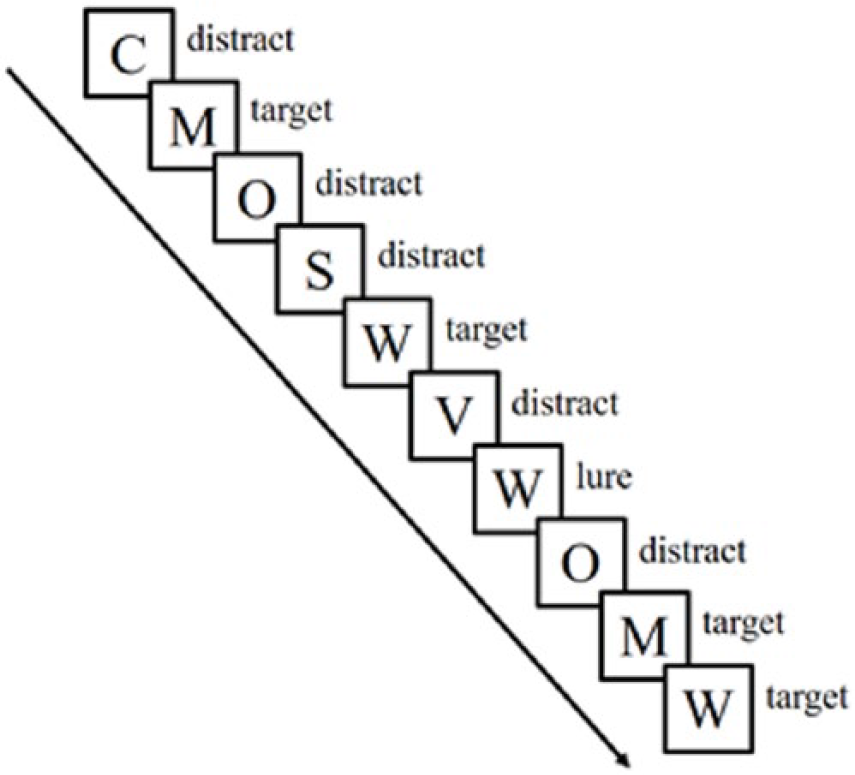
Examples of trial types and stimuli used in the Conditional-Go/No-go task.
Each trial began with a fixation target presented in the center of a computer screen for 500 ms, followed by a blank for 250 ms. Next, the letter stimulus was presented for 300 ms, which was followed by a blank screen for 700 ms. Participants had a total of 1000 ms to respond to each letter. There were three blocks of 600 trials, presented in a pseudo-random order. To ensure that the participants understood the instructions of this task, participants were asked to complete a practice block before the experimental trials. The practice block that could be repeated if needed consisted of 40 trials (16 target trials, 20 distractor trials, and 4 lure trials).
In addition, by controlling the lag numbers, the interval trials between the last target trial and the current lure trial formed different processing demands. According to the order of stimuli presentation, there were three conditions for lag numbers. If the same target letter was presented two times in a row, without any other letter between them, this was considered as lag-0 level. For example, if the last target letter (e.g. M) was immediately followed by the same letter (e.g. M), the current trial was considered as a lag-0 lure trial. In this way, there was less WM processing demand for lag-0 trials. Rather, if the current lure trial was separated from the last target trial by one distractor (or two distractors), the current lure trial could be defined as a lag-1 (or lag-2) trial. Compared to lag-0 trials, which just required one to process the lure stimulus, in these lag-1 (or lag-2) trials, participants had to do more processing, including encoding the distract letter, comparing with the current target, making a decision, and deleting the irrelevant information (i.e., distract letters) in order to avoid confusing the current letter with target letter. Therefore, the three types of trials imposed different WM processing demand on the participants, and there are also some different storage demands.
Results
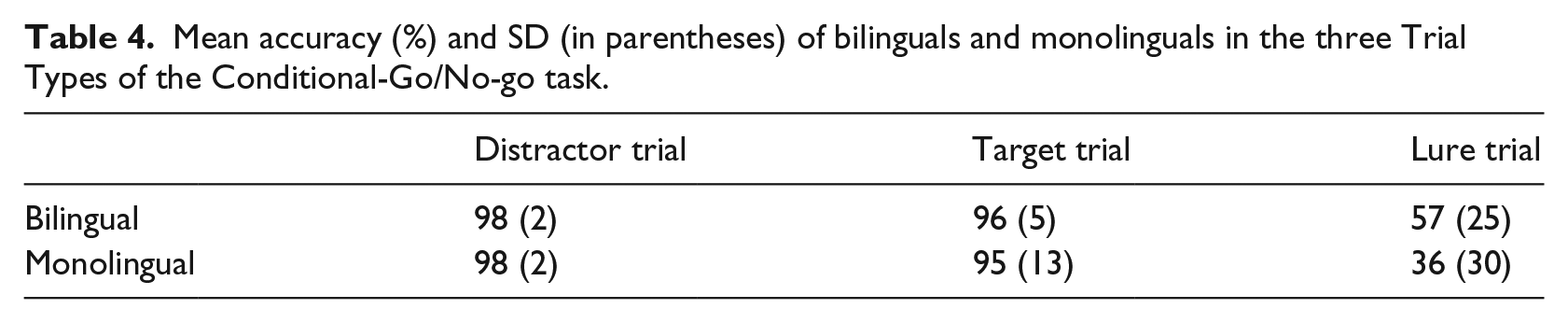
Except two data missing, 56 data entered the analysis for the Conditional-GNG. Table 4 presents the accuracy of bilingual and monolingual groups for the three trial types of the Conditional-GNG. A 2 (Group) × 3 (Trial Type) ANOVA for accuracy indicated that the main effect of Group, F(1,54) = 7.94, p = 0.007, η p 2 = 0.13, and Trial Types, F(1,54) = 159.53, p < 0.001, η p 2 = 0.75, were significant, as was the Group × Trial Type interaction, F(1,54) = 6.21, p = 0.03, η p 2 = 0.10. The bilinguals outperformed monolinguals in the lure trial, F(1,54) = 7.55, p = 0.008, η p 2 = 0.12; however, no significant difference in the target trial [F(1,54) = 0.03, p = 0.85, η p 2 = 0.0005] or the distractor trial [F(1,54) = 0.14, p = 0.70, η p 2 = 0.002] was observed.
Mean accuracy (%) and SD (in parentheses) of bilinguals and monolinguals in the three Trial Types of the Conditional-Go/No-go task.
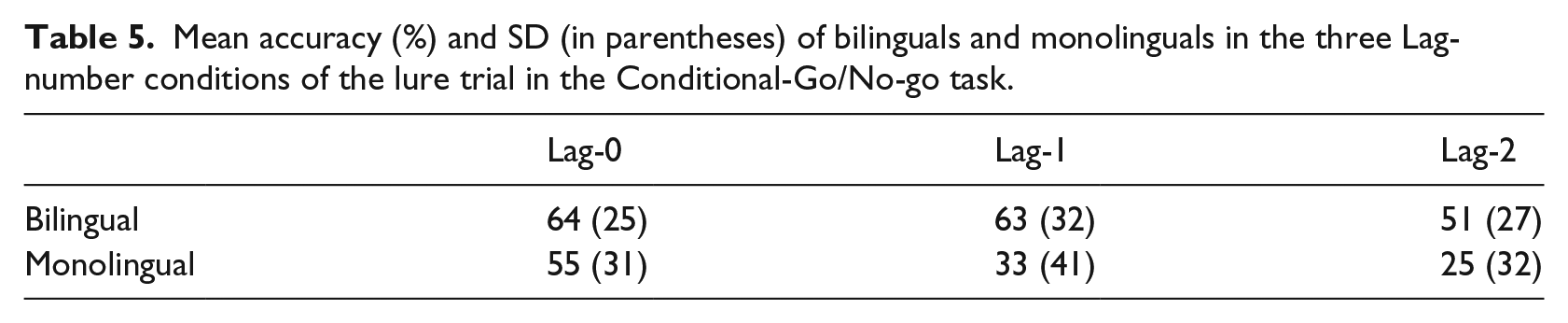
To examine the influence of processing demand on bilingual advantage, we further analyzed the accuracy of the lure trial. Table 5 presents the accuracy of the bilingual and monolingual groups for three lag-number conditions of the lure trial. The main effects of Group, F(1,54) = 7.50, p = 0.008, η p 2 = 0.12, and Lag Numbers, F(1,54) = 23.86, p < 0.001, η p 2 = 0.31, were significant, as was the Group × Lag Numbers interaction, F(1,54) = 7.18, p = 0.001, η p 2 = 0.12. More importantly, the Group effect reached a significant level for both the lag-1 and lag-2 conditions, but not for the lag-0 condition. The results suggest that the bilingual advantage in response inhibition only occurred in lag-1 and lag-2 conditions, in which participants need to allocate resources to keep the last target letter and update it until the lure letter (or another target letter) was presented.
Mean accuracy (%) and SD (in parentheses) of bilinguals and monolinguals in the three Lag-number conditions of the lure trial in the Conditional-Go/No-go task.
Convergent validity for indexes of executive functions from cross-tasks
Because the indexes of interference suppression and response inhibition derived from a different task, we further explored the convergent validity of these indexes by calculating the correlation degree between them (Paap et al., 2015). The higher the degree of correlation among different indexes, the more consistent the executive control processing they possessed. For interference suppression, the correlation between the flanker effect of the standard flanker task and that of the modified flanker task reached significance (r = 0.39, p < 0.005); for response inhibition, the correlation between the No-go accuracy of the standard Go/No-go task and that of the modified flanker task was significant (r = 0.43, p < 0.005), as was with the lure trial accuracy of the Conditional-GNG (r = 0.32, p = 0.01). The results of convergent validity revealed that the tasks adopted in the present study measured the same executive control abilities, excluding the task-specific confounding effect.
General discussion
The current study explored the relationship between task demand in WM and bilingual cognitive advantage. The low WM demand condition included the flanker task and the Go/No-go task, measuring interference suppression and response inhibition, respectively. The high WM demand task, especially the storage demand, was a modified flanker task, measuring two types of inhibitions synchronously (Experiment 1); and the high WM demand task, emphasizing the processing demand, was a Conditional-GNG, only assessing response inhibition (Experiment 2). Consistent with our hypothesis, for interference suppression, the bilingual advantage was observed in the high WM demand condition, and not in the low WM demand condition; for response inhibition, we found a significant response inhibition advantage in bilinguals only under the high processing demand condition, not in other conditions. Moreover, the tests of convergent validity revealed that the indexes of interference suppression or response inhibition, from different executive control tasks, measured the same executive control processes.
The bilingual advantage in interference suppression
The results revealed that there was a bilingual advantage in interference suppression; however, this effect was limited to the high WM demand task. Consistent with previous studies using flanker tasks (Dong & Xie, 2014; Yow & Li, 2015), there was no significant effect of bilingualism on executive functions in the flanker task. For instance, Dong and Xie (2014) assessed how the L2 proficiency and language interpreting experience contribute to executive control in the flanker task and the Wisconsin card sorting test (WCST; testing mental set shifting). The results found no significant group difference in the flanker task; however, the interpreting experience enhanced the performance of the WSCT. Not only the behavioral evidence but also the electrophysiological findings of bilingual advantage drew a similar conclusion (Wu et al., 2016), namely no between-group differences in the magnitude of the flanker effect, which was observed in the N2 component. In electrophysiological studies, N2, a typical negative-going component related to inhibition, has been analyzed in flanker task to explore interference suppression. However, Luk, De Sa, and Bialystok (2011) revealed that, compared to monolinguals and late bilinguals, the smallest flanker effect (i.e., the response time cost for incongruent trials) was observed in early bilinguals. Furthermore, the bilingual advantage showed by Luk et al. (2011) was limited to early bilinguals, and not late bilinguals.
The modified flanker task used in our current study was adopted by Bunge et al. (2002) and Brydges et al. (2013), which distinguished interference inhibition and response suppression effectively. More importantly, the task improved the WM demands of the task by combining the standard flanker task and the Go/No-go task. In the high WM demand condition, the bilingual benefit in interference suppression was in line with several previous studies (Bialystok & Viswanathan, 2009; Costa et al., 2009; Fan, Wang, Wu, & Lin, 2012). For instance, Bialystok et al. (2009) and Fan et al. (2012) used a faces task, which contained more than one condition and measured three components of executive functions (i.e., shifting, interference suppression, and response inhibition). The faces task consisted of the straight-eye condition, where the colored eyes always look straight ahead, and the gaze shift condition, where the colored eyes look toward the left- or right-hand side of the screen in the congruent and incongruent trials, respectively. Participants’ key-pressed responses depended on the eye color; in the case of green eyes, the key was pressed on the same side as the target location, and in case of red eyes, the key was pressed on the opposite side. Therefore, the differences between red-eye trials and green-eye trials reflect response inhibition, and the differences between incongruent trials and congruent trials in gaze-shift condition reflect interference suppression. The two studies (Bialystok et al., 2009; Fan et al., 2012) found that there was a bilingual advantage in interference suppression. There is no doubt that the faces task is more difficult than the flanker task, although the faces task did not define its features or characteristics. Although previous studies found that the bilingual advantage in executive functions was present in some tasks (e.g., faces task) but absent in other tasks (e.g., flanker task), they did not compare these tasks within one study and did not discuss the reasons for these inconsistent results. In the present study, by comparing low demand tasks with the high demand task, we found that the bilingual advantage in interference suppression is influenced by the features of executive control tasks, especially the WM demands.
The executive control theory proposed that the executive resources are limited, and executive control ability can effectively allocate these limited resources depending on the task demand to achieve a prioritized goal (Qu et al., 2015). Our study further supported the executive control theory by manipulating the WM demand of tasks. Because of the limitation and competition of executive resources, bilinguals, who exercised executive control ability frequently during experiences that are controlled by daily languages, could efficiently allocate these resources to a more complex modified flanker task, leading to better performance than monolinguals. However, when there were enough executive resources for conflict resolution, without competition, such as low WM demand tasks (flanker and Go/No-go task), the benefit effect in bilinguals also disappeared. In other words, the long-lasting influence of bilingual experience on executive control was modulated by task demand in WM.
The bilingual advantage in response inhibition
Although response inhibition is a necessary part of conflict resolution, it has been ignored in many executive control tasks of bilingual advantage studies. As Paap and Greenberg (2013) suggested, the common term ‘inhibitory control’ ignored the distinction between interference suppression and response inhibition. In terms of bilingual experiences, such as the language switching experience, individuals need to suppress the interference effect from non-target words and the proponent/automatic responses (e.g., speaking the more familiar language). In this way, response inhibition ability should receive the same practice as interference suppression.
Given the relationship between the two types of inhibition, we assumed that there would be a bilingual benefit in response inhibition. Our results showed that the increasing storage demands (the modified flanker task in Experiment 1) could not detect the response inhibition advantage for bilinguals; however, the Conditional-GNG measured the bilingual benefit effectively (Experiment 2). Compared to interference control, for the process of response inhibition it is necessary to analyze the target stimuli and update them, emphasizing the importance of processing. Regarding the difference in results on response inhibition in the modified flanker task and the Conditional-GNG, one possible explanation is the competition of processing resources. When participants performed the modified flanker task, they needed to identify the no-go signal only, without competition for the processing resources. However, in the Conditional-GNG, participants not only needed to analyze each letter presented on the screen, but also make a quick decision as to whether the current letter was same as the last target letter, with the competition of processing resources to some extent. However, Bialystok et al. (2009) and Fan et al. (2012) found that there was no response inhibition advantage in bilingual children and adults. The divergence between our findings and previous works may result from the task characteristics measuring response inhibition, in which the faces task failed to form a significant habitual response (i.e., 50% congruent trials and 50% incongruent trials). Another possibility is that the response inhibitions measured by our study and faces task may reflect, to some extent, different WM demand. We cannot provide a conclusive explanation as to why the bilingual benefits in response inhibition are so difficult to find; however, the WM demand of tasks should be taken into consideration in future research.
The mechanisms of bilingual advantage in executive functions
The bilingual executive control advantage cannot function without bilingual language processing. This bilingual benefit is believed to occur because both languages of bilinguals are activated ‘non-selectively’, even in completely monolingual contexts (De Groot, Delmaar, & Lupker, 2000; Green, 1998). Such non-selective activation creates cross-linguistic interference from the non-target language during language processing. According to our findings, the bilingual advantages in interference suppression and response inhibition, which were detected in different executive control tasks with high storage demand (modified flanker task in Experiment 1) and high processing demand (Conditional-GNG in Experiment 2), might further enrich the executive control theory. In a way, executive control ability is a ‘unity’ concept, which consists of different components. Therefore, the advanced effect may occur in a specific component. At an individual level, the more we use one specific component under certain circumstances, the more we develop it. For bilinguals, when their two languages are activated non-selectively, they often invoke interference suppression to ignore the non-target language under such high storage circumstance; however, when they are exposed to a bilingual context, they must utilize response inhibition to make an appropriate response by processing incoming visual or auditory stimuli continuously under such high processing circumstances. For this reason, the bilingual advantage in interference suppression and response inhibition may occur in different circumstances.
In conclusion, the current study firstly investigated the effect of task demand in WM on bilingual cognitive advantage. The results suggested that the bilingual cognitive control advantage was regulated by the task demand of WM. Different executive bilingual benefits were related to different features of WM demand. The bilingual advantage in interference suppression was more regulated by WM storage demand, whereas the bilingual advantage in response inhibition was more regulated by the WM processing demand of the executive control task.
Footnotes
Declaration of conflicting interests
The author(s) declared no potential conflicts of interest with respect to the research, authorship, and/or publication of this article.
Funding
The author(s) disclosed receipt of the following financial support for the research, authorship, and/or publication of this article: The study was supported by National Natural Science Foundation of China(31571142), Guangdong Province Universities and colleges Pearl River Younger Scholar Funded Scheme to Ruiming Wang.