



Abstract
Aims and Objectives:
The present study explores the question of whether learning a third language (L3) in an English as a foreign language (EFL) classroom setting induces improved inhibitory control compared with that found in bilinguals, considering task complexity and language proficiency.
Methodology:
Thirty-six Chinese–English second language (L2) young adult learners and 121 Chinese–English–Japanese/French/Russian/German L3 young adult learners with three levels of L3 proficiency participated in the study. Simon arrow tasks were employed to measure two types of inhibitory control: response inhibition (the less complex task with univalent stimuli) and interference suppression (the more complex task with bivalent stimuli).
Data and Analysis:
Statistics using ANOVAs and multiple comparisons were employed to analyze the effects of L3 learning on the reaction time and accuracy for response inhibition and interference suppression, respectively.
Findings:
The results demonstrated that L3 learners did not outperform L2 learners in the two types of inhibitory control: response inhibition (less complex) and interference suppression (more complex). Moreover, L3 learners with a higher proficiency did not display better inhibitory control than those with a lower proficiency in response inhibition and interference suppression. However, as the L3 proficiency increased, some specific aspects of inhibitory control did improve and exhibited a nonlinear pattern.
Originality:
The present study extends bilingual advantage in inhibitory control to formal L3 learning, exploring whether bilingual advantage in inhibitory control also appears in L3 learners, considering task complexity and language proficiency.
Significance/implications:
The present study contributes to the theory of the relationship between multilingualism and inhibitory control by showing that this relationship may be more complex than it is understood currently. Learning an additional language to L2, particularly short-term learning, may not lead to an incremental advantage in overall inhibitory control. However, as learning time increases, changes may appear in specific aspects of inhibitory control, and may be a nonlinear one.
Keywords
Introduction
The relationship between bilingualism and inhibitory control has attracted continuous attention (for reviews, see Antoniou, 2019; Poarch & Krott, 2019; Vīnerte & Sabourin, 2019). A number of studies have shown positive effects (e.g., Bialystok et al., 2004, 2005, 2008; Coderre & van Heuven, 2014; Martin-Rhee & Bialystok, 2008; Marton et al., 2017), though some have failed to demonstrate significant bilingual advantages (e.g., Antón et al., 2014; Duñabeitia et al., 2014; Gathercole et al., 2014; Kirk et al., 2014; Ladas et al., 2015; Paap et al., 2015; Poarch & van Hell, 2012). Recently, with the debate going on, research on this topic has been extended to include more factors. A few studies have started to explore trilingual advantages, raising the question of whether obtaining the command of a third language (L3) could further enhance cognitive control. This relationship between multilingualism and inhibitory control has theoretical implications for cognitive plasticity and practical implications for educational programs (Schroeder & Marian, 2016). The few studies that have studied cognitive control among trilinguals have yielded inconclusive results (e.g., Madrazo & Bernardo, 2012; Madrazo & Bernardo, 2018; Poarch & van Hell, 2012; Schroeder & Marian, 2016), which presents a theoretical urgency for more studies from diverse perspectives. In response to this need, and with an aim to gain a better-informed understanding of the cognitive control in trilinguals, we investigated the relationship between L3 learning and inhibitory control, in a classroom-based instruction context and with consideration of task complexity and language proficiency.
Inhibitory control
Inhibitory control is “the ability to ignore irrelevant information and attend to relevant information” (Schroeder & Marian, 2016, p. 9). Some research has shown that inhibitory control continues to increase during adolescence (Luna, 2009; Luna et al., 2004), but after attaining a zenith in young adulthood, tends to decline with normal ageing (Hasher et al., 1991; Hasher & Zacks, 1988). Other research demonstrates that executive functions, an important component of which is inhibitory control, can be trained and improved throughout life (Bergman Nutley et al., 2011; Diamond & Lee, 2011; Holmes et al., 2009; Klingberg, 2010; Klingberg et al., 2005; Thorell et al., 2009). This would imply that inhibitory control is dynamic and trainable, and therefore persistently malleable to life experiences such as learning a new language.
There is a distinction between the inhibitory control of response inhibition and that of interference suppression (Bunge et al., 2002). Response inhibition, which is a kind of behavioral inhibition, may be viewed as a merely “motoric” (Bialystok et al., 2008, p. 869) and lower-level inhibitory control mechanism, whereas interference suppression is associated with inhibition of attention, which is a higher-level inhibitory control mechanism. This distinction is based on the difference between tasks involving univalent stimuli, which comprise one dimension and two possible responses, and tasks involving bivalent stimuli, which contain two conflicting dimensions with two different responses for each dimension (Madrazo & Bernardo, 2018; Martin-Rhee & Bialystok, 2008).
The popular research tools used to investigate inhibitory control include (1) the Eriksen Flanker task (Eriksen & Eriksen, 1974), which measures response inhibition by asking participants to indicate and respond to the target item that is the middle item in a row of five items, regardless of the target item’s congruency with the rest of the four items; (2) the Simon task (Simon & Rudell, 1967), which includes one-dimensional univalent stimuli to measure response inhibition and two-dimensional bivalent stimuli to measure interference suppression; (3) the Stroop task (Stroop, 1935), which consists of colored words requiring inhibitory control to suppress the interference of the word meaning and name the word color; and (4) the go/no go task, which requires response inhibition to respond to a go trial usually by pressing a button on the keyboard but not to press any button for other trials, and the many modifications of these four tools, such as utilizing shape, arrow, number, or word variations of the original stimuli.
Inhibitory control and bilingual/multilingualism
The most popular hypothesis with regard to the relationship between inhibitory control and bilingualism is that bilinguals need to inhibit the interference of the non-target language to communicate competently in the target language (e.g., Gambi & Hartsuiker, 2016; Kroll & Bialystok, 2014). Green (1998) proposed the Inhibitory Control Model for interpreting how bilinguals control their lexico-semantic systems during second language (L2) processing to achieve the desired output. The model comprises three separable aspects: first, one level of control involves language task schemas that compete to control output; second, the locus of word selection is the lemma level . . . and selection involves the use of language tags; third, control at the lemma level is inhibitory and reactive. (Green, 1998, p. 68)
Later, Green and Abutalebi (2013) formulated the adaptive control hypothesis, holding that the bilingual language control process adapts in accordance with the recurrent demands arising from the interactional context. On the basis of the Inhibitory Control Model and language suppression hypothesis (Green, 1998), stimuli eliciting both L1 and L2 responses are bivalent stimuli in an experimental context (Finkbeiner et al., 2006). Extended to the process of language comprehension and production, this means the non-target language responses should be suppressed for language selection, which was later supported by empirical studies on the role of inhibitory control in bilingual language selection (e.g., Giezen et al., 2015; Kroll et al., 2008; Linck et al., 2012; Liu et al., 2014).
Blumenfeld and Marian (2014) examined the relationship between two types of inhibitory control and bilingualism within the framework of the Dimensional Overlap Model (Kornblum et al., 1999), a model accounting for different inhibition mechanisms. According to Blumenfeld and Marian (2014, p. 613), stimulus–stimulus inhibition (two-dimensional or bivalent stimuli, measuring interference suppression) means conflict between co-activated language representations, whereas stimulus–response inhibition (one-dimensional or univalent stimuli, measuring response inhibition) means conflict between two overt responses if cross-linguistic conflict has not been resolved by the time the response stage is reached. They proposed that bilingual language processing may rely more heavily on stimulus–stimulus inhibition than on stimulus–response inhibition as a result of cross-linguistic competition resolved at the lexical level. Therefore, bilinguals would perform better on the Stroop task (interference suppression in the present study) than on the Simon task (response inhibition in the present study) and the monolingual Stroop performance.
Although a number of studies have failed to demonstrate distinct advantages in inhibitory control among bilinguals (e.g., Antón et al., 2014; Bialystok et al., 2010; Duñabeitia et al., 2014; Gathercole et al., 2014; Kirk et al., 2014; Ladas et al., 2015; Morton & Harper, 2007; Paap et al., 2015; Paap & Greenberg, 2013; Poarch & van Hell, 2012), the preponderance of studies has provided evidence that bilinguals show better inhibitory control than monolinguals (e.g., Bialystok et al., 2004, 2005; Bialystok & Martin, 2004; Blom et al., 2014, 2017; Carlson & Meltzoff, 2008; Costa et al., 2009; Crivello et al., 2016; De Cat et al., 2018; Engel de Abreu et al., 2012; Gold et al., 2013; Morales et al., 2013; Poarch & Bialystok, 2015; Poarch & van Hell, 2012; Prior & MacWhinney, 2010; Thomas-Sunesson et al., 2018). Since these studies link bilingual experience with improved inhibitory control, it may follow that learning and using an L3 would further enhance the capacity for inhibitory control.
However, the relatively sparse literature on trilingualism does not give consistent findings in this regard. Kwon and Lee (2017) provided evidence for further increase in trilingual inhibitory control. They studied a group of 32 English–Korean bilinguals who underwent training in German as L3. Follow-up electroencephalography (EEG) recordings during the performance of a version of the continuous performance test that measured response inhibition revealed an increase in the amplitude of P3a wave after instruction in L3, which suggests an enhancement of response inhibition.
However, several studies did not find trilingual advantage in inhibitory control, especially in response inhibition. For instance, Madrazo and Bernardo (2012) did not find group differences in response inhibition measured by a go/no-go task between bilingual and trilingual university students. Vega-Mendoza et al. (2015) did not find an incremental benefit of trilingualism on the performance of response inhibition in the Everyday Attention Task that required children or young adults to count the number of low tones in a list of high- and low-pitched tones. Other null effects were from Poarch and van Hell (2012), which examined inhibitory control processes in three groups of bilinguals and trilinguals (5- to 8-year-old children) with two executive control tasks (the Simon task that measured interference suppression and the Attentional Networks Task). Another piece of negative evidence comes from Poarch and Bialystok (2015), which assessed the inhibitory function of 8- to 11-year-old trilingual, bilingual, and monolingual children with flanker tasks. They found that though trilinguals and bilinguals outperformed monolinguals, trilinguals performed similarly to bilinguals, which suggests no additional gains of response inhibition in trilinguals.
Bilingual/multilingual inhibitory control and task complexity
Some researchers have investigated the effects of bilingualism on cognitive control as a function of task complexity or difficulty. These studies generally suggest that bilingual advantages in inhibitory control are more likely to be found in more complex or difficult tasks. For instance, Costa et al. (2009) compared the performance of 122 bilinguals and monolinguals in a low-monitoring condition flanker task, in which the trials were either congruent or incongruent, and a high-monitoring condition flanker tasks, with congruent and incongruent trials in random alternation. Their study indicated a significant bilingual response inhibition advantage only in the performance of the high-monitoring condition task. Martin-Rhee and Bialystok (2008) also found the relationship between better inhibitory control and task difficulty or complexity in a series of studies of inhibitory control in bilingual and monolingual children. Their first study included a demanding Simon task calling for immediate response and easier tasks entailing short or long delays to respond. Significant bilingual advantages occurred only in the more demanding task. In their second study, they targeted the univalent display Stroop task as a less challenging test of response inhibition and the more difficult bivalent display Simon task of interference suppression. Their results here also showed that bilingual children responded faster in the Simon task, but not in the Stroop task. Their third study employed an adapted Simon task to create univalent displays that required response inhibition and bivalent displays that required interference suppression. Here, the bilingual children again responded more rapidly in bivalent trials, but not in univalent trials.
Another study carried out by Qu et al. (2016) on the influence of task demands on bilingual and monolingual executive control also demonstrated evidence for a bilingual advantage in inhibitory control in more demanding tasks. In this study, they tested Chinese monolinguals and Chinese–English bilinguals with four versions of a color-shape switching task designed to be of different levels of demand. They found that bilingual advantage appeared in suppression when the task had a high demand for response suppression (the task which suppresses conflicting responses) and also in activation when the task had a high demand for response activation (the task which activates non-conflicting responses when there was no extra demand of response suppression).
Extending these bilingual studies to trilingual inhibitory control, Madrazo and Bernardo (2018) showed the positive relationship between trilingualism and augmented inhibitory control in more complicated tasks. They compared trilinguals and bilinguals, who completed a series of Simon arrow tasks involving response inhibition and interference suppression. Their study revealed that the trilinguals outperformed bilinguals in the more complicated tasks involving both interference suppression and response inhibition, but this advantage was negligible in trials involving only response inhibition.
Bilingual/multilingual inhibitory control and language proficiency
There have been a few recent studies concerning the relationship between language proficiency and bilingual inhibitory control (e.g., Bosma et al., 2017; Boumeester et al., 2019; Hui et al., 2020; Iluz-Cohen & Armon-Lotem, 2013; Poarch, 2018; Poarch & van Hell, 2012; Singh & Mishra, 2012, 2013; Wang et al., 2016; Yow & Li, 2015). However, similar studies on trilingualism have not been found. Most of these studies have generated a positive relationship. Poarch and van Hell (2012) examined inhibitory control in three groups of bilingual and trilingual children, namely, German learners of English, German–English bilinguals, and German–English–Language X trilinguals. The two L2 learner groups (German-speaking learners of English as L2) had studied English in a German–English bilingual school for 1.3 years (lower L2 proficiency group) or for 2.8 years (higher L2 proficiency group). The results of Simon task measuring interference suppression and Attentional Networks Task performance showed better conflict resolution in the higher L2 proficiency group. However, a replication study in the same participants (Poarch, 2018) had mixed results, with the higher L2 proficiency group showing better inhibitory control in the Flanker task measuring response inhibition but not in the Simon task. In another study, Iluz-Cohen and Armon-Lotem (2013) applied the Embedded Figure Task as a test of inhibition ability and the Classification Task of sorting and shifting ability. They found that bilingual children with higher language proficiency (HLP; including balanced-HLP, L2-dominant, L1-dominant) significantly outperformed bilingual children with low language proficiency (LLP; low proficiency in both languages) with respect to inhibition. Singh and Mishra (2012, 2013) employing two versions of a saccadic arrow Stroop task, respectively, investigated the effect of L2 proficiency on inhibitory control in Hindi–English bilinguals and provided positive evidence for the role of L2 proficiency. Similarly, Wang et al. (2016) administered the Simon arrow task in adult Mandarin learners of English with high and low proficiency in L2, finding that high-proficiency learners outperformed low-proficiency peers in interference suppression observed with the bivalent Simon arrow tasks. Most recently, Hui et al. (2020) using a Stroop task investigated the relationship between L2 proficiency and inhibitory control ability in L1-dominant speakers with different degrees of proficiency in L2. They also found that L2 learners with higher proficiency performed significantly better in response inhibition in the Stroop task.
Several key features emerge from this review of research on bilingual/multilingual advantages in inhibitory control. First, substantial studies have investigated bilingual advantages over monolinguals regarding inhibitory control, whereas studies in trilingual advantages have been scant and yielded rather inclusive results. Second, some lines of evidence indicate that language proficiency and task complexity somehow play roles in improving bilingual/trilingual inhibitory control. Third, although most research has hitherto targeted bilinguals/multilinguals who are regular and natural users of two or more languages, little has been done with L2 and/or L3 learners in the foreign language context where L2 or L3 is mainly instructed in the classroom. To generate a more comprehensive theory of trilingual inhibitory control, more research inclusive of different types of participants and other contexts of language experience is incontestably necessary. These considerations have informed the design of the current study.
The current study
In the current study, we tried to explore whether the advantage in inhibitory control reported in bilinguals also appears in L3 learners, considering the role of task complexity and language proficiency. To this end, we compared the performances in two types of inhibitory control: first between L2 and L3 learners, then among three groups of L3 learners with different proficiency levels, with the L2 group as the baseline. The two types of inhibitory control are (1) response inhibition, a lower level of mechanism measured through univalent stimuli with a lower level of complexity and (2) interference suppression, a higher level of mechanism measured through bivalent stimuli with a higher level of complexity. L3 proficiency included three levels: low-level (Group L3-freshmen), intermediate level (Group L3-sophomores), and higher level (Group L3-juniors).
Specifically, we raised the following two questions:
Do L3 learners outperform L2 learners in accuracy and speed of inhibitory control in response inhibition and interference suppression, respectively?
Do higher proficiency L3 learners outperform lower proficiency L3 learners in accuracy and speed of inhibitory control in response inhibition and interference suppression, respectively?
The literature review shows that though the results of bilingual/trilingual advantage in inhibitory control have been inconclusive, some studies on bilingual inhibitory control and a few on trilingual inhibitory control have supported enhanced inhibitory control, especially in more complex tasks, or in more proficient bilinguals. Therefore, for our first research question, we hypothesize that L3 learners would outperform L2 learners in accuracy and speed of interference suppression, but not in response inhibition. For our second research question, we hypothesize that L3 learners with higher proficiency would outperform L3 learners with lower proficiency in accuracy and speed in interference suppression, but not in response inhibition.
Method
Participants
Participants were 157 undergraduates, who were native Chinese and had been living and received education all the time in China. They were all healthy and had been admitted into a high-ranking university in China with similar excellent performance in China’s University Entrance Examination, which tested several subjects including English as a foreign language. By choosing these participants before data collection, we managed to control some potential factors that might affect inhibitory control, such as health, culture, and education.
To gain more insights into the participants’ background, we also instructed them to fill in a Language Background Questionnaire, reporting their age, languages learned, language exposure, language use frequency, and parental professions, which are summarized in Table 1.
Demographic information of participants.
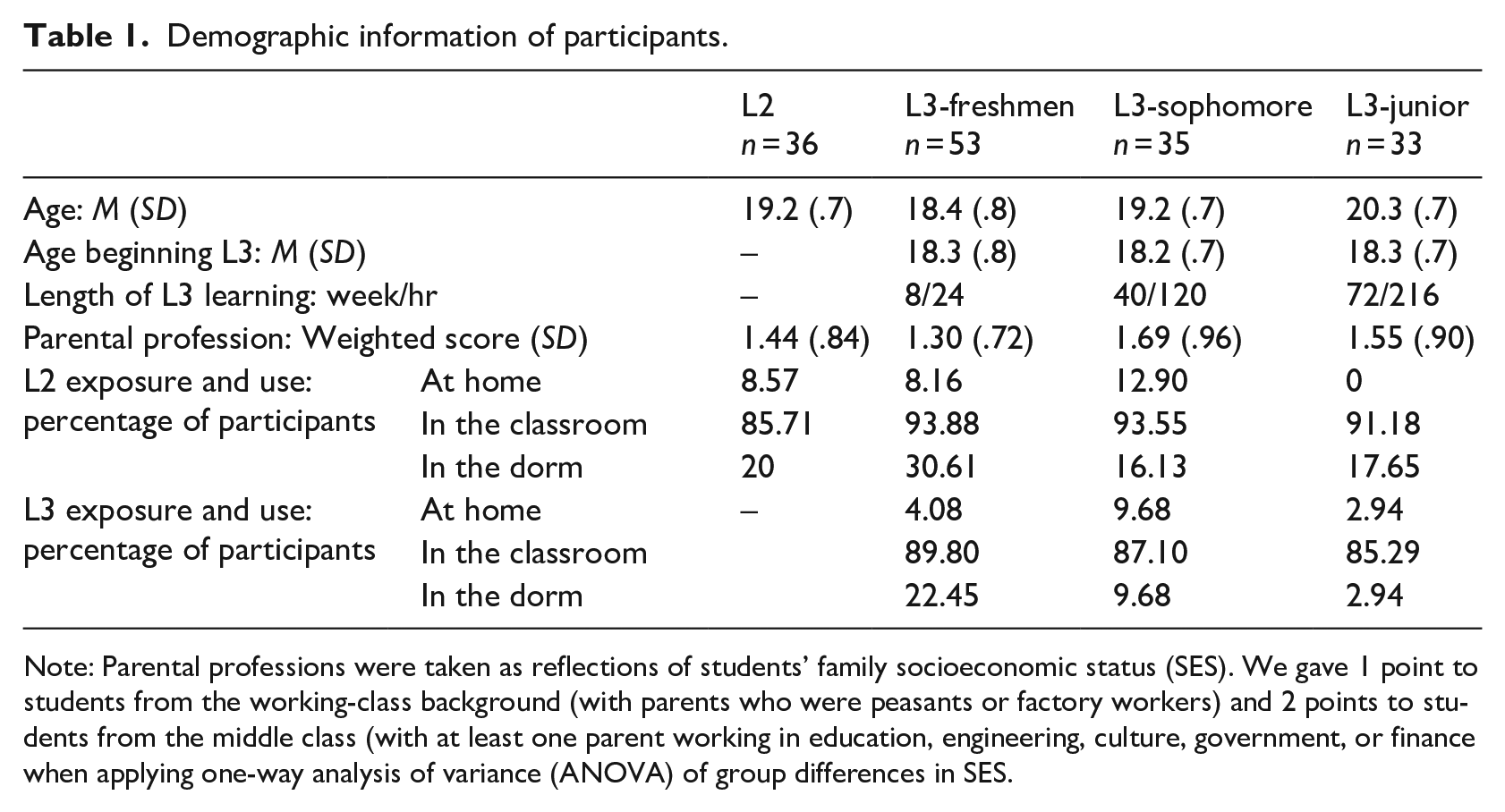
Note: Parental professions were taken as reflections of students’ family socioeconomic status (SES). We gave 1 point to students from the working-class background (with parents who were peasants or factory workers) and 2 points to students from the middle class (with at least one parent working in education, engineering, culture, government, or finance when applying one-way analysis of variance (ANOVA) of group differences in SES.
L2 learners
These participants were 36 sophomores at a high-ranking Chinese university who were native Chinese speakers, majoring in various subjects other than English, and learning English as a compulsory L2 course (M age = 19.2 years, SD = 0.7, 20 males, 16 females). They had started to learn English as a compulsory subject since Grade 3 in elementary school, and thus had learned English as an L2 under the instructional context for 10 years. None of the participants had continuous exposure to languages apart from Chinese and English. Apart from the necessary listening, reading, speaking, and writing practice in and outside the English classroom, they had little language-switching experience in daily communication. Because of the foreign-language learning environment, these Chinese students, who used English mainly in the English class, had a much lower proficiency in English than in their native language, and therefore were regarded as unbalanced bilinguals.
L3 learners
These participants were 121 (32 males, 89 females) freshmen, sophomores, and juniors at the same university who were also native speakers of Chinese learning English (L2) as their major and Language X (Japanese, French, Russian, or German) as a compulsory L3 course. These L3 learners also started to learn English as a compulsory subject from Grade 3 in elementary school and thus had, respectively, 9 years (Group L3-freshmen), 10 years (Group L3-sophomores), or 11 years (Group L3-juniors) of English learning experience at school and at university. All English majors at universities in China must learn an L3, but have a choice from the major languages, including Japanese, French, German, and Russian. Among these languages, Japanese has some similarities to the participants’ L1, Chinese, particularly in vocabulary and writing system (see Shibatani, 2019). The other three languages, German, French, and Russian, all belong to the Indo-European language family and are different from Chinese which belongs to the Sino-Tibetan language family (see Eberhard et al., 2021). None of these participants had studied an L3 before attending the L3 learning program at university, in which they took 4 45-min classes each week for 32 weeks within an academic year. In the instructional context, L3 learners learn the vocabulary, grammar, and practice reading, writing, speaking, and writing in and outside class, having little language switching in daily communication. Among these L3 learners, 53 were freshmen (M age = 18.4 years, SD = 0.8), who had learned an L3 for 8 weeks (approximately 24 hr); 35 were sophomores (M age = 19.2 years, SD = 0.7), who had learned an L3 for 40 weeks (about 120 hr); and 33 were juniors (M age = 20.3 years, SD = 0.7), who had learned an L3 for 72 weeks (216 hr). Just as L2 learners in the present study, L3 learners in the present study were also regarded as unbalanced trilinguals, most proficient in their native language Chinese, much less proficient in English, and least proficient in their L3.
Given that these L3 learners were exposed to and used an L3 mainly in the classroom, they were categorized into three subgroups with different L3 proficiency in accordance with the mean length of language learning (e.g., Poarch & van Hell, 2012), namely, Group L3-freshmen (low proficiency), Group L3-sophomores (intermediate proficiency), and Group L3-juniors (higher proficiency). It should be acknowledged that HLP here might include both L3 and L2 proficiency, since L3 learners were also learning their L2. This implies that L2 proficiency may be a confounding factor and should be taken care of in reporting and interpretation of the results about the effect of L3 learners’ language proficiency on inhibitory control.
Parents’ occupations were considered to represent the socioeconomic status (SES, e.g., Ma et al., 2018). Of the L2 learners, 78% were from the middle class (scored “2”), with at least one parent working in education, engineering, culture, government, or finance and 22% from the working class (scored “1”), with parents who were peasants or factory workers. Of the L3 learners, 76% were from the middle class and 24% from the working class. One-way analysis of variance (ANOVA) of weighted SES scores showed that SES did not differ significantly across the four groups [F(3, 153) = 1.55, p = .20].
Simon arrow task
In this study, we consider inhibitory control to consist of response inhibition, which refers to the ability to inhibit response to irrelevant information, and interference suppression, which refers to the ability to suppress interference from unrelated stimuli. We measured the accuracy and reaction time (RT) of these two types of inhibitory control.
The Simon arrow task in this study used arrow stimuli rather than stimuli consisting of different colors or letters, thus aiming to avoid confounds due to language inference. In addition, we presented the arrow stimuli two-dimensionally, pointing in different directions, and appearing in different positions on the computer monitor. This allowed the measurement of response inhibition by univalent trials and interference suppression by bivalent trials. The Simon arrow task was presented on 21.5-in. computer monitors using the Psychopy v3.0 software, with “←”/“→” programmed as the stimuli. Participants were instructed to respond as quickly and accurately as possible. The univalent trials included two blocks of 100 trials, consisting of 50 control and 50 reverse trials. In the control and reverse trials, an arrow stimulus was presented at the center of the screen. Under the control condition, participants were instructed to press a key indicating the same direction as indicated by the stimulus, which required neither response inhibition nor interference suppression. Under the reverse condition, participants were to press a key indicating the opposite direction of the arrow stimulus, which required response inhibition. A smaller difference in accuracy and RT between control and reverse trials demonstrated a better response inhibition.
The bivalent trials consisted of one block of single trial type for which 32 congruent trials and 32 incongruent trials were presented separately. The arrow stimulus direction and location on the screen were consistent in the congruent trials, but inconsistent in the incongruent trials. A smaller difference in accuracy and RT between congruent and incongruent trials would demonstrate better interference suppression. There were also blocks of 32 mixed trials, with a random presentation of either congruent trials or incongruent trials. The three blocks were counterbalanced across participants. Except for the single-type bivalent trials, trials within the other two blocks were randomized.
Before starting the main trials, participants read a page of instructions in their L1, and completed 10 practice trials with provision of audio feedback. For each main trial, participants were to gaze at a fixation point for 500 ms, followed by a 250-ms blank screen interval. Then an arrow stimulus appeared and remained on the screen until the participant had responded to the target, whereupon the next trial started after a 1,000-ms intertrial interval.
There is extensive evidence supporting that the RT to incongruent trials are longer than to congruent trials, and the magnitude of the differences between congruent and incongruent trials causes Simon effect (e.g., Simon & Rudell, 1967) with smaller Simon effect suggesting better inhibitory control.
Procedure and data analysis
The data were collected in two computer rooms with identical equipment during three sessions at the beginning of the first semester of the 2018–2019 academic year. Participants received verbal and written instructions in Chinese on the Simon arrow task, and were seated in separate cubicles for the experiment, which took 45 min, including time spent in completing the language background questionnaire. As compensation, participants were gifted a USB flash drive.
We ran repeated ANOVAs to find whether there were group differences in Simon effects (indicating ability in inhibitory control), marked by the significance of effect of group × type, group × condition, and the group × type×condition interactions. We also ran separate repeated ANOVAs and one-way ANOVAs when there was a significant group difference, but no significant group × type/condition, or group × type × condition effect to find specific groups differences.
Results
The performance of the two language groups in the less complex univalent and the more complex bivalent trials of Simon arrow task was compared, respectively, to determine whether the overall L3 learning experience influenced the two types of inhibitory control, namely, response inhibition and interference suppression. Only correct responses were included for all the following analyses of RT scores.
Comparison between L2 and L3 learners
Response inhibition
The mean accuracy rates and the mean reaction times of L2 and L3 learners under two conditions in the univalent task are shown in Figure 1 and Figure 2 respectively.
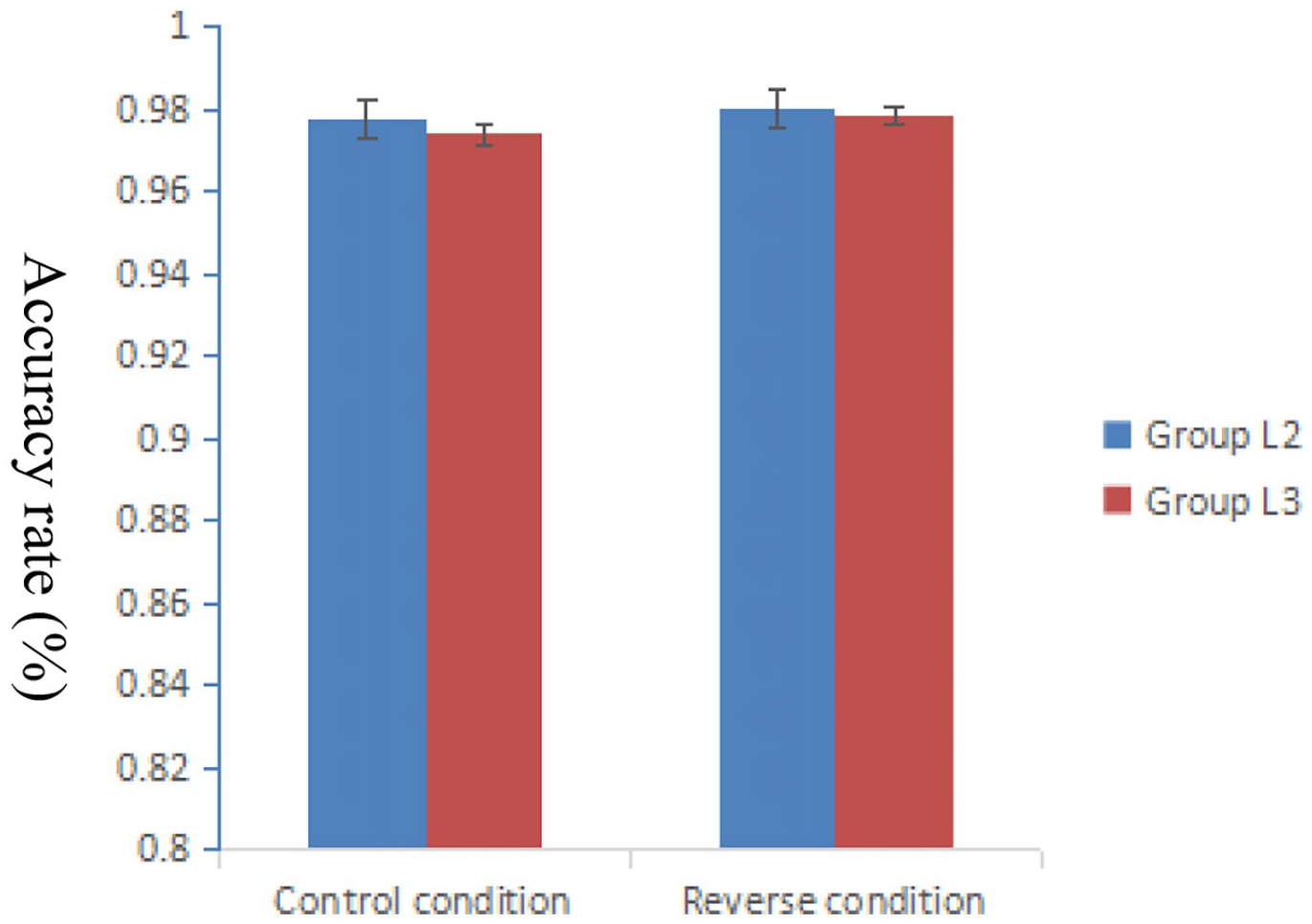
Mean accuracy rate and standard error of univalent trials for language groups (Group L2 vs. Group L3).
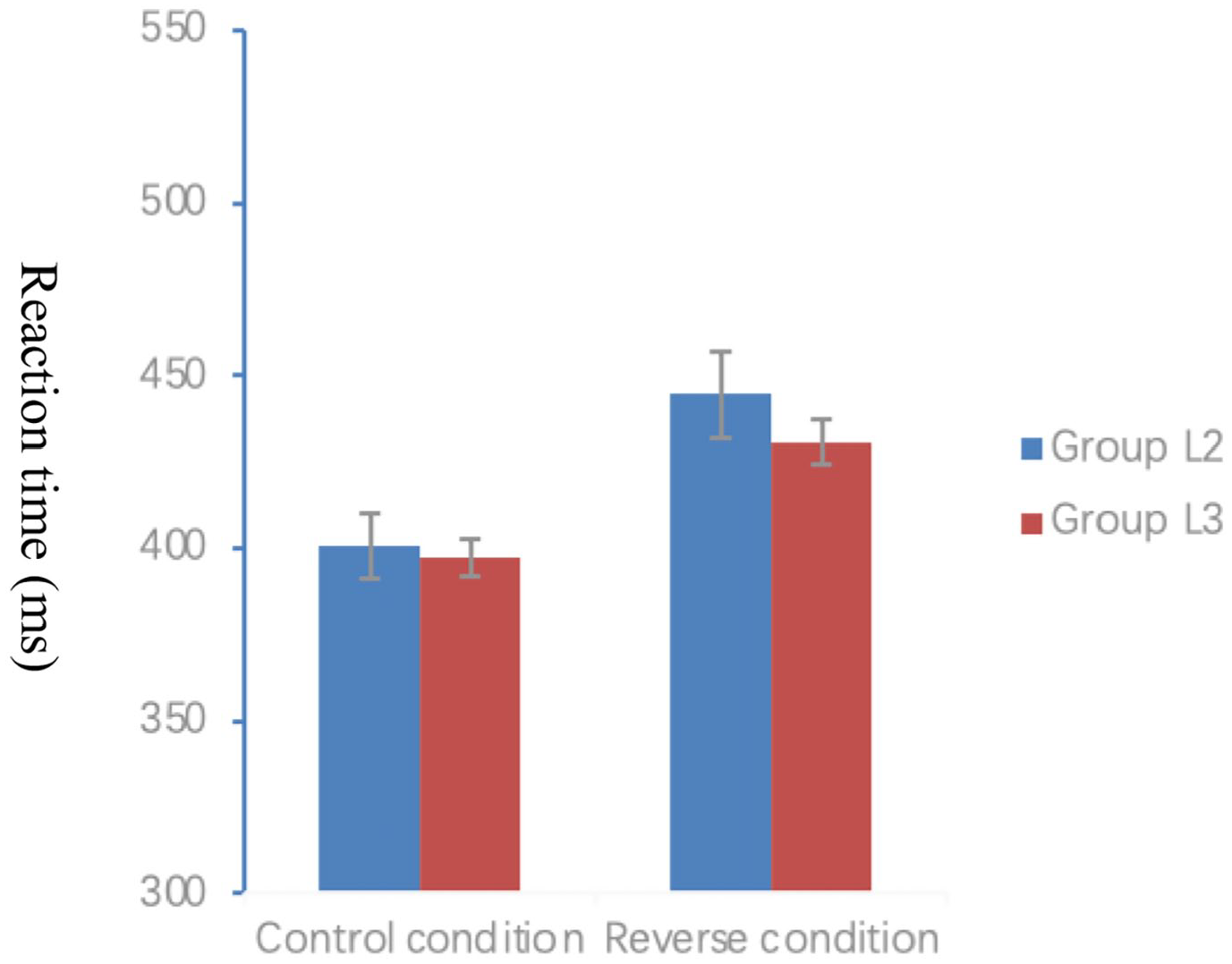
Mean reaction time and standard error of univalent trials for language groups (Group L2 vs. Group L3).
A 2 × 2 two-way ANOVA test was run to compare performances of different language groups in univalent trials. Language groups (Group L2 vs. Group L3) were the between-subject factors, trial condition (control vs. reverse) was a within-subject factor, and the two dependent variables (accuracy, RT) were processed separately.
The ANOVA of accuracy rates generated no significant effect for group, trial condition, or the interaction between group and trial condition, with all ps > .05 showing that the two groups did not differ in accuracy of response inhibition.
The ANOVA of RT yielded a main effect of trial condition [F(1, 135) = 31.070, p = .000, η2 = .187], indicating that reverse trials were performed more slowly than the control trials. However, neither the main effect for group (p = .339) nor the effect of group × condition (p = .470) was significant, indicating that the two groups performed at similar speed in response inhibition.
Independent t-tests were run to compare the accuracy rates and RTs in control and reverse conditions, respectively, between Group L2 and Group L3. No significant difference was found.
Interference suppression
Figure 3 shows that the accuracy rates in single-congruent, single-incongruent, and mixed-congruent tasks were all very high (lowest at 96.65%), while those in the mixed-incongruent task were lower (highest at 93.86%). Figure 4 shows that RTs of single-congruent, mixed-congruent, and mixed-incongruent trials of L3 learners were a little faster.
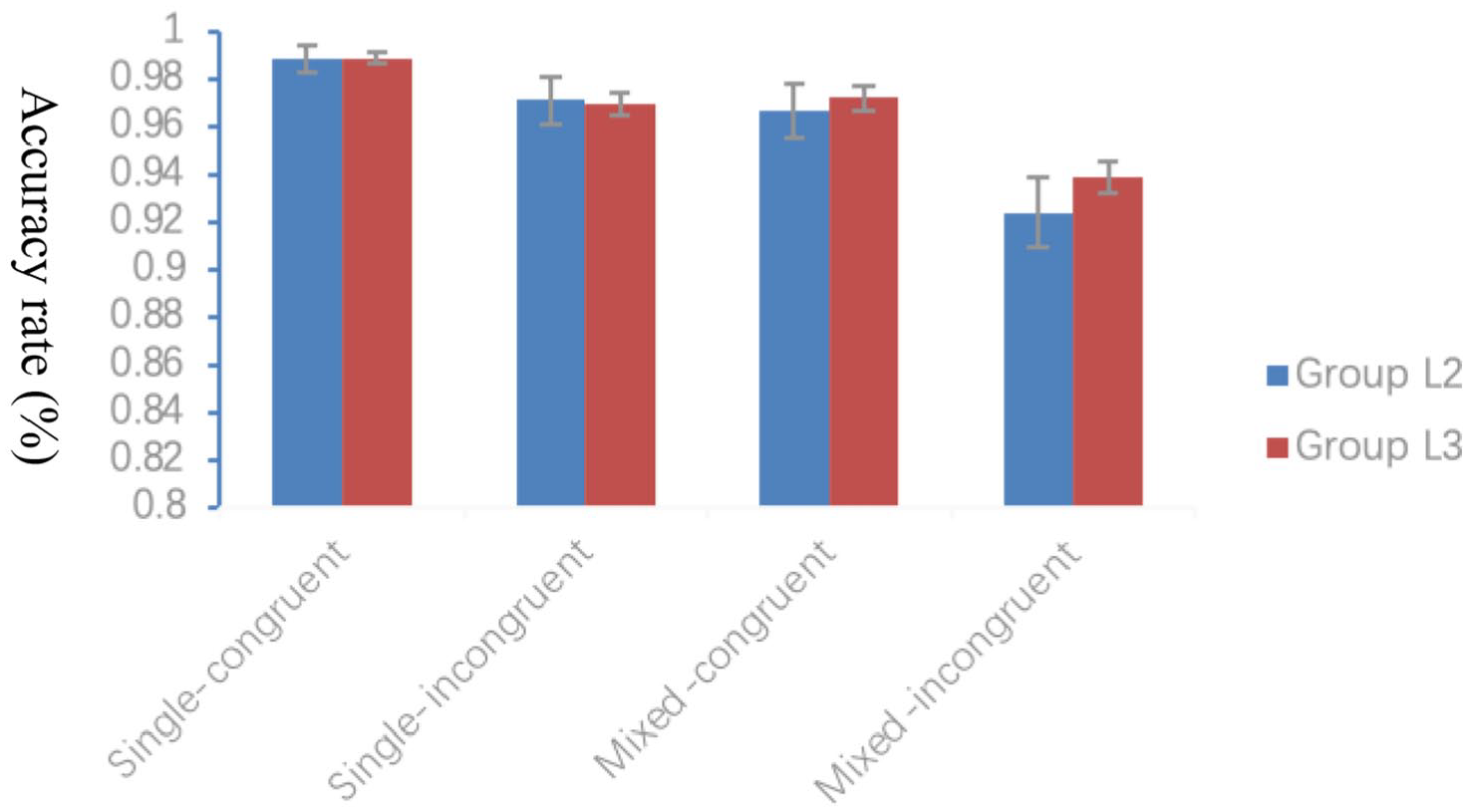
Mean accuracy rate and standard error of bivalent trials for language groups (Group L2 vs. Group L3).
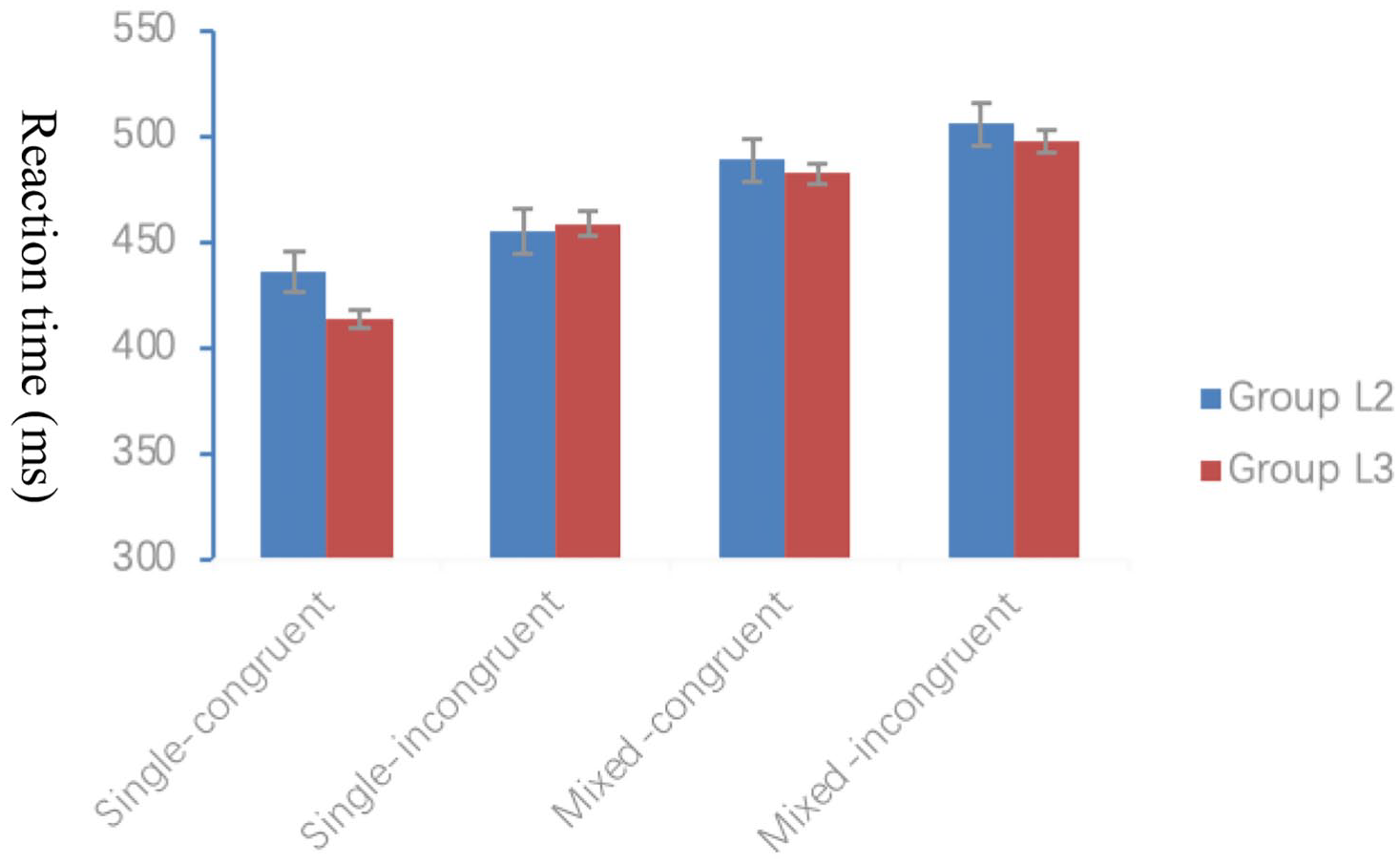
Mean reaction time and standard error of bivalent trials for language groups (Group L2 vs. Group L3).
A 2×2×2 ANOVA analysis of accuracy rates demonstrated a significant effect of trial condition [F(1, 138) = 30.307, p = .000, η2 = .180] and type [F(1, 138) = 33.473, p = .000, η2 = .195]. However, neither the main effect of group nor any of the interaction effect was significant, with all ps > .05, demonstrating that the two groups did not differ in accuracy of interference suppression.
The RT analysis generated no significant main effect for group, p = .375. Nevertheless, the main effect of trial condition [F(1, 128) = 192.633, p = .000, η2 = .601] and trial type [F(1, 128) = 53.480, p = .000, η2 = .295] were significant. A significant interaction between group, trial condition, and trial type [F(1, 128) = 6.334, p = .013, η2 = .047] was found. To further test the directionality of the three-way interaction, two 2 × 2 ANOVAs were run for single and mixed condition, respectively. The results showed that neither the effect of group nor the group × type interaction was significant for the mixed condition. However, for the single condition, the Simon effect for the L3 group (44.69 ms) was bigger than that for the L2 group (18.74 ms) [F(1, 128)= 7.144, p = .009, η2 = .053]. To find out the specific difference between the two groups, independent t-tests of RTs were run for the two trial types in single condition. The t-test results showed that Group L3 performed significantly faster than Group L2 in single-congruent trials [t = 2.333, p = .021]. However, no difference between the two groups was found in RT for the incongruent trial.
These results seem to indicate that L3 learners in the present study exhibited weaker inhibitory control than L2 learners in interference suppression, which was mainly generated because L3 learners performed faster in single-congruent trials.
Comparison between L3 learners with different L3 proficiency
Response inhibition
Figure 5 shows the mean accuracy rates for the four groups (Group L2, Group L3-freshmen, Group L3-sophomores, and Group L3-juniors) in the response inhibition. First, a high accuracy rate was found for all groups (all above 96%). Second, the mean accuracy rates exhibited a fall–rise trend, dropping from baseline Group L2 to Group L3-freshmen and Group L3-sophomores, and then rising to Group L3-juniors.
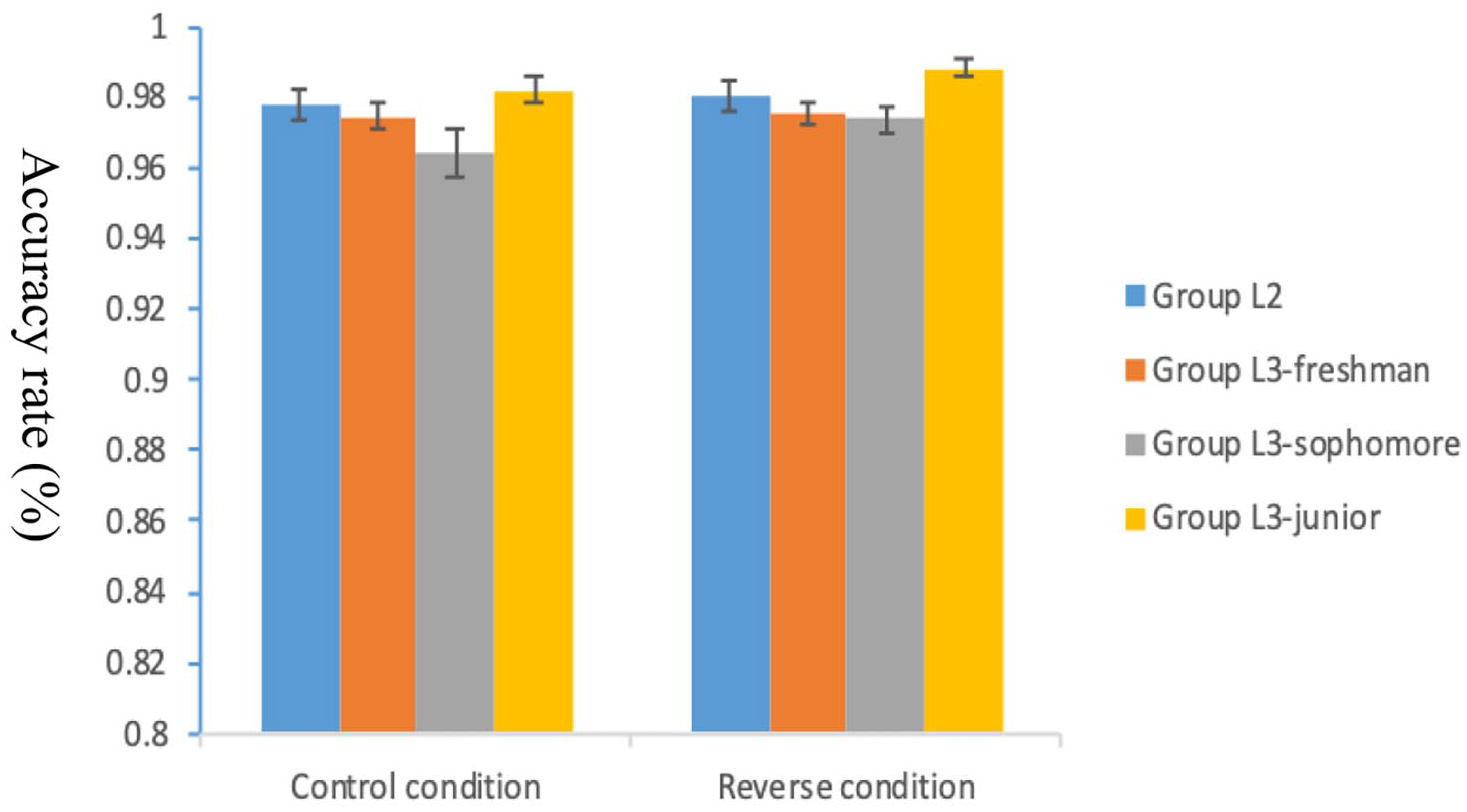
Mean accuracy rate and standard error of univalent trials for language groups (Group L2, Group L3-freshmen, Group L3-sophomores, vs. Group L3-juniors).
A 4 × 2 ANOVA of accuracy rate indicated a statistical main effect of group [F(3, 137)= 3.352, p = .021, η2 = .068], however, no significant group × condition interaction was found.
Post hoc tests for univalent trials found that there were differences between Group L3-juniors and L3-freshmen (p = .030) and between Group L3 Juniors and L3-sophomore (p = .003). However, no difference was found between Group L2 and any of the three L3 groups.
One-way ANOVA was run to compare the four groups under control and reverse condition, respectively. No difference was found between Group L2 and any of the three groups. However, in the control condition, L3-juniors performed more accurately than L3-sophomore (p = .014). In the reverse condition, L3-junior again performed more accurately than both L3-freshmen (p = .018) and L3-sophomore (p = .019).
The above results together show that although no difference in Simon effects was found between the four groups, language proficiency was found to affect accuracy in specific tasks, with higher proficiency L3 learners performing more accurately than lower-level L3 learners.
Figure 6 shows a nonlinear trend of the RT for the four groups, which decreases in speed from baseline L2 group to L3-freshmen, then rises to L3-sophomore, and then decreases again to L3-junior.
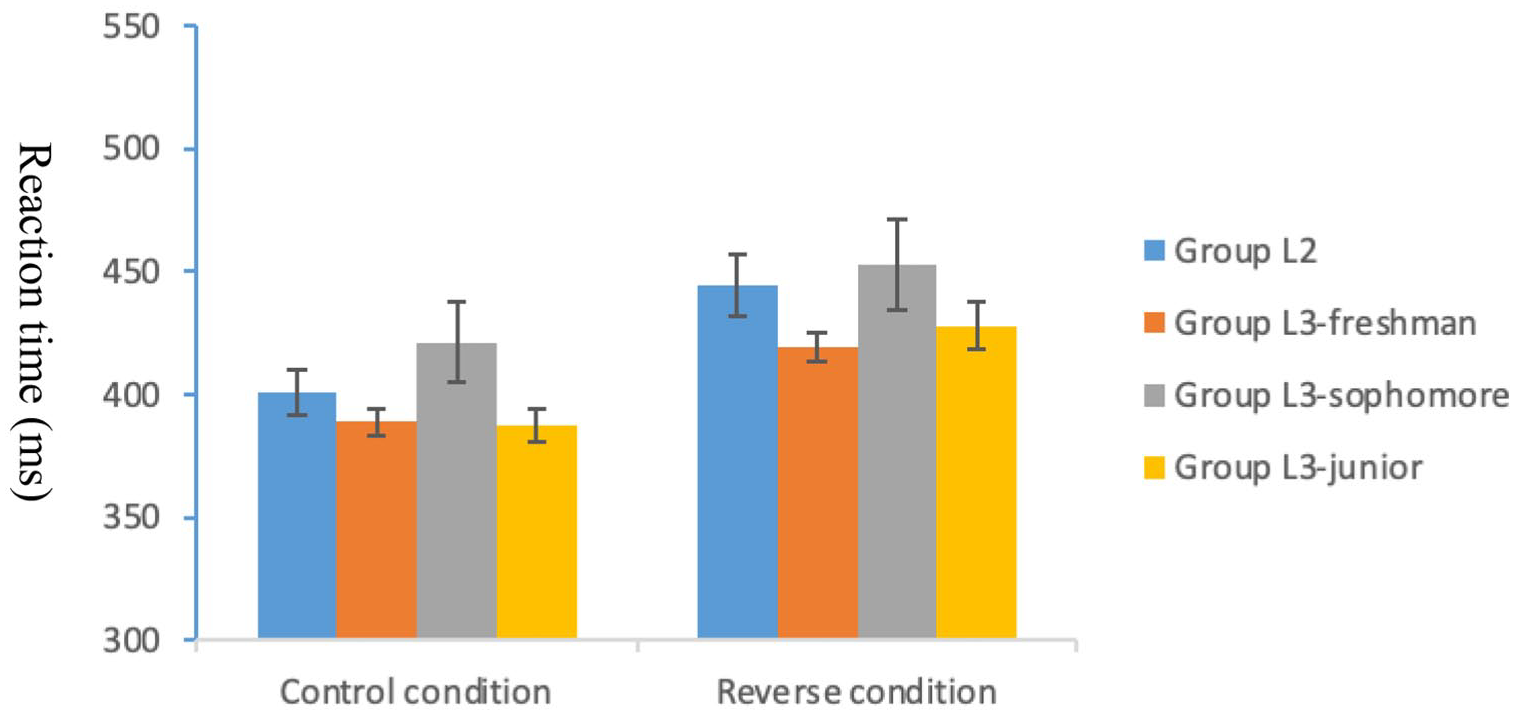
Mean reaction time and standard error of univalent trials for language groups (Group L2, Group L3-freshmen, Group L3-sophomores, vs. Group L3-juniors).
The ANOVA analyses of RT of the four groups generated the main effects for group [F(3, 133) = 3.090, p = .029, η2 = .065] and trial condition [F(1, 133) = 36.862, p = .000, η2 = .218], but not for group × condition interaction (p > .05), indicating that there was no group advantage in response inhibition.
Least significance difference (LSD) post hoc multiple comparisons of RT showed a significant difference between L3-sophomorse and L3-freshmen (p = .006) and between L3-juniors and L3-sophmores (p = .023). However, no difference was found between Group L2 and any of the three L3 groups.
One-way ANOVA tests were run to explore the performance of four groups in specific tasks. L3 sophomores were found to perform significantly more slowly than L3 freshmen (p = .014) and L3-juniors (p = .018) under the control condition. In the reverse condition, L3-sophomores were found to perform significantly more slowly than L3-freshmen (p = .035).
It was already acknowledged in the “Participants” section that in the present study L2 proficiency might be a confounding factor of L3 proficiency. However, the results here showed no differences between Group L2 (sophomores) and any of the L3 groups, which indicates that the possible confounding role of L2 proficiency was not significant. Moreover, it was assumed that the L2 proficiency of L3 learners in the present study might be relatively slower to change than their L3 proficiency, since they had already reached an intermediate level after learning the L2 for about 10 years. Therefore, it is concluded that the effects here might be caused mainly by the difference in L3 proficiency.
Interference suppression
Figure 7 shows the trend of mean accuracy rates for the four groups in four trial types, single-congruent, single-incongruent, mixed-congruent, and mixed-incongruent, which increases from baseline Group L2 to L3-freshmen, decreases to L3-sophomores, then rises to L3-juniors. It can also be seen that all the accuracy rates are high, particularly in the single-congruent, single-incongruent, and mixed-congruent tasks, with those in incongruent tasks lower than those in the congruent ones.
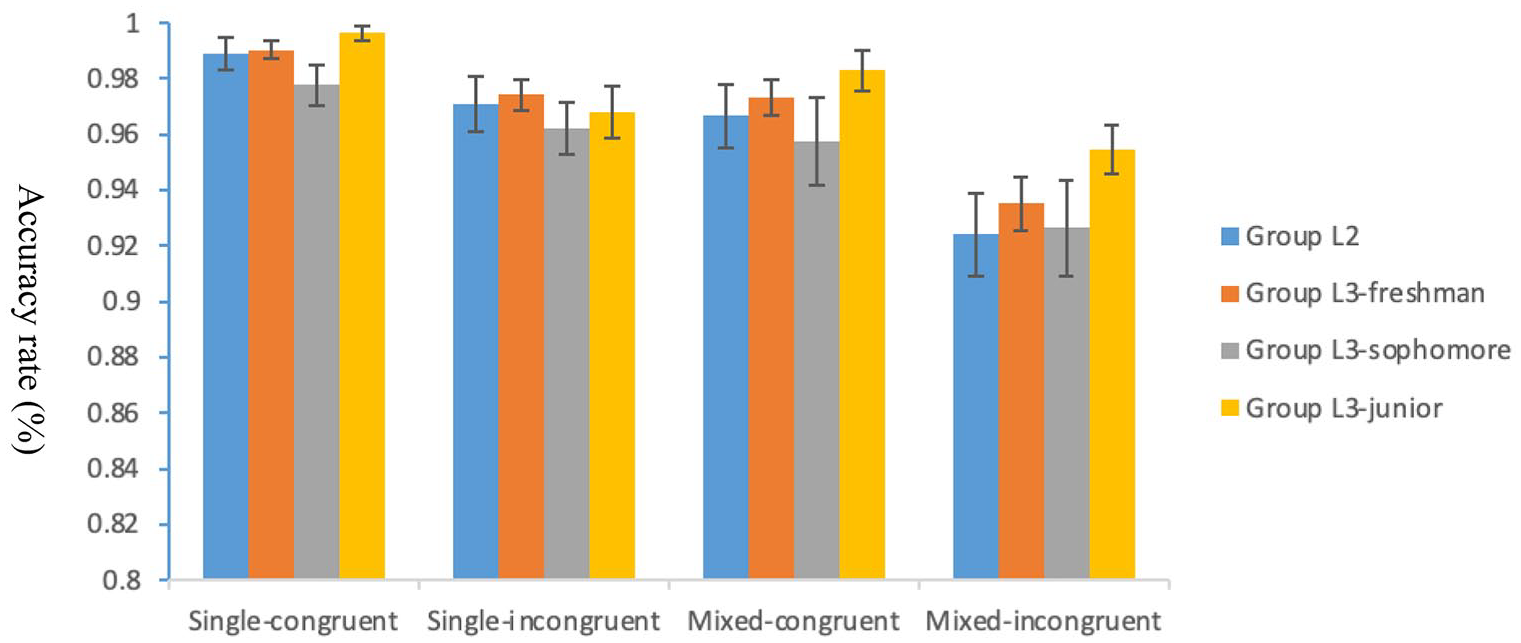
Mean accuracy rate and standard error of bivalent trials for language groups (Group L2, Group L3-freshmen, Group L3-sophomores vs. Group L3-juniors).
The 4 × 2 × 2 ANOVA analysis of accuracy showed significant main effects of trial condition and type, with participants responding more accurately under the single trial condition [F(1, 136) = 35.437, p = .000, η2 = .207] and congruent trials [F(1, 136) = 44.958, p = .000, η2 = .248]. However, no significant effect was found for the group and any of the interactions, indicating that there was no group advantage in interference suppression.
Figure 8 shows that the trend of RT in single-congruent and mixed-congruent trials exhibited a linear deceasing pattern, whereas those in single-incongruent and mixed-incongruent were nonlinear ones, with L3 juniors performing within a shorter time than all the other three groups.
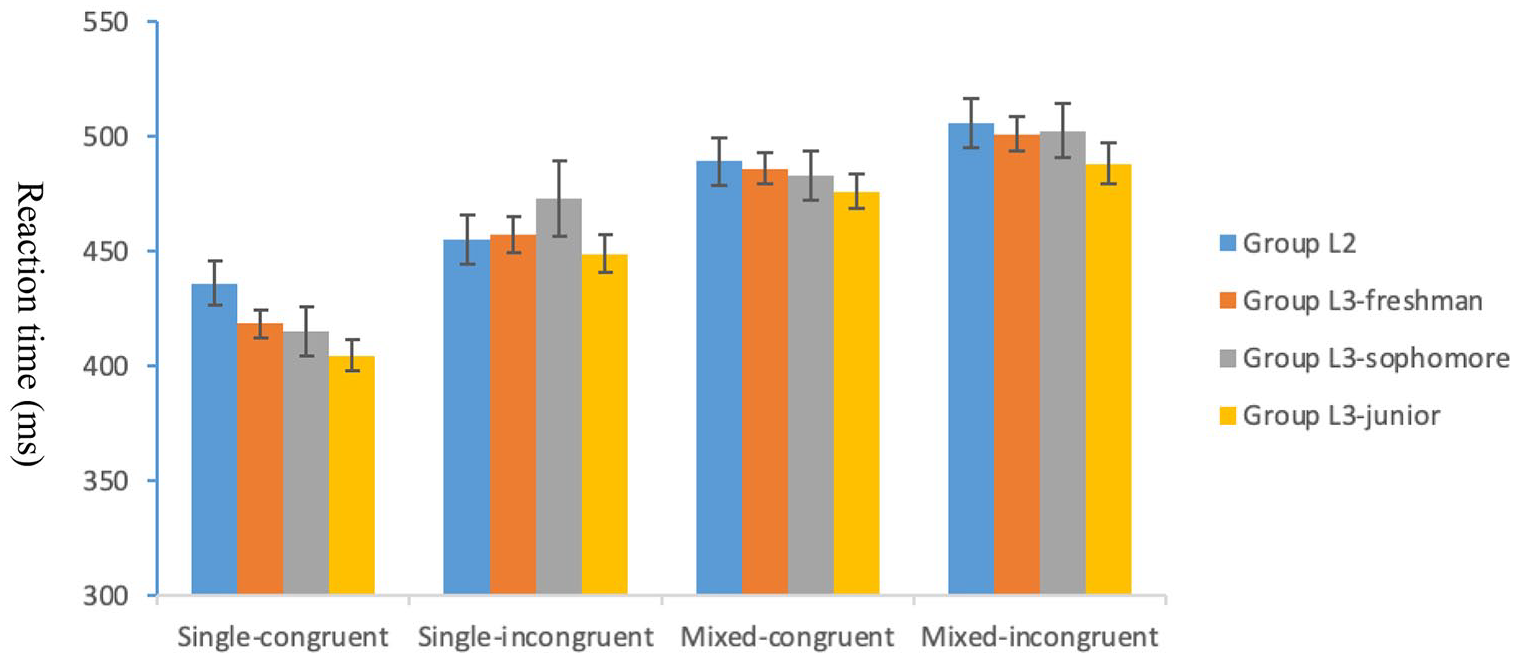
Mean reaction time and standard error of bivalent trials for language groups (Group L2, Group L3-freshmen, Group L3-sophomores vs. Group L3-juniors).
Analysis of RTs showed significant main effect of trial condition [F(1, 126) = 255.393, p = .000, η2 = .670] and trial type [F(1, 126) = 98.010, p = .000, η2 = .438], and an interaction between trial condition and trial type [F(1, 126) = 25.651, p = .000, η2 = .169]. Nevertheless, neither main group effect nor group × trial×condition effect was significant, indicating that there was no group advantage of interference suppression.
Discussion
This study investigates whether L3 learning brings about an extra advantage compared with L2 learning in two types of inhibitory control with different levels of complexity, response inhibition (less complex) and interference suppression (more complex). Our first question is whether L3 learners outperform L2 learners in accuracy and speed of response inhibition and interference suppression. The results from the Simon arrow task showed no difference between L3 and L2 learners in either accuracy or RT of response inhibition, which indicates that L3 learning did not bring advantage in response inhibition to the L3 learner in the present study. These results confirmed our hypothesis that L3 learners would not outperform L2 learners in both accuracy and RT in response inhibition. In terms of interference suppression, the result turned out to be complicated. While no difference was found between L2 and L3 learners in accuracy, L3 learners showed some larger Simon effect of RT. This result seems to suggest that L3 learning did not improve the learners’ inhibitory control but might have put L3 learners in the present study at a disadvantage. However, the L3 disadvantage was caused by L3 learners’ faster speed in the single-congruent task. This result appeared to mainly but not completely reject our hypothesis that L3 learners would outperform L2 learners in both accuracy and RT in interference suppression.
These results of our study seem to be in agreement with the findings of Madrazo and Bernardo (2012), Poarch and Bialystok (2015), and Poarch and van Hell (2012) that L3 learning or trilingual experience have no incremental effect on inhibitory control, and do not support the findings of Kwon and Lee (2017) that L3 learning enhances L3 learners’ inhibitory control and the findings of Madrazo and Bernardo (2018) that trilingual advantages relate to more complex tasks.
We speculated two assumptions to explain this pattern of inhibitory development in our study. First, our L3 learners might have been near the ceiling of inhibitory control, particularly in terms of accuracy. Our participants were university students and had learned an L2 for about 10 years. After long years of honing inhibitory control through bilingual switch and other cognitive activities, their inhibitory control was already at a relatively high level, with the lowest accuracy rate above 96% in congruent tasks and 92% in incongruent tasks, and with an average speed of about 400 ms in congruent tasks and 500 ms in incongruent tasks. This kind of ceiling effect was also discussed in Schroeder and Marian (2016), which, referring to the supply–demand mismatch hypothesis, explained that “trilingualism did, in fact, increase the demands but that for many of the bilinguals, the inhibitory supply was already near their ceiling level and could not advance any further” [p.9].
Second, the relatively short L3 learning time might have been insufficient to cause an increase in inhibitory control. The L3 learners in the present study had learned an L3 under an instructional context with the learning time ranging from 24 to 216 hr, whereas they had learned their L2 for about 10 years. This kind of relationship between a high or balanced degree of language proficiency to enhanced executive function was found in studies on bilingual executive functioning (see also Bosma et al., 2017; Boumeester et al., 2019; Yow & Li, 2015). For instance, Thomas-Sunesson et al. (2018), in their study on the bilingual advantage in Hispanic children in the United States, found that children who had more balanced proficiency between their two languages showed stronger executive function than those who had more asymmetric proficiencies in their two languages. Therefore, a short L3 learning time may have been one of the reasons why L3 advantage in inhibitory control over L2 learners was not found in the present study.
As for L3 learners’ faster performance in single-congruent trial type in interference suppression, but not in the other three trial types (single-incongruent, mixed-congruent, and mixed-incongruent trials), we would attribute it to the rudimentary positive effect of the short-term L3 learning on specific aspects of inhibitory control, which could be observed in tasks with a certain manageable degree of complexity, but not too difficult or complicated to be managed. The single-congruent trials in the interference suppression task belong to a bivalent trial type, which is more challenging than the univalent trial type in response inhibition, but easier than the single-incongruent, the mixed-congruent, and the mixed-incongruent trials.
A relevant result was found in a study on task demands and bilingual advantage in inhibitory control by Qu et al. (2016). Their results revealed no differences in mixing costs between bilinguals and monolinguals in three of their tasks. However, in the ScAc task (suppress one set of conflicting responses and simultaneously activate another set of conflicting responses), which was much more complex than the other three tasks, bilinguals even had significantly larger mixing costs in accuracy than monolinguals.
This result of our research implies that the mechanism of trilingual inhibitory control may be more complicated than currently realized and needs to be observed from more specific perspectives.
Our second question is whether higher proficiency L3 learners outperform lower proficiency L3 learners in accuracy and speed of inhibitory control in response inhibition and interference suppression. No difference was found between L3 learners with different proficiency levels in the Simon effects of response inhibition and interference suppression. However, some group differences were found in specific tasks of inhibitory control: L3 learners with higher and lower proficiency outperformed L3 learners with intermediate proficiency in both accuracy and RT of response inhibition, demonstrating a U-shaped curve for accuracy and speed, respectively, in the reverse task of response inhibition. This finding is in line with the U-shaped curve in cognitive development. Morse et al. (2011) pointed out that a commonly found phenomenon in developmental psychology is the U-shaped curve, in which “previously stable abilities become temporarily absent or disrupted for a period of time (sometimes months) before returning in a changed but stable form as new competencies emerge” (p. 3034). Gershkoff-Stowe and Thelen (2004) discussed that U-shaped development could be regarded as a part of the ordinary mechanism of change. Applying the dynamic systems theory, they explained that the U-shaped behavior resulted from continuous changes in the collective dynamics of multiple, contingent processes, whereas the appearance of regression reflects the self-organization of contributing components in different configurations that depend upon the status of the components, the environment, and the task. We attributed the U-shaped pattern of L3 learners’ response inhibition to the change in the dynamic systems of L3 learners’ inhibitory control, in which L3 as a new component interacted with the existing L1 and L2, causing the regression of response inhibition during the reorganization of both the systems of language and inhibitory control.
However, we only observed the U-shape pattern in some specific tasks of inhibitory control. Therefore, more research, particularly longitudinal research, needs to be carried out to reveal more about the relationship between language proficiency and L3 inhibitory control.
Conclusion and future directions
The current study investigated the effects of L3 learning on inhibitory control in college-age adults, considering task complexity and language proficiency. Our results demonstrate that generally, L3 learners did not outperform L2 learners in the two types of inhibitory control, response inhibition (the less complex task), and interference suppression (the more complex task). Moreover, our L3 learners at different proficiency levels had equivalent inhibitory control in response inhibition and interference suppression, thus not confirming a short-term training effect on inhibitory control enhancement attained by learning an L3. However, our further analysis based on group differences showed some positive relationship between L3 proficiency and specific abilities of inhibitory control, particularly a U-shaped pattern of increase in accuracy as well as reaction time.
We acknowledge certain limitations of the current study, which have implications for the design of future studies. First, although our participants were well-matched in terms of age, education, and SES, we did not control the potential confounding effects of the working-memory capacity (Diamond, 2013). Individual differences in working memory might have had influences on inhibitory control, despite the similar demographics of the study population. Therefore, future studies are encouraged to control the factor of working memory. Second, we classified the language proficiency of our participants according to the mean length classroom hours of L3 learning, rather than on the standard proficiency test scores. Although L3 learning in our study happened almost exclusively in the language classroom, we suggest a more stringent control of language proficiency by administering some standard language proficiency tests in future studies. Moreover, the possible confounding role of L2 proficiency should also be well-considered. Third, the cross-sectional design of the present study is another limitation. In light of the result of a possible nonlinear change of inhibitory control, a longitudinal design might allow better generalization. Fourth, our participants had little language switching experience in daily life, and future studies might include participants with different levels of switching experience in daily life and consider the effect of language switching experience on trilingual inhibitory control, as some researchers (e.g., Verreyt et al., 2016) did in research on bilingual inhibitory advantage.
Nevertheless, the findings of the present study contribute to the theory of the relationship between multilingualism and inhibitory control by showing that this relationship may be more complex than it is understood currently. Learning of a language additional to L2, particularly short-term learning, may not lead to an incremental advantage in overall inhibitory control. However, as the learning time increases, changes may appear in specific aspects of inhibitory control, and may be a nonlinear one.
Footnotes
Declaration of conflicting interests
The author(s) declared no potential conflicts of interest with respect to the research, authorship, and/or publication of this article.
Funding
The author(s) disclosed receipt of the following financial support for the research, authorship, and/or publication of this article: This work was funded by The Fifth Jiangsu 333 High-level Talents Project (Grant number BRA2020033).
