



Abstract
Aims and objectives:
Past research has shown that multicultural experience and multilingualism can be positively associated with creativity. However, very few studies have focused simultaneously on all these variables. Our aim is to consider both sets of predictors simultaneously, clarifying whether the impact of these variables on creativity is cumulative or redundant.
Design/methodology/approach:
The design combines correlational and quasi-experimental approaches. It is also strongly multivariate and includes various measurement methods. Variables of interest were assessed with questionnaires (N = 596) and creativity tasks (N = 174) in laboratory settings. The scope of the study, therefore, is relatively large and encompasses several indicators.
Data and analysis:
We use multiple regressions with latent and manifest variables. Latent variables were constructed for all sets of key predictors (multilingualism, traveling experience, living abroad experience); predictors were regressed on four types of creativity variables, also latent in most cases (creative potential; creative interests, activities, and achievements; creative performance in a writing task; creative performance on a remote association task).
Findings/conclusions:
Results shows that both multicultural experience and multilingualism are positively related with various manifestations of creativity. Overall, the results indicate complementary effects of multicultural experience and multilingualism on creativity. The most robust predictors are multilingualism and variables representing deep immersion in foreign countries.
Originality:
Three features make this study unique: (a) it examines both multilingualism and multiculturalism; (b) the sample population is broader than in most studies, which often focus on migrant populations; and (c) it implements a multimethod operationalization of creativity.
Significance/implications:
The paper goes beyond received approaches to the link between human diversity and creativity; the analysis is put in relation with other research work that focuses on policy implications for diversity, particularly in the areas of bilingualism and bicultural identity. Implications regarding the connections between creativity, multilingualism, and general executive functioning are also discussed.
Introduction
The general notion that diversity enhances creativity has been in the air for a long time, encompassing the ideological diversity of societies (e.g. Simonton, 1976), the diversity of teams in the workplace (Milliken et al., 2003), and the diversity of individual cultural experience (e.g. Leung et al., 2008). In this short research note, we focus on the latter and also consider the role that multilingualism may play in this complex diversity–creativity connection at the individual level. 1
Multicultural experience and creativity
Many variables related to individual multicultural experience have been found to be positively correlated to creativity. In particular, Maddux and Galinsky (2009) have shown that time spent living abroad has a positive impact on creativity. This effect was found in various studies, conducted in a range of different settings and using different creativity tasks. Specifically, it was found that the impact of time spent abroad is mediated by the extent to which individuals have adapted while abroad. By contrast, time spent not living, but merely traveling abroad did not have a positive effect on creativity, arguably because the person is less likely, when traveling instead of actually living abroad, to have been immersed in the local culture. Indeed, Leung et al. (2008) also suggest that immersion depth is important for the positive link between multicultural experience and creativity to emerge.
Subsequent studies along these lines of research (Benet-Martínez et al., 2006; Tadmor et al., 2009, 2012) suggest that individuals who identify with two cultures show enhanced creativity, by comparison with assimilated or segregated individuals who identify with one culture only. These effects were explained by a process called integrative complexity, which refers to the ability to view things from multiple perspectives and combine them into a coherent whole. In integrative theory, Gocłowska and Crisp (2014) have specifically proposed that it is dual-identity processes that foster creativity. Individuals with complex social identities have to alternate their identities across contexts (thus enhancing their flexibility), integrate remote and potentially conflictual cultural elements (hence integrating distant and conflicting ideas more easily), and finally broaden their self-definition (which is conducive to widening their creative base).
Multilingualism and creativity
There is also a growing literature showing positive relations between multilingualism and creativity. This is anchored in a tradition focused on the cognitive costs and benefits of bilingualism (e.g. Bialystok, 2017). Very broadly, this literature shows that bilingualism is positively associated with enhanced executive functions, mental control, and cognitive flexibility. Kharkhurin (2012) has provided convincing evidence of a specific correlation between multilingualism and creativity in a variety of tasks. Consistent with the work of Bialystok, the mechanisms that could account for this positive correlation are related to selective attention and inhibition, flexibility, and codeswitching habits (Kharkhurin, 2011; Kharkhurin & Wei, 2015) as well as the specific notion of “Language Mediated Concept Activation,” reflecting the fact that the mastering of several languages arguably leads to richer and more complex conceptual connections (Kharkhurin, 2017).
Most of the multilingualism–creativity research, however, was based on specific (mostly migrant) populations. There have been only a few studies focused on the impact of bilingualism on creativity in a non-immigration context. Ghonsooly and Showqi (2012) have shown that second-language acquisition was positively related to divergent thinking abilities. Likewise, we have shown (Fürst & Grin, 2018a) that proficiency in a second language is positively related to several indicators of creativity (e.g. idea generation abilities, creative activities and achievements). However, although the literature is growing, results regarding the general population await replication and extension. It seems important, in particular, to study non-migrant populations, to consider a variety of L2 levels (not only high-proficiency individuals) and, by extension, abilities in additional languages (L3, L4, etc.).
Synthesis, assessment, and objectives of this study
So far, the two strands of research just reviewed have remained relatively isolated from each other. Studies on the relation between multilingualism and creativity rarely consider the potential impact of broader cultural diversity. However, as the first section makes clear, there is a large array of cultural variables (other than language) that can explain the multilingualism–creativity link, at least in part. This is especially true for studies focused on migrant populations, because the effect of multilingualism may be confounded with the effect of exposure to different cultures, or this exposure may moderate the relation between multilingualism and creativity (Kharkhurin, 2010). The reverse is true for studies that focus on the relation between multiculturalism and creativity: the role of multilingualism is very rarely controlled for. The problem here is that features typically associated with bi- or multicultural identities (e.g. enhanced cognitive flexibility) may actually be driven by multilingualism.
In short, past research focuses either on multilingualism and creativity or on multicultural experience and creativity. However, given the often observed correlation between language skills and intercultural experience, the risk of confounds is high when considering only one of these two types of variables. Not all contributions include a range of controls sufficient for teasing apart their respective roles. In this study, we propose to integrate these research traditions, using a multivariate approach that also encompasses a large number of creativity indicators.
Method
Participants and procedure 2
The observations have been gathered across four different subsamples, resulting in a final total sample of 596 observations (71.8% undergraduate students; 65.9% women; mean age of 28.01 years, SD = 11.2). Observations were gathered either with paper-and-pencil questionnaires (42.6% of respondents) or with computerized questionnaires. One subsample (187 undergraduate students at the University of Geneva; 68.3% women; mean age of 23.5 years, SD = 8.7) also completed creativity tasks. All these questionnaires and tasks are described below.
Material and variables
Experience abroad, multicultural identity, and multilingualism (questionnaires)
Living abroad
The living abroad experience was assessed using (a) the approximate total duration of living abroad (scale from 0 to 5); 3 and (b) the total number of different countries where the respondent has lived (scale from 1 = “I’ve always lived in the same country” to 5 = “five or more different countries). In the analyses below, these two variables (r = .68; p < .001) are combined into a single factor score.
Traveling abroad
The experience of traveling abroad was operationalized through (a) the total number of countries in which the respondent has traveled for a duration of at least seven days (answers ranging from 1 to 7) 4 and (b) the diversity of travel destinations (participants had to indicate how many different regions of the world they had visited; seven simplified regions were listed, yielding scores ranging from 1 to 7). In the analyses below, these two variables (r = .70; p < .001) are combined into a single factor score.
Important countries
As a proxy of multicultural identity, we asked participants to list the countries that matter to them. It was explicitly indicated that such a country could be “your current country of residence, the country of origin of your family, a country where you have lived or traveled long and/or many times, a country where you’ve had an important life experience, or a country you feel close to for other reasons.” In the following analysis, this “important countries” variable is the number of countries reported as important (scores ranging from 0 to 5).
Multilingualism
In this study, multilingualism was operationalized with two main indicators: (a) the number of foreign languages known by a person (regardless of level of mastery) and (b) overall linguistic skills, which represent the mean skills across three possible foreign languages (L2, L3, L4) in four types of skills (understanding (when listening), speaking, reading, and writing). These skill levels, ranging from 0 to 7, were measured through a self-assessment grid based on the Common European Framework of Reference. In the analyses below, these two variables (r = .76; p < .001) are combined into a single factor score.
Creativity questionnaires
Creative potential
In accordance with the synthesis provided by Fürst and Grin (2018b), creative potential was operationalized with four variables: openness and intellect (2 × 6 items) and idea generation and idea selection (2 × 6 items). The items of these two scales describe behavior related to creativity (e.g. “I easily come up with a lot of ideas,” “I carefully craft and elaborate my idea”). Participants were asked to rate how often this behavior applies to them. Answers are provided on a scale from 1 = “almost never” to 5 = “very often.” For all four scales, Cronbach’s alphas were high, ranging from .70 to .87. In the following analysis, these four variables are grouped in a single creative potential latent variable, with factor loadings ranging from .45 to .80.
Creative interests, activities, and achievements
Creative interests, activities, and achievements were investigated in seven domains (for example music, literature, and writing, and performance art). The interest subscale consists of six items (across the seven domains, Cronbach’s alphas ranged from .81 to .87); the activity subscale consists of five items (Cronbach’s alphas ranging from .72 to .85), as does the achievement subscale (Cronbach’s alphas from .62 to .90). Using a five-point scale, participants rated how often these typical expressions of creativity applied to them (e.g. “I spend at least one or two hours per week in activities related to this domain,” “I have participated in contests or requested funding in this domain”). In the following analysis, overall interests, activities, and achievements are combined into a single factor (factor loadings ranging from .62 to .99).
Creativity tasks
Story task
In this task (Lubart et al., 2011) participants were provided with the beginning of a story and then asked to imagine and write the ending. Texts were then rated for quality and originality using a multiple-rater, double-blind randomized procedure. Raters were peers provided with detailed instructions. These ratings were modeled following the procedure described in Fürst and Grin (2018b). Basically, an originality and a quality factor were extracted from the individual ratings, and a second-order factor representing overall creativity was then extracted from the two first-order factors (loadings of .84 and .75, yielding a composite reliability of .77; Raykov, 1997).
Remote associates test
The 12-item French version of the remote associates test developed by Maddux and Galinsky (2009) was also included as a creativity task. For each item, the principle of this task is to find a word that uncovers the conceptual connection between three target words (e.g. target: blank–white–lines; answer: paper). This task was presented on computer; time to complete it was limited to five minutes. Since we used the first two items as examples, the final scores range from 0 to 10 only. Cronbach’s alpha in this sample is .72.
Results and discussion
Table 1 shows that, as expected, multilingualism is correlated with both living and traveling abroad experience. This confirms the interest in testing the impact of all these predictors simultaneously in order to disentangle potential redundancies. Table 1 also shows that among the various creativity measures, several are only moderately correlated and thus not interchangeable (e.g. the correlation between the story task and creative interests, activities, and achievements is only .22), confirming again the relevance of a multivariate approach.
Correlations between all key variables.
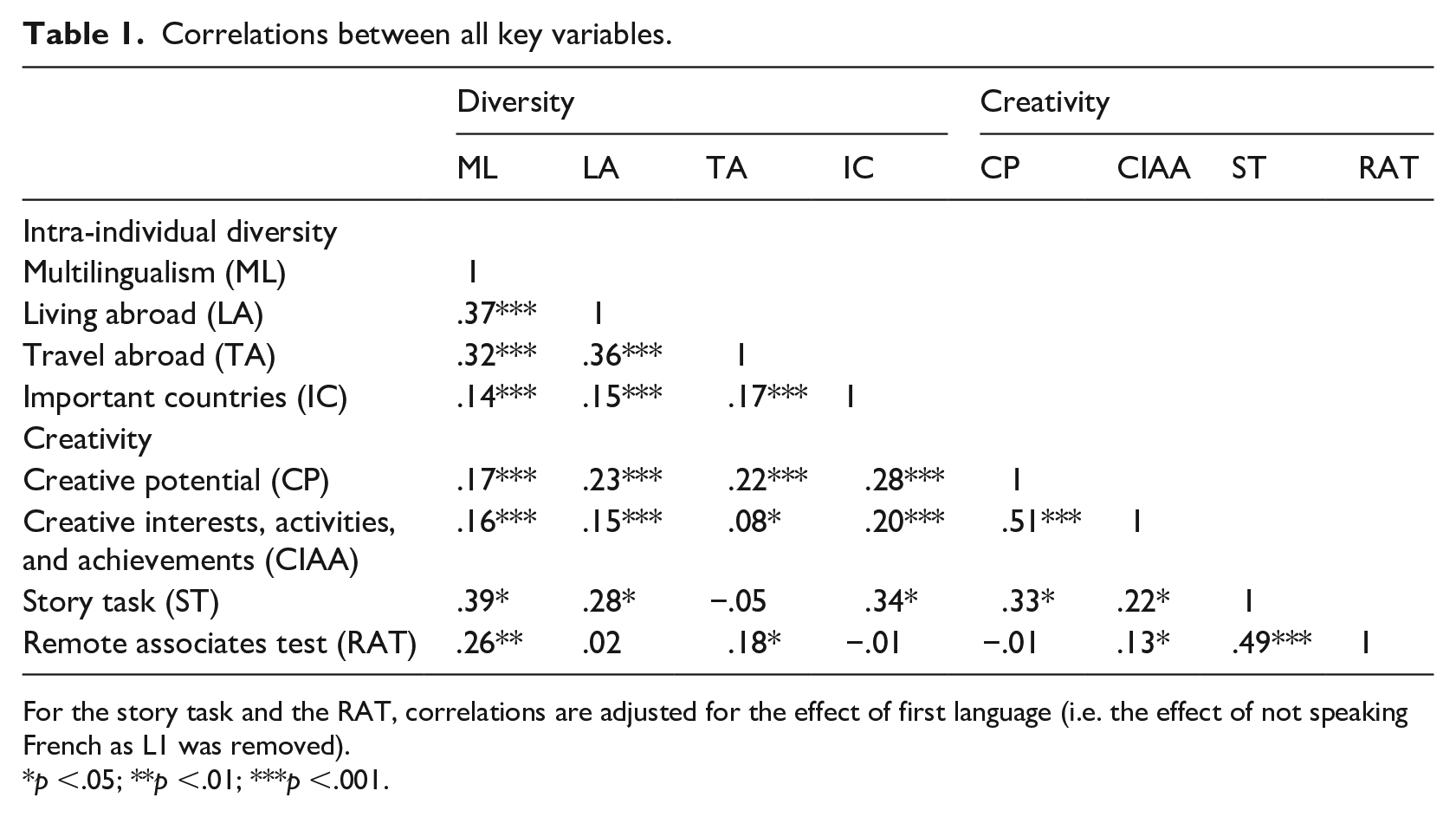
For the story task and the RAT, correlations are adjusted for the effect of first language (i.e. the effect of not speaking French as L1 was removed).
p <.05; **p <.01; ***p <.001.
Multiple regression results (Table 2) show that both multilingualism and multicultural experience variables (i.e. the travel abroad and important countries variables) have a positive impact on potential creativity. 5 This clearly suggests complementarity rather than redundancy between these predictors. As for creative interests, activities, and achievements, only two predictors are significant: multilingualism and “important countries.” Results based on creativity tasks yield a similar picture. In the story task, the only significant predictors are, again, multilingualism and important countries. 6 Finally, in the remote associates test, the only significant predictor is multilingualism.
Multiple regression results.
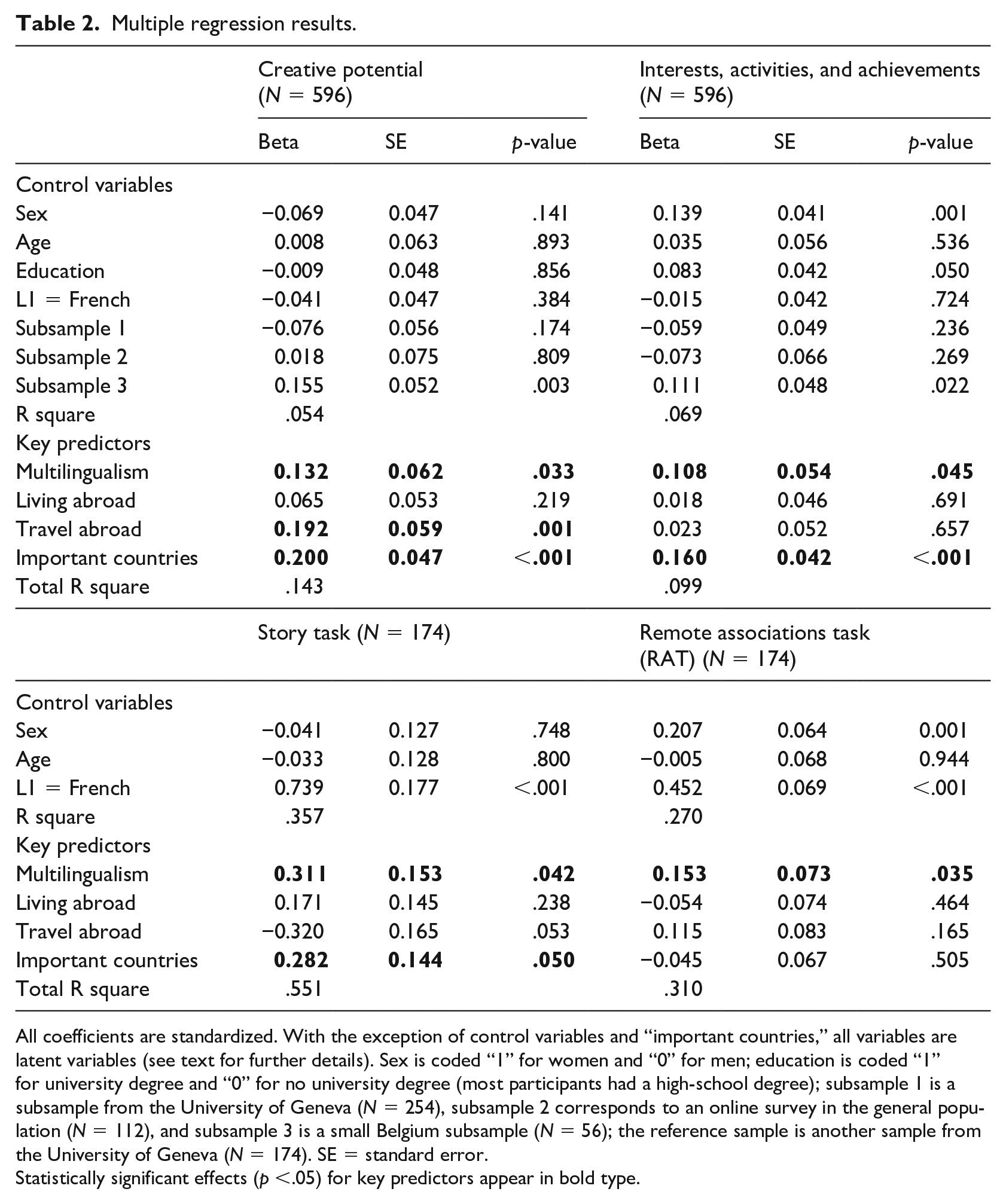
All coefficients are standardized. With the exception of control variables and “important countries,” all variables are latent variables (see text for further details). Sex is coded “1” for women and “0” for men; education is coded “1” for university degree and “0” for no university degree (most participants had a high-school degree); subsample 1 is a subsample from the University of Geneva (N = 254), subsample 2 corresponds to an online survey in the general population (N = 112), and subsample 3 is a small Belgium subsample (N = 56); the reference sample is another sample from the University of Geneva (N = 174). SE = standard error.
Statistically significant effects (p <.05) for key predictors appear in bold type.
In sum, in most cases described in Table 2, the key predictors are the multilingualism and important countries variables. Hence, it seems that these two variables actually capture the essence of deep immersion experience and multicultural identity, and therefore predict most of the creativity scores, leaving comparatively little to explain through sheer living abroad or traveling experience (that is, multicultural experience without a relatively strong impact on identity). These results are consistent with the literature showing a positive connection between multilingualism and creativity (e.g. Kharkhurin, 2012, 2017) and with the literature insisting on the importance of deep immersion while living abroad (e.g. Maddux & Galinsky, 2009). This also suggests that the important countries variable used in this paper is a suitable proxy of the complex notion of bicultural identity (e.g. Leung et al., 2008; Tadmor et al., 2012).
One caveat, however, is that the creativity tasks predicted by these variables are mostly verbal in nature. There were actually two additional creativity tasks available in the present dataset—one divergent thinking task (alternative uses) and one drawing task—but none of the predictors discussed here had a significant impact on them (for a complete description of these tasks, see Fürst & Grin, 2018b). This heterogeneity of effects probably reflects the fact that creativity is a very difficult concept to pin down with a few tasks only; task specificity in creativity research has indeed been known for decades (see, e.g. Baer, 1993). In other words, it is extremely difficult to assess “overall” or “general” creativity, that is, beyond (considerable) task specificity. Hence, at this point, despite important efforts in past research, reliable and well-replicated effects are scarce.
The results reported here are encouraging, and most of them align with previous research. However, the scope for direct comparison with these earlier contributions (as well as among them) is limited for two main reasons. First, this study is, to the best of our knowledge, the first to disentangle the impact of linguistic factors from that of individual multicultural experience. The second reason is that the high specificity of any creativity task (quite apart from the risk of lack of validity) often precludes direct comparison between studies.
Two additional facts call for caution. The first is that, at group level, the impact of “group diversity” on creativity—which had long been viewed as essentially positive—was recently found to be mixed or null (Wang et al., 2017). Of course, group diversity is very different from individual multilingualism or multicultural identity. However, this suggests that past research may have been too prompt to consider diversity (of whatever kind) as an overall positive factor. The second troubling fact regards the cognitive processes that may underpin the link between bilingualism and creativity. Here, the classical idea has been that bilingualism is positively associated with enhanced executive functioning (and by extension, with creativity). However, this has also been challenged recently: Lehtonen et al. (2018) have shown that this effect of bilingualism on executive functioning simply disappears when estimates are corrected for publication bias. This is of particular interest, since it suggests that a creativity-enhancing effect of multilingualism may exist even if there is no strong effect of multilingualism through executive functions.
Certainly, many of the results from earlier research can be assumed to hold, and this study confirms several of them; multilingualism and multicultural identity seem to favor creativity, at least under certain conditions. However, the precise nature of these conditions has crucial importance. In this paper, we have shown the relevance of distinguishing between, and simultaneously assessing, multilingualism and multicultural experience. We have also drawn on two types of information, namely, questionnaire-based and task-based measurements, enabling us to overcome the limitations of single-assessment approaches. We believe that taking these various aspects into account is essential for future work, before questions about the links between the complex variables at hand can be answered with an acceptable degree of confidence.
Footnotes
Author’s note
Guillaume Fürst is also affiliated with Swiss Distance Learning University.
Declaration of conflicting interests
The author(s) declared no potential conflicts of interest with respect to the research, authorship, and/or publication of this article.
Funding
The author(s) disclosed receipt of the following financial support for the research, authorship, and/or publication of this article: The research leading to these results has received funding from the European Community’s Seventh Framework Programme under grant agreement No. 613344 (Project MIME).
Notes
Author biographies
 ), financed by the European Commission. François Grin sits on the board of several scientific journals and is the Editor-in-Chief of the Language Problems and Language Planning.