



Abstract
Purpose:
Based on self-determination theory, this study compared the motivation of emergent bilinguals and full bilinguals in English and Japanese learning at an international elementary school in Japan.
Methodology:
This study employed a questionnaire on motivational orientations in English and Japanese learning.
Data and analysis:
Participants were 104 children who had either English or Japanese as their first language or had an English and Japanese bilingual background. A mixed-measures analysis of variance and correlation analysis were performed on the survey data.
Findings:
Although the degree of internalization of motivation differed depending on whether students were emergent or full bilinguals, the pattern of their motivational intensity in learning English and Japanese was similar among the three groups. Specifically, the full bilinguals internalized motivation in English and Japanese learning equally, while members of both the emergent bilingual groups internalized motivation only in learning the main language of instruction, English. Regarding the respective motivational intensity in the learning of the two languages, autonomous motivation (intrinsic motivation and identified regulation) was significantly stronger in English learning than Japanese learning among the groups, except identified regulation in the emergent bilinguals with English as their first language, while controlled motivation (introjected and external regulation) was significantly stronger in Japanese learning than English learning. Correlation analysis between English learning and Japanese learning additionally showed that for the full bilinguals, intrinsic motivation in English learning did not correlate to that in Japanese learning, whereas such motivation was positively correlated among emergent bilinguals.
Originality:
This is the first cross-lingual study using self-determination theory to compare motivation between emergent children reciprocally learning their first and second languages. It also compares the motivation of emergent children to that of fully bilingual children learning two first languages.
Implications:
Different patterns of motivation among emergent and full bilinguals necessitate corresponding classroom strategies.
Keywords
Introduction
Motivation—especially the intensity of the motive—is a major element in second-language (L2) learning. This being so, several L2 motivational studies based on self-determination theory (SDT), introduced by Deci and Ryan (1985), have been conducted with elementary school students in Japan (Carreira, 2011, 2012; Carreira et al., 2013; Oga-Baldwin et al., 2017; Tanaka & Kutsuki, 2018). These studies were mostly driven by the need to prepare for the changes to Japan’s Ministry of Education, Culture, Sports, Science, and Technology’s (MEXT) educational policy in 2020, which made English education for elementary schools compulsory, with a strong emphasis on autonomous learning and intrinsic motivation (MEXT, 2017). Against the background of this policy change, the number of children with dual nationalities and foreign children has been increasing. A study found that motivation in L1 students with such backgrounds was stronger than motivation in L2 students in learning English (Tanaka & Kutsuki, 2018). Researchers, however, have focused on L2 learning: mainly English. We believe it is also important to investigate students’ motivation in relation to their first language (L1). Such research will offer findings useful both in Japan and in a growing number of contexts globally for children with different backgrounds.
In this trend, some families choose immersion courses and international schools for their children in Japan. Therefore, it is worth observing that, in Japan, bilingual education is not the divisive issue it has become, for example, in those areas of North America that have prominent Hispanic or other immigrant populations. According to Cummins (2009), bilingual education is rarely controversial when it is intended for majority groups in society. If a comparison is to be made with a North American context, we may find the best comparison in Tomozawa and Majima (2015), who see English–Japanese bilingual education for Japanese students in Japan as resembling Canada’s French immersion programs for anglophone students and French language programs for francophone students. The anglophone and francophone students belong to majority groups, and French programs are implemented for them without contention. Similarly, English–Japanese bilingual education in Japan is provided based on the interest of the majority group, emphasizing the importance of English for globalization (MEXT, 2013), and this emphasis has made such education acceptable in Japanese society. Tomozawa and Majima additionally noted the expensive tuition of schools with bilingual programs in Japan ($10,000 to $20,000 per year). Thus, they mainly draw students with affluent parents who expect their children to achieve high proficiency in English and Japanese, developing into bilingual people.
That said, defining bilinguals is as problematic in Japan as it is elsewhere, and as this question of definition is essential for our study, in the following section, we shall include a review of some definitional trends of the last two decades and their relevance to the Japanese case.
Theoretical overview
Defining a bilingual and bilingual education at international schools
How should a bilingual be defined? Recently, a holistic view of bilinguals emphasizing a continuum of L1 and L2 has come into favor. Grosjean (2021) suggests, “Bilinguals are those who use two or more languages (or dialects) in their everyday lives” (p. 7). Valdés et al. (2003) advocate a continuum of bilingual proficiency from language A to language B. These scholars emphasize that bilinguals are not the sum of two monolinguals. Rather, they regularly use two languages and construct a comprehensive language system to connect two languages, which is entirely different from how monolinguals use their language. Therefore, in the last 10 years, a new term has gained traction—emergent bilinguals—which carries the implication of development from nascent to full bilingualism (Baker & Wright, 2021; García, 2009). As these terms denoting degrees of bilingualism precisely describe language learners’ mindsets, encompassing both their L1 and L2 in a bilingual process (rather than referring merely to L2 learning), they have been widely welcomed in bilingual education in North America (see de Oliveira, 2019). Regrettably, however, they have not gained recognition in Japan, even though educators there would find them equally useful.
Baker and Wright (2021) suggest that international schools cannot be categorized as bilingual educational institutions if English is the sole language of instruction. However, those schools are to be included in bilingual education if they intend to develop proficiency and literacy of L1 in addition to their L2 for international students of English L1 or L2 and for host-country students. In these international schools, as in dual language programs, the benefits of developing biliterate bilingualism through learning academic subjects in both English and local languages for both international and local students are recognized (Carder, 2007). Japanese international schools that use English and Japanese as mediums of instruction qualify as providers of “bilingual education” according to this conception.
Defining intrinsic and extrinsic motivation
SDT states that an action will succeed depending on the degree of perceived orientation, categorized as intrinsic and extrinsic motivation (Deci & Ryan, 1985; Ryan & Deci, 2002, 2017) The motivation that causes learners to enjoy learning for its own sake is referred to as intrinsic motivation. It has repeatedly been demonstrated that intrinsic motivation leads to engagement in L2 learning and ultimately results in positive academic outcomes (Ando et al., 2008; McEown et al., 2014).
However, extrinsic motivation refers to behaviors determined by external orientations. It consists of three types of regulation—identified, introjected, and external regulation—concerning the degree of internalization of the action, which is termed self-determination in the language educational field (Carreira, 2012; Noels et al., 1999, 2000; Tanaka & Kutsuki, 2018). 1 Identified regulation refers to an internalized type of extrinsic motivation. This internalization may be owing to personal importance placed on achieving objectives based on social values—for example, studying a language to obtain one’s ideal future. The act of learning can be distinct from one’s values.
The other two types of regulation—introjected and external regulation—constitute extrinsic motivation that is not internalized. As learners orient their actions according to external factors, they will stop the action once they can escape the influence of those factors. Introjected regulation is the orientation that enables one to maintain self-esteem. It can be partly internalized; however, the action is not the result of one’s own values. An example is striving to do better than other students. The least self-determined type of extrinsic motivation is external regulation. With this orientation, learners take actions to avoid facing negative external outcomes, such as parental disapproval of poor results.
Among the above orientations, a continuum from the more self-determined to the less self-determined forms has been theoretically determined. Tanaka and Kutsuki (2018) suggest that it is like each color in a rainbow, which means that each motivational orientation has a distinct characteristic, but all the characteristics contribute to constructing a continuum of motivational orientations. To validly assess these intrinsic and extrinsic types of motivation in SDT, Noels et al. (2000) established a statistical method to justify the continuum in language learning that examines whether a strong correlation exists between adjacent regulations; when the regulations fall apart, the correlations will be few or none. This method has been used in several motivation studies (e.g., Carreira, 2012; Tanaka & Kutsuki, 2018).
Categorization and internalization of motivational orientations
Ryan and Deci (2017) categorized the orientations further as autonomous motivation (intrinsic motivation and identified regulation) and controlled motivation (introjected and external regulation). 2 The former refers to voluntary actions, and the latter refers to actions resulting from internal or external pressure. This categorization is also applicable to elementary school children in Japan. In his meta-analysis of academic motivation in elementary schools, Okada (2010) found strong correlations within autonomous motivation (between intrinsic motivation and identified regulation) and controlled motivation (between introjected and external regulation). Sakurai (2017) suggests that having multiple motivations (i.e., having a strong autonomous motivation) is part of the developmental process of school-aged children because pupils expand their intrinsic motivation to identified regulation after cultivating enough intrinsic motivation. 3 For example, a child fascinated by insects may dream of becoming a science teacher (Sakurai, 2017). Therefore, it is expected that if children have stronger autonomous motivation (intrinsic motivation and identified regulation) than controlled motivation (introjected and external regulations), they are more likely to pursue their studies further than children who only have strong intrinsic motivation.
Relations between motivations of L1 and L2 learners and in L1 and L2 learning
Previous studies have primarily focused on comparing motivation between L1 and L2 learners. In general, the findings indicate that learners who felt a stronger connection to the target language showed internalized and stronger motivation. For example, Comanaru and Noels (2009) found that the motivation of heritage language learners, eager to establish their self-concept and to meet heritage obligations, was stronger than that of foreign language learners. Similarly, L1 learners have been found to enjoy target-language learning more than L2 learners (Tanaka & Kutsuki, 2018).
Regrettably, little research has compared individual learners’ motivation in L1 and L2 learning, perhaps because motivation in L1 acquisition has been considered fundamentally different from that in L2 acquisition (Corder, 1967). However, in bilingual education, this need not apply, as the way language is learned differs from that in L1 and L2 acquisition. Specifically, in bilingual education, emergent bilingual students learn an L2, and fully bilingual students learn an L1 after having already acquired L1 basic interpersonal communicative skills (Cummins, 2001). Such students learn academic subjects through both L1 and L2 or L1s, which means that they mainly cultivate cognitive-academic language proficiency or academic language at school (Butler, 2011; Cummins, 2001). To acquire literacy, they need to work hard at language study.
The cognitive-academic language proficiency theory hypothesizes that, in the North American context, internalized motivation of minority language learning is positively related to the motivation to learn English, their L2, which is a majority language among minority language learners (Landry et al., 2009). However, at international schools in Japan, the meaning of minority and majority languages is not so straightforward. English L1 students are L1 learners of a world majority language and, simultaneously, heritage language learners of their L1 in Japan (Tanaka & Kutsuki, 2018). We hypothesize that their motivation in English learning may be stronger than that in Japanese learning, and it could also correlate with their Japanese learning, which is, of course, a majority language in Japan.
The motivation to learn Japanese among Japanese L1 learners may be stronger than their motivation to learn English. Furthermore, following Landry et al. (2009), their drive to learn Japanese may enhance their English learning; English is a majority language at English–Japanese international schools in Japan. In addition, at international schools, there may be English–Japanese bilingual speakers who have an attachment to both languages. We also hypothesize that the internalization of motivation among full bilinguals may be like that of both the English and Japanese L1 groups, as both languages are their L1s. They would have a strong motivation to learn English, like emergent bilinguals of English L1, and to learn Japanese, like emergent bilinguals of Japanese L1. Among the full bilinguals, there would be no difference between the intensity of motivation in learning English and Japanese.
We would like to add a note of caution here. In examining the relationship between motivational orientations toward academic language learning and other subjects, some scholars suggest that intrinsic motivation works similarly in language learning and a variety of academic subjects. For example, Ando et al. (2008) found that, among Japanese elementary school pupils, the intensity of intrinsic motivation did not differ between learning Japanese and mathematics. Pupils raised their hands and became involved to the same degree, whether in a student-centered Japanese discussion class or a teacher-centered lesson on arithmetic. Carreira (2011) also established that intrinsic motivation in learning academic subjects, in general, may affect intrinsic motivation in learning English. One reason for this similar tendency may be the effect of the value of learning that is, in general, imparted in the classroom. As students learn values through education, if teachers are successful, their students might have a similar intensity of intrinsic motivation in learning different academic subjects. It is meaningful to compare the motivation of learners who mutually learn their L1 and L2 in academic subjects, as motivation will be stronger in L1 learning than in L2 learning. However, the difference might be erased by the effect of the overall respect for learning inculcated at English–Japanese international schools, the goal of which is to make students value the two languages equally.
Study purpose
In examining the patterns of motivation for English and Japanese learning among students in the three groups of students (English L1, Japanese L1, and English–Japanese full bilinguals) in an international elementary school, this study had three goals. It aimed to determine,
Method
Participants
The study participants were 104 students (55 girls and 49 boys) from an English–Japanese international school in Japan. The parents of these second- to sixth-graders gave informed consent for their involvement in this study. Specifically, a day before the implementation of the survey, we explained the details of the survey to the participants’ parents and clearly conveyed that taking part in the survey was not mandatory. This made it possible for parents and children to decide together at home whether they would like to participate. The Japanese school system consists of grades one to six; however, the first graders did not take part in this study, as the school schedule did not permit their participation in the questionnaire survey. For the purposes of the study, the data of participants who answered all the items in the questionnaire and who indicated their best-spoken language as English, Japanese, or both in the questionnaire were retained for analysis. The native language of the students was categorized based on their perception of their best-spoken language: English L1, 31 (30%); Japanese L1, 52 (50%); and English–Japanese bilingual, 21 (20%). As all participants attended an English–Japanese international school and used the two languages for learning subjects, we defined English L1 and Japanese L1 participants as emergent bilinguals and English–Japanese bilingual participants as full bilinguals. Although the sample size of total participants was fair, the sample size of each group became uneven when we categorized them into the three groups based on participants’ responses in the questionnaire. To compensate for this, the effect size was calculated. The means of their ages, calculated based on the school years, were 9.6 years (ranged from 7 to 12 years). Note that it is not possible to skip years in the Japanese school system; therefore, the participants are all of the standard age of their grade.
At the school, all students study the English language and core subjects in English. However, the Japanese language and Japanese studies are taught in Japanese. This school is different from other international schools in Japan because it is one of the few schools authorized by the School Education Act, Japan (Article 1). Thus, the curriculum followed is that of the Japanese education system.
Materials
This study employed a questionnaire comprising two sections. The first consisted of 15 items regarding motivational orientations in English learning from Tanaka and Kutsuki (2018). It measured the degree of agreement on responses to the question “Why are you learning English?” with a 5-point scale (1 = strongly disagree to 5 = strongly agree). The responses consisted of intrinsic motivation (four items; e.g., “Because I enjoy studying English”), identified regulation (three items; e.g., “Because it will help me get into better schools later in life”), introjected regulation (five items; e.g., “Because I feel I am uncool if I am not good at English”), and external regulation (three items; e.g., “Because people will be angry at me if I do not get good scores on English tests”). The second section was structured identically; however, the word “English” was replaced with the word “Japanese.” The questionnaire was written in both English and Japanese for easy understanding among participants from different language backgrounds.
Analysis
SPSS version 22 (IBM) was used for statistical analyses. To answer Research Questions 1 and 2, a three-way mixed-measures analysis of variance (ANOVA) with Bonferroni’s post hoc test was used. Specifically, the mean level of each item was calculated, and the levels were compared across three definitions: language learning conditions (English learning and Japanese learning) and motivational orientations (intrinsic motivation, identified, introjected, and external regulation) as the within-subjects factors, and (researched) groups (English L1, Japanese L1, and fully bilingual) as the between-subjects factors. The simple interaction between language learning conditions and motivational orientations was tested for each group. To answer Research Question 3, a Pearson’s correlation analysis was performed between each mean level of motivational orientations of the three groups in English learning and the corresponding orientations in Japanese learning.
Procedure
The survey was conducted by the researchers aided by school staff. The researchers visited each classroom and distributed the questionnaires. They also read aloud every question in English and/or Japanese depending on the language/s requested by the participants. The questionnaire was answered anonymously.
Results
Descriptive statistics, reliability, and validity of the variables
First, descriptive statistics and the reliability and validity of the variables were considered. To summarize the data, the means and standard deviations of the variables were calculated (Table 1). Intrinsic motivation displayed the highest mean level, followed by identified, introjected, and external regulation in both languages. To establish reliability, the Cronbach’s alpha index of each variable was computed. The internal consistency of each variable was reasonably high, rating from .72 to .79 in English learning and .74 to .86 in Japanese learning. To ensure construct validity, the correlations for each variable were calculated. In accordance with previous studies (Carreira, 2012; Noels et al., 2000; Tanaka & Kutsuki, 2018), the construct of the SDT can be justified by calculating correlations between regulations. The correlations should be strong when regulations are adjacent and should be lower or no correlations should exist when the regulations are distant. In our data, intrinsic motivation positively correlated with identified regulation but not with introjected or external regulation. Among the various extrinsic motivations, the correlations between variables were stronger than the correlation between intrinsic motivation and identified regulation. These results confirmed the continuum of motivational orientations of the construct in accordance with SDT.
Motivational orientation means, standard deviations, Cronbach’s alpha, and correlations.
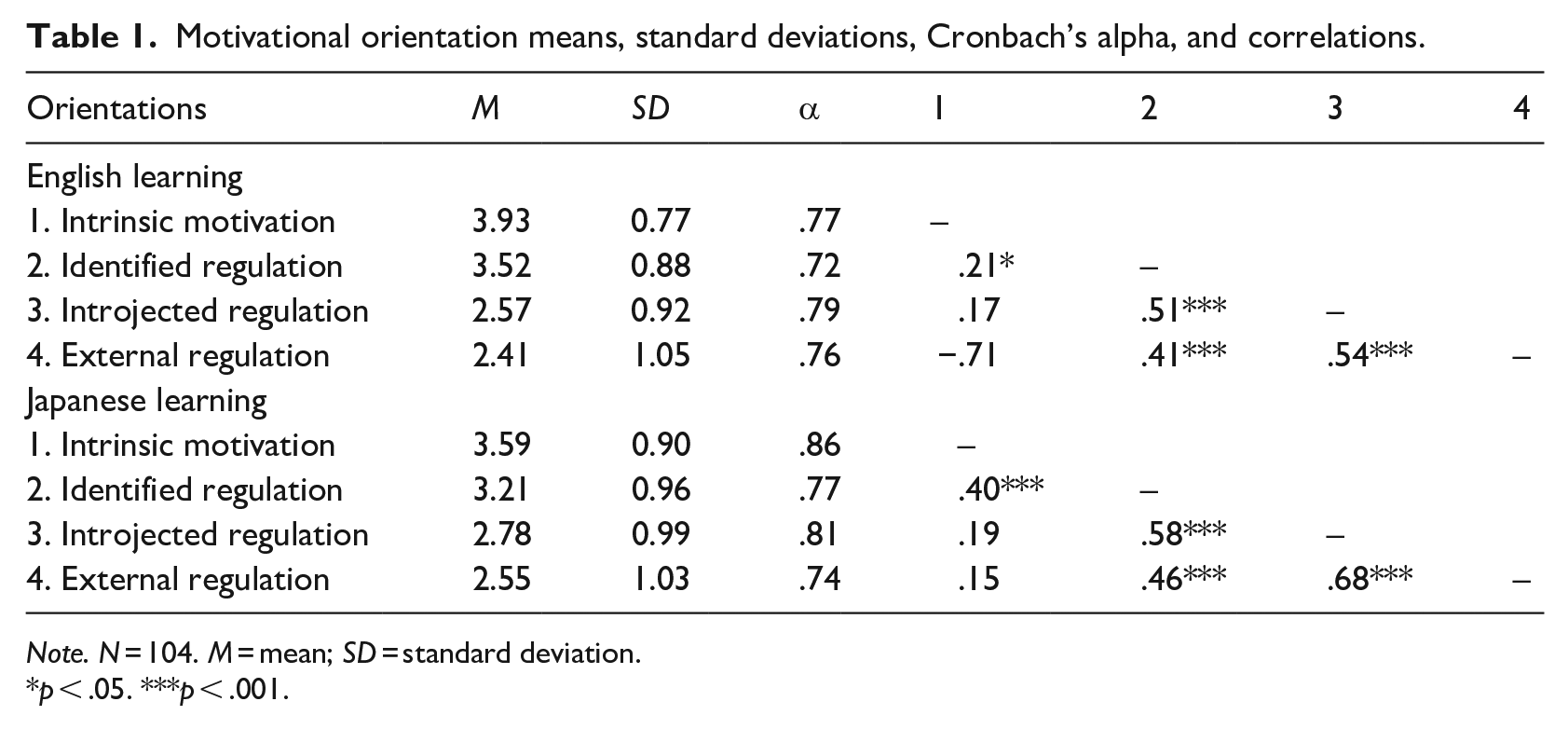
Note. N = 104. M = mean; SD = standard deviation.
p < .05. ***p < .001.
Relations between groups, language learning conditions, and motivation
To analyze Research Questions 1 and 2, we performed a three-way mixed ANOVA with two language learning conditions (English learning and Japanese learning) and four motivational orientations (intrinsic motivation, identified, introjected, and external regulation) as the within-subjects factors, and the three groups (English L1, Japanese L1, and fully bilingual) as the between-subjects factors. Table 2 shows the means and standard deviations of the groups.
Means and standard deviations of motivational orientations in English learning and Japanese learning for each group.
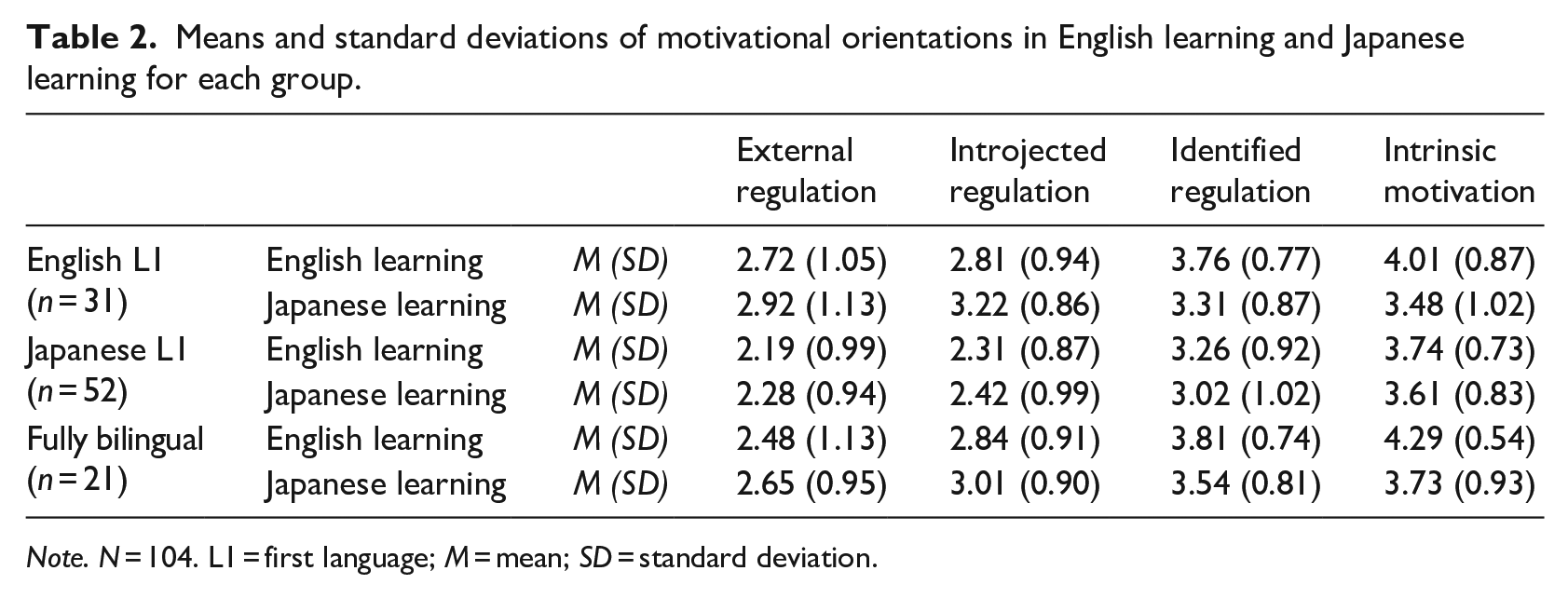
Note. N = 104. L1 = first language; M = mean; SD = standard deviation.
The results indicated a significant three-way interaction among the groups, language learning conditions, and motivation (Table 3). To interpret the three-way interaction, we performed a simple interaction analysis, which revealed a significant interaction between the language learning conditions and motivation in all three groups, English L1: F(3, 303) = 8.73, p < .001,
Results of three-way analysis of variance of group, language learning conditions, and motivation.

p < .05. *** p < .001.
The simple–simple main effect of motivation was significant on English learning for all three groups, English L1: F(3, 303) = 6.52, p < .001,
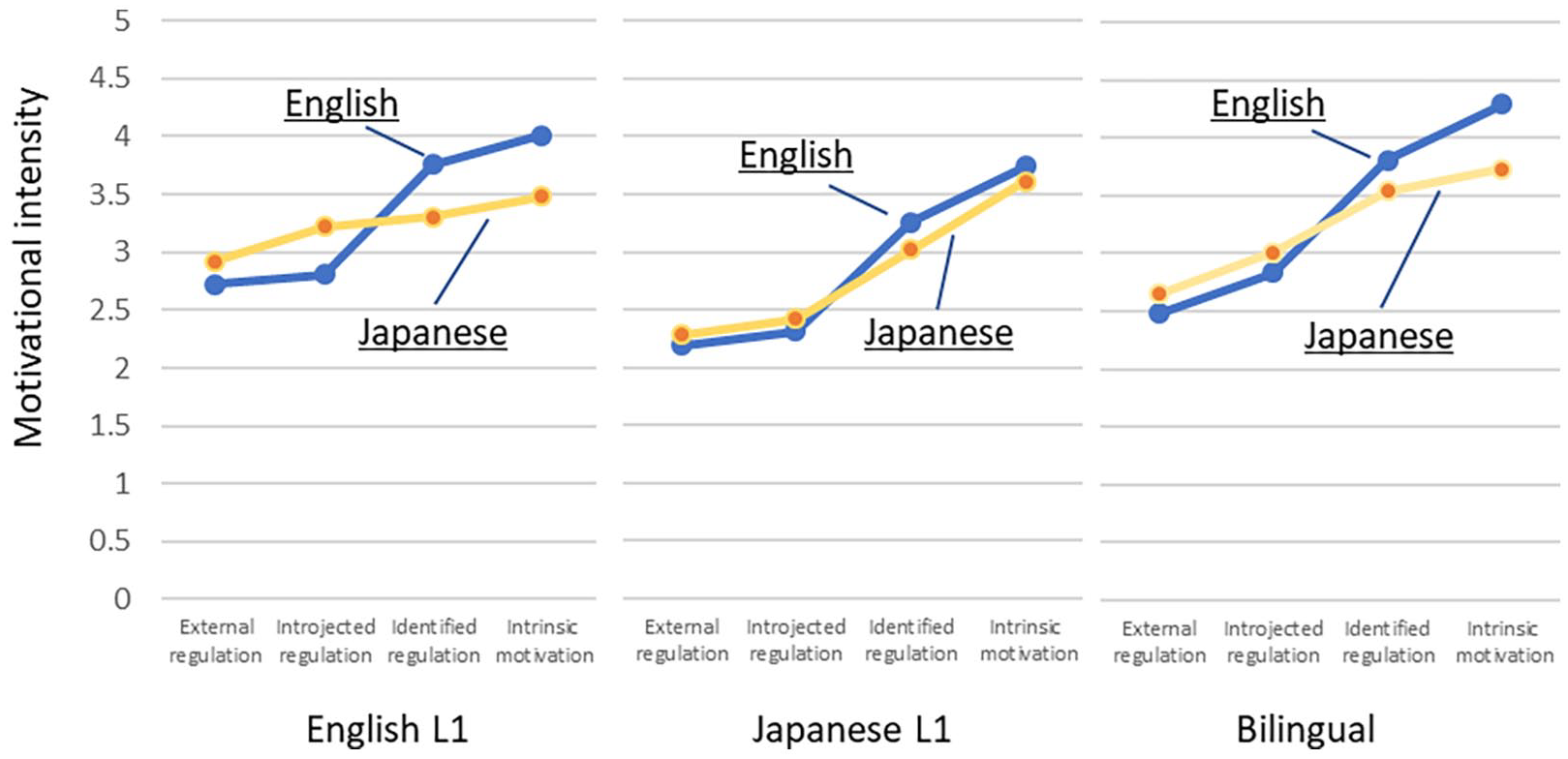
Comparison of motivational orientations among the three groups.
The simple–simple main effect of conditions was significant in almost all motivational orientations of all groups. Specifically, autonomous motivation (intrinsic motivation and identified regulation) was stronger in English learning than that in Japanese learning among the three groups, except identified regulation of the English L1 group. In contrast, controlled motivation (introjected and external regulation) in Japanese learning was stronger than that in English learning among the three groups.
In depth, for autonomous motivation, the simple–simple main effect of conditions for intrinsic motivation of the English L1 group, F(1, 101) = 36.63, p < .001,
For controlled motivation, the simple–simple main effect of conditions for introjected regulation of the English L1 group, F(1, 101) = 29.76, p < .001,
To analyze Research Question 3, we performed a correlation analysis of each motivational orientation between English learning and Japanese learning. All pairs were positively and moderately or strongly correlated (in the order of .60 for moderate and above .70 for strong) except intrinsic motivation in the fully bilingual group (Table 4).
Correlations of motivational orientations between English learning and Japanese learning by group.

Note. N = 104. L1 = first language.
p < .001.
Discussion
Degree of internalization of motivation in English and in Japanese learning
To answer Research Question 1, the degree of internalization of motivation for Japanese and English learning among the three groups was investigated. Specifically, we compared the mean levels of orientations (from intrinsic to external) in English learning among the groups, and did the same in Japanese learning, and then compared those two patterns. The results suggest that the internalization of motivational orientations toward English and Japanese learning was different among the three groups. First, the motivation was not equally internalized in the emergent bilingual groups in English and Japanese learning. Specifically, the English L1 group significantly internalized the motivation for learning English but not Japanese. Thus, these students had significantly higher autonomous motivation (intrinsic motivation and identified regulation) than controlled motivation (introjected and external regulation) in English learning, while no difference was detected in the pattern of their motivation toward Japanese learning when the motivations of the three groups were compared. This result for the English L1 group can be logically explained as they were living in Japan and studying English as heritage language learners at the international school. They would have related the importance of English learning to their personal enjoyment and their future. Sakurai (2017) suggests that students who possess stronger autonomous motivation are more likely to continue their studies than children having only stronger intrinsic motivation. Thus, emergent bilinguals of English L1 would pursue their English learning more than emergent bilinguals of Japanese L1, which is discussed in the following section.
Consistent with our findings for the English L1 group, the Japanese L1 group also significantly internalized motivation in English learning. They possessed significantly higher intrinsic motivation than identified, introjected, and external regulations in English learning when the three groups were compared. However, no difference was found in their motivation toward Japanese learning. This result differed from our expectation that the motivation of Japanese L1 students would be more internalized than that of their L2 counterparts as they devoted themselves to the language for a longer duration of time. Furthermore, our results indicated that their L2 motivation was more internalized than their L1 motivation; that is, they internalized motivation in the main instructional language for their academic subjects. Thus, it is reasonable to conclude that this difference in internalized motivation is attributable to the social value placed on English, the main medium of instruction at the school. SDT posits that people internalize social values, and accordingly, the main instructional language, English, may be more internalized than the minor instructional language, Japanese, by the emergent bilinguals of Japanese L1 at the international school.
In contrast, the fully bilingual group possessed internalized motivation in learning both languages. Specifically, they possessed higher autonomous motivation (intrinsic motivation and identified regulation) than controlled motivation (introjected and external regulation) toward both English and Japanese learning. Sakurai (2017) suggested that high autonomous motivation shows students’ development after they devote themselves to learning with intrinsic motivation at an early age. Similarly, we can conclude that the fully bilingual group would have devoted themselves to learning both languages with intrinsic motivation at an early age, and thus possessed high autonomous motivation (intrinsic motivation and identified regulation) in both languages. These results are reasonable since full bilinguals would have an attachment to both languages, as English and Japanese are their heritage language or L1 at an international school in the English as a foreign language context. This makes it easier for them to enjoy language learning and be aware of the importance of language learning for their future compared to emergent bilinguals.
In summation, full bilinguals equally internalized motivation in English and Japanese learning, while emergent bilinguals (English L1 and Japanese L1) internalized motivation only in English learning. We had expected that the internalization of motivation would reflect the amount of time devoted to language learning. However, we must conclude that the recognition of the importance of the languages in relation to their socio-cultural background and the immediate social environment of children could also play a key role.
Comparison of motivational orientations between English and Japanese learning
To answer Research Question 2, the relationship between each motivational orientation (intrinsic, identified, introjected, and external) in English learning and the corresponding orientation in Japanese learning among the three groups was investigated. Specifically, we compared if the mean level of each motivational orientation (e.g., intrinsic) in English learning differs to the mean level of the corresponding orientation (e.g., intrinsic) in Japanese learning, and then compared the relationship among the groups. The results of our study suggest that the motivational orientations of the three groups statistically differ between English learning and Japanese learning at the English–Japanese international school in Japan, except for the identified regulation of the English L1 group. Autonomous motivation (intrinsic motivation and identified regulation) in English learning is stronger than that in Japanese learning among the three groups except identified regulation in the English L1 group. Controlled motivation (introjected and external regulation) in Japanese learning is stronger than that in English learning among the three groups.
The results are different from our prediction that motivation in L1 learning would be stronger than that in L2 learning. This is because the findings in the previous studies (Comanaru & Noels, 2009; Tanaka & Kutsuki, 2018) suggested that the motivation of heritage language or L1 learners was stronger than that of non-heritage or L2 language learners. This proved not to be the case when the relationship between English learning and Japanese learning is compared within learners in the three groups within the same environment, except for the identified regulation of the English L1 group. This result may be attributable to the strong influence of school education, as suggested by Ando et al. (2008) and Carreira (2011), who compared the motivation for learning different subjects among learners at public elementary schools in Japan. In our study, we believed that we were measuring motivation based on participants’ L1, whereas the motivation of both our L1 and L2 learners may have been enhanced by the school’s mission to nurture bilingual learning which has a main language of instruction, English and a minor language of instruction, Japanese. Students, regardless of their background, would think that learning English is more enjoyable and useful for their future than learning Japanese, while learning Japanese is more controlling than learning English. Although the previous studies (Comanaru & Noels, 2009; Tanaka & Kutsuki, 2018) similarly measured motivation in language learning, the participants’ motivations in their study were only analyzed based on one condition (e.g., English learning). In the present study, the participants reciprocally possessed L1 and L2 in the same environment. This means L1 students, who have an advantage in a class, can be L2 students at a disadvantage in the other class. In addition, there are students with two L1s who see their friends’ ups and downs of language learning in the respective class. Therefore, students in all three groups may be able to empathize with each other’s difficulties and enjoy each other’s success. This may also result in motivating them with a similar tendency in English and Japanese learning, though they would place different social value on the two languages of instruction.
In the present study, there was an exception in identified regulation of English L1 group, which showed no significant difference in intensity of motivation between English learning and Japanese learning. The emergent bilinguals of English L1 may think that learning Japanese is important for their future, as well as learning English. This may be because the international school where we implemented this study did not have a secondary school. Therefore, they might think that they would need Japanese learning to study at a local secondary school in Japan. This would also show a strong influence of social surroundings on motivation among the young learners.
The correlations of motivational orientations between English and Japanese learning
To answer Research Question 3, we investigated whether each motivational orientation in English learning positively correlates to the corresponding orientation in Japanese learning among the three groups. All the pairs of motivation between English and Japanese learning in intrinsic motivation and three types of extrinsic motivation were positively correlated except for intrinsic motivation in the fully bilingual group. This observation suggests that the emergent bilinguals (English L1 and Japanese L1) did not decide to learn either language over the other. Instead, they were motivated to learn both simultaneously. This finding for the English L1 group supported Landry et al.’s (2009) hypothesis that minority language learners who are internally motivated to learn their L1 will also be motivated to learn the majority language as an L2. As established in the previous section, the emergent bilinguals of English L1 were internally motivated to learn their L1, English. Therefore, they were also motivated to learn the majority language in Japan, Japanese. As for emergent bilinguals of Japanese L1, we also found that they were internally motivated to learn English which correlated to them learning Japanese; however, English is L2 for these students. This result differed from our expectation that L1 is more internalized than L2. However, their motivation in learning English was positively correlated to that in learning Japanese. Thus, we can conclude that the motivation of emergent bilinguals of Japanese L1 was similar to that of emergent bilinguals of English L1 at the international school in Japan.
In contrast, the fully bilingual group considered English and Japanese as two separate goals and could choose to learn one language with intrinsic motivation. This was a direct result of having two native languages. The full bilinguals, whose L1s were both English and Japanese, had attitudes toward language learning different from those of the emergent bilinguals learning their L2. In particular, the emergent bilinguals might have considered language learning objectively because they had an L2, but the full bilinguals subjectively perceived both languages as L1s. This may be attributed to the fact that the emergent bilinguals would have explicit knowledge of learning a language as they have learned an L2. Full bilinguals would adopt implicit knowledge in language learning, as both languages are their L1s. Contrary to our expectations that motivation for bilingual learners would be similar to that of emergent bilinguals of L1s, our findings did not support the same.
Pedagogical implications
Our study has two pedagogical implications. First, teachers should be careful not to misjudge motivation among emergent bilinguals. Among these learners, the internalization of motivation toward bilingual learning will be seen only in their learning of the major language. However, motivation itself for the learning of both languages can be positively related, which is something teachers can effectively use.
Second, teachers need to be careful about teaching bilingual learners in a school where two languages are used pedagogically. Fully bilinguals may happily choose to learn only one language at a time, while they may similarly internalize both languages. Intrinsic motivation of this group is not interdependent between English learning and Japanese learning, while that of emergent bilinguals is interdependent. Thus, it is important to let full bilinguals enjoy learning both of their L1s to motivate themselves through their own experiences in each language.
Limitations
This study had some limitations. First, we focused on students’ perceptions of their motivation based on the categorization of their perceived best-spoken languages. Therefore, the categorizations may not be as strict as they seem to be. However, we believe that perception is important in motivation studies, as how students perceive their native languages will change their behavior toward its study. As a result, successful academic outcomes in language learning emerge. Second, the sample size is limited. If we had a larger sample size, the results of correlation analyses would have more statistical power. Third, although our study investigated the motivation in learning two languages between emergent and full bilinguals, it could only capture momentary motivation. Motivation is dynamic and can change with time. Longitudinal research will enable the implementation of deeper analysis with multidimensional aspects. Further research is required to determine L1 and L2 motivation in depth.
Conclusion
All students at the international elementary school showed a similar pattern of intensity of motivation in learning two languages—English and Japanese. They showed stronger intensity of autonomous motivation (intrinsic motivation and identified regulation) in English learning than Japanese learning, except for the identified regulation of the emergent bilinguals of English L1, whereas they showed stronger intensity of controlled motivation (introjected and external regulation) in Japanese learning than English learning. However, the degree of internalization of motivation in English and Japanese learning differed among the groups. The fully bilingual group seems to possess a similar internalization of motivation in bilingual learning, as they had stronger autonomous motivation than controlled motivation in both English and Japanese learning. In contrast, the internalization of motivation among emergent bilingual (English L1 and Japanese L1) groups was seen only in English learning. Therefore, we conclude that bilingual education for young learners would influence the intensity of motivation to learn two languages in a similar manner, but their internalization of motivation and intensity of identified regulation—motivation toward their future—could be different based on their social backgrounds and immediate social context.
Footnotes
Acknowledgements
The authors are grateful to the children at the international school for participating in this study. The authors also thank the teachers and administrators of the school who cooperated with them in the implementation of this study.
Declaration of conflicting interests
The author(s) declared no potential conflicts of interest with respect to the research, authorship, and/or publication of this article.
Funding
The author(s) disclosed receipt of the following financial support for the research, authorship, and/or publication of this article: This work was partly supported by JSPS KAKENHI Grant Number [18K00898] awarded to the first author and Grant Number [24730713] awarded to the second author.
