




Abstract
Aims:
This study on Belgian Dutch caregivers aims to complement research on multilingual family language planning with a multivarietal perspective. As transitions between varieties are often more gradual, it is revealing to study which emotions surface in caregivers’ reflection on these varieties. The Belgian Dutch case is selected given its historically highly emotional macro-level language debate, its exoglossic norm and its transition from diglossia to diaglossia.
Methodology:
The aim is pursued through mixed methodology, combining variationist analysis with a bottom-up discourse analytic approach.
Data and analysis:
We juxtapose data from two Belgian Dutch families. For each family, a qualitative analysis identifies the expressions of (the lack of) emotions found in metalinguistic interviews on varieties of Dutch with the caregivers (80’). This information is triangulated with a quantitative analysis of the caregivers’ use of standard and nonstandard pronouns of address in self-recorded dinner table conversations (260’; N = 1004).
Findings:
Results reveal caregivers’ attempts to manage conflicting emotions related to the Flemish language situation, and how they lead to (dis)harmony in the family.
Originality:
This paper contributes to our understanding of emotions in family language policy (FLP) in its focus on a multivarietal context and in its mixed methodology.
Implications:
Our findings resonate with research on multilingual FLP’s, which we tie to caregivers’ diglossic description of the diaglossic Flemish context. The shifting relationship between emotions expressed in the interviews and the language choices made in practice, overall support the value of mixed methods FLP research.
Family language policy: multilingual versus multivarietal
Language policy and planning activities grew in the 1950s and 1960s and centered around hierarchies between colonial and local languages in decolonized nations (Ricento, 2000). Later, as terms like bilingualism and diglossia were demonstrated to be more complex than previously thought, and the role of ideology came into consideration more, these initial conceptions of language policy were challenged and expanded upon (Ricento, 2000).
As a natural response to this shift in language policy research from general, explicit macro-level policies to specific phenomena like ideology, some scholars began to focus on the way language policy takes shape in micro-communities like (nuclear) families. Family language policy (FLP) has here been defined as “explicit and overt planning in relation to language use within the home among family members” (King et al., 2008, p. 907). Initial research illustrated how this FLP is often influenced by the same processes that shape macro-level policies (Spolsky, 2012).
Overall, as Piller (2001) notes, FLP has mainly been studied in multilingual settings. Piller herself has, for instance, examined the strategies caregivers devise to ensure that their children become bi- or multilingual, and how their relative success in that endeavor is influenced by societal ideas about bi- and multilingualism. Likewise, King et al. (2008), Curdt-Christiansen (2009), Van Mensel (2016), Obojska (2018), and del Puy Ciriza (2019) examine strategies for bi- and multilingual FLPs and how community and societal pressures influence FLPs. In their editorial to a special issue on the matter, Curdt-Christiansen and Gao (2021) propose that the family should even be considered a critical site where the negotiation between various levels of language policies are negotiated. Obojska (2018) and del Puy Ciriza (2019), and several chapters in Schalley and Eisenchlas (2020) in particular, additionally pay closer attention to the influence that emotions have on FLP, examining the complex, often contradictory and overlapping ways speakers feel about maintaining heritage languages. Studying emotions in FLP can in this sense help better understand how such policies operate.
This paper aims to seize this opportunity by examining emotions in FLPs in multivarietal contexts in particular. This can complement multilingual FLP as we anticipate multivarietal FLP to be more implicit than multilingual FLPs, given that substandard varieties are not always perceived as separate linguistic systems but as stratified layers of a single language (Auer, 2011). However, many of the same social phenomena and parenting strategies are still relevant. Substandard varieties can also carry social meaning in the form of negative evaluations (Lybaert, 2017), which also entails the presence of emotions. The broader potential of studying multivarietal family language has been demonstrated by De Houwer (2003), Smith et al. (2013), and Van De Mieroop et al. (2016). These studies illustrate how the tensions between standard and nonstandard language affect production and evaluation of language use in the home, similar to how tensions affect FLP in multilingual situations.
To study this relation between FLP and emotions in multivarietal context, we focus on the multivarietal case of Belgian Dutch. This case is particularly informative given the standardization history of Dutch in Flanders, the northern part of Belgium, which is marked by a complex macro-level language policy, strong opinions and emotions. The aim of this paper is to tease out whether we can see traces of this in Flemish micro-level FLPs. The following section will explain the linguistic history of Flanders. After this, we will identify and define some of the emotions that are relevant to the Flemish language context, which will lead us into our research questions.
Belgian Dutch: a crash-course
Belgian Dutch is spoken in the northern half of Belgium, a country split into different regions and language communities according to the languages historically spoken in each region. Because French was the only official language of Belgium until the twentieth century, French was the default language in most public domains in Flanders, but various dialects of Dutch were used at home (Jaspers & Van Hoof, 2013). No standard variety of Dutch was in place. When Dutch became the only official language in Flanders, policymakers then implemented a standard by adopting Standard Dutch (SD) as it was long established in the Netherlands, this way orienting Flanders toward an exoglossic norm (Auer, 2011; Jaspers & Van Hoof, 2013 and see De Schutter, 2022 for an overview of language policy). A terminological consequence is that “Flemish” (Vlaams) is used to refer to the region “the Northern part of Belgium”, not to the language used in this region. Instead, in a bid to underline the linguistic union with the Netherlands and with the standard variety “Standard Dutch” that is used in both Flanders and the Netherlands, “Belgian Dutch” (Belgisch Nederlands) is used to refer to the official language of Flanders (Vlaanderen).
To enhance the entrenchment of the “foreign” standard adopted from the Netherlands, a period followed in the second half of the twentieth century of what has been referred to as hyperstandardization (Grondelaers & Van Hout, 2011; Jaspers & Van Hoof, 2013) with robust, explicit language policies (Delarue, 2013) marked by a strong standard language ideology (Milroy, 2002). The significant efforts to promote Standard Dutch in education and the media for instance included primetime TV series explaining how to speak Standard Dutch. These efforts did result in general public acceptance of the new norm as the standard variety, though its exoglossic nature restricted its broader use in the Flemish community: the standard variety felt too foreign for daily communication (Jaspers & Van Hoof, 2013). In turn, a supraregional Flemish variety emerged as informal norm for day-to-day communication, Colloquial Belgian Dutch (CBD). Flanders as such moved from a diglossic system with traditional dialects versus the new standard, to a diaglossic system, with CBD found as intermediate variety in between standard and dialect (Geeraerts, 2001a). Unlike dialects, which are more and more restricted to older generations (Ghyselen & De Vogelaer, 2013), many Flemings speak CBD frequently in everyday situations, including educational and professional settings, which leads some to consider the spread of CBD as evidence of a growing Flemish self-confidence and as an emancipation from Standard Dutch (Grondelaers & Van Hout, 2011). At the same time, nonstandard varieties, including both dialects and CBD, are often still considered less prestigious and less appropriate for formal contexts (Geeraerts, 2001a).
An emotional debate
The Flemish language history resonates in the often heated and emotionally loaded societal debates about the use and appropriateness of the language varieties available in Flanders that still spark up at regular intervals. Close consultation of previous research on Dutch in Flanders points to shame, pride, confidence, and insecurity as the most relevant emotions to this debate, complemented by the expression of a lack emotion, viz. indifference. Below, we give a brief general definition for these emotions and for “indifference,” and explain their particular relevance for the Flemish context by providing selected fragments from opinion pieces published in public media outlets. This way, we tap into the underexploited potential of the societal treatment approach, which, in his overview of language attitude research, Garrettt (2010) describes as the way in which particular linguistic phenomena are discussed and employed in “various sources in the public domain” (p. 51). A more detailed description of the way we have identified the manifestation of these emotions in the Flemish family language context will then follow further down in “Methods.”
Shame and pride are both self-conscious emotions, related to an individual’s self-perception (Galmiche, 2017; Gibson, 2018). Pride is associated with positive self-perception (Ross & Stracke, 2016) and can be either authentic or hubristic (Tracy & Robins, 2007), in the sense of being an accurate or inaccurate reflection of an individual’s actual abilities. Shame can be considered as the opposite of pride in that it is associated with negative self-perception (Galmiche, 2017). Lybaert (2017) suggests that some speakers in Flanders may feel pride in speaking local varieties of Dutch (compare Miyake, 1995 description of dialect pride), or they may feel shame over their inability to speak Standard Dutch consistently in formal or pedagogical situations (see also Geeraerts, 2001b; Lybaert, 2017b, and compare Jiang & Dewaele, 2019; Sevinç & Backus, 2017b, for research outside of the Flemish context). Pride and shame have emerged regularly in the media debate as well, as we see in examples (1) and (2) respectively. Both fragments can be considered ends of the continuum from pride to shame.
“It is especially crucial that (young) language users . . . should learn that their language is not incorrect, not bad, not wrong, and not of lesser worth. Isn’t the essence of our multicultural society that everyone should be able to be proud of his or her language and background, without having fingers pointed at them?” (opinion piece by linguists Gert De Sutter, Stefan Grondelaers, and Steven Delarue in magazine MO*- Mondiaal Nieuws, 13 November 2017) 1
“You ought to hear it, what all gets babbled and jabbered in the vicinity of a lectern [these days]” (opinion piece by fiction writer Dimitri Verhulst in newspaper De Morgen, 31 August 2012) 2
The next two emotions, confidence and insecurity, can also be considered as each other’s opposites. A feeling of confidence indicates a greater feeling of ability and agency, while insecurity indicates a lack of trust in or certainty over one’s own ability or agency (Postareff & Lindblom-Ylänne, 2011). Previous work on the Flemish language situation shows that both might apply: speakers might feel either confident or insecure about their ability to speak SD consistently (Jaspers & Van Hoof, 2013; Plevoets, 2008). A historic example of the fiercely negative appraisal of Flemish confidence found in the public domain in the early rise of Colloquial Belgian Dutch is found in (3).
“Verkavelings-Vlaams [CBD], that’s the language of a newfangled, thoroughly false Flemish confidence, it’s the language born out of a contempt for the speech of ordinary people and out of a fear of Dutch, a monstrosity is what it is, that language of the new Flanders, that radiates intellectual laziness.” (in Het Belgisch Labyrint, a book on the Belgian context by essay writer and journalist Geert Van Istendael, published in 1989.)
In shaping their language regards, viz., their “language attitudes and metalinguistic beliefs about language” (Preston, 2018), Flemish language users can express these emotional tensions found in the macro-level debate. Yet, they can also choose to resign from the discussion: some speakers in Flanders may position themselves as indifferent toward any debates surrounding language in Flanders. Following Truesdale and Pell (2018, p. 131), we distinguish indifference from apathy. Apathy is “the absence of an aroused response” and indifference is “the deliberate expression of a lack of arousal below an expected neutral baseline.” We believe that it is crucial to study this conscious expression of a lack of arousal, or more broadly considered, a lack of emotion, alongside the (un)conscious expression of emotion in the context of family language planning. Particularly, following insights from Grondelaers and van Hout (2011) and Delarue (2013), we anticipate that Belgian Dutch parents may engage in this deliberate expression of indifference, declining to take a stance on the status of different language varieties at their disposal.
Research questions
The general aim of our case study is to gauge which of the emotions above appear in caregivers’ regards concerning the Flemish language situation at large and their family language policy in particular. At the same time, we want to compare the emotions that surface in reflections on language in Flanders with caregivers’ actual language practice, gauging whether and to what extent different emotions about the Flemish language situation equally result in different patterns of variation when comparing adult-directed and child-directed speech. For instance, a higher use of non-standard variants could be anticipated for caregivers who express pride toward non-standard varieties and who feel confident about their own language use. Instead, we might find a fair amount of variation between standard and non-standard forms in the child-directed speech of caregivers who feel shame concerning their own language us (orienting toward standard forms) but likewise reflect insecurity toward their own ability to use the standard language (resulting in use of vernacular forms) (see AUTHORS 2016, and also Curdt-Christiansen, & Gao, 2021). Three research questions are addressed:
These research questions ask for a triangulated approach. RQ1, which aims to understand to what extent emotions identified through societal treatment of the macro-level and a review of previous research play out in caregivers’ language regards, will be addressed by verifying which emotions surface in caregivers’ self-reported language regards in metalinguistic interviews on the Flemish language situation, and how this relates to any possible position of the expression of a lack of emotion (indifference). To this end, a bottom-up discursive analytic approach is adopted, imbued with insights from conversation analysis. RQ2 is a prerequisite for RQ3, with the aim of clarifying the relationship between the Flemish language situation and speakers’ linguistic behavior in family language practice. RQ2 will be addressed by studying language choices in spontaneous conversation in the family context through a straightforward variationist analysis of one salient sociolinguistic variable. RQ3 aims to integrate the insights from RQ1 and RQ2 to gain a more holistic understanding of the interplay between emotions, policy, and practice in Flanders. This final question will be addressed in the discussion section.
Data
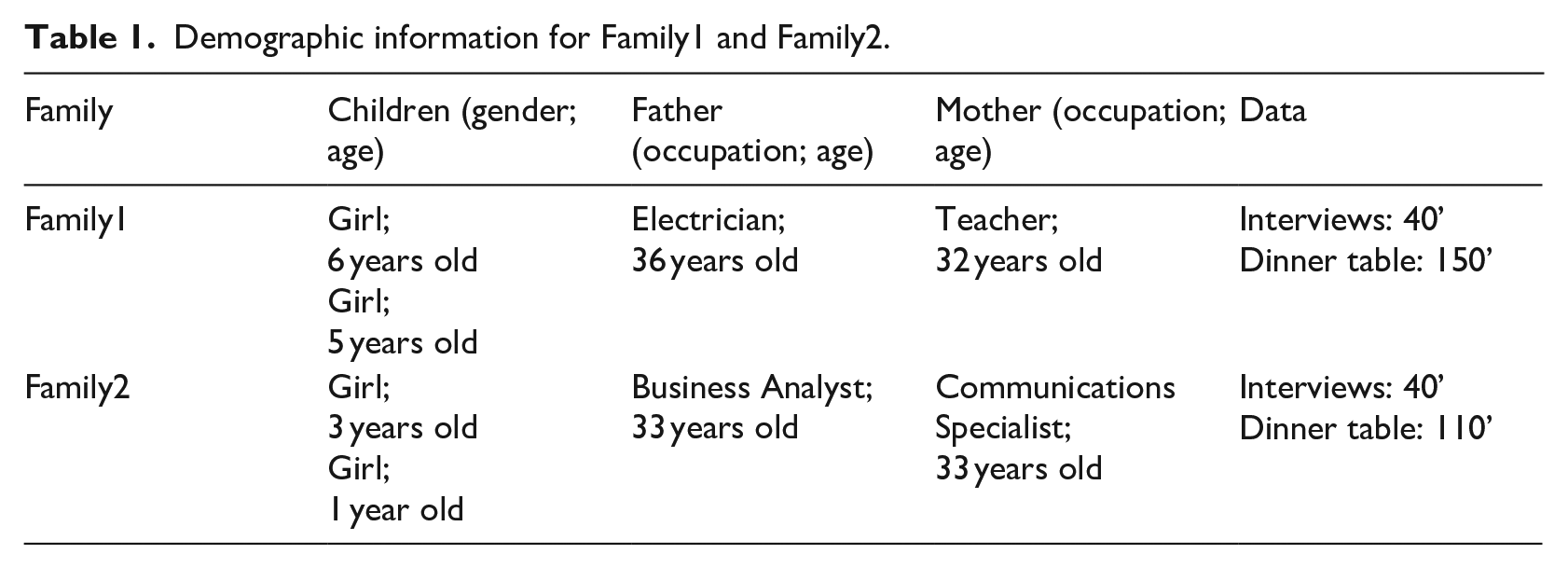
The data used to address our research questions consist of caregivers’ responses to audio-recorded metalinguistic interviews (RQ1), and of self-recorded audio and video of family dinner table conversations (RQ2) for two families selected from a larger corpus of family data from the Brabantic dialect region, located in the center of Flanders (see also AUTHORS 2016, 2021). We juxtapose data for caregivers from the two families listed in Table 1, as a pilot study seemed to showcase interesting oppositions in the interplay between language regard and emotion in these caregivers’ metalinguistic interviews. As can be seen in Table 1, the mother of each family has an occupation where strong communication skills and/or knowledge of Standard Dutch is required, which could impact the mother’s norm orientation (see “Discussion”). Furthermore, in an attempt to reduce SES-differences between the families, at least one parent per family has at least a BA degree.
Demographic information for Family1 and Family2.
The interview data, which forms the basis for addressing RQ1, were collected after the recordings of the family’s spontaneous speech (see below) and consist of one metalinguistic interview per caregiver. These interviews, which are audio-only recordings, were conducted by students enrolled in the final year of a bachelor in linguistics program. The interviewers were native speakers of Dutch who conducted the interview as part of their linguistics research training. They were trained to conduct semi-structured interviews following an interview guideline. Specifically, the caregivers were asked a series of questions about their knowledge of language variation in Flanders, about their own linguistic behavior and competencies, and about language use within the family, including evaluations of their partners’ language use and any distinction between child-directed speech and adult-directed speech. Questions on language regard were asked, with the goal of observing how emotion surfaces in discussions about language regard, without explicitly probing for it. In this way, we hope to have avoided an overly conscious orientation to and replication of the emotions that typically circulate in Flemish society regarding language varieties.
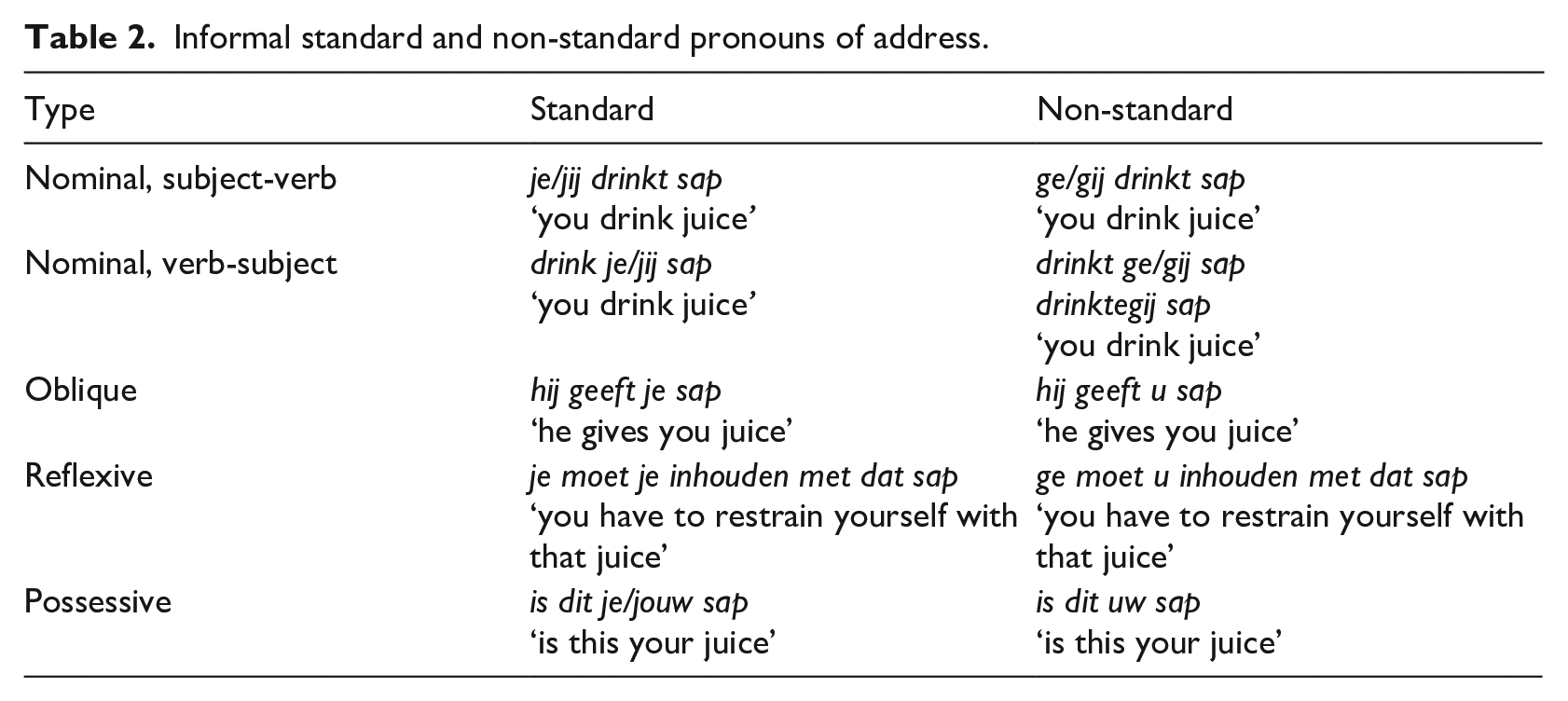
The self-recorded dinner table conversations that are used for RQ2, consist of over 4 hours of recordings of spontaneous speech during mealtime. Different sociolinguistics variables were present in the data, but we chose to focus on second-person singular pronouns (nonstandard gij/u/uw and standard jij/jou/jouw, e.g., ge speelt vs. je speelt “you play,” N = 1004), given the high degree of awareness language users have of this alternation (AUTHORS 2016, pp. 39-40; Ghyselen & De Vogelaer, 2018; Vandekerckhove, 2005).
Methods
Given the prominence of RQ1 for our analyses, we provide a detailed description of the bottom-up discursive analyses of the emotions found in the interview responses. Next, we additionally provide some background to the fairly straightforward variationist approach followed for RQ2.
Qualitative analysis of interview excerpts (RQ1)
In addressing RQ1, we drew on the conversation analytic framework. This means that we consider how emotions and emotional stances are created in situ over the course of a conversation, and sometimes co-constructed between interlocutors (Peräkyla & Sorjonen, 2012a, 2012b), in this case the caregiver and the interviewer(s). Emotional stances are public positions that speakers take up to display certain emotional evaluations of the topic at hand (Peräkyla & Sorjonen, 2012b, pp. 4–5). In our case study, we are looking for instances where Flemish caregivers display emotional stances when discussing their language regards, as a means to gain insight into participants’ emotions without inquiring about them directly.
There are a number of resources that speakers use to construct emotion in interaction. These can be divided into three basic categories, namely verbal, vocal and nonvocal resources (Peräkyla & Sorjonen, 2012b, pp. 6–9). As we will be analyzing audio-recorded interviews, we will only focus on the former two:
Verbal cues include certain syntactic constructions (active or passive voice), lexical choices (use of specific adjectives), and quantifiers or intensifiers, that may signal particular emotional stances in different contexts (Peräkyla & Sorjonen, 2012b).
Vocal cues include phonetic and prosodic resources. Lengthening of a sound or changes in pitch can, for instance, be important indicators of emotional stances. Prosodic resources often have a stronger effect on stance than lexical choices alone, especially when they occur in particular places in the sequential organization (Goodwin et al., 2012). Nonverbal vocal cues like laughter (Haakana, 2012) or sighing (Hoey, 2014) also give indications of emotional stances.
In determining which emotions are constructed in speech, it is important to appreciate the highly context-sensitive nature of these resources (Couper-Kuhlen, 2012) and the potential disconnect between inner and outer emotions. In addition, rather than considering “single resources in isolation,” it is by analyzing “the cooccurrence of resources from different modalities and levels of modality” that “emotional stances and their intensity” are displayed (Peräkyla & Sorjonen, 2012b, p. 9). For example, a speaker may use a nonverbal vocal cue, like laughter (Haakana, 2012) or sighing (Hoey, 2014), in addition to a number of verbal cues, and these, together, may then express one complex emotion or emotional stance like shame. Therefore, we aim to perform holistic analyses that capture the nuances of the interview responses by scrutinizing how verbal and vocal cues together, in their particular context of use, construct a certain emotional stance or the expression of a non-emotional state (indifference).
Quantitative analysis of dinner table speech (RQ2)
Tying in with earlier work in developmental sociolinguistics (see, for example, Smith et al., 2013), the quantitative analysis targets potential style-shifts in Family1 and Family2 comparing the relative presence of standard and non-standard pronouns of address in child-directed speech and adult-directed speech. The style-shifts were measured for mother and father separately. Table 2 provides an overview of the address forms that are considered standard and non-standard in the informal context of family dinner table conversations (compare Zenner & Van De Mieroop, 2021, and see De Vogelaer, 2008; Debrabandere, 2005 for more details). The proportion of standardness was calculated following the principle of the sociolinguistic variable (cp. Chevrot et al., 2000) by dividing the number of standard pronouns by the total number of pronouns of address, per speaker (mother, father) and per addressee style (adult-directed, child-directed). Significance of effects was gauged on the absolute frequencies through Chi² tests. In case of significance, effect sizes were measured through Cramer’s V. This test provides an indication of association strength, with an output between 0 (no association) and 1 (strong association).
Informal standard and non-standard pronouns of address.
Results
This section presents the findings for the two juxtaposed families separately. For each family, we first focus on the emotional mix that surfaced in the interviews (RQ1), which we illustrate with crucial interview excerpts. 3 Then we give a brief overview of the findings of the parents’ language use in practice (RQ2). The discussion section of our paper will bring these findings together (RQ3).
Family1
Emotions in interviews
One of the most prominent emotions expressed in the interviews with Family1 with regard to FLP is Excerpt 1
In this excerpt, the father first temporally distances himself from any potential plan to have a norm-oriented FLP, as we see by the use of the repeated phrase ‘helemaal in t begin’/ way in the beginning (lines 1 and 6). He creates further distance from an explicit discussion of FLP by pausing a number of times, thus signaling a hesitancy about how to answer the question. Furthermore, he expresses additional detachment from the topic by downplaying the significance of this discussion by means of several hedges and mitigators (‘wel eens iets’/ once. . .something, line 2; ‘een beetjen’/a little, line 4 ‘eens’/once, line 7). These markers all signal the lack of importance he attaches to the implementation of a FLP in this interview.
Interestingly, when discussing the topic in more detail, it is on the one hand framed as obvious (line 3) for the father that there should be a little bit of attention to a FLP, and, on the other hand, that the orientation of this FLP should be in the direction of more normative language varieties like SD, from which the father simultaneously distances himself. This is done, first, by briefly pausing before and after the term ‘juiste taalgebruik’/right language use (line 5), thus separating it from the rest of his turn. Second, he uses mincing pronunciation to indicate a view that prestige varieties are normative and therefore distant from his typical speech. Finally, he also later latches on a single laughter particle after repeating the phrase way in the beginning, which signals the double voicing in this pronunciation shift. These linguistic resources invoke a view of prestige varieties as a normative issue rather than valuable linguistic tools, which are presented as to a certain extent self-evident for the Flemish context, and thereby the father also suggests conscious indifference toward the topic of FLP.
In her interview, the mother largely mirrors the father’s distant, indifferent position toward prestige varieties and actually also expresses a highly similar interpretation that such varieties are normative but not necessarily essential. However, she takes this a step further and expresses some
Dinner table speech
In Table 3, we can see that in the spontaneous speech at the dinner table, both caregivers used nonstandard pronouns the majority of the time in both adult- and child-directed speech. The father used almost no SD pronouns, and the difference between his adult-directed and child-directed speech was not significant (p for Fisher exact > 0.05), while the mother used more SD in her CDS, and the difference with her ADS was significant, X² (df = 1, N = 219) = 17.18, p < .001. A Cramer’s V test showed that the effect size for the mother’s results was somewhat large (0.293).
Standard and nonstandard pronouns in CDS and ADS for Family1.
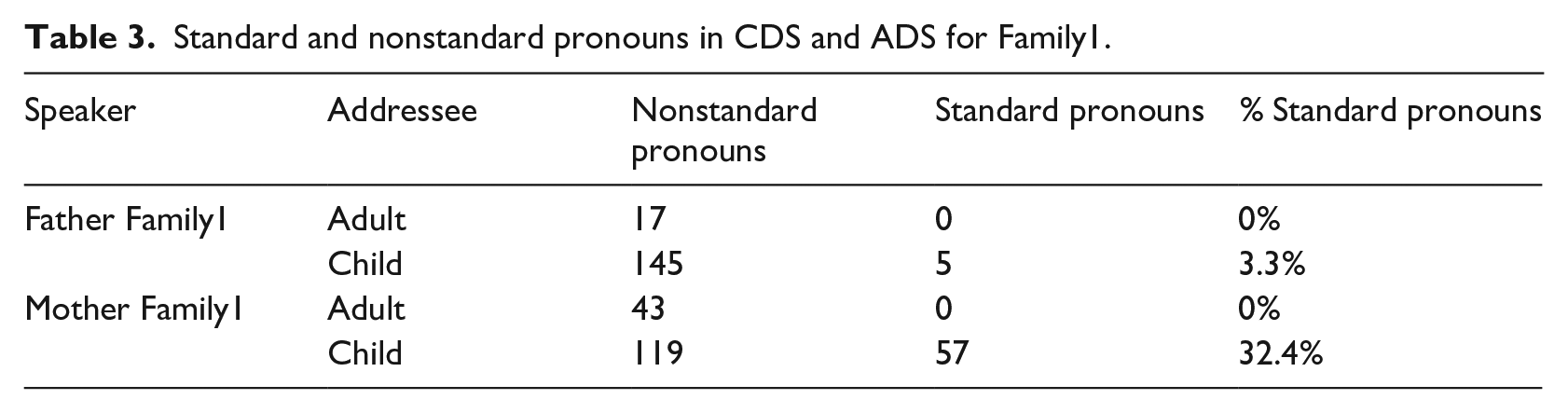
This thus shows that the father’s indifference toward SD is nicely reflected in his actual language practices, while the mother’s indifference, enhanced by her dialect pride, seems to be countered by her clear attempts to “clean up” her pronouns when speaking to the children.
Family2
Emotions in interviews
Family2 contrasts with the previous family’s emotional profile, showing a fairly different range of emotions, but also in the sense that the mother and the father in Family2 express contrasting emotions. Turning to the mother first, she seems to express primarily shame and insecurity when discussing the FLP, as in Excerpt 2, where she is asked about what she thinks of the different language varieties spoken in Flanders: Excerpt 2
When initially asked if she avoids speaking dialect with children, the mother first sighs in line 7 and starts to say no I try before the interviewer interrupts her to continue the question and add something about talking like people on tv do. Due to this interruption, she repeats what she was about to say before, putting emphasis on the word try this time (line 7), which indicates an intention to speak more standard but also an insecurity about whether she actually does or is able to. She then elongates the vowel in the word also in line 8 (Goodwin et al., 2012: 29) to sketch a counter-intentional scenario (what she does not want her kids to do), before trailing off at the end of the phrase in line 9, thus leaving this scenario unuttered. However, she does express a desire to not use dialect at home in lines 10–12, but indicates that she is insecure about her ability to do so by putting stress on the word self-evident in the negative construction in line 11. Also, the repeated use of the word ‘probeer’/try (lines 12 and 14)—bringing the total number of uses of the word try in this excerpt to 4—indicates once more a very
Furthermore, the feeling of shame also emerges here, as through the phrase for her in line 15, she evokes the notion that a good parent should try to speak prettier (line 16) as much as possible around children. This is then contrasted with an expression of failure in this respect (line 16) that is mitigated by the ensuing laughter (line 17), but which, together with the closing sigh, further indicate
When asked later on in the interview about her partner’s language use, the mother states that she believes that he will also ‘try to pay attention to it,’
6
but how this will be ‘in the same category of wishful thinking’
7
as herself. As such, she projects similar feelings of shame and insecurity upon her husband. Yet, when this topic is discussed with the father, we see quite a different range of emotions occurring, which emerge quite explicitly in the account in Excerpt 3a of the lessons he had at school that specifically focused on standard versus nonstandard words: Excerpt 3a
Although this is not a topic the father initiated himself, as it comes from a very explicit question about his experience with taalzuivering (“language purification”) at school, it is clear that the father has a keen interest in this topic as he begins a long monologue about his experiences. His long narrative follows Labov and Waletzky’s (1967) canonical narrative structure, starting with an orientation (lines 1-3), where the father orients the conversation toward his high school Dutch teacher. In line 3, he begins the complicating action, which focuses on the section of this teacher’s class that dealt with “correct” language use, in which he quickly moves to listing examples of standard-nonstandard word pairs that he learned in school (lines 6-7). The fact that he still remembers these words and other details like the A4 pages they were printed on (lines 11-12) is used to demonstrate his thorough knowledge of SD, which already hints at his Excerpt 3b
Confidence really starts coming to the fore explicitly through the word choice and prosodic stress from line 14 onward, in the resolution of the story. There, he states that these lessons on standard language from almost two decades ago have really stuck with him (‘en sindsdien let ik daar ook wel op’/ and since then I really pay attention to that). He is then asked if adhering to language norms is important to him (line 15), which initiates the evaluation, where he explains in very certain terms that knowing and speaking SD is important, even if he feels some dialect pride (lines 17-18). Interestingly, the father’s confidence is further underlined by his—rather unexpected in this context—expression of dialect pride (lines 19-20) where he refers to the fact that he would rather be speaking dialect but chooses not to. It is exactly by presenting his use of SD as a choice that he makes despite his preference for dialect, that he strongly expresses his confident stance in this respect.
This is further underscored in lines 20-25, where he begins a new and contrasting hypothetical narrative (Van De Mieroop, 2021), where he expresses his disapproval of people who fail to speak SD consistently and sincerely. He first uses reported speech (Buttny, 1997) to imitate people who try and fail to speak SD, thereby painting them as ignorant, using the emblematic nonstandard word ‘weeral’/again, which he recalled explicitly in line 6. He follows this imitation with one of the most explicit references to emotion in this data set- (‘da(t) wringt dan bij mij’/then that doesn’t sit right with me in line 26). This annoyance with the false confidence of others thinking they are using SD the right way while using the “wrong” words shows the intensity and certainty of his confidence. This stands in contrast to his wife’s insecurity about FLP, and the feelings she projects on her husband. Thus, though both caregivers seem to agree that SD use is important in their FLP, the father feels confident about his ability to speak SD, while the mother feels the opposite emotion, insecurity, in addition to shame, while anticipating the same from the father.
In Excerpt 4, we see how the conflict between the mother’s insecurity and shame and the father’s confidence contributes to the emergence of another emotion related to the SD-based FLP.
Excerpt 4
It is noticeable that the mother takes a question about both parents correcting each other and reformulates it from oriented to her own behavior (I in line 3) to that of her husband (Axel in line 7) after the interviewer overlaps and gives in the presence of children as a context where this might happen. Thus, when the question is worded more specifically and the mother has had more time to consider what is being asked, she refers only to the father when she thinks of correcting language. When sketching this situation, the initial laughter (line 6), the pauses (lines 7 and 9) and the emphasis on all in line 9 result in a dramatic effect, adding extra weight to the mother’s description. Her laughter is mirrored by the interviewer (line 11), but then the mother switches to a more serious frame from line 11 onwards to express her annoyance with the father’s habit of correcting in lines 11–12. The choice of the words unbearable and irritating, as well as the prosodic stress on these words (cf. Goodwin et al., 2012: 22), and the double use of the intensifier really, all express and emphasize this feeling of annoyance. It is interesting that she softens the second use of really in line 12 (cf. almost). This may show some awareness of how negative and intensely emotional her word choice is in talking to an unfamiliar interviewer. Nevertheless, the interviewer does primarily appear to notice the negativity in the response (cf. her response in line 13), emically demonstrating that the sensitive nature of this topic is foregrounded.
Interestingly, when this topic arises in the father’s interview, his reaction corroborates the sensitivity of this issue among the caregivers in this family. In particular, the father claims that when he corrects the mother, he says, ‘I get the word know-it-all hurled at my head’, 11 which, through the verb choice clearly reflects the mother’s feelings of annoyance. Finally, the lexical choice for the particular reproach — viz., know—it—all — also reinforces the confidence expressed by the father before in his competence regarding correct language use. So, by invoking this particular reproach, he is also, in a way, agreeing with the notion that he, in fact, knows it all.
Dinner table speech
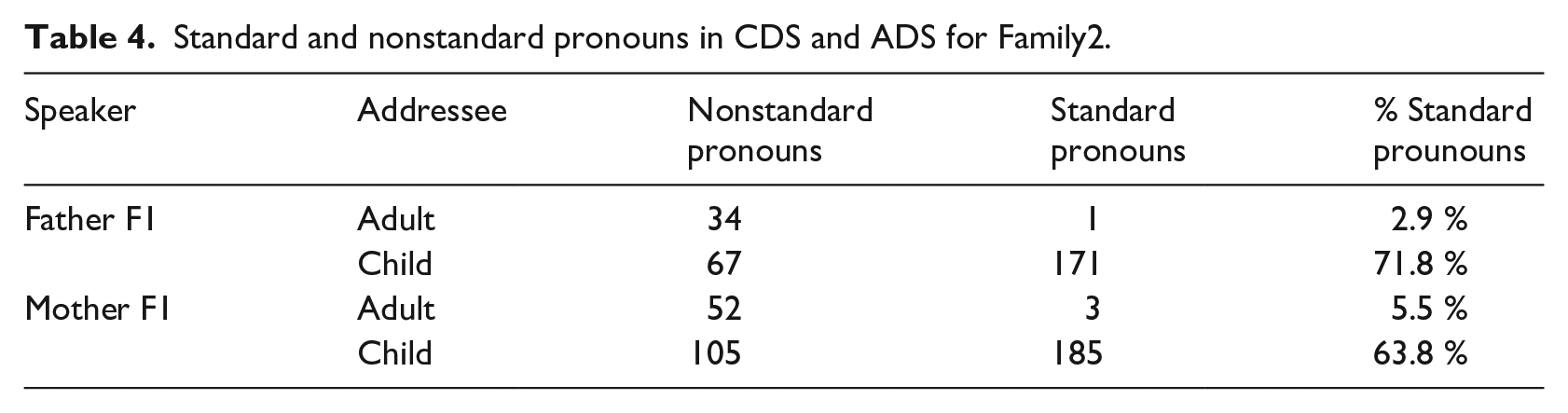
When we turn to see how these caregivers’ contrasting emotions toward a norm-oriented FLP play out in practice, the language usage data in Table 4 instead show striking similarities between the two caregivers. There were far more SD pronouns in this family than in the previous family, particularly in child-directed speech. The mother used significantly more standard pronouns when speaking with children (χ²(df = 1, N = 345) = 61.12, p < .0001), with a large effect size (Cramer’s V = 0.429). The same is true for the father (χ²(df = 1, N = 273) = 59.38, p < .0001; Cramer’s V = 0.478). This reflects the fact that both caregivers have rather strong views on FLP and the importance of SD, even though they are subject to fairly contrasting emotions.
Standard and nonstandard pronouns in CDS and ADS for Family2.
Discussion and conclusion
The macro-level policy debate on Belgian Dutch and associated emotions seem to affect micro-level policy in these two families in quite different ways. Both caregivers in Family1 mostly expressed pride in local nonstandard varieties and (sometimes deliberate) indifference toward the macro-level debates and a strict, norm-oriented FLP, despite the mother using more Standard Dutch pronouns. In Family2, we instead found a conflict between the mother’s shame and insecurity and the father’s confidence, which surprisingly resulted in relatively unified switch patterns, where both caregivers used far more standard pronouns and more extensive adaptations in child-directed speech.
There are a few ways this research could be expanded upon in the future to provide more support for these initial findings. First, interview recordings that contain video would allow for further contextualizing responses using observable visual phenomena like gesture and eye gaze. Second, it would be useful to study more than just one highly salient sociolinguistic variable in the quantitative analyses. Third, it could be revealing to delve (even) deeper into the personal history of caregivers with language variation and standardization, to better grasp the similarities and differences in ideologies found in this paper. Fourth, it could examine more families, as this case study only dealt with two families that met specific criteria.
Nevertheless, the juxtaposition of the two families presented in this study already reveals some interesting patterns. First, we attested each of the emotions we anticipated to find, pride, shame, confidence, and insecurity, alongside clear expressions of a lack of emotion (indifference), with annoyance or irritation appearing as additional emotions. When comparing mothers and fathers, both harmony (Family1) and disharmony (Family2) between caregivers is attested. The multivarietal Belgian Dutch setting thus seems to engender similar positive, negative, and indifferent emotional stances toward certain language practices in FLP as multilingual situations (cf. Obojska, 2018 and del Puy Ciriza, 2019) and hence seems to be a critical site where policies are negotiated, as suggested by Curdt-Christiansen and Gao (2021). These similarities can be linked up with caregivers’ description of the Belgian Dutch context in diglossic rather than diaglossic terms. In the interviews, parents typically distinguish between separate L- and H-varieties (Auer, 2011), steering clear of the diaglossic gray area in between. As such, clear parallels can arise in caregivers’ reflections in multivarietal and multilingual contexts. More research is of course needed to fully grasp caregivers’ perceptions of the Belgium Dutch stratum and of the features they associate with the varieties they identify (though see Lybaert, 2014, and Ghyselen & De Vogelaer, 2018), and to better understand the origin of the different ideologies and emotions reflected in both the interviews and the actual linguistic practices. For one thing, it appears that schooling leaves important traces on ideologies and emotions for the father of Family2, and it might also further help explain the stronger norm orientation of the mother of Family1, who is a teacher. 12
In methodological terms, our findings demonstrate the value of using data triangulation for FLP research. Without the interview data, we would not be able to uncover caregivers’ metalinguistic reflection on their child-directed speech, and without studying the actual speech, we would not have been able to uncover if caregivers’ behavior in practice coincided or contrasted with their interview responses. Crucially, where some caregivers show remarkably similar patterns in either interview or usage data, the comparison of both reveals differences for other caregivers.
We hope these promising insights serve as an incentive for future studies, further illuminating the way caregivers inherit, alter and/or transmit emotions and ideologies in complex multilingual and multivarietal language situations.
Footnotes
Declaration of conflicting interests
The author(s) declared no potential conflicts of interest with respect to the research, authorship, and/or publication of this article.
Funding
The authors disclosed receipt of the following financial support for the research, authorship, and/or publication of this article: from FWO Flanders for the research presented in this article (G072819N).
