



Abstract
Objectives:
Although prior research has found that vocabulary size and speed of lexical access in toddlerhood predict language development later in childhood, whether relations are significant appears to depend on differences across studies in task and participant characteristics. The current study expands on these findings by comparing the relative predictive utility of a direct measure of vocabulary size and two measures of speed of lexical access to later vocabulary development in simultaneous bilingual children.
Methodology:
Participants included 32 French-English bilingual children in a longitudinal cohort study tested at 23 months, age 3, and age 4. At 23 months, children completed a two-alternative forced-choice measure of vocabulary from which we coded decontextualized receptive vocabulary, and speed of lexical access operationalized as visual response latency and haptic response latency. At ages 3 and 4, children completed a standardized receptive vocabulary assessment.
Data and Analysis:
We examined the relation between 23-month predictors and outcomes using correlational and regression analyses.
Findings/Conclusions:
Decontextualized vocabulary at 23 months predicted vocabulary outcomes at ages 3 and 4. Visual response latency predicted vocabulary at age 3, but not age 4. Haptic response latency predicted vocabulary at age 4, but not age 3. Neither vocabulary nor latency was significant when controlling for the effects of the other predictors.
Originality:
This is the first study to investigate the relation between multiple direct measures of vocabulary and lexical access and language outcomes in bilingual children.
Significance/Implications:
This study contributes to our understanding of toddler language measures and how demand characteristics interact with participant characteristics to influence the roles of these measures in predicting later outcomes.
Limitations:
Given the small sample size and limited outcome measures, results should be interpreted with some caution and used to guide future research on early predictors of long-term vocabulary development in bilingual children.
Introduction
Across the second year of life, children rapidly learn new words and become more efficient at processing the meanings of known words (referred to here as “speed of lexical access” or “lexical access”; DeAnda et al., 2018; Fernald et al., 1998, 2006; Hendrickson et al., 2017; Hurtado et al., 2008; Legacy et al., 2018; Peter et al., 2019). Vocabulary size and speed of lexical access are also related such that children who know more words also access the meanings of known words more quickly (Beaudin et al., 2024; DeAnda et al., 2018; Fernald & Marchman, 2012; Fernald et al., 2006; Hendrickson et al., 2015, 2017; Hurtado et al., 2008, 2014; Legacy et al., 2016, 2018; Marchman et al., 2010, 2020; Marchman & Fernald, 2008; Poulin-Dubois et al., 2013; Smolak et al., 2021). Additionally, both vocabulary and lexical access predict language and cognitive outcomes later in childhood (Beaudin et al., 2024; Friend et al., 2018, 2019; Marchman et al., 2020; Marchman & Fernald, 2008; Smolak et al., 2021; Smolak et al., 2022). However, there are discrepancies across studies: whether findings are significant depends on participant characteristics such as participants’ age at testing, the length of time between measurement and outcome, and the tasks used to measure vocabulary and lexical access. The goal of the current study is to expand on recent research exploring the effect of task demands on the observed relationship between vocabulary, lexical access, and outcomes by comparing prediction from early decontextualized receptive vocabulary size on a direct two-alternative forced-choice measure and two measures of speed of lexical access to later receptive vocabulary development in a sample of simultaneous bilingual children.
Relation Between Vocabulary and Lexical Access
A large body of work has found a relationship between speed of lexical access and vocabulary (Beaudin et al., 2024; DeAnda et al., 2018; Fernald & Marchman, 2012; Fernald et al., 2006; Hendrickson et al., 2015, 2017; Hurtado et al., 2008, 2014; Legacy et al., 2016, 2018; Marchman et al., 2010, 2020; Marchman & Fernald, 2008; Peter et al., 2019; Poulin-Dubois et al., 2013; Smolak et al., 2021). However, there are discrepancies in findings both within and across studies. In a seminal longitudinal study, Fernald and colleagues (2006) found that speed of lexical access, operationalized as the latency for children to shift their gaze from a distractor to a target image upon hearing the target word in a looking-while-listening paradigm, was concurrently associated with parent-reported receptive vocabulary at 15 months and expressive vocabulary at 25 months, but not 15, 18, or 21 months. Lexical access at 25 months, however, was associated with growth and acceleration in expressive vocabulary over time from 15 to 25 months. Similarly, Peter and colleagues (2019) found that speed of lexical access at 19 months (but not 15 or 31 months) was associated with parent-reported expressive vocabulary from 19 to 37 months. Lexical access at 19 months was also associated with acceleration in vocabulary over time from 19 to 25 months, but only for children with relatively smaller vocabularies.
A similar issue has been found in studies operationalizing speed of lexical access as latency to touch a target image. DeAnda and colleagues (2018) found that lexical access and directly-assessed decontextualized receptive vocabulary were associated concurrently at 16 and 22 months in monolingual and bilingual children. Legacy and colleagues (2016, 2018), using the same paradigm, found significant concurrent relationships at 16 months in monolingual children and in bilingual children’s non-dominant, but not dominant, language. By 22 months, all concurrent correlations were significant. Lexical access at 16 months predicted vocabulary at 22 months in the bilingual sample, but not the monolingual sample.
In summary, although speed of lexical access and vocabulary are generally related, whether the relationship is significant appears to depend on factors including participant age, sample characteristics (e.g., monolingual or bilingual), the length of time between the measurement of vocabulary and lexical access (correlations are stronger when both are measured concurrently than when one is used as an outcome measure), and the tasks used to measure lexical access and vocabulary (see Smolak et al., 2021, 2022). Importantly, although both vocabulary and lexical access predict language and cognitive outcomes later in childhood (Beaudin et al., 2024; Friend et al., 2018, 2019; Marchman et al., 2020; Marchman & Fernald, 2008; Smolak et al., 2021, 2022), the strength of these relationships also seems to vary by participant and task characteristics (Beaudin et al., 2024; Friend et al., 2018, 2019; Smolak et al., 2021, 2022). We review differences in task demands and how they may influence these observed relationships below.
Differences in Measurement Characteristics
In looking paradigms, toddlers search the visual field for a match to an auditory stimulus with relative automaticity (Fernald et al., 1998; Golinkoff et al., 1987). In contrast, touch paradigms involve not only word recognition but also offline decision-making processes and motoric control. Motor skills are associated with executive functions in young children; therefore, touch responses may involve a bigger cognitive load than eye gaze (e.g., Gottwald et al., 2016). Different paradigms may also tap word representations of different strengths. For example, Hendrickson and colleagues (2015, 2017) found that looking latency and touch responses in a two-alternative forced choice task converged when toddlers touched the target and when they did not touch either image: visual latencies were significantly faster on target-touch trials than on no-touch trials. However, responses diverged when children touched the distractor: latencies were as quick on distractor-touch trials as on target-touch trials. The authors discussed these findings in the context of the graded representations framework (Munakata, 2001), which proposes that knowledge is graded in nature and that some tasks (e.g., looking tasks) tap weaker knowledge representations than other tasks (e.g., touching tasks). Weak word representations may prompt a look toward the target image, but a stronger representation is needed to overcome the prepotent response for children to touch the image they were looking at first (i.e., the distractor). In summary, the latency of visual response may index automatic processing of word knowledge along a continuum of representation strengths, whereas the latency of touch response may index processing of words with relatively stronger representations, along with decision-making processes and executive control.
Smolak and colleagues (2021) found that individual differences in visual versus touch measures were differentially associated with outcomes. Specifically, directly-assessed decontextualized receptive vocabulary and speed of lexical access assessed via visual response latency (VRL) at 22 months predicted receptive vocabulary outcomes at ages 3 and 4, but speed of lexical access assessed via haptic response latency (HRL) did not. The authors suggested that variance in the HRL measure attributable to factors other than speed of lexical access limited its predictive utility to later vocabulary, but that it may predict other measures of language and cognition. In a follow-up study, Smolak and colleagues (2022) found that HRL at 22 months was not associated with any language-based outcome from ages 3 to 5, but it was correlated with executive function at age 3 (but not age 4 or 5). Given the association with executive function, HRL may have greater predictive utility for children with greater skill in executive functions and therefore more control over motoric responses. Beaudin and colleagues (2024) tested this hypothesis by examining the link between HRL and later receptive vocabulary in a sample of children with exposure to a second language, as bilingual children have been reported to have greater inhibitory control skills than monolinguals (e.g., Barac & Bialystok, 2011; Beaudin & Poulin-Dubois, 2022; Crivello et al., 2016; Poulin-Dubois et al., 2011; Sorge et al., 2017, but cf. Lowe et al., 2021; Paap et al., 2015). They found that HRL and receptive vocabulary at 23 months were both associated with later receptive vocabulary at age 3 but not age 5. In the current study, we extend this work by comparing prediction from early vocabulary and two measures of lexical access in bilingual children.
Current Study
The goal of the present study is to compare prediction from decontextualized receptive vocabulary and speed of lexical access assessed via HRL and VRL to later receptive vocabulary in bilingual children. This study is informed by findings from a monolingual sample that vocabulary and VRL predicted later vocabulary development, but HRL did not (Smolak et al., 2021) and findings of an effect of HRL on later vocabulary in a sample of children with exposure to a second language (Beaudin et al., 2024). The current study expands on these findings in two ways. First, we include a measure of lexical access assessed via VRL, which has been shown to be a stronger predictor of outcomes than HRL in monolingual children (Smolak et al., 2021). Second, we include a sample of bilingual children with a more balanced and restricted profile of language exposure. Given some evidence of links between vocabulary and lexical access primarily within, but not across, languages (e.g., Marchman et al., 2010), we conduct analyses within children’s dominant language only. We hypothesize, consistent with prior work, that both vocabulary and VRL at 23 months will predict vocabulary outcomes at ages 3 and 4. We further hypothesize that HRL will predict vocabulary at age 3, but not age 4, given findings of an association between HRL and vocabulary at age 3 but not age 5 in a similar sample (Beaudin et al., 2024). Finally, we hypothesize that 23-month vocabulary will predict vocabulary outcomes when controlling for the effect of HRL and VRL, but that HRL and VRL will not predict outcomes when controlling for the effect of vocabulary, consistent with Smolak et al. (2021).
Method
Participants
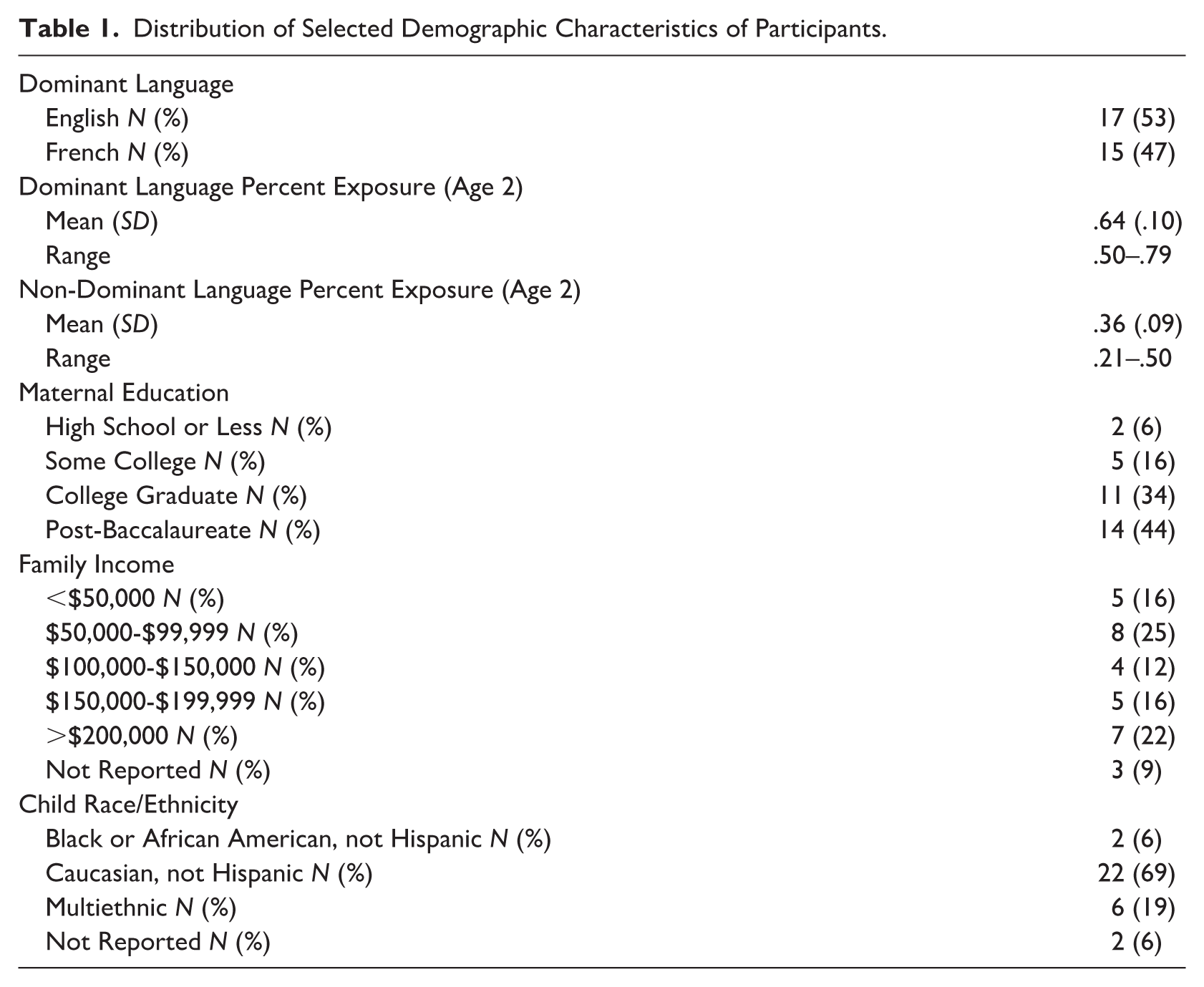
The current sample is comprised of simultaneous French-English bilingual children who were part of a larger, multi-institutional longitudinal cohort study consisting of six waves of data collection. Participants were recruited at 16 months of age through birth lists provided by a governmental health agency in a large bilingual city in Québec, Canada. All participants were born full-term and were typically developing at the time of recruitment. Bilingual status was defined as exposure to a second language at least 20% of the time from birth and was determined at each visit via parent report. Children exposed to a third language were included if exposure was less than 10%. A total of 72 children were recruited, but 40 were excluded due to becoming monolingual or multilingual (N = 12), missing data (N = 6), fussiness (N = 4), or attrition (N = 18). The final sample consisted of 32 children (13 girls) at 23 months of age (M = 23 months;13 days, range = 20;27–25;12), 30 children (12 girls) at 3 years (M = 36;13, range = 34;15–38;27), and 25 children (11 girls) at 4 years (M = 49;13, range = 46;27–52;3). See Table 1 for demographic data.
Distribution of Selected Demographic Characteristics of Participants.
Measures
Language Exposure Assessment Tool
Participants’ relative exposure to English and French was determined via parent report using the Language Exposure Assessment Tool (LEAT; DeAnda, Bosch, et al., 2016). The LEAT gathers information on individuals who regularly interact with the child and the number of hours those individuals spend talking directly to the child and being overheard by the child in each language per day. Percent exposure is calculated using the hours of exposure to each language over the course of the child’s life. Internal consistency of the LEAT is excellent, and percent exposure is associated with vocabulary size in bilingual toddlers (DeAnda, Bosch, et al., 2016). The child’s dominant language, which we refer to here as L1, was the language in which the child had the greatest relative exposure.
Computerized Comprehension Task
The Computerized Comprehension Task (CCT; Friend & Keplinger, 2003, 2008) is a two-alternative forced choice measure of decontextualized vocabulary comprehension. The child was seated on the caregiver’s lap approximately 30 cm from a touch-sensitive monitor, and the experimenter was seated to the side. The caregiver wore blackout sunglasses and headphones to prevent parental interference. A camera situated above the monitor recorded the child’s face, and a camera behind the child recorded touch responses. Each trial began with a blue screen. The experimenter delivered a prompt containing the target word (e.g., “Where is the dog? Touch dog”) in a child-friendly voice and advanced the trial such that two images appeared on-screen shortly after the onset of the target word. The side of the screen on which the target image appeared was pseudorandomized across trials with the constraint that it did not appear on the same side on more than two consecutive trials, and it appeared with equal frequency on each side. The images remained on screen for 7 s or until the child touched the target. A target touch yielded auditory feedback (e.g., the sound of a dog barking), while a distractor touch yielded no feedback.
The 41 words on the CCT were chosen from the MacArthur-Bates Communicative Development Inventories: Words and Gestures form (MCDI; Fenson et al., 2007) and included a mix of nouns, verbs, and adjectives. There were approximately equal numbers of easy (comprehended by >66% of 16-month-olds), moderate (33%–66%), and difficult words (<33%) based on MCDI normative data (Frank et al., 2017). The French version of the CCT is an adaptation of the English version using French language norms (Kern, 1999; Trudeau et al., 1999). Both versions of the CCT have moderate test–retest reliability and short-term stability across a 4-month time span and convergent and predictive validity in both monolingual and bilingual children (Friend & Keplinger, 2008; Friend et al., 2012, 2018; Friend & Zesiger, 2011; Poulin-Dubois et al., 2013).
CCT Vocabulary
Vocabulary was recorded automatically by the CCT program as the number of touches to the target image.
VRL Coding
Coding was completed using ELAN (Lausberg & Sloetjes, 2009; Max Planck Institute for Psycholinguistics, 2024) with videos from the child’s face and touch response, and an audio waveform extracted from the video of the child’s face. A first coder annotated the onset and offset of the first instance of the target word (e.g., “Where is the DOG?”) and the side of the screen the target image appeared on. A second coder, blind to the target word and side, coded the frame in which the images appeared and where the child was looking (left, right, away, or out of frame). Approximately 25% of videos were coded for inter-rater agreement. Reliability was calculated for the onset (72% within one frame and 94% within two frames) and offset (72% within one frame and 94% within two frames) of the target word, and visual fixation shifts (84% within one frame and 94% within two frames).
To calculate VRL, consistent with Fernald and colleagues (Fernald et al., 2008), we included only trials on which children were initially fixating on the distractor image. VRL was calculated as the average latency to shift fixation from the distractor to the target image from image onset. Latencies less than 400 ms or greater than 2,000 ms were excluded because short latencies are likely to reflect fixations planned prior to target word comprehension, and fixations further from target word onset are less likely to be driven by the stimulus (Fernald et al., 2008; Hendrickson et al., 2015, 2017). Eight children did not have data for VRL because of technological difficulties.
HRL
HRL was calculated as the average latency to touch the target from image onset and was automatically recorded by the CCT program. As with VRL, trials with latencies less than 400 ms were excluded.
Peabody Picture Vocabulary Test-III and Échelle de Vocabulaire en Images Peabody
Receptive vocabulary at ages 3 and 4 was assessed using the Peabody Picture Vocabulary Test-III (PPVT; Dunn & Dunn, 1997) and the Échelle de Vocabulaire en Images Peabody (EVIP; Dunn et al., 1993) standard scores. The PPVT is an adaptive, standardized measure suitable for individuals ages 2 years and 6 months through adulthood. It was normed on monolingual speakers of English. The EVIP is the French adaptation of the English PPVT and was normed on monolingual French speakers. Internal consistency, reliability, and validity of the PPVT and EVIP are high.
Procedure
Before each wave, caregivers completed the LEAT over the phone. Caregivers provided written informed consent to participate prior to data collection at each wave. Each wave consisted of two visits, one in English and one in French, which were completed 1–2 weeks apart. The order of visits was counterbalanced across participants. At 23 months, children completed the CCT in English and French. At ages 3 and 4, children completed the PPVT and EVIP along with a battery of other language and cognitive assessments. At 23 months, we evaluated CCT vocabulary, VRL, and HRL in the dominant language, which was determined based on parent report of relative language exposure. At ages 3 and 4, because of evidence that parental reports of language exposure were not predictive of language dominance at later ages in this sample (Friend et al., 2018), PPVT vocabulary in L1 was determined based on child performance: the language with the highest PPVT/EVIP standard score was used as L1. See Supplementary Table 3 for additional detail on L1 based on parent report and child performance.
Data Analytic Plan
All analyses were conducted using R version 4.3.2 (R Core Team, 2023) in RStudio 2025.05.1 (Posit Team, 2025). First, we examined zero-order correlations between predictor variables (CCT vocabulary, VRL, and HRL), outcome variables (PPVT vocabulary at ages 3 and 4), and potential control variables (child age, child sex, and maternal education). We then conducted a series of linear regressions. For each outcome timepoint, we constructed (a) an intercept-only model; (b) a model with control variables that were significantly correlated with outcomes; and (c) models with predictors that were significantly correlated with outcomes both alone and in combination. Nested models were compared using chi-likelihood ratio tests. Standardized regression coefficients were calculated using the lm.beta package (Behrendt, 2023). Missing data were deleted case-wise, and the sample size for each analysis is noted in the results.
Results
Descriptive Statistics and Zero-Order Correlations
Descriptive statistics and zero-order correlations are reported in Supplemental Table 1. All variables were approximately normally distributed. VRL was significantly correlated with PPVT vocabulary at age 3. There were no other significant correlations. Examination of scatterplots between predictor and outcome variables revealed 3 bivariate outliers, which were subsequently removed from analyses (see Supplemental Material for scatterplots and additional information on outliers). Descriptive statistics and zero-order correlations with outliers removed are reported in Table 2. No control variables were significantly associated with outcomes. CCT vocabulary was correlated with PPVT vocabulary at ages 3 and 4. VRL was correlated with PPVT vocabulary at age 3 but not age 4. Finally, HRL was correlated with PPVT vocabulary at age 4 but not age 3.
Descriptive Statistics and Zero-Order Correlations With Outliers Removed.
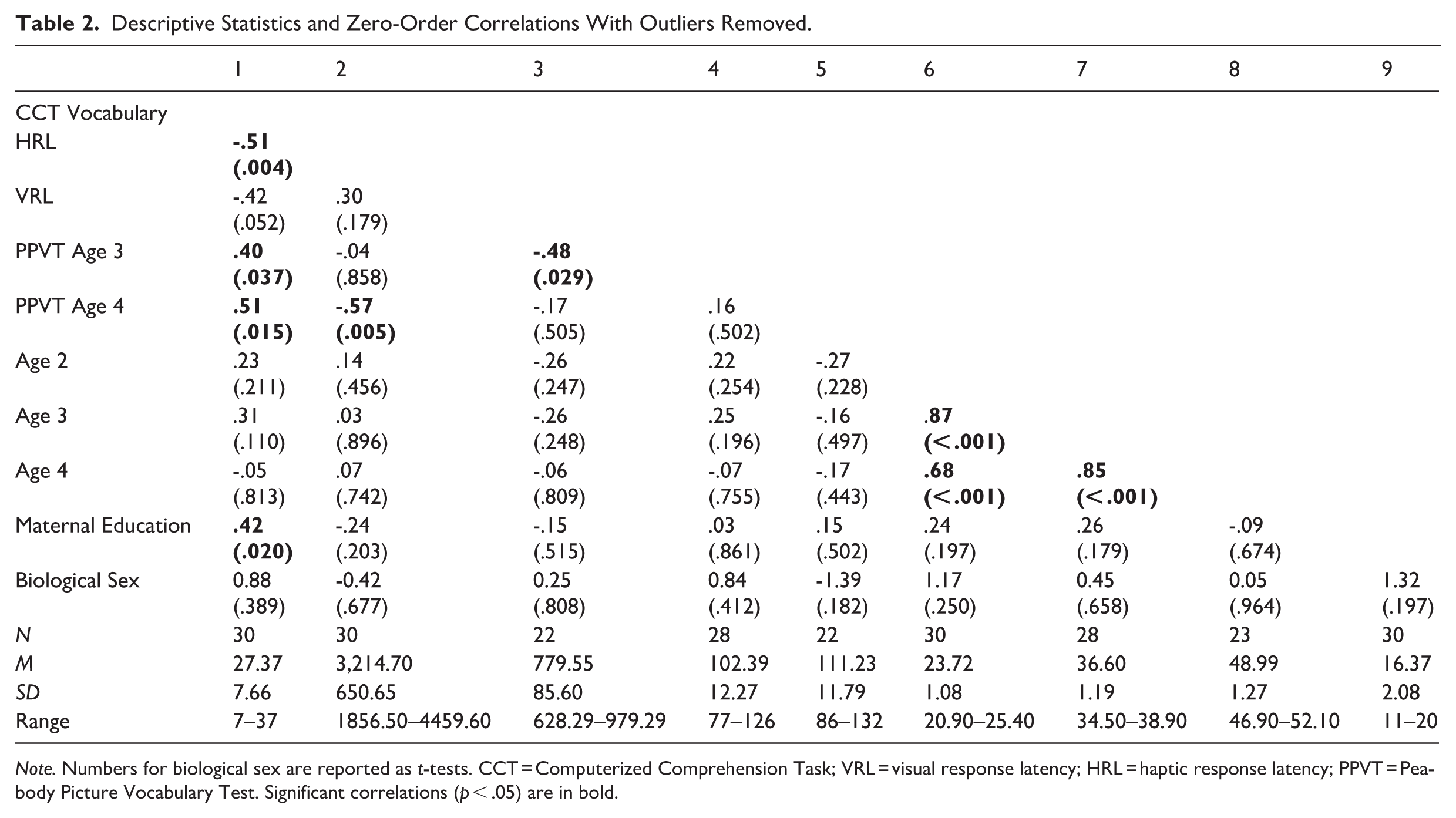
Note. Numbers for biological sex are reported as t-tests. CCT = Computerized Comprehension Task; VRL = visual response latency; HRL = haptic response latency; PPVT = Peabody Picture Vocabulary Test. Significant correlations (p < .05) are in bold.
Regression Analyses
Predicting Vocabulary at Age 3
In the models predicting PPVT vocabulary at age 3, the addition of CCT vocabulary to the intercept-only model was marginally significant, F(1, 19) = 3.60, p = .07. The addition of VRL to the intercept-only model was significant, F(1, 19) = 5.56, p = .03. When considering models with combinations of predictors, the addition of CCT vocabulary to the model with VRL alone was not significant, F(1, 18) = 1.19, p = .29. The addition of VRL to the model with CCT alone was also not significant, F(1, 18) = 2.85, p = .11. Therefore, while both CCT vocabulary and VRL independently predicted PPVT vocabulary at age 3, neither contributed significant unique variance when accounting for the other. See Table 3 for model parameters.
Parameters for Models Predicting PPVT Vocabulary at Age 3.
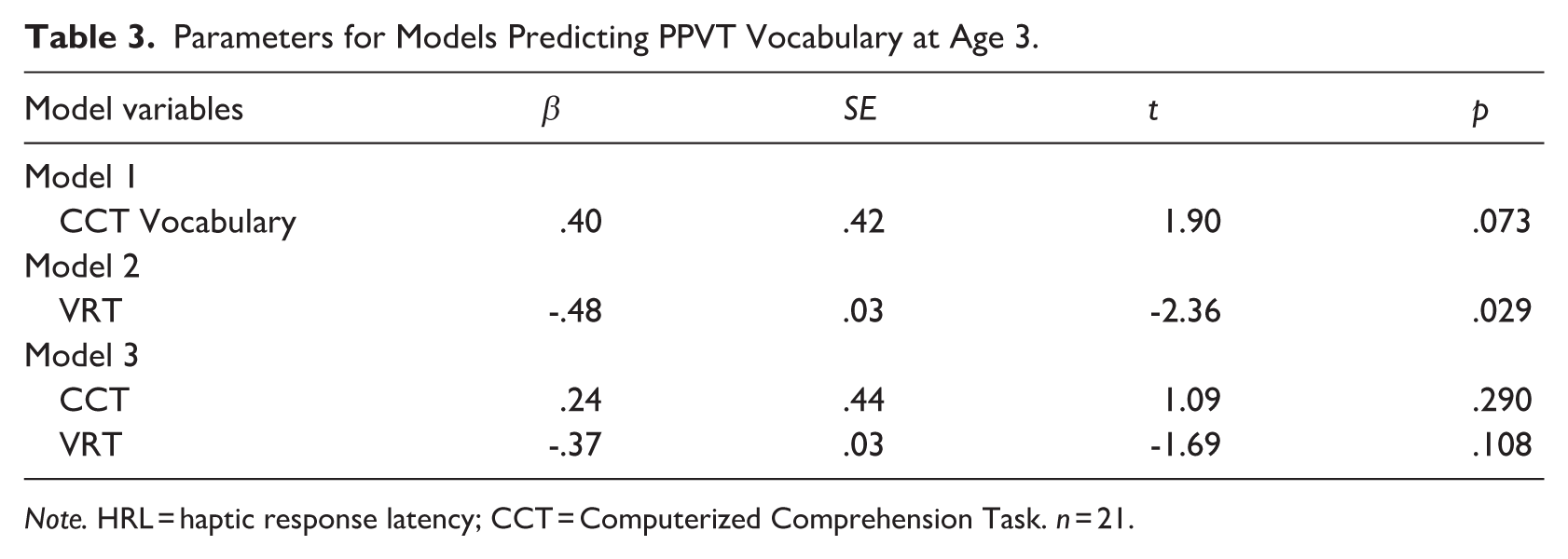
Note. HRL = haptic response latency; CCT = Computerized Comprehension Task. n = 21.
Predicting Vocabulary at Age 4
In the models predicting PPVT vocabulary at age 4, the addition of CCT vocabulary to the intercept-only model was significant, F(1, 20) = 7.08, p = .02. The addition of HRL to the intercept-only model was also significant, F(1, 20) = 9.91, p = .01. When considering models with combinations of predictors, the addition of CCT vocabulary to the model with HRL alone was not significant, F(1, 19) = 1.03, p = .32. The addition of HRL to the model with CCT alone was marginally significant, F(1, 19) = 3.13, p = .09. Thus, both CCT vocabulary and HRL independently predicted PPVT vocabulary outcomes at age 4. While CCT vocabulary did not predict significant unique variance when controlling for the effect of HRL, HRL did marginally predict unique variance when controlling for the effect of CCT vocabulary. See Table 4 for model parameters.
Parameters for Models Predicting PPVT Vocabulary at Age 4.
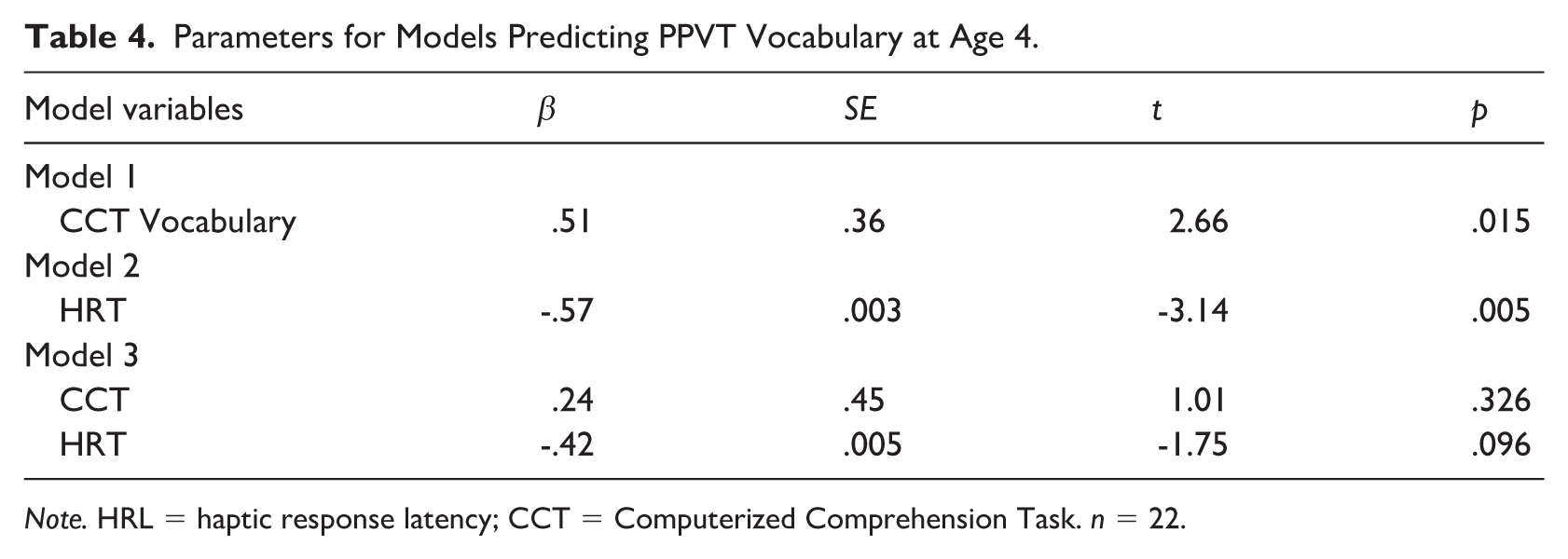
Note. HRL = haptic response latency; CCT = Computerized Comprehension Task. n = 22.
Discussion
The goal of the current study was to extend prior work comparing the relative predictive utility of early language assessments by examining prediction from decontextualized receptive vocabulary and two measures of speed of lexical access at 23 months to receptive vocabulary at ages 3 and 4 in bilingual children. This study was motivated by prior work in monolingual children showing that both vocabulary and speed of lexical access assessed via VRL predicted vocabulary and language outcomes up to age 8, but HRL did not (Fernald et al., 2006; Friend et al., 2018, 2019; Marchman & Fernald, 2008; Smolak et al., 2021, 2022). Beaudin and colleagues (2024) extended this research to children exposed to a second language and found that HRL in the dominant language predicted vocabulary outcomes at age 3 but not age 5. Smolak and colleagues (2021, 2022) and Beaudin and colleagues (2024) hypothesized that dissociations in predictive utility across measures may be due to differential demand characteristics of the tasks. In the case of haptic response, demand characteristics include decision-making processes and executive control (e.g., Gottwald et al., 2016). For bilingual children, who have been shown to have an advantage over monolingual children in inhibitory control (e.g., Barac & Bialystok, 2011; Beaudin & Poulin-Dubois, 2022; Crivello et al., 2016; Poulin-Dubois et al., 2011; Sorge et al., 2017), haptic response may be a stronger indicator of lexical processing efficiency than in monolingual children. The current study adds to this work by including an additional measure of speed of lexical access (VRL) in a sample of children with exposure to a second language that is typically defined as bilingual (i.e., exposure to a second language more than 20% of the time).
We first hypothesized that both decontextualized receptive vocabulary and VRL at 23 months would predict receptive vocabulary at ages 3 and 4. This hypothesis was partially supported. Vocabulary at 23 months predicted vocabulary outcomes at both ages, whereas VRL predicted outcomes at age 3 but not age 4. That CCT vocabulary was a reliable predictor of outcomes is consistent with prior work demonstrating that the CCT is a more robust predictor of later vocabulary, language, and kindergarten readiness than other common toddler measures like lexical access or parent report (Friend et al., 2018, 2019; Patrucco-Nanchen et al., 2019; Smolak et al., 2021, 2022). That VRL predicted vocabulary outcomes at age 3 but not age 4 is inconsistent with prior work showing an effect of visual latency on vocabulary and language up to age 8 (Marchman & Fernald, 2008; Smolak et al., 2021). However, this prior work was conducted in monolingual samples. Further, Marchman and Fernald (2008) used a task with only 10 familiar nouns. In contrast, the present work included bilingual children and a more conservative task that includes 41 nouns, verbs, and adjectives. Evidence suggests that, as early as age 2, bilingual children activate words in both languages during online word processing (cf. DeAnda, Poulin-Dubois, et al., 2016). In addition, bilingual children process words for which they have translation equivalents in the other language faster than words for which they do not have translation equivalents (Poulin-Dubois et al., 2018). Therefore, there may be additional lexical competition dynamics contributing to variation in speed of lexical access in bilingual children that limit its utility as a predictor of long-term vocabulary outcomes. Although prior research has found that visual speed of lexical access predicted vocabulary outcomes in bilingual children from 30 to 36 months (Hurtado et al., 2014), and in sequential bilingual children from 24 to 54 months (Marchman et al., 2020), this is the first study to our knowledge examining long-term prediction from visual speed of lexical access within the dominant language of simultaneous bilingual children and using a task with words of varying difficulty. Alternatively, it is possible that the small sample size in the current study limited our power to detect an effect of VRL on vocabulary at age 4. Future research should continue to examine the long-term stability of early measures of the lexical-semantic system in bilingual children. In addition, future research would benefit from exploring these relationships within children’s non-dominant language and across languages.
Second, we hypothesized that HRL would predict vocabulary at age 3, but that it would not predict vocabulary by age 4, consistent with findings from Beaudin and colleagues (2024). However, we found that HRL predicted vocabulary at age 4 but not at age 3. This discrepancy may be due to differences across samples. While Beaudin and colleagues (2024) included children with a range of exposure to a second language, the current study included only a subsample of children with more balanced exposure to a second language. It is not clear why, in the current sample, HRL predicted outcomes at age 4 but not at age 3. One possibility is that we examined relationships within children’s dominant language, and some children’s dominant language switched between ages 3 and 4. However, this accounted for a small percentage of children (9%), and results were the same if these children were excluded from the analyses.
Finally, we hypothesized that decontextualized vocabulary would be the only unique predictor when controlling for the effect of the other predictors. This hypothesis was not supported. No predictor was significant when controlling for the effect of other predictors. These results may be due to the small sample size and resulting limited power. However, the sample sizes in the current regressions (21 and 22 after exclusions of children without VRL data and outliers) were similar to Marchman and Fernald (2008), who found unique effects of vocabulary and speed of lexical access on outcomes in a sample of 28 children.
The primary limitation of the present study is the small sample size and high level of attrition, which resulted in reduced power, particularly in regression models with multiple predictors. Results should therefore be interpreted with caution and considered in the light of other similar research. A second limitation is that we only measured receptive vocabulary as an outcome. Marchman and Fernald (2008) found that early expressive vocabulary and visual speed of lexical access predicted expressive language, working memory, and IQ at age 8, and Smolak and colleagues (2022) found that early receptive vocabulary, but not HRL, predicted a range of linguistic outcomes from 3 to 5 years of age. It is possible that, with a greater range of outcome measures, we would see a different pattern of results.
In conclusion, the current study extends prior research on the foundational nature of early vocabulary and lexical access for subsequent vocabulary development. Consistent with prior research, decontextualized receptive vocabulary and speed of lexical access measured via VRL predicted later vocabulary development. In contrast to prior results on monolingual children, but consistent with recent work with children exposed to a second language, lexical access measured via HRL also predicted later vocabulary. The present study contributes to our knowledge of the relative predictive utility of toddler semantic measures and how demand characteristics may interact with participant characteristics to influence the roles of these measures in predicting later outcomes. However, given some methodological limitations, results should be interpreted with caution and used to guide future research on early predictors of long-term vocabulary development in bilingual children.
Supplemental Material
sj-docx-1-ijb-10.1177_13670069261451719 – Supplemental material for Predicting Vocabulary Development in Bilingual Children Using Early Measures of Word Comprehension
Supplemental material, sj-docx-1-ijb-10.1177_13670069261451719 for Predicting Vocabulary Development in Bilingual Children Using Early Measures of Word Comprehension by Erin Smolak, Eve Michaud and Diane Poulin-Dubois in International Journal of Bilingualism
Footnotes
Acknowledgements
The authors gratefully acknowledge Isadora De Oliveira and Alexandra Meltzer for their assistance in data coding.

Ethical Considerations
This study was approved by the Concordia University Human Research Ethics Committee (approval no. #UH2003-058-6).
Consent to Participate
Participants’ legal guardians provided written informed consent prior to participating.
Consent for Publication
Not applicable.
Author Contributions
Funding
The authors disclosed receipt of the following financial support for the research, authorship, and/or publication of this article: This research was supported by NICHD award #R01HD468058 to Margaret Friend and does not necessarily represent the views of the National Institutes of Health. A Discovery grant from the Natural Sciences and Engineering Research Council of Canada, awarded to Diane Poulin-Dubois (#2003-2013), also supported this research.
Declaration of Conflicting Interests
The authors declared no potential conflicts of interest with respect to the research, authorship, and/or publication of this article.
Data Availability Statement
Data available upon request.
Supplemental Material
Supplemental material for this article is available online.
Author Biographies
References
Supplementary Material
Please find the following supplemental material available below.
For Open Access articles published under a Creative Commons License, all supplemental material carries the same license as the article it is associated with.
For non-Open Access articles published, all supplemental material carries a non-exclusive license, and permission requests for re-use of supplemental material or any part of supplemental material shall be sent directly to the copyright owner as specified in the copyright notice associated with the article.
